Stay Updated Subscribe today for the latest research + reporting about environmental news. Subscribe Now

Stay Updated Subscribe today for the latest research + reporting about environmental news.

Subscribe Now

Kendra Chamberlin

Kendra Chamberlin

Kendra Chamberlain

About Kendra Chamberlain

Columbia Insight contributing editor Kendra Chamberlain is a freelance journalist based in Eugene, Oregon, covering environment, energy and climate change. Her work has appeared in DeSmog Blog, High Country News, InvestigateWest and Ensia.

Snake River dams proponents to lose important voice in Wash., DC

Wash. Rep. Cathy McMorris Rodgers’ decision to retire from Congress leaves a power void in the long-running dams fight

Cathy McMorris Rodgers

New opening: Wash. Rep. Cathy McMorris Rodgers has stood in the way of dam removal. Will her successor? Photo: Gage Skidmore/Wikimedia Commons

By Kendra Chamberlain. February 20, 2024. For the past two years, the chair of the U.S. House Committee on Energy and Commerce has come from the Pacific Northwest.

That’s significant because the committee has a broad jurisdiction encompassing energy, the environment and more. This includes approving legislation before any action could be taken to breach or remove four contested dams along the Lower Snake River.

But earlier this month, Committee Chair Cathy McMorris Rodgers (R-Wash.) announced she won’t run for reelection this year. (Ore. Republican Greg Walden has previously served as the committee’s chair or ranking minority member.)

Vice Chair Kelly Armstrong (R-N.D.) is also leaving the House to run for governor of his home state.

This leaves leadership for the committee—which will play a key role in the future of the dams that many enviros want to see breached—up in the air.

The Hill reports two Republicans are vying for the top spot: Brett Guthrie (R-Ky.) and Bob Latta (R-Ohio).

If the Democrats win back the House in November, Frank Pallone (D-N.J.) could become the chair as the committee’s ranking Democrat.

The only remaining committee member from the Pacific Northwest is Rep. Kim Schrier (D-Wash.), who is also the minority’s vice ranking member.

Schrier’s role in the dams drama could become particularly important if the Democrats win back the House in 2024.

So where does she stand on the dams? Hard to say.

In 2022, Schrier sent a letter to President Biden expressing her “disappointment” over the release of draft reports related to the dams. [A previous version of this story incorrectly stated that Schirier’s 8th Congressional District includes all four of the contested Snake River dams. In fact, it contains none of the dams. —Editor]

“I continue to support policies that are grounded in the best available science, honor tribal treaty rights and reflect the cultural and economic values of our region,” she wrote in 2022. “Washingtonians know that the question of the four Lower Snake River Dams is a complex one and that it’s a decision that should be made in consultation with all affected stakeholders, not by an agency in Washington, DC, 3,000 miles away.”

Last month, Schrier struck a similarly cautious tone.

“I’ve long said that the issue of the Lower Snake River dams is incredibly complex,” she said. “And because of that, all constituents who have a stake need to have a seat at the table.”

Repubs still saying no

Any dam breaching would require congressional authorization and likely need to get past the Energy and Commerce committee before being approved.

McMorris Rodgers has fiercely opposed the idea of breaching the dams, arguing that to do so would jeopardize grid reliability in the region and “permanently harm our way of life in Washington.”

Republicans generally opposed potential breaching of the dams during the handful of congressional hearings held on the subject last year.
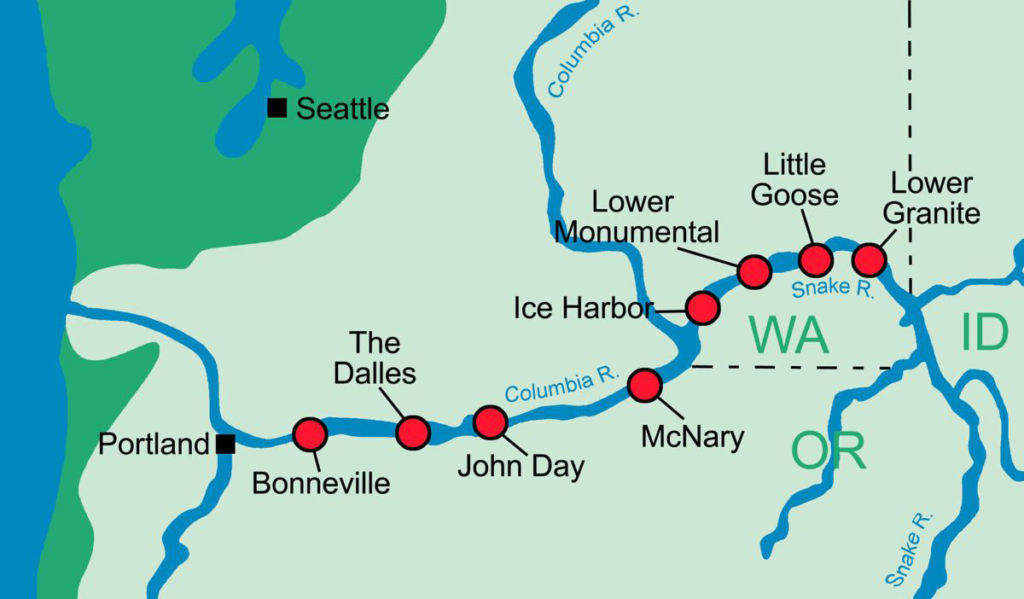
Dams on lower Columbia Snake River system

Fish fight: Conservationists have long fought to restore the Snake River watershed by having Ice Harbor, Lower Monumental, Little Goose and Lower Granite dams breached. Map: USACE

But Greg Reynolds, Snake River campaign director at the conservation nonprofit Trout Unlimited, points out that the first person to bring the idea to Congress was Idaho Republican Rep. Mike Simpson.

“He brought it forth with the idea that we need a bipartisan solution that works for everybody in the region,” McReynolds told Columbia Insight. “The issue remains bipartisan, and the solution has to be bipartisan. That is how we get this done, by looking forward to what the region needs.

“My hope is that the next chair will be focused on looking forward and not looking back, so that we can move the region forward to a future that has salmon and abundant energy, as opposed to where we are now, where we don’t have an abundance of either.”

The presidential election will grab headlines, but, as usual, it’s the down-ticket races that will determine how environmental actions on the ground are legislated.

Or not.
By |2026-02-09T13:08:16-08:0002/20/2024|Government|0 Comments

Dry February? Another dismal snowpack means cutting back again

Oregon is faring better than Washington and Idaho, but record lows will put irrigators in a tough spot come spring

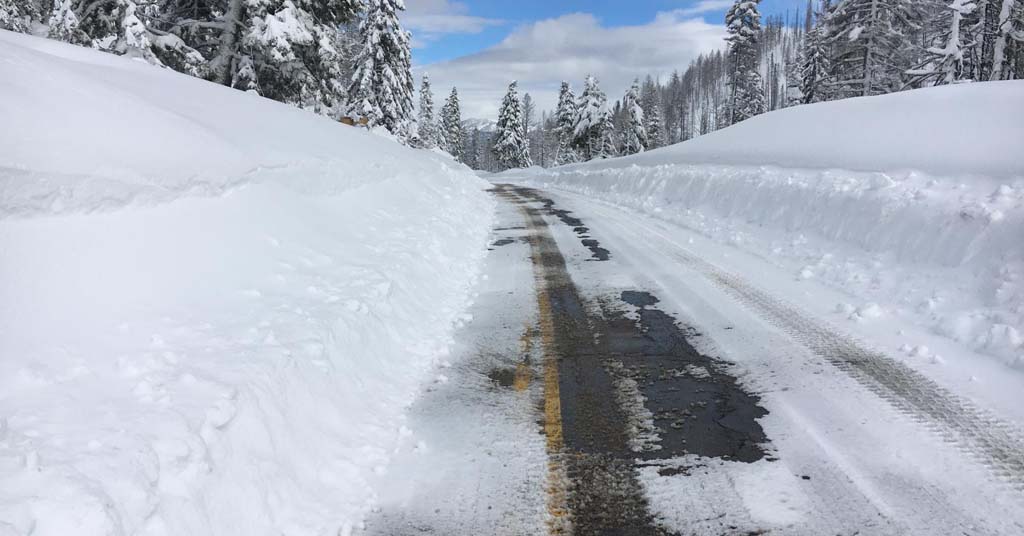
Idaho highway covered in snow

Better days: Snowpack across the Northwest is suffering in comparison with previous years. File photo: Idaho Farm Bureau Federation

By Kendra Chamberlain. February 6, 2024. Washington’s Statewide Drought Lead, Caroline Mellor, is predicting a tough spring for the state’s water rights holders.

The Washington Department of Ecology declared a drought emergency in 12 watersheds and across 12 counties last summer. There’s no indication the state’s water supplies will recover this year.

“Now is the time for water users to start making plans for a dry spring,” Mellor said during a water supply committee meeting last month. “Start thinking about your seasonal water rights transfers because there’s no reason to believe drought conditions will end soon.”

The Pacific Northwest has seen less snowpack this winter than normal, which will likely put irrigators in a tight spot during the summer months.

The Pacific jet stream is experiencing an El Niño weather pattern, which typically results in warmer and drier winter months for the region.

But research indicates climate change has been eroding snowpack levels across the northern hemisphere for the last 40 years as temperatures warm.

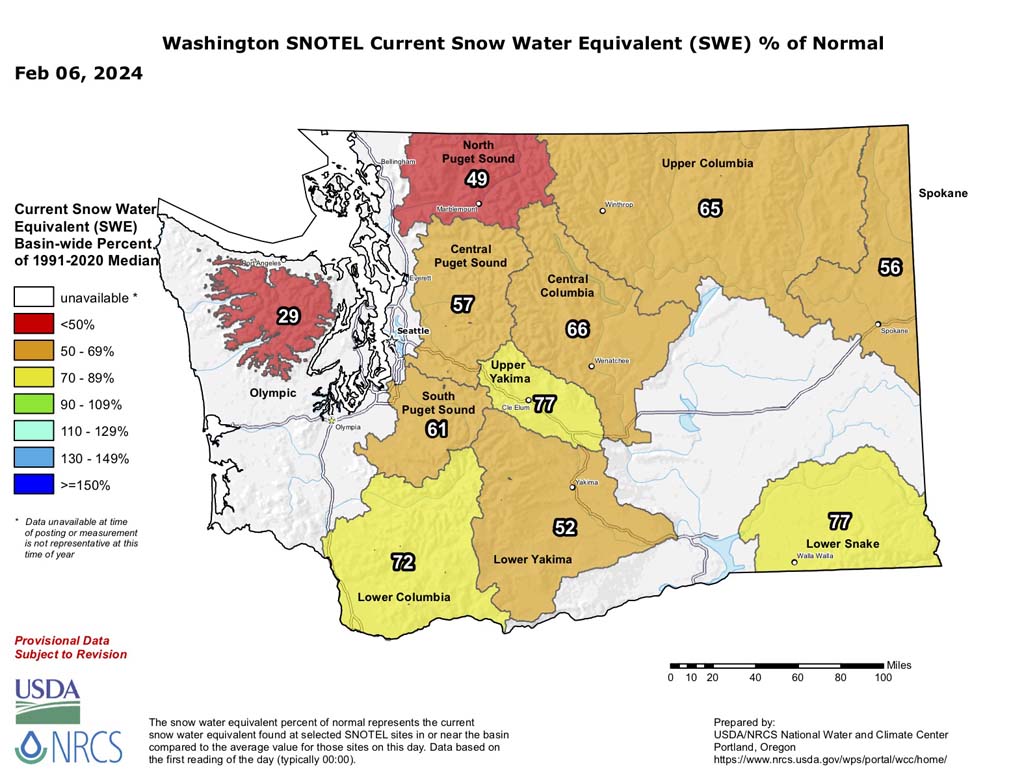
Washington state map showing poor snowpack

Map: USDA/NRCS

The water year so far, which began Oct. 1, has been warm and dry, leaving much of the region with below average snowpack.

Washington in particular has seen little snow accumulation so far this winter.

“They’re faring far worse in terms of snowpack, specifically the Olympic Peninsula, areas around Baker and the North Cascades National Park, and even down into the central Cascades in Washington,” Matt Warbritton, supervisory hydrologist at the U.S. Department of Agriculture’s Natural Resources Conservation Service, told Columbia Insight.

The lack of snowpack can be attributed to an unusually warm December—it was the third warmest December in Washington’s records, dating to 1895.

Temperature anomalies for the month of December ranged from 4 to 8 degrees higher than normal, representing huge shifts in temperature.

Snowpack was at record lows for the state at the start of January, and though the recent spate of winter storms did deliver significant accumulations of snow, it wasn’t enough to offset the deficit.

Idaho, Oregon also lagging

Snowpack across northwestern Idaho is also below normal, and the panhandle is currently at record or near-record lows.

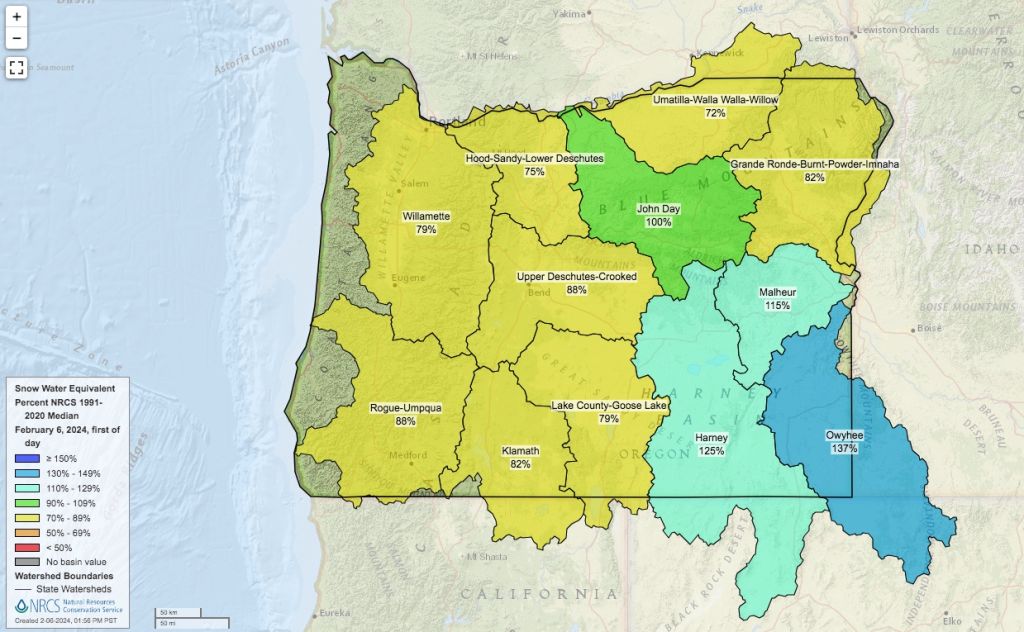
Oregon’s southern and western regions are also below normal, though much of the east side of the state has seen above average snow accumulation.

Oregon snow water equivalent map, Feb 6, 2024

Oregon snow water equivalent map as of Feb. 6, 2024: NRCS

“In areas where there’s low snowpack, especially well below normal snowpack, this is going to have quite a bit of impact on summer water supplies,” said Warbritton. “Less water being stored as snowpack in the mountains means less snowmelt that’s going to be available to go into streams, and flow into reservoirs and fill those reservoirs.”

El Niño years often mean warmer temperatures and less precipitation in the spring months, which Warbritton said may potentially drive drought conditions and even increased wildfire risk later this year.

Snowpack declines likely to accelerate

Snowpack declines may be reaching a new tipping point, according to a study published last month in Nature.

The study found seasonal snowpacks across the northern hemisphere, including within the Columbia River Basin, have declined significantly over the past 40 years due to climate change.

The study determined the Columbia River Basin has seen a 4.8% decline in snowpack per decade since the 1980s, and predicts the Basin will see a 33% decline in snow water equivalent by the end of the century.

Study authors Alexander Gottlieb and Justin Mankin predict snow-dependent watersheds like the Columbia River Basin will see accelerated water supply losses over the next decades.

“We were most concerned with how warming is affecting the amount of water stored in snow,” Gottlieb said in a statement. “The loss of that reservoir is the most immediate and potent risk that climate change poses to society in terms of diminishing snowfall and accumulation.”

By |2026-02-11T11:10:20-08:0002/06/2024|Agriculture, Water|0 Comments

Forest Service to remove protections from 17 rivers in Idaho

The move sets a precedent “that is pretty disturbing” according to conservationists

Kelly Creek in Nez Perce-Clearwater National Forests

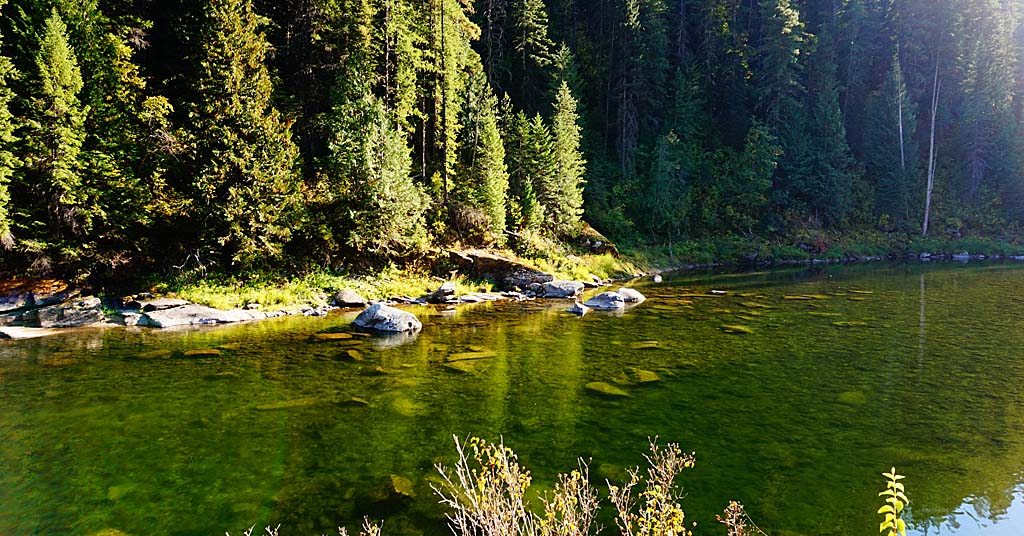
Fresh assessment: The Nez Perce-Clearwater National Forests are home to wilderness, wildlife, fisheries, timber harvest, livestock grazing, mining and recreation opportunities. Photo: JD Cooper

By Kendra Chamberlain. January 30, 2024. The Nez Perce-Clearwater National Forests comprise 4 million acres of beautiful and diverse land located in north-central Idaho. Now, under a new management plan, the U.S. Forest Service is stripping protections from 17 of its rivers.

The plan, released late last year, includes a dramatically pared down list of rivers proposed for Wild and Scenic designation that has conservationists and recreationalists alarmed.

Wild and Scenic designation can only be authorized by Congress or by the Secretary of the Interior, but forest and land management plans often identify streams and rivers that are eligible for designation.

Once deemed eligible, the rivers and streams are afforded interim protections until Congress can act on them.

For the past 35 years, 29 streams and rivers of the Nez Perce-Clearwater Forests were deemed eligible under a forest management plan that dated back to the 1980s.

The USFS identified a total of 89 rivers as eligible for protections under the new draft plan. But the agency conducted a “suitability” study on those eligible rivers, whittling the list down to just 12.

That step has rubbed conservationists the wrong way. Idaho Rivers United, along with American Whitewater and American Rivers, held a webinar last week to raise the alarm.

Nick Kunath, conservation manager of Idaho Rivers United, told Columbia Insight it isn’t common for a forest management plan to include a suitability analysis.

“They will determine eligibility. And typically, that’s where it stops in forest planning,” said Kunath. “The reason it gets so murky is that suitability is never really defined in the Wild and Scenic Rivers Act. It really is a subjective criteria.”

“While it is correct that suitability studies are not required to be conducted with forest plan revision, it would be beneficial to do so when possible,” according to a USFS website. “Because forest and grassland plans set forth the desired conditions across the plan area and are developed with consideration of integrated resource management, it would be better to conduct the analysis for suitability within the broader picture that comes with the revision analysis. Conducting the analysis with the revision process also eliminates the need for a separate environmental analysis.”

Kunath emphasized the Forest Service has no obligation to include a suitability study, and that doing so has had profound implications for the waters of the Nez Perce-Clearwater Forests.

“Idaho Rivers United and some other organizations are somewhat unsure whether or not that’s even legal to be doing this extra step during this planning process,” he said.

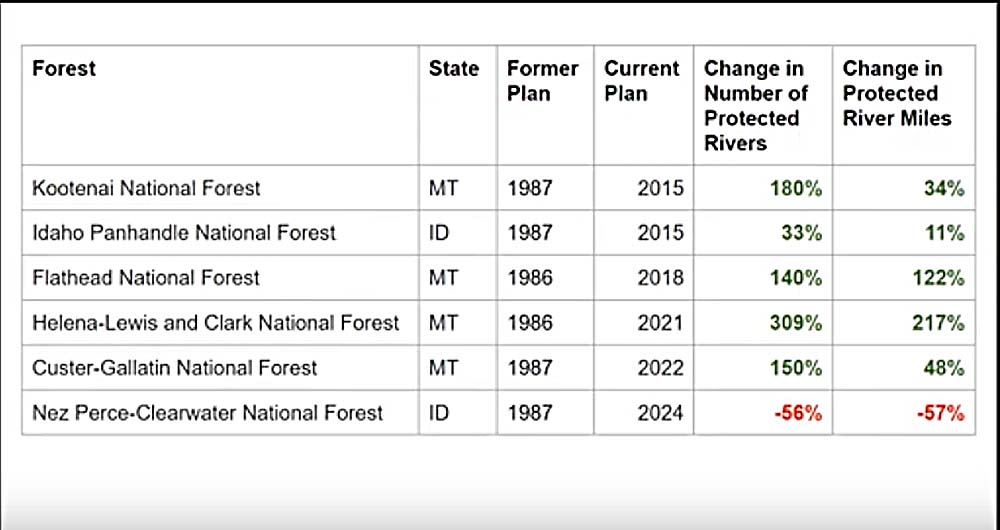
Forest management revisions often offer opportunities to expand protections for rivers and streams, said Kunath. Under the new plan, the Nez Perce-Clearwater Forest will be the only forest in the Pacific Northwest in the last decade to see a decrease in river protections under a new management plan.

Chart shows river protection stats in Idaho and Montana

Source: American Rivers

This could signal a larger trend afoot at the USFS, according to Lisa Ronald, American Rivers’ associate conservation director for western Montana.

She points to the recent revision of the Ashley National Forest in Utah, which similarly conducted a suitability analysis.

More troubling, Ronald said, was that the rivers previously deemed eligible but not suitable will not be reconsidered for protections under the Ashley plan.

“These two forests are starting to set a trend that is pretty disturbing within the planning process,” Ronald said during the webinar. “What that means is that we’re living right now in the peak of river protection—that the most rivers are ever going to be protected is right now.”

Idaho Rivers United and other groups have filed formal objections to the USFS plan.

By |2026-02-11T11:09:37-08:0001/30/2024|Rivers|0 Comments

Pac NW added to national plan for utility-scale solar power

Conservation and hunting groups worry that solar facilities on public lands will disrupt wildlife corridors

Solar energy factory

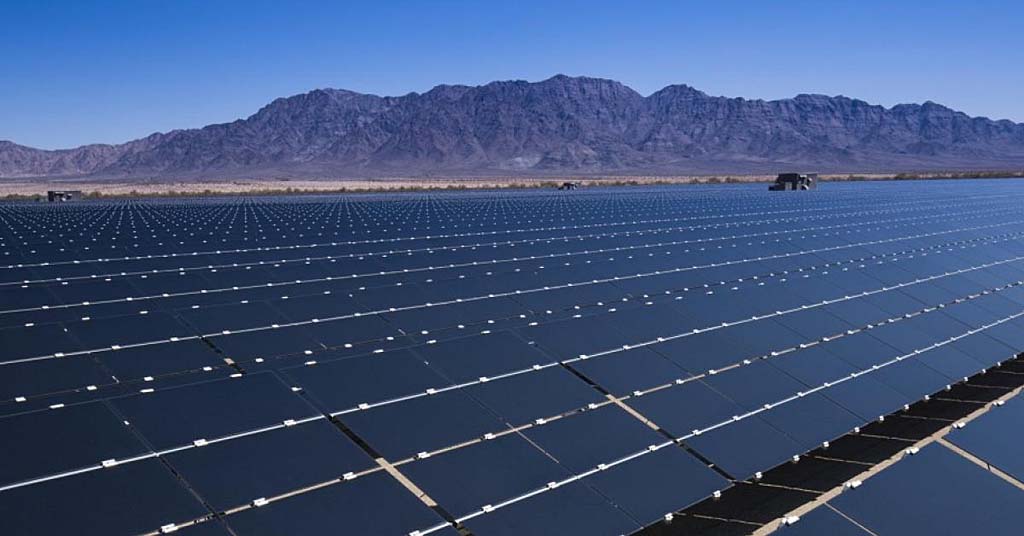
Hot spots: Sites like the Dry Lake Solar Energy Zone in Nevada are chosen for the Western Solar Plan for their high solar potential. Photo: BLM

By Kendra Chamberlain. January 23, 2024. The U.S. Bureau of Land Management has opened up its 2012 Western Solar Plan to include Washington, Oregon, Idaho, Wyoming and Montana. The original Western Solar Plan identified only Arizona, California, Colorado, Nevada, New Mexico and Utah as areas for solar development.

The expanded plan proposes opening 22 million acres of public land across all 11 states for solar development.

The agency says it has identified 700,00 acres of that land as ideal for solar development because it is within 10 miles of existing or planned transmission lines, has comparatively few sensitive resources and offers minimal conflict with other uses of public lands.

The BLM manages roughly 10 million acres of land in Idaho and 12.5 million in Oregon. There’s relatively little BLM land in Washington.

The BLM announced the expansion of the plan last week.

The Biden administration has set a target of a fully renewable energy grid by 2035.

Disrupting wildlife migration

The proposal, which could see enough solar development to power tens of millions of homes, has been touted as an important step in the Biden Administration’s clean energy transition.

But there’s a drawback: some of the land proposed for solar development is prime winter range for mule deer and other big game.

Concern has been growing over conflicts between new solar-energy facilities and wildlife, as Columbia Insight reported last year.

BLM’s solar proposal may further fragment what’s left of the wildlife corridors big game use to migrate throughout the year.

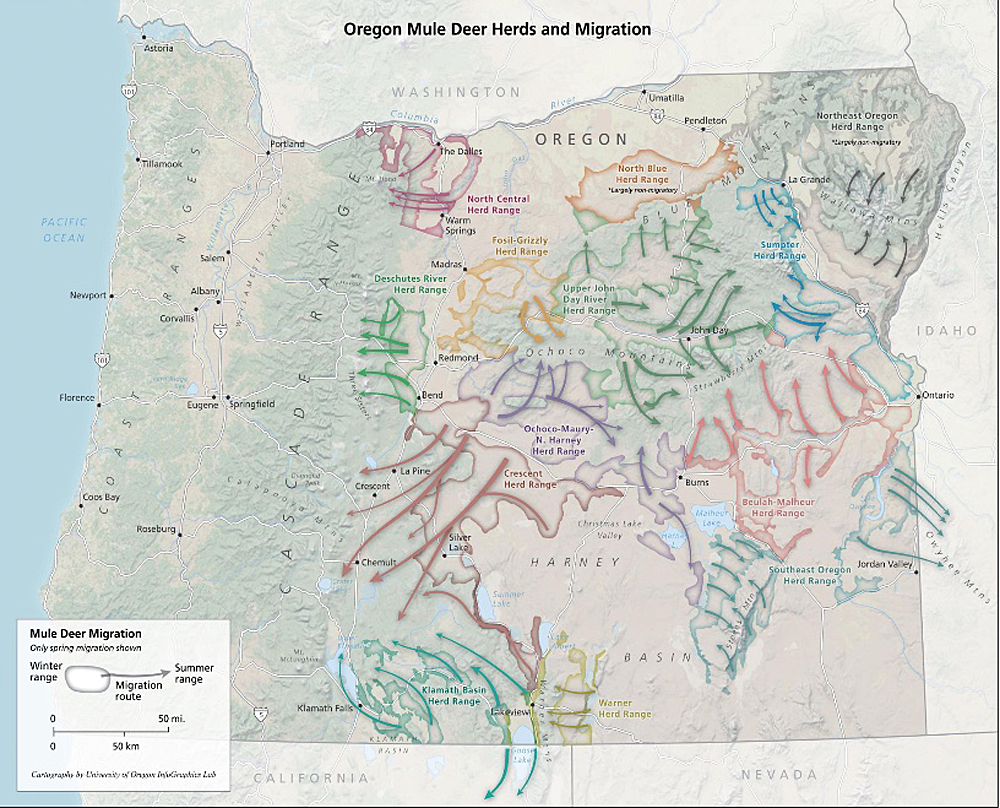
Mule deer migration map

Moving on: East of the Cascades, upwards of 98% of mule deer in Oregon are migratory. Map: ODFW

“All these utility-scale solar farms are required to have external fences around them,” said Mike Totey, conservation director at Oregon Hunters Association (OHA). “Once that occurs, basically that area is off-limits for big game.”

Mule deer are particularly vulnerable to habitat fragmentation; their populations are declining across the West.

Biologists point to a host of factors contributing to the decline, including disease and drought. But habitat fragmentation across Oregon, Washington and Idaho is hitting the species especially hard.

Mule deer spend their winters in lower elevation sage-steppe and juniper woodlands and move into the higher elevations during the spring and summer to raise fawns and fatten up.

Migrating mule deer have what Totey called “site fidelity” in their seasonal routes.

“They’ll move to an area for summer range … and they’ll take another path back down to that winter range and essentially repeat that cycle in those same areas along those same pathways, those travel corridors, every single year,” Totey told Columbia Insight.

While BLM has recently streamlined its siting process for solar development under the Western Solar Plan, Totey wants wildlife corridor fragmentation to be considered during future NEPA process for specific solar projects in the region.

“One of the things that we just have not really got our arms around is the cumulative impact [of these solar farms],” he said. “What happens when you put the next one in? There’s been—as near as I can find—really, very little work to try and determine what those cumulative impacts are.”

By |2026-02-18T15:39:07-08:0001/23/2024|Energy, Government|0 Comments

Newly discovered vitamin source may help wild salmon survive

A dietary shift has led to a vitamin B1 deficiency in Pacific salmon. Researchers want to combat it

Chinook salmon

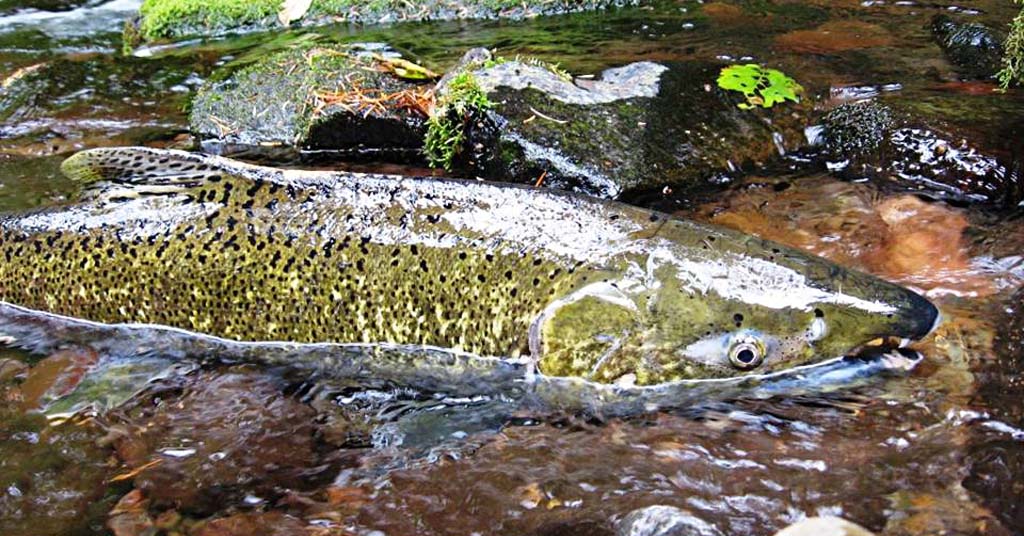
Be one: Chinook salmon are finding it increasingly difficult to live in harmony with their surroundings. Photo: OSU

By Kendra Chamberlain. January 9, 2024. Researchers at Oregon State University have discovered a freshwater source of the vitamin thiamine that may help give wild salmon populations a leg up against thiamine deficiency complex (TDC).

Wildlife around the world is suffering from a lack of thiamine. The vitamin, also known as B1, is a vital component to all cellular activity and consequently is incredibly important for all organisms on earth.

In Pacific salmon, California hatchery employees began noticing higher mortality rates in hatchery fry in early 2020.

Researchers determined the culprit was TDC, then linked the thiamine deficiencies to changes in salmon diet in the Pacific Ocean.

Christopher Suffridge, senior research associate in the Department of Microbiology in the OSU College of Science, and doctoral student Kelly Shannon, have found possible sources of thiamine in freshwater spawning grounds that may help boost thiamine levels in California’s wild chinook populations.

In the Sacramento River watershed, the team found increased prevalence of two families of bacteria in dammed rivers that has increased the availability of thiamine in areas where salmon spawn.

“Bacteria of these groups have been found in past studies to be associated with human impacts of rivers, such as the generation of reservoirs by the building of dams,” Shannon told Columbia Insight in an email. “Overall, this tells us there could be an ecological role at play since humans play a major role in structuring compositions of microbial communities, the bedrock of freshwater (and all global) food webs and thiamine availability, by how we change the flow and chemistry of rivers.”

Scientists don’t know why TDC has become so widespread among wildlife around the globe.

Thiamine deficiencies have been linked to population declines of several fish species, including trout in the Great Lakes and both Pacific and Atlantic salmon, as well as dozens of bird species, eel and mussels, and even moose.

Diet shift tied to climate change

Thiamine is produced by species of bacteria, fungi, plants and phytoplankton, and moves through the food web as predators catch and eat prey.

But some animals also have high levels of thiaminase, an enzyme that breaks down thiamine.

If an animal consumes too much thiaminase, the enzyme will begin breaking down its own thiamine stores.

That’s exactly what researchers think is happening to salmon populations in the Pacific, according to Suffridge.

Populations of chinook salmon from California are now consuming a much less diverse diet while out in the Pacific, relying mostly on anchovies.

“Anchovies are high in the enzyme thiaminase,” Suffridge told Columbia Insight in an email.

“The prevalence of anchovies in the marine feeding grounds for the chinook is likely driven by oceanographic shifts tied to climate change,” he added. “Normally the chinook’s diet is balanced between sardines, squid and anchovies.”

The consequences of that shift in diet are now becoming clear.

When females return to their freshwater spawning grounds and lay eggs, the thiamine deficiency is passed on to the eggs. And while hatchery salmon are now treated with thiamine baths to help combat TDC, the benefits of those baths are short lived if the salmon are being exposed to higher than normal levels of thiaminase while in the ocean.

The discovery of thiamine in freshwater spawning grounds is good news for salmon populations.

Suffridge described it as a “naturally occurring thiamine bath.” But the concentrations of thiamine found were still much lower than those given to fish in hatcheries.

It’s still unclear if these natural sources of thiamine are at high enough concentrations to “truly mitigate the symptoms of TDC,” said Shannon.

By |2026-02-11T13:28:49-08:0001/09/2024|Salmon|0 Comments

It’s official: White House plan to remove Snake River dams made public

Despite accusations, the Lower Snake River dams plan isn’t a done deal. Only Congress can authorize breaching the dams

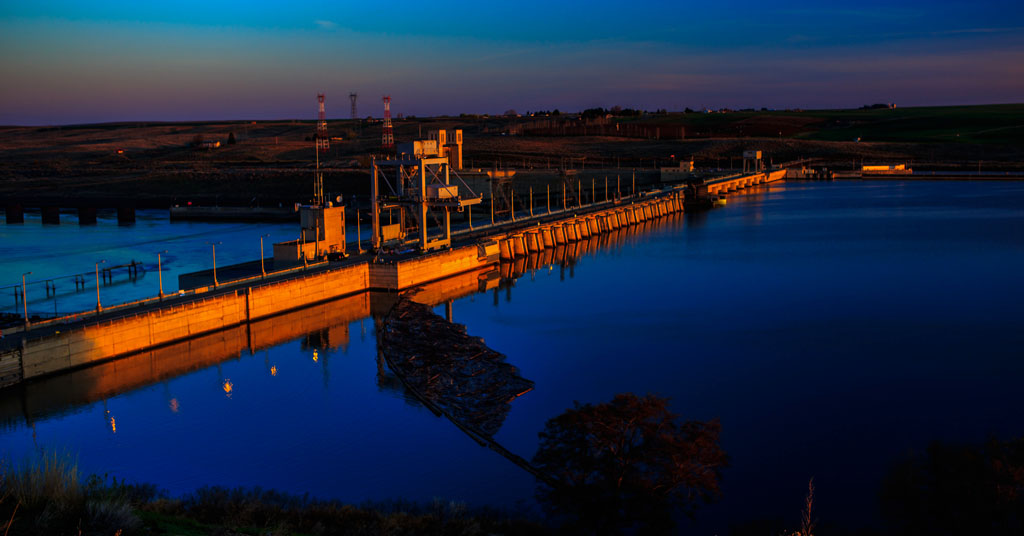
Ice Harbor Dam on the Snake River at sunrise

Into the breach: Tribes and conservation groups are cheering a plan to make four dams on the Snake River obsolete, including Ice Harbor Dam (pictured). Photo: Wikimedia Commons

By Kendra Chamberlain. December 20, 2023. On November 29, a “leaked” document outlined a Biden administration agreement with states, Tribes and conservation groups to breach four controversial dams located in Washington along the Snake River.

The news sent opponents of breaching the dams into a tizzy of ginned-up outrage.

“The Biden administration has been secretly conspiring with tribal nations and environmental groups,” wrote the conservative think tank American Experiment.

If anything about the Biden administration’s position on the dams was unknown, it’s been the worst kept secret in Washington. The president has been facing pressure to declare his support of the move for more than two years and very clearly tipped his hand back in September.

Last week, the White House released the highly anticipated settlement agreement that aims to boost salmon recovery in the Lower Snake River while developing more renewable energy in the Columbia River Basin.

The agreement doesn’t call for breaching the four dams on the Lower Snake River—only Congress can authorize the breaching of those dams, which are operated by the federal Bonneville Power Administration (BPA).

But it does allocate federal funding and Department of Energy support for the development of tribally owned renewable energy sources.

The settlement is the culmination of 22 years of conflict across four different lawsuits between tribal nations and environmental groups and five federal agencies over the dams and their impacts on salmon.

The resulting Memorandum of Understanding (MOU), between the Confederated Tribes and Bands of the Yakama Nation, Confederated Tribes of the Umatilla Indian Reservation, Confederated Tribes of the Warm Springs Reservation of Oregon and the Nez Perce Tribe, along with the states of Oregon and Washington and several nonprofits, calls for up to $1 billion in investments along the Lower Snake River over the next decade for salmon recovery and renewable energy build-outs.

Replacing power

Energy generation has been at the center of the litigation and settlement negotiations, which were held in private, a fact that concerned some BPA customers who say they’ve been left out of the negotiations.

The hand-wringing reached a fever pitch when that now infamous draft version of the agreement became public last month and Ore. Rep. Cliff Bentz (R) held a House Committee on Natural Resources oversight hearing on the issue.

Miles Johnson, legal director at Columbia RiverKeeper, which was party to the litigation, said concerns over replacing the hydroelectric energy are overblown.

“Replacing the services of the Snake River dams, from an electrical perspective, it’s just not that big of a lift,” Johnson said. “The Snake River dams don’t produce that much power. Most of the power that they produce is in the spring and summer when the region has way more power than it actually needs.”

Dams on lower Columbia Snake River system

Electric issue: Starting with Ice Harbor Dam and moving east (red dots indicate dams), four Snake River dams have been a bone of contention for decades. Map: USACE

The U.S. Department of Energy will facilitate the build-out of one to three gigawatts of tribally sponsored renewable energy production under the MOU, which may help replace the hydropower with more clean energy resources. But the agreement doesn’t commit BPA to buying that power.

The settlement includes federal promises to fund studies on how removing the dams will impact irrigation and recreation, which environmental groups say will “pave the way” for Congress to authorize breaching the dams in the future.

“Congresspeople in the Pacific Northwest—from both sides of the aisle—understand that the Snake River dams need to be removed if we want to see abundant salmon and steelhead, [and] if we want to honor Tribal treaty rights,” Johnson said. “But at the same time, there are things that need to be done before we can just yank out those dams. And this agreement is designed to deal with a lot of those things.”

The Pacific Northwest’s only nonprofit, non-advertiser-driven news source devoted to environmental issues affecting the Columbia River Basin, Columbia Insight depends on support from readers like you. You can help us continue investigating critical stories by donating here.

By |2026-02-18T15:53:16-08:0012/20/2023|Government, News, Salmon|0 Comments

© Copyright 2013-2025 Columbia Insight. All Rights Reserved.

As a 501(c)3 nonprofit organization, all donations to Columbia Insight are tax deductible to the full extent of the law. Our nonprofit federal tax-exempt number is 82-4504894.