
After a controversy in the Columbia River Gorge, the luxe camping alternative is under scrutiny
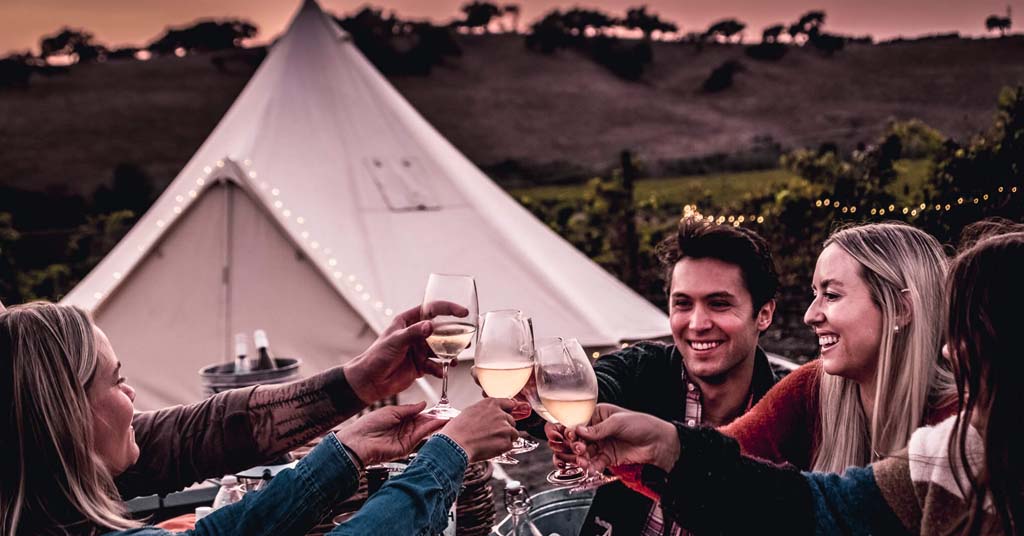
Here’s to you: Your reaction to this photo from Talley Vineyard in California probably says a lot about your attitude toward glamping. Photo: Talley Vineyard
Erica Browne Grivas. October 16, 2025. The last time my family camped at Mount St. Helens—in July, when it “never rains” in the Pacific Northwest—it poured. Our old tents had no hope.
Granted, we’re hardly mountaineers. We dust off our gear every other summer. So, we hiked the lava fields in wet clothes before heading home early.
That morning, if someone had offered me a glamping tent with a working roof, I’d have tapped my credit card faster than you can say s’mores.
Camping often comes with roots in your back, campfires that refuse to light, animals that raid food stores and weather that laughs in your face.
Some say that’s the whole point: that camping is meant to test your grit, teach you to problem-solve and channel your inner pioneer.
But for those who want nature without the misery, or who have mobility issues, glamping is a tempting middle ground.
It’s that well-groomed middle ground—cozy beds, espresso machines within arm’s reach—that has made glamping both wildly popular and deeply controversial.

Columbia River gorge: Is it still camping if no one has to pull KP duty? Photo: Under Canvas
Critics argue it threatens fragile ecosystems, inflates tourism pressures and dilutes the spirit of “real” camping.
Where traditional camping offers unknowns and adventure, glamping swaps in reassuring comfort. You’ll find a wide spectrum from simple tent sites under $100 to modern, tiny homes for upward of $400 a day.
At minimum, you’ll skip the epic battle with tent poles, be protected from the weather and enjoy easy access to a fire pit and restroom. At the luxe end, there may be a camping store on-site, heating and plumbing in your cabin and a sauna to dissolve any knots in your muscles from the trail.
Some resorts market sustainability, while others treat the wilderness more like a backdrop—a disconnect that’s sparking fierce debates in the Columbia River Gorge, around the Pacific Northwest and across the country.
Instagram cocktail
Paying for outdoor comfort isn’t new—imagine sherpas, palanquins, and carpeted safari tents—but glamping as an industry is relatively recent. The word hit the Oxford English Dictionary in 2016, but it was the pandemic that lit the fire under glamping.
According to a 2022 report by Kampgrounds of America (KOA), nearly 17 million households reported taking a glamping trip in 2021; a 155% increase over 2019.
The North American market is expected to nearly double to $1.8 billion by 2032, prompting major hotel chains to acquire and partner with glamping brands.

Shelter animal: This is what Under Canvas means when it says it offers an “elevated outdoor experience.” Photo: Under Canvas
In 2024, Hyatt Hotels Corp. integrated glamping brand Under Canvas’ 13 U.S. sites near major outdoor destinations like Yellowstone National Park and Maine’s Acadia National Park.
“During the pandemic, outdoor experiences gained in popularity and a new audience of traveler became acquainted with both glamping and national park exploration,” a Hyatt spokesperson explained, adding that forging alliances with outdoor brands is building momentum.
The KOA report noted that travelers increasingly crave “experience” travel, seeking ever-more unique stays, whether in tree houses, Airstream trailers or igloos. Blending eco-tourism, comfort, wellness and luxury makes a potent Instagram cocktail that fuels public interest.
Glamping giants like Hyatt are leaning into this trend with curated experiences, such as readings with Reese Witherspoon’s Reese’s Book Club authors and wellness retreats hoping to transform camping into lifestyle content.
But in places where glamping expands into pristine wilderness areas, local communities are pushing back.
Gorge controversy
It’s no surprise glamping has come to the iconic wilderness of the Pacific Northwest, and to mixed reviews.
Over the past couple of years, the tension came to a head in the Columbia River Gorge, where residents in Husum, Wash., fought—and lost—a court battle to stop Under Canvas from opening a new site.
The 120-acre resort, opened in May, features canvas tents with king beds, gas fireplaces and private bathrooms, along with higher-end options like stargazing tents and multi-tent sites. Amenities include a yoga deck, cafe with seasonal dishes, nightly s’mores, kids’ activities and other programming.

Tourist season greetings: Gorge locals protested the arrival of Under Canvas in 2025. Photo: Under Canvas Not Welcome
Under Canvas says it reduces water and power usage by not offering Wi-Fi, employing pull-chain showers and low-flow toilets and rechargeable batteries.
Opponents of the resort remain unconvinced.
“We moved here to have a rural lifestyle, raise our daughter and to engage in agriculture (commercial pear and apple orchard),” said Dennis White, an organizer of the suit who has lived in the neighborhood for 46 years. “UC has turned all of this on its head. Gone is the peace and quiet and safety of our neighborhood.”
Since opening, he says, the resort has brought “a ten-fold increase in traffic with increased accident risk and suffocating road dust” that settles even inside his home.
White also worries about wildfire risk and argues the development adds little value to the community. He contends the resort creates only part-time jobs while adding pressure to local housing availability and generating minimal property tax revenue.
He says the resort is “owned by outside investors who will have little concern for community well-being, destroyed wildlife habitat and (it is) an aesthetic and noisy blight.”
Is this just classic NIMBY-ism in a flannel shirt? Consider what happened near Mount Baker in Washington, where a stargazing igloo resort raised $1.2 million in crowdfunding, only to collapse after building just one igloo because local infrastructure couldn’t support the proposed 35-dome complex.
The property sold in spring for $459,275—a reminder of what can go wrong when glamping projects are poorly planned.
Despite such cautionary tales, glamping isn’t all downside for local communities. The KOA study found that glampers, perhaps in a “treat yo’self” mindset, spend 45% more in nearby towns than traditional campers—a boon for restaurants, shops and other local businesses.
Established glamping resorts in the Pacific Northwest include Bay Point Landing, with beachfront modern cabins and Airstreams in Coos Bay, Ore., and Snow Peak Campfield on the Long Beach Peninsula in Washington, offering options from tents to cabin suites. There’s a spa with a cold plunge if you’re ready to get your Wim Hof on.
Nature’s onramp?
Glamping—other than the most expensive options—may help make nature more accessible.
Outside magazine posited glamping might be the ideal “gateway drug to get kids hooked on camping,” which isn’t a bad thing.
I’d add it’s also an onramp for adventure-averse partners or beginners of any age.
As federal funding for parks and environmental protections erode, our natural spaces need love and attention—that starts with our presence.

Nature of the beast: With Mount Hood as a backdrop, Under Canvas Columbia River Gorge sits on 120 acres in Washington’s White Salmon River Valley. Photo: Under Canvas
In an era when fewer kids spend time outdoors, anything that gets people into nature—even luxury tents—might be worth the trade-offs. People protect what they love, and you can’t love what you’ve never experienced.
With glamping, you don’t need to buy or maintain all the gear that comes with camping, making it more accessible for many.
Traditional camping has long struggled with accessibility barriers, from gear costs to cultural comfort levels in outdoor spaces. The KOA study indicated one-in-five Black travelers have glamped in the last 12 months, and that Hispanic travelers are the largest demographic.
So, is glamping real camping? Maybe not. But it can prevent soggy socks and hangry arguments over recalcitrant firewood.
That alone may encourage more people to experience the outdoors if not as Lewis and Clark, at least in a way they can appreciate.
If glamping creates more advocates for public lands, perhaps we can learn to love camping with a side of Turkish towels and espresso.






As a dedicated camper for over 50 years, I would never consider glamping as camping. It’s not about nature; it’s about corporate entertainment for the wealthier.
My camping experiences are full of stories—like the one you led with—about unexpected weather, tasteless food, forgotten items, solitude in the national forests, exploration with my family, and holding my nose in stinky outhouses.
The photo of the Gorge’s UC looks like a medical camp out of WWII! Even the state parks offer more privacy and access to plants.
But many Americans seem more interested in status and Instagram selfies than actually spending time in nature.
It’s worth pointing out that a hotel would not be permitted at the rural site where Under Canvas constructed its latest resort. “Glamping” is meant to suggest a variant of camping but now seems to include not only luxury tents but also high-end RVs, tiny homes, and modern cabins. Where does the glampification end? As Hyatt understands, these are all essentially hotels regardless of what you call them.
Glamping is not camping. Sorry. It’s a glorified outing that could just as easily be accomplished by setting up a wall tent or yurt in the backyard. It would be cheaper to stay home. Clampers seem too lazy or unwilling to actually get outdoors and dirty. I camp in a thirty year old Ford campervan and bring a tent, too. On the worst of rainy days I can retreat to the van with my wet dog. On dry starfilled nights I sleep in my tent without a rain fly and marvel at the sky. And for a lot less money. You don’t need a $100K Sprinter Van to camp.
As a long-distance backpacker who has certainly earned the views, I often think about the days before there were trails to follow. Now, there are apps that tell you where the water and tent sites are and people spend thousands on gear and devices. Old-timers wouldn’t agree that current backpacking is anything like it used to be, and I don’t think the issue of “glamping” is a question of whether it is actually “camping” (it is not). Most people I know think of camping as having their car right next to them, in a campground, in nature…how is this so different than glamping? Instead of comparing apples and oranges, let’s focus on the use of the land. Is it possible that glamping could have less of an environmental impact than other developments? Is it possible that getting people out in nature will cause them to vote in favor of conservation? Is it really a fact that glampers are all rich snobs that don’t want to get dirty? If I could get my non-backpacking friends to spend a weekend with me hiking in nature without hearing complaints, I would go enjoy it.
Glamping is not camping. While I do have a travel trailer rather than a tent these days, I go to visit the Nature around my campground, just as I did with a tent. Seeing the wildlife and hearing the sounds of Nature without boomboxes, ice in my drink, and electric lights at night are what camping is to me