Enhanced Geothermal Systems are breaking new ground. How deep can they go in the quest to satisfy AI?
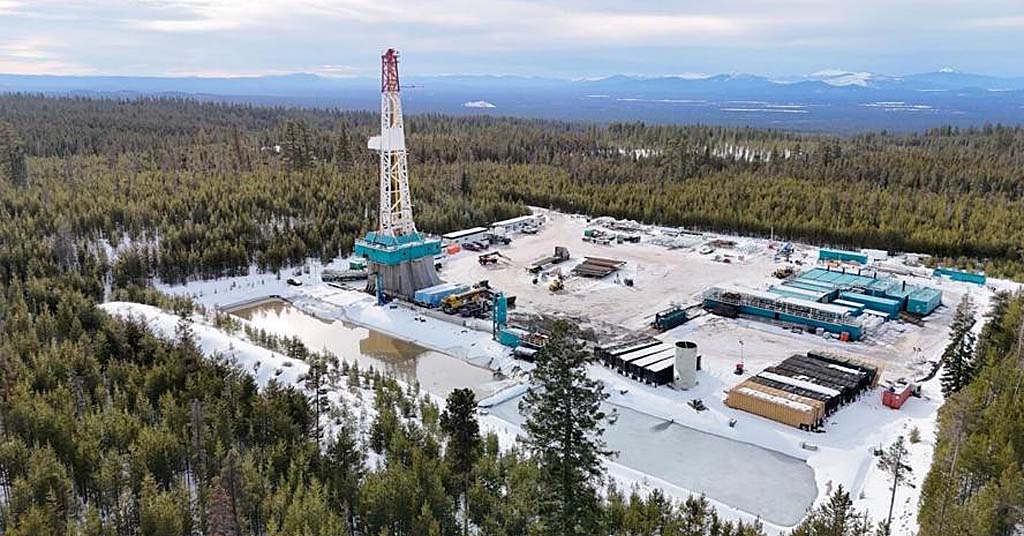
Going deep: The Mazama Energy operation in central Oregon has plans to alter the world. Photo: Mazama Energy
By Kendra Chamberlain. November 5, 2025. A venture capitalist-backed energy company has made what it’s calling a technological leap in geothermal at its facility in a volcanic crater south of Bend, Ore., in the Cascade Range.
Texas-based Mazama Energy is building a pilot plant for the firm’s “enhanced geothermal systems” (EGS) near the Newberry Volcano, south of Bend. The area is considered one of the largest geothermal reservoirs in the United States.
After drilling a pair of boreholes that reach two miles down into the earth, the company announced it has measured a recorded-breaking temperature of 629° F (331° C).
The company says it’s the first time a geothermal system of this kind has reached such high temperatures.
Mazama is hoping to use the aptly named Super Hot Rock system to heat water to create steam, which will be used to turn turbines to generate power.
The company is touting its facility as a clean energy solution to growing power demands of data centers and artificial intelligence.
“The Newberry pilot provides a blueprint for unlocking baseload, utility-scale, carbon-free energy from the Earth’s crust worldwide, which is what the next generation of AI and cloud infrastructure requires,” Mazama Energy CEO Sriram Vasantharajan said in a press release.
Mazama Energy plans to open a 15-megawatt pilot power station in 2026, and later expand to a 200-megawatt project at the site. The company is hoping to reach even hotter rocks, in the range of 750° F (400° C).
Earth-shaking potential
Most geothermal systems tap into shallow heat reservoirs, like hot springs. Enhanced geothermal systems reach thousands of feet down to access hotter and more consistent heat temperatures.
Those hotter temperatures could translate directly into more power potential, according to Vinod Khosla, founder of Khosla Ventures, which incubated Mazama Energy.
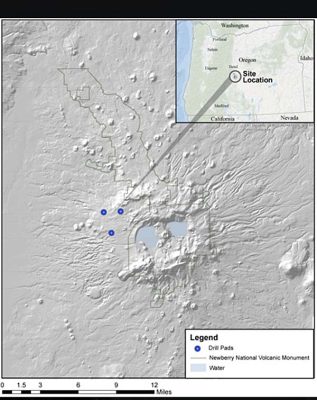
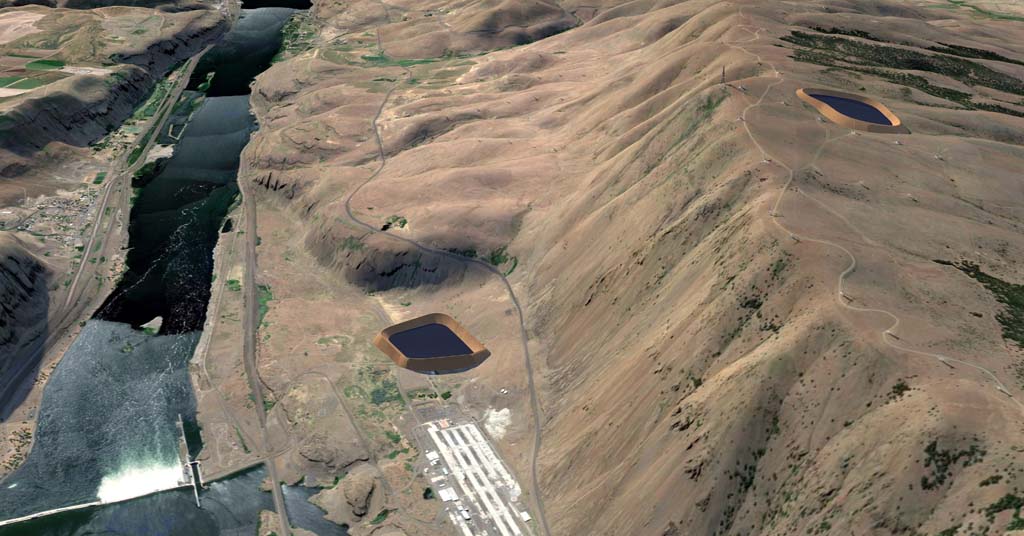
The Mazama site is located near the Newberry National Volcano Monument. Map: Mazama Energy
“This one site can produce five gigawatts of energy,” Khosla said during a recent TechCrunch Disrupt event.
EGS has several advantages over other energy sources. It produces no carbon dioxide emissions, it’s available around the clock (unlike solar or wind power) and it can potentially be developed nearly anywhere in the world.
Environmental issues include “induced seismicity,” earthquakes caused by digging far below the surface of the planet.
According to a 2025 report by Sustainability Directory, “fluid injection can trigger earthquakes by altering the stress state of existing faults. The magnitude of these induced earthquakes can range from minor tremors to potentially damaging events.”
In 2006 and 2007, three earthquakes measuring more than 3 on the Richter scale closed an EGS project in Basel, Switzerland. The quakes were caused by the injection of cold water deep beneath the earth in an attempt to fracture hot, unstable rock.
“By carefully controlling the injection pressure and flow rate, it may be possible to minimize the risk of triggering large earthquakes,” according to Sustainability Directory. “However, eliminating the risk entirely is difficult, and managing public perception and acceptance of induced seismicity is an ongoing challenge.”
Lengthy process
Geothermal energy testing at the Newberry site has been ongoing for decades, led in large part by the Seattle-based AltaRock Energy.
In 2023, AltaRock partnered with Texas-based Blade Energy Partners Ltd. to form Mazama Energy.
The company received a grant in 2024 from the U.S. Department of Energy’s Geothermal Technologies Office to support the pilot plant, in collaboration with three DOE national laboratories: Lawrence Berkeley National Laboratory, Pacific Northwest National Laboratory and National Renewable Energy Laboratory.
Oregon State University and the University of Oklahoma and are also involved in the project.