The company is fighting back, saying the plaintiffs’ claims are based on “inaccurate and grossly incomplete information”
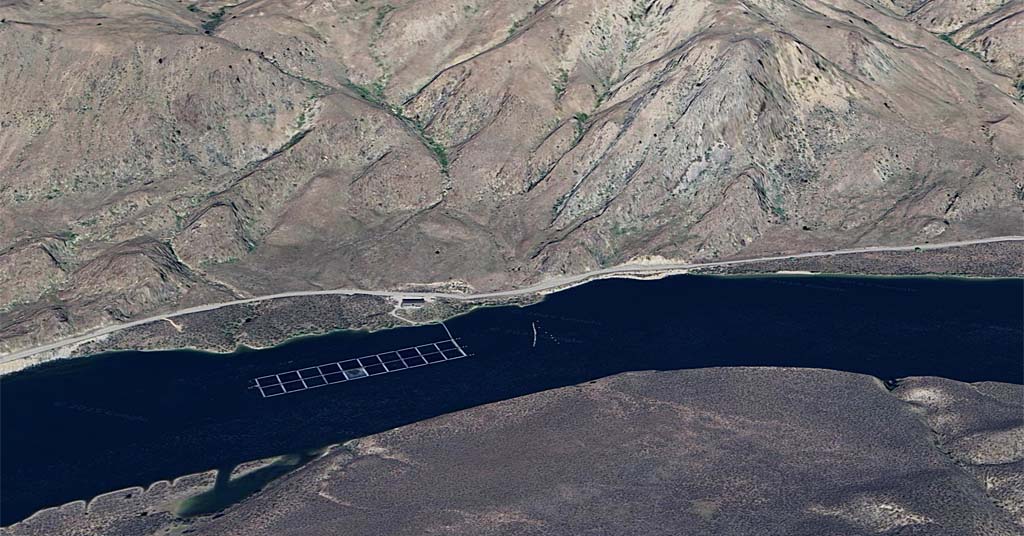
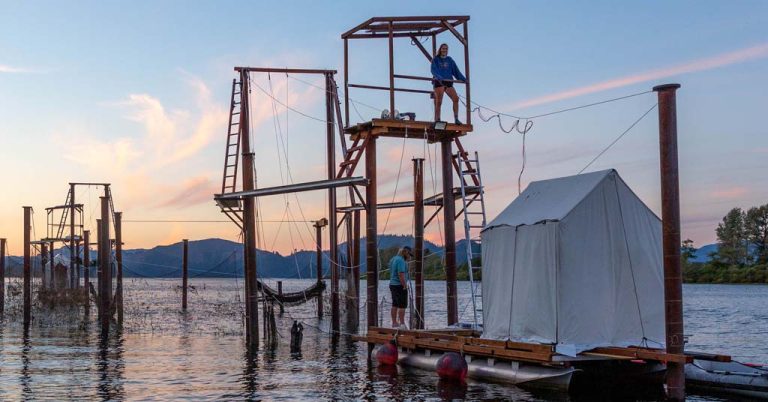
Pen state: Aquaculture operations on the Columbia River have drawn criticism from environmentalists and lawmakers. Photo: Wild Fish Conservancy
By Kendra Chamberlain. July 17, 2025. Wild Fish Conservancy and the Center for Food Safety have filed a lawsuit against Clackamas, Ore.-based Pacific Seafood over alleged Clean Water Act permit violations at its net pen aquaculture facilities located along the Columbia River in Nespelem, Wash. in the north-central part of the state.
Pacific Seafood raises steelhead trout at its facilities in partnership with the Confederated Tribes of the Colville Reservation. The fish farm received Best Aquaculture Practices (BAP) certification in 2013, which emphasizes environmental responsibility and sustainability in fish farming.
“It’s an incredibly risky practice,” Emma Helverson, executive director of Wild Fish Conservancy, told Columbia Insight, referring in general to net pen aquaculture.
Her organization and the Center for Food Safety argue that Pacific Seafood’s fish farms have exceeded federal pollution discharge limits and have failed to properly monitor and report those violations, citing documents the groups obtained through the Freedom of Information Act (FOIA).
The groups claim the facilities have been in “continuous violation” of their National Pollutant Discharge Elimination System (NPDES) permits since April 2020.
Pacific Seafood denies the allegations.
“We’ve made clear to the plaintiffs that their claims are based on inaccurate and grossly incomplete information, but they decided to file it anyway. We plan to fight these claims,” a spokesperson from the company told Columbia Insight in an email.
Pacific Seafood seemed to dismiss the alleged permit violations as “minor issues” in a separate statement made to the industry publication Aquaculture North America.
“At Pacific Seafood, we are deeply committed to environmental stewardship, supporting local jobs, and driving economic benefits in the communities where we operate,” the statement said. “This type of lawsuit is unfortunately used by a variety of environmental groups and their lawyers to extract attorney fees and excessive penalties over minor issues experienced by companies working tirelessly to comply with stringent and complex federal permits.”
Net pen use in fish farming has drawn ire from environmentalists and state regulators alike.
Critics say the practice is problematic for a number of reasons. Net pen farms are vulnerable to disease outbreaks that can reach native fish populations; fish often escape, impacting local fish populations; and the waste generated at the farms cannot be contained within the nets and is carried downstream.
The State of Washington banned the practice outright in marine waters it manages after an incident in Puget Sound in 2017 that resulted in the release of 250,000 non-native Atlantic salmon in to Puget Sound and the Salish Sea.
This year, Oregon lawmakers introduced but did not pass legislation that would similarly ban net pen aquaculture in state waters.
Helverson said billions of dollars have been spent to restore water quality on the Columbia River and for salmon recovery efforts—and that net pen fish farming often has negative ecological impacts.
“There’s no other industry in Washington that I am aware of that’s allowed to discharge untreated waste directly into public water sources as a point source,” said Helverson. “I would argue we shouldn’t be discharging any untreated waste into public water sources.
“Asking the industry to comply with common sense laws to prevent too much pollution from being discharged into one of our most important waterways is, in my opinion, not a high ask.”