
Critics say Washington’s Department of Natural Resources is moving ahead with timber sales that will destroy crucial habitat
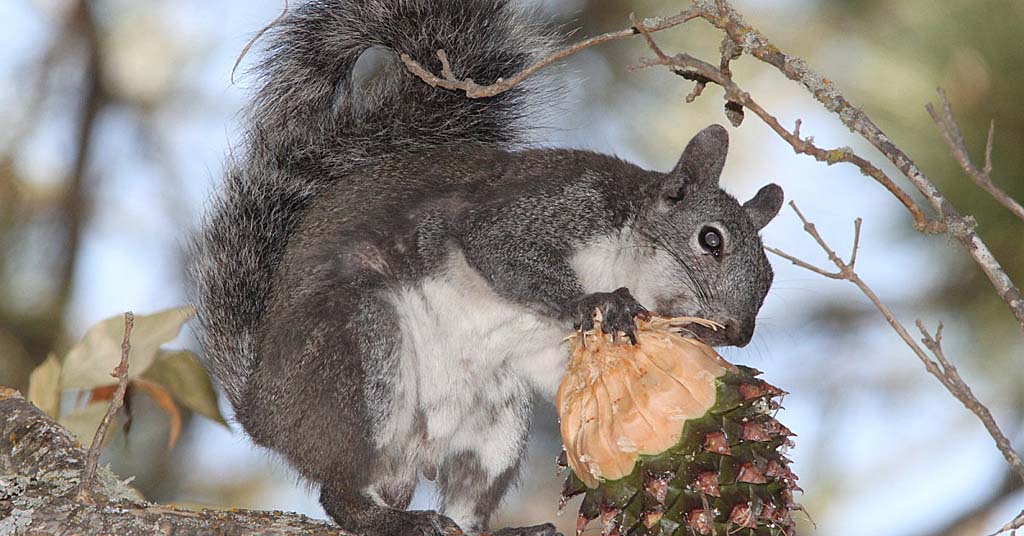
Small bites: Western gray squirrels live in low elevation oak, maple and coniferous forests. Their habitat is being cut down. Photo: Alan Schmierer/CC
By Nick Engelfried. November 20, 2025. Washington’s western gray squirrels are in trouble. The tree-climbing rodents, not to be confused with invasive eastern gray squirrels, have just three populations in the state. Each faces threats to survival.
This hasn’t stopped the state’s Department of Natural Resources from permitting two new logging projects in western gray squirrel habitat in Klickitat County in southern Washington, a stronghold for the species.
About two miles north of Lyle, Wash., in the Columbia River Gorge, the Q Tidyman sale involves logging conifer-oak forest, home to one of the highest concentrations of western gray squirrel nests in the state.
DNR says trees will be harvested in a way that protects the species.
Environmental groups are skeptical.
About an hour’s drive north, the Gotchen sale has drawn criticism from locals who say DNR failed to adequately account for the imperiled squirrels’ presence.
Western gray squirrels were listed as a state-endangered species in 2023, but DNR has not designated critical habitat for them on its lands.
“As an agency, DNR has yet to really acknowledge the specific habitat needs of this species,” says Ryan Ruggiero, director of the Friends of the Columbia Gorge Land Trust. “They should try to avoid disturbing western gray squirrel habitat at all costs, with so few left in the state.”
Squirrels in decline
With long, bushy tails, silver-gray backs and white underbellies, western gray squirrels once ranged across much of the state. Only about 400-1,400 survive.
“The threats to this species are many,” says Bill Weiler, a former Department of Fish and
Wildlife biologist who chairs the board of Friends of the White Salmon River. “You’ve got logging, development, climate change and competition from squirrels that aren’t native to this region.”
Unlike introduced eastern gray squirrels, western gray squirrels don’t occur in urban areas. They dwell mainly in mixed conifer-oak woodlands, an ecosystem that has suffered since the arrival of European settlers.
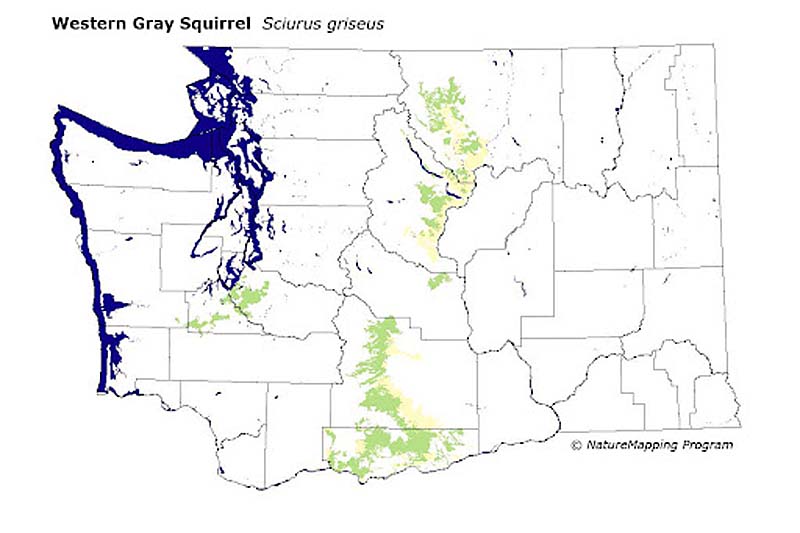
Western gray squirrel range in green and yellow. Map: Nature Mapping
One western gray squirrel population persists west of Washington’s Cascades, on the Lewis-McChord military base, about 12 miles south of Tacoma. Two others survive east of the mountains, one in Okanagan and Chelan counties and another in Klickitat County.
The Q Tidyman and Gotchen sales affect this last population.
Q Tidyman encompasses 114 acres of Douglas-fir, Oregon white oak and Ponderosa pine forest. This is ideal western gray squirrel habitat.
“The area has one of the largest populations known in the state, with 80-85 confirmed nests,” says Weiler, who began studying western gray squirrels in the 1990s when Washington listed them as threatened.
In preparing the Q Tidyman sale, DNR noted the presence of western gray squirrels.
The agency described plans to protect them, including leaving nest trees standing, not logging during nesting season, and harvesting 50% fewer trees than would be cut if the species wasn’t present.
Weiler still has concerns.
“Any timber sale comes with an incredible amount of unknowns,” says Weiler. “There’s noise from logging equipment, and falling trees hitting and affecting other trees in ways that are difficult to predict. This all has an impact on western gray squirrels.”
Q Tidyman doesn’t contain much valuable timber, and the sale is expected to generate little revenue.
An October timber sale auction for Q Tidyman produced zero bidders.
Meanwhile, a plan is in the works to transfer management of the land from DNR to the state’s Department of Fish and Wildlife, whose chief goal would be habitat conservation.
This would help complete a patchwork of protected lands spanning some of the area’s most valuable ecosystems.
“Q Tidyman doesn’t have much good timber, but is important for wildlife,” says Ruggiero. “It would make more sense for DNR to swap out this sale for one on lands without the habitat value it has.”
DNR plans to reset the minimum bidding price for Q Tidyman and hold another auction on Nov. 20.
Nests photographed
The Gotchen timber sale includes 979 acres of forest dominated by Douglas-fir, with some other conifers and Oregon white oak. DNR’s environmental review noted western gray squirrels in the sale’s Unit 2, but not the 890 acres of Units 1 and 3.
Local environmental groups have documented the squirrels and their nests in these other units, however, and say DNR didn’t conduct a thorough survey.
“It seems they didn’t expect to find western gray squirrels, so they didn’t look hard,” says Joshua Wright, programs director at the Legacy Forest Defense Coalition.
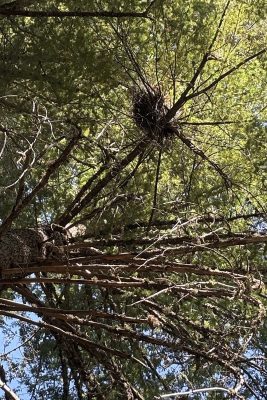
Heads up: Western gray squirrel nest in the Gotchen timber sale Unit 3. Photo: Joshua Wright
Wright visited Gotchen Unit 3 in May, after a local community member alerted him to the presence of the squirrels. Wright found and photographed four western gray squirrel nests there, and since then the local tipster captured videos of the squirrels in Units 1 and 3, including near the nests Wright located.
One video shows what appears to be a lactating female squirrel.
In a letter to DNR, Wright said he could survey only a small part of Gotchen, and Unit 3 likely contains “dozens” of western gray squirrel nests.
DNR replied, saying the agency’s staff found “no signs of active use of any of the potential nests” Wright identified.
Weiler, who has also seen Wright’s nests and has studied western gray squirrels as extensively as anyone in the state, doubts whether DNR could know this.
“It’s a pretty difficult thing to say a western gray squirrel nest is no longer active,” says Weiler. “They are bigger than basketballs and almost impossible to see into from ground level. Given squirrels have been filmed close by, you have to ask what nests they are using? Probably the ones we found nearby.”
Ryan Rodruck, DNR’s communications manager for eastern Washington, told Columbia Insight in an email the presence of western gray squirrels in the area prior to logging shows the agency has done a good job looking out for the species.
“[The Gotchen] sale meets the legal requirements for the protection of western gray squirrels and will help ensure the continued viability of this forest stand,” wrote Rodruck. “The presence of foraging western gray squirrels in the vicinity indicates the Department of Natural Resources’ successful long-term sustainable stewardship of this land.”
DNR did not respond to specific questions about the presence of western gray squirrels in Unit 3, or whether the agency has thoroughly assessed for the species within the Gotchen sale.
Co-existing with logging
Those who worry about timber sales in Klickitat County impacting western gray squirrels don’t necessarily oppose all logging there.
“It’s important Klickitat County maintain our forest resource economic base, for many reasons,” says Pat Arnold, executive director of Friends of the White Salmon River.
In Arnold’s view, the worst threat to western gray squirrels isn’t logging alone, but also habitat fragmentation caused by roads and sprawling urban development. However, she is concerned by what she sees as DNR’s reluctance to ensure logging projects protect a state-endangered species.
“I’ve seen a lot of timber harvest projects that are intensely destructive of western gray squirrel habitat,” says Arnold.
Like other Washington counties with state trust forestlands, Klickitat County receives revenue from timber sales in its boundaries. The Klickitat County Board of Commissioners did not reply to requests for comment for this story.
The Q Tidyman sale has earned some good marks from environmental groups for taking western gray squirrel habitat into account.
However, the concentration of the squirrels in a relatively small area raises inherent risks.
“It’s just the wrong place to have a timber sale,” says Weiler.
Wright believes the larger Gotchen sale could move forward while protecting the squirrels, but it would require DNR taking a step back to thoroughly re-evaluate the species’ presence.
“They should pause the sale, determine what areas western gray squirrels are using, then work to preserve the species from there,” says Wright. “They would have to avoid logging certain areas, but they could still have a perfectly viable timber sale.”
So far, DNR isn’t following this advice.
In May, the agency held a successful timber sale for Gotchen. Road-building activity in preparation for logging appears to have already started.
Emails between DNR staff, obtained as part of a public records request by a member of Friends of the White Salmon River, suggest the agency felt urgency to move the Gotchen sale forward to meet timber harvest goals.
In a Dec. 2, 2024, email to other staff, Southeast Region Proprietary Manager Kevin Alexander noted that DNR had so far put up 13,089 million board feet (mmbf) for sale in the 2024-2025 biennium. Alexander said Gotchen would produce “just over 6,996 mmbf,” allowing DNR to hit its biennium target of 20,000 mmbf.
DNR has done little to protect western gray squirrels in Gotchen Unit 3, beyond marking the specific trees where Wright photographed nests as “leave trees.”
Surrounding trees, which would provide forage and habitat for any squirrels using the nests, remain set to be harvested.
“There are western gray squirrel nests in that forest which DNR never looked for,” says Weiler. “We found them, they’re on camera and DNR should be taking adequate steps to protect them. But they’re not.”








Thank you for this informative article! Western Gray Squirrels were listed as threatened over 30 years ago. DNR and WDFW protection was minimal, and two years ago WGS were uplisted to endangered status. If our state agencies don’t step up to better protect them, these squirrels will soon be extirpated in WA. DNR’s refusal to acknowledge their habitation and reproduction at Gotchen or to refrain from disturbing a core population at Tidyman, and WDFW’s failure to intercede timely with DNR, are unconscionable. I beg the public to speak up now. Please email or call DNR Commissioner Upthegrove (cpl@dnr.wa.gov; 360-902-1004) and WDFW Director Susewind (Kelly.Susewind@dfw.wa.gov; 360-902-2200) to ask for a pause of the Gotchen harvest until protection for squirrels are in place. Sadly,Tidyman was auctioned today despite repeated requests for a pause until WDFW could acquire it as a wildlife conservation area. I ask: why is DNR doing harm like this?
Thanks for the links to take action. It would be great to see the state take some steps to prevent the further loss of this species in Washington.
DNR seems to be rushing through these sales before the Washington State Court of Appeals issues a decision in Vancouver Audubon Society v. Washington DNR (Western Gray Squirrels Critical Habitat). Oral arguments were held before a three judge panel on Sep. 12, 2025. The judges seemed inclined to support the appellants (Vancouver Audubon Society, Friends of the Columbia Gorge, Friends of the White Salmon River, Center for Biological Diversity, and WildEarth Guardians) argument that WAC 222-16-080(3) requires that the DNR “shall” prepare and submit to the Forest Practices Board a proposed list of critical habitats within 30 days of the Washington Department of Fish and Wildlife listing a species as endangered. DNR failed to perform this duty by the mandatory Jan. 27, 2024, deadline after the western gray squirrel’s listing as endangered, and has not done so to this day. During oral arguments, the judges seemed skeptical of DNR’s response is that it is not required to comply with the mandatory duties established by the state regulation, and that no party can challenge its failures to do so. Judge Birk told DNR’s attorney, “you’re running up against a certain level of judicial impatience here,” referring to DNR’s ongoing failure to comply with its 30-day deadline for proposing critical habitats.
Designating and then protecting “critical habitats” for endangered species is one of the most important steps towards saving and recovering an endangered species. It is disappointing to find out that DNR is not taking these requirements seriously in Klickitat County. With the deadline of January 27, 2024 that was noted in this article, it is important for the public to contact DNR to tell them we care about endangered species. Thank you for letting the public know many of the details of this failure and why it is important.
Does another state agency, our WA Department of Fish and Wildlife (WDFW), also have a role to play here? Just listing this species as “endangered” certainly is not enough to recover “at risk” populations. What is the local WDFW biologist, or other WDFW biologists, doing in Klickitat County?
We need more articles like this one about wildlife. Wild species are facing so many threats in today’s world. The public needs to hear about these species. This newspaper is one of the best sources of information. Thanks so much. You are making a difference by informing the public about what our state agencies are and are not doing. Now it is up to the people in WA State to use this information and contact DNR and tell them we care about our wildlife.
The state legislature has acknowledged the critical urgency of stemming accelerating biodiversity loss in WA, and has budgeted millions to address this ecological crisis. Meanwhile, DNR considers board-foot targets to be more important, rather than saving an endangered forest species that helps to propagate oaks and other diverse tree species. Logging Gotchen to improve habitat for these squirrels 20 years from now is pointless if the logging removes their nests and food source and kills them today. By the time future habitat improvements are manifested, the squirrels are no more. DNR should acknowledge the evidence that the squirrels are present, define critical habitat, and pause harvest and future sales until adequate plans for protecting these endangered animals are in place.