
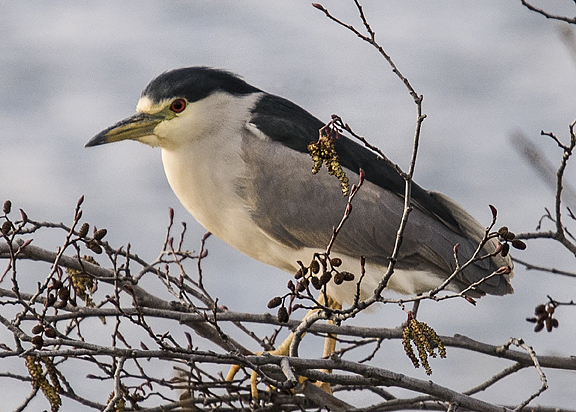
[/media-credit] Adult Black-crowned Night-Herons have a dark cap and wings with a bluish grey hue and red eyes. Their necks are shorter than other herons and they appear stocky with short tails.
While admiring the view of the Columbia River in the daylight’s last glimmers, I heard a wooshing of wings overhead and a few barky calls: “wok wok wok.” My son and I looked up and saw a big graceful bird with broad flapping wings flying barely 50 feet above us. My son guessed it was an owl due to its large size and the time of day of the sighting, but the bill was too large and pointed.
I am an experienced bird watcher, but was still surprised when I checked my field guide that this was a Black-crowned Night-Heron (Nycticorax nycticorax), because at the time I was not aware of its presence in Hood River.
Although this species is widespread throughout the United States, Nichols Basin in Hood River, Oregon is the only documented place in the entire Columbia River Gorge that has a regular winter communal roost. Bird watchers often travel from the surrounding area to view and photograph these beautiful herons. Black-crowned Night-Herons are most often observed at dusk flying from their daytime resting place to marsh or wetland habitat to feed. These social birds generally stay together in groups for nesting and for daytime roosting.
This communal roost in the basin was discovered by local bird watching guide Stuart Johnston in the early 2000s. Every year for the last ten years, Johnston has documented a small, but consistent, wintering colony of 5 to12 Black-crowned Night-Herons at Nichols Basin and posting on eBird, an online database used by citizen scientists. The birds are generally present in a communal roost between September and April in Nichols Basin, and individual birds can be observed sporadically in various locations in the Columbia Gorge when they migrate to their nesting grounds or as young disperse during their first year.
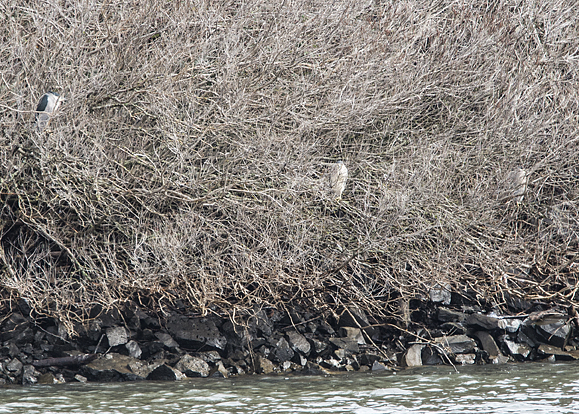
[/media-credit] Black-crowned Night Herons perched in the brush can be easy to miss. Can you spot three?
Many people have lived in Hood River for years and never noticed this local wildlife gem. Over 25 years ago, I started my journey as an avian field biologist, sparked when I learned that I walked past a large wintering population of Snowy Plovers every week, while walking the beach near my home. I was ‘introduced’ to this bird by a flier posted at the beach enlisting volunteers to monitor this threatened shorebird. After volunteering with the biologists and learning about the behaviors of these birds as well as the native beach plants and the beach ecosystem, my connection with the environment deepened. I have continued watching birds, because there are always hidden surprises for those willing to seek them.
Changes to natural habitats occur with the tides, floods, storms, and other shifts of nature. Nichols Basin in Hood River has changed drastically over the past year mostly due to construction. Before 2015, much of the western and southern edge of Nichols Basin was either inaccessible or uninviting to pedestrians. Construction began in 2015 on the Port of Hood River’s west edge trail project. A paved and landscaped pedestrian trail opened July of 2015 curving around part of the basin. What was formerly uninviting for public recreation now resembles a city park with benches and lawn. Hotel construction is currently underway on the south end of the basin, and there are more plans for trail work and habitat restoration.
Stuart Johnston and several other local bird watchers wrote the Port of Hood River Commissioners about the presence of these birds in Nichols Basin explaining how rare an occurrence this roost is for the Columbia Gorge. They suggested ways to conserve the roosting site  including: desirable plantings for restoration efforts and timing disturbance of the roost area.
Johnston was pleased to see that despite changes in the landscape and ongoing construction, the birds returned to the basin in fall 2015 on their annual migration. “The birds seem to be adapting to the altered habitat,” he said. “They have shifted their roosting spots along the east bank to use different bushes and trees than previous years. This year I once observed some birds along the west bank for the first time low to the water in some false indigo bushes.”
“These night herons are still vulnerable,” he said, “to increased disturbance due to changes in habitat from ongoing construction and restoration efforts, access by pedestrians, stand up paddle boarders, dogs off leash, fisherman, and well-meaning bird photographers that can accidentally flush the birds from their roost.”
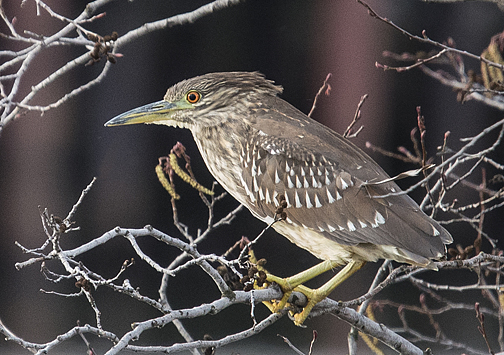
[/media-credit] Juvenile Black-crowned Night-Herons are brown with white streaks and spots. They do not attain full adult plumage for three years.
Fortunately, the Black-crowned Night Herons have different requirements for nesting and have never used Nichols Basin during the peak of the summer tourist season in Hood River. The birds migrate away from the basin in March-April and return September-October. Nonetheless, once the hotel is open and trail around it is complete, there will be increased use of the area by pedestrians, water vehicles, and other recreational activities.
“View them from a distance using binoculars or spotting scopes from the west bank along the path or the lawn rather than going through brush to bank or veering close to them from the water,” Johnston said. “Try to avoid flushing them and stressing out birds that already endure enough stress with all the changes in habitat and increased use by the public. If the herons are continually disturbed, they may not continue to stay in the basin in the future. A little extra effort from people could ensure the long-term stability of this unique wintering colony in the Gorge.”
While these birds are not listed as threatened or endangered, their continued presence is seen by some of us as a sign that we are keeping our ecosystem relatively intact and healthy. When we start to lose diversity, we lose links in the food chain. We lose the excitement of our children getting to see amazing creatures sharing space with us, as they have through the ages.













Great article Miko….very informative….I like the conservation message to protect the birds.
We have been observing these herons in Nichols Basin for several years with great excitement. After seeing the recent landscaping and new trail along the east side we became so saddened at the missed opportunity by the Port to provide more diverse native plant habitat in their landscape plans. We are again alarmed but all of the construction of the new hotel to the south of the basin and wonder what impact this will have on all of the bird life around here. We hope more citizens can become concerned to speak to the Port about providing better ecological habitat so we can all continue to observe a variety of plants and animals in a healthy environment.
Thank you for your comments and concern. There is a hyper link in my article (on the word habitat restoration) to the Hood River News article that explains that there will be further habitat restoration. I am not certain of what the plans are specifically, but we hope that restoration efforts continue to provide bird habitat.
I love these Herons, so majestic! We were at Coyote Wildlife Preserve near Fremont, CA and by sheer luck saw one hiding in the reeds and then discovered 6 others next to it. If you have any ideas on where to see a Green Heron we’d love to know. Thanks so much for your article.
Thank you Nicole! A friend of mine saw a Green Heron in the marshy area of Waucoma Basin (the Hook area) in Hood River, OR last spring. Green Herons are tough to spot because they are solitary and blend in well, but they prefer marshes, lakes, and ponds. They have been seen at Ridgefield Wildlife Refuge and I saw a nice photo essay about them breeding in Fernhill Wetlands in Portland. Thanks for reading.
Hi Miko,
I am working with Columbia Riverkeeper and the Oregon Youth Conservation Corp to restore Nichols Natural Area. We are going to craft an information board tomorrow and would like to use this article on the board (with your name and website printed, of course). Would this be all right with you?
Thanks,
Kate Samson
That would be wonderful. I have one already printed out left over from an event that I will drop by your office to save a little paper and ink!