
Western redcedars are declining at home, but they’re climate change winners in Central Europe’s changing climate
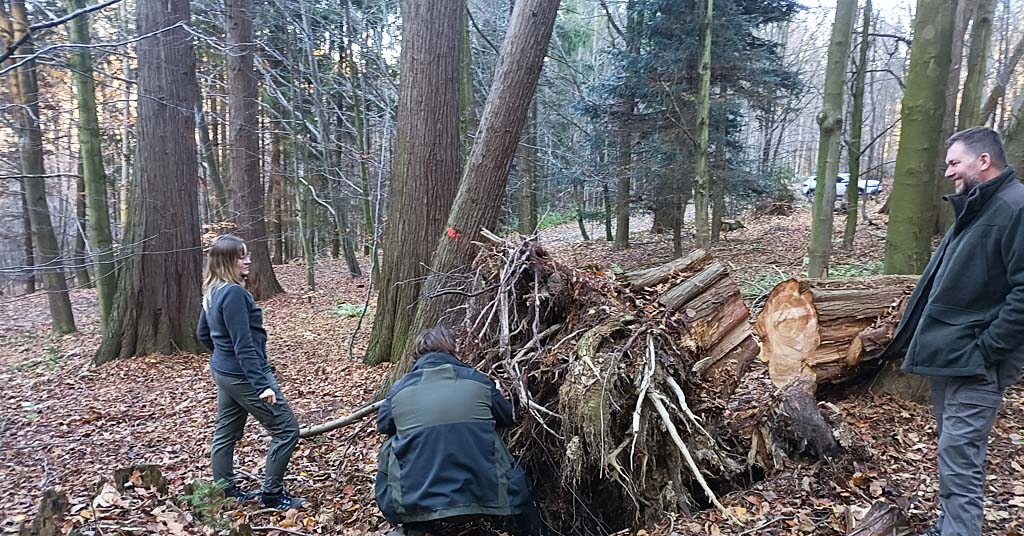
West world: Western redcedars from the Pacific Northwest are thriving at this experimental forest in the Czech Republic. Photo: Pavel Horák
By Nathan Gilles. January 15, 2026. Starting in 2017 and 2018, western redcedar trees in Oregon and Washington started dying off in record numbers.
A peer-reviewed study published in 2023, as well as a comprehensive 2022 government report, linked the struggling trees to the abnormally warm and dry climate the Pacific Northwest has experienced in recent decades.
The climate-induced death of western redcedars has led some to consider replacing the water-loving trees with more drought-tolerant alternatives.
But while western redcedar is losing favor at home, in Europe the tree is being considered as a tool for adapting to climate change.
According to a study published last fall in the Journal of Forest Science, while western redcedars were suffering in the changing climate of Oregon and Washington, the trees were thriving in the changing climate of Central Europe.
The study, conducted by scientists from Mendel University in Brno in the Czech Republic, examined climate and tree ring growth data from an experimental forest in the northeastern Czech Republic where western redcedars were planted in early 20th century.
The age of the forest provided the researchers with over a century of tree growth data that they compared to climate records over the same period. Critically, this included recent decades when climate change has accelerated in Central Europe.
During this last period of the study, despite growing less during periods of summer drought, the study’s western redcedars nonetheless experienced their largest period of growth, far surpassing the study’s other two tree species.
In addition to looking at western redcedar, the study also examined the relationship between climate and the growth of two other tree species planted in the forest around the same time: Scots pine, a tree native to the region, and Port Orford cedar, another Pacific Northwest native introduced to the region.
In total, the study examined 41 individual trees: 19 western redcedars, 12 Scots pines and 10 Port Orford cedars.
The study’s Scots pines and Port Orford cedars also grew less during periods of summer drought.
Motivated to change by change
The performance of western redcedar over the other two species led the study’s authors to conclude that the Northwest native is “a particularly promising candidate for future application in Central European conditions under ongoing GCC [Global Climate Change].”
European foresters are looking for climate-resilient trees for the same reason North American foresters are.
Trees the world over are growing less and dying due to warmer, drier conditions tied to climate change.
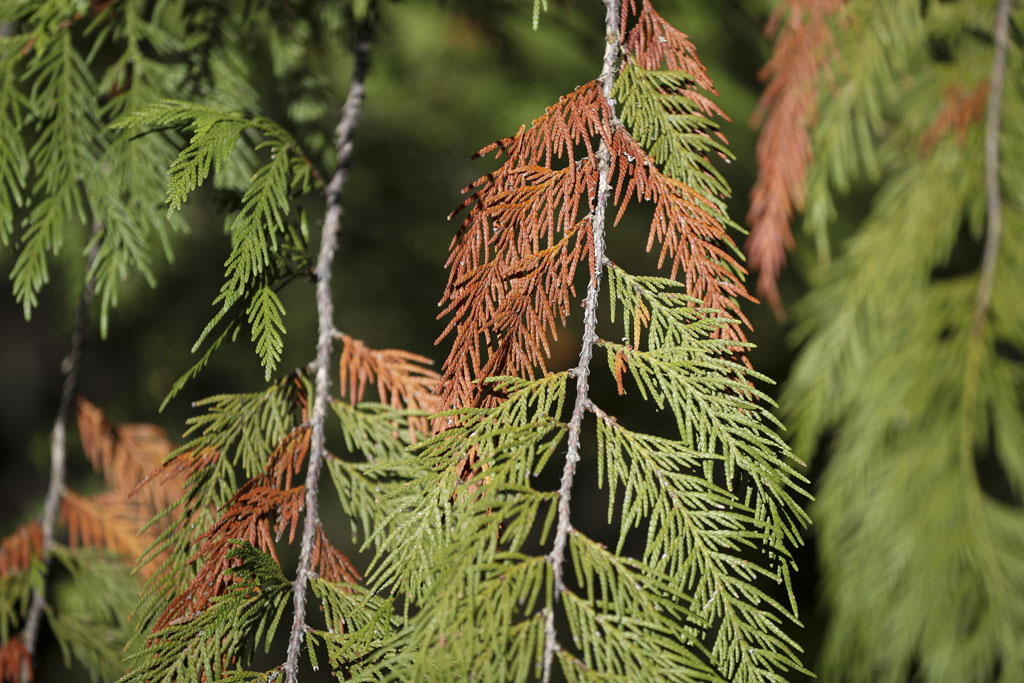
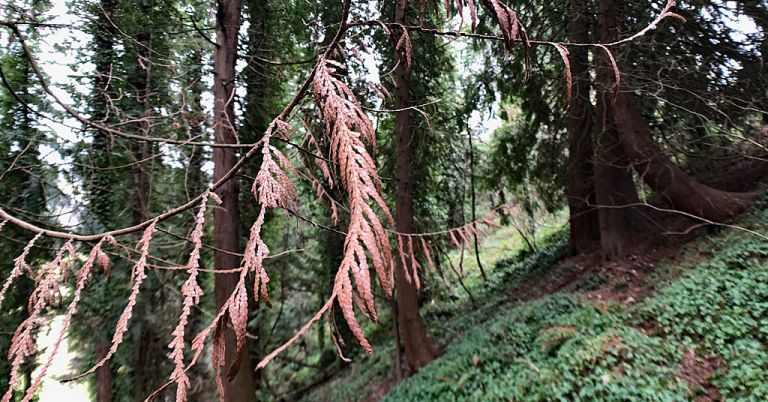
Code red: Dead needles hang on a western red cedar tree in Oregon’s Willamette National Forest. Photo: AP Photo/Amanda Loman
Study lead author Pavel Horák, researcher at the Department of Silviculture, Faculty of Forestry and Wood Technology at Mendel University in Brno in the Czech Republic, says finding climate change resilient species to plant in European forests was a major impetus for the study.
“We are now starting to have the problem [of] preserving our forests made up of local trees at lower altitudes basically because it is too hot and too dry,” says Horák.
As Columbia Insight first reported, in the Pacific Northwest scientists have tied climate changes to growth declines and die-offs in at least 10 native tree species.
In addition to western redcedar, impacted trees include bigleaf maple, Douglas fir and the four true fir species that died off in record numbers in 2022 as part of “Firmageddon.”
In Europe, trees impacted by climate changes include native beeches, pines and spruce.
Assisted migration
Horák and colleagues’ study joins a growing body of research with potential applications for assisted migration.
Assisted migration is the idea that people can—and, some argue, should—help plants, animals and even fungi physically move to keep up with our warming climate.
When it comes to tress, there are multiple kinds of assisted migration, as well as numerous motivations for doing it.
Reasons vary from finding a new home for trees—as some hope to do for redwoods and sequoias—to finding climate-resilient substitutes for native trees whether for ecological reasons or timber production.
Arguments against assisted migration center around concerns that migrated trees could become invasive in their new homes, as well as worries that the migrated trees are unlikely to support as many animals as native species.
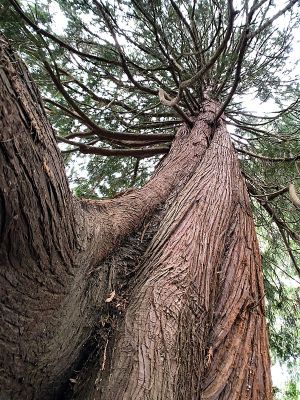
Raised right: Healthy western redcedar in Washington. Photo: Nathan Gilles
To avoid these potential harms, most arguing for the assisted migration of trees prefer moving the seeds of trees within their current native growing ranges, something the U.S. Forest Service is experimenting with.
Or they argue for moving trees just north of current growing ranges, something advocates for migrating redwoods and sequoias from California to Oregon and Washington are already doing.
Very few have argued for the wholesale relocation of species across oceans, as Horák and colleagues’ study suggests could be done with western redcedar.
“I think this [study] is a valuable addition to current efforts to understand how species might be affected by climate change,” says Dave Peterson, professor of forest ecology at the University of Washington, who was not involved in the study.
Peterson says foresters and managers in the Pacific Northwest are unlikely to consider using a tree species from different continents. But he says the study’s findings could give foresters in the Pacific Northwest food for thought.
“We would never consider establishing a forest of say, Norway spruce or something like that over here, but maybe we should,” says Peterson. “It looks like from this particular study that they have matched up a PNW species with a climate that’s more favorable.”
Robbie Andrus, adjoint faculty at the School of the Environment at Washington State University, who was not involved in the study, agrees that the study upends the conventional wisdom on how to do assisted migration.
“I think it is a really interesting experiment, especially from the perspective of putting these trees in a place that has a totally different climate regime to what they’re used to and seeing that they appear to be prospering,” says Andrus.
Andrus, who was the lead author of the 2023 peer-reviewed study linking western redcedar decline to drought, says while Horák and colleagues’ study doesn’t spell out why the climate of Central Europe might be more favorable than the Pacific Northwest’s for western redcedar, it does provide clues.
“In the Pacific Northwest, with the really warm and dry summers that we have been getting, that’s really driving the limitation on tree growth,” says Andrus. “Without that moisture, then the trees shut down growth.”
This is what Andrus and colleagues found in their 2023 study on western redcedar.
The study determined that back-to-back droughts were strongly correlated with slower tree growth. When growth slowed enough, the trees died.
“I think the major thing that’s going on here [in Horák and colleagues’ study] is there is precipitation coming in the growing season [at the study’s experimental forest] when the trees are photosynthesizing,” says Andrus.
In addition, the forest used in the study hasn’t gotten as warm as the Pacific Northwest in recent years.
This suggests, says Andrus, that western redcedars at the study site likely need less water and experience less stress during periods of summer drought.
Study limitations
Horák and colleagues’ study has limitations.
One is the study’s small sample size—just 41 trees.
The study area—just one forest—is also small. This makes sweeping generalizations about the study’s findings unwise.
The study, however, has time on its side.
While multiple studies in recent decades have examined migrated trees and climate, most cover years or, when lucky, several decades of data.
Having data for over a century sets the study apart.
“You need to be really careful about short-term studies,” says Donald Zobel, retired professor in the Department of Botany and Plant Pathology at Oregon State University, who was not involved in the study. “There are some genotypes that, like people, do very well early, but then they slow down. Where others are late bloomers. So, it is good that this is a long study.”
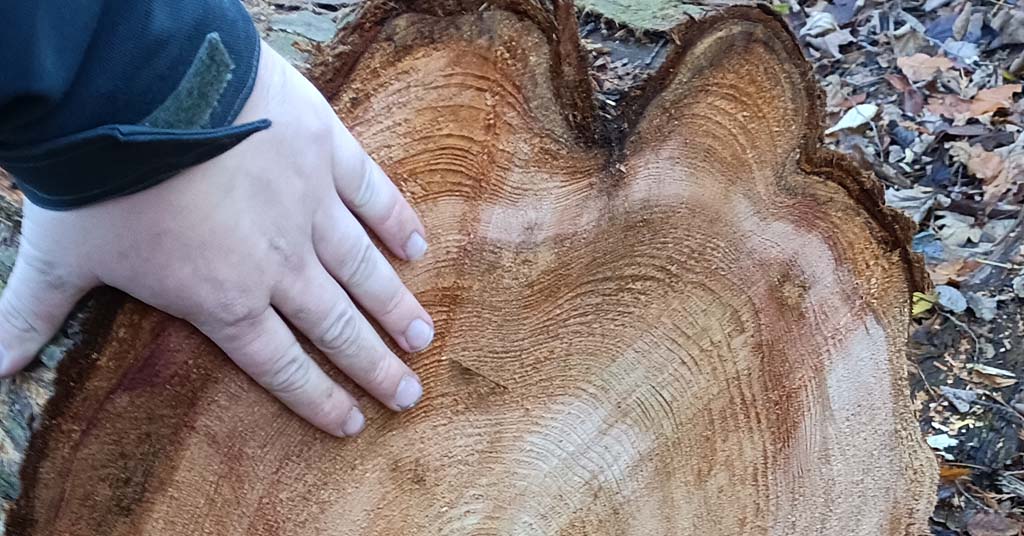
Wellness check: The Mendel University study examined climate and tree ring growth data. Photo: Pavel Horák
But here, the age of the study’s stand of trees is also a weakness.
Horák says the experimental forest was originally owned by a nobleman, who brought the western redcedars and Port Orford cedars to the Czech Republic during the heyday of interest among the upper classes in exotic plants. No records were kept on the origin of the trees’ seeds as was common at the time.
“That’s the problem, or let’s say limitation of our study,” says Horák. “In these older stands, we don’t know the origin of the seeds.”
Not knowing the origin is a problem because trees of the same species can vary widely in their genetic traits and ability to withstand different climates depending on where they grow.
Trees and plants in general have growing ranges that are largely determined by temperature and precipitation, but also by factors including soil types.
The range of the western redcedar follows the moderate temperatures and wet conditions of the Pacific coastline from northern California to the Southeast Alaskan panhandle. Sort of.
Although the vast majority of western redcedars can be found on the wet, west side of the Cascades Range, the trees can also be found in the temperature-fluctuating drier climate of eastside of the region, in the mountains of eastern Washington, Idaho and Montana.
Trees in this eastern distribution are believed to be more drought tolerant and more tolerant of temperature shifts than trees in the western distribution, something Andrus says could be seen in the data of his 2023 study.
It’s unknown if the trees in Horák and colleagues’ study came from the eastern or western distribution.
Something similar might be going on with Port Orford cedar.
Port Orford cedar’s range runs some 200 miles from Coos Bay, Ore., to California’s Humboldt County.
Although its range is small, it contains a sizeable amount of genetic variation, according to Zobel, who participated in genetic studies of the tree in the early 2000s.
Zobel says these variations of Port Orford cedar also grow very differently in different kinds of soils.
“If the soil was particularly favorable, or unfavorable, for the seed sources of Port Orford cedar used in the study, especially if it differed from the source soil for that seed source, the potential growth at that site may not represent the species at large,” says Zobel.
Once prized for its wood, since the 1950s Port Orford cedar populations have been decimated by an introduced fungus.






A very good alternative to Western Red Cedar is Incense Cedar, Calocedrus decurrens which is drought tolerant and pest resistant. I’ve seen Incense Cedar growing on Mt Hood and in the Columbia Gorge at upper Rowena and Mill Creek in Oregon’s Wasco County.