Stay Updated Subscribe today for the latest research + reporting about environmental news. Subscribe Now

Stay Updated Subscribe today for the latest research + reporting about environmental news.

Subscribe Now

Susan Hess

Susan Hess

About Valerie Brown

Valerie Brown, lives near Portland, Oregon. She specializes in science and environment writing, particularly environmental health and climate change, including the health effects of chemical and radiation exposures, carbon sequestration, and climate change’s effects on forests and oceans.

The amazing ancient lamprey

These intriguing and unsettling fish are more important than you might think
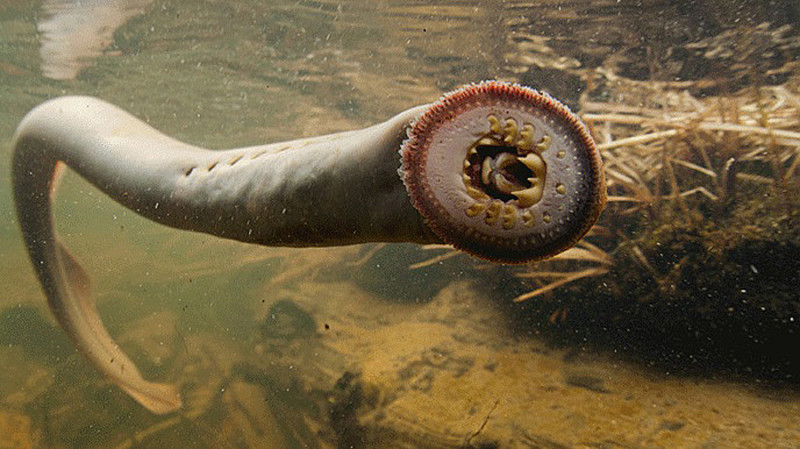
Pacific lamprey. Photo: U.S. National Park Service

Written by longtime contributor Valerie Brown, this story was originally published in February 2018 and has remained a favorite of Columbia Insight staff and readers. It’s presented here as part of our Classic Insight series. —Editor

By Valerie Brown, July 14, 2022. Imagine this: You develop from an egg into a larva in fine stream sediment. Over the next three to seven years you live there, eyeless and sexless, eating diatoms and algae.

Then you metamorphose into a male or female fish with a two-lobed dorsal fin, two eyes, no bones and a round mouth with teeth made of keratin (the same thing as fingernails).

Something tells you that you must go down to the sea, where you affix your mouth to the side of a bigger fish and suck its fluids out for your own benefit.

After a few years doing this, you get the call to return home, so you swim upstream, leapfrogging your way through rapids by glomming your mouth onto rock above rock above rock, until you reach your original stream. Or something quite like it.

You never eat again. You spawn and die. Congratulations! You are a lamprey.

The lamprey is clearly not an example of “charismatic megafauna,” like bears and wolves, but it’s nevertheless a vital member of the Pacific Northwest ecosystem and an icon for Native Americans, who prize the fish for food, medicine and ceremony.

Sadly, Pacific lamprey and their cousins, river lamprey, have all but disappeared from Northwest rivers and streams. Like the Pacific salmon that migrate up the very same rivers to spawn in fall and winter, they’ve felt the devastating effects of habitat loss, dams, chemical pollution and dredging.

What’s their problem?

Compared with salmon, lamprey have 20% more protein and eight times their fat content.

This makes them popular with predators but also results in accumulations of heavy metals like mercury and persistent fat-loving chemicals such as certain pesticides and PCBs.

Lamprey larvae are also heavily exposed to pollutants during their long residence in stream sediments.
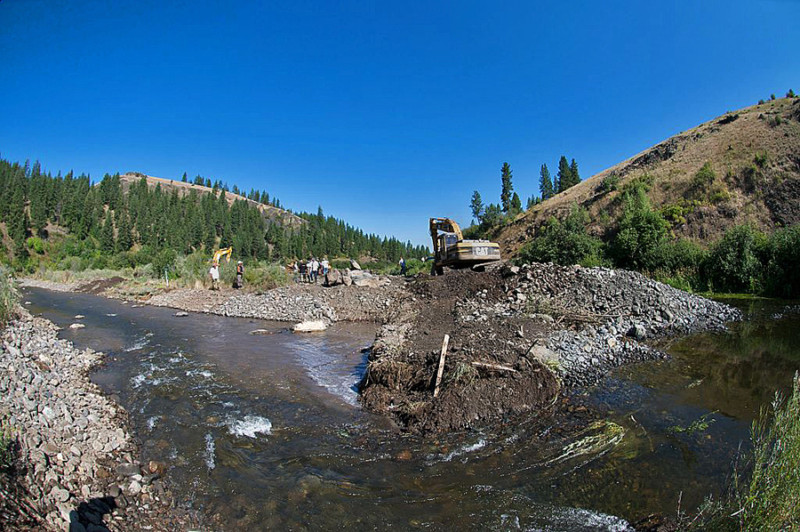
Remediating dredge spoils on the Middle Fork of the John Day River. Photo: Sam Beebe/Ecotrust/CC 

Dredging has been a problem for lamprey because dredges scrape up the stream bed and deposit it chaotically, mobilizing mercury deposits as well as throwing lamprey larvae—called ammocoetes—out of the water and destroying their habitats.

Dams, however, appear to be the biggest thing lampreys can’t adapt to. Lamprey don’t do well with the accommodations aimed at salmon because they’re weaker swimmers, and need round surfaces, rather than right angles, in order to lock their lips on something to climb.

About half of them simply give up after repeated tries at fish ladders.

Many ammocoetes also find themselves marooned in farmers’ fields and ditches because the meshes inserted into irrigation outflows, designed for salmon, are too big to keep lamprey out.

Recovery

There are some 39 species of lamprey around the world, about half of which are parasitic. In the Northwest, Pacific and river lampreys are parasitic, while brook lampreys are not. The first two are also anadromous, meaning they migrate between freshwater and saltwater.

In the Northwest, lamprey have historically been regarded by European Americans as trash fish that damage sport fish, and in the past, they were sometimes poisoned or harvested for fish meal.

According to Sara Thompson of the Columbia Intertribal Fish Commission, the only place in Oregon where tribal members can currently harvest lamprey in any quantity is at Willamette Falls near Oregon City—historically one of the largest sources of lamprey in the Columbia Basin, although tribal memory recalls vastly more at Celilo Falls on the Columbia before construction of The Dalles Dam.

But in the Columbia River Basin there is now a concerted effort to restore the lamprey for both cultural and ecological reasons.

There is some good news regarding this effort. In 2008, the Army Corps of Engineers embarked on a $50 million search for better lamprey passage designs, especially at the Bonneville Dam, a 200-foot wall of concrete that creates one of the most daunting obstacles for lamprey along the entire Columbia River.

Likewise, three lamprey summits since 2004 led to a commitment by the U.S. Fish & Wildlife Service to work toward lamprey recovery with the tribes, state and local agencies, and other stakeholders. In 2012, these groups signed a conservation agreement to restore Pacific lamprey to their historical range and to preserve the tribes’ cultural uses of lamprey.
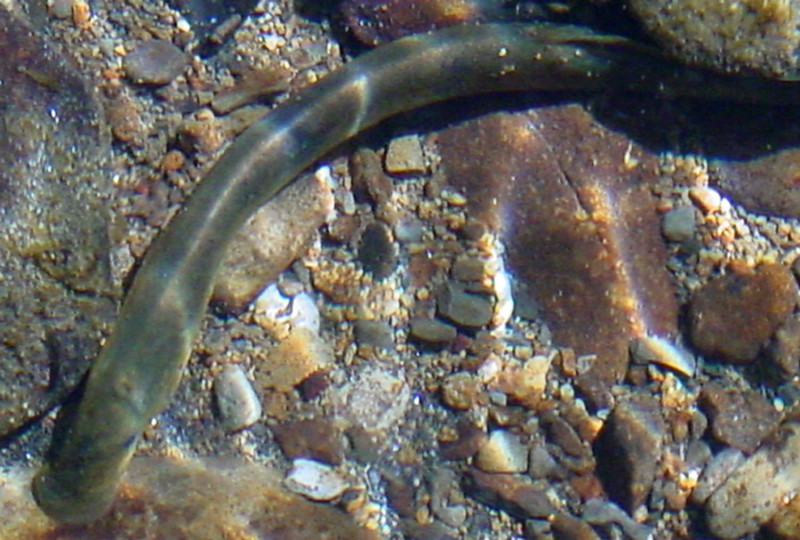
Lamprey pre-date dinosaurs. They’ve survived for 300 to 400 million years. Photo: U.S. Fish & Wildlife Service

The Yakama Nation’s goal “is to bring back the lamprey in abundance, so they’re there in the stream and in sustainable numbers that allows the tribal members to harvest them,” says Ralph Lampman, lamprey research biologist for Yakama Nation Fisheries.

To that end, the tribe has established a lamprey hatchery to study the fish’s life history, genetics, and survival challenges. The Nez Perce Tribe has also established a hatchery in an attempt to return lamprey to the Snake River Basin, which has been almost completely inaccessible to the fish since dam construction.

The Confederated Tribes of the Umatilla Indian Reservation have begun an ambitious program of research, translocation and hatchery propagation of lamprey (along with habitat restoration) on the Umatilla, Walla Walla and Grande Ronde Rivers.

The Confederated Tribes of Warm Springs are also working on lamprey recovery in the Deschutes River and other waterways that originate on their land. In 2016, they completed rehabilitation of the heavily dredged Oxbow area on the Middle Fork of the John Day River.

In the Gorge, the removal in 2010 of the Powerdale Dam in Oregon’s Hood River and the Condit Dam in Washington’s White Salmon River has allowed Pacific lamprey to return to these rivers all on their own.

Acquired taste

Those who study these strange, unattractive fish—often called eels—tend to become admirers.

Margaret Docker, who is one of the world’s leading lamprey experts and a biology professor at the University of Manitoba, began her life’s work in graduate school studying the Great Lakes’ invasive Atlantic sea lampreys.

“My research was focused on how to kill them, but within about six months, I had started to develop a grudging respect,” Docker says. “No matter what we tried to do to control them they were one step ahead of us. Within a number of years I was an apologist.”

She is fascinated by the lamprey’s sexual differentiation and behavior, especially because relatively little of their lives is actually lived as one sex or the other.

Lampreys’ very survival suggests that they’re more malleable, perhaps even wilier, than we give them credit for.

“The key to them having survived for 300 to 400 million years [is] that instead of becoming specialists, they’re generalists: freshwater resident/anadromous; parasitic/not parasitic; this stream/that stream,” Docker says. “Lamprey have only rudimentary vertebrae, but in terms of brain development and a lot of other things they have characteristic hallmarks of vertebrate evolution, a development of brain and sense organs that you don’t see in invertebrates.”

Lampreys’ intriguing evolutionary pedigree has inspired other scientists to use them as lab animals to examine their development and compare it with “higher” vertebrates. Neuroscientists are studying how lampreys use the neurotransmitter serotonin, as well as other brain chemicals they share in common with humans.

This is currently a bit difficult, given that lamprey spend three to seven years as larvae and their life cycles are far more complex than those of experimental subjects such as mice.

To many people, the thought of eating a lamprey is, well, icky. But these fish have been prized around the world for millennia.

Native Americans view the lamprey as a First Food, a creature that gave up its life to humans in exchange for human environmental stewardship.

Northwest tribes cook lamprey on a stick over a fire, smoke them and use the oil for medicines, including dried lamprey tail as a pain reliever for teething babies, Lampman says.

Lampman developed his taste for lamprey in Japan, where they’re eaten as sashimi and in stir fries.

“They can be chewy,” he says, but slow cooking takes care of that. “In the Northwest, lamprey are often grilled and eaten on a hot dog bun.”

In Europe, the lamprey has remained popular, especially in Portugal, where one sea lamprey can fetch upward of $60. Medieval England even incorporated lamprey into royal politics, resulting in the City of Gloucester owing the sovereign a lamprey pie every year, and at least one British family coat of arms stylized lampreys.

Wayback machine

Because lampreys are primitive cousins of creatures like our own deep ancestors, evolutionary biologists and molecular geneticists are very interested in them.

These fish have survived at least two major mass extinctions and dozens of minor ones without significant alterations in their anatomy or lifestyle.

Classified as vertebrates, lamprey departed ways with our own lineage when other fish started developing jaws, bones and fins.

Molecular clock analysis suggests this happened “on the order of 500 million years ago—but it may go much deeper,” says Michael Coates, a research associate in geology at the Field Museum of Natural History in Chicago.

Coates, who is hunting for the common ancestor of lampreys and other bony fish, was on a 2006 research team that discovered a lovely impression of a lamprey about 1.6 inches long in 360-million-year-old South African rocks.

“What amazed me was to find a lamprey that was so close to modern lampreys anatomically,” Coates says.

R-E-S-P-E-C-T

The lampreys’ most important feature is their role in ecosystems, a crucial role that has been ignored for far too long.

Lamprey enhance the surroundings at both ends of their life cycle— cleaning up stream bed sediment, recycling nutrients, serving as food for other fish as larvae and adults and transporting minerals from the sea up into the tributary systems of the Columbia drainage when they die.

They also form a protective buffer for salmon because they’re easier for predators to catch. So no matter how gross they might seem, there are many reasons to honor the lamprey and encourage their recovery.

“It’s so reassuring to see such interest in lampreys these days,” says Docker. “For the last 20 years of my career I had people telling me, ‘Margaret, you can’t make a career out of lampreys.’ They’ve finally come into their own.”
By |2023-01-29T14:53:31-08:0007/14/2022|Wildlife|0 Comments

El legado de salud del aluminio continúa flotando sobre Gorge

La fundición de aluminio de Dalles cerró en 1987, pero los sitios de reciclaje y vertedero de aluminio siguen siendo una preocupación para los trabajadores y la comunidad.

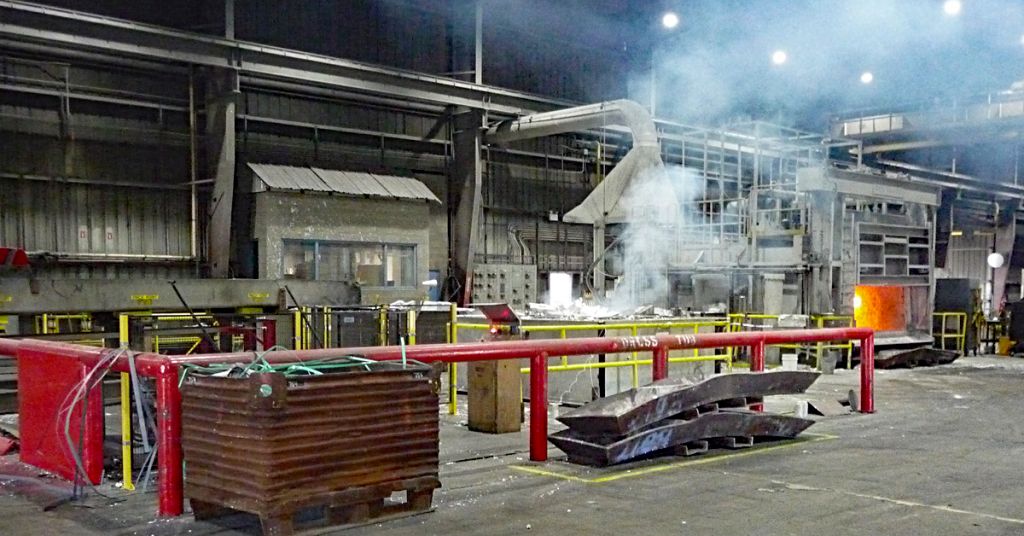
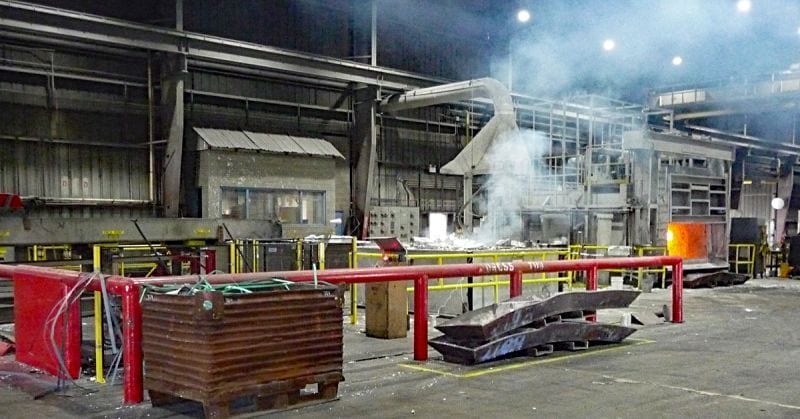
EPA inspection photo, Hydro Extrusions induction furnace 1 visible emissions, smoke fumes open furnace

Una inspección de la EPA de Oregon en 2019 de la instalación de Hydro Extrusión en The Dalles, Oregon, resultó en una multa de $1.3 millones por violaciones de la Ley de Aire Limpio. Foto de EPA de Oregon

Por Valerie Brown. 8 de marzo de 2021. Desde principios del siglo XX, The Dalles ha sido una ciudad industrial, musculosa, llena de promesas de crecimiento basado en la espectacular cantidad de energía disponible de su propia presa hidroeléctrica local. La Segunda Guerra Mundial trajo la industria del aluminio al noroeste del Pacífico, y la fundición Harvey Aluminium (adquirida por Martin-Marietta Aluminium Co. en 1970) se convirtió en un importante empleador en The Dalles. Terminado en 1958, mantuvo hasta 500 trabajadores en trabajos estables y bien remunerados.

Pero pronto, la otra industria importante de The Dalles, los huertos, sufrió fallas catastróficas en las cosechas porque la fundición emitía tanto flúor que las flores no podían dar frutos. A principios de la década de 1950 había alrededor de 500 acres de huertos de duraznos en el área. Ninguno queda hoy.

El problema era tan grave que, a partir de 1961, los horticultores demandaron a Harvey Aluminium (y luego a Martin-Marietta) al menos 14 veces. Los demandantes no buscaban dinero, querían recuperar su aire puro.

Eventualmente recuperaron algo. Pero The Dalles todavía estaba expuesta a enormes cantidades de contaminación de la fundición de aluminio, tanto que la fundición se convirtió en un sitio Superfund cuando cerró en 1987. Sigue sujeta a monitoreo y supervisión en el futuro previsible para garantizar que el cianuro, el fluoruro, el policíclico Los hidrocarburos aromáticos y los sulfatos no se mueven hacia las aguas superficiales, subterráneas y suelos.

Muchos residentes de The Dalles asumen que la calidad del aire en estos días se ve afectada principalmente por la planta de amarres de ferrocarril de AmeriTies, que envía el olor de naftalina al aire debido al uso de hidrocarburos aromáticos policíclicos, como la naftaleno.

Pero todavía hay una empresa de aluminio en The Dalles. Hydro Extrusión, recicla aluminio y emplea a unas 70 personas. La planta es una subsidiaria de Norsk Hydro, una multinacional con sede en Noruega.

En enero de 2020, el Departamento de Calidad Ambiental de Oregón dió a Hydro Extrusión una multa de $1.3 millones, la multa más grande en la historia de la agencia, por violaciones múltiples y flagrantes de la calidad del aire, que duró más de un año. Tras el anuncio de la multa, una investigación de Columbia Insight de abril de 2020 exploró los problemas de salud de la comunidad y los trabajadores asociados con la exposición a los productos químicos, incluido el aluminio, que se utiliza en el reciclaje.


Peligros de la chatarra de aluminio contaminada

Todo el mundo está expuesto al aluminio: es el tercer elemento más abundante en la corteza terrestre. Después del acero, se ha convertido en el segundo metal más importante en la fabricación moderna. Hay muchas fuentes de exposición al aluminio, como el agua potable, los antitranspirantes, el té, el humo del tabaco y los cosméticos.

Para la mayoría de las personas, el aluminio aparece y desaparece con bastante rapidez, pero una parte se acumula en los huesos y el cerebro.

Con el tiempo, es probable que las personas que trabajan en el procesamiento de aluminio y los residentes de los vecindarios cercanos a los sitios de procesamiento estén más expuestos que el público en general a cantidades mayores de aluminio y otros productos químicos utilizados en la industria.

El reciclaje se considera “verde” en comparación con la fundición primaria de mineral de bauxita y alúmina, que exige sólo el 5 por ciento de la energía requerida para el procesamiento original. Hydro Extrusión utiliza chatarra de aluminio industrial como la que produce la fábrica de automóviles Tesla en California. La chatarra se tritura, se funde y luego se moldea en nuevos lingotes que cumplen con las especificaciones del cliente.

Hydro incurrió en la multa de Oregon DEQ porque estaba usando chatarra contaminada con “orgánicos”, un término para varios compuestos de carbono como plásticos, papel, caucho, grasa, rotulador y pintura. Cuando se queman, los orgánicos producen dioxinas, furanos, compuestos orgánicos volátiles y compuestos de flúor y cloro altamente tóxicos.

El permiso de Hydro no permite el uso de chatarra contaminada. DEQ no ha indicado si las operaciones normales de Hydro violaron la Ley de Aire Limpio (CAA). Pero incluso en operaciones normales, el reciclaje de aluminio emite sustancias reguladas por la CAA, muchas de las cuales pueden dañar la salud humana.

La CAA abarca unas 187 sustancias químicas que no pueden emitirse por encima de los niveles que, según afirma la EPA, protegen la salud humana. Irónicamente, el aluminio en sí no está en esa lista, aunque puede ser extremadamente tóxico para los seres humanos, los animales y las plantas.

Exposición a gases

El reciclaje de aluminio produce menos formas de contaminación, y algo diferentes, que la fundición de su mineral. Determinar qué emite Hydro no es un proceso sencillo. La multa del DEQ se basó en las observaciones de los inspectores de la EPA y el DEQ que presenciaron un humo espeso dentro del edificio durante dos días en abril de 2019. Los inspectores no tenían que saber qué había específicamente en el humo; su misma existencia les decía que la chatarra estaba contaminada y que la planta estaba violando la CAA.

Los inspectores de EPA y DEQ presenciaron condiciones dentro de la planta que eran inaceptables. Por ejemplo, el informe del inspector de la EPA señaló que los cuatro hornos de inducción de la instalación estaban “abiertos al edificio sin conductos de ventilación de gases de escape … todos los gases de escape se ventilan en el edificio”.

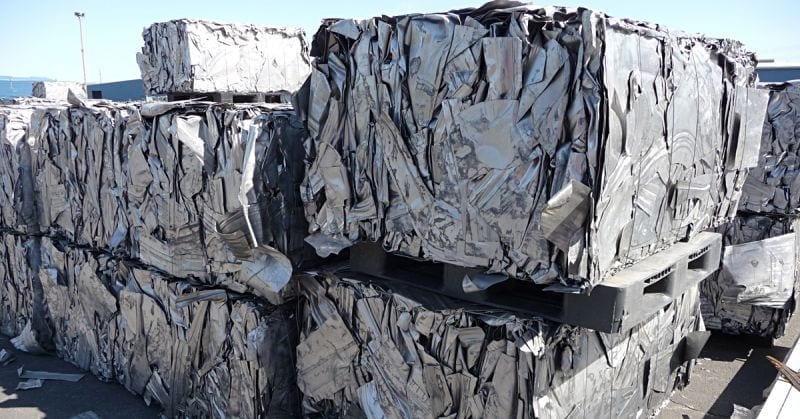
Tesla-Cass aluminum scrap at Hydro Extrusions Dalles EPA Inspection photo

La chatarra de aluminio aguarda su procesamiento. Foto de EPA de Oregon

Esto significa que los trabajadores estuvieron expuestos directamente a estos gases, junto con humos y partículas. El inspector de la EPA habló con un empleado de 32 años que dijo, “la cantidad de humo que estábamos observando era típica”. Posteriormente, el DEQ notificó a la Seguridad y Salud Ocupacional de Oregon los resultados de la inspección.

Desde que Norsk Hydro compró la planta en 2018, se han presentado tres reclamos de compensación para trabajadores en Hydro Extrusions, incluido un reclamo por daño respiratorio.

En febrero de 2019, unas seis semanas antes de que los inspectores de la EPA y el DEQ hicieran su visita al sitio, ocurrió un incidente similar al que los inspectores observaron en abril cuando un humo espeso y vapores llenaron la habitación. Un empleado presentó una queja ante OSHA el 26 de febrero. Un ex empleado de Hydro Extrusions, que habló con Columbia Insight pero se negó a ser identificado por temor a represalias, confirmó este incidente.

Un empleado dejó el trabajo y fue al hospital, donde le diagnosticaron la enfermedad de los humos metálicos, según un reclamo proporcionado por la División de Compensación para Trabajadores de Oregon. Los síntomas de esta enfermedad incluyen náuseas, fiebre, escalofríos, dolores musculares y articulares y dolores de cabeza.

La enfermedad por vapores metálicos suele ser “un trastorno autolimitado, que se resuelve en un par de días y no tiene complicaciones graves ni efectos a largo plazo”, dice Peter Spencer, profesor de neurología y ciencias de la salud ocupacional en la Universidad de Ciencias y Salud de Oregon en Portland.

Oregon OSHA investigó el incidente de febrero de 2019 el 7 de marzo y descubrió que fue una ocurrencia única y que la compañía había ajustado sus prácticas. OSHA no tomó ninguna otra acción.

Las partículas penetran en los pulmones.

La química exacta de las emisiones del horno en el reciclaje de aluminio varía según los requisitos del cliente. La chatarra de aluminio generalmente contiene otros metales como magnesio, manganeso, cobre, litio y zinc. Es posible que sea necesario eliminarlos o cambiar sus proporciones. Esto se logra agregando “fundente”, generalmente fluoruro o cloruro en polvo. El fundente reacciona con ingredientes no deseados y los trabajadores luego lo raspan de la parte superior de la masa fundida con paletas.

Los productos del fundente se convierten en escoria, el principal producto de desecho del reciclaje de aluminio. La escoria comprende principalmente cloruros de aluminio, sodio y potasio junto con varios compuestos de nitrógeno, azufre, fósforo y carbono.

A veces, los vapores tóxicos escapan de la masa fundida si las piezas sólidas de aluminio no se sumergen lo suficientemente rápido o si se agrega demasiado fundente. El inspector de la EPA grabó un video de dichos humos el día de la inspección. Los humos como los producidos durante el reciclaje de aluminio son esencialmente partículas ultrafinas de metales mezcladas con vapores volátiles.

Video de inspección de Oregon EPA 2019 de la instalación de Hydro Extrusión en The Dalles.

Las partículas están reguladas por la Ley de Aire Limpio según su tamaño, y el tamaño es muy importante. Para fines reglamentarios, las partículas se dividen en dos categorías: 10 micrones de diámetro y 2,5 micrones de diámetro. Se sabe que todos los tamaños causan lesiones pulmonares graves, pero esos 2,5 micrones o menos pueden llegar mucho más profundamente a los pulmones.

Las nanopartículas más pequeñas, como las que se encuentran en los vapores (un tamaño de millonésimas de micras, en el rango de los virus) pueden penetrar aún más profundamente. También pueden cruzar las barreras hematoencefálica y placentaria e incluso viajar por el nervio olfatorio en la nariz hasta el cerebro. La CAA no regula los metales directamente, pero considera que las partículas son un indicador del contenido de metal.

El inspector de la EPA en 2019 estaba más preocupado por las partículas de 250 micrones y más grandes. La ley anti-molestias de Oregon prohíbe a cualquier parte permitir la deposición visible en la propiedad de otros de partículas más grandes que esto. El inspector descubrió que estas partículas no viajaban más allá de los límites de la planta, pero también informó que se liberaron grandes cantidades de polvo fugitivo en los terrenos de la planta mientras la escoria se amontonaba en los camiones para su eliminación, y la empresa no estaba haciendo nada para evitar el polvo. volviéndose aerotransportado.

Para los trabajadores, si no para la comunidad, esto es preocupante. Sadie Costello, epidemióloga ocupacional y ambiental de la Universidad de California en Berkeley, ha encontrado una mayor incidencia de cardiopatía isquémica (causada por arterias estrechas) en trabajadores expuestos a partículas de 2,5 micrones y más pequeñas en fundiciones de aluminio e instalaciones de fabricación.

Vínculos con enfermedades neurológicas

Existen otros riesgos para la salud a más largo plazo asociados con el reciclaje de aluminio, incluidos numerosos problemas respiratorios, trastornos neurológicos, daño óseo, cánceres y enfermedades renales. Además de los diversos productos químicos utilizados en el procesamiento, el aluminio en sí está asociado con efectos graves para la salud, el más polémico de los cuales es la enfermedad de Alzheimer.

El aluminio es el material más abundante en el aire en las plantas de reciclaje de aluminio. Los científicos aún no se ponen de acuerdo sobre si el aluminio debe considerarse una causa directa de la enfermedad de Alzheimer, pero muchos estudios han asociado la exposición al aluminio con problemas neurológicos.

Los científicos han sabido durante décadas que el aluminio es tanto inflamatorio como neurotoxina.

Un claro ejemplo proviene de las personas con enfermedad renal que necesitan diálisis con frecuencia. En la década de 1980 se observó que los fluidos utilizados para la diálisis concentran inadvertidamente el aluminio que se encuentra de forma natural en el agua. Algunos pacientes que recibieron dosis altas desarrollaron “demencia por diálisis”. Una vez que se reconoció esta conexión, se redujo el contenido de aluminio de los fluidos y el problema desapareció en gran medida.

Numerosos estudios han encontrado deterioro cognitivo entre los trabajadores expuestos al aluminio, incluso por trabajos de soldadura y fundición. Un gran estudio chino de trabajadores de fundiciones en 2019 encontró que los niveles de aluminio en sangre se correlacionan fuertemente con los grados de deterioro cognitivo, aunque el nivel de educación se identificó como un factor moderador. Aproximadamente dos tercios de los sujetos tenían bajos niveles de educación.

También hay alguna evidencia de que el aluminio puede tener efectos transgeneracionales si está en forma de nanopartículas. Un estudio de 2018 de ratones encontró que las crías de madres expuestas durante el embarazo a una solución salina infundida con nanopartículas de aluminio sufrían retraso en el desarrollo, ansiedad y déficits de aprendizaje y memoria. Las crías de ratón también tenían niveles significativamente más altos de aluminio en el área del hipocampo del cerebro. El aluminio había atravesado la barrera placentaria.

Aunque la investigación no es concluyente, el aluminio también se ha sugerido como un factor en el trastorno del espectro autista, la enfermedad de Parkinson, la esclerosis múltiple y la esclerosis lateral amiotrófica.

Spencer de OHSU sigue siendo escéptico sobre estas conexiones.

“En la década de los 90, hemos visto varios estudios que sugieren que podría haber alguna asociación entre la ingesta de aluminio y los cambios neuropsicológicos”, dice. “Yo diría que el jurado aún está deliberando sobre esto. … Se reconoce entre los trabajadores que la exposición al aluminio tiene el potencial de acumularse con el    tiempo ”.

Esa acumulación podría hacer que el cerebro sea más vulnerable a la enfermedad de Alzheimer incluso si el aluminio no es una causa directa, dice Stephen Bondy, profesor de medicina y farmacología en la Universidad de California en Irvine. La inflamación del cerebro aumenta de forma natural con la edad y las exposiciones al aluminio en etapas tempranas de la vida pueden acelerar el problema.

“Si acelera el envejecimiento en el cerebro con una inflamación temprana, está acelerando el riesgo de Alzheimer”, dice Bondy.

Se sabe poco sobre la cantidad de contaminantes que realmente ingresan a los cuerpos de los trabajadores del reciclaje de aluminio. Un estudio británico encontró que los trabajadores en el procesamiento secundario de aluminio tenían exposiciones personales de polvo inhalable de 700-5,600 microgramos por metro cúbico, aproximadamente el 13 por ciento del cual era aluminio. También hubo proporciones significativas de sales de flúor y cantidades más pequeñas de sales de cloro. Las actividades que exponen a los trabajadores a las cantidades más altas fueron agregar chatarra a un horno y quitar la escoria de la parte superior de la masa fundida.

Existe poca información sobre las cantidades y los tipos de exposición a los contaminantes de Hydro que experimentan los residentes locales o si están sufriendo problemas de salud asociados con los materiales de reciclaje de aluminio. El tamaño relativamente pequeño de la población de The Dalles dificultaría la obtención de datos estadísticamente significativos para vecindarios específicos. La mayoría de los datos epidemiológicos disponibles de la Autoridad de Salud de Oregón no incluyen datos a nivel de ciudad.

Una correlación interesante, que no necesariamente demuestra causa y efecto, es que el tramo censal con la esperanza de vida más baja (73,9 años) en el condado de Wasco (The Dalles es la sede del condado) es el tramo donde se encuentra Hydro. El tramo con la esperanza de vida más alta (83,2) se encuentra en la parte sur menos poblada del condado.

Según el perfil de justicia ambiental de la EPA, los residentes de The Dalles se encuentran en el 2 por ciento superior de las ciudades del estado en su proximidad a un sitio Superfund, pero por debajo del promedio de Oregon para las partículas de ozono y diésel. Esta falta de datos dificulta la determinación de los efectos de las emisiones en toda la comunidad.

“La deriva potencial del proceso industrial es una de las muchas preocupaciones de las comunidades cercanas a los sitios industriales”, dice Costello. “Espero que la exposición de la comunidad a partículas de procesamiento de aluminio sea órdenes de magnitud más bajas que las exposiciones de los trabajadores. Por lo tanto, para los adultos sanos, puede que no sea demasiado preocupante, pero cuando se consideran los bebés, los niños y las personas enfermas, las dosis bajas las 24 horas del día, los 7 días de la semana pueden ser más preocupantes “.

Se necesitan más estudios

Una forma de responder preguntas sobre el impacto de Hydro en la calidad del aire de The Dalles y los efectos que sus emisiones pueden tener en la salud pública sería probar los niveles ambientales de contaminantes dentro y fuera de la fábrica y determinar la carga corporal de estos contaminantes en tanto trabajadores como miembros de la comunidad.

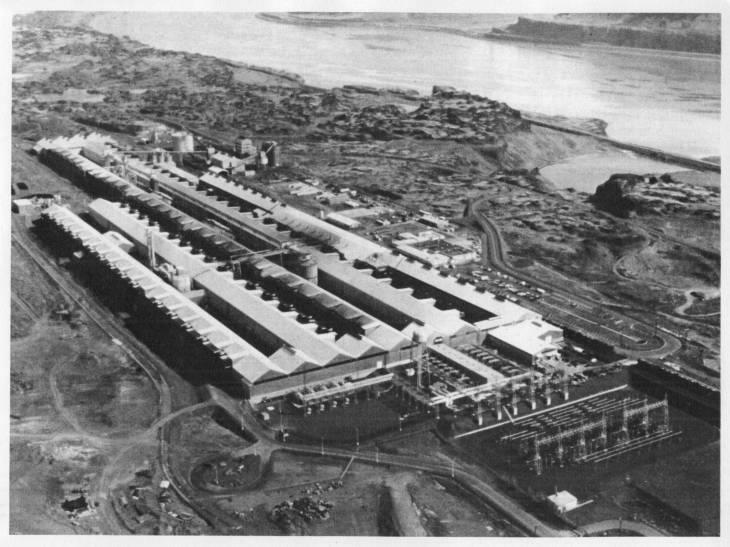
Las operaciones de fundición se llevaron a cabo en la planta de aluminio Martin-Marietta de 305 acres en The Dalles entre 1958 y 1987. Ahora es un sitio del programa “Superfund”. Cortesía de Washington Rural Heritage

“La forma de llegar a esto es usar el principio de precaución”, dice Spencer, “que es monitorear a los trabajadores expuestos a humos de aluminio u otras fuentes para asegurarse de que sus niveles en orina o potencialmente sus niveles en plasma [sangre] no excedan lo que nosotros consideramos aceptable “.

Costello cree que medir los niveles de aire es la forma más directa de evaluar y mejorar las condiciones de los trabajadores.

“Animaría a las fábricas a realizar un buen muestreo de aire en la fábrica, actualizar su equipo a los más altos estándares y proporcionar equipo de protección personal y capacitación para todos sus trabajadores”, dice ella.

Un ex empleado de Hydro señaló que cuando Norsk Hydro compró la antigua Northwest Aluminium Specialties y la renombró, la nueva administración proporcionó equipo de protección personal para reemplazar las “camisas de manga larga” que antes eran la única protección de los empleados.

No está claro si Hydro ha modernizado su sistema de ventilación para dirigir el gas y los humos lejos de los trabajadores.

Después de los dos incidentes severos de humo en 2019, la gerencia de Hydro presentó más materiales de capacitación. Pero estos incidentes fueron tratados como inusuales y no indicativos de exposiciones continuas de los trabajadores o la comunidad. No se sabe si Hydro no ha realizado ningún seguimiento biológico de los trabajadores ni ha medido los niveles de contaminación ambiental dentro de la planta. La compañía se negó a proporcionar información o dar su consentimiento para una entrevista con Columbia Insight para esta historia.

Además de la falta de datos sobre miles de sitios similares en todo el país, existen numerosos problemas con la regulación de productos químicos peligrosos. Las regulaciones de salud ocupacional a menudo se orientan hacia los accidentes en lugar de las exposiciones crónicas; los niveles de exposición aceptables se calculan por separado para cada sustancia química y no tienen en cuenta los efectos de las combinaciones de sustancias químicas; y pasan por alto la diversidad de las consecuencias de la exposición a sustancias químicas en función de la edad, el sexo y otros rasgos de las personas; por ejemplo, las exposiciones prenatales pueden desencadenar enfermedades de aparición en la edad adulta muchas décadas después.

Es posible que los trabajadores y los residentes deseen considerar formas de obtener más información sobre qué sustancias químicas peligrosas está emitiendo Hydro en qué cantidades y si están transportando cargas corporales de esas sustancias a niveles que podrían afectar su salud. Una forma de hacerlo sería crear un proyecto financiado colectivamente y asociarse con investigadores relevantes. El sitio web www.scistarter.org ayuda a los ciudadanos a diseñar estudios científicamente válidos sobre problemas comunitarios.

Una cosa es cierta: no importa lo que puedan revelar tales esfuerzos, la necesidad de trabajos y la orgullosa historia de The Dalles moderarán las opciones de la comunidad.

Valerie Brown ha cubierto la salud ambiental durante más de dos décadas, publicando en Environmental Health Perspectives, Scientific American y en otros lugares.

La serie de Columbia Insight que se centra en la industria del aluminio en Columbia River Gorge cuenta con el apoyo de una beca de la Sociedad de Periodistas Ambientales.

Major grant adds new voices to Gorge activism

Comunidades founder Ubaldo Hernandez grew up in Mexico City. In the early 2000s he helped found Radio Tierra in Hood River, Oregon. Columbia Riverkeeper photo

With a new grant, Comunidades will engage communities of color in environmental issues affecting the Columbia River Gorge

Valerie Brown, May 14, 2020. The Gorge environmental community is expanding courtesy of a significant grant to a relatively new organization: Comunidades.

The three-year, $225,000 grant from the Group Health Foundation will enable the group to hire its first paid staff, reach out to the area’s Latinos on both sides of the Columbia River, raise environmental health awareness and press for social and political change.

Founded in 2018 by Columbia Riverkeeper senior organizer Ubaldo Hernandez, Comunidades comprises a small core of people hailing from White Salmon, Hood River, The Dalles and Parkdale. The group does not yet have an office or website.

The first order of business, says Hernandez, is educating the community to understand the variety of environmental problems it faces.

“The Latinos don’t know how they’re being affected by numerous issues,” says Hernandez.

For example, Comunidades will add its voice to the call from the Yakama Nation and environmental activist groups to clean up Bradford Island, where numerous people of color want to fish but are unable to because the fish have the highest levels of polychlorinated biphenyl compounds—known carcinogens—in the Pacific Northwest.

The island has been an indigenous fishing site for millennia but was used as a dump by the Army Corps of Engineers as it constructed the Bonneville Dam. Sediments on the island also contain lead, mercury and hydrocarbons.

Environmentalists, tribes and the states of Oregon and Washington want the EPA to designate the island a Superfund site.

Many Latinos, Hernandez says, may not understand the term “Superfund” even as they’re directly affected by pollution from such sites, of which there are many in the mid-Columbia region. The Dalles has two: the property now occupied by the railroad tie manufacturer Amerities, and the property now occupied by Google and an aluminum recycling plant.

READ MORE ON CI: Pollution From Aluminum Still an Issue in The Dalles

Hernandez intends Comunidades to engage with the community regarding air pollution from the Amerities plant, which has become a sore point in the city.

When he attended a forum sponsored by The Dalles Air Coalition about the problem, he was the only Latino there. As a next step he’s suggested the Oregon Department of Environmental Quality hold a Spanish-language forum to encourage Latino participation.

“Right now it’s on hold [because Covid-19] but we want to see if we can do a Zoom meeting,” he says.

Taking on pesticides

Another issue of concern for Comunidades is widespread pesticide exposures among agricultural workers.

Joel Iboa, chairperson of Oregon’s Environmental Justice Task Force, points out that much migrant housing is located close to agricultural fields; most food preparation is done outside; and children mostly play outside.

“The spraying of harmful chemicals near housing [makes it] pretty difficult for people to be out of harm’s way,” he says.

Iboa is looking forward to the “added capacity” Comunidades will bring to the Gorge region on these and other aspects of environmental justice in Oregon.

One way for grassroots groups to have real influence, Iboa says, is to organize members to testify before legislators on issues of concern.

In the last legislative session, organizations including Pineros y Campesinos and Beyond Toxics brought farm workers to testify in favor of a bill to prohibit aerial spraying of the highly toxic pesticide chlorpyrifos. Their testimony was effective, and the bill was close to passage in the Oregon Senate—until Republicans protested a climate change bill by walking out of the chamber and preventing a vote.

The bill’s supporters plan to re-introduce the bill.

The agricultural industry is highly dependent on Latino workers. A concern is pesticide exposure for farm workers and their families. Jurgen Hess photo

Hernandez envisions Comunidades eventually adding political work to its agenda, but his first priority is to increase membership and begin building coalitions with other groups.

For communities of color, he says, it’s not possible to entirely separate environmental issues from social justice concerns because of the disparities in income, health and other aspects of life compared with majority populations.

Nowhere is this more evident than the coronavirus pandemic. According to The Oregonian, “Latinos account for 31 percent of the nearly 2,100 Oregonians with coronavirus whose ethnicity is known, even though they represent only 13 percent of the state’s total population.”

Not everyone views infectious diseases as an environmental issue, but globally, new pathogens are emerging from the disruption of ecosystems by logging, agriculture and other human intrusions. Pathogens disproportionately harm people already stressed by poor health care, low income and narrow occupational options.

Although the relationship between traditional environmental groups and environmental justice activists isn’t always comfortable, the former could benefit a great deal from bringing Latinos to their causes. A 2015 Pew Research Center analysis found that 70 percent of Latinos believe the earth is warming because of human activity. In 2014, 76 percent of Hispanics—and 84 percent of blacks—agreed that, “This country should do whatever it takes to protect the environment,” compared with 67 percent of whites.

Census figures show Hood River County’s population is about 30 percent Hispanic—a significantly higher proportion than the rest of Oregon.

“There are many Latinos who want to protect clean water, clean air and all of our natural resources, but have not engaged in traditional environmental groups,” Hernandez stated in press release. “Comunidades aims to change that.”

By |2023-05-15T14:05:47-07:0005/14/2020|Natural Resources|0 Comments

Pollution from aluminum still an issue in The Dalles

The Dalles’ long relationship with aluminum continues with the largest air toxics fine in DEQ history

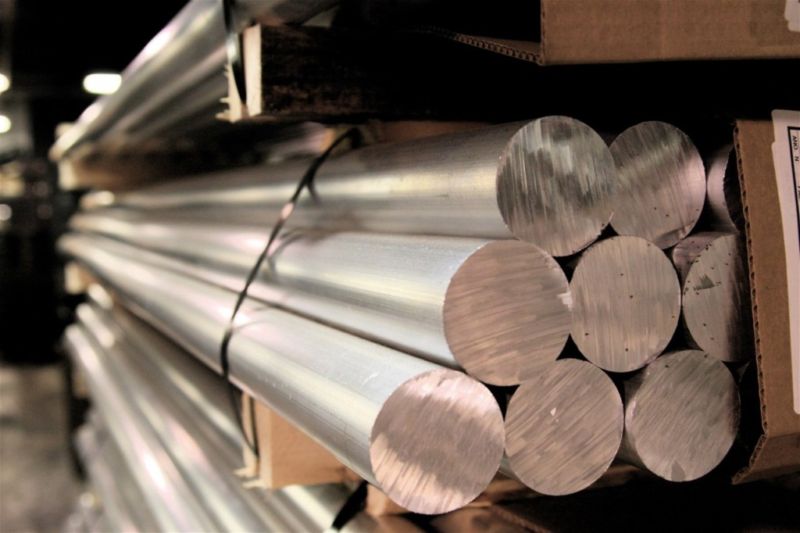
Aluminum logs produced from scrap aluminum at Hydro Extrusions LLC, The Dalles, OR. Photo by George Esteich

By Valerie Brown. April 23, 2020. On April 24, 2019, inspectors from the Oregon Department of Environmental Quality and the U.S. Environmental Protection Agency arrived at Hydro Extrusion USA, LLC (also known as The Dalles Cast) in The Dalles for an unannounced two-day inspection. As a result of their visit, the aluminum recycling company received the largest fine for air pollution in Oregon’s history — nearly $1.3 million.

The fine was triggered by violations of Title V of the federal Clean Air Act, which requires polluters to keep their hazardous emissions below certain levels. The agencies found that contaminated scrap, also called “dirty charge,” was the source of most of the violations. They also found that the company had failed to comply with several record-keeping and safety regulations for more than a year.

Aluminum is the most valuable material in the recycling industry, and it requires only five to eight percent of the energy required to process primary aluminum from bauxite ore or alumina. However, aluminum recycling, and recycling in general, are increasingly plagued by various contaminants that complicate the re-use of the desired materials. Some of the complexity stems from the additional air pollution created when the contaminants pass through the aluminum melting furnaces.

According to Laura Gleim, DEQ’s eastern region public affairs specialist, the agency does not know exactly what toxic pollutants were emitted from the dirty charge. She says that, in order to use dirty charge legally, the company would have to conduct source testing to determine which additional pollutants it would have to acquire permits for, and then install appropriate mechanisms to capture those pollutants.

“Part of why the fine was so high was because…they’re supposed to up front come to us and show us they can meet the applicable emissions for the dirty charge,” says Gleim. Hydro Extrusion did not respond to multiple requests by Columbia Insight for comment.

“A white-gray smoke”

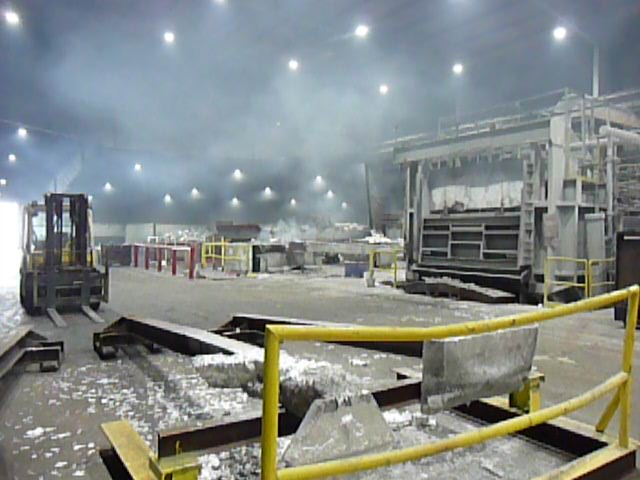
The Hydro Extrusion building is a large open space containing four induction furnaces, two holder furnaces, and four homogenizing furnaces. According to the EPA inspection report, the inspectors witnessed billows of “white-gray smoke” filling the building headspace. When they inspected the bales of scrap aluminum awaiting reprocessing, they found that much of the metal “had a gray-black residue coating” which, when rubbed with a finger, produced a “gritty, greasy texture.”

White gray smoke fills the Hydro Extrusion building head space. Photo courtesy of Oregon DEQ

Although the inspectors did not identify the contamination, it is likely to have been materials like paint, lubrication, marker pen, or plastic, which are often hydrocarbon-based materials frequently mixed with scrap aluminum and, in principle, removed before the scrap is melted. Burning these materials can produce highly toxic compounds, which is why most furnaces have venting hoods above them. But the inspectors noted that the hoods in the Hydro Extrusion facility were ineffective, as they were not directly connected to the ductwork carrying emissions through the roof vents to the outside.

Variable chemistry          

Even without dirty charge, aluminum recycling requires the use of hazardous materials. Normal operations entail adding various chemicals to alter the chemistry to the desired state and remove unwanted elements such as magnesium and hydrogen. The scrap is processed in batches tailored to the needs of the customer, so there is variation in the recipes.

Most additions are termed “flux.” A common flux powder is a mix of chloride and fluoride salts that prevents the aluminum from reacting chemically with nonmetals and captures unwanted elements.  But these salts may react with the aluminum to form aluminum chloride and aluminum fluoride — both powerful respiratory irritants — which are supposed to be removed by the exhaust system.

And these are just two of the 188 toxic air pollutants the EPA regulates under the Clean Air Act. For secondary aluminum plants, other emissions of concern also include dioxins, furans, various organic (carbon-based) compounds, and particulates. The health effects of exposures to these substances, the EPA says, “can include cancer, respiratory irritation, and damage to the nervous system.”

Decades in The Dalles

Aluminum processing in The Dalles has a long history. A full ore/alumina smelter was built in the 1950s by Harvey Aluminum, a California company, and for a while the smelter was the largest employer in the city.

Martin Marietta bought Harvey in 1970, but as environmental costs mounted up, The Dalles plant — then much bigger than the current recycling facility — became a Superfund site. It was removed from the National Priorities List in 1996, but is still monitored because its soils contained  cyanide, fluoride, asbestos, polycyclic aromatic hydrocarbons and arsenic, and groundwater on the site contained cyanide and fluoride. Responsibility for the Superfund pollution remains with the current owner, Lockheed Martin, which merged with Martin Marietta in 1995.

Martin Marietta Aluminum Plant, The Dalles. Photo courtesy of Washington Rural Heritage

The financial and energy crises of the late 1970s, mid-1980s and early 2000s collapsed the primary aluminum market in the Columbia Basin, which at its peak had ten operating smelters. After that, a handful of locals, including employees, bought and ran some of the smelters, but they found it difficult to turn a profit. The Dalles’ long relationship with aluminum continues with the largest air toxics fine in DEQ history.

In 2015, the remaining active plant in The Dalles, Northwest Aluminum Specialties Inc., became the ninth North American location of a Norwegian company, Sapa Extrusions. And in 2017, Sapa was bought by Hydro Extrusions, LLC, another Norwegian multinational operating in 40 countries with 35,000 employees.

The bright side?

According to the DEQ, the company knew it was violating the law. But in the time since the fines were levied, it has begun to correct some of these problems.

One former Hydro employee noted that before the Norwegian companies took over, the chief safety gear available to workers while running the furnaces, adding flux, and pouring molten aluminum into molds was long-sleeved shirts. (The employee declined to be identified publicly out of concern over reprisals.) After the Norwegian companies assumed ownership, he said, the employees were issued fire-resistant safety suits and procedures were put in writing. And, according to Gleim, the company has engaged a consultant and is “working to improve environmental compliance and environmental management procedures.”

Why it matters

The recycling plant in The Dalles is much smaller than any of the ten primary aluminum smelters that used to dot the Columbia Basin. The environmental and occupational problems associated with aluminum recycling are less egregious than those produced by smelters, and the plant’s 70 employees are far fewer than the hundreds the smelter employed at its peak. The energy demands of recycling are also minuscule compared to primary smelting, and thus recycling emits far fewer greenhouse gases.

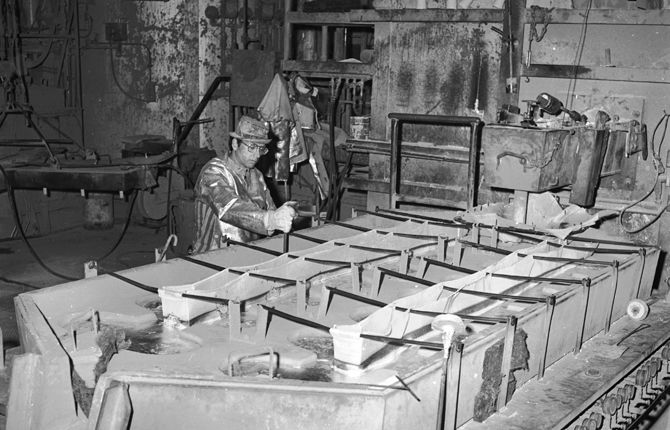
From the Dalles Chronicle archives, workers at the Western Aluminum Producers Plant manufacture aluminum ingots in 1979.

Still, its emissions add to the pollutants in The Dalles, whose downtown is sandwiched between two highly contaminated industrial sites. As we reported in 2017, the Amerities railroad tie plant in The Dalles has come under fire for its emissions of naphthalene and other pollutants. (That site sits on the Union Pacific Superfund site about three and a half miles east of Hydro.)

Air toxics became a political hot potato in 2016, when Portland residents learned that Bullseye Glass was emitting significant pollutants in a residential neighborhood. In response, the state created the Cleaner Air Oregon initiative, which included a three-year air toxics monitoring project at five locations, including the Wasco County Library in The Dalles. Earlier this year, the DEQ released the results for 2018, and The Dalles’ levels of naphthalene, acetaldehyde, and formaldehyde — all carcinogens — were significantly higher than any other site. The report stated that these compounds and three others “are present at levels of concern in both urban and rural areas.”

Does Hydro bear any responsibility for those pollutant levels? It’s complicated. The site’s 2016 DEQ permit lists naphthalene and formaldehyde as “potential” emissions, but naphthalene can also be emitted by both aluminum recycling and railroad tie factories, and wildfires can produce significant levels of all three PAHs. And as Gleim explains: “It’s difficult to pinpoint exact sources from this kind of monitoring data.” 

Stay tuned

For many Gorge residents, the recent DEQ and EPA action, while dramatic, may be less than satisfactory.

Rachel Najjar, a former resident of The Dalles and a co-founder of The Dalles Air Coalition, was “shocked” by the size of the DEQ fine, but believes regulatory enforcement is inconsistent and patchy. “It feels like they pick and choose polluters that they want to fine, instead of having clear, health-based regulations for all polluters,” Najjar said in an email.

“Industry needs to be paying the price with money, instead of the community paying for it with their lives and health,” she continued.

But Hydro may never have to pay the full amount of the DEQ fine. The company is appealing the DEQ’s order and fine, and is negotiating a settlement with the state.

By |2021-03-16T13:10:29-07:0004/23/2020|Aluminum, Energy, Waste Management|5 Comments

Oregon’s agricultural lands face off with the state’s growing urban population

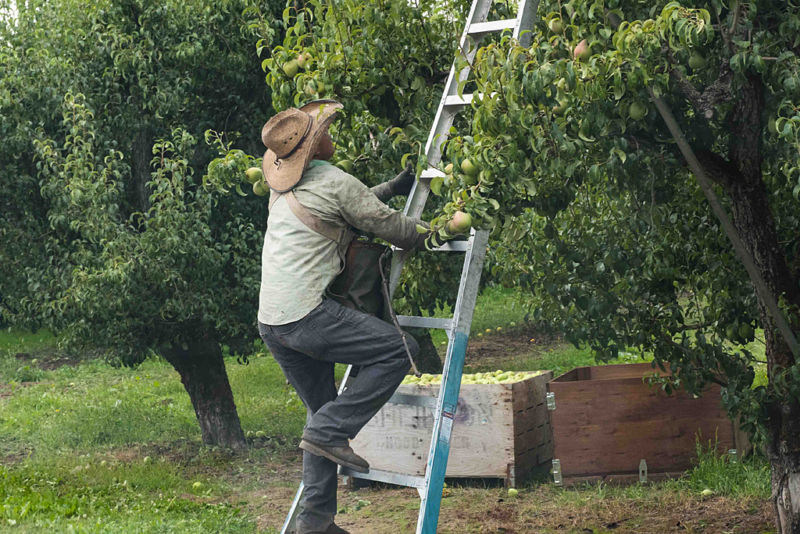
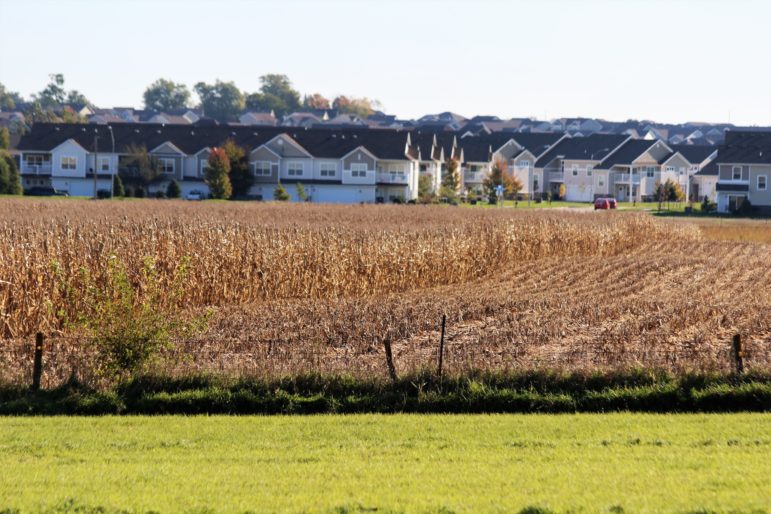
Photo by Jeff Sigmund, IowaWatch

By Valerie Brown. March 12, 2020. Contrasts between urban and rural life have been around since Aesop’s fable of the country mouse and the city mouse. But in the rapidly-changing state of Oregon, these contrasts are turning into conflict as urban areas expand and agricultural areas find themselves colonized by both low-density housing big houses on big lots, sometimes called “trophy houses” — and higher-density subdivisions.

Fourth-generation pear grower Erick von Lubken has grown accustomed to this urban-rural friction on his family’s orchard south of Hood River. In 1988, a neighboring property owner sold its land to a developer for a golf course. Von Lubken’s family objected all the way through a Land Use Board of Appeals proceeding. (Although they failed to block the golf course, their case did establish a subsequent precedent for keeping golf courses off high-value farmland.)

Now, von Lubcken says wryly, “I farm surrounded by a golf course along with two extremely busy roads that run next to a high school.”

Meanwhile, roughly 100 miles south of von Lubken’s orchard, Mickey Killingsworth raises sheep on 20 acres outside of Madras. “My north border is a subdivision,” she says. “I can tell you horror story after horror story.”

Killingsworth’s problems with the subdivision mostly involve problems with dogs — either residents’ dogs go after her lambs or someone complains about her dogs barking randomly, which she says that, as working dogs, they don’t actually do.

It’s this naïveté of urbanites about the realities of agriculture that Killingsworth finds most frustrating. And this is a common point of contention in a state where the line between urban and rural communities is either shrinking, shifting or disappearing altogether.

Many people who move to the urban-rural interface “may want to build a nice house in the orchards because it’s beautiful,” says Mike Omeg, whose family grows Bing cherries south of The Dalles. However, he adds that they typically aren’t prepared for “those agricultural activities like mowing and kicking up dust, or the noise of a harvest crew next door to you at five in the morning picking.”

Urban Density

Like it or not, low-density housing and urban sprawl are a fait accompli, especially in areas surrounding large cities and regions of high recreational value — places like central Oregon, the Gorge and the Wallowas.

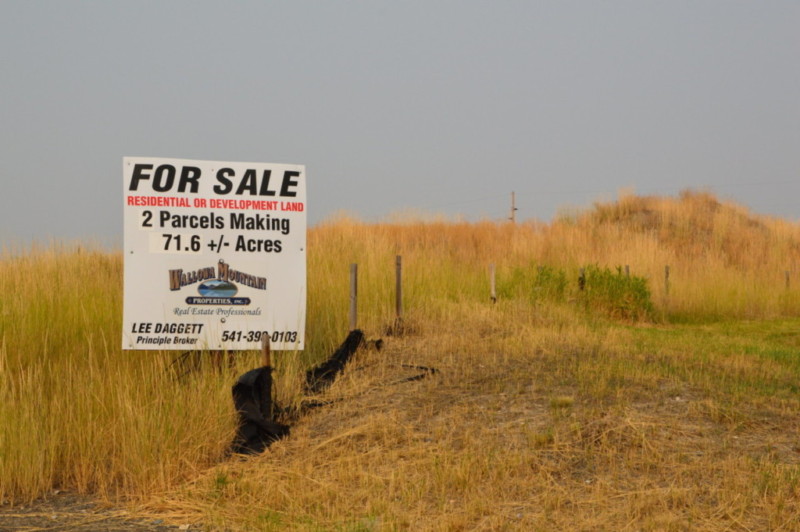
For Sale signs offering subdivided pieces of farmland are becoming increasingly common throughout the state, especially in areas with high recreational value like Wallowa County. Photo courtesy of NRCS Oregon

But Jim Johnson, land use and water planning coordinator for the Oregon Department of Agriculture, says that while things may seem dire in Oregon, “Washington has a much greater problem and Idaho is a joke.”

In this sense, some regulation is better than none, and Oregon has protected farmland since the 1962 establishment of the “essential farm use” policy. That policy has been eroded by exceptions, which grew from the original five to about 60 now. (Examples include exceptions made for quarries, wineries, private airports and campgrounds.)

Further regulation arrived in the 1970s with the establishment of the Land Conservation Development Commission and the Land Use Board of Appeals. The legislation created the Urban Growth Boundary (UGB) policy, which was designed to prevent urban sprawl. The program has dramatically slowed the loss of farmland, but it has by no means stopped it.

Data shows that Oregon’s population has gone from 2.2 million in 1974 to almost 4 million today (with another 1.2 million expected by around 2050). And in that same period of time, the state has lost half a million acres of prime farmland.

This population growth puts pressure on housing costs. According to the nonprofit 1000 Friends of Oregon, there is a housing shortfall of 155,000 homes in Oregon — and the demand for affordable housing is only expected to increase in the future. Expansion has to go out or up, but until HR2001 became law last year, zoning codes prevented multi-family dwellings in single-family developments. The change should help keep cities inside their UGBs.

Complicating matters further is the fact that land use in Oregon is governed by state laws, but is administered at the city and county levels. And while farmers want their land to be protected, many resent government intrusion. Measure 37, passed by voters in 2004, gave property owners a right to compensation for lost value caused by regulation, but the program was not funded. In 2007 voters approved Measure 49, which stipulated compensation in the form of buildable home sites on land outside UGBs. This triggered a spate of 5000 new home sites, mostly near Portland and Bend.

Squeezed from all sides

While city dwellers wrestle with increased density and skyrocketing home prices, farmers face other pressures. According to Oregon State University, in 1985, it took gross sales of about $80,000 to support a family on a farm. In 2005, it took $250,000.

So in order to stay in business, farmers have needed to acquire ever more land. Many end up with several small parcels rather than one big piece of land. Johnson explains that in the Willamette Valley, some farmers may be working 200 acres chopped into as many as 20 small plots. This is incredibly inefficient.

Satellite imagery shows the Urban Growth Boundary near Beaverton, Oregon.

A second source of anxiety is the graying of the farming population. According to the Center for Small Farms and Community Food Systems at Oregon State University, the average age of farmers in Oregon is 60, and as Baby Boom farmers retire they will be transferring nearly two-thirds of Oregon’s farmland to someone else. Many retiring farmers would like to pass their land on to their children, but this is a fraught process. If the farmer dies without securing the succession, the heirs may end up paying extra estate taxes and may have to sell the farm even if they don’t want to.

To add insult to injury, residential development pushes up the price of land, so that “it’s impossible for a lot of people to buy farmland if they actually are farmers, or to continue to farm if they’re in farm families and one sibling has to buy another one out,” says Parkdale pear grower Mike McCarthy, who also serves as president of the board for 1000 Friends of Oregon.

“Bill Gates will buy [the land] to ride a horse on,” he says.

Is help on the way?

Resources to help farmers with these pressures are increasing. Nellie McAdams, a third–generation hazelnut farmer near Gaston (west of Portland), says, “One of the questions is how to match people without a successor to people who have the skills but not an inheritance.” Oregon FarmLink connects these two groups. McAdams has started a statewide land trust program to develop agricultural easements, similar to conservation easements, that can be incorporated into financing for a farm sale. The Oregon Agricultural Heritage Program awards grants to watershed councils and nonprofits to develop conservation easements that will enhance environmental values such as water quality and wildlife habitat in agricultural lands. The Oregon State University Extension Service’s Ties to the Land program provides information and support for succession planning. In Washington, the PCC Farmland Trust works to preserve agricultural land. One method is to buy at-risk land, establish conservation easements and then sell or lease the land to a farmer.

Agriculture is not just another industry. It is necessary to support life as we know it. And the pressures placed on farmers by urban- and suburbanites will continue for the foreseeable future as the Earth’s human population (and the subsequent demand for both food and housing) grows. In the long run, a lighter environmental footprint on all sides may be the only thing that enables the country mouse and the city mouse to get along.

By |2020-08-06T09:50:14-07:0003/12/2020|Agriculture, News|2 Comments

The Return of Clearwater Coho

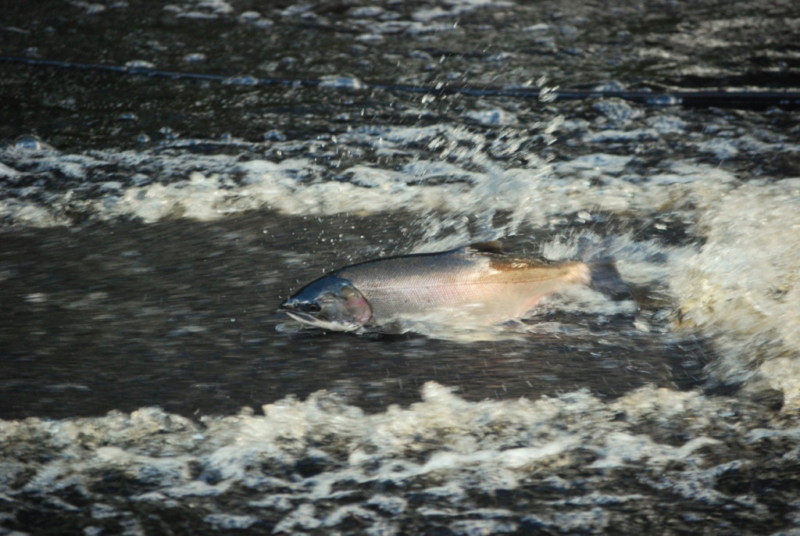
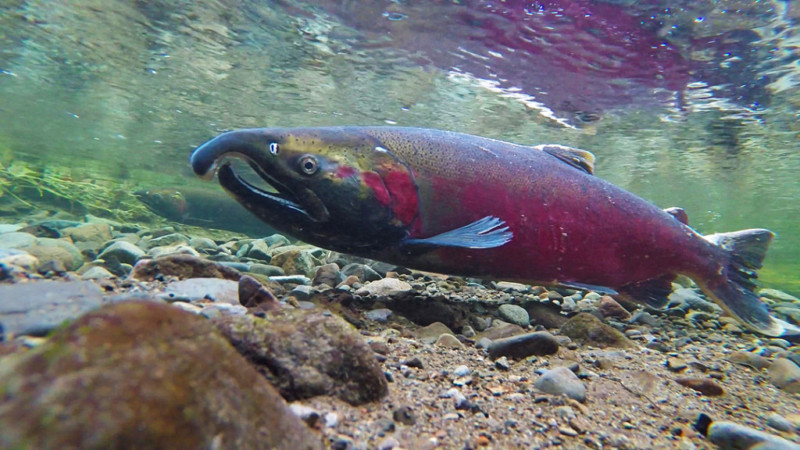
A chrome-bright coho salmon rockets up a shallow stretch of river. Photo by K. King, USFWS

Against the odds, the Nez Perce tribe is coaxing coho to return to their ancestral river.

By Valerie Brown. Feb. 6, 2020. Pacific salmon are under threat throughout their native range. Looking at the Columbia River Basin alone, most stocks are either vastly reduced or past the point of no return. 106 runs of anadromous fish have already gone extinct in the Basin, leaving approximately 40 percent of the region’s rivers devoid of one their greatest resources.

These are desperate times, indeed, and desperate measures have already been taken — perhaps nowhere more notably than on Idaho’s Clearwater River, where the Nez Perce are restoring habitat, developing innovative hatchery methods for coho salmon, and bending a few rules in the process.

Tribal members, scientists, wild fish advocates and river managers in the Pacific Northwest have long wrestled with how to respond to the decline of these complex animals. And it’s been a hot-button issue in the region since before the 1980s, when those same groups finally started admitting that salmon were going to disappear altogether without some major changes in human behavior.

But for the Nez Perce, “letting fish not survive is not an option.” So says Becky Johnson, the tribe’s leading coho expert.

500 miles away from home

Not surprisingly, the Basin’s most severely affected salmon populations are those that have to negotiate upwards of 500 miles of river and traverse eight dams to reach their spawning grounds. This includes all of the salmon populations native to the lower Snake River, the Salmon River, and the Clearwater River in Idaho.

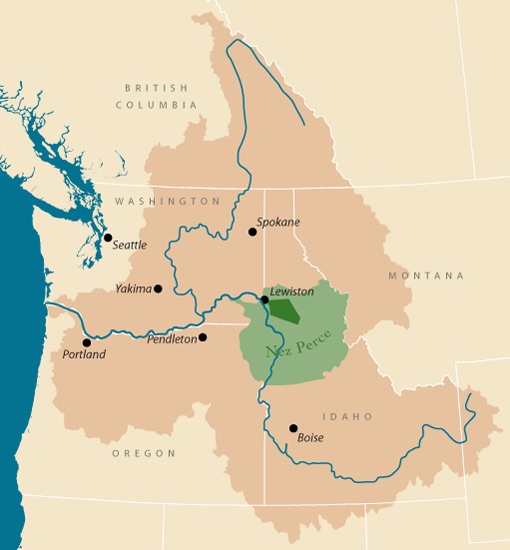
A map showing the traditional territory of the Nez Perce that was ceded to United States (light green), the current boundaries of the Nez Perce reservation (dark green), and the entire Columbia River Basin (dark tan). Map courtesy of CRITFC

And looking specifically at coho salmon in the Clearwater, records show that the species disappeared before they even had a chance to be classified as endangered or threatened.

It was the dams — particularly the Lewiston dam, built in 1927 — that sounded the death knell of the Clearwater coho, which were officially declared extirpated in 1985. Chinook and steelhead were also devastated and remain threatened or endangered today. (The Lewiston dam isn’t there any more, but it was replaced by four newer dams on the lower Snake.)

The Idaho Department of Fish and Game tried and failed to reintroduce coho into the lower Snake system in 1962. And during the late 1970’s, Snake River coho were considered for inclusion in the Northwest Power Act, which obligates utilities to mitigate the harm done to fish in the Columbia basin. But by that point it was too late. The fish were already gone.

In the early 1990’s, however, following a decade that was ruled by pessimism, there was renewed interest in preserving and recovering salmon stocks in the region. This interest was fueled, in part, by the four tribes that refused to give up their traditional fishing rights in the Basin: the Nez Perce, Warm Springs, Umatilla and Yakama.

In 1994, the Nez Perce took decisive action to bring coho back to the Clearwater. But the tribe faced a major hurdle from the start: there were no coho native to the river available to serve as a broodstock. So the tribe got half a million coho eggs from federal hatcheries on the lower Columbia (below Bonneville dam). Idaho Fish and Game officials did not approve of the Nez Perce project, Johnson says. But the chance to get such a big batch of coho eggs was enough to inspire the tribe to truck the eggs all the way to the reservation without a long-term plan or a transport permit from the state.

[perfectpullquote align=”full” bordertop=”false” cite=”” link=”” color=”” class=”” size=””]“We out-planted those coho under threat of arrest,” Johnson recalls.[/perfectpullquote]

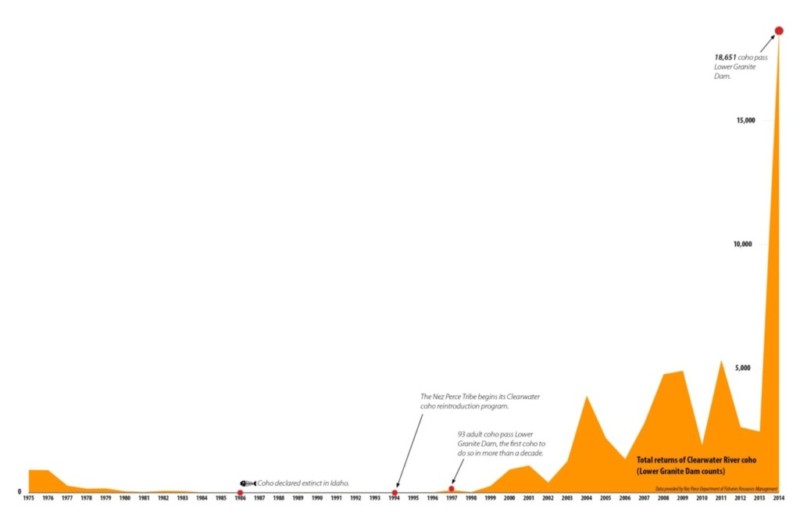
Fast forward 20 years, and in 2014 the tribe and the State of Idaho were able to open a tribal- and sport-fishing season for coho for the first time in Idaho history. The number of returning fish that year reached 18,651. Numbers have dropped since then, but the tribe continues to work toward a sustainable fishing season, which would require about 14,000 fish to return every year.

This graph shows dramatic comeback of coho in the Clearwater. Graph courtesy of CRITFC

Idaho’s official attitude has mellowed considerably since 1994. According to the state’s chief of fisheries, Jim Frederick, “We’ve been excited to see how successful that program has been. It’s just beginning to provide some great opportunities for tribal members and recreational [fishing]. I give them a great deal of credit.”

It’s complicated

Because the salmon life cycle is so complex, reestablishing a population anywhere is dicey. To survive, salmon have to be able to adapt to a wide range of surroundings, from beaver ponds to vast rapids to slack water reservoirs to saltwater. This is one of the reasons why coming up with a workable management policy is so difficult. On their journey from their natal streams to the Pacific and back again, the fish utilize floodplains, wetlands, meandering streams, fast-moving water, brackish estuaries and open ocean.

Salmon are also adapted to micro-environments when spawning. “We started with fish from the lower river that didn’t have to pass any dams, and moved them 500 miles from the ocean,” Johnson explains. The first returning fish had to be able to make the return trip on their own, perhaps drawing on some genetic memory of ancient spawning grounds.

And it seems to be working. “Even though they have a tough time, we’re seeing thousands of fish return as compared to when there were none,” Johnson says.

There has long been controversy over the role of hatchery fish and their negative effects on wild populations. Wild fish survive the ocean phase of their lives far better than hatchery fish, but as Johnson says: “You’ve got to be able to use the tool that will increase survival. And we wouldn’t be able to do this program without hatcheries.”

“If we didn’t have the dams we wouldn’t need the hatcheries,” she adds.

There is also recent research showing that some differences between wild and hatchery fish are epigenetic – related not to different genes but to different gene expression – suggesting that hatchery fish might be able to up their game and recover the behaviors of their wild cousins under the right conditions.

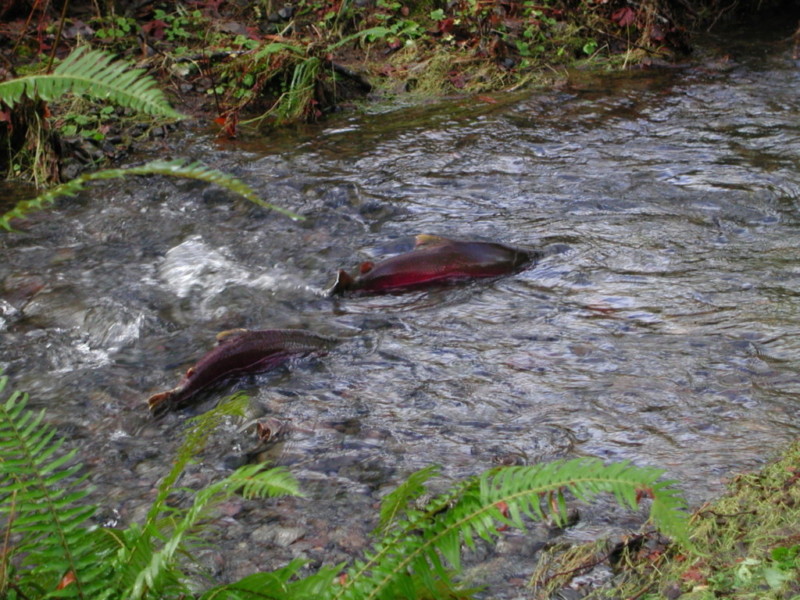
A male coho displays full spawning colors while digging a redd in its natal stream. Photo courtesy BLM

The Nez Perce program is aimed at sticking as closely as possible to the wild genotype. “We take wild fish into the hatchery for broodstock and have hatchery fish that go out into nature to spawn,” says Johnson. Thus the most robust hatchery fish that have made the round trip can then be used for a new broodstock — wilder, at least, if not truly wild.

The ghastly gauntlet

Even with carefully tended hatchery and wild populations on the Clearwater, there are many factors beyond the tribe’s control. Migration presents a ghastly gauntlet for all anadromous fish and water temperature is becoming a major problem. (Currently, the water behind the Dworshak dam is released in the summer months to cool the Snake River for adult fish returning from the ocean.) These fish have to traverse multiple reservoirs, encountering native and introduced predators, including sea lions, walleye and smallmouth bass. Ocean conditions also vary dramatically according to cyclical patterns such as the North Pacific Oscillation and El Niño/La Niña.

Elephants on the table

Most, but not all, stakeholders acknowledge that the single most effective action to help coho (along with all of the other migratory fish in the Columbia Basin) would be to take out as many dams as possible. “Recovery is near impossible without freeing up the lower Snake,” says Bert Bowler, a fisheries biologist with Snake River Salmon Solutions.

Of course, the four dams on the lower Snake were built with federal money, so it will take federal permission — and funding — to remove them. And while Bowler believes removal is a distant prospect, Johnson is optimistic. “There will be a day when they come out,” she says. ”At some point the cost to maintain and take care of them as they age will outweigh the benefits.”

It can’t happen fast enough for the fish, because, as Bowler points out: “The elephant in the room is the rate at which climate change is overtaking us.” Restoring salmon habitat and free-flowing rivers may be the only hope of giving salmon a robust enough environment to survive the looming stresses of drought, heat waves, warm water, crashes in prey populations, and ocean acidification.

But as the story of coho in the Clearwater shows, the bond between people and fish can be surprisingly deep. Johnson, a native of Leavenworth, Washington, thought she wanted to be a physical therapist when she started college. But when a biology professor arranged a summer project for her with the local tribe, Johnson says she “was hooked.” She took a job with the Nez Perce straight out of college and has never looked back. She believes the tribes will never abandon the coho, chinook, steelhead and lamprey they are nursing back to vitality.

“I thought if anybody was going to fix this problem, the tribes will, because they care so deeply,” Johnson says.

“They’re like the protectors. Having fish for them is like breathing.”

Photo courtesy of the Oregon Dept. of Forestry. (Click here to watch an underwater video from Alaska’s Campbell Creek)

© Copyright 2013-2025 Columbia Insight. All Rights Reserved.

As a 501(c)3 nonprofit organization, all donations to Columbia Insight are tax deductible to the full extent of the law. Our nonprofit federal tax-exempt number is 82-4504894.