Stay Updated Subscribe today for the latest research + reporting about environmental news. Subscribe Now

Stay Updated Subscribe today for the latest research + reporting about environmental news.

Subscribe Now

Susan Hess

Susan Hess

Susan Hess

About Susan Hess

Susan Hess is Columbia Insight's publisher.

Landfills: Garbage, the New Gold

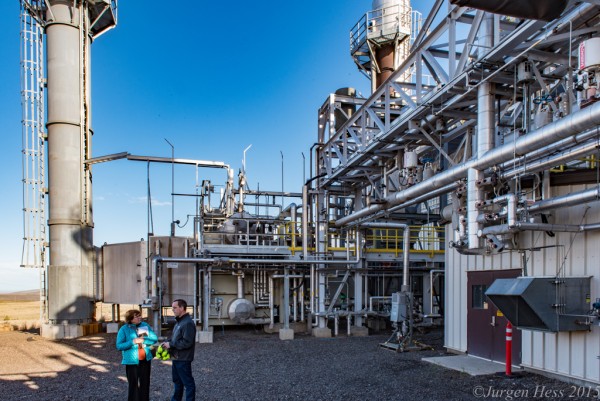
Five miles up Roosevelt Grade Road high above the Columbia River is one of the biggest gas-to-energy plants in the United States. From methane produced by garbage, the plant generates enough electricity to power 25,000 homes—all the homes in Wasco and Klickitat Counties and the City of Hood River.
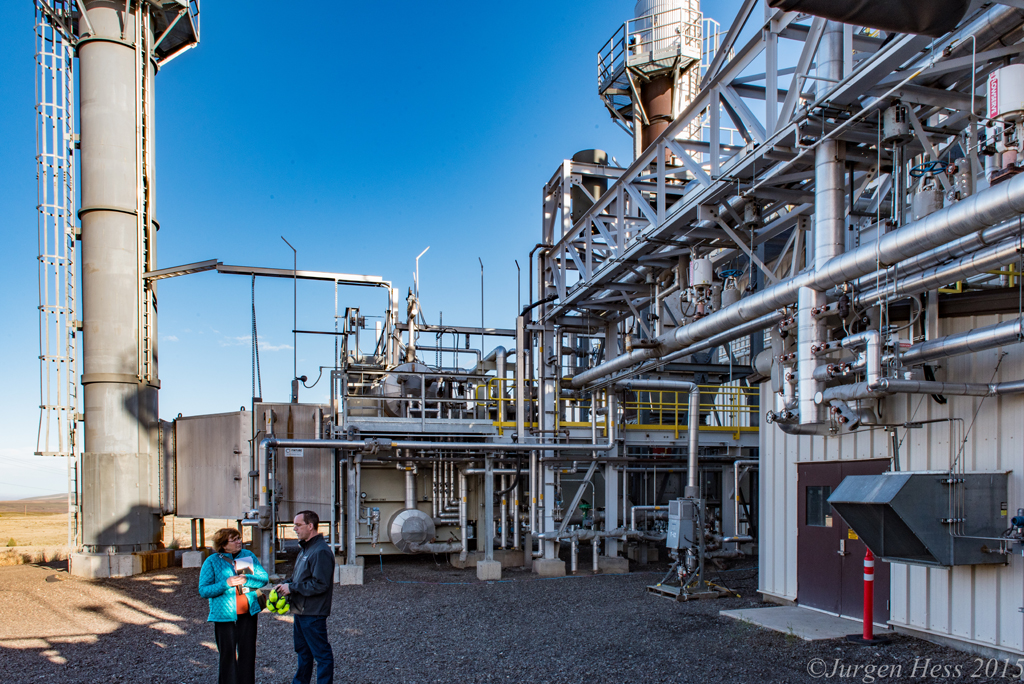
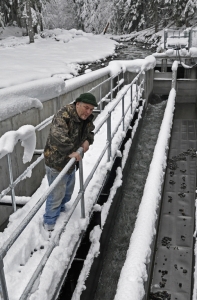
Kevin Ricks (R) manages Klickitat County's H.W. Hill Landfill Gas Project

[/media-credit] Kevin Ricks (R) manages Klickitat County’s H.W. Hill Landfill Gas Project

Landfills used to be the last repository, a place to bury forever the empty lipstick case, the juice box, meatloaf left out too long, broken pencils, oily rags, batteries: everything. But over the last 20 years, landfills turned into laboratories. “The landfill is a multi-million dollar piece of environmental infrastructure,” says Jackie Lang, Senior Communications Manager for Waste Management.

The Columbia River Gorge is home to five landfills. The dry climate of the eastern Gorge and the high hills that flank the Columbia River form almost perfect conditions for landfills, and the Gorge provides one final ingredient: a well-connected transportation corridor. Garbage comes to these regional landfills from as far away as Alaska and one time even from Antarctica.

The landfills are an almost unnoticed industry in a region focused on agriculture, fishing, dams, drones, and recreation. But the five landfills together receive over five million tons of garbage every year. They provide over 300 family wage jobs in a part of the Gorge where jobs are scarce.

They pay over $12.5 million annually to the counties in host fees in addition to property taxes. In Klickitat County, the host fee and taxes paid by Roosevelt Regional Landfill make up one fifth of the county’s budget.

“But clearly the future is in finding ways to use garbage for beneficial purposes,” says Ms. Lang. “As a company, we are committed to that as the end game.”
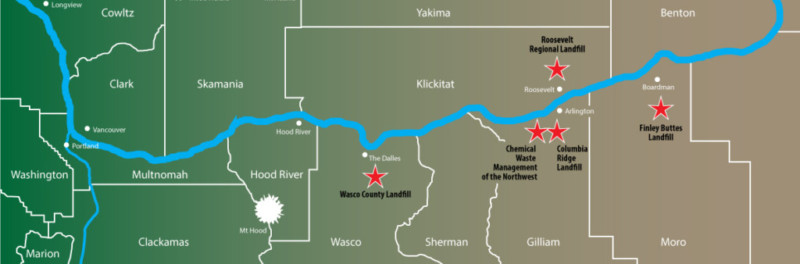
LF map - Copy

If there were a Guinness Book page for landfills, the Gorge ones would fill it. Columbia Ridge is the largest landfill in Oregon, Roosevelt Regional largest in Washington.  Both are in the top 10 largest landfills in the United States. Chemical Waste is the only hazardous waste landfill in the Pacific Northwest and the surrounding region, including western Canada.

From an aerial view the landfills look a bit like someone is in the midst of developing a golf course, but hasn’t yet planted the greens. The size is astonishing, yet hardly anyone goes there who isn’t somehow employed there. Once, almost everyone went to the dump: hauling a pickup load of yard trimmings or odds and ends of debris from a house remodeling project, and every community had a nearby dump.

Why landfills?
Then some 25 years ago people discovered that across the U.S. most of those dumps were leaching contaminants into groundwater and rivers, attracting rats, and polluting the air. There are times when you need big government to handle big problems. That time it was the Environmental Protection Agency that stepped in and set regulations to protect public health and the environment, effectively ending dumps and giving rise to landfills that are safe, sanitary, and monitored, but much too expensive for most communities.

To be economically feasible, landfills had to take not just your town’s garbage, but the next town’s and the next and the next. They were built far from the city out in the wide open spaces of the eastern Gorge, because in the cities, no one wanted a landfill in their ‘back yard.’

Portland, Oregon’s story is typical. In the 1980s, the metropolitan area’s scattered landfills were filling up. Every site that Metro planners selected, local residents rejected. With local landfills close to capacity, Metro finally appealed to the State for authority to site one regardless of objections.

“At the eleventh hour, Waste Management offered to build a landfill on a site they owned in Gilliam County,” said David Allaway, Senior Policy Analyst for Oregon Department of Environmental Quality. The condition was that Metro agree to send them all the metro area solid waste for 20 years. Today, five days a week, 50 to 60 trucks a day leave the Portland Metro area taking over 400,000 to 500,000 tons of garbage a year to Waste Management?s Columbia Ridge Landfill.
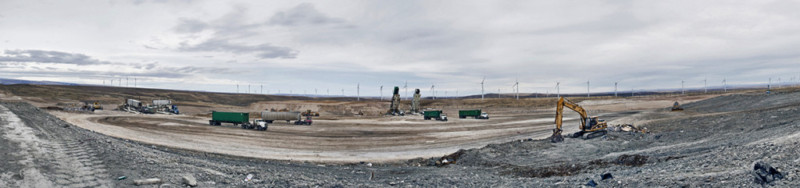
Columbia Ridge Recycling and Landfill. Click to enlarge.

That much garbage needs big companies. The companies that own these landfills are listed on the New York Stock Exchange; two are Fortune 500 companies, one is listed in the Fortune 1000.

The big cities and towns wanted the landfills far away, and Wasco, Gilliam, Morrow, and Klickitat Counties welcomed them. In addition to property taxes, the companies pay the county where they’re located an annual host or license fee based on the volume of garbage. Usually the fee is based on the amount of solid waste brought to the landfill. For example in Gilliam County, the fee is $1.75 per ton. For the most recent year, that came to $3.1 million.

“It’s important to the County,” said Dennis Gronquist, Gilliam County Commissioner. “It’s allowed us to fund daycare, the senior lunch program, and provides some for schools. Waste Management and Metro have been super to deal with.” In a way, every time you put something in the trash bin, you’re helping rural Oregon.

Ms. Lang sees it as a partnership. “People in the Portland metro area have a lot to be proud of. They are doing a fabulous job reducing waste and recycling. They can also be proud that they are providing an economic engine for a thriving rural Oregon community.”

County officials say the landfills are good neighbors. They take care of the roads leading to the landfills, pick up litter, erect fences to keep stray litter on site, fund scholarships, buy 4-H animals, and they make a point of saying that landfills give off little odor.

The overseers
That has to do with the regulations EPA sets and then are implemented and overseen by states and/or counties. Landfills, besides taking garbage, must: prevent leaching, cover incoming garbage daily, and keep methane from entering the atmosphere.

Before fracking came along and overtook the top spot, dumps were one of the major methane emitters. Of the two big greenhouse gases, methane and carbon dioxide, methane is 28 times more potent, a very bad actor. Landfills can either burn it off in flares or capture it to create energy, which three of these landfills are doing. Capturing the gas and getting it to places where it can be used or burned is one of the reasons building a landfill is so expensive.

The same for leachate, a term sort of unique to landfills. It refers to liquids that move through the landfill and pick up harmful substances—things you don’t want in groundwater, rivers, farmlands. The Gorge’s hilltops provide landfill sites that keep landfills high above groundwater. Then landfills have multiple layers of compacted soil and liners to prevent leakage. (See graphic: Anatomy of a Landfill). Most recirculate the leachate back into the landfill to speed up decomposition and gas production.
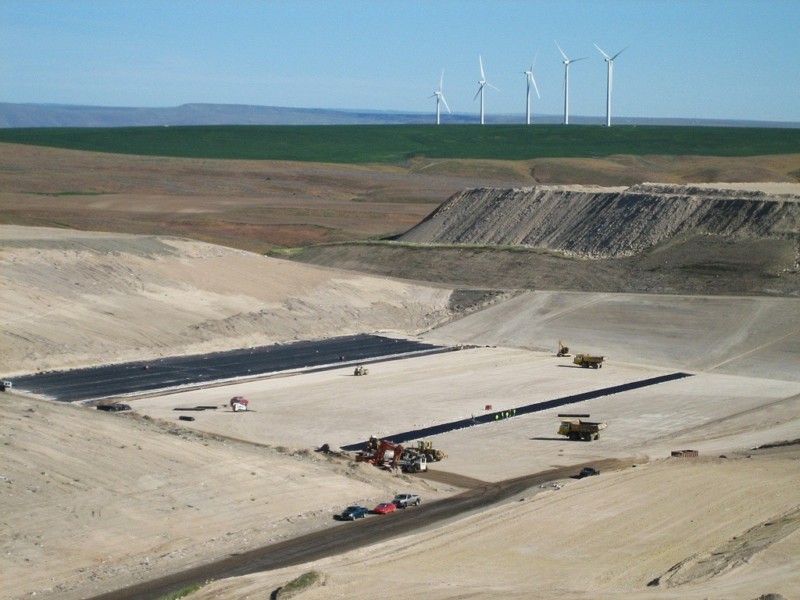
Building a landfill.

[/media-credit] Building a landfill.

The companies are required to have wells around the site and to test and monitor gases and leachate. Regulating agencies inspect multiple times yearly. The four landfills on the Oregon side of the Columbia are regulated by the Oregon Department of Environmental Quality. In Washington, the Klickitat County Health Department regulates Roosevelt Regional Landfill.  Both agencies say the landfills are state-of-the-art and well managed.

“It’s an environmentally sound way of handling solid waste,” said Kevin Barry, Klickitat County Public Health Director. He said Roosevelt Regional often exceeds standards. “For example, federal regulation requires a 60 mil liner we use 80 mil.”

Chemical Waste Management is a different type landfill. It’s the only one that can and does take hazardous waste. As you would expect, putting hazardous materials into a landfill needs a different set of regulations: materials may need to be stabilized, treated and encapsulated.

Each of the five landfills is set up to take a lot of garbage: enough capacity for the next 100 to 150 years. “The hope is to get to zero waste,” Mr. Barry said, “but we’ll always have garbage and this is the responsible way to handle it.”

Recycling rates have been creeping up, but the market for them goes up and down. “Almost all recyclables have a negative value right now,” said David Skakel Tri-County Hazardous Waste & Recycling manager.

Since no one wants a landfill close to them, garbage moves: sometimes surprising distances.

From Where to where?
Cities, counties, or regional agencies, and private businesses contract with a landfill company. You’d think that the trash—that you put in your bin, gets picked up and taken to a transfer station, compacted, and hauled to a landfill—would go to the nearest one. Sometimes that’s true, but just as often not. The landfill business is competitive, so companies give out only a few names that they have contracts with:

  • The Tri-Cities and Clark County, Washington (which contains Vancouver metro area) sends solid waste by barge to Finley Buttes.
  • Hood River and Wasco Counties’ waste goes by truck to Wasco County.
  • Portland metro garbage is trucked to Columbia Ridge (and to another Waste Management landfill near McMinnville.) The City of Seattle and Kitsap County, WA garbage goes by train to Columbia Ridge.
  • Several Alaskan cities send garbage by barge to Seattle where it’s put on a train and taken to Roosevelt Regional. It also gets garbage from California and Montana.
  • Chemical Waste Management of the Northwest receives hazardous material from Washington, Oregon, Montana, Idaho, Utah, Wyoming, Hawaii, Alaska and Western Canada.

“Oregon DEQ was concerned when the companies first proposed bringing garbage from out of state,” said Lissa Druback, Oregon DEQ’s Solid Waste/Hazardous Waste/Spills Manager. The result was a ruling that requires out-of-state entities to meet the same requirements as a similar Oregon entity: recycling, separating trash, etc.

Too much gas and diesel used transporting garbage? For those who analyze such things, in a product’s lifecycle manufacturing a lipstick case, battery, juice box and so on is called the ‘upstream’ end. The ‘downstream’ end is when it’s thrown in the garbage and taken to a landfill.

The upstream issue
“Our society at times borders on obsession with the trivial. These discussions almost always focus on what happens at the compost site or the landfill. Almost never does anyone ask about the upstream impacts. But that’s where the majority of impacts likely occur,” wrote David Allaway, Oregon DEQ policy and program analyst in the Solid Waste Program.

“Upstream processes contribute about 20 times more domestic greenhouse gases than waste management does,” Allaway said. “Landfills are viscerally offensive to people, but when we in DEQ measure the impact of landfills versus production and upstream supply, the impacts upstream are typically 10 to 20 times higher.” The impact of transporting garbage, he says, is in insignificant in comparison.

While that discussion goes on, those working on landfills are busy figuring out how to make new things from garbage.

The frontier
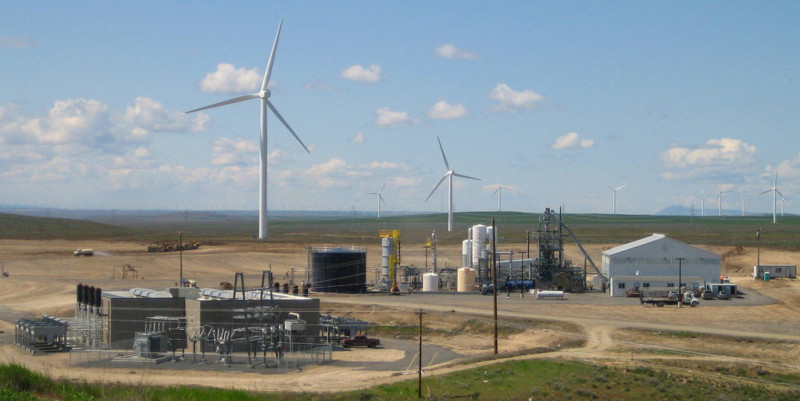
Columbia Hills Landfill.

[/media-credit] Columbia Ridge Recycling and Landfill. Click to enlarge.

The landfill companies are, as Ms. Lang said, “finding ways to use garbage for beneficial purposes”—developing power generation, mining, manufacturing.

Garbage buried under a soil cover decomposes; as it does, it emits methane. Harnessed in a gas-to-energy plant, methane turns generators to produce electricity. Processed a different way and you get transportation fuels, both the fuels and electricity are renewable energy.

“EPA considers landfill gas-to-energy projects as carbon neutral, because the carbon emissions are from organic material that was recently in the atmosphere,” said Kevin Ricks, Generation Asset & Special Projects Manager for Klickitat?s gas-to-energy plant on Roosevelt Regional. “It’s different than taking gas that was sequestered in the earth, and then bringing it up and burning it—now you’re adding to the carbon in the atmosphere.”

Three of the landfills have onsite gas-to-energy plants. Together they generate 41.4 MW.

Finley Buttes leases land to a power company. Waste Management owns the plant on Columbia Ridge. Their plant generates 12.8 megawatts (MW) and sells it to Seattle City Light. Waste Management also leases some land there to PacifiCorp for 90 wind turbines generating 150 MW.

Klickitat County owns the plant on Roosevelt Regional Landfill. As mentioned earlier, it is one of the biggest gas-to-energy plants in the nation. It’s a $70 million facility with 10 family wage jobs: total payroll $1.1 million on gross revenue of $7 million.

When all its generators are running, the plant can produces 36 MW, an amount equal to the output of more than 20 wind turbines.
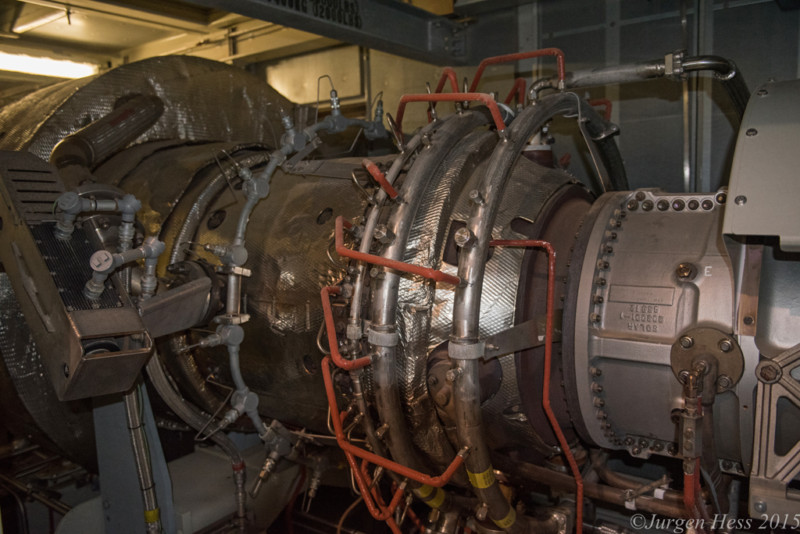
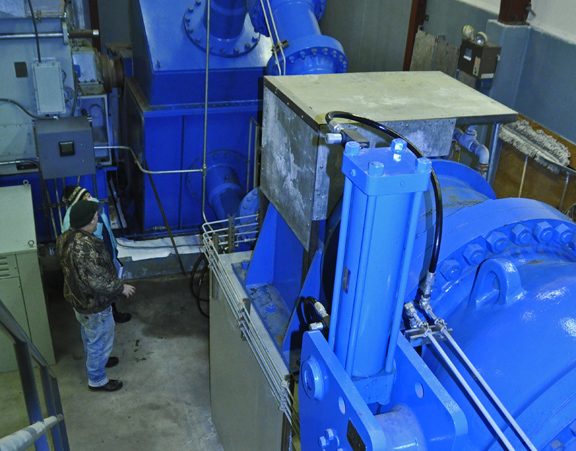
One of two engines at Klickitat PUD's gas to energy plant.

[/media-credit] One of two engines at Klickitat PUD’s gas to energy plant. Click to enlarge.

Typically the plant runs produces 26 MW. It has two 10 MW combustion turbines (think jet engines) and recovers heat to run a 6 MW steam generator and steam turbine. The electricity produced is “sold into the California market, just because that’s the highest value,” Mr. Ricks says.

Taking landfill gas and refining it to run turbines is a complex process. The very complexity is what makes Mr. Ricks (who formerly worked in the Navy’s nuclear power program) love this job.

Vacuums pull landfill gas to the plant. The gas holds lots of components not visible to the naked eye. Before it can be used, individual machines remove sulfur, siloxanes (used in in many products like: cosmetics, hair products, lubricants), and water. “The gas when it comes in, it’s saturated, so we’re pulling in about, call it 44,000 pounds an hour of gas and 4,000 pounds of that is water vapor,” Mr. Ricks said. “We remove the water and the water is condensed, and it goes back to the landfill.”

Klickitat County is investigating the possibility of developing a plant to produce renewable natural gas for transportation fuels. That would require additional steps to remove nitrogen and carbon dioxide, but creates more value for Klickitat County, because electricity prices are currently at an all-time low.

A new company starts operation this spring on another section of the landfill. Spokane, Washington incinerates its garbage and sends the ash to Roosevelt Regional. The new company is opening a plant to mine the ash for metals.

Wasco County Landfill is the smallest of the Gorge landfills. The type of garbage they take, Manager Nancy Mitchell explained, doesn’t have the enough moisture needed to create the amount of methane needed to run a power plant.

“We’re good neighbors,” Ms. Mitchell says. “We do a lot for the County. I invite people to come to the landfill and talk to me. We’re proud of what we do.”
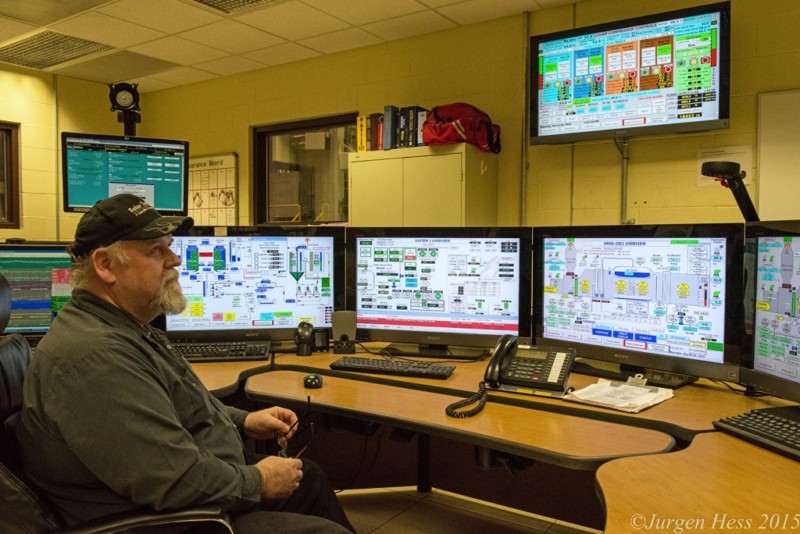
Dale Ransom, Operations Technician, monitors opertion of the generating plant.

[/media-credit] Dale Ransom, Operations Technician, monitors operation of Klickitat PUD’s generating plant.
Oil Train Derailment Déjà Vu

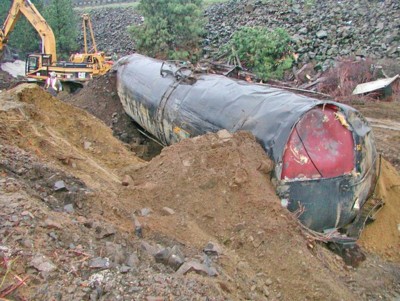
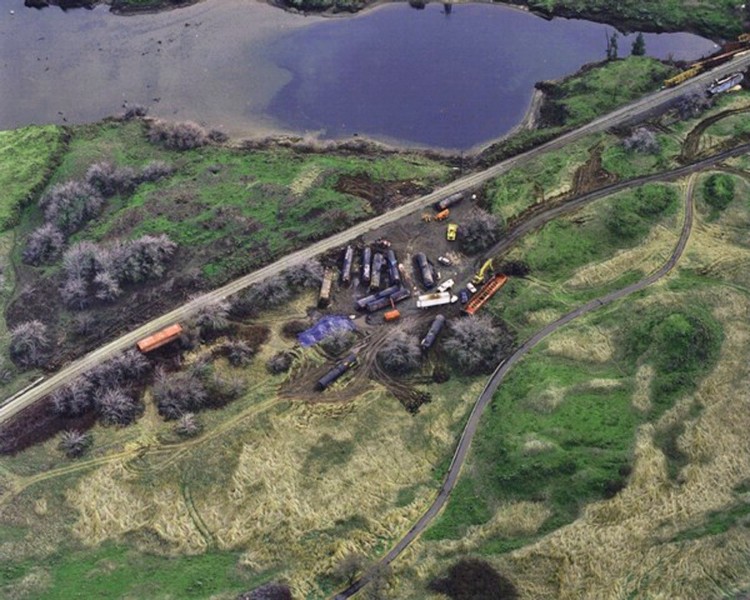
2003 Union Pacific derailement Dalles

Train carrying soybean oil, phenol, other hazardous chemicals, and various cargo derailed near The Dalles, OR 2003.

By Susan Hess, June 6, 2016. On Thursday night, January 9, 2003, a track split under a Union Pacific freight train just west of The Dalles. Fifty of the train’s 94 cars derailed. The cars carrying hazardous materials were the immediate concern. Miraculously none leaked. But four cars full of soybean oil leaked 12,000 gallons alongside the river. For wildlife oil is oil, it coats birds, mammals and plants, smothers fish, suffocates aquatic organisms and destroys wildlife’s food supplies and habitats.

Clean up took two months. At the time, state and federal officials said that despite the large derailment and damage, “We were lucky this time.” Luck is fickle.


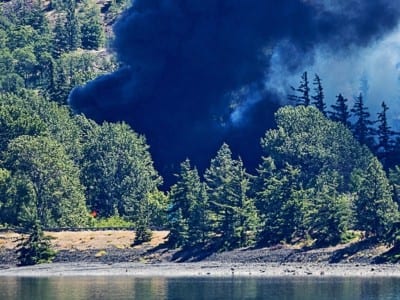
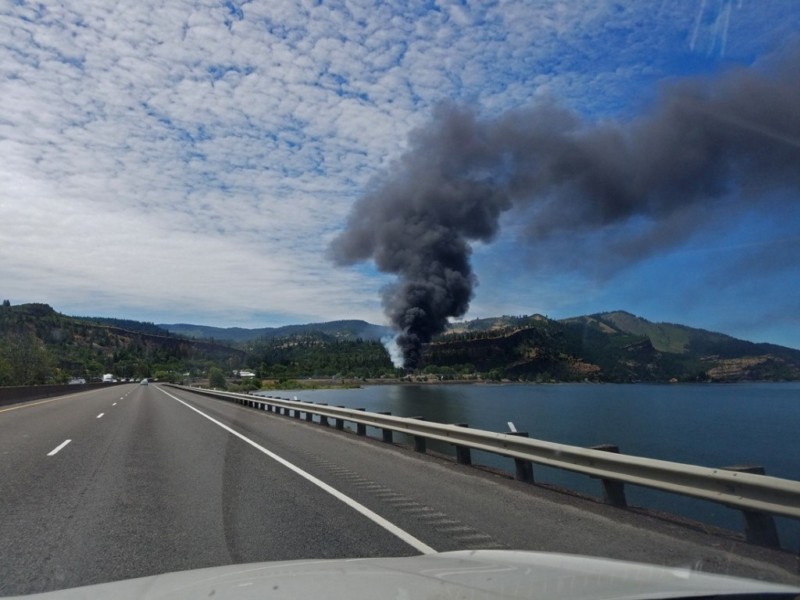
Friday, June 4, 2016, a Union Pacific train derailed in Mosier, Oregon just 15 miles west of the 2003 derailment. This time all cars carried hazardous materials: Bakken crude oil. This time several caught fire, pouring black smoke into the atmosphere.

Fire from derailment in Mosier, June 2016, 15 miles west of the 2003 derailment

The elementary school was evacuated. The sewer treatment plant was heavily damaged. A short term fix today allowed? residents use showers, toilets, sinks. Monday night the boil water order was lifted.

Impact to fish and wildlife has not been evaluated thoroughly yet because access is limited according to Angie Wilson, City of Mosier. Because of extensive media coverage and limited access, EnviroGorge is not doing in depth reporting of this derailment.

EnviroGorge reported on oil transportation in the Gorge in April 2015, read that article here.

For updates on the current derailment in Mosier:

Washington Department of Ecology: Incident page

From WA DOE page: “Sampling is being conducted on the drinking water and residents are being asked to boil water until the sampling results are complete. Air monitoring continues to be conducted 24/7 and is currently in the healthy range. All oil has been removed from the damaged rail cars. Oil from the cars is being vacuumed out onto special tanker trucks and being transferred to The Dalles before going to is final destination in Tacoma. Thirteen rail cars remain on site, two have been fully pumped, or partially, the remaining 10 will be pumped as quickly as possible. Additionally, the damaged rail was repaired.”

State of Oregon Department of Environmental Quality

Columbia River Inter-Tribal Fish Commission

City of Mosier

By |2024-01-23T09:57:04-08:0006/06/2016|Energy, News, Old Articles, Transportation|1 Comment

The Oil Train Elephant in the Room

Editorial by Susan Hess

2016-06-03 12.48.01_edited-1 resized

[/media-credit] Smoke from Mosier, OR caused by derailment on June 3, 2016 was visible all over the Gorge

Friday, June 3, the State of Oregon’s Environmental Justice Taskforce met in Hood River. To start the meeting they asked community members to tell them about local concerns. Lack of affordable housing, transportation, and agricultural pesticides were named. I added that the dramatically increasing number of oil and coal trains running along both sides of the Columbia River concern all the Gorge communities.

Two hours into the meeting, I received a text and photo from EnviroGorge Associate Editor Miko Ruhlen about a train derailment at Mosier, Oregon just four miles away. I told the group and passed my phone around and told them if they looked out the meeting room windows they could see the black smoke pouring over the east hills. No one did.

The woman representing Oregon Department of Environmental Quality, called her office to make sure the agency was on it. People began looking for information on their cell phones and laptops. Next to me, people joked about their luck that their departments didn?t have to be involved, one from Oregon OHSA. The joking continued until I let them know that I was there to report on the meeting for EnviroGorge and Radio Tierra.

The taskforce got back onto their agenda with no discussion of the derailment. For two hours more the meeting went on about important stuff: air toxics: industrial air (especially the artesian glass factories), wood smoke, diesel fumes.

At last the meeting paused for public comment. I asked if the Taskforce would like to comment on the derailment. One person said that the governors of Oregon and Washington had met to talk about the issues around fossil fuel transportation. I said, “I wondered if the Taskforce would like to comment on this specific event. The elementary school is being evacuated.”

The chair said that these things are tragic. Another said, “Our hearts go out to the responders and citizens.” And they returned to their agenda.

It seemed an odd response or lack of response for a group concerned with Oregon’s environmental issues.

Among those attending were members of the Taskforce, representatives from Govenor Kate Brown’s Office, Oregon OSHAA, Oregon Public Utility Commission, Oregon Department of Environmental Quality, Oregon Fish and Wildlife, Oregon Water Resource Commission, Mayor of Cascade Locks, Local Water Alliance, Mount Hood Meadows, several local orchardists, The Next Door, Confederated Tribes of Warm Springs, Confederated Tribes of the Umatilla Reservation.

By |2019-04-11T10:59:45-07:0006/06/2016|Energy, More, Old Articles, Transportation|4 Comments

Looking under ODOT’s bridges

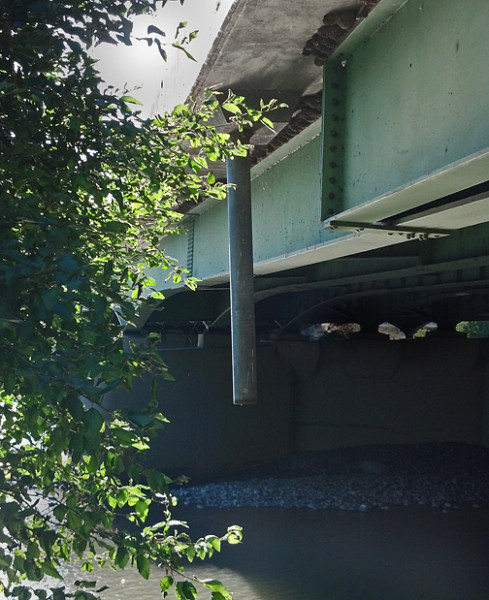
IMG_20150720_075818_400 final2The storm drain pipe on the I-84 bridge sends highway rain water directly into the Hood River, but the water carries with it: vehicle oil, plastic bags, coffee cups, cigarettes, etc. into the river. Did the fish and game staff approve this? It wouldn’t take much to filter out material, the technology is available. Thoughts?
The Battle Over Renewable Energy

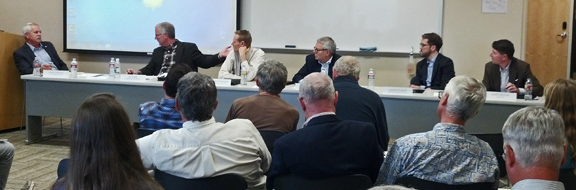
Representative Mark Johnson leads a forum on Energy at the Columbia Gorge Community College in September 2015.

[/media-credit] Rep. Mark Johnson (far left) leads an energy forum in Hood River Sept. 2015. From left: Jay Ward, Energy Trust of Oregon; John Gernstenberger, Hood River Electric Co-op; Gary Bauer, Northwest Natural; Varner Seaman, Portland General Electric; Scott Bolton, PacifiCorp.

This September Rep. Mark Johnson, R-District 52, held an energy forum in Hood River. The panel included executives from major energy players in Oregon, but in the question and answer segment all the increasingly heated audience questions went to Varner Seamam, Portland General Electric’s State Legislative Affairs Manager and PacifiCorp’s Scott Bolton.

The big electric utilities are proposing changes to the rules that give rise to small renewable energy projects’ wind farms, solar energy systems, dairy digesters, and hydroelectric plants. The owners and developers of these projects are alarmed and angry.

Farmers Irrigation manager Jer Camarata of Hood River, Oregon told the legislators that the irrigation rates the district charges their farmers are a fourth of what they would be without the revenue from their small hydroelectric plant.

Craig DeHart inspects the section of the plant that was altered to allow safer fish passage in the stream behind.

[/media-credit] Craig DeHart inspects a fish screen that replaced a dam. Allowing fish passage in the stream behind.

“We’ve spent $30 to $40 million from our funds on piping, removing fish barriers, and improving water quality–instream and for patrons,” said Craig DeHart, Middle Fork Irrigation general manager (Parkdale, Oregon). “The largest share of that has come from our hydro revenue.” Things benefiting farmers, salmon, and water conservation.

East of Wasco, Oregon, Ormand Hilderbrand developed PáTu Wind Farm on his family’s acreage. He estimates that his six-turbine wind farm puts $500,000 a year into struggling Sherman County in the form of salaries and taxes.

Others said the changes the utilities are proposing may raise irrigation rates for farmers, put some small renewable projects out of business and stop any further projects. Worst case, these changes could hamstring the energy security these independent projects are to provide.

Many of these small scale renewable energy projects came about because of a 1978 federal act known as PURPA, Public Utility Regulatory Policies Act. After the oil crisis in the 1970s the federal government decided the country’s security needed to be less dependent on imported oil and fossil fuels. PURPA was its answer. Its aim is to encourage innovative small-scale renewable energy generation. It required big utility companies like PacifiCorp and PGE to buy electricity from these small producers. While PURPA is a federal law, the individual states set the rate the utilities must pay and the length of contracts.

In Oregon, the Public Utility Commission (PUC) sets those rules. To be eligible a renewable energy project has to be generating no more than 10 megawatts?enough electricity to power about 6,000 homes–all the homes in The Dalles.

The current controversy is about the rules PUC set for the big utilities. PacifiCorp and PGE are required to buy all power generated by small projects (QFs in the bureaucratic lingo for Qualifying Facilities), offer them a 15-year standard contract, and pay for that electricity at a price the PUC sets. Generally that price is the ‘avoided cost,’ a calculation of what it would cost a utility if it had to build another energy plant.

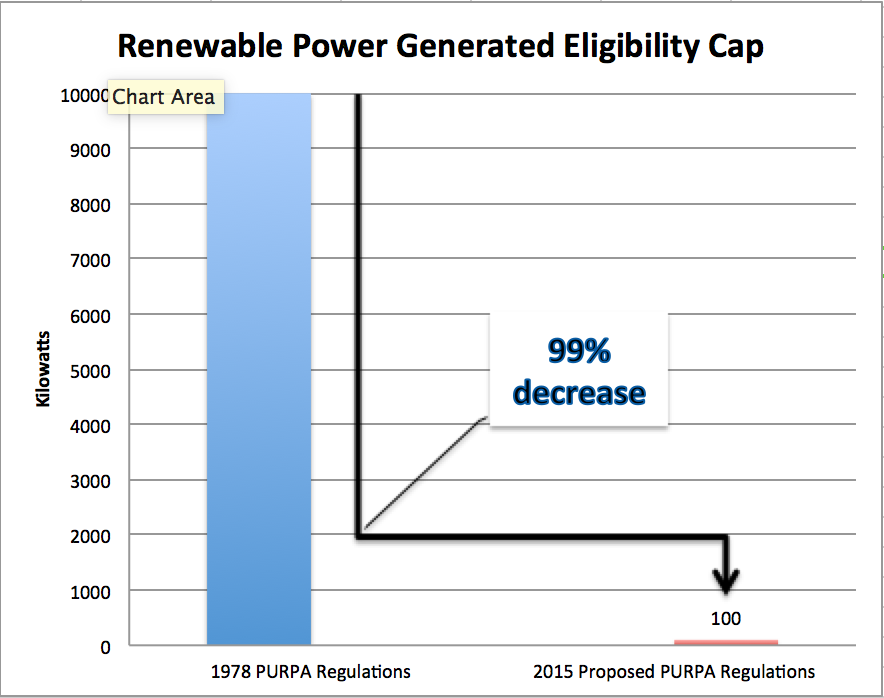
On May 21 this year, PacifiCorp filed an application with the PUC asking it to reduce the fixed-price contract length to three years and lower the eligibility cap from 10 megawatts (10,000 kilowatts) to 100 kilowatts–a 99 percent reduction.

This graph depicts the proposed changes to requirements of energy output in comparison to the current standards set back in 1978 (Emily Long).

[/media-credit] This graph depicts proposed changes of project eligibility?? compared to the current standards.

Within days, a flurry of petitions to intervene landed at the PUC, filed by both current QFs and renewable energy developers.

“At 100 kilowatts almost every qualifying facility doesn’t qualify for standard contract prices,” says John Lowe, Renewable Energy Coalition’s director, an organization representing 50 QFs (all but two are hydroelectric). “PacifiCorp’s strategy effectively stops new projects and puts existing long-term contracts into jeopardy when they come up for renewal.”

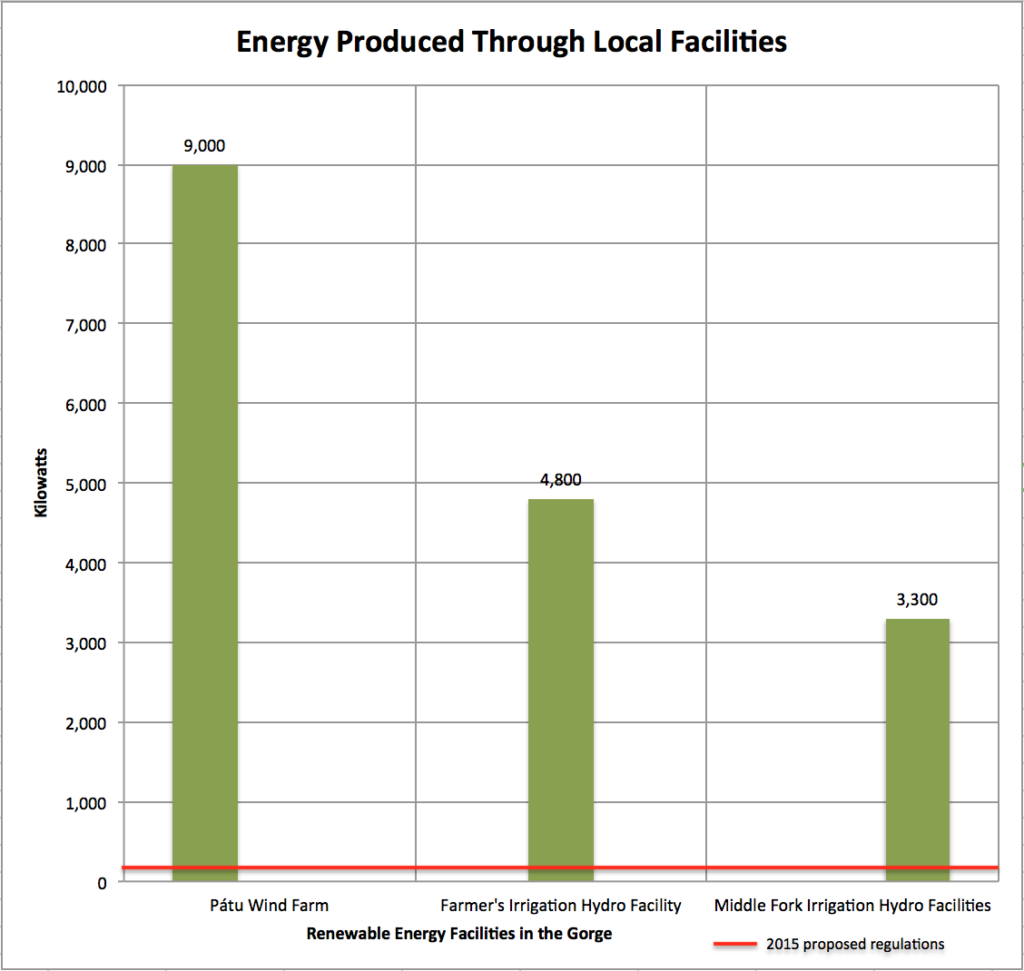
If the qualifying level is 100 kilowatts, three Gorge entities will not be eligible for the standard contract when their contracts come up for renewal. In Hood River County, Farmers Irrigation’s hydro facility generates 4,800 kilowatts (4.8 MW); Middle Fork Irrigation District 3,300. In Sherman County, PáTu Wind Farm generates 9,000.

The standard contract is important to QFs, because no time is spent on negotiating the contact term and standard published price are set.

PacifiCorp claims the increasing number of these projects is forcing them to buy more power than they need. In PacifiCorp’s filing to the PUC, they say in Oregon they are already buying 338 MW from QFs and have requests for 587 MW more. Between the existing and proposed PURPA contracts PacifiCorps stated: “would be enough to supply 56 percent of the Company’s average Oregon retail load.”

PUC staff response refutes that statistic saying that the amount would actually be less than 36 percent.

In an email to Envirogorge, Mr. Bolton, vice president of external affairs for PacifiCorp wrote, “To be clear, we are not saying ‘no to power purchases from renewable energy developers. We are saying that long term contracts tend to lock in prices that are not reflective of the market, which is more competitive and offering more technology choices than ever before.”

[/media-credit] A graph depicting the amount of energy a few facilities in the Gorge produce.

What has driven down the price of energy is fracking. It has provided so much natural gas that the big utilities can buy it to generate electricity much cheaper than the prices they are paying the QFs. “With natural gas prices low and the price of solar dropping, the 15 year contracts are making them and therefore their customers pay more,” Mr. Bolton says, than the current market price.

In addition PacifiCorp feels that not all the projects are coming from small producers. “The key issue here is small,” Mr. Bolton wrote. “Many of the projects being proposed are 80 MW projects backed by Wall Street firms. We don’t think these kinds of projects should be able to demand 20 year fixed term contracts with prices set 2 years ago. We think we can get our customers a better deal. Naturally, these Wall Street backed firms want to get sweetheart deals on the backs of our customers.”

Mr. Lowe agrees that some big out-of-state companies are circumventing the act’s intent. He thinks that while the system needs fixing, it “doesn’t warrant shutting down PURPA. A more surgical approach is needed.”

Once a price is agreed on, it would seem that a power source is a power source whether it’s a coal plant or a small hydroelectric system. But when PacifiCorp and PGE buy power from the QFs, the cost is passed through to the ratepayer. When they produce their own power, they can earn a return.

The three year contract is especially untenable to the QFs. “From 2008-2010, we spent several hundred thousand dollars trying to renegotiate a simple new [15 year] power sales contract,” Farmer’s Irrigation’s Jer Camarata wrote in an appeal to Oregon Sen. Chuck Thompson. “It makes no economic sense to do this every three years.” Earlier this year, PacifiCorp won a similar case to the one they are proposing in Oregon. The Idaho PUC granted their request to reduce the required contracts for wind and solar from 20 years to two years.

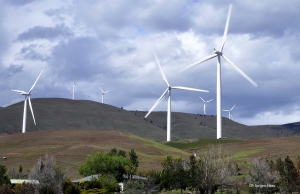
Wind turbines in eastern Washington.

[/media-credit] Wind turbines in eastern Washington.

Equally troubling to the QFs is what might happen when they need to upgrade their systems. Mr. Hilderbrand estimates he went to 30 to 40 banks trying to find one willing to loan him $20 million to construct his six-tower wind facility. He fears that when he needs to upgrade, which could easily run $10 to $15 million, a three year contract will make it impossible to find a lender.

Since the audience at Rep. Johnson’s forum included other legislators, both sides of the dispute aimed comments to bolster their positions. The legislators so far have been quiet on whether they will weigh in at the PUC.

“I think it is important that we have a dialogue about how we move forward as a community, a state and a nation,” Mr. Bolton wrote Envirogorge, “balancing the needs and costs of energy with the climate and the environment.”

That dialogue may well turn on PUC’s decision due in early 2016.

Piece by Piece

Sometimes I find myself standing, almost outside of myself, wondering why I do this. I wonder what the people driving past think: that I’m someone doing a community service sentence or that I own this stretch of land along Hood River’s Cascade Street? Usually when I pick up litter, I carry a used-plastic bag, one of the many I’ve found and cleaned from previous litter pickups. Today I decided to pile the litter up, and the pile has grown to an impossible-to-miss size.

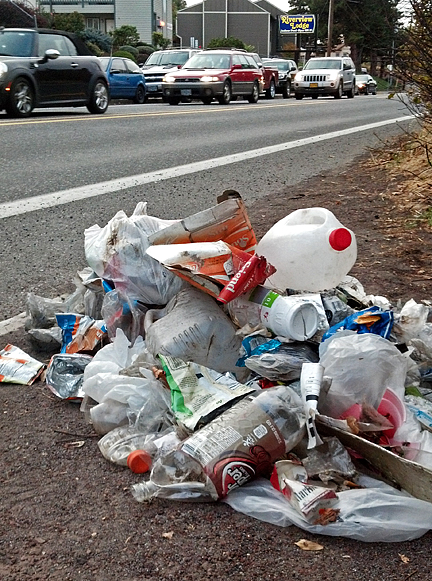
An hour?s work yielded this pile of trash picked up right along Hood River?s busiest street, Cascade.

[/media-credit] An hour’s work yielded this pile of trash picked up right along Hood River’s busiest street, Cascade.

I decided to pile it up, when it occurred to me how many people drive this road. Thirteenth Street ends here sending people onto what is Hwy. 30. On this late Friday afternoon, a steady stream drives past.

I feel good when I pick up litter: freeing plants from plastic bags or whatever covers them. They will once again get sunlight and rainwater after long hot summers. I usually get a peaceful feeling–like some kind of meditation, and so I try to do it with grace. But today, I feel some unfocused anger. Who or what to blame?

It’s dismaying to see how much accumulated in the months since I picked it up a year ago. I start to feel that I’m the only one who cares, the only one, period, who picks up litter. Other people tell me they do, too, but today I feel I’m the only one, heroic. I start thinking that the city, the county, and ODOT (who must own this stretch) should pay me to do this.

Once a guy walking behind me, as I made my way up the street picking up litter, told me I was on a futile exercise. But mostly through all the years, people have stopped or called out to say thanks. It always makes me feel great.

Years ago I sent away for a grabber. You can pick things up without bending over or getting your hands dirty. You ‘grab’ things that are just out of reach. Today it’s a big help, because the trash-filled bushes are so thick.

The first thing I pick up is a gallon milk jug half-full of now curdled milk. Holding my nose, I pour it out along the tall wood fence that lines this section. The white line stands out in the brown dirt. Moving a few yards west to avoid the smell, I start the pile with it.

I like people to see someone doing this happy, but today I’m defiant. Piece by piece the pile grows: an empty cigarette package, two chunks of rigid-black-plastic nondescript car parts, a liter pop bottle, a deflated pink birthday balloon–its perky message crumpled, candy wrappers, Styrofoam cups, potato chip bags, empty water and juice bottles, a brown-glass beer bottle, a plastic pop glass from McDonalds, a plastic container that once held cookies or crackers, innumerable plastic bags, another gallon milk container, a plastic clam shell, a newspaper advertising section, a smashed red plastic cup, paper sandwich wrappers, cardboard beer package.

The pile grows wider and higher till I begin to wonder if I will need to go up to the house and bring the pickup.

As passionate as I am about picking this stuff up, I TRY not to lecture. No one likes to be lectured. But I can tell you why I keep at it. I think that maybe this one plastic bag I pick up will not be washed into the sewer system, will not then sweep down the Columbia on into the ocean, and no sea creature will gobble it up thinking it’s some juicy morsel and fill it stomach with plastic that will slowly starve it to death. And I won’t have to see any more pictures that some good-Samaritan veterinarian will take of yet another sea bird, sea turtle, or whale with its belly cut open exposing a gut full of bottle caps, scraps of plastic bags, and bits of fishing line.

© Copyright 2013-2025 Columbia Insight. All Rights Reserved.

As a 501(c)3 nonprofit organization, all donations to Columbia Insight are tax deductible to the full extent of the law. Our nonprofit federal tax-exempt number is 82-4504894.