Stay Updated Subscribe today for the latest research + reporting about environmental news. Subscribe Now

Stay Updated Subscribe today for the latest research + reporting about environmental news.

Subscribe Now

Susan Hess

Susan Hess

Susan Hess

About Susan Hess

Susan Hess is Columbia Insight's publisher.

The Gorge

Defining the Gorge – Essay by Susan Hess.
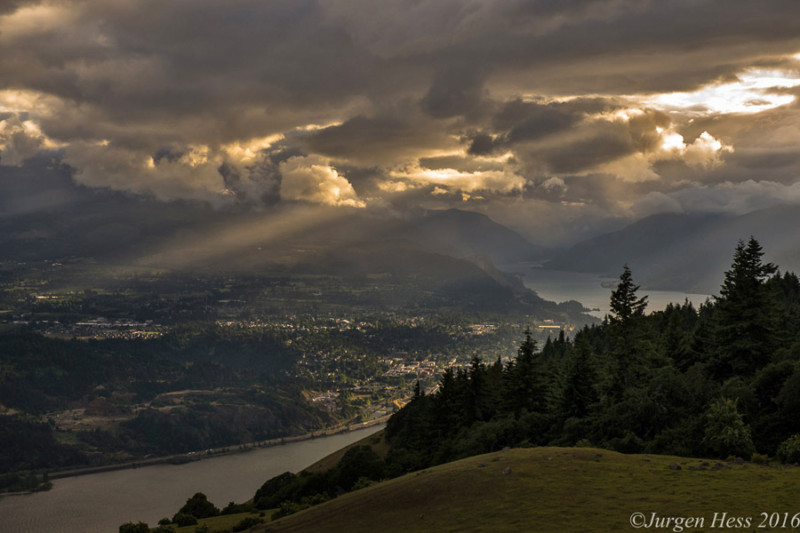
stormy-gorge_edited-1How to define the Gorge? Given that our name is EnviroGorge, readers expect that our stories will focus on happenings in the Columbia River Gorge. Yet a story by Azor Cole told about Reactor B on the Hanford Nuclear Reservation becoming a National Park. It’s not only puzzling as to why a building that made material for bombs fits with parks like Crater Lake and Mt. Rainer, but why we ran a story on a place north of the Tri-Cities.

A story on the over capacity on Gorge trails featured a photograph of a woman standing on a trail looking towards a waterfall. Alert reader Bill Uhlman pointed out: “Hate to quibble, but this waterfall is really not in ‘the gorge.’ It appears to be Tamanawas Falls, which is on Mt. Hood off of Hwy 35.”

Another reader asked why we did a story on Malheur National Wildlife Refuge—clearly far from the Gorge.

Fair comments. And ones that EnviroGorge staff and writers talk about with almost every story.

One definition is the boundary of the Columbia River Gorge National Scenic Area: the 80 mile stretch from the Sandy River at Portland’s edge to the Deschutes River west of The Dalles. But geographically the cliffs that hem the river reach many miles beyond.

When we look at whether a story fits our mission, we also look at the social, economic, political and environmental connections. Our mission: to start conversations about environmental and conservation issues that shape the Columbia River Gorge.

Hanford’s potential impact on the Gorge cannot be overstated. If the radioactive groundwater below Hanford continues leaking into the Columbia, it will poison every creature that lives in and depends on the river. No salmon. No windsurfing. What happens there, matters to the Gorge. We ran Azor’s story the month of National Park Service centennial.

Bill Uhlman’s point that Tamanawas Falls  seems outside the Gorge made us think carefully about why we felt it fit. What we considered in that decision is that recreation binds a huge swath: Mt. Hood to Mt. Adams and the Portland-Vancouver metro area to Maryhill.

The Malheur refuge is a critical nesting, feeding and resting spot for millions birds as they migrate. Many fly over the Gorge on their north and south-bound journeys. Many stop here. What happens at Malheur may mean the difference to the survival of cranes, ducks, eagles, and so many more.

In a story on the increasing number of oil trains passing through the Gorge, Valerie Brown looked to see what effect that would have on farmers getting wheat to market. Here the issue was the intricate connection between economic and environmental factors.

We depend on our readers to help us tell stories correctly, accurately and to question us when we seem off target. It helps us examine our decisions and use that for future stories. With the proliferation of ‘fake’ news we appreciate our readers that use critical thinking when they peruse media. Thank you for reading and commenting.
By |2019-04-11T10:11:50-07:0011/28/2016|News, Old Articles, Uncategorized|2 Comments

EnviroGorge Needs You

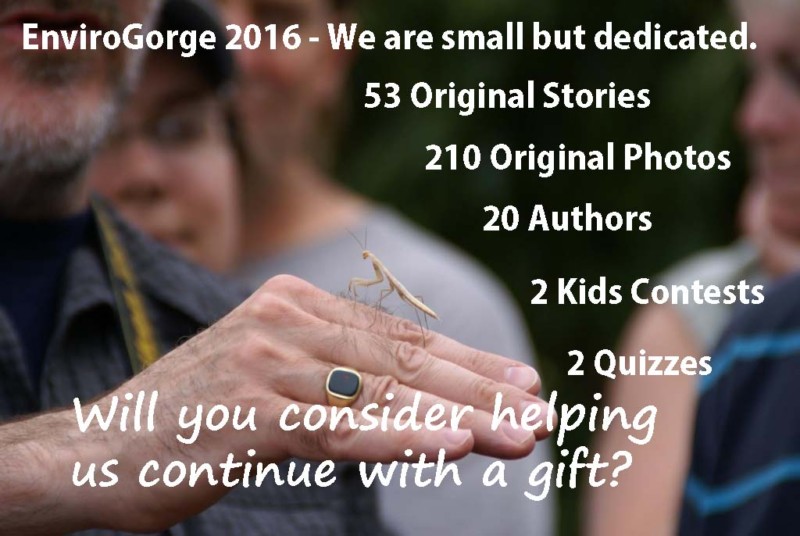
ask-photo-1024x686-revised-2You came to our magazine, EnviroGorge, as a reader seeking information and inspiration about the Gorge environment.

Now we come to ask for your help. The need for quality reporting on our Columbia River Gorge environment is greater than ever. Will you consider becoming a supporter by making a gift?

Envirogorge, LLC was founded with private funds, but to continue providing independent environmental journalism, we must now rely on your generosity.

We are launching a $10,000 campaign that will help?allowing us to pay talented local freelance journalists to tell the important stories of this special place, our home, the Columbia Gorge.

The Gorge holds a thousand treasured places between the eastern sage steppe and the Cascade Mountain forests to the west. One area I personally love: Columbia Hills State Park lying in the Gorge’s northeast end. You hike up a steep gravel road across grasslands to the rounded spine of the Columbia Hills. In spring, wind-pushed clouds pour over the ridge; wildflowers carpet wide-open acres.  Oak woodlands grow in the hills’ folds, sheltered from wind and summer sun. Tawny slopes fade east around a bend in the river. To the south, Oregon stretches to the horizons, topped by Mt. Hood.

This breathtaking spot encapsulates what I’m trying to do. I love this Gorge. Many of us do. And it seems to me it is worth doing things that make this place last—now more than ever.

[media-credit id=2 align=”alignright” width=”150″]SONY DSC[/media-credit]

For the upcoming year, EnviroGorge will use your funds to write about the issues and people important to you and our Gorge community. On our site you’ll see links to a few stories we’ve covered this year. These efforts take talented people doing good work. And, of course, money.

Will you help us continue to do this work for the Columbia Gorge in 2017 and beyond? Can you help us reach our $10,000 goal? We cannot do significant independent reporting without your help. We know many worthy businesses, groups and causes seek your help. We would be honored if you choose to support EnviroGorge.

Susan Hess, Publisher
EnviroGorge, LLC

Support Our Work

Click to contribute (Paypal, Visa, MC)

or mail to: P.O. Box 163, Hood River, OR 97031

-Continue our work $10-$30 

-Youth outreach $50-100 

-Hire Freelance writers $125-$250   

-Sponsor our site $300-$1,000            

Tell us what stories and themes you would like to see more of - we love to hear from our readers.

Gifts of $50 or more will receive a free non-invasive flower mix seed packet and will be entered into a drawing to receive a free copy of Landscaping with Natives in the Columbia Gorge by Jurgen Hess (please send us your address). EnviroGorge LLC is not a non-profit entity so you will not receive a letter for your taxes.

To advertise email us at Susanh(at)envirogorge.com. Don't forget to subscribe for free by hitting the subscribe button on the home page!

Thank you for your generosity!

Support Our Work


By |2019-04-11T10:12:06-07:0011/14/2016|News, Old Articles, Uncategorized|1 Comment

Packing it Out


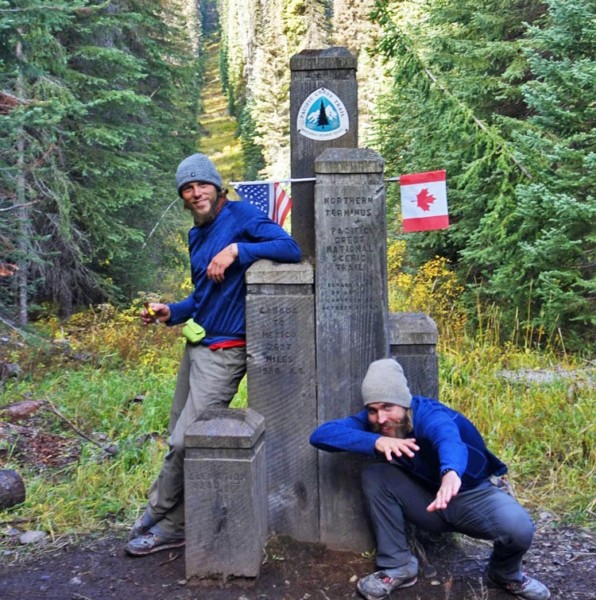
Seth and Paul at the U.S. Canada border along PCT trail.

Seth and Paul reach the Canada-United States border, the northern terminus of the Pacific Crest Trail.

Packing it Out. Something big. Something audacious. By Susan Hess.  Nov. 14, 2016. Photos courtesy of Packing it Out. Video by Miko Ruhlen

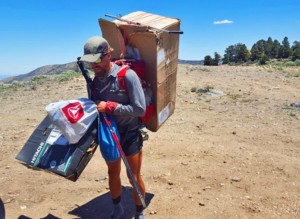
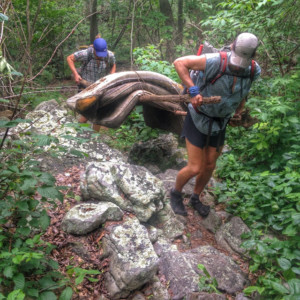
When you ask Seth and Paul what they picked up along the Pacific Crest Trail, the first thing they mention is the six-pound pair of boots. Not the 70-pound mattress, the red lantern, the TV frame, but the boots. Someone nailed an extra sole to the boots and lost or dropped them by the trail. Seth and Paul carried them 100 miles through the California Sierras. The 70 pound mattress they only had to carry a quarter mile. Really? Along a mountain trail?

Paul ‘Spice’ Twedt, 30, and Seth ‘Cap’ Orme, 26, met the summer of 2014 when they worked for a Minnesota wilderness guiding company. That winter, the slow time for guiding, they decided to hike the Appalachian Trail the next summer, but they also wanted to do something astonishing. Walking the 2,190 miles was not big enough.

On a visit home Orme went hiking. After a summer of being a guide, he automatically picked up trash as he hiked. “We set the example for the people we take out there. After a short hike, I was looking out, inspired by the beauty of the area, and holding a big bag of trash in my hand.”

Back in Minnesota, he told Twedt, “Man, we should try and clean up the whole Appalachian Trail.”

“That sounds audacious.”paultwedt-edited

They picked up 1,100 pounds of trash summer 2015. The trail’s often steep grades and scrambling over and under boulders took a toll on them. Twedt said he hiked in pain every day from planter fasciitis and bone bruising. But they had found their career. They went back home to plan, train, and get sponsors for the Pacific Crest Trail.

Seth Orme has startlingly blue eyes. He talks fast and with such animated intensity that you have the sense of being swept along as he tells why they decided to clean two trails that together equal almost one fifth the circumference of the earth.

?The idea we came up with, cleaning, is one aspect, but really the thing we?re trying to do is inspire other people. We want to inspire this higher level of environmental stewardship. We?re

[people] getting pretty good at cleaning up our own trash. We don?t do a very good job of picking up other trash that we see.?

For the PCT, they trained for seven months: did 100 pushups every day, ran 40 miles a week and arrived at Campo, California May 6, 2016 prepared, professional. “You almost have to create your own challenges,” Twedt said. Paul Twedt is tall, thin, soft spoken, words come measured. He and Seth picked  a challenge: to run 41 miles. Only later did they learned that  on the July  the heat index was 130 degrees.

balloon-editedpaul-balloon

Days on the trail were mixed with side trips for speaking engagements. On their northward journey, when they reached the California-Oregon border, they were days short to be at the PCT Days Event in Cascade Locks, where they were to promote their sponsors. They bought a train ticket and rode the rail line to Portland, and from there hitched a ride to the event. At the end of the event, they had to get back to where they got off the trail, which was the other side of Oregon.

“Because the goal with a through hike is that you want to hike the length of the trail,” Twedt said. “You want to connect your footsteps all the way.”

They hitched rides down to Klamath Falls, and walked the PCT back to Cascade Locks.

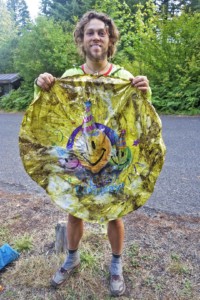
Every day on the trail they picked up trash. 721 pounds in total: 27 Mylar balloons, bottles, the mattress, TV frame, vases. And the boots. “Outrageous. Outrageously heavy,” Twedt said.

The two men weighed what they picked up every day with a digital luggage scale, but the figure doesn’t include the most common thing they cleaned up: toilet paper.

“We bury it properly,” Twedt said, “the way it should be buried: according to Leave No Trace principles. We don’t count it, because I would get really negative. There’s no way to quantify that without it affecting our mindset, ’cause there is so much of it.”

img_1314They also made sure the trash they picked got to a dumpster or trash can. Even the mattress. At an RV park near the trail, residents let them lean the mattress up against their dumpster.


But there are almost no photos of trash on their blog: Packing it Out. The photos are almost all of the beautiful scenery and the quiet peace of back country. “A lot of people get this negative mentality and want to say, ‘Those people are terrible,’ Negative reinforcement doesn’t work; it’s the positive reinforcement that works,” Orme said. “We keep a positive attitude while we’re doing what we’re doing. We try not to just show pictures of trash, because we don’t want people to just see the negative. We want people to see what we’re doing is beautiful. It’s wonderful. We love being out here. These outdoor places are worth keeping beautiful.”

“We want to be these high energy people that people can be inspired by,” Twedt adds.

Still there were times when they got the ‘trash blues.’ “We usually don’t talk,” Orme said. “We just pick up. If we talk, it’s probably going to be something negative. We both know it’s trash blues time. Let’s just do it. Let’s knock this out. We get serious then we give ourselves a high five. Then we get a milkshake.”

Every now and then when you talk with them, they seem so sure, so confident in themselves, in their ability to meet any challenge, in the rightness of their goal. You wonder if they can hold on to this optimism; become our modern day John Muirs.

Below: Video interview of Seth and Paul at EnviroGorge.


Spice and Cap reached the PCT terminus at the Canadian border September 28. After dedicating some time to reflect on the trip, they’ll start planning next year’s expedition. It may be biking across the country, a book of short stories from the trail, more speaking engagements and stopping at communities across the country taking people out on local trails.

“We do the extreme side. We’re out for five months living out of a backpack picking up all this trash. It doesn’t matter if you’re going for a five minute hike or you’re going out for a five month expedition,” Orme said. “We can all take a little bit of time to pick up the trash that we find. That’s our hope.”

Voting

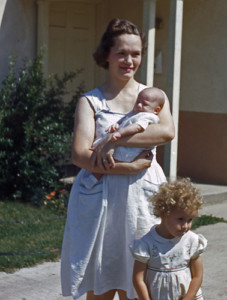
Josephine Webb holding Frank, w/ Susan Webb looking off-camera, Whittier, CA Aug 1945

Josephine Webb holding Frank, w/ Susan Webb looking off-camera, Whittier, CA Aug 1945

By Susan Hess. Updated from original version published in the Hood River News in 2008.

Emma Josephine Parsons Webb, my mother, voted for the first time at age 40.

“The company transferred us from Oklahoma to Montana in June 1952,” she said. “For the November presidential election, we didn’t meet Montana’s six month residency requirement.”

She talked to the election authorities, and they told her she could vote by getting an absentee ballot from Oklahoma. “Since we no longer lived in Oklahoma, we certainly couldn’t vote absentee,” she says. By the next presidential election, the company had transferred the family again, first to Wyoming then to Colorado, which required a one year residency.

“I missed the time frame by three weeks.”

Four years later, in 1960, having met Colorado’s residency law, the state granted my mother the privilege of voting for the president of the United States.

My mother was born in Washington D.C. in July 1920. In August of that year, the 19th Amendment to the Constitution gave women — 144 years after our country’s founding — the right to vote. Eight million of them did in that November. Susan B. Anthony and Elizabeth Cady Stanton whose long fight brought it about, died before they themselves got to vote.

Oregon doesn’t require you to live in the state for a specific length of time in order to vote. Brian Beebe, Hood River County Clerk, says you just have to sign the registration form saying you live in Oregon.

For people today, life means: working, fixing meals, going to the children’s games and concerts, doing laundry, spending time with family and friends, volunteering, exercising, or just taking time to sit and stare at the wall. We want to be good citizens, but frequently studying the issues gets crunched in the few minutes before work: speed-reading the newspaper or gobbling ten minutes of radio or television news before bed.

“Some people say they don’t bother to vote, because their vote doesn’t count,” Josephine said. “Maybe one vote isn’t that important, but it’s still a right many people fought hard to achieve.”

For African Americans, the 13th Amendment abolished slavery, at last, in 1865. The 14th, in 1868 made them citizens and granted all equal protection of the law. The 15th, in 1879, made it illegal to deny any citizen the right to vote because of race or color or because he or she was a former slave.

Yet, many places in this democratic union, whose outstretched arms promised freedom to the world’s ‘huddled masses,’ devised ways to block African Americans from voting: poll taxes, literacy tests, and outright refusals to register them. Not until the Voting Rights Act of 1965, were the barriers finally broken. How many African Americans, whites, people of all colors paved the way to the Act with beatings, lynching, jail time, and their deaths, we’ll never know.

And yet, in the 2000 presidential election, The New York Times found that Florida ballots of African American and Hispanic voters, and those of people over 65 were twice as likely as ballots of whites to be rejected.

Asian-Americans fared no better. Chinese Americans were not allowed to become citizens until 1943. Japanese Americans and other Asian Americans had to wait until 1952. Only when they achieved citizenship could they vote.

Up until 1970, you could be drafted, join the military, perhaps be wounded or die fighting for your country at age 18, but you couldn’t vote till you turned 21. The 26th Amendment corrected that injustice.

Today ex-felons in some states cannot vote. May sound fair, but what one state considers a felony, another rules a minor infraction. And black males are disproportionately affected. They make up 35 percent of all Americans barred from voting.

It seems a shame not to vote and vote with gusto. So many people in the world never get the chance. “There’s a lot of political name-calling and lobbying, but at least our elections today are held without having military or police forces needed to protect citizens at the polling places,” my mother says.

Here in Oregon, we don’t even need to leave our homes; we vote by mail.

I don’t have the answer as to how we find time to really know the issues or candidates’ voting records. I think no matter how much we study, we never get all the information we need or want. We do our best; read what we can; go to whatever forums and candidate fairs we can.

I hate to nag people about this; I think we’re nagged at about enough things. My friend Scott says I am nagging.

I am.

This right is too precious not to use. It’s a gift from Susan B. Anthony; Martin Luther King; from all the people who marched, fought through the courts and congresses, stood in front of police dogs and fire hoses; and all the soldiers whose life blood drained out on battlefields, so we could lift that pencil and mark ‘x.’

According to the Hood River County Elections Website, Hood River County’s voter turnout varies from 26 percent in a special district election to 85 percent in the last presidential election.  Turnout depends on how many candidates and issues are on the ballot, whether offices are contested or not, the level of publicity or controversy surrounding an issue or candidate, and whether an election concerns local, state or national issues.

The majority of the election turnouts don’t come near that 85 percent mark. The 2012 presidential election had an 85 percent voter turnout and at the time had 11,658 registered voters. Then, even in a big year such as the last presidential race 1,749 people that were registered did not vote. As of Oct. 3, 2016 there are 13,265 registered voters in Hood River County according to Mr. Beebe. If only 85 percent of them vote in the upcoming November election, that is almost 2,000 people not voting.

Why would 2,000 registered voters not vote?

It’s not only time that keeps people from voting: What possible difference does my one vote make in all the millions cast? One candidate is just like another. They make campaign promises and forget them when they get elected. They end up owing favors to whatever big corporation contributed the most money to their campaign. It doesn’t matter. In 2000, the majority voted for Gore, yet Bush became president. I dont care about the issues on this ballot. By the time people back east vote, the vote has already been decided.

It’s tough. It’s always been tough. When this country began, only white male landowners could vote. African Americans, women, Asian-Americans, and the young fought ignorance and prejudice. If you were one of them, it didn’t matter that you paid taxes, served in the military or lived here a life time.

Josephine Webb passed away in 2010. Once my mother got the right to vote, she never missed an election.  Not one. “Doesn’t matter if it’s for governor or the school budget,” she said. “What if everyone stayed home? What would happen?”

By |2019-04-11T10:12:43-07:0011/03/2016|News, Old Articles, Uncategorized|1 Comment

Singletrack

Chris Creasy biking at Post Canyon

Chris Creasy at Family Man

By Susan Hess. Sept. 6, 2016.

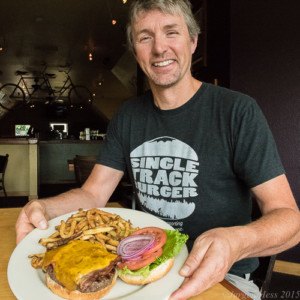
The Singletrack Barbeque Bacon Cheeseburger is a half-pound beef patty, topped with cheddar cheese, bacon, barbeque sauce, lettuce, tomato, onion—all somehow contained between a hamburger bun. This mountain-size burger 6th Street Bistro owners Chris and Stacie Creasy named and linked to mountain biking.

For every Singletrack burger sold, the Creasys donate $1 to 44 Trails Association and Hood River Area Trail Stewards (HRATS), two cycling organizations that build and help maintain trails in the Hood River area. “The way the system works is that we alternate on the months who gets what money,” said Mr. Creasy. “Say if January is one organization, February is the next. They just keep flip-flopping throughout the year.” In 2015 that amounted to almost $3,000.

“How great is it, that you have this local business that has taken this initiative to give back to our trail community,” says Heather Pola, Vice President on HRATS Board. The Creasys’ donation “is not earmarked for anything in particular, meaning it could go toward buying loppers, hose, rakes: meaning tools. It could be put toward our insurance. Having that on a regular basis is a great feeling.”

HRATS focuses on the Post Canyon trail system—land owned by Hood River County and managed primarily for timber production. Those trails appeal to the rider who wants action, speed, jumps, and obstacles. 44 Trails takes in the trails off Highway 44 on land primarily in the Mt. Hood National Forest. Those biking 44 Trails want a quiet time in the forest.

van

Chris and Stacie Creasy at Family Man

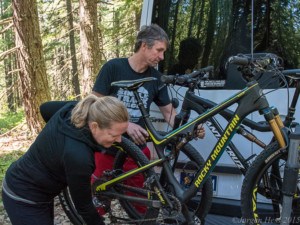
Chris and Stacie Creasy and Park Chambers contributions help fill the financial gap. Another business, Hood River Bicycles, also donates to both 44 Trails and HRATS. Owner Park Chambers gives $5 for each bike rental. The person renting a bike tells where they plan to bike and the money goes to the group for that area. That amounted to $6,300 since he started the program in 2014.

The two businesses “understand there is a ton of connectivity between the community and the National Forest,” says Jim Thornton, Recreation Specialist & Operations for the Mt. Hood Ranger District and liaison to 44 Trails. “44 Trails Association provides a link between the community and the forest. Having a relationship between 44 Trails and the businesses and the forest benefits: hikers, bikers, equestrians, hunters, and the forest.”

Trail maintenance funding has taken a heavy hit over the last 20 years. Federal and state money that used to go to maintaining recreation trails has instead gone to fighting forest fires. “In 1995, fire made up 16 percent of the Forest Service?s annual appropriated budget?this year, for the first time, more than 50 percent of the Forest Service?s annual budget will be dedicated to wildfire,” Aug. 2015 U.S. Forest Service report.

“We’re losing more and more trail miles,” Mr. Thornton says, “because of lack of maintenance or deferred maintenance. Then that increases use on a small amount of trails.”

Jim Thornton checking the compost

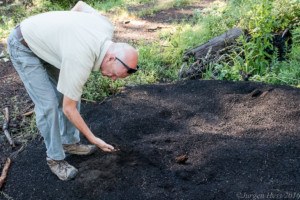
Jim Thornton checks compost from Dirt Hugger for the trails

On the trail system off Highway 44, Mr. Thornton uses the funds to buy a compost material to ‘armor’ the trails for the heavy bike and equestrian use those trails get. The material creates a hardened system with a 50 year life. Everything has to be extra strength, including waterbars. “The little hand-put-in waterbars won‘t hold up,” Mr. Thornton says.

“Besides the heavy trail maintenance on the trail tread, 44 Trails ‘logs out’ to a full width clearing limit.” That‘s about six feet. “The local business monies support these efforts. And is extremely helpful!” Mr. Thornton says. “An ungodly amount of blowdowns gets cut each year. I would estimate 1500 trees are cut per year to open these trails for use.”

Jim Thornton along on of the singletrack trails in the 44 Trails system

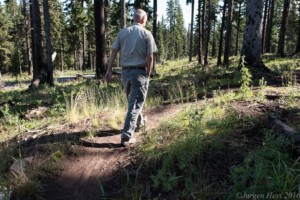
Jim Thornton along one of the singletrack trails in the 44 Trails system

Unlike most trails in Post Canyon, the trails in the 44 system are the burger‘s namesake: Singletrack. “It‘s a ribbon in the natural environment,” Mr. Thornton says. “Thoughtful consideration for the natural world in your trail alignment will produce a single track trail: 12 to 24 inches wide.”

He likes users “to have the feeling of brush hitting your face, hitting your elbows, your knees getting wet. To be touched by the natural world. I do less invasive work to protect the natural environment, to be respectful to the natural world and all the other ecosystems that live outside the trails—through proper alignment and consciousness.”

Burger

Chris Creasy shows off the Singletrack burger

The Singletrack contribution is “one of those things that I feel really proud to be supporting,” Mr. Creasy said. “I think it‘s making a difference for us as a business, because I think a lot of people come to Hood River to ride, and for me, because I really like to ride as well. It works out great. It really does.”

And if the Singletrack burger‘s calorie level is just too high, say you‘ve only ridden 15 hours, or you follow the vegetarian lifestyle, it also comes: veggie burger and salad.

Subi Salon: earth friendly beauty

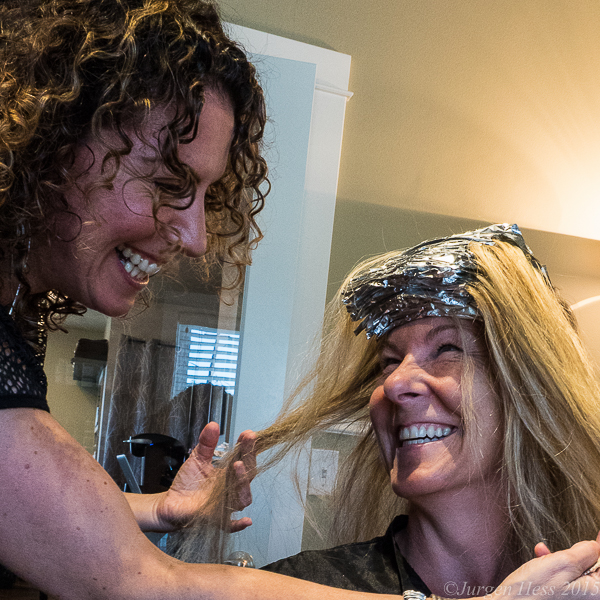
Some lucky people’s hair naturally holds sun-kissed highlights. But many, many people get red, gold, or violet—if that calls them—highlights from a beauty salon. It takes skill to weave the colors. A thin section of your hair is combed onto a paper-thin piece of foil, dye brushed on, foil closed, and repeated until your head looks like an ad for an aluminum company.

Subi (lt) shows the foils she's putting in Denice Bukovansky's hair.

[/media-credit] Subi putting foils in Denice Bukovansky’s hair

For years, the used foils could only go in a landfill, because of the chemicals contained in the coloring solutions or because they were plastic-coated. A solution came seven years ago when a Canadian man waiting to get his hair cut noticed how many women were getting their haired colored and wondered what happened to all the used foils. Very little it turned out. He began doing something about it. His company Green Circle Salons found a way to repurpose them.

One of the company’s newest members is Subi Salon in Hood River. Owner Subhadra Katz, Subi, is holding a grand opening in her new Hood River heights location Aug. 12, 2016 from 5 to 7 p.m. In the interest of full disclosure, Subi is the author’s hairdresser. Subi radiates energy for every aspect of hair care and for eco-friendly hair products and recycling.

“I have a thing that nobody knows about and I want help to get the word out: I collect all beauty products for Ann Marie Jelderks. And that can be anything: toothpaste, mascara, deodorant, hair products, any makeup,” Subi says. Ann Marie ships it to Terra Cycle, who recycles them (and almost everything). The money Ann Marie receives she donates to FISH Food Bank.

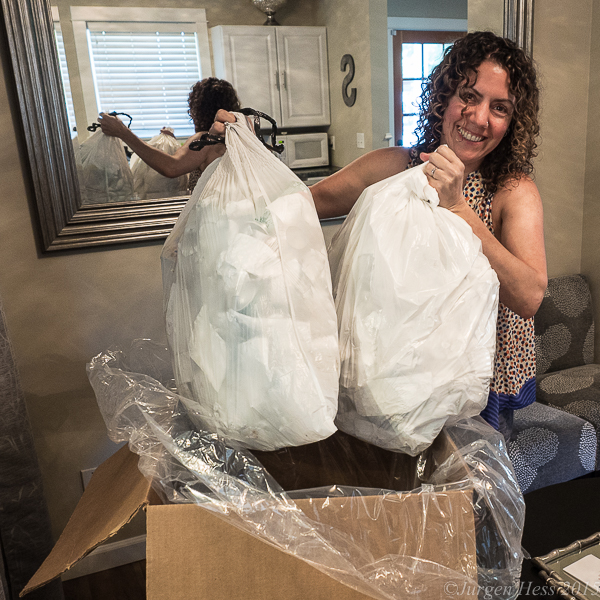
[/media-credit] Foils ready to be shipped

Green Circle Salons (GCS) takes the used foils and color tubes, the snipped-off hair, and left-over coloring.

Foils and tubes: “They take all the foils?tons and tons and tons,” Subi says. North American hair salons toss away over 109,000 pounds of foils and color tubes every day, writes Will Simpson, Business Development and Education for Green Circle. The metals are sent to a recycler, where they’re smelted to liquid form, turned into ingots and sold to manufacturers. It became practical to develop a way to process them once there was a sufficient quantity.

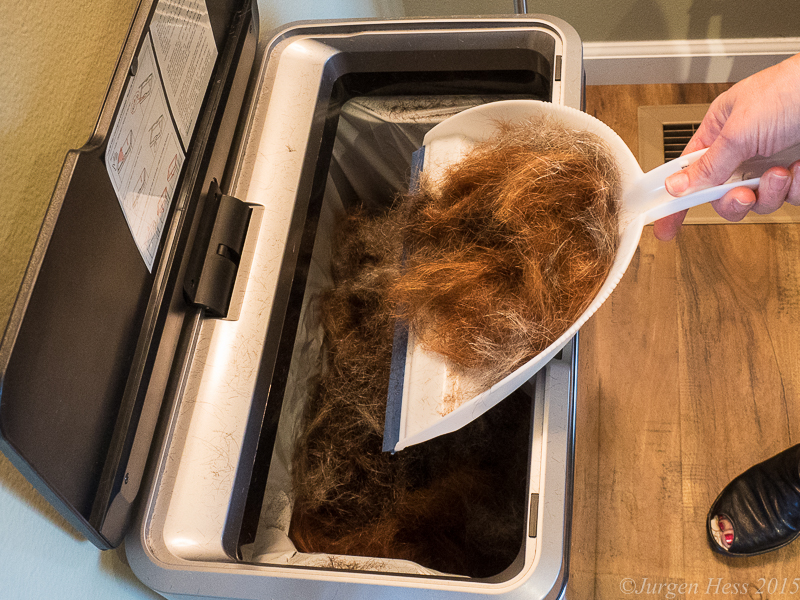
Hair clippings: “The thing about hair is that it is so absorbent,” Subi says. GCS came up with the idea of stuffing the hair into nylon stockings to make oil spill booms. The company pays women at a minimum security correction facility to make them. The booms work on land and in shallow water spills, but not in deep or fast flowing water. GCS also developed a prototype flat mat made by felting hair. The mats are designed to filter storm water in municipal drains.

Green Circle Salons provides specialize waste containers.

[/media-credit] Green Circle Salons specialized waste containers.

Hair color. “When you’re rinsing a color, there’s no way to be 100 percent accurate. There’s always some left,” Subi says. In most salons it’s rinsed down the drain, where it goes into the storm sewer system, but the chemicals aren’t filtered out and go into the rivers, lakes and ocean. GCS sends hair color leftovers to a chemical waste treatment company–the water is removed and the remaining solution neutralized.

“There is no money to be made from the materials: foils, hair, color,” says Will Simpson. Instead the company earns money from an Environmental Stewardship Fee. Salon owners ask clients if they would like to pay $1 for the service. “I haven’t found anyone yet who says no to paying the green fee,” Subi says. “At the end of the month—it’s all on trust basis—they ask me how many clients I had, and I pay that many dollars per head. I’m happy to cover it if the clients don’t want to.”

All the used material go into a large shipping box GCS supplies. When the box is full, Subi calls UPS to pick it up and it’s shipped via UPS carbon neutral shipping.

Besides color agents, salons also use shampoos, conditioners, styling gels and more. Subi’s preference is Davines products. “They’re 100% biodegradable, organic,” she says. “They’re cruelty-free, gluten-free, paraben-free, sulfate-free and vegan. Parabens and sulfates are the two big culprits in the beauty industry.” Davines offsets its environmental impact by using renewable energy in its plants and offices.

Subi’s hope is that all the salons in Hood River join Green Circle and carry eco-friendly products. “There’s no reason for us all to not be doing it. And we could even say Hood River is all beauty sustainable. It would be a great thing to claim for our town.”

© Copyright 2013-2025 Columbia Insight. All Rights Reserved.

As a 501(c)3 nonprofit organization, all donations to Columbia Insight are tax deductible to the full extent of the law. Our nonprofit federal tax-exempt number is 82-4504894.