Stay Updated Subscribe today for the latest research + reporting about environmental news. Subscribe Now

Stay Updated Subscribe today for the latest research + reporting about environmental news.

Subscribe Now

Susan Hess

Susan Hess

Susan Hess

About Susan Hess

Susan Hess is Columbia Insight's publisher.

Eagle Creek Fire Tues. 9-5-2017
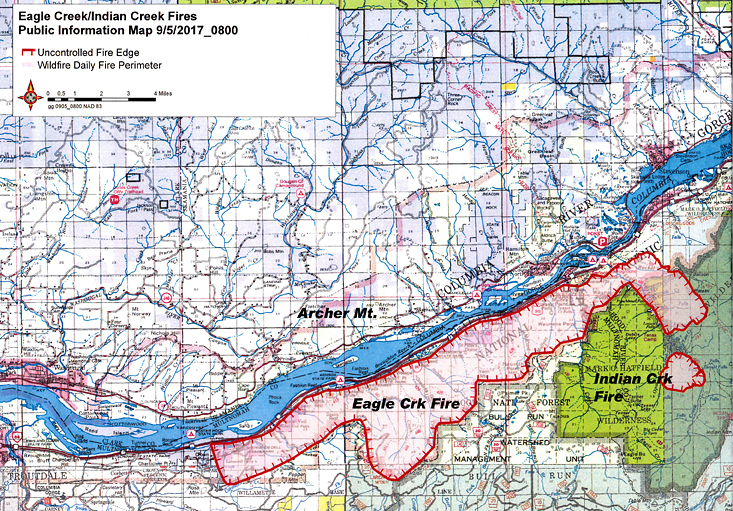
 

Eagle Creek Fire.  12 noon. 9-5-2017 Tom Berglund, Public Information Officer for the fire reported this morning, “The fire blew up last night to over 10,000 acres pushing the fire west to Corbett. The town of Corbett is requesting help. Ember started a fire on Archer Mountain in Washington. The focus of efforts is on protecting lives and structures.” For more: https://inciweb.nwcg.gov/incident/5584/

Evacuations area have been expanded.

I-84 is now closed westbound from The Dalles at MP 87 (near bridge). It remains closed east and west bound from Hood River MP62 to Troutdale. For more info: odot.com or wsdot.com
By |2018-09-30T06:35:22-07:0009/05/2017|News, Old Articles, Wildfire|0 Comments

Eagle Creek Fire updates

Eagle Creek Fire. Monday, 9-4-2017, 7:00 p.m.  

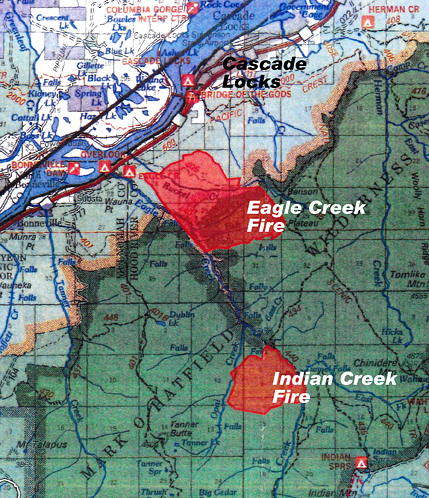
Fire officicals have combined the Eagle Creek and Indian Creek fire to be managed under one Incident Management Team.

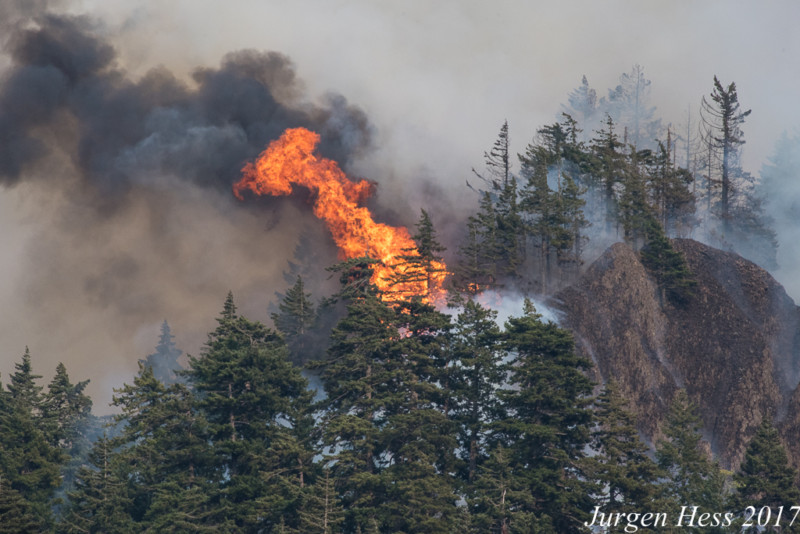
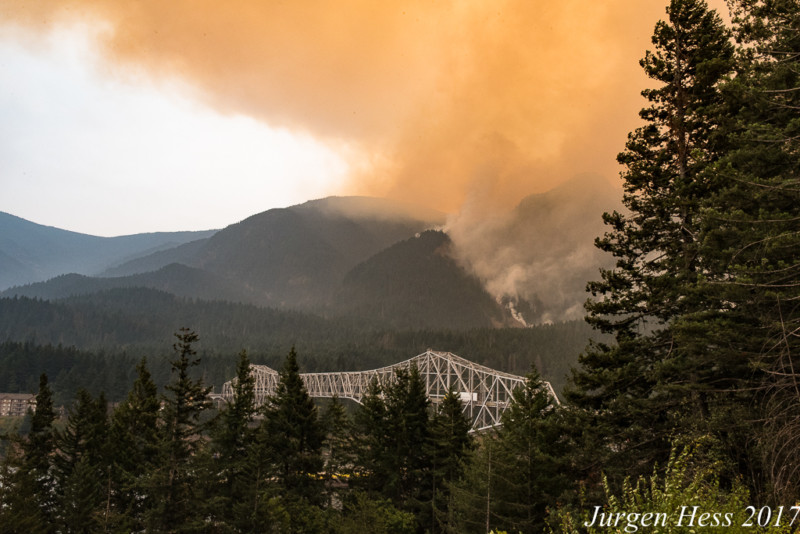
Fire reached ridgetops by Mon. afternoon. Bridge of the Gods in foreground. See more photos and fire map below.

ODOT issued late the afternoon the following highway closure alert:

  • I-84, 2 miles West of Hood River MP 62; Closure
    The highway is closed WB at Exit 62: West Hood River / Westcliff Drive. Trucks use US-26 as alternate route.
    Updated: 09/04/2017 5:53 pm
  • I-84, 4 miles East of Multnomah Falls MP 35; Closure
    The highway is closed EB at Exit 35: Ainsworth State Park. Trucks use US-26 as alternate route.
    Updated: 09/04/2017 5:53 pm

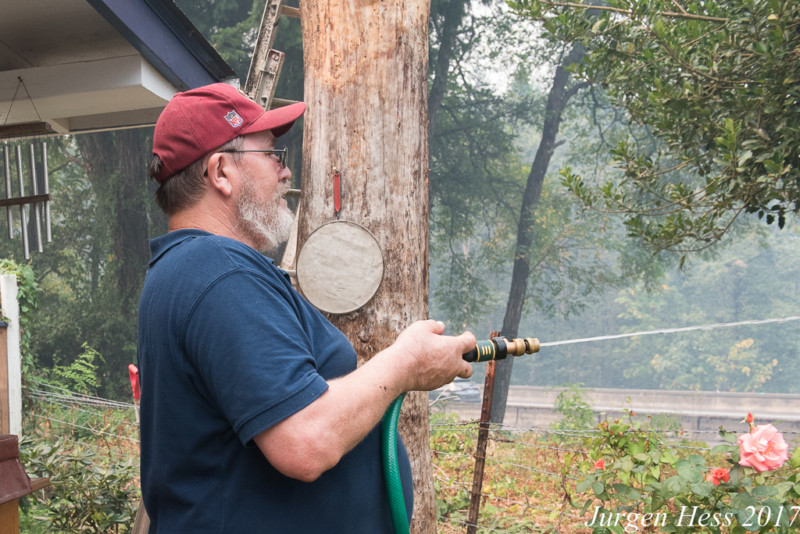
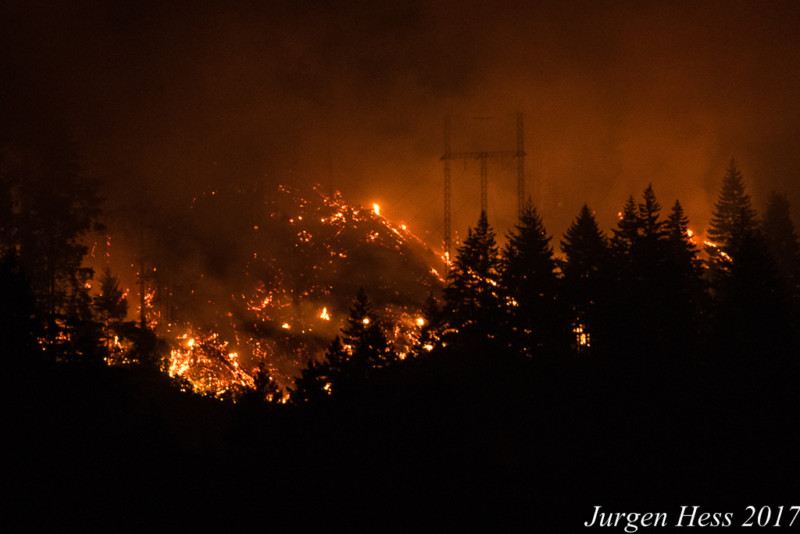
Photos below: Map of fire comlex. Cascade Locks resident Dave Gierke watering roof and lawn to protect his home. Night photo: BPA transmission lines eerie silhouette in the fire glow.

Incident Commander, Shawn Sheldon said there will be an infrared flight over the fire tonight to determine the boundary of the fire and locate hotspots.  For more information: https://inciweb.nwcg.gov/incident/5584 or Incident contact phone: 541-392-1632, email: eaglecreekfire2017@gmail.com.

By |2018-01-22T10:54:46-08:0009/05/2017|News, Old Articles, Wildfire|4 Comments

Eagle Creek Fire within quarter mile of Cascade Locks

Eagle Creek Fire, Monday. September 4, 2017, 1:30 p.m.

The fire is now at 3,200 acres. No additional evacuations have been ordered since yesterday, said Hood River County Sheriff Matt English. Rock Creek Center across the river in Stevenson, Washington is providing a place for evacuees. English had just returned from there and said everything is going well. “The highest priority is structural protection,” English said.

Pieces of burnt conifer needles and ash were falling even 20 miles away in Hood River and White Salmon.

Oregon Governor Kate Brown has invoked the Conflagration Act, which means that all the structural (city/county) fire departments that can come to help get reimbursed for their costs.

Cascade Locks resident Dave Gierke lives on SadieB Drive, on the south side of town. He has sprinklers going on his roof and all around his house. “I’m going to stay and protect my house; I want to keep everything moist. I’m hoping for the best.”

Lt. Jim Pulito, with Columbia River Fire and Rescuse, Sacoppose, Oregon is currently stationed nearby on Sternwheeler Drive and Spelling Place. He brought a crew of 18 and three engines.

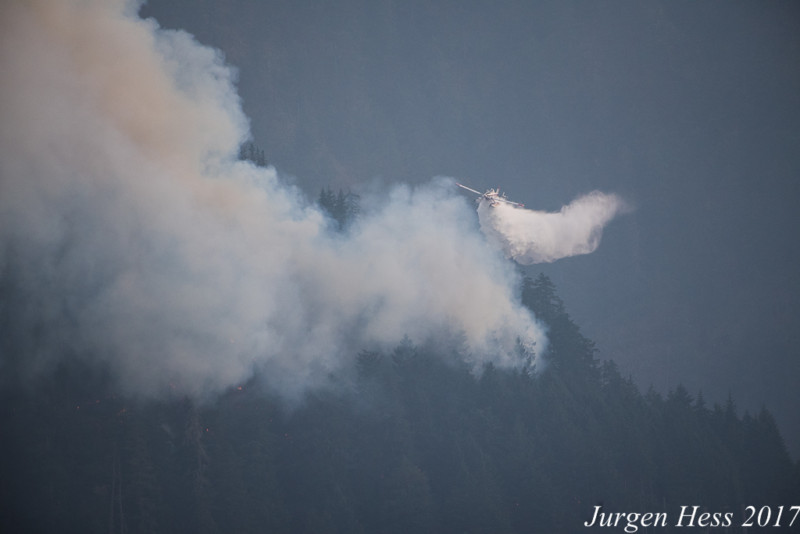
“There is five mile closure around the fire for all aircraft and drones,” said Mike Renault, Hood River County Reserve Deputy. This will take in part of the Indian Creek Fire now just two air miles away from the Eagle Creek fire. Fire Bosses (an amphibious scooper air tanker) continuously swoop water from the Columbia, drop water on the fire, and fly back to the Columbia to reload.

“After the danger is past, we will be working to get people back into their houses,” Sheriff English said. “Right now it is important to have good collaboration and communication between all the different fire departments and agencies.”

Hood River Fire Department Facebook page has additional information.

Eagle Creek Fire. Sunday, Sept. 03, 2017. 7 p.m.

[media-credit id=2 align=”alignright” width=”1024″][/media-credit]

In Cascade Locks, Oregon, 283 homes, including 15 businesses, have been evacuated today due to a forest fire now burning within a quarter mile of the town, Incident Commander Loretta Duke told EnviroGorge. The Multnomah County Sheriff department has gone door-to-door advising people of the evacuation notice.

Fire investigators have determined that the fire was started by someone on the Eagle Creek Trail using fireworks.

The fire started Saturday. As of this evening the fire is being pushed east by winds. There is a high probability that the wind direction will shift tonight. Airplanes, called Fire Bosses, are scooping water out of the Columbia River and dumping it on the fire.

Smoke is a health concern in the area of the fire and those with health conditions affected by smoke should stay indoors, said Rachael Pawlitz, Public Affairs Officer for the Columbia River Gorge National Scenic Area.

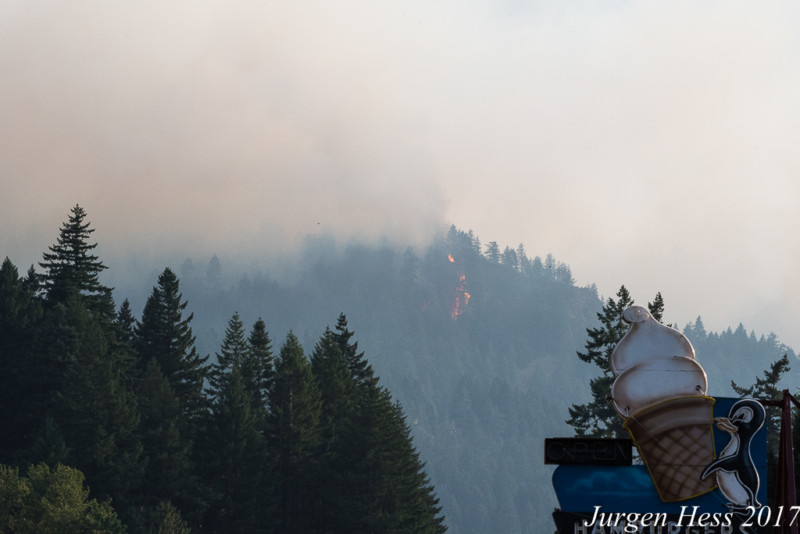
Fire seen from Cascade Locks.

Fire Boss dropping water on fire.

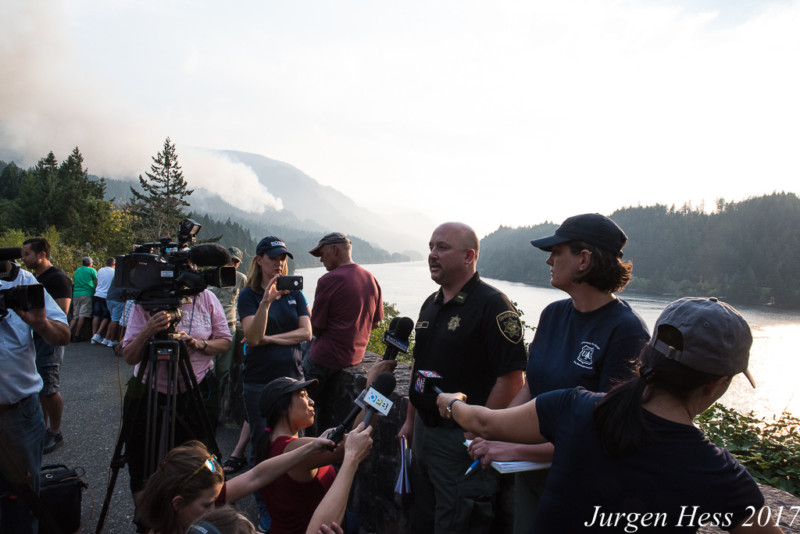
Rachael Pawlitz, CRGNSA at, press conference.

By |2018-09-30T06:40:20-07:0009/04/2017|News, Old Articles, Wildfire|0 Comments

Sign up to tour energy plant and landfill

Join the EnviroGorge Tour:
Roosevelt Regional Landfill & Klickitat County Gas-to-Energy Plant
Thursday September 28, 2017

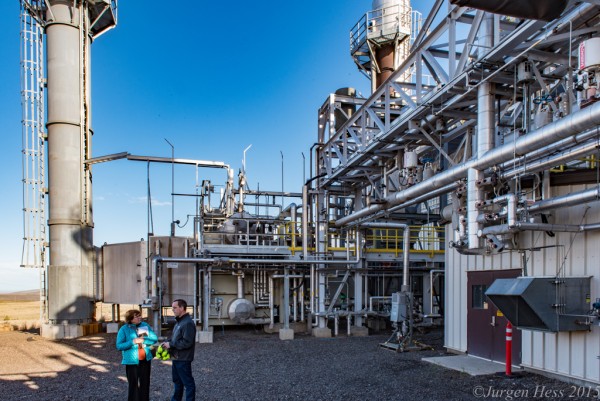
Find out where your garbage goes. See how landfills turn trash into electricity. Learn how a landfill works. See the newest job creator. We’ll take a private tour with managers of Roosevelt Regional Landfill and Klickitat County’s gas-to-energy plant–the largest in the U.S. See the newest way to reuse our waste: a metal recovery plant on the landfill.

Date: Thursday, September 28, 9 a.m. to 4 p.m.
Meet: Hood River
Cost: $45 for person includes snacks and transportation.
Leader: Susan Hess
Advance registration required. As the bus holds 16, so please book today! 
Register online in advance through Hood River Community Education.

If you need help with online registration , contact:
Hood River Community Education at 541-386-2055 or EnviroGorge susanh(at)envirogorge.com

Learn more by reading Landfills: Garbage the New Gold.

By |2017-08-31T22:20:54-07:0008/31/2017|News, Old Articles, Waste Management|0 Comments

Competition for Water Heats Up

By Susan Hess. Aug. 14, 2017. John Buckley stood at East Fork Irrigation District’s headgate looking up the river. It’s one of his favorite places.

The East Fork of the Hood River runs through a dense forest at that spot, rumbling over the rocky bed, rocks swept down off Mt. Hood.

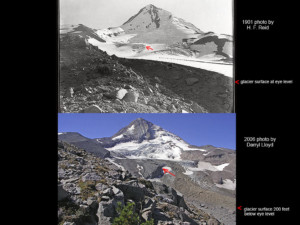
Mt. Hood’s shrinking glaciers by Darryl Lloyd.

Buckley, the district’s manager, comes to this critical spot often. It’s where East Fork diverts the amount of water it’s allowed. Since the 1890s, the district has held a legal right to take water from this river.

Each summer Mt. Hood’s glaciers’ slow melt provided farmers ample water. But scientists predict that the glaciers will lose 96 percent of their current size by 2100, and that East Fork may be dry in late summer, when crops need it most.  

“To meet climate change,” Buckley said, “we plan to put in maybe two to three medium size reservoirs, and put in more piping to convey water rather than open canals. And pray a lot.”

The planned reservoirs will capture rain and seasonal snowmelt. What will the water right be then? How will it affect the water rights of those downstream? Whose rights come first: cities? agriculture? fish?  wildlife? One always comes last.

The issue has led to heated fights and the upending of long held rights in the Klamath Basin, the Sacramento River, and the Colorado River. Those who cannot speak for themselves often get pushed to the back of the line or overlooked as OPB’s feature pointed out in  Birds Take Backseat To Fish, Farms In the Klamath Basin.

The right to water. In the western United States (west of the Mississippi River) water law is: first in time, first in right. In the west, the first person to get a water right on a stream/river is the last to be shut off in times of low flow. First come, first served. In Oregon and Washington every molecule of water has a right attached to it. Still, more people are and will be looking for water.

In the next 20 years, Hood River County’s population is projected to increase by 25 percen—adding over 6,000 people, Wasco County by 4,400.

With no access to new water rights there are increasing attempts to privatize public water. People who live in the Columbia River Gorge saw this first hand with Nestlé‘s proposal to obtain the publicly owned rights held by Oregon Department of Fish and Wildlife. Their application is still to be processed. Whatever is ahead, agriculture is on the front line.


In the Gorge, agriculture holds the largest amount of water rights.

2014 was the hottest year on record for Planet Earth. 2015 hotter. 2016 hotter yet. The planet has now had three consecutive years of record-breaking heat. And drought is temperature driven.

“We’re seeing more volatility in temperature year round and higher spring temperatures,” said Mike Omeg who grows cherries on 330 acres south of The Dalles. “We come out of spring same as in the past. But it warms up quickly. 2015 was the earliest year ever, and 2016 beat that.

“So we irrigate with more intensity earlier. Crops grow faster because of higher temperatures. We may begin watering three weeks earlier and then at the end of the irrigation season, water three extra weeks. So total amount of water we use increases.”

Four Hood River County irrigation districts hold water rights: East Fork, Middle Fork, Farmers, and Dee. In Wasco County, the main district is The Dalles Irrigation District. The two counties use different water sources, and because of that, their effects on the environment differ.

Hood River’s irrigation water comes from Mt. Hood. The Dalles Irrigation District pumps water out of the Columbia River.

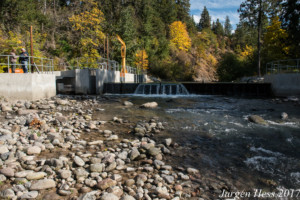
EFID head gate. The district keeps 15 cubic feet per second flowing past this diversion to ensure water for fish.

Hood River irrigation districts divert water coming off the mountain high up in the valley. It’s a money saver because water can be gravity fed to patrons.

The problem with taking water out high in the watershed is that it decreases instream flows and that impacts fish. “If you’re taking it out higher up in the system, it’s not available for aquatic organisms for a good portion of the length of the stream,” said Cindy Thieman, Hood River Watershed Coordinator. “Salmon in particular are going to be occupying those areas downstream.”

“It’s living space for fish,” Thieman said. Less water equals less fish habitat for food and spawning and increased disease. Stream and river temperatures rise, especially in late summer. The Hood River (main stem) is listed by Oregon DEQ for exceeding temperature standards.  Salmon need cold water. Every degree rise decreases oxygen for them to breath.

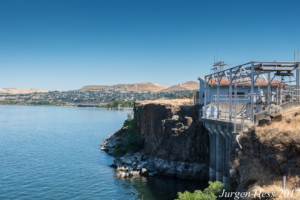
The Dalles Irrigation District (TDID)  The district pumps out of the Columbia to reservoirs 1,300 feet uphill. Pumps push enormous volumes of water up an elevation equivalent to a 120 story building.  Water is heavy. Power is expensive. Through a long term agreement, the Bonneville Power Administration sells power to them at cost.

The Dalles Irrigation District water intake on the Columbia

“Without that rate, the assessment would be  astronomical,” said TDID Manager, Danny Saldivar. “For smaller farmers it would affect the way they do their farming.”

The issue for fish is that irrigators are pumping water out of the Columbia River along its entire length. This is a basin that stretches to the Tetons and far into Canada. Cumulatively they leave a river often too hot for sturgeon, lamprey, and salmon–they, too, have water rights.

The State of Oregon has instream water rights to protect fish. But those rights are junior rights, for some puzzling reason not acquired until 1987, versus FID’s 1874 right. All Hood River irrigation districts hold rights senior to instream, said Les Perkins, Farmers Irrigation District Director. So in a drought, they have a legal right to dewater the rivers. “But,” Perkins said, “it would be folly to do that.”

The Tribes’ rights. The Confederated Tribes of the Warm Springs treaty gives them the right to fish throughout their ceded lands, which takes in all of Hood River and Wasco Counties and beyond. Even though the Tribes want to keep water in the rivers for fish and the districts want to take it out for crops, there is a mutual respect between them. East Fork has agreed to keep 15 cubic feet per second always flowing in the East Fork of the Hood River. Still, the tribe has made it clear that to protect fish they would sue to prevent dewatering.

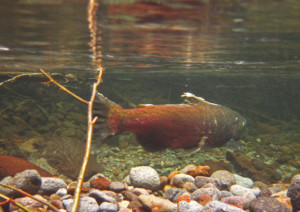
Blaine Eineichner photo: Chinook Salmon

The Cities. Millions of people depend on Mt. Hood for water. On the mountain’s west slope lies Portland’s Bull Run Reservoir, to the north the City of Hood River owns three springs, and to the east side signs mark the boundaries of The Dalles watershed. You would think that fish, which were here long before humans arrived, would have a prior claim on water, but as with the irrigators, the city’s rights are senior.

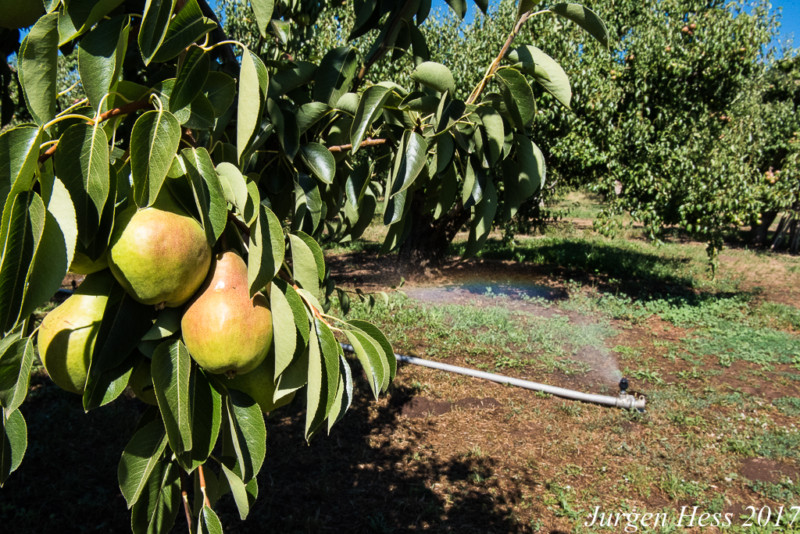
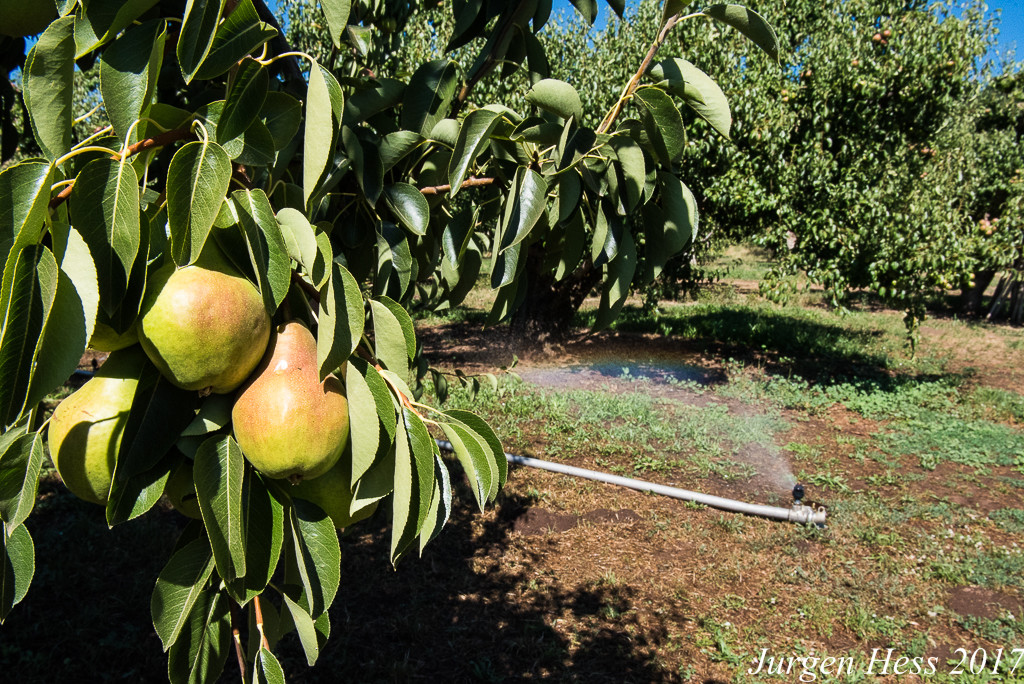
Meeting competing demands. One way to get more water to meet demand is to eliminate waste. Farmers, as a group, are way ahead in using water more efficiently. One method is using pipes instead of open canals: reducing water loss due to seepage and evaporation by 30 to 40 percent. Perkins said, “We are using half as much water per acre as we were 30 years ago.”

FID and Middle Fork systems now are almost completely piped. The Dalles entire system is piped and pressurized. The most gains will come from piping East Fork’s remaining canals.

Districts encourage using micro-sprinklers or drip irrigation and installing soil moisture probes.  Just as farmers are becoming more efficient, a new water user is converting farm land.

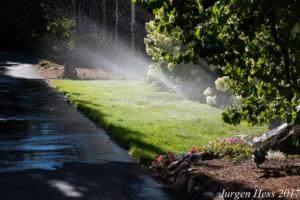
In a subdivision west of Hood River, a home owner waters lawn  and pavement mid-afternoon on a 101 degree day with irrigation water.

Rural residential.  Irrigation districts formed to provide water for crops. But throughout Oregon and Washington farms are sold and subdivided into residential developments. The water right attached to farmland passes on to the subdivision. Whatever that amount was now must be divided among the residential parcels, the water now used for landscaping and lawns. Half of Farmers Irrigation District’s 1,850 accounts are now small parcels: 338 of them within the City of Hood River.

Unlike in cities where each molecule is metered and the owner charged accordingly, irrigation districts charge a flat fee. So there is no incentive for rural residential users to use water conservatively. Some may, but overall residences use more water per land area than agricultural users.

While the obvious solution would seem to be to put in meters, Perkins said that meters require more maintenance and staff time. Already, he says, 70 percent of their summer staff’s time is spent dealing with small land holders.

Future: If scientists’ predictions hold, in eighty years only four percent of Mt. Hood’s current glaciers will remain. Hood River valley irrigators’ plans are already underway. Farmers Irrigation is raising Kingsley Reservoir eight feet. Middle Fork hopes to raise their Lawrence Lake Dam three feet. East Fork hopes to have their systems piped by 2040, and reservoirs built. The Dalles Irrigation District is not worried, they don’t see the Columbia River running out.

Outside the reach of irrigation districts, wells have provided water. With wells, orchards and vineyards supplanted dryland wheat, sagebrush, cattle grazing. Well owners, too, have water rights, but a 2016 Oregonian series,‘Draining Oregon,’ showed that the state is giving out more water rights than are available, causing water levels in aquifers, streams and neighbors’ wells to drop. Cherry orchardist Omeg said their well that for decades has provided 1,500 gallons per minute now delivers 600.

Cities guard their water supplies. They have the most voters who can pressure lawmakers to put their needs above salmon and agriculture. While irrigation companies work to be efficient they are clear that in a severe drought, their duty is to serve patrons first. That would leave fish in a bad place. Irrigators dewatered part of the Deschutes River three years in a row stranding fish. Volunteers using buckets and nets rescued as many as they could.  

“Water is a resource we can’t live without,” said The Dalles Irrigation’s Saldivar. “If we continue to not respect the resource, it won’t be around in the future. We’ll run out.”


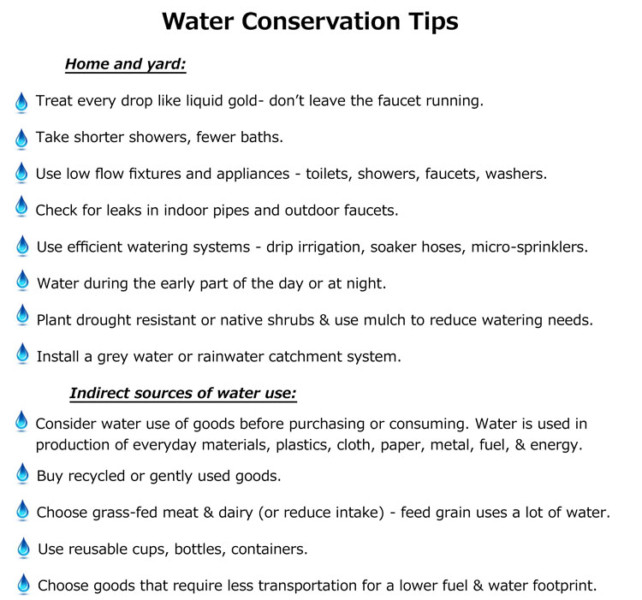
Learn about your household’s water foot print by using a water calculator like this one from Grace Communications Foundation: http://www.watercalculator.org/complete/


RELATED POSTS


A Mountain of Difference

Opinion Piece by Editor Susan Hess.

Originally published in 2004 in the Hood River News. Re-published here because it seems timely right now — in light of the affordable housing debates throughout the greater Gorge and Portland areas.

The man with the compact SUV invites Jurgen and me to ride with him up to the Mt. Adams cross-country ski trail we’ve all volunteered to brush out.  

“Where do you live?” he asks.

“In Hood River.”

“Oh. Nice to have some outsiders come and help.”

Outsiders? I think, We just live across the river. Instead I ask, “How long have you lived around here?”

“We moved here in 1998,” he says. He tells us he and his wife live near Trout Lake sixty percent of the year, but also own a condo in Portland, and another in southern California. I hope my mind will just ignore it, but no, it’s already thinking, Three houses? I want to ask him if it wouldn’t be cheaper to just rent during the short time they stay in the other towns.

A Columbia Gorge house with a large footprint.

I don’t, because I don’t really want to know. If I asked, it wouldn’t really be a question. I’d just be making a point—that there are hundreds of thousands homeless, and millions without adequate heath care. I want to say that we dam wild rivers, burn coal, or pipe gas to generate power in order to heat and cool places vacant most of the time.

I don’t want to insult the man. He seems like a person whose team you’d like to be on at the company picnic—the kind who would take everyone out for ice cream afterwards. Yet I know, as hard as I try, the way I feel shows. I don’t know how. Maybe it’s what I don’t say or the questions I don’t ask. Maybe my eyes say what my mind thinks, but I don’t say anything.

He’s proud of his success. He makes enough money to own three houses. Yet Jurgen and I say nothing. He must sense something, yet continues friendly chatter as we wind up the gravel roads.

At the trailhead, the five of us, four volunteers and a Forest Service employee, pull out clippers and saws and start up the steep trail in the already warm morning. Our driver tells us he’s planted hundreds of trees on his land. I admire that. We finish by noon, eat lunch and join the other seven working on a trail several miles away. By 2 p.m., the trails are clear and ready for next winter snows.

Yet, I finish the day frustrated.  I volunteered because we love to cross country ski, and that sport’s trails mostly use old logging roads making them pretty easy on the environment. Ten or twelve of us spent most of a day working on a project that benefits us directly. And this was the second trail work party this summer.

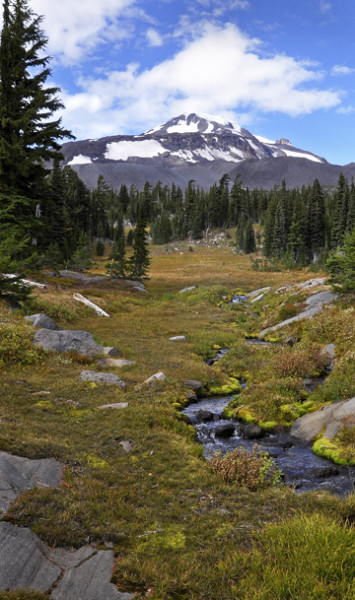
[/media-credit] Gotchen Meadows, Mt. Adams

To reach the trails, we drove up one-lane gravel roads through dense stands of pines, firs, and larch. Scarlet gilia, Indian paint-brush, orange lilies bloomed along the road. Snow covered Mt. Adams rose above the ridge tops. Everyone in the work party loves to ski and hike here because of the beauty, and yet we all drove past miles of roadside littered with discarded pop and beer cans, oil bottles, water bottles. Why is it so rare to enlist a work group to clean this place?

I wonder about the man who drove us here. Not him specifically, but the millions who with a similar lifestyle, who love nature so much they ski, mountain climb, hike, kayak, windsurf—any kind of sport to be out in the wilds—and then build larger and more homes and offices than they need, which end up destroying the very natural areas they love.

Later, a friend disagrees with me. “It’s the success of people like him who bring jobs, who fuel the economy, and who donate their time and money to causes like trail clearing.”

I always get to this point. Maybe it’s my mother voice in my head, but I think, who am I to be looking and judging other people’s lifestyle. Do I live that simply?

Still, I think about all the car gasoline fumes and aviation fuel exhaust misting down on the forests he loves as he travels between homes. Do we think one person’s affect makes so little difference? My friend tells me I don’t know why our driver keeps those houses or why he has to travel between them. True. And I stop talking to her about it. I’m not talking about one person; I’m thinking how many just like him have multiple homes. What if we all had three homes? Can earth sustain the impact?

In the movie Dr. Zhivago, two people talk about people cutting up furniture, anything wood to burn in the freezing winter. One says that surely it can’t hurt in desperate times. The other replies: not one person, no, but a million, yes.

Several weeks ago, Jurgen and I tried to reach the trailhead to Lookout Mountain. Five miles up, snow blocked the road. We decided to slowly make our way back down and pick up litter as we went. We filled four giant garbage bags. It’s unbelievable to see a mountain meadow filled with wildflowers and find there a gallon plastic yellow container filled with used oil. What would cause someone to do that? Insanity?

Today, as our driver takes us back to our car from our day clearing trail, he tells us the gray digger squirrels ruin many of his plants. We have heard this story told with slight variation dozens of times. Person moves from city to country and complains to us about nuisance deer eating their gardens. Or tell us their worry over coyotes getting a pet dog or cat. I try not to say anything. Sometimes I succeed. I cherish those who understand they destroy wildlife habitat when they move into these places and do their best to ameliorate the damage they do.

Off and on through the day, the man talked of his love for his children and grandchildren. I admire that quality. As we load loppers, chain saws, and hard hats at day’s end, our driver turns to the Forest Service employee and asks when we he gets his free trail pass. This time Jurgen speaks out, “The Forest Services needs the money for keeping trails open, and it’s only $30.” I think of the irony of the man with many houses, international travel, ski vacations asking this of a Forest Service employee who lives in a bunkhouse hoping his temporary job might turn into full time work someday.

Our driver donates many days to other causes. He worked tirelessly this day without complaint, yet I can’t reconcile this lifestyle choice with conserving earth’s resources.

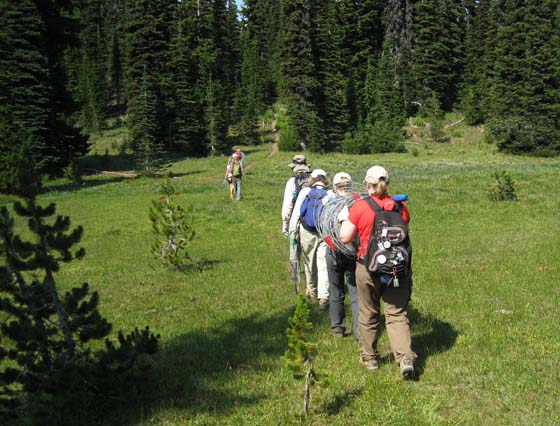
Volunteer trail work crew.

© Copyright 2013-2025 Columbia Insight. All Rights Reserved.

As a 501(c)3 nonprofit organization, all donations to Columbia Insight are tax deductible to the full extent of the law. Our nonprofit federal tax-exempt number is 82-4504894.