Stay Updated Subscribe today for the latest research + reporting about environmental news. Subscribe Now

Stay Updated Subscribe today for the latest research + reporting about environmental news.

Subscribe Now

Susan Hess

Susan Hess

Susan Hess

About Susan Hess

Susan Hess is Columbia Insight's publisher.

Arbor Day 2018: Tichenor Takes the Lead
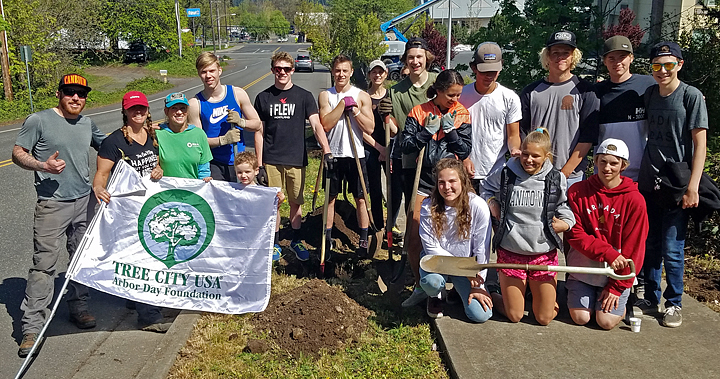
High school junior Matthew Tichenor (center, wearing a green t-shirt) took charge of this year’s Arbor Day celebration, helping plan, organize and conduct a tree planting on Rand Road. Photo by Susan Hess.

By Susan Hess. May 3, 2018. Matthew Tichenor finished track practice and headed to Hood River City Hall. His name was first on the City Council agenda. Still in shorts and running shoes, he walked up to the microphone to give the council and staff an update on the city’s Arbor Day event.

Hood River is one of the 3,400 cities across the United States that have been named a Tree City USA, an honor that requires the town to hold an annual Arbor Day celebration. This year, high school junior Matthew Tichenor took a lead role.

Celebration implies something with cake and ribbon cutting. But the City’s Tree Committee went with Tyler Roth and Jacquie Barone’s plan to replant trees instead–eleven of them along busy Rand Road, where a number of trees had died. Committee member Kass Bergstrom knew that her son’s friend, Matthew, was looking for an extended application project and invited him to consider taking on this Arbor Day planting.

Every Oregon high school student must take on an ‘extended application project.’ The goal is for students to take on an experience where they use their academic knowledge and apply it in a real life situation. They have to take charge of all or a significant part of a project.

Matthew emailed the committee: “I’d love to get involved with the Rand Road tree planting. I spoke with Kass about the project needs, and I believe I’d be a great asset to some of them. I think I could help out with/take on public relations and education outreach, as I’m very involved with the community, have a strong influence, and I know many teachers, such as Mr. Becker. If these positions won’t work out, I’d still love to get involved with the project any way I can.”

The group took to him immediately. They realized that, as manager of the project, he could use a mentor. Committee member and developer Jacquie Barone offered to take on that role.

Within a week, Matthew had sent out a two page spread sheet with two supply lists for both days of the project. “Please let me know what you can help supply,” he wrote to all involved. “If anyone has any concerns with these lists, let me know, and I’ll get on it.

“I’m also really happy to say that the [high school] Leo’s Club is going to donate $250 to help fund the project. I talked to Rosauers, and they are donating 3 dozen boxes of donuts for April 20 and another bunch for April 27.” He wrote press releases and rallied volunteers. People liked the idea that on Earth Day they would dig dirt and on Arbor Day they would plant trees.

Fifteen high school students showed up on April 20 to dig holes. One week later another grou students, Rand Road neighbors, tree committee members and city staff filled each hole with a six-foot sapling.
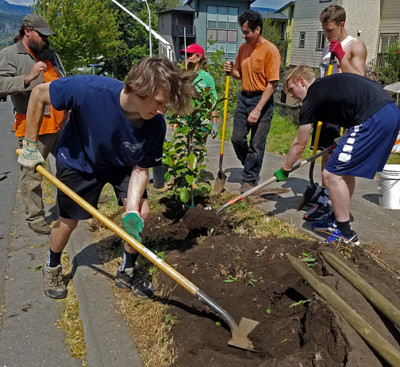
Matthew (front left) digs a hole alongside other volunteers. Photo by Susan Hess.

“I was impressed with the quality of kids Matthew recruited,” Barone said. “He was a hard working leader, positive and good spirited. That energized everybody.”

All those qualities were needed because the site slopes steeply and the ground holds chunks of concrete and asphalt from road construction and gravel sprayed on winter roads. Thick stakes had to be driven into the packed earth to hold the trees steady in the Gorge winds, and watering bags were attached to each tree.

The planting finished late in the afternoon. A new row of trees stretched up the hill. The sidewalk was swept, hoses were rolled up and put away, buckets and shovels loaded into cars and trucks. Most people had drifted away as the work wrapped up, while Matthew stood checking the last details. Behind him Jacquie shouted, “Hey, Matthew!” He swung around and saw Jacquie and Tyler swinging a cooler full of ice water. He jumped and laughed.

By |2019-02-27T14:42:54-08:0005/03/2018|Natural Resources, News, Old Articles, Plants|0 Comments

Behind the scenes at the Bingen-White Salmon Wastewater Treatment Plant

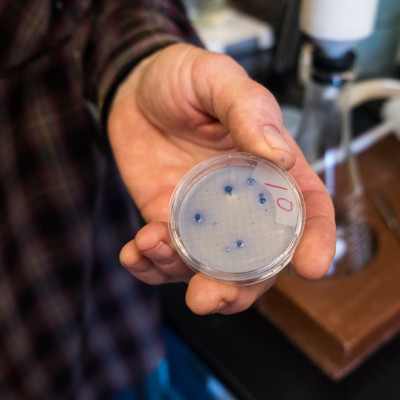
By Susan Hess. Mar. 22, 2018. Eight dark-blue, pebble-sized dots grew overnight in the petri dish Tom Hons held. Hons, who manages the Bingen-White Salmon Wastewater Treatment Plant, counted twice to make sure: 1,2,3,4,5,6,7,8. Eight fecal coliform bacteria colonies that went from invisible to visible in 24 hours.

Usually when we picture a wastewater treatment plant, should we ever think about them, it is of a circular concrete tank holding some brown substance that we don’t want to think about too deeply. But the reason they are called wastewater, rather than sewage plants, is that 99.9 percent of waste stream coming into the plant is water. Only 0.1 percent is solids. And all that water must go into the river.

Water from the kitchen sink, the dishwasher; water from the toilet and the washing machine and the shower. It all goes to the treatment plant. Wash latex paint out of your paint brush in the utility room sink and it ends up at the plant, swimming with the myriad things we put down the drain without a thought.

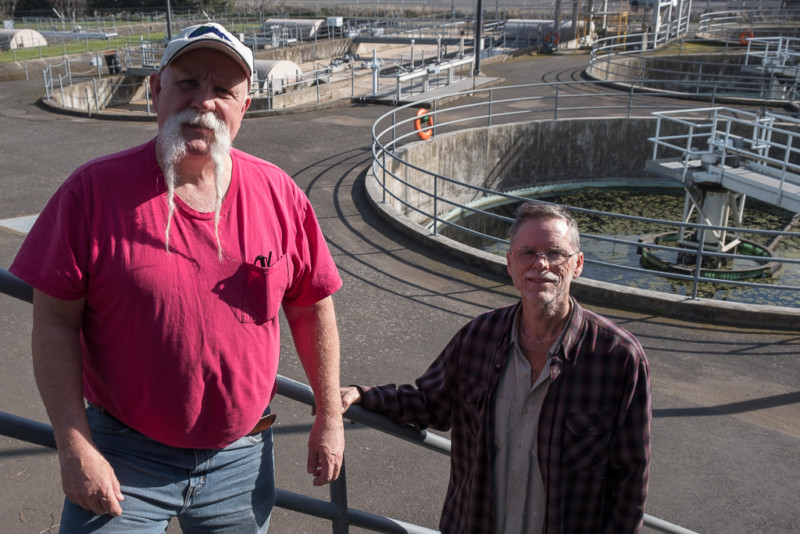
James ‘Buck’ Buckland and Tom Hons (left to right) work together to ensure that the wastewater leaving the Bingen-White Salmon plant meets or surpasses environmental standards. Photo by Jurgen Hess

Cue the tall and craggy Hons who, along with the mustache-sporting wastewater operator James ‘Buck’ Buckland, oversees the day-to-day operations at the Bingen plant. Both cheerful people, who love the complexities of their jobs. They follow standards set by the state—the Department of Ecology in Washington and the Department of Environmental Quality in Oregon—in order to take what comes in, called influent, and eliminate the harmful bacteria and pollutants. But today’s treatment systems are unable to eradicate newer pollutants, such as pharmaceuticals, PCBs, flame retardants and heavy metals, which are more difficult to remove.

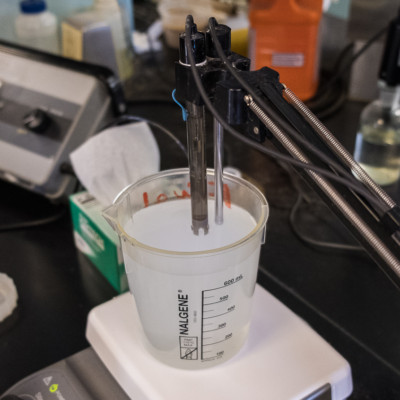
Every day, Hons and Buckland test both the influent (coming in) and effluent (going out). Samples are tested for heavy metals like cadmium, lead, mercury, zinc and copper. (Luckily there’s not much to test for because, as the soft spoken Hons says, Bingen and White Salmon have little industry.) Every space in the kitchen-size lab holds some kind of equipment to test the amount of oxygen in the water, pH levels, temperature, suspended solids and so on.

Hons’ lab is filled with specialized equipment that measures, among other things, the oxygen, temperature and pH levels of the water. Photo by Jurgen Hess

Twice a week they test for fecal coliform, an indicator species of pathogenic bacterium that can pose potential health risks. The people, along with the salmon, sturgeon and lamprey that rely on clean water in the Columbia River depend on people like Hons and Buckland to signficantly reduce the population of fecal coliform.

One way the Bingen-White Salmon plant does this is by using ultraviolet lights to disinfect the influent. The system sends water past the lights, which lowers the population of fecal coliform before it leaves the plant as effluent.   

“The water that we’re sending out to the river is really clean,” Hons says. “And most bacteria are attached to particles, so if you can make the water have few particles, then you’re going to be cutting down the population.”

“Then we have limits on temperature also, like 23 to 25 degrees centigrade That’s a new limit in the last 5 to 10 years. And that’s a tough one,” he continues, “because there’s not much we can do to lower the temperature.” He and Buck talk about putting shade cloths over the aeration basin and the clarifier (settling) tanks—someday.

Temperature matters very much to salmon, as Hons explains: “Let’s say at 20 degrees centigrade, which is 68 degrees, at zero degree chlorinity, the maximum amount of soluble oxygen is essentially 9 parts per million. So think of that: 9 parts per million! That’s all the oxygen in water available to aquatic life to extract for life. To breathe!

“It doesn’t seem possible. And we have 20 percent of oxygen when we’re breathing in. So we have a pretty rich amount of oxygen available. 9 parts per million! That’s completely soluble at 20 degrees. If you get hotter than that, the solubility goes down. That’s why salmon and trout need the cold water, because of the solubility of oxygen. At 25ºC you’re down to 8.2. Those are in parts per million. So these organisms are really sensitive to how much oxygen they have available.”

According to Lori Epstein, Water Quality Director for Columbia Riverkeeper, “The ideal temperature for salmon is 5 to 13ºC.” But, she explains, “the Columbia is often above 20ºC, especially in summer. Temperatures above 25ºC are lethal for salmon, if they are in it for a length of time. Salmon leapfrog to cold refugia, like at the mouths of tributaries.” This forces them to collect in masses, where diseases easily spread, especially in hot temperatures, adding more stresses to the cascade of life-threatening conditions along the river, including dams and pollution.

The 0.1 percent that does end up at the Bingen wastewater plant is biosolid, organic matter recycled from sewage. The plant is required to reduce the solids suspended in the liquid by 85 percent.

“We’re much higher; we can be up to 99% efficiency,” Hons says. Once a year, trucks haul the biosolids to wheat and barley fields near Goldendale, where Hons and Ecology soil scientists calculate the per acre loading rate to determine the amount of nitrogen to apply. 

Each blue dot in the petri dish Hons is holding represents a colony of coliform bacteria. Photo by Susan Hess

A wastewater plant is a place where most of us would work hard to not touch anything. It is, after all, full of bacteria. Most plants, like the one in Bingen/White Salmon, are activated sludge plants, which means they use bacteria—good bacteria—to consume incoming sewage as food. By balancing the temperature, pH and oxygen levels in the water, the plant operators help the good bacteria eat up that food efficiently and turn it into carbon dioxide and water.

“Bacteria are incredible at what they do,” says Hons. The day he counted the coliform in the petri dish, he talked with admiration about even these not-so-good bacteria.

“So in 24 hours, one bacteria grew into each of these colonies to be this visible. That’s an amazing growth rate! A bacteria is totally small. Totally invisible. So in 24 hours they multiplied into a visible spot that’s got billions of bacteria.”

Thank you EnviroGorge Supporters!

 “The greatest threat to our planet is believing
that someone else will save it.” – Robert Swan

With EnviroGorge financial supporters, we can continue critical investigative reporting to keep local people educated about environmental issues impacting our Columbia River Gorge region—and our entire planet.

Thank you for being an important part of our collaborative endeavor:

Margery Abbott
Kelsey Alsheimer
Matthew Barmann
David Berger
Lynn Bergeron
Otto & Jan Behrmann
Seth Bradley
Valerie Brown
Marjorie Byrne
Dee & Martin Campos-Davis
Dennis Carlson
Pat & Lonnie Case 
Tina Castanares 
Alison Church
Diana Clark
Peter Cornelison
Lynne Davidson
Julia DeArmond
George Domijan & Jennifer Hull
Michal Drabanski
Beth Flake
Cathy Flick
Kay Floria

Brent Foster
Michael Friend
Cecilia Goodnight
Douglas Grissom
Chuck Haynie
Nicole Hess & Tom Guinan
Thomas Hons
Ann Marie Jelderks
Subi Katz
Peggy & Jim Kelter
Mike Kitts 
Paul & Maria Kollas
Stephen Labadie
Darvel Lloyd
Darryl Lloyd
Emily Long
Becki Montgomery
John Murphy
Bonnie New
Deborah Olson
Buck Parker & Fran Finney
Amy Peterson
Dan Richardson
Lynda Sacamono

Mary Lou Soscia
Elizabeth Stanek
Rhonda Starling
Dave Stauffacher
Jan Thomas
Marvin & Ruth Turner
Marie Uhlir
Frank & Colleen Webb
Peter Zurcher
Common Energy
Egg River Café
Hood River Hobbies
Humble Roots
The Mesquitery
Tum-a-Lum Lumber
Support is always appreciated.

By |2018-02-01T09:50:19-08:0001/25/2018|Old Articles, Uncategorized|0 Comments

Recycling Ban Impacts Gorge

By Susanne Wright and Susan Hess.  China has had enough and it’s not taking it anymore: our recycling, that is. January 1, 2018 China began a ban on imported post-consumer plastic and unsorted paper. Until recently, China was the world’s largest recycler of paper and plastics, which it used as raw material for making consumer goods. But due to high levels of contaminants in the materials it receives from the United States, it enacted a full ban.

Most recycle bins are for commingle items: newspapers, magazines, office paper, aluminum and tin cans, plastic milk jugs and shampoo bottles. All mixed together. Commingled. But wrong things in the bin contaminate the material.

“There are two types of contamination,” says Jim Winterbottom, district manager of Waste Connections. “One is when folks put things in the bins that aren’t part of the program: garden hoses, Styrofoam, packing peanuts, plastic bags. The second is when people don’t properly prepare items: not rinsing out cans, yogurt containers, milk jugs.”

China allows some contamination in recyclables, but it wants it at a 0.5 percent level. Recyclables coming from the U.S. had been running 15 to 20 percent. China then had to dump the material in their landfills.

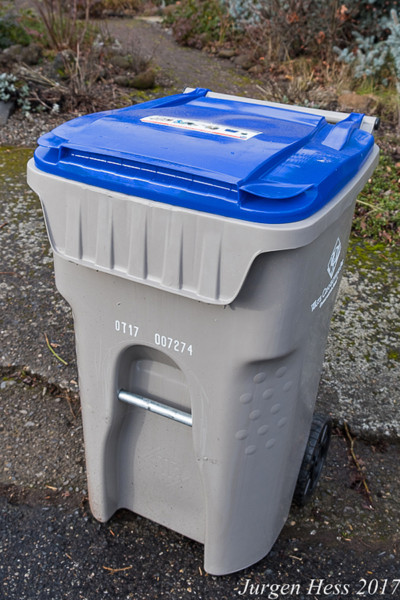
China announced its ban just as the City of Hood River started a three-roll-cart system last May. Since then, the material in the commingled bins (blue lids) has been going to the landfill. “We don’t want it to go to the landfill,” Winterbottom says. “We want to find a home for recyclables. We believe the market will change. We don’t want to have to retrain people.”

The good news. Tons and tons of items are being recycled. “Cardboard and glass,” he says, “are still going to market.  Cardboard, however, you must take to the transfer station, unless you have commercial bin designated for cardboard. Concrete, tires, motor oil, appliances, scrap metal, electronic waste and yard debris are still getting recycled.”

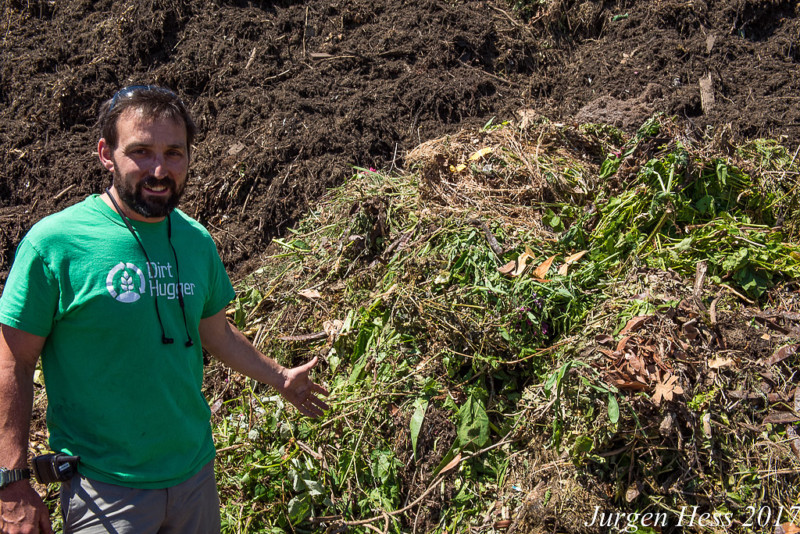
Pierce Louis, Dirt Hugger

The organic matter (branches, leaves, grass clipping) has been a bright spot in Hood River’s program. Five months into the program the City reported dramatic benefits. In one area collection of organic matter increased 56 percent: 681 tons of food scraps and yard waste collected.

The organic waste feedstock coming into the City’s waste program partner, Dirt Hugger, is “some of the cleanest we?ve ever seen,” Pierce Louis wrote in a waste report to Hood River City. That translates into high quality locally generated material for area farmers, wineries, and gardeners looking to amend depleted soils. Air quality also improved. Louis reports a “90-ton reduction of carbon dioxide based on a greenhouse gas emissions formula.” This encouraging data suggests that comprehensive recycling systems and an informed public produce a positive environmental force.


The Contaminant Problem

Contamination occurs whenever non-recyclable items are placed in a recycling bin. Food is a major source of contamination in paper recycling. Paper products smeared with food or grease: a pizza box, paper towels or take-out food containers cannot be processed because paper fibers cannot be separated from oils in the pulping process. Food, liquids, oil, and hazardous chemicals can all contaminate paper. Non-recyclable items, like Styrofoam, must be laboriously hand-sorted out at processing centers.

Last March, Oregon recycling processors began stepping up efforts to remove contaminants in commingled recycling. The result has been a back-up of recycling and storage problems, a situation that may worsen this year. The Oregon DEQ is scrambling to create new, long-term recycling systems and working with local governments, industry representatives, and recycling processors.

Peter Spendelow, Natural Resource Specialist at Oregon DEQ, said in an Oct. 2, 2017 OPB Earthfix interview that “the loss of Chinese buyers is a major disruption in the recycling market. It’s unclear where all the paper and plastic will go instead. We?ve seen markets go up and down before, but this is big. When the major buyer cuts out with almost no notice—it’s going to be a struggle for a while. There’s just no way around it.”

Recycling Instructions remain the same

Despite the China ban, recycling instruction for The Dalles, Hood River, and Cascade Locks residents has not changed. “We hope this is short-term. So continue the practice of curbside recycling,” says David Skakel, Tri-County Hazardous Waste Coordinator.  

The best solution to our current plastics and paper waste problem is to generate less of it. Take the EnviroGorge Reuse/Reduce challenge.

By |2019-02-27T14:49:11-08:0001/16/2018|Energy, News, Old Articles, Waste Management|0 Comments

Reuse & Reduce Challenge

How to keep recyclables out of the landfill: use less. Take the EnviroGorge Recycle challenge. Send us what you’re doing to reduce waste. Comment below on our website. Email us. Post on our Facebook page. Here are some ideas. We’re sure you have more!

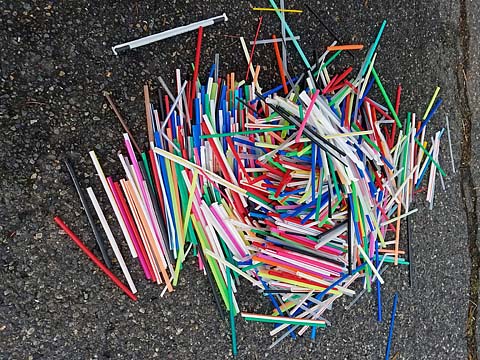
  • Request: no drinking straws. Americans use over five-hundred million plastic straws per day yet most are not recycled and end up in landfills and oceans. Be proactive and sip sans straw or purchase reusable straws.
  • Bring your own travel mug for your morning drive-through coffee. Starbucks gives out 4 billion to-go cups annually but most of them end up in the landfill because they are lined with plastic.
  • Clamshells are for clams. Recycling centers in Oregon recently stopped accepting clear plastic ‘clamshell’ containers. Request your take-out and baked goods be placed in a recyclable container or bring your own.
  • Use reusable shopping bags not only for groceries, but for everything you buy. Plastic bags are soiling the planet, with 60,000 plastic bags being consumed in the U.S. every 5 seconds. Invest in durable cloth bags.
  • Shop local to reduce online delivery packaging. Our online shopping has cardboard consequences.

Straws found on the streets of Hood River

By |2019-02-27T14:49:20-08:0001/16/2018|Energy, News, Old Articles, Waste Management|0 Comments

© Copyright 2013-2025 Columbia Insight. All Rights Reserved.

As a 501(c)3 nonprofit organization, all donations to Columbia Insight are tax deductible to the full extent of the law. Our nonprofit federal tax-exempt number is 82-4504894.