Stay Updated Subscribe today for the latest research + reporting about environmental news. Subscribe Now

Stay Updated Subscribe today for the latest research + reporting about environmental news.

Subscribe Now

Susan Hess

Susan Hess

Susan Hess

About Susan Hess

Susan Hess is Columbia Insight's publisher.

Handy Summer Tools: Air Quality Websites

By Susan Hess. July 12, 2018. Fire season arrived in the Gorge this month with a fire near Rowena, Oregon. Last fall?s Eagle Creek Fire poured smoke into the Gorge. “Wildfire smoke is a mixture of gases and fine particles from burning trees and other plant material. The gases and fine particles can be dangerous if inhaled,” the Oregon Health Authority writes.

The States of Oregon and Washington post daily reports on how clean the air is and provide information on potential health risks. These reports cover a variety of pollutants besides smoke. Both states put the information on easy-to-use maps, like the one below from July 11 at the White Salmon, WA monitoring station.
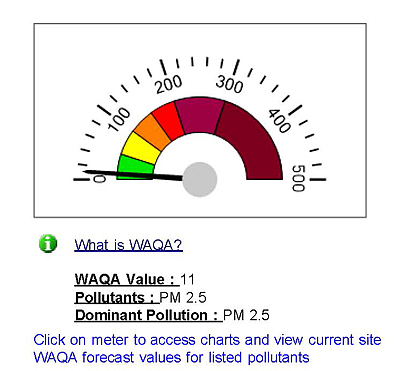
July 11, 2018. White Salmon, WA air quality. Green indicates: Good

Oregon
The Air Quality Index is a daily measure of how clean the air is and provides information on potential health risks. “Oregon?s index is based on three pollutants regulated by the federal Clean Air Act: ground-level ozone, particle pollution and nitrogen dioxide. The highest of the AQI values for the individual pollutants becomes the AQI value for that day. For example, if values are 90 for ozone and 88 for nitrogen dioxide, the AQI reported would be 90 for the pollutant ozone on that day,” OR DEQ website. To put a link on your phone search for OregonAir in your app store.

Oregon air quality map: Air Quality Index
Check the information page, Air Quality Today for more.

Washington
Washington’s Air Monitoring Network is a service of the Washington Department of Ecology: “We manage smoke, car pollution, industrial emissions, and other pollutants so communities have healthy air to breathe.”

Washington air quality map. Air Quality Monitoring Website
 

By |2019-02-27T14:38:21-08:0007/12/2018|Climate Change, News, Old Articles|0 Comments

Comments. We get comments.

By Susan Hess. June 21, 2018. A lot of interesting information exchange goes on in our articles’ Comments section. That exchange or dialogue is a key part of what we?re trying to inspire at Envirogorge. We thought some of you might have missed them, so this week we pulled a selection. Hope you’ll join the discussions.

(And…happy first day of summer.)

Proposal to allow Mountain Bikes in Wilderness

A crowd draws a crowd, and you are all on the wrong side of this. Wilderness needs more protectors, and mountain bikers are conservationists who support the penultimate land protection designation, but not at their expense. Historical documentation proves bicycling and other human powered activities were never meant to be prohibited from these lands, despite what the extremist Wilderness Watch feeds you. Open your minds. Wilderness will be better for it.—-J. Muir

I believe that the legislating of human powered bicycle use in National Wilderness Areas can be rationally discussed, but only with an agreed upon definition of Wilderness. This is necessary, of course given the simple fact that many individual’s or group’s (‘crowd’s’) definitions of Wilderness Areas may evidence marked variability.
         In general, many human associations in the USA have deferred to the Wilderness Act for this definition as this law defines potential Wilderness Areas (individually approved by acts of Congress) as well as managing parameters for the four federal agencies administering Wilderness Areas. Initially, and perhaps still the U.S. Forest Service oversaw the vast majority of Wilderness Area acreage upon passage of the Wilderness Act in 1964.
        For reference: Section 4(c) of the 1964 Wilderness Act states, “[T]here shall be…no use of motor vehicles, motorized equipment or motorboats, no landing of aircraft, no other form of mechanical transport, and no structure or installation within any such area.” (emphasis added). Congress also stated, in Section 2(a) of the Wilderness Act, that the purpose of the Act was, in part, to protect these areas from “expanding settlement and growing mechanization,….” (emphasis added)
        Fortunately for Wilderness Areas and their dependent biota today and tomorrow, human permit/quota systems will of necessity come to pass administratively in many to most Wilderness Areas. Note: they are currently being developed for five Wildernesses in the Oregon Cascades. This Wilderness management effort is essential to minimizing homo sapien?s increasing impact on these uniquely wilder ecosystems for the well-being of all.
—-Paul Moyer, White Salmon, WA.

Camping at Owl Creek Pass

What a lovely portrait not only of Owl Creek, but even more so of a loving family and the gifts we can pass on to our kids by letting them share in our memories.—-K.M. KOwalski

I could picture the trailhead and the Sawtooth Wilderness Area where I backpacked in many an autumn and woke up to the silence of the first snow and knew it was time to start back to the town and a job I had escaped for a time. Time when you could find pure water and the goats were not very afraid of you; when you could be alone..—-Marilyn Sirois

Weyerhaeuser logging in Scenic Area Raises Concerns

Thank you for giving an excellent summary of the facts and what’s been reported in the news. But there’s more to the story. I recently photographed the area of planned clear cuts the best I could without trespassing. It’s a forest after all, and as you know I’ve been documenting my love of forested areas for a long time now. My brother Darvel and I hiked the mile-long stretch of the historic Mark O. Hatfield Trail; and we also bushwhacked through the poison-oak woodlands above and below it.
        Our intent was to ground truth in the areas that would be most adversely impacted by the Weyerhaeuser project. To our surprise and wonderment, the dense forest harbors impressive old-growth trees. We measured some ponderosa pine and Douglas fir at more than four feet in diameter (DBH). Thus, we found a remarkable forest that few people give a second thought. We now know that the historic trail and the forest it passes through are irreplaceable treasures of the eastern Gorge. They must be protected at all costs. It’s the least that both private companies and public agencies can do for future generations.—-Darryl Lloyd

Nobody, Anybody & Everybody

What a great poem for a very worrisome problem. Thank you for bringing attention to this problem in such a faraway place, but yet are still our neighbors on this planet.—-Nancy Webb

To Spill or Not to Spill

Better than removing the dams as some have proposed. It does not mention that it often releases water at this time due to high water as such is happening in eastern Washington state. We have to ameliorate the impact of human activity on the environment, and this is part of it. DIfficulty comes when we have a low snow pack and then have to release water for the salmon. Is it possible to to measure downstream swim and release water in close approximation to that time? Water temperature is another issue that releasing more water will help the smolts to deal with, as well as the spring up river runs.—-Judy Nelson

Trout Lake Organic Dairy, a Family Affair

Such an interesting story! I have known about the Pearsons for years because I work for the vet who used to call on Monte. I remember that antibiotics were definitely not the routine, used only when truly needed. We will have to make an effort to stop by to meet these good people. Those eggs sure look good, too! —-Maria Kollas

This is such an amazing story. I live in the west end of the gorge and love it! So nice to read about people who are interested in organic products.—-Judy Wiley

The Pearsons are amazing people. We are new to the community and they have welcomed us with open arms. Plus, we enjoy picking up our milk and eggs from their farm, so delicious.—-Shelly


Behind the scenes at the Bingen-White Salmon 

Wastewater Treatment Plant

Editor’s Note: A discussion about whether bacteria or bacterium or bacterias is plural form ended with this wonderful poem from John Smith, whose posts on his blog Good Blood, Bad Blood provide a great start to the day.

There once was a lonely bacterium,
Who wandered the sludgy mysterium.

He then joined a gang with diphtheria
And we now know him as bacteria
—-John E. Smith

By |2019-02-27T14:39:09-08:0006/21/2018|News, Old Articles, Uncategorized|1 Comment

Proposal to allow Mountain Bikes in Wilderness

By Susan Hess. June 7, 2018. Friends of Mt. Adams is one of the latest organizations to voice opposition to pending congressional bills that would allow mechanized transport, including mountain biking, in federally designated wilderness areas. The mountain bike organization, Sustainable Trails Coalition, is one of the most vocal groups in favor of the bills. A group of 150 organizations have joined to oppose the bills including Portland Mazamas, Sierra Club, Cascade Forest Conservancy, Wilderness Watch, and Izaak Walton League.

If passed, the two bills (Senate bill S.2877 and House bill H.R. 1349) would change the intent of the1964 Wilderness Act, which specifically excluded all types of mechanized transport including bicycles in designated wilderness. A 1990 amendment to the Americans with Disabilities Act allowed wheelchairs in wilderness.

The Act established a National Wilderness Preservation System of federal lands “where the earth and its community of life are untrammeled by man, where man himself is a visitor who does not remain.”

Trapper Creek Wilderness, Washington

By |2019-02-27T14:39:45-08:0006/07/2018|Conservation, Forestry, News, Old Articles|3 Comments

Weyerhaeuser logging in Scenic Area raises concerns

By Susan Hess. May 31, 2018. Weyerhaeuser is set to begin logging 250 acres within the Columbia River Gorge National Scenic Area. The location has raised concerns, because Weyerhaeuser plans to clearcut the timber in this nationally significant area.

The site covers scattered tracts of land the company owns east of Hood River, Oregon. The properties are in the General Management Area (GMA) designation. The Scenic Area Act “precludes the regulation of forest practices within the GMA,” so logging operations don’t need approval or review by the Columbia River Gorge Commission, the county, or the U.S. Forest Service. 

Weyerhaeuser’s logging plan does have to meet Oregon’s Forest Practices Act, which is overseen by Oregon Department of Forestry (ODF). During ODF’s review process, the Commission wrote to them listing potential impacts clearcutting would have on wildlife, recreation, and scenic values.

The company’s planned harvest has met the Forest Practive Act regulations and ODF will monitor the operation. The company can begin logging at any time. ODF regulations limits clearcuts to 120 acres. But a company can clearcut an adjacent unit if there is a 300 foot buffer. Otherwise, it must wait to clearcut an adjacent unit until the logged unit has ‘greened-up,’ which takes four to six years. In this case, Weyerhaeuser’s properties are scattered and may meet the requirements so they can log the entire 250 acres.

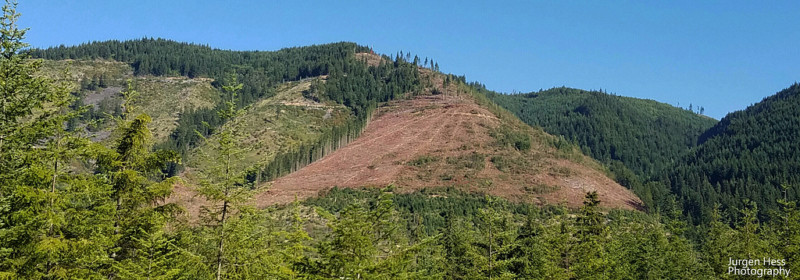
Clearcut on Lost Lake Road in Hood River County. Adjacent sites to the west have ‘greened up.’

The Friends of the Columbia Gorge also wrote Weyerhaeuser and ODF asking them to reconsider and “develop a forest management plan that is more consistent with the protection of our national scenic treasure.” They’d like to see “selective harvest of trees, much smaller clearcuts, and the phased implementation of the project to lessen adverse impacts to scenic, natural, recreation, and cultural resources.” And the Friends sent an alert to their 8,500 members urging them to contact Weyerhaeuser.

Weyerhaeuser’s Sustainable Forestry Policy states among other things that it will: “consider aesthetic values by identifying sensitive areas and adapting practices accordingly; identify sites of special ecological, geological, cultural, and historical importance and manage them in a manner appropriate for their unique features.” The policy includes Weyerhaeuser’s commitment to harvest sustainably for the long term, protect soil, minimize erosion, and provide a diversity of habitats for plants and wildlife.


New water quality permit for Washington wineries

Susan Hess. May 24, 2018. The Washington Department of Ecology adopted a new Winery General Permit to prevent pollution and protect water quality. The permit takes effect June 1, 2019, giving wineries a year to prepare.

“We worked closely with local winemakers to develop a permit that provides environmental protection in way that lightens the financial and operational hardship on wineries, especially for smaller wineries,” Heather Bartlett, Ecology Water Quality Program Manager wrote in a media release.

After California, Washington is the second largest wine-producing state in the country. Wastewater comes mainly from activities like washing tanks and equipment. According to Ecology, that wastewater is corrosive and can “damage soil and crops, kill aquatic life, degrade the infrastructure in wastewater treatment plants, and pull metals from the soil into groundwater that can harm people.”

The permit applies to wineries that discharge more than 53,505 gallons of wastewater a year. Over the next year, Ecology will hold workshops for wineries on this new permit.


For detail information www.ecology.wa.gov/winerypermit or via Ecology’s winery email listserv for updates. 

This permit can be appealed to the Washington Pollution Control Hearings Board within 30 days of becoming effective.

Trout Lake Organic Dairy, a Family Affair

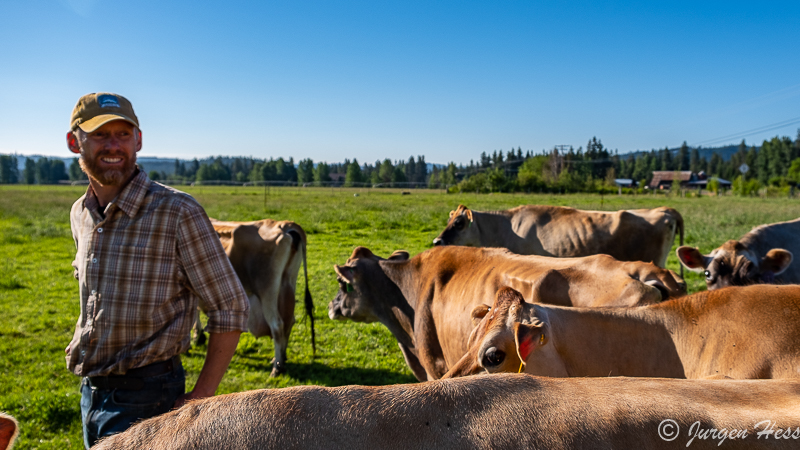
Jesse Pearson leading Jerseys cows to pasture.

By Susan Hess. May 24, 2018. In the last six years, 46 dairies in Washington closed or were consolidated. Dairies across the country are struggling due to a combination of factors. “A big reason is because dairy farms have increased in size so much,” says Jesse Pearson, who with his parents Monte and Laura, owns Mountain Laurel Jerseys Dairy.

“So now you have farms, even organic farms that have thousands and thousands of cows. So they are able to produce milk more efficiently. But the only thing is, they’re producing a lot more milk, so there is a huge surplus of milk right now worldwide. So that drives the prices down.” Mountain Laurel consists of 20 cows in a farm business where the average herd runs to 500 cows. Three Mile Canyon Farm in eastern Oregon has around 30,000.

Carving a niche.
Pearson, a tall and lanky 43-year-old, exudes a calm cheerfulness, even as he explains that the only way the farm survives is because they sell raw milk. Most dairies sell to cooperatives, but the Pearsons direct-market themselves. It’s an extra job to self-market, he says, “but it really helps us to survive as a small family farm. We can just decide what our price needs to be. What the customer is willing to pay.”

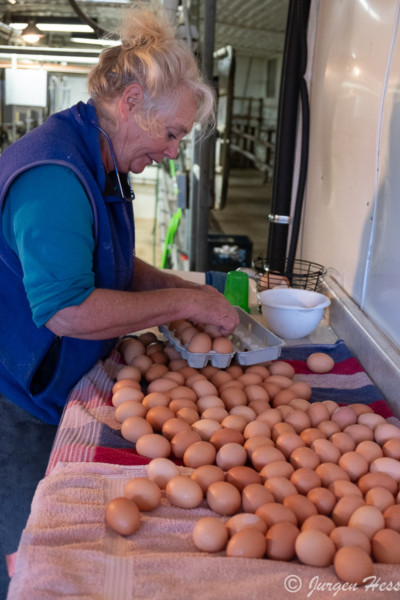
Laura Pearson gathers, washes and packs their organic eggs.

The dairy spreads east of Trout Lake, Washington, an hour and a half east of Vancouver. The farm was homesteaded by Pearson’s great-grandfather in 1883. Pearson’s dad Monte had the diary certified organic 23 years ago, one of the first in the Northwest. The farm now sells eggs, beef, lamb, and vegetables, all certified organic.

The chickens were Monte and Laura’s dream. This year they’re raising over 400 Rhode Island Reds, and eggs now are second to dairy in generating farm income.

Going away. Coming back.
Pearson grew up on this farm. His wife Megan grew up on a nearby farm. But for 10 years they lived off and on in the Kashmir state in India, where they went to start churches. At times, they worked at an orphanage, taught English and led tour groups. They came back to Washington every two years or so for six months, until it became harder and more expensive as the family grew to eight children.

Because of those years in India, Pearson has a different take on farm life. “Now I appreciate so much the stability and the regularity. I think it makes me appreciate the work. It feels so new and interesting, maybe, and because it feels a little safer too. There’s a side to being free and traveling around the world that’s fun, but it makes you appreciate the stability. I do the same thing every day at the same time.”

The family lives across the road from the farm, and all the kids help on the farm. Parents Monte and Laura live next door and the grandmother next door to them.

A business plan for a family farm.
The farm, in fact, is a corporation (that also includes Pearson?s brother who owns a separate dairy a few miles away). A limited liability corporation, Pearson Family Farms, owns the land, and the brothers lease land and buildings from the LLC, but they are paying themselves, making it a savings account.

“We pay cash for all our equipment,” Pearson says. “So that means we just have to buy old, antique kind of equipment. Hundreds of dollars, not thousands. That means we don’t have the complicated computer systems on our tractors and equipment. But I’m so thankful that my dad didn’t have any debt on this farm. All the land is paid off. So I could start something crazy like this with only 20 cows.” He laughs.

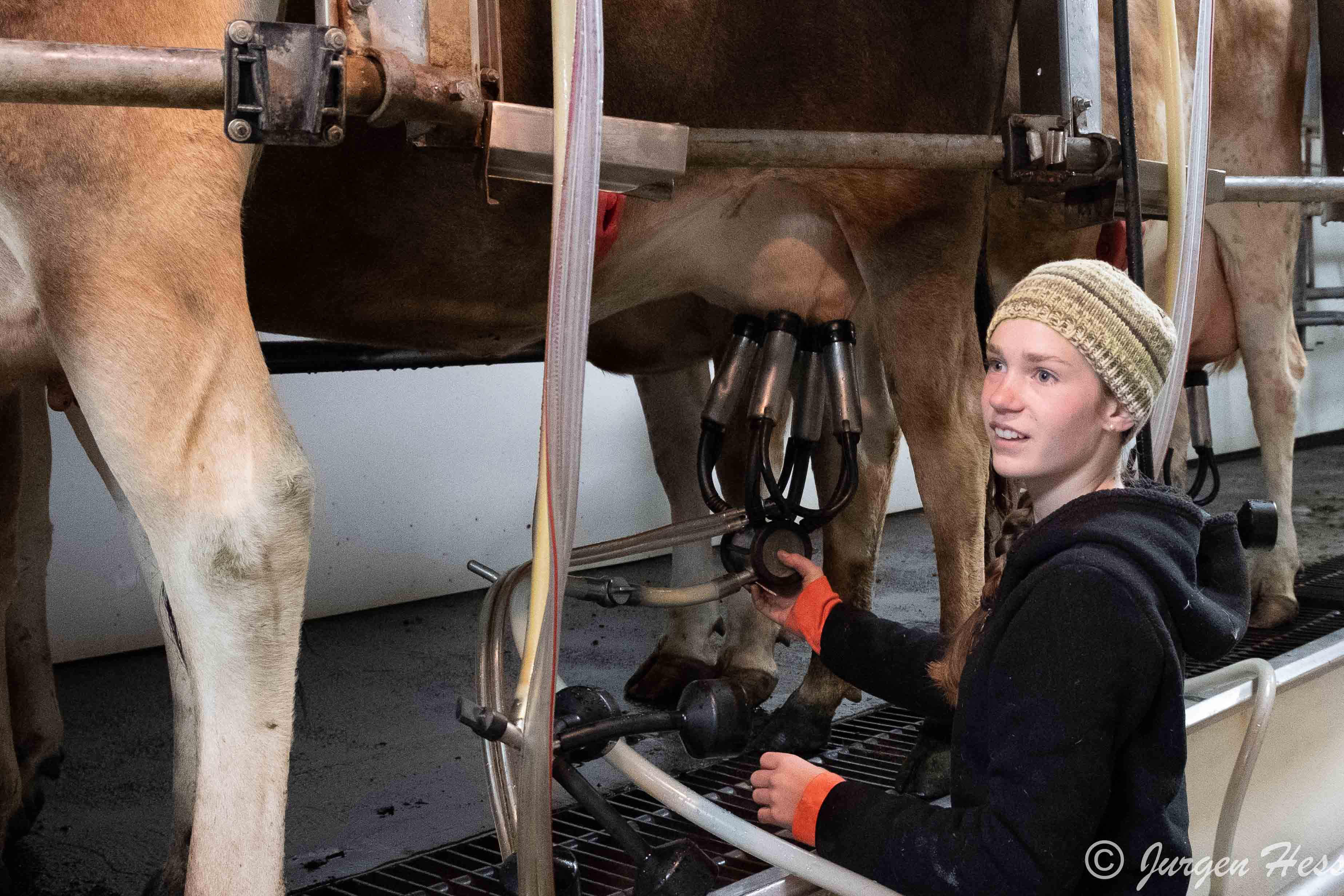
Havilah Pearson and her dad Jesse milk every morning.

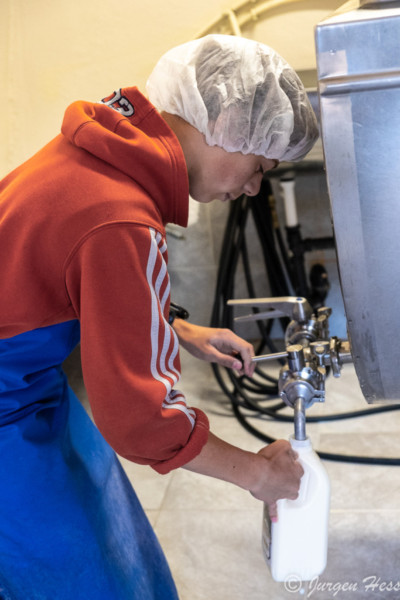
Shane Pearson fills milk containers.


Fortunately Mountain Laurel’s organic raw milk sells in stores for a premium price: $16 a gallon. The cows are grass-fed.  On a recent morning, clouds of pollen rose out of the fields as the cows made their way from the milking barn to pasture–moving to a new pasture with fresh grass as they do every day.

“The great thing about grass-fed is that I don’t have to pay for a semi-truckload of corn that comes from the other side of the country,” he says. “And I don’t have to be dependent on politics in Russia and China and Argentina that dictates the price of corn. So it allows us to be a little more self-reliant. Cows don’t give as much milk if they’re not eating grain. So then we’re not able to sell as much milk. That’s why most farmers feed grain to their cows. You’d think it would be a no-brainer: if you didn’t have to pay for grain and the cows were healthier.”

Raw milk can only be sold in Washington, and Vancouver is one of their main markets. They sell it through a milk-drop system. Different individuals open up their homes to friends and neighbors who place an order.

The way they sell their lambs is perhaps not so surprising considering that this is a farmer who lived in Muslim Kashmir. “I try to build relationships with the immigrants in Portland, Muslim people,” Pearson says. “They like lamb for the holidays. Now we have some people that come up every year to butcher their own lambs here. I help them out with the butchering part, but they like to do the killing part themselves, because they have a specific way they want to do it, a religious way.”

For the land and river.
The White Salmon River runs only a couple hundred yards away. Keeping manure from getting into rivers is a concern nationwide. The Pearsons put in a tank the size of a city water reservoir; rain and snow melt from the farm yard is pumped into the it. In the summer, that water is run through their irrigation system. For the fields, they put in a pivot irrigation system that limits the amount of water put on the land. Manure from the barn is composted.

Rural residential developments increasingly spread across the Trout Lake valley. For 135 years the Pearson family’s dairy farm has kept large tracts of open space intact and the business in local ownership. In this era, the norm is ever larger industrial-sized farms and absentee ownership. If the public wants these small family farms they will have to support them, and the farmer must find a balance between preserving family value farms and the fast changing market.

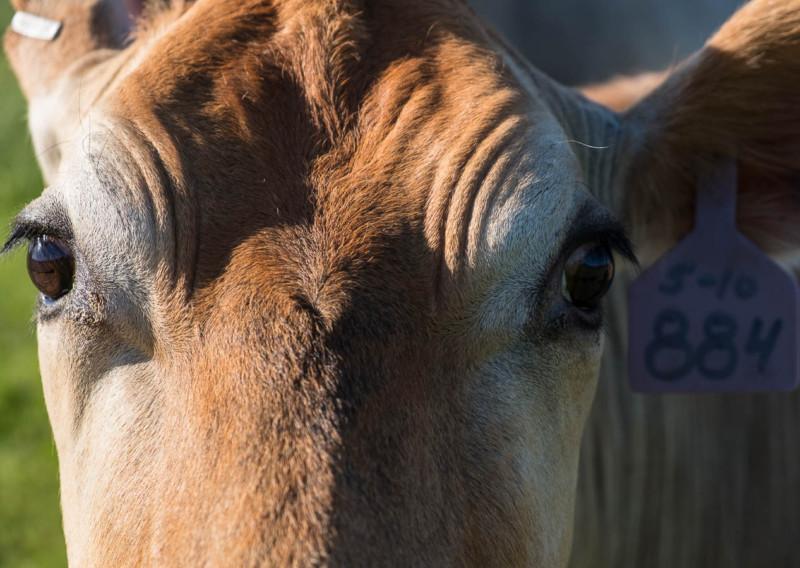
Poppy

For Jesse Pearson, the heart of the farm is the gentle doe-eyed Jerseys. “I always like to tell people our cows are special,” Pearson says, “because they’re grass fed, organic, and they’re Jerseys. The Jersey breed’s milk is typically creamier than milk from other cows. And the taste of milk is in the cream.”

By |2019-02-27T14:41:06-08:0005/24/2018|Agriculture, Features, Old Articles|14 Comments

© Copyright 2013-2025 Columbia Insight. All Rights Reserved.

As a 501(c)3 nonprofit organization, all donations to Columbia Insight are tax deductible to the full extent of the law. Our nonprofit federal tax-exempt number is 82-4504894.