Stay Updated Subscribe today for the latest research + reporting about environmental news. Subscribe Now

Stay Updated Subscribe today for the latest research + reporting about environmental news.

Subscribe Now

Susan Hess

Susan Hess

Susan Hess

About Susan Hess

Susan Hess is Columbia Insight's publisher.

Recycling batteries

If you’ve ever tried to include dead alkaline (or other) batteries in your curbside recycling bin, and had them left behind by the collection crew, you probably share a common frustration.

You think: These things include chemicals, and metals, and they can’t be good for the environment. What can I do with them?

Options have grown. Several businesses in the Gorge are running their own battery recycling efforts. Radio Shack on Hood River’s Heights, is helping provide drop-off options for residents. About a year ago, store owner Dave Henne started accepting drop-offs from customers. He’s got about five months worth of batteries awaiting transfer to the next hazardous waste collection date.
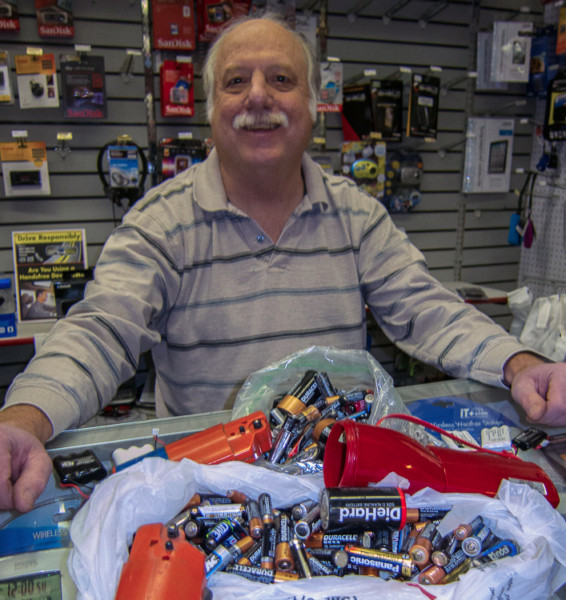
Dave Henne displays some of the batteries that people have dropped off over the last 5 months at Radio Shack on the Heights in Hood River.

You and I could collect and deliver our own waste batteries, if we chose to (or could remember). But because there are only four hazardous waste collection dates per year, the year-round drop-off option at a place such as Radio Shack provides a lot of convenience for people with small volumes of batteries, according to David Skakel, program coordinator for the Tri-County Hazardous Waste & Recycling Program.

Next collection time. He says either he or Susan Hess (Envirogorge.com editor) will pick up the batteries from Radio Shack and drop them off at the transfer station on hazardous waste days. The next collection date is from 9 a.m. to 2 p.m. Aug. 15, 2014 in Hood River, and the same hours Aug. 16, 2014 in The Dalles.

What goes where. Skakel says lead-acid batteries (the type typically found in cars, or uninterruptible power sources for computers) can be taken to the transfer station any day of the week.

“Anything that says PB on it stands for lead-acid,” he says. Other rechargeable batteries such as nickel cadmium and lithium need to go through the hazardous waste collection.

Why the change in battery recycling. Skakel says manufacturing changes have reduced concerns about toxicity. “The key issue now is with resource shortages. Global companies are starting to sober up to this from a profitability motive. They’re running out of feedstock and materials for manufacturing.”

In short, it’s cheaper and easier to tap a recycled resource for rare earth metals than to seek and extract them from natural sources. Because those metals are critical to defense and electronics applications, they also become a matter of national security. Recycled sources minimize pressures to militarily pursue natural resources.

Skakel applauds domestic battery manufacturers for taking the lead on recycling for the last 20 years. They even sought legislation in Oregon that would have mandated recycling—an effort to bring off-shore battery makers into the recycling fold—but push-back from the computer industry squashed that initiative.

Henne says Radio Shack used to have a national program of recycling batteries, but the requirements for packaging and shipping made it onerous on retailers, so he stopped taking part. The local program has been a nice alternative.

Skakel says alkaline batteries—the type we install in flashlights, smoke detectors and portable radios —don’t have much resource for recycling. He says Tri-County now collects them and sends them off for use as fuel in steel smelting.
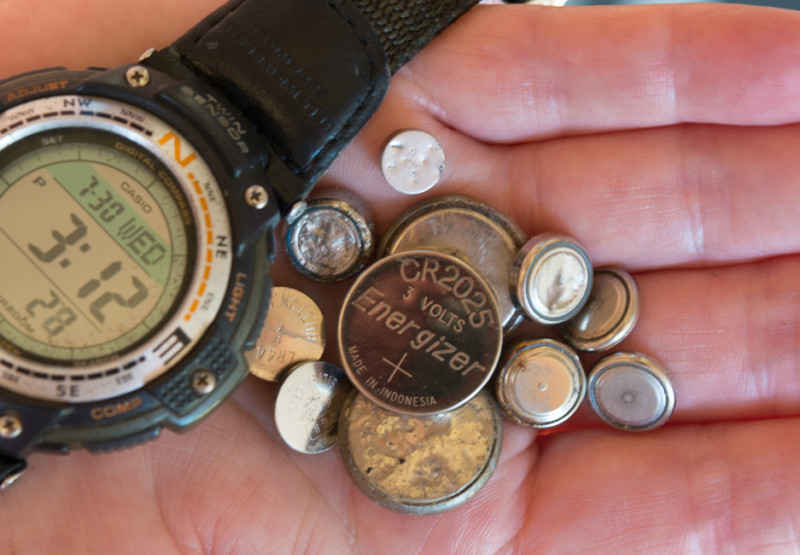
Small batteries are worth money.

Small battery market. Chris Strader and his wife, Julie, owners of Hood River Jewelers, have collected watch batteries for years. When he has four or five pounds, he ships them off to a refinery in Georgia, and they send him a check for the value of the reclaimed metals. “The money is in the silver. There’s a small amount of silver in the batteries. But it’s mostly stainless steel.”

Still, little bits add up. And, after all, it’s the thought that counts.

By |2019-04-11T11:21:07-07:0007/30/2014|Energy, News, Old Articles, Waste Management|0 Comments

Nature Spaces awards: Manja 2014

Manja Warner’s garden.

Every year in the house’s tiny front yard a profusion of plants and flowers grow. It’s an old-fashion garden. It would be lovely anywhere, but it stands out here because it sits in the middle of a commercial strip on Hood River’s 12th Street.

This spot inspired me to start an award program for similar places: yards or gardens or farms where people are making an effort to create places for nature. Twice a month July through October I’ll be giving out a $25 cash or gift certificate. The first award goes Manja Warner who creates the 12th Street garden. She receives a $25 gift certificate to Farm Stand grocery.

Manja says people often come up to her and say how much they like the garden. “The most frequent comment,” she says, “is that they love to watch the garden change from one season to the next and from one year to the next.” Some people ask for starts or give her a start from their own gardens.

In the back yard Manja developed a square foot garden. You step through a side gate and the busy street disappears into a lush landscape. Her gardens are popular with bees, butterflies, moths, and hummingbirds.

This is the second award she’s won for her garden. In 2000 her garden won $2000 from the National Garden Association’s school garden program. At that time she had a preschool and the children developed a garden for the senses: taste, scent, texture.

If you’d like to nominate someone, email susanh@envirogorge.com. I’ll be looking for places with no or minimal lawn and giving preference for those using native plants.

By |2019-04-11T11:21:16-07:0007/15/2014|Old Articles, Uncategorized|0 Comments

Get your float on with earth friendly gear

Editor’s note: Sadly three years after we published this article, the Kayak Shed burned down and did not reopen.

By Stu Watson. Apr. 3, 2014. When it comes to the environmental impacts and benefits of paddle sports products, John Hart has jumped into the river and bobbed downstream with some of the most innovative manufacturers in the industry.

Owner since 2000 of the Kayak Shed in Hood River, Hart once worked in product design and development with Patagonia. That brand earned early props for its work sourcing organic cotton, reducing waste and avoiding harmful chemicals.

Shortly after Patagonia bought Lotus Designs, a maker of paddle sports life jackets, Hart headed north, while the former Lotus owners three years later started Astral Buoyancy in North Carolina. They wanted to make water-play products with low environmental footprint.

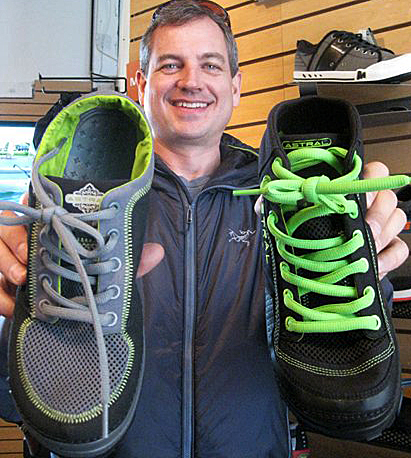
John Hart shows off some recent shoe designs from Astral Buoyancy. Photo: Stu Watson

These days, Hart is happy and proud to stock Astral life vests and shoes. He has watched as the company aggressively worked to move its vests away from polyvinyl chloride foams, which kick out toxic chemicals during production, and as they degrade.

Cheap, flexible, functional, PVC products often incorporate phthalates to impart flexibility. But pthalates have been implicated in a variety of health problems. The Centers for Disease Control, for instance, notes that phthalates can affect human reproductive activity, and developmenet of reproductive systems in children.

If you want the micro-detail, check out this summary from the Environmental Protection Agency about the different types of phthalates . Tests continue to assess possible carcinogenic properties.

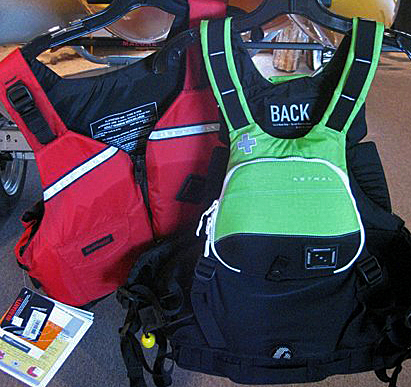
Hart notes that Astral loops backward and forward in its design efforts. For instance, it moved from PVC to the natural fiber, kapok, in its vests. Kapok was the standard for shipboard life vests for most of the 20th century.

Although it molds well to the body, the supplies of kapok proved of inconsistent quality, so Astral moved on. Research led Astral founder Philip Curry to a Taiwanese company, Winboss , which makes Gaia NBR (nitrile butadiene rubber) foam.

Gaia contributes far fewer volatile organic compounds to the atmosphere, and doesn’t involve the chlorine and phthalates associated with other foams.

“We are constantly working to find new methods and materials to make outdoor products more sustainable, so we can enjoy the outdoors for generations to come,” said Yonton Mehler, general manager at Astral Buoyancy.

Old-school foam vest (left) and the latest (right) from Astral Buoyancy. Photo: Stu Watson

We wouldn’t want to leave the impression that Patagonia and Astral are the only innovators and that the Kayak Shed is the only retailer celebrating earth-friendly design REI educates its consumers about flotation options), as does Mountain Equipment Cooperative.

Hart says the Astral folks are also evolving the materials used in their footwear. Next up? Use of recycled tire treads. Huaraches, anyone?

Stu Watson worked for more than 20 years for several Northwest newspapers and magazines, before starting freelance work in 1997.

By |2019-04-11T11:22:00-07:0004/03/2014|More, Natural Resources, Old Articles, Water|0 Comments

© Copyright 2013-2025 Columbia Insight. All Rights Reserved.

As a 501(c)3 nonprofit organization, all donations to Columbia Insight are tax deductible to the full extent of the law. Our nonprofit federal tax-exempt number is 82-4504894.