Stay Updated Subscribe today for the latest research + reporting about environmental news. Subscribe Now

Stay Updated Subscribe today for the latest research + reporting about environmental news.

Subscribe Now

Susan Hess

Susan Hess

Susan Hess

About Susan Hess

Susan Hess is Columbia Insight's publisher.

Dangerous Little Things

A couple of weeks ago I heard a talk that reminded me of that saying: a little learning is a dangerous thing.

The speaker came to talk about his eco-friendly landscape. He and his family were fairly new to the Gorge and all its quirky environments. They settled in the dry land of eastern Wasco County. He noticed immediately that, though there were quail all around, none of these birds (which he loves) came on to their land.

He decided it was because the site lacked cover. He wanted bushes for them and wanted it fast. And so he planted Himalayan blackberries—telling the audience that was okay, because on west facing slopes they wouldn’t spread far. Oh, the optimism.

He missed the fact birds, bears and coyotes disperse berry seeds over an extensive area. They defecate the seeds; bury seeds; seeds stick to feathers and fur.

The aroma of ripe Himalayan blackberries on a summer day is dreamy and the berries taste like sweet sunshine. If only the plant didn’t take over—growing into massive thickets. It invades riparian areas, forest edges, oak woodlands, meadows, roadsides, clear-cuts and any open forest types—hence it is an invasive species in the Pacific Northwest.

Native plants that need sun can’t compete—low growing vegetation and the seedlings of Douglas fir and Oregon white oak. Blackberry thickets limit animals’ access to forage and water. They are shallow rooted. When they cover the banks of streams and rivers, the area can become unstable. Inversely, native shrubs and trees have deep, bank-stabilizing roots. While some animals eat the Blackberry they are a poor replacement for a diverse native plant community.

Economically they impact orchards. Himalayan blackberries are a huge host for the Spotted wing Drosophila, according to Steve Castagnoli, tree fruit specialist at the Hood River OSU Experiment Station. The fly is a pest on cherries and blueberries.

We hope the well-meaning man will reconsider. Remove the Himalayan blackberries. Plant native plants.
By |2016-12-13T01:59:32-08:0004/30/2015|Old Articles, Uncategorized|2 Comments

Bandel-Ramirez Family wins Nature Space Award

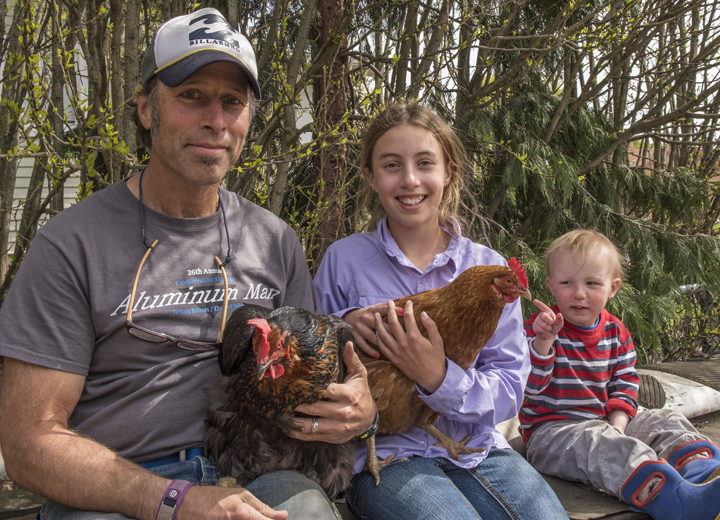
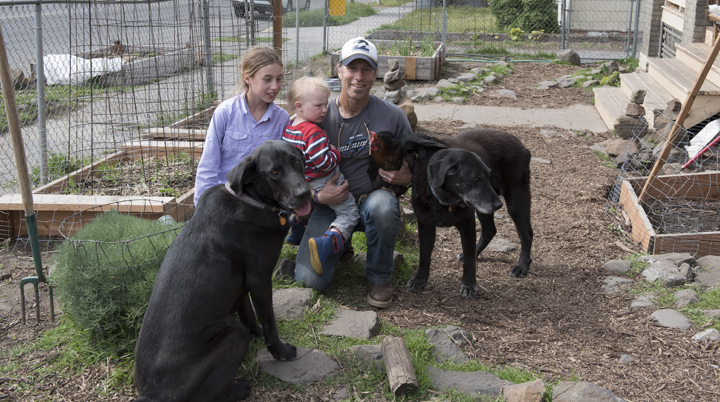
Maisie, Lolo, David (with chicken) Bandel-Ramirez. Dogs Truman and Dano. Mom Elena, an RN, was resting for her shift when the picture was taken.

Maisie, Lolo, David (with chicken) Bandel-Ramirez. Dogs Truman and Dano. Mom Elena, an RN, was resting for her shift.

The Bandel-Ramirez family wins the first 2015 Envirogorge Nature Space Award. The family, parents David and Elena and children Maisie and Lolo, won for converting a lawn into an urban garden. It’s shared space. There’s Dano and Truman, two giant (but gentle) dogs; three chickens, a couple of baby chicks, and a rabbit that would just as soon be left alone. (more…)

By |2019-04-11T11:17:30-07:0004/21/2015|Old Articles, Uncategorized|2 Comments

The Walk-Instead Challenge. Are you in?

Transportation: trains, cars, boats, bikes and of course walking–the object of a challenge we have for you this month. Till the end of January 2015, we’re challenging you to walk instead of driving to one of your usual destinations. Who’s in?

Why do we care? Well it’s the environment. Think one person can make a difference? Here’s a chance to prove it. Share your stories or photos of where you walked instead.  Comment here or post to Facebook, tweet or Instagram @envirogorge #walkinstead

By |2019-04-11T11:19:36-07:0001/07/2015|Energy, More, Old Articles, Transportation|2 Comments

Old Growth Growing, an essay by Bonnie New

I meandered recently in a shady old growth forest of the Olympic peninsula and felt the awe of the BIG—the extent of forest, the size of the trees, the arc of time and biological process, the shaping forces of wind and temperature and water, the whole orchestral magnificence of life cycles and elements. At my feet was a world of a mesmerizing detail. Here were tiny slick mushrooms, furry banks of moss, splotchy leaves falling to the ground, insects scurrying and burrowing—vibrant pieces of the woodland orchestra.

I know the feeling of SMALL, even insignificance, in the presence of this BIG. I have wished to be more, to build with bigger blocks, to create a bigger impact, to leave a bigger footprint in this needy world. But the impressive universe of the forest is a working pile of pieces – little pieces, spent leaves, hungry decomposers, tailored enzymes, hopeful seedlings. There is a place for each, indeed a need for each. Remove one and the forest is less, and different, and moving forward into a changed future. So too for me and my kind. I should remember.

By |2020-09-30T19:54:16-07:0011/11/2014|Essays, More, Old Articles|1 Comment

Nature Space Award: Oak Street Apartments

Photo by Jerry Giarraputo.

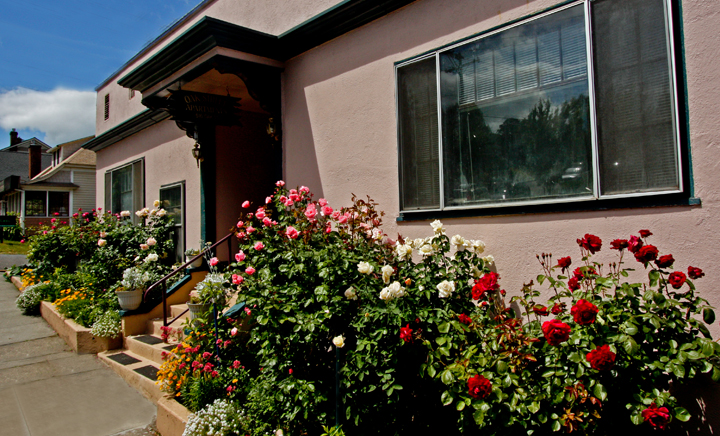
The vegetable and flower garden at the corner of Oak and 6th Streets is a big part of what makes downtown Hood River so appealing to visitors and residents.

C. J. Wertgen owns Oak Street Apartments at that corner. Around the perimeter of the building she created a garden filled with roses and peppers, lilies and artichokes, nasturtiums and carrots, squash and mums, sage and lemon mint and more. Steve Frazier, who has one of the apartments, helps garden and is part of the reason the roses are so successful.

C. J. Wertgen

C. J.’s daughter Lori Martinez nominated her garden for our Nature Space award. We liked the garden and the fact that unlike other businesses C. J. even planted the area under the grating beside the street. It’s those extra things that make a place stand out. She wins one of Envirogorge’s $25 awards for places where people are creating places for nature.

This urban garden is open to all who drive or walk along the town’s main street. “I like the green,” C. J. says. “I like to see things grow. It’s my pleasure to share it.”

By |2019-04-11T11:20:42-07:0009/09/2014|Old Articles, Uncategorized|4 Comments

Nature Space Award: White Salmon Community Partners

Jewett Street, White Salmon, Washington

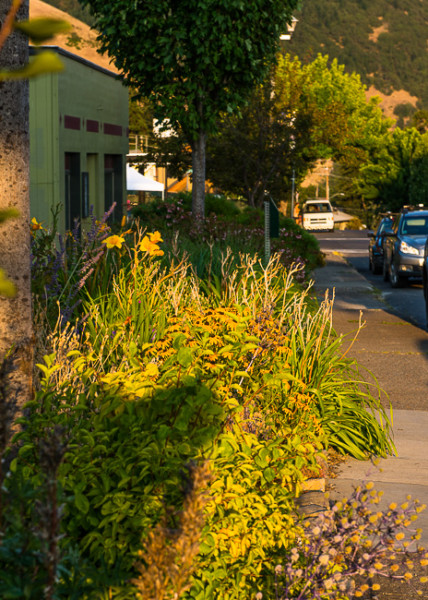
A narrow garden extends several blocks along Jewett Street separating the shops, restaurants and offices from the street. Julia DeArmond nominated downtown White Salmon, Washington urban street garden.

“I enjoy the planting strips for the feeling of vitality it brings to the main streets of town,” Julia says. “I appreciate my city prioritizing beauty in this way.”

We at Envirogorge agree with Julia. The plantings create a colorful and welcoming atmosphere to the downtown. This street garden also stands out because of the partnership between community volunteers, businesses and the City of White Salmon. We’re awarding White Salmon Community Partners our second Nature Space Award.

The City originally planted the strip and even had a gardener who maintained it. Then around 2009 the city hit a water shortage and discontinued caring for it.

“The plants went to pot,” says Lloyd DeKay. The trees survived but the flowers and shrubs were in sad shape.

When the city resolved the water crisis, he and Celynn VanDeventer stepped up to take over. “We wanted it to look beautiful,” he says, “so we decided we could do this.”

The volunteers and businesses that joined them formed into a group called Community Partners and went to work restoring the blocks-long five foot wide the planting strip.

The partners put in a drip irrigation system that the city provided. Downtown businesses and citizens donated money to buy new plants. Today, five years later, the plants are thriving. Bees, spiders, and birds use it—demonstrating the health of the narrow ecosystem.

Several times a year Lloyd and Celynn put out a call for a work day.

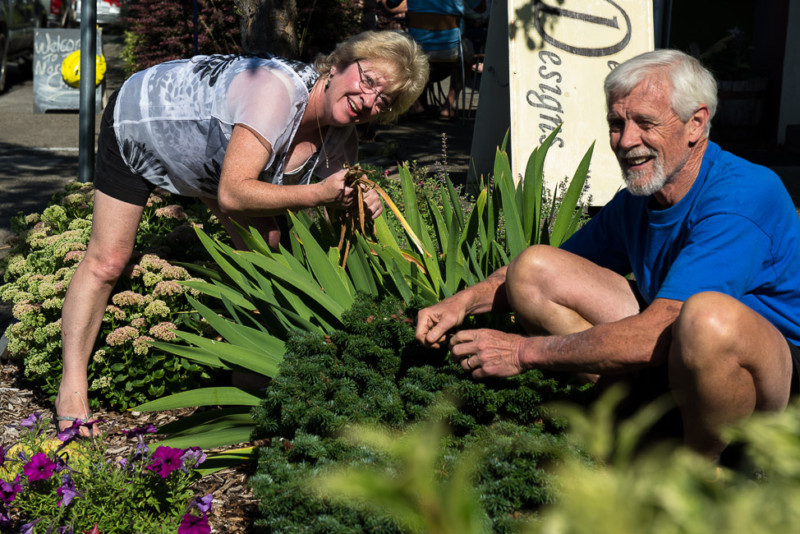
Celynn VanDeventer and Lloyd Dekay tending Jewett Street plantings

“The community takes care of it,” Celynn says, “even people 10 miles up Snowden help. We did this because we wanted people to see that White Salmon is a beautiful place to visit. We want it to be inviting.”

Community Partners added more projects: painted salmon in downtown crosswalks, hired an artist to paint murals on fencing that blocks a couple of empty lots, and bought colorful banners for the light poles.

“Over the past five years there’s been a massive increase in community pride,” Lloyd says. “The whole community has gotten much more excited about downtown White Salmon. The town is beginning to stand out as a little gem.”


By |2019-04-11T11:21:00-07:0008/06/2014|Old Articles, Uncategorized|1 Comment

© Copyright 2013-2025 Columbia Insight. All Rights Reserved.

As a 501(c)3 nonprofit organization, all donations to Columbia Insight are tax deductible to the full extent of the law. Our nonprofit federal tax-exempt number is 82-4504894.