Stay Updated Subscribe today for the latest research + reporting about environmental news. Subscribe Now

Stay Updated Subscribe today for the latest research + reporting about environmental news.

Subscribe Now

Susan Hess

Susan Hess

Susan Hess

About Susan Hess

Susan Hess is Columbia Insight's publisher.

Indian Creek Canyon Fire in Hood River

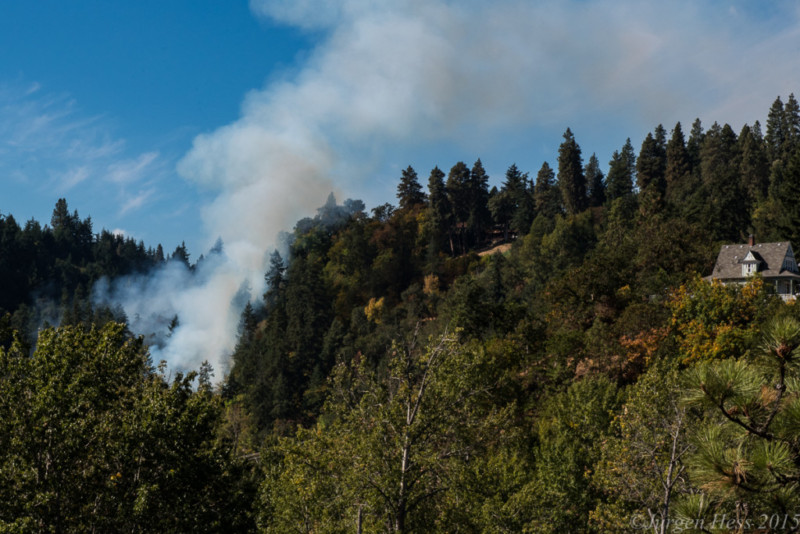
Sept. 27, 2015. Sunday evening an off duty firefighter spotted smoke near the mouth of Indian Creek where it enters the Hood River. The fire spread up the canyon on the north side of Indian Creek.

As of Monday afternoon, the fire had covered two and a half acres. Firefighters have been able to keep the fire below the popular Indian Creek Trail and halt westward spread at the bend in trail (below Third Street). Indian Creek trail is currently closed.

Captain Dave Smith of the Hood River Fire Department had a crew stationed at 3rd and Pine Streets in Hood River to protect homes along the top of the canyon. He said crews are trying to get a fire line completely around the fire–difficult in the steep terrain. To assist a helicopter dropped water on the fire all day Monday.

While the cause is still unknown, there was no lightning in the area. The fire is on Oregon Department of Forestry protected land–they are the lead on the fire. Sunday evening crews from surrounding firefighting agencies responded: Columbia River Gorge National Scenic Area, City of Hood River, Westside, Wy’East, Cascade Locks, Bingen, White Salmon, and Husum.
By |2019-04-11T11:09:52-07:0009/29/2015|Climate Change, News, Old Articles, Wildfire|0 Comments

What I Will Miss

The fires are more than air pollution, more than lost logging and grazing. But for now the focus must be on the urgency to somehow contain the unprecedented acreage burning in Oregon and Washington.

I wonder what I will find when I can once again hike to Bird Creek Meadows. Just a month ago, a group of us drove to Bird Lake and hiked the Crooked Creek Trail. The trail followed meandering streams so clear we could see every rock of the stream beds. The trail turned a corner and through the conifers would be a waterfall. We paused just to enjoy the beauty. Wildflowers grew thick on stream sides. Just past one waterfall the trail went through a half acre of Indian paintbrush—glorious in shades of red and orange.

Above the Round the Mountain Trail, we walked over glacier-grooved rock through Bird Creek Meadow full of blue gentian, pink monkey flowers, and purple lupines. We rested at Hell Roaring Overlook, the glacier carved valley. Above it, we looked up to snow topped Mt. Adams.

We turned around there and wandered down through forests thick with firs, pine and spruce. Huckleberries and bear grass grew below the trees

This six mile loop is one of thousands that fires have burned this summer. They are places where we go to hike, ski, and to just be in that beauty, breath mountain air, smell sunshine on pine needles.

I will miss that place, my place—a place thousands felt was their special place. It’s seems almost petty to grieve the loss of a place where we went only to recreate, when so many have lost homes and jobs. But recreation doesn’t really describe the importance of those wild places.

We need these places for in the vastness of our country, wild mountain areas are few. Deserts, wonderful in their own way, claim perhaps a third of the land. Agriculture, logging, and urban areas—concentrated and scattered—have reduced the amount of once untrammeled wild that seemed unending.

Like the loss of place, the effect of the fires on wildlife and domestic animals is little reported. So much is on our human concerns—homes burned or threatened. But we know such vast fires are destroying the habitat—the homes—of deer, elk, birds, horses and cattle.

Neil Kayser grazes cattle on Mt. Adams. As soon as the Cougar Creek Fire started, he and his ranch hands began searching the mountain to get the cattle out of danger. But even that early, some were already maimed. Their pain hurts us, too.

The smoke clogged air the last weeks created a pall to match our sadness of all the losses.

After the fires end, the trees will be a forest of blackened boles, the ground a sea of grey ash. There will be new growth springing up in the newly released nitrogen, but the sheltering forest we knew will only be there for generations far from now.

By |2020-09-30T19:54:14-07:0008/24/2015|Essays, More, Old Articles|3 Comments

Yellowstone Summers

Our family rented a cabin in Yellowstone National Park for a few days each summer the years we lived, first in Casper, Wyoming and then Denver. My mom drove us four kids north from Casper along the winding road through Wind River Canyon.

There may have been an official entrance to the park, but for us, Yellowstone started where the road turned steep and ran between mountainsides green with conifers. We always noticed the green. It was like coming to an oasis after the parched plateau surrounding Casper.

Once on every trip, the car would vapor lock—annoying my mother and making it that much longer till we got to Yellowstone. Mother parked the car at the side of the road until it cooled enough to start again. Ranch trucks passed us—hauling truckloads of sheep up to the national forests that bounded the park.

My dad always came later. He worked for Wyo-Ben, a company that mined bentonite–used in drilling oil wells. Their plant was in Cody, a town east of Yellowstone, and a place I remember being closed off one summer during a polio outbreak. My dad sold ‘mud’ to drilling sites all over Wyoming. He’d work the latest oil fields, stop in the Cody office, and come meet us in the park.

The cabins we rented near Lake Yellowstone were so basic they seemed little changed since the days of the early fur trappers—small single pane windows, weathered single-board walls, metal beds with thin mattresses, and a small wood stove. Its one luxury was that it had two rooms: one my parents slept in and the ‘big’ room shared by us four kids.

The cluster of cabins sat under tall pines. Nights were cold at the 8,000 foot elevation. We woke in the morning to sun filtered by the pines, but it was as cold in the cabin as outside. We’d lie in bed hoping somebody else would get up and start a fire. Finally, my dad or my oldest brother would get up, teeth chattering and light it.

The altitude and the cold made for pure air, and the fragrant pines made it smell like you could just sit and breathe it in and that would be  wonder enough. But it was sweeter, because at home in Casper, we breathed the sulfur fumes of Casper’s oil refineries.

By day, we left the cabins to see Yellowstone’s wonders. We stood to watch old Faithful erupt; leaned out the car window to look at bears that stopped lines of cars, saw Morning Glory pool, bought cheap souvenirs in the gift store, and tried to take in the size of Yellowstone Falls—unused to ever seeing that much water.

I don’t think my parents ever knew or guessed that of all the things we did and saw, what I treasure most was sunlight filtered through the pines, the beauty of the hills and meadows, and summer mountain-cold nights that made pulling up the covers cozy. And it was the sense of wild that I as a child and teen could feel. Trees grew where they grew with the patterns nature provided. I felt I belonged there.

I remember so little of those cabins—not eating breakfast there, not coming in with suitcases. I just remember the smell of campfire smoke and those thin wood walls and the feeling that we had come to someplace that suited us; that was the best the world had to offer.

By |2020-09-30T19:54:15-07:0007/23/2015|Essays, More, Old Articles|3 Comments

74° and Sunny. Bad News for Fish.

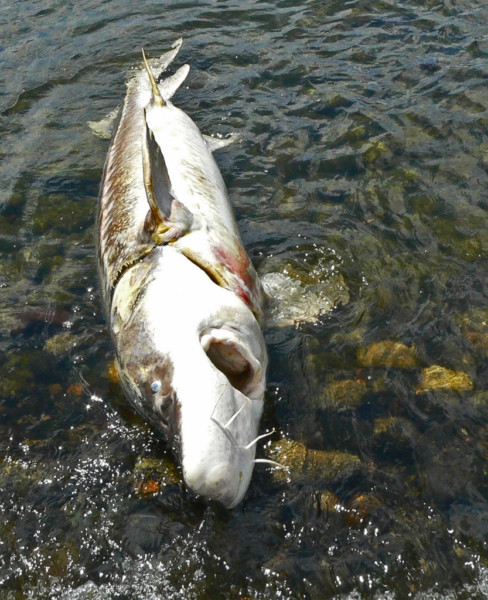
Dead sturgeon. Photo:WDFW

Dead sturgeon. Photo:WDFW

Paddle boarding to the very lowest part of the White Salmon River Friday evening, July 17, Margaret Neuman counted about 31 dead and 70 live sockeye. The Executive Director of Mid-Columbia Fisheries Enhancement Group writes: “These are sockeye salmon, presumably headed (or should be headed) to the Okanagan and Wenatchee Rivers on the upper Columbia. Sockeye are not native to the White Salmon and do not spawn here. The assumption is that these fish were/are stressed by high temperatures in the Columbia River and have moved into the White Salmon to get some relief. Cold water holds more oxygen which is better for cold water species like salmon and trout.”

Washington Dept. of Fish & Wildlife is keeping track of drought-related fish kills, so please share information regarding what you are seeing on the river and in the tributaries to: Thomas Buehrens, WDFD, 360-906-6700 x6851, Thomas.Buehrens@dfw.wa.gov

The summer’s drought in the Columbia River Basin is brutal on salmon, steelhead and sturgeon:

  • The Oregon Department of Fish and Wildlife has curtailed fishing hours on most of Oregon’s rivers to avoid additional stress on native fish already suffering from high water temperatures and low stream flows from this year’s drought. One example of that stress — an estimated 109 wild spring chinook salmon in the upper section of the Middle Fork John Day River died last week, apparently due to low river flows and warm temperatures. Columbia Basin Fish and Wildlife News Bulletin. July 17, 2015.
  • Columbia River mainstem from Bonneville Dam to Chief Joseph and above yielded devastating adult sturgeon and sockeye mortalities this week. Columbia River conditions are lower, warmer, and clearer than recent five- and ten-year averages. Current outflow at Bonneville Dam is averaging 137 kcfs for July, compared to the recent five-year average for July 1-14 of 287 kcfs. Water temperatures have been above average all year and currently average 74º F for July 1-14, compared to the five-year average of 64º F for this same timeframe. WDFW Drought Status Update for July 17, 2015
  • U.S. Fish and Wildlife Service has cleared out the Warm Springs National Fish Hatchery in central Oregon transferring more than 160,000 juvenile spring Chinook and 680 adult fish from to the Little White Salmon Fish Hatchery in the Columbia Gorge. Salmon prefer water temperatures in the 50s becoming stressed and prone to disease in the 60s. Current river temps are exceeding 70 degrees, temperatures usually not seen until late summer at the tail end of the salmon runs. The Oregoninan. July 22, 2015.
  • Washington state fishery managers are closing or restricting fishing on more than 30 rivers throughout Washington to help protect fish in areas where drought conditions have reduced flows and increased water temperatures. Columbia Basin Fish and Wildlife News Bulletin. July 17, 2015.
  • Fisheries managers began trapping endangered Snake River sockeye salmon from Lower Granite Dam Monday and transporting the fish to Eagle Hatchery in Idaho as river managers struggled to keep the river cool. As of Wednesday this week, just five fish had been captured and transported. Columbia Basin Fish and Wildlife News Bulletin. July 17, 2015.
  • As many as 80 large, broodstock-sized sturgeon were found dead this week in the Columbia River upstream of Bonneville Dam, triggering a complete closure of fishing for what some are calling “valuable, almost irreplaceable fish.” Preliminary investigations point to warmer than average water temperatures as the cause of the die-off, prompting the two-state Columbia River Compact to close the river to recreational sturgeon fishing until further notice, effective Saturday, July 18 — an action that was unanimously supported by biologists and river guides alike. Columbia Basin Fish and Wildlife News Bulletin. July 17, 2015.

The Star Magnolia

The star magnolia grew at the south edge of our front yard next to the Sunquist’s driveway. Our cat Tasha liked to lie under the tree, where our elderly neighbors would fuss over her as they went in and out. The tree was one of those that seem a cross between a tree and a bush—high enough to be a tree, but just barely. In the spring, you could see how it got its name. Its white blossoms looked like star beams.

Besides the lone pear, the front yard was an open space. But if our two daughters and their friends were in the front yard, I’d look first to the star magnolia. There they’d be, legs dangling from its sturdy branches. It was better than a tree house, because it constantly changed with the seasons; it could follow their imaginations.

Once or twice we would play badminton in the front yard, although tricky with the pear tree. And other than mowing it in summer, the yard was a sort of Sahara—I mean it was green, but it was something to cross to get to where you wanted to go.

The star magnolia came to me, because water situation promises to be dire for much of the west this summer and fall. We here in the Gorge have read with sympathy of the plight of the drought in the southeast of the U.S. But this time we are not exempt. So the talk of cutting back water use swelled in California, and crept only slowly into Oregon conversations. Now it’s here. The snows never did come. Mountain roads that usually are closed until mid-July have been snow-free for a couple months.

Irrigation districts are thinking anxiously about whose water they might have to cut off. Asking now for voluntary cutbacks. The watershed council is asking city dwellers to let their lawns go brown to save water for farms, orchards and fish. Driving down a Hood River street last night and I really noticed the emerald green lawns stretching to the street. Will it be hard to be the first one to go brown? Or will they put a sign in the yard proud to say—a brown lawn for farms and fish?

That’s why the star magnolia came to me, because almost everyone’s front yard is like that. They’re like an art piece to be looked at, but not used. How often do you see people spreading a picnic on their front lawn? Pull out a bench and read a book there? See kids playing tag or hide and seek in the lawn?

Go brown. It’s much more fun up in the magnolia.

Clearing the Air: The Power of Methane

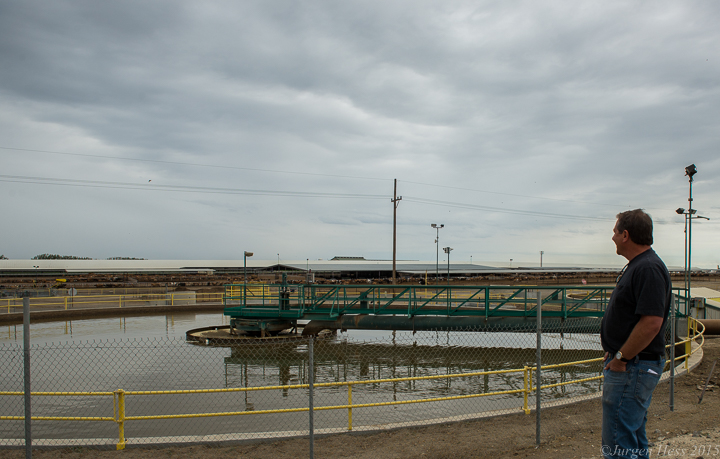
Rick Morck stands by one of Threemile Canyon Farms two clarifers. Behind it, stand some of the farms' 25,000 dairy cows.

Rick Morck stands by one of Threemile Canyon Farms two clarifers. Behind it, stand some of the farms’ 25,000 dairy cows.

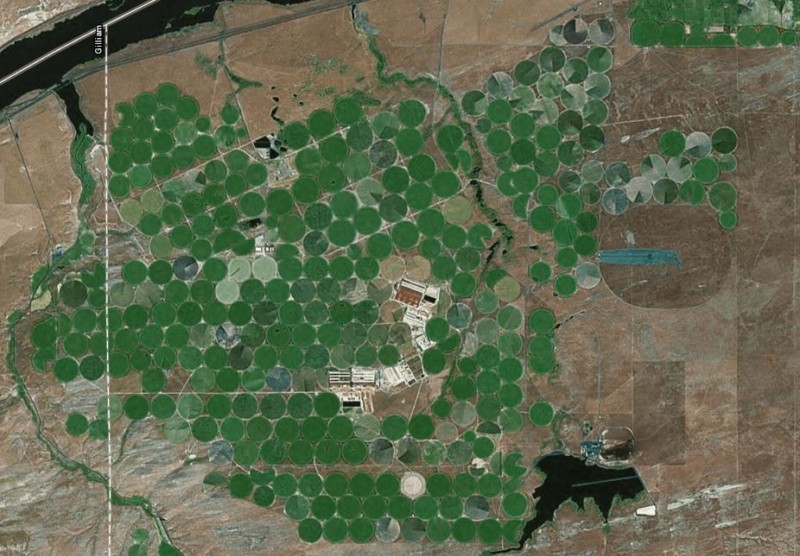
Everything about Threemile Canyon Farms is supersize. It covers 40,000 acres near Boardman, Oregon; raises 25,000 dairy cows which produce 130,000 gallons of milk– every day; grows 230,000 tons of potatoes a year; and 8,000 acres of organically certified vegetables. It may be the only gated farm in the Northwest and one that has a security guard station at every gate. (more…)

© Copyright 2013-2025 Columbia Insight. All Rights Reserved.

As a 501(c)3 nonprofit organization, all donations to Columbia Insight are tax deductible to the full extent of the law. Our nonprofit federal tax-exempt number is 82-4504894.