Stay Updated Subscribe today for the latest research + reporting about environmental news. Subscribe Now

Stay Updated Subscribe today for the latest research + reporting about environmental news.

Subscribe Now

Steven Hawley

Steven Hawley

Steven Hawley

About Steven Hawley

Steven Hawley is a writer and filmmaker from Hood River, Oregon. He's the writer and co-producer of the documentary film Dammed to Extinction, (2019) and author of Recovering a Lost River (Beacon Press, 2011). His latest book, Cracked: The Future of Dams in a Hot, Crazy World, will be published by Patagonia Books in May 2023.

Pump it up? The economics of stored-hydro energy may not be as green as the pitch

As electricity markets evolve, a noted economist says several proposed renewable-energy projects could cost more than they’ll ever make
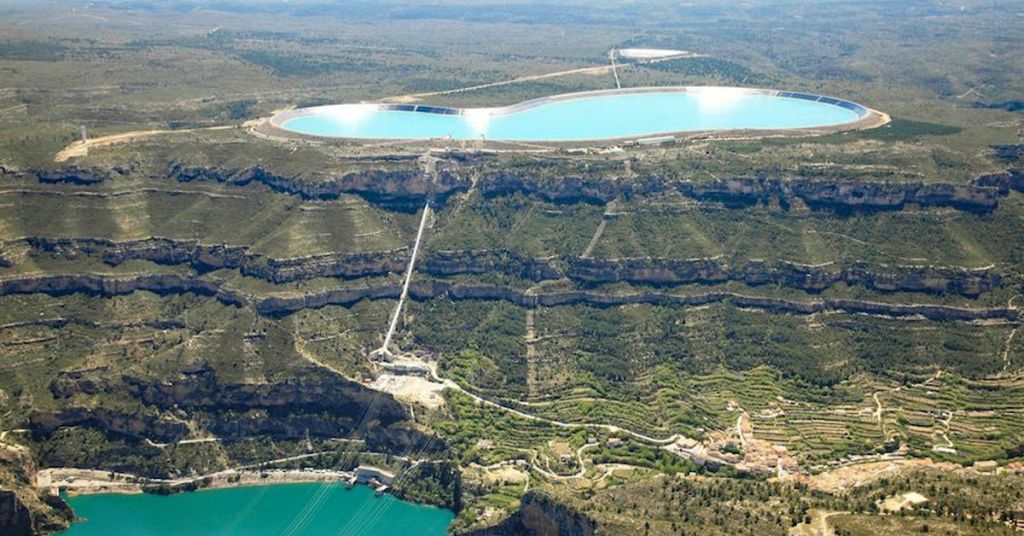
La Meula Pumped-Hydoo Power Station. Photo: Iberdrola

Still pumped: Completed in 2013 near Valencia, Spain, the 1,772 megawatt La Meula is one of the world’s 10 largest pumped-storage hydropower plants. Smaller pumped-storage projects have been proposed across the Pacific Northwest. Photo: Iberdrola

By Steven Hawley. April 28, 2022. Two proposed hydropower projects in southern Oregon, and a third just across the Columbia River near Goldendale, Wash., have so far generated no electricity, but plenty of controversy.

Environmental concerns have put the brakes on pumped hydropower storage in the region, with opponents citing the effect of high-voltage power lines on migrating birds, and the havoc construction of dams and reservoirs would wreak on sites of cultural significance to Klamath and Yakama Nations.

Boston-based Rye Development, the company managing two of the projects, has promised to work with stakeholders to address their concerns. A third project, on the Owyhee, is a project of rPlus Hydro.

But a more complicated problem awaits each of these energy projects should any of them be completed: will they generate enough revenue to keep their doors open?

According to one veteran energy consultant, it’s unlikely that any pumped-storage project in the region will turn a profit, and it will be a challenge for the proposed operations to simply to meet debt payments and operating costs.

Earnings report

Tony Jones lives outside of Boise. He’s worked for Idaho governors Phil Batt and Dirk Kempthorne, each of who were impressed with Jones’ accurate prediction of Idaho’s energy picture on the heels of deregulation in the late 1990s.

A push on the part of staunchly conservative legislators in the state to deregulate energy markets was unsuccessful, and despite forecasts that Idaho would be left behind in a market-driven low-price revolution, Jones accurately predicted nothing of the sort would happen. He was right.
Tony Jones

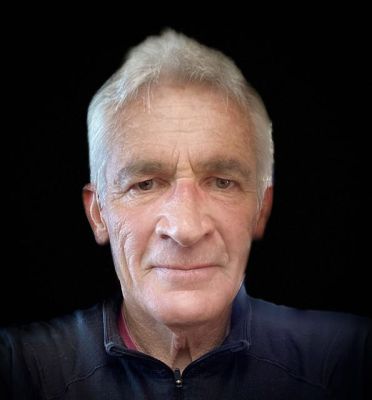
Crunch time: Tony Jones of Rocky Mountain Econometrics examines the numbers behind major energy projects. Photo: Tony Jones

Since then, Jones has founded Rocky Mountain Econometrics, which specializes in environmental issues with particular emphasis on energy and the impact of hydroelectric dams on salmon and the environment. In addition to those Idaho governors, past clients include Idaho Rivers United and the National Wildlife Foundation.

In 2019, he was commissioned by the conservation NGO American Rivers to assess the economic viability of the proposed Goldendale project. His conclusion: the $2.5 billion price tag would cost more than the project would ever likely earn.

One of the few ways it could ever make money, wrote Jones, would be if the owners stiffed their investors by declaring bankruptcy, and different owners were able to acquire the infrastructure for pennies on the dollar.

“They said I’m wrong, that I don’t understand how the plant will operate,” says Jones. “As an economist, I’ve always been open-minded. I say, ‘Okay, make me smarter. Tell me where the money comes from, because I’m just not seeing it.’ They got kind of pissed at me when that report came out, but they didn’t prove me wrong.”

Jones was hired to analyze another proposed pumped-storage project in Idaho, on a fork of the Boise River, and drew similar conclusions to the Goldendale site.

At the request of Columbia Insight, he took a brief look at the two Oregon projects: the $850 million, 400-megawatt Swan Lake project near Klamath Falls; and a $1.5 billion, 600-megawatt proposal that would be built near the Owyhee River.

“The Klamath project doesn’t look as troubled [as Goldendale],” says Jones. “But that doesn’t mean it’s not troubled.”

Jones was unimpressed with the Owyhee project, as well.

“That proposal comes with some numbers I was able to access, and it looks to me like it’s projected efficiency is only going to hit about 36 percent,” says Jones. “That means that most of the time, it will just be sitting out there, the reservoirs evaporating in the desert.”

Tricky timing

The challenge for pumped-storage hydro lies in its claim to be a reliable, cost-effective backup “battery” for renewable, but intermittent sources of energy like solar and wind power.

When the wind stops blowing or the sun doesn’t shine, some other source of generation, driven by batteries, fossil fuel or conventional hydropower, is needed.

The question for pumped storage is how it stacks up against these other options.

Prohibitive up-front capital costs are a significant drawback, says Jones, but not the biggest problem.
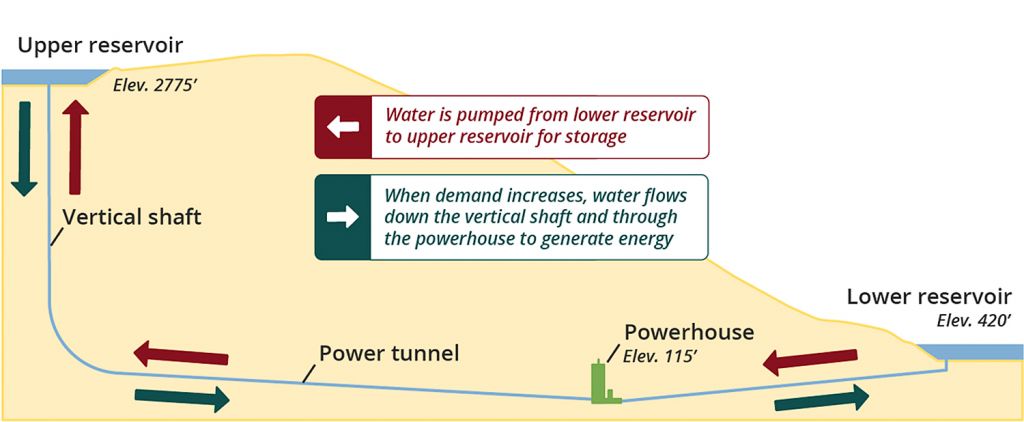
Proposed pumped-hydro project near Goldendale, Washington, project location. Image from Washington Department of Ecology

How it works: Proposed pumped-hydro project near Goldendale, Washi. Image: Wash. Dept. of Ecology

Closed-loop systems like the ones proposed in Oregon by Rye Development will rely on pumping water uphill from a lower reservoir to an upper reservoir via a subterranean pipe when the price of electricity is low, and moving the same water back down the pipe to spin a turbine when the price of energy is high.

According to Jones’s analysis, the timing, duration and distances in daily price swings in western energy markets don’t translate to profitability for pumped storage. Jones predicts that the Goldendale pumped-storage project will require a $102 per-megawatt-hour price to turn a profit.

In April 2022, during an unusual cold snap, electricity prices in the region averaged around $45.

The Northwest Power and Conservation Council, which has provided the Pacific Northwest with detailed energy supply-and-demand forecasts every five years since 1980, says in its latest draft plan that prices for power in 2021 ranged from $18 to $30 per megawatt hour. By 2026, the projected range is $12 to $17 per megawatt hour; by 2041 around $10 per megawatt hour; and by 2041 “significant levels of low or no-cost power will be available most daylight hours throughout the year.”

Power surge

Dramatic changes in both supply and demand for energy are fundamentally reshaping western energy markets. Primarily because of the 14,000 megawatts of solar power installed in California over the past 20 years—an astonishing accomplishment, exceeding the capacity of the federal hydropower system on the Columbia River—the timing of peak demand, which used to be midday, has been flattened and then some.

On many days, the midday price for power goes negative—producers are actually paying consumers to take it off the grid.


Solar thermal in the Cali desert

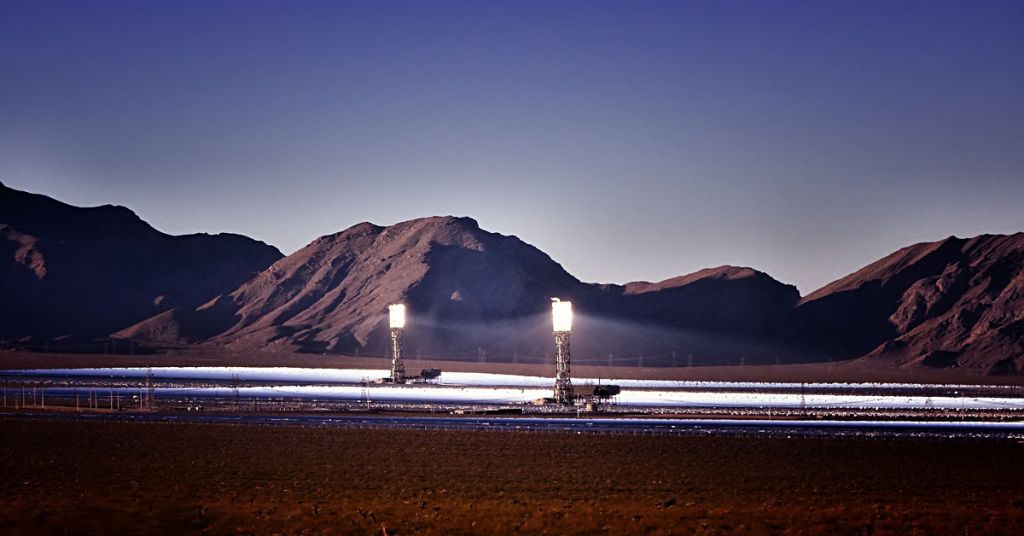
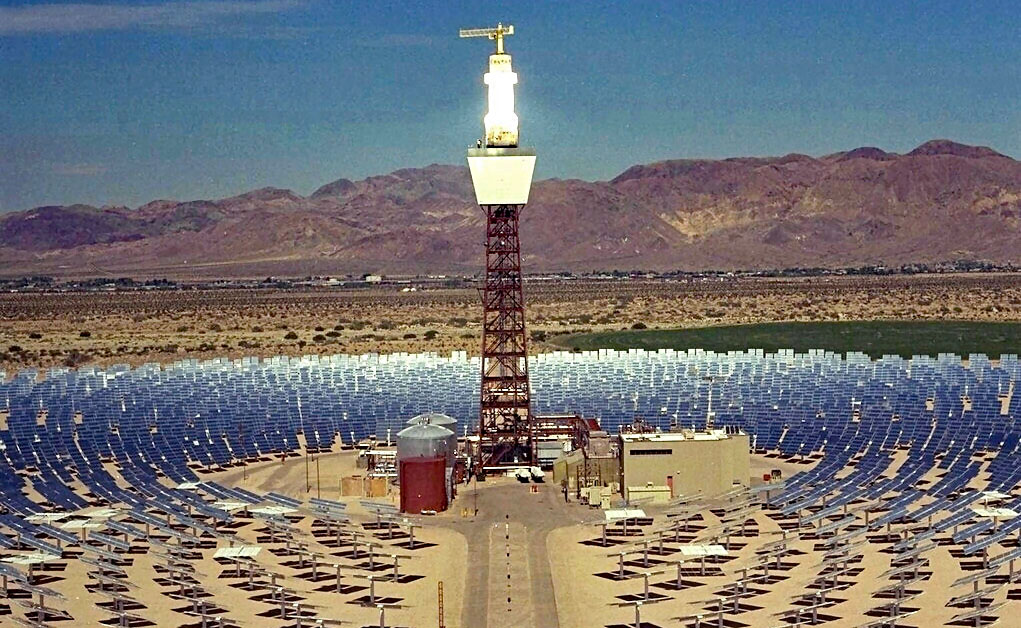
White hot trend: Solar thermal collectors in the Southern California desert focus reflect sunlight on boilers that produce steam to turn electric generators.          Photo: International Rivers/CC

In addition, peak demand has been pushed to late afternoon and early evening, when solar panel production wanes as the sun goes down, but energy demand rises.

Energy wonks have taken to calling this re-shaped daily demand a “duck curve,” as the hours of energy use plotted over a day now resembles the shape of a duck’s back and neck.

“For these projects to be profitable they [pumped storage producers] will need eight to 10 hours of the high prices that go along with high demand,” says Jones. “But instead, they’re getting one to two hours.”

Even if pumped storage wants to compete for those one to two hours of peak price, says Jones, other sources have a natural advantage.

Tesla, for example, is back-ordered for a year on its utility-scale Megapack battery array. Each unit can store and then deliver on demand up to three megawatt hours of electricity. For $850 million, Tesla will sell you a hundred of these at a time—and utilities are lining up to get them.

The California utility Pacific Gas and Electric, for example, announced on April 18 that its 233 Megapack array with 750 megawatts of backup power was fully operational.

Crunch the numbers: for under $2 billion, PG&E got 350 megawatts more of what Swan Lake has promised, but with a smaller footprint, and with other, more nuanced advantages. For a variety of technical reasons, batteries will be able to meet shorter, steeper spikes of demand better than pumped storage.

“By the time a pumped storage system is ready to respond, the battery guys will have taken the price spike off the table,” says Jones.

Hold up a sec

Adam Schultz is the Oregon Department of Energy’s Electricity & Markets Policy Group lead.

He points out that the market forces at play in California and the West may not affect Oregon’s pumped-storage projects as directly as Tony Jones prognosticates.

“In Oregon, we still have vertically integrated utilities that are looking at an energy portfolio to meet their needs,” says Shultz. “They’re not having to get power off that open spot market in California. So, conceivably, pumped storage might contract with one or more of these utilities as part of that portfolio.”
Proposed pumped-hydro project near Goldendale, Washington, reservoir locations. Photo from Washington Department of Ecology

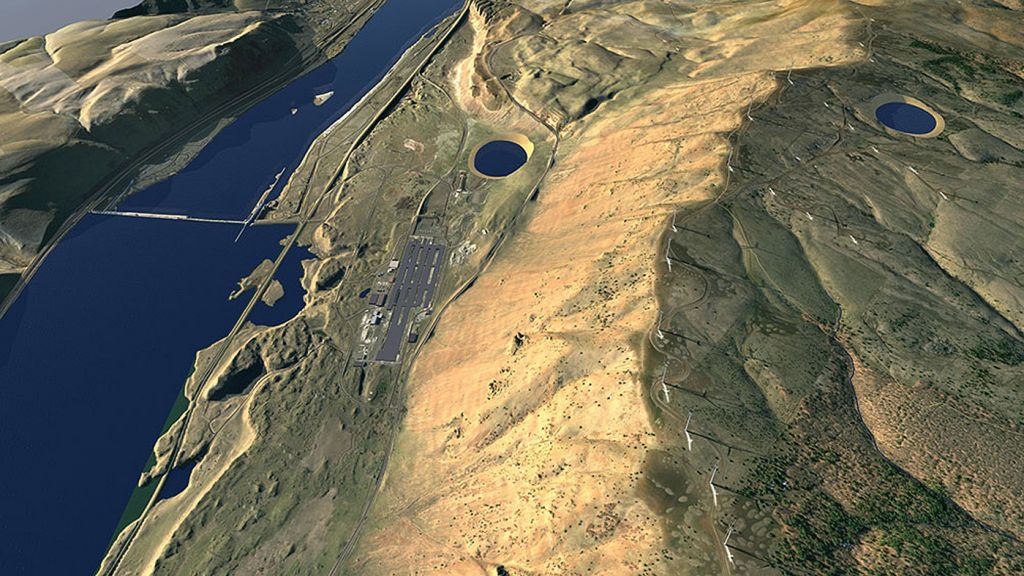
Up grade? Proposed pumped-storage project near Goldendale, Wash. The blue circles represent reservoir locations. Image: Wash. Dept. of Ecology

But that larger and more volatile market, says Schultz, does affect Oregon’s utilities.

The Bonneville Power Administration, he notes, is the most influential player in the state’s energy concern. For most of its existence, the BPA has operated on a business model based upon selling hydropower outside the region, mostly to California, on that more lucrative open market.

It’s used the windfall from those sales to keep electricity rates within the Pacific Northwest low.

But that model won’t be valid much longer if prevailing energy forecasts hold true.

The shifting sands point to the need for the state to engage in planning to figure out which kinds of new energy projects might fit best with Oregon’s future needs.

So is any kind of coordinated plan in the works?

“No,” says Schultz, with apparent frustration. “There’s a lot of buzz around that topic right now. But nothing definitive.”

Uphill battle

In late 2020, Rye sold its Goldendale and Swan Lake pumped-storage projects to Copenhagen Infrastructure Partners, a Denmark-based investment firm. Rye has continued to manage the projects.

Erik Steimle is the company’s vice president of development. In a September 2021, podcast hosted by the Oregon Department of Energy, Steimle described pumped storage as “the cornerstone of a Pacific Northwest clean energy economy.”

“Pumped storage relies on proven technology, domestic resources and offers a long-term solution to achieve our clean energy future. Our region will not be able to add more solar, wind and other renewable energy onto the grid and maintain grid reliability without a massive amount of additional storage capacity,” Steimle tells Columbia Insight via email. “The integration of intermittent renewables to the grid in lieu of fossil fuel-burning resources will rely on highly flexible, economical bulk energy storage that can respond to swings in demand and help ensure uninterrupted power to homes and businesses.
“In today’s economy, pumped storage is the only asset that provides large-scale, cost-effective renewable energy storage capacity and a range of essential grid reliability services. The value of pumped storage will only increase as more intermittent renewable resources are added to the grid in our efforts to meet 100% carbon-free mandates.

“A dearth of evidence, including research used by Pacific Northwest utilities in their Integrated Resource Planning (IRP), clearly prove the economic value of pumped storage.”

Steimle refers to PacifiCorp’s 2021 filing of preliminary FERC permits for 11 pumped storage projects throughout the West as evidence that utilities understand the need for this technology in addition to batteries.

Yet the rest of the country seems to be hitting the pause button on such developments. Around the United States since 2014, 67 new pumped-storage projects have been proposed. Only three have been permitted and none have begun construction.

For Jones, the troubles for pumped storage are beyond purely economic.

“These projects have the potential to be highly disruptive,” he says.

The Goldendale project, when pumping water to the upper reservoir, would consume the same amount of electricity as 770,000 homes, more households than in all of Idaho.

In Jones’s calculations, Goldendale will be a net consumer of energy.

“It’s kind of insane,” he says.

A previous version of this article inaccurately stated that Rye Development had not responded to Columbia Insight’s request for comment. —Editor

The Fred W. Fields Fund of Oregon Community Foundation supported this story.

OCF logo

By |2026-01-29T10:04:37-08:0004/28/2022|Renewable Energy|6 Comments

Uneven load: How rural communities shoulder the energy burden of cities

Large-scale alternative energy installations aren’t always the win-win for rural counties they’re made out to be

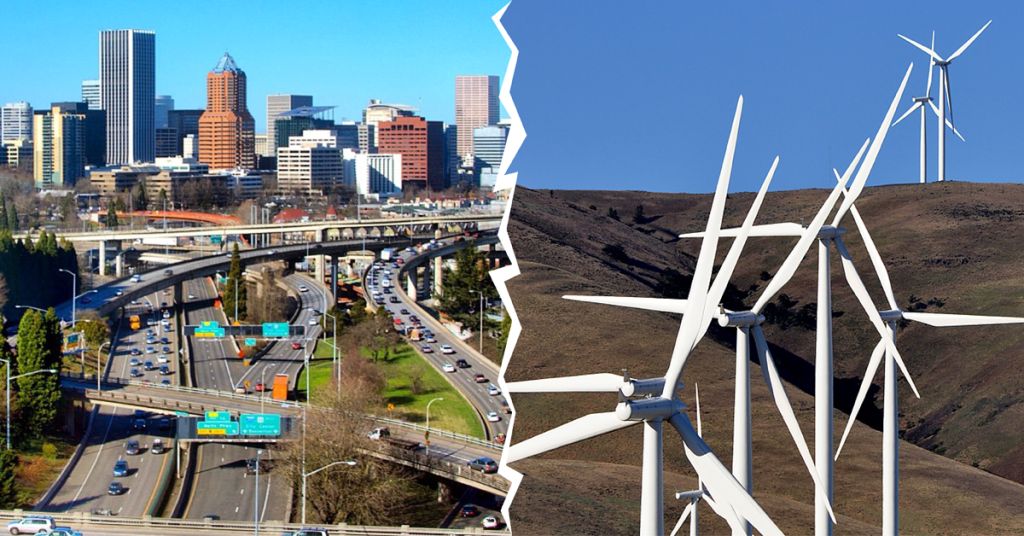
Portland and Klickitat County, Wash.

Division of power: Alternative energy installations tend to be located far from the urban centers that increasingly rely on them for energy. Photos: David Evers/CC (Portland), Jurgen Hess (turbines)

By Steven Hawley. February 10, 2022. For 140 years, Sherman County in north-central Oregon has been fertile wheat country. For the last 20 it’s also been rich wind energy territory.

The two commodities, thought Dave Pinkerton back in the late 1990s, might form the basis of a potentially lucrative strategic partnership.

Pinkerton Ranch has been growing wheat in the loamy soil and semi-arid rolling hills of western Sherman County, near the town of Moro, since Pinkerton’s great-grandfather seeded ground here in 1889. In the living room of the house that patriarch of the family built in 1890, his great-grandson watches a farm economics report blaring from a 50-inch, flat-screen TV.

Pinkerton’s 65-year-old face is all farmer—the lines around the eyes and mouth trace a career and family history of great pride, wry Irish humor and satisfaction in the work.

But there’s a tension in those lines that also conveys a farmer’s constant companion. He’s worried.

“I’m retired. So I just get to do the fun stuff. But now my son-in-law pays the bills,” says Pinkerton. “And right now the costs are enormous.”

He describes the scarcity, and subsequent skyrocketing price, of inputs: seed, chemicals, software that modern farm equipment utilizes to maximize efficiency.

“And now they say if the Russians get into Ukraine, we’ll have $200-a-barrel petroleum. That means $8-a-gallon diesel,” he says. “There’s not much good news. Kinda makes me want to turn it to the cartoon channel.”

Dave Pinkerton 2 by Jurgen Hess

Wheat and wind: Oregon farmer Dave Pinkerton has leased a sizable part his land to wind energy concerns. Photo: Jurgen Hess

Twenty-five years ago, the vagaries of farm life were somewhat ameliorated when the wind power industry came knocking. Leasing land to energy companies hopping early onto the push to embrace renewable power was a way to insulate against the economic risk factors in farming.

“It’s some money, not a lot,” says Pinkerton. “It’ll help me retire with some beer money, and it will be there for the kids when I’m gone.”

But it’s not without its complications.

Pinkerton points out that it’s landowners, not strictly farmers, who benefit from these leases.

“I was in a position to negotiate, because we own some [about half of the 5,000 acres Pinkerton Ranch cultivates] of our own ground,” he says. “But the farmer who’s leasing ground doesn’t benefit. And since he needs to maintain a good relationship with his landlord, he’s less likely to complain. So if that guy has a couple off years, he’s not farming anymore. And that’s not good, because there’s fewer and fewer of us.”

The advent of wind power has arguably been good financially for Sherman County. A windfall of millions of dollars has allowed the county to improve its schools, build a new courthouse and better maintain its roads. Each of the county’s 1,800 residents over 18 gets a check, courtesy of wind power revenue, for $590 each year.

Yet Pinkerton worries about factors beyond the bottom line.

“When they sell this as a green energy project, he says, “there’s nothing green about it.”

Growing inequality

Over the coming year, Columbia Insight will be investigating the growing footprint of renewable energy projects in rural Oregon and around the Columbia River Basin.

To many urban-dwellers in the region, the prospect of a big wind or solar project means progress toward the urgent goal of weaning civilization off fossil fuel.

But to those with roots in farm or timber country, these projects sometimes represent nothing more than a new wrinkle in an old pattern: resource extraction by monied interests that call the shots from an office at least several zip codes away, perhaps a few jobs, and too often, lasting damage to local water, soil, fish, wildlife and the once-pristine view.

Baldock Solar Station Photo by Oregon Department of Transportation

Bright or blight? The Baldock Solar Station is 1.75 megawatt solar array south of Portland. Photo: Oregon Department of Transportation

Don Albrecht is a rural sociologist and director of The Rural Development Center housed at Utah State University. He describes a crisis in rural western America long in the making that has metastatized over the past five years.

He points to grim statistics: the average male worker [in rural communities] makes less than they did in 1973 in constant dollars. In non-metropolitan counties, the poverty rate has actually increased since the Great Recession of 2007 to 2009.

Two-thirds of jobs in logging and wood products manufacturing are gone.

The trend translates in Oregon to an urban-rural income inequality. According to U.S. Census data, the average Clackamas County (which is predominately suburban Portland) household income is $62,000. In Wheeler County, south of Sherman County and out of the wind-power boom, it’s $33,000.

The cause of much of this decline, says Albrecht, is automation.

“I did some work in a timber town in Idaho a few years ago,” he says. “One of the county commissioners told me that when he was a kid, his county had nine saw mills, and now they had just one. And if I could bring back the eight they’d lost, the county’s problems would be solved.

“But those mills are not coming back. For starters, it’s possible that one remaining saw mill on its own can produce what the other eight did combined. So the jobs are going away, but the jobs remaining don’t pay much. Anger and frustration have increased.”

Lots of energy, lots of land

Economically stagnant, some rural communities seem particularly vulnerable to the overtures of a big company pitching an energy project that might help save the temperate version of the planet.

Can these companies help break both the habits of fossil fuel dependence and rural resource exploitation?

Dave Pinkerton is skeptical.

“When they put up one of these towers, they use more gas and diesel in one day than we use on our farm in an entire year,” he says.

Sherman County wind towers by Jurgen Hess

You can’t eat the view: But you can grow crops on some of the land occupied by wind towers in Oregon’s Sherman County. Photo: Jurgen Hess

The kind of power that only an internal combustion engine can produce is needed because the wind towers are gargantuan, 600 feet tall when one of the three turbine blades points skyward parallel to the tower base.

“The crane they bring in here weighs 2 million pounds,” says Pinkerton.

He’s become concerned about the future of the soil that has supplied his family with a decent living for more than a century.

“When we first signed a deal to put towers on our ground, we were told a half-an-acre footprint for each of them,” he says. “We signed up for four towers and figured we’d lose two acres. Those were 1.5 megawatt towers. But these new ones are bigger, 4.3 megawatts. And the last one they put in they took somewhere between seven and 12 acres.”

Acres of mud

Pinkerton pulls on a pair of boots, and we hop in his truck for a tour.

After the thick frost on the windshield clears, we look east across the miles-long view, over a succession of brown, eyebrow-shaped hilltops studded with gray wheat stubble, a hint of green here and there where next year’s crop has sprouted.

There are wind towers as far as you can see.

TK: Dave Pinkerton in Sherman County, Oregon. Photo: Jurgenhessphotography

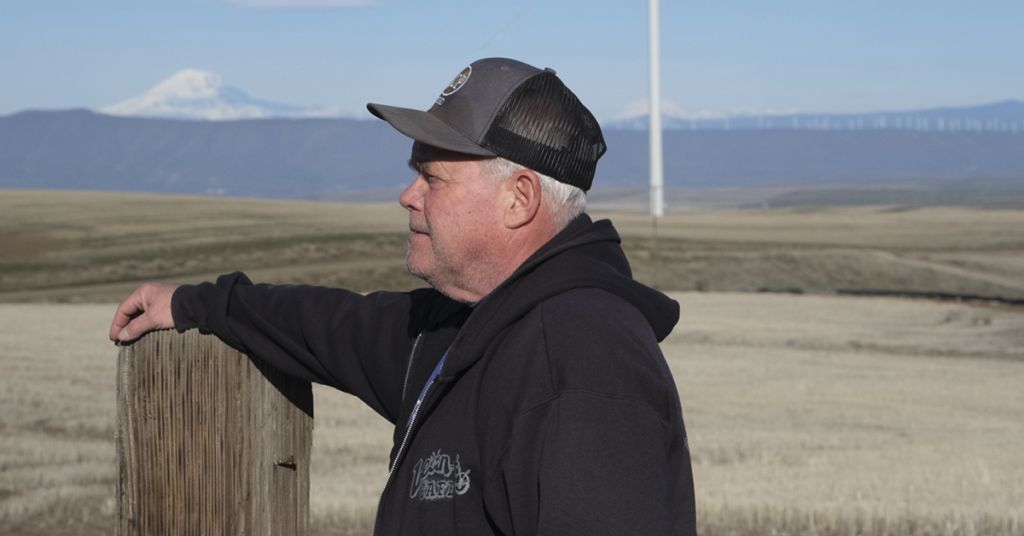
Outside influence: Dave Pinkerton on his Oregon farm within view of turbine towers and Mt. Adams in Washington. Photo: Jurgen Hess

He points out several places where contractors for Avengrid and Brookfield, two foreign companies invested in local wind farms, re-routed access roads in a way that will make it more difficult to move farm equipment around them.

He stops at the single mammoth tower. Installed last summer, it inspired him to start complaining loudly.

In September 2021, Pinkerton and 10 other farmers sent a letter to Oregon’s Energy Facility Siting Council alleging that developer Avangrid Renewables had failed to comply with requirements for building the Golden Hills Wind Project, in Sherman County, a project that would drop 51 turbines on 29,500 acres.

“Look at this,” he says. “You could fit four or five football fields in this mess.”

The wind whips up, rippling the surface of a puddle on the edge of at least five acres of barren mud.

“I told these guys, if you see a pool, you have a problem. You did something wrong,” says Pinkerton. “That water needs to drain back in the ground. We’ve practiced soil conservation for at least 50 years here, up to and including a lot of our ground now being no-till.

“We don’t lose soil anymore. We might lose some water, but it comes off clean. They say they’ll put all this back, and it’ll be good as it was before. But I can tell you, soil compaction is forever.”

Shouting into the wind

We grind back to Pinkerton’s place. He shows me his shop, part of which he’s converting into an improvised sports bar, complete with neon signs and a pool table, a retirement project.

There’s a small “Trump 2020” flag among lots of flags hanging from the rafters.

“I’m a conservative, but I have liberal friends, and we disagree, but we get along, which is pretty important in this world,” he says.

He tells me about a meeting he had recently with several wind industry representatives in his shop/bar, after he began voicing his concerns.

“There were six of us in here,” says Pinkerton, “and one of the company guys says ‘nice work, you have raised the ire of every anti-wind group around.’ And I said, ‘Wait a minute, you didn’t do things the way we agreed you’d do them, and I’m practicing my First Amendment rights because of it.’”

Appreciate this story? Consider donating to Columbia Insight.

What Pinkerton wants is for boots-on-the-ground farmers to be involved in the layout and construction of any new towers or existing tower upgrades. To preserve valuable ground, he says, you have to have eyes on it that know what they’re looking at.

It’s the kind of familiarity that comes with living your whole life in the house and on the farm your great-grandfather built.

The end of the story of the summit meeting in the barn, says Pinkerton, went like this: upon closer examination of the paperwork, it turned out the roads were changed to accommodate tower construction without consulting the right people—the ones on whose property the towers and roads were built.

“One of them asked if I wanted them to put the roads where we’d originally had them planned,” says Pinkerton. “Well you can’t just put a road back once it’s built. I said ‘it’s very kind of you to offer, but it’s too late. I wish you’d have asked me before you did it.’”

The Fred W. Fields Fund of Oregon Community Foundation supported this story.
OCF logo

By |2025-10-29T12:46:29-07:0002/10/2022|Energy|6 Comments

Hydro-fade: Pac NW power production is in dramatic flux

Alternative power sources in California are upending the energy market and changing perceptions (and profits) of hydropower

Ivanpah Solar Electric Generating System, Cali-Nevada

Light years ahead: In the Mojave Desert on the California-Nevada border, the Ivanpah Solar Electric Generating System focuses solar energy on boilers on solar power towers. It’s among the world’s largest solar thermal power stations. Photo by Altus/CC

By Steven Hawley. June 17, 2021. A draft power plan for the Pacific Northwest, due for release this summer, outlines challenges for defenders of hydropower, as well as opportunity for those who say its time for some dams to go.

The report, from the Northwest Power and Conservation Council (NPCC), forecasts power demand in the region will remain flat or slightly decline through 2030.

Climate change will make both hydropower production and salmon recovery more challenging. Renewables will continue to proliferate, and the price of solar will continue to drop.

That last development places some daunting new challenges in front of utilities in the region.

MORE: Electric cars and dams: An uncomfortable connection

The bulk of power produced in the Columbia River Basin comes from 31 dams whose power output is marketed and sold by the Bonneville Power Administration (BPA). Less than half of it is put to use by consumers inside the Pacific Northwest. The rest is sold south via high-capacity power lines known as the Western Intertie Network to electricity-hungry cities in Southern California.

These “secondary,” outside-the-home-territory transactions were once a reliably lucrative arrangement for the BPA. On the open market for electricity sales, midday demand sent prices soaring.

[perfectpullquote align=”full” bordertop=”false” cite=”” link=”” color=”” class=”” size=””]Tumultuous market conditions of the last decade aren’t an anomaly—the way we produce electricity is undergoing profound change.[/perfectpullquote]

The federal power marketing authority could meet California’s needs, still keep the lights on in Seattle and Portland, and collect handsome profits from its California ventures. This windfall, in turn, was used to buy down rates for what the BPA calls its “preference” customers inside the Pacific Northwest.

This customer base is comprised of public utility districts and rural electrical co-ops around the region, who rely on long-term “firm” power contracts with the BPA.

The happy result for these preference customers has traditionally been some of the cheapest electricity rates in the country. But with the rapid development of California’s ambitious renewable energy policy, hydropower’s long joyride on the Columbia River appears to be slowing down.

California solar changes Pac NW profits

The contrast between California’s energy transformation and the Pacific Northwest’s aging, mid-20th century dams is startling. Since the early 2000s, California has built over 12,000 megawatts of solar power. In terms of capacity, this’s nearly equal to what those 31 dams on the Columbia produce.

California has taken a giant leap toward modernizing its energy system to reflect 21st-century realities.

By contrast, the Columbia River’s flagship power plant, Grand Coulee Dam in Washington, was built in 1937. The average life expectancy of a dam is 50 years. (More than half of the dams in the United States have exceeded that time frame.)

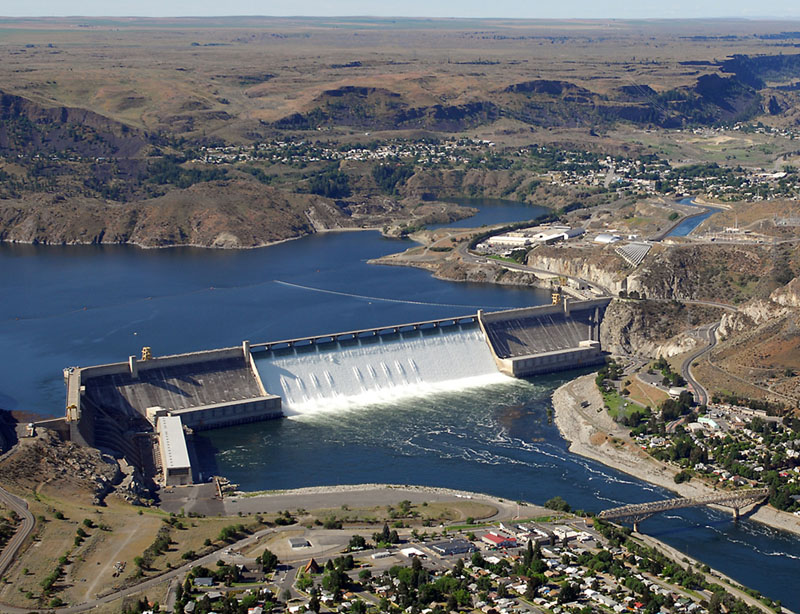
Grand Coulee Dam photo by U.S. Bureau of Reclamation

Direct current: Completed in 1942, Grand Coulee Dam is the largest hydropower producer in the United States and cornerstone for water control on the Columbia River. Photo by Bureau of Reclamation

But the trouble isn’t limited to infrastructure that’s aging out.

The economics of solar power are providing utilities as well as consumers with unprecedented opportunity to make the switch. The price of a solar panel has dropped 89% since 2010, according to the International Renewables Agency.

MORE: ‘The stars are aligned’: Rep. Mike Simpson breaks down plan to breach Snake River dams

Last year marked the beginning of a solar mandate for residential construction in the Golden State, with every new home there required to feature solar panels on its roof.

Utility-scale solar projects have spread across California. Last year, the 8Minute solar energy company inked a deal with the City of Los Angeles to provide 400 megawatts of solar power, with 1,200 megawatts of battery storage to boot, for less than $25 a megawatt hour.

For comparison’s sake, the four lower Snake River dams average 900 megawatts of power production annually. But that energy costs significantly more than what 8Minute will deliver to Los Angeles. BPA customers on firm power contracts are paying $37 a megawatt hour.

Since 2009, BPA’s rates have risen 30%. Aging dams, deferred maintenance and upgrades, and funding federal pensions for the BPA’s 2,100 employees virtually guarantee the agency’s rates are going up.

[perfectpullquote align=”full” bordertop=”false” cite=”” link=”” color=”” class=”” size=””]“We hit a place where standard industry practices diverged from the policy landscape in the West.” —Ben Kujala, Northwest Power and Conservation Council[/perfectpullquote]

Meanwhile, the price of solar is predicted to fall further, at least through 2030.

Steve Kern, the former head of Cowlitz PUD in southwest Washington, summed up the tenuous nature of the BPA’s future in 2018, not long before he retired.

“A financial cliff is coming,” said Kern, noting that BPA’s rates were already higher than the going market rate, and its power prices are forecast to be 55% above those market rates by 2028. Who’s going to sign up for BPA power at those prices?”

New world confirmed

Gone, too, is the ready availability of profitable midday electricity sales. Energy wonk blogs buzz with allusions to “the duck curve”—a glib turn of phrase that describes how electricity prices are now lowest in the middle of the day when they used to be highest—thanks in large part to solar panels’ peak production that occurs then.

So much electricity is available now in midday, in fact, that prices routinely dip below $10 a megawatt hour, and occasionally head into negative territory—meaning producers are paying consumers to take it.

The duck curve helps explain why the BPA’s debt problems—$15 billion in the red—are mounting. Cash reserves of almost a billion dollars in 2009 were reduced to near zero in 2019 on the agency’s power sales ledger.

Solar thermal in the Cali desert

Bright future: Solar thermal collectors are among the world’s top renewable energy sources. Photo by International Rivers/CC

A profitable summer of 2020—good water supply and a hot Southern California summer—helped shore up finances in the short term. But with historic drought gripping the West this summer, quick profits are less likely.

The long-term outlook isn’t so rosy. And it isn’t just critics of the BPA who are pointing this out.

The Northwest Power and Conservation Council (NPCC) is an interstate compact between Idaho, Washington, Oregon and Montana, created with the passage of a 1980 federal law that aimed to balance the needs of salmon recovery and electricity production in the Columbia River Basin. The governors of each state appoint two representatives to the eight-person voting body, which ultimately ratifies or denies a range of Council policies.

MORE: Opinion: Storage is a critical piece of our clean energy future

Council staff writes plans and recommendations for the Bonneville Power Administration, for both its salmon recovery efforts as well as ensuring an adequate and reliable supply of electricity.

The Northwest Power Act, the law that created the NPCC, isn’t perfect: its critics point out it lacks regulatory teeth; that is, the recommendations made by the Council amount to little more than that.

Ed Chaney, who in the 1980s was Idaho Governor Cecil Andrus’ right-hand man on salmon recovery issues, and who has sued the Council several times over its failure to institute effective salmon recovery policy, is skeptical of NPCC’s continued existence.

Dalles Dam by Jurgen Hess

Steady as she goes: The Dalles Dam, Oregon. Photo by Jurgen Hess

“The Council has accomplished the incredible feat of overseeing the expenditure of billions of public dollars and produced the opposite of what the Power Act required,” says Chaney. “Snake River salmon and Bonneville are now both threatened with extinction.”

Chaney has tracked how the Council’s work on salmon recovery was ceded back to the BPA and NOAA over the years as litigation over endangered salmon stocks began to dominate recovery plans.

Despite abdicating the salmon recovery portion of its mission, every five years the Council still produces a report on the energy picture in the region, and makes forecasts based on a survey of factors that affect power supply and demand.

As work began on the current draft plan, Ben Kujala, the NPCC’s power division director, was initially taken aback by the results of the model they deploy to help craft the Council’s energy report. It was forecasting the need for a massive build-out of gas-fired power plants, a move at odds with what was happening on the ground.

MORE: Opinion: Why the Gorge pumped-hydro project is opposed by the Yakama Nation

“The forecast still had elements of how we’d forecast prices in our previous power plans,” says Kujala. “But we had hit a place where standard industry planning practices had diverged sharply from the policy landscape in the West.”

The model’s inputs were updated to reflect that current reality. A final draft of the ninth power plan will be ready sometime this summer, but initial findings of the plan have been previewed on several occasions in Council proceedings.

The draft report confirms the tumultuous market conditions of the last decade aren’t an anomaly—the way we produce and distribute electricity is undergoing a profound change.

Hydro’s reliable appeal

Kujala, who moved over to the NPCC from a job with the Bonneville Power Administration as an energy analyst, cautions that the decision for utility managers isn’t as simple as signing an energy contract with a solar provider. He points out that utility managers and their commissioners might be inclined to stick with the BPA, paying more for power that comes with perks.

“Convenience has value,” says Kujala. “You sign up with a [BPA preference customer contract] and you get reliable power that is shaped to meet your customers’ demand. It’s a nice tidy package delivered to your doorstep.”

On the flip side, the vulnerability of that same contract is the vagaries of its price: BPA doesn’t set a fixed rate for its preference customers’ power purchases. When rates soar, as they have over the past decade, those same customers at least cast a furtive glance at what might be a better deal elsewhere.

So is solar a better deal?

Ben Kujala Courtesy of Northwest Power and Conservation Council

Rain or shine: Power planner Ben Kujala. Courtesy of NPCC

It’s a decision, says Kujala, that utility managers face with some trepidation—but not, if he can help it, without good information to aid in deliberations. Where the future lies will very much depend on the size, location and specific needs of individual utilities.

“A solar project has a fixed price,” he says. “You know what you’re getting. Sure, you might have a few cloudy days, but if you do a $25-a-megawatt solar project, you’re pretty sure you know what’s coming out.”

By contrast, a drawback of a long-term contract with the BPA, says Kujala, is price uncertainty, particularly in an era of profound change in the energy business. A 20-year term is standard for preference customers.

MORE: What’s wrong with solar power? More than you know

Tony Jones is an Idaho energy economist. He’s studied the federal hydropower system on the Columbia for three decades, and has a piece of advice for utility managers.

“You don’t want to be the first to sign one of those 20-year contracts,” he says. “There’s a scenario here where a few key customers head for the exits. That leaves the remaining customers with rate increases to make up the cost of those departing customers.

“In any business, a shrinking customer base is a death spiral. And you don’t want to be the PUD in the region stuck with the prospect of trying prop up the BPA.”

The best way for Bonneville to survive, says Jones, is to get rid of its most vulnerable assets. The worst of the lot, he figures, are the four lower Snake River dams.

Reassessing Snake River dams

Kujala has been asked often since Idaho Rep. Mike Simpson proposed a concept for removing the four lower Snake River dams about whether the NPCC’s draft power plan will provide any insight into the feasibility of that prospect.

He says the updated model they’re using is capable of providing a picture of what the federal hydropower system would look like without the Snake River dams. But in part because of the hotly contested politics of dam removal, he’d want the input of Council representatives.

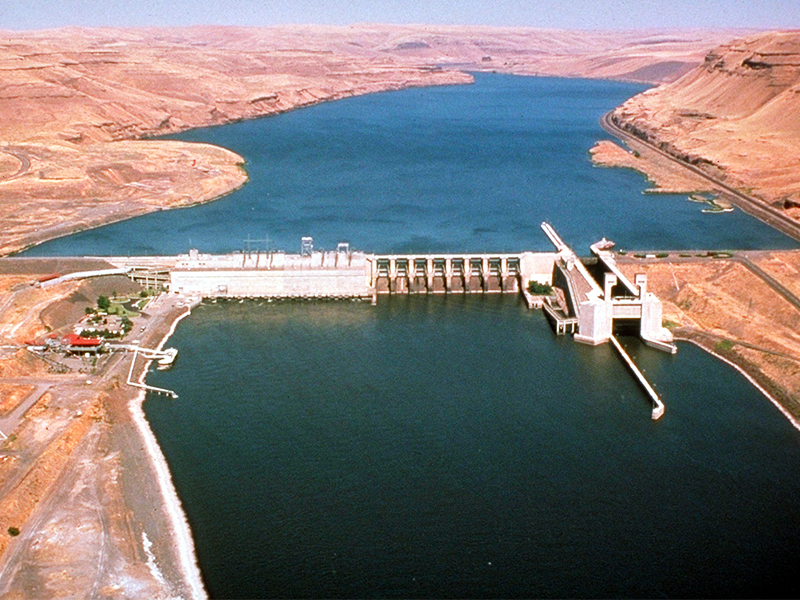
Lower_Monumental_Dam credit USACE_

Trouble in paradise: Washington’s Lower Monumental Dam is one of four dams along the Snake River that environmentalists call “salmon-killing machines.” Photo by USACE

“What the Council does well is we pull everyone into a room, we make them all sit there and we go through everything in exhaustive detail,” he says. “We say ‘these are the inputs you wanted, these are the conclusions that came out,’ and we go through those slowly and methodically. We absolutely have the capability of doing it, and I think we could do it in maybe a more nuanced way than what’s been done so far. But it would be a big process.”

The public will have a chance to weigh in on the draft plan at an as-yet undetermined time this summer, an opportunity Kujala encourages citizens to take.

“Part of what we’re here for is to be helping people understand what’s going on in the power system,” he says. “We want to be one of the places people can turn to.”

READ MORE SNAKE RIVER STRANGLEHOLD STORIES

SEJ logo with urlColumbia Insight‘s series focusing on the Lower Snake River dams is supported by a grant from the Society of Environmental Journalists.


Appreciate this story? To support environmental journalism on Columbia Insight click here

© Copyright 2013-2025 Columbia Insight. All Rights Reserved.

As a 501(c)3 nonprofit organization, all donations to Columbia Insight are tax deductible to the full extent of the law. Our nonprofit federal tax-exempt number is 82-4504894.