Stay Updated Subscribe today for the latest research + reporting about environmental news. Subscribe Now

Stay Updated Subscribe today for the latest research + reporting about environmental news.

Subscribe Now

Miko Ruhlen

Miko Ruhlen

About Miko Ruhlen

Miko Ruhlen, Associate Editor. Miko graduated from U.C. Berkeley and worked in California and the Columbia Gorge for well over a decade as an avian field biologist with non-profits, government agencies, and private consulting firms. She and her husband live in Hood River, Oregon. They own Hood River Hobbies and volunteer for local citizen science bird surveys and lead bird walks in their spare time.

Bag Ban Hood River

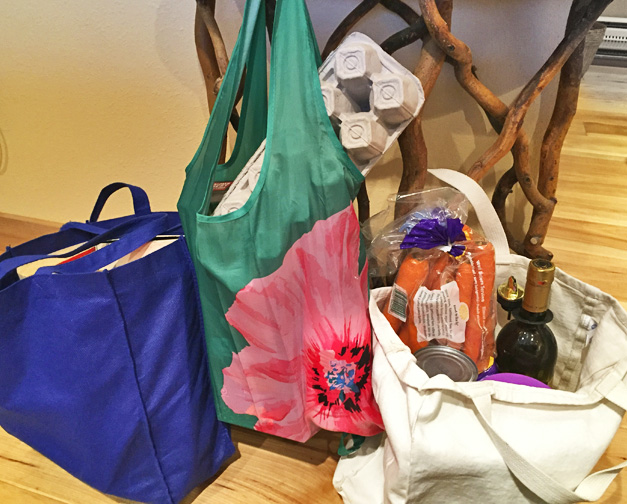
New Bag Ordinance in Hood River – Bring reusable bags to the store starting March 1st.

By Miko Ruhlen. Jan. 13, 2017. On January 9, 2017 Hood River City Council voted unanimously to adopt Ordinance 2030 to impose restrictions on the distribution of single-use plastic bags and certain paper bags within the City’s retail establishments.

“Too many single-use plastic bags are released or find their way into the environment,” the ordinance states, “…plastics, including plastic film bags, is a significant form of environmental pollution that is demonstrably harmful to wildlife.” The Council listed other adverse impacts of plastic bags: damage to sorting and processing machinery in resource recovery, and consuming raw material and energy in the manufacturing and waste disposal of bags. The Council also states in the document that it seeks to “encourage the use of reusable bags for day-to-day shopping.”

Starting March 1, 2017  for large Hood River retailers (50 or more full-time employees) the ordinance states that “retail establishments shall not provide or make available single-use plastic carryout bags or non-recyclable paper bags.” Smaller retailers (less than 50 employees) will have to comply with the same rules as larger ones beginning July 1, 2017. This ordinance does not affect businesses that primarily prepare food and beverage, or retail stores outside of Hood River City limits.

Although commonly known as a ‘plastic bag ban,’ Ordinance 2030 also restricts larger paper bags. Retailers will be required to charge a minimum of 5 cents per bag for the typical handled paper bags used at check out at most grocery stores. These bags are referred to in the ordinance as ‘barrel-sized’ paper bags (approximately 12 inches wide x 7 inches deep x 13-18 inches tall or a capacity of 1,100 to 1,600 cubic inches). These barrel-sized paper bags will also need to be 100 percent recyclable and contain a minimum of 40 percent post-consumer waste.

Although the ordinance specifies that 5 cents is the minimum, retailers may charge more. Steve Morgan, manager of Hood River Rosauers said in an interview that they will only charge 5 cents per bag.

Not affected by the ordinance are small paper bags, paper ice cream bags, paper wine bags, or plastic produce, meat, and bulk food bags. Large paper bags given out by small retail shops that have the same capacity as barrel-sized bags, will also have a 5 cent fee and meet recycling requirements.

The ordinance only applies to stores within the City of Hood River. Although stores outside Hood River City limits will still be able to give out single-use plastic bags, the ordinance will greatly reduce the quantity given out in the area. Approximately 700,000 single-use plastic checkout bags were given out per year by Rosauers in Hood River at a cost of approximately 4 cents each in 2008 according to previous store manager Kevin Harris (Hood River News article March 26, 2008 by Susan Hess). The current manager, Morgan, confirmed that that is likely still a pretty close estimate of current use and cost.

Mayor Blackburn said citizens and businesses have mixed opinions about the bag ordinance. He said the most interesting comment he heard was from a Rosauers employee who said, “We’ve been expecting this. We’ve been waiting to be told.” Blackburn mentioned that one local retailer told him in response to the potential 5 cent fee, “that it could cost them 11 times that (5 cents) to give away a large paper bag,” and that this ordinance will give them an avenue to recoup some costs rather than having to implement fees for bags unilaterally.

Reusable bag availability is also required by this ordinance. All retail shops “must make reusable bags available at a reasonable cost to all customers.” When asked if the ‘Take a bag, leave a bag’ program that a local volunteer student group started at several area grocery stores would fill the requirement, he said it would “assuming the bin of bags wasn’t empty half the time.”

Retailers could be fined a minimum of $200 for each offense if they violate the ordinance. This fine would be per ‘reported violation’ according to Hood River Mayor Paul Blackburn. Although enforcement details are not yet mapped out and are somewhat discretionary, Blackburn expects that most of it will be in response to complaints and follow up compliance visits with warnings given out before the $200 fee is assigned.

Many people in Hood River County have been pushing for this environmental measure for months or years including some youth at Wy’east Middle School who wrote essays to the City Council, Hood River News, and EnviroGorge. Others are concerned about the impact to their business practices and will have to work on ways to adjust while keeping customers happy. It is clear that many businesses and most consumers in Hood River will have to adjust their bag purchasing and bag-toting habits starting in March of this year.
By |2018-11-30T13:48:11-08:0001/13/2017|Energy, News, Old Articles, Waste Management|17 Comments

Happy New Year

[/media-credit] Thank you for joining us on our journeys!

We at EnviroGorge wish all of our readers a Happy New Year!

We want to especially acknowledge and thank readers and business sponsors who supported EnviroGorge with financial donations, volunteered services or time. Without you EnviroGorge would not be able to continue its mission. Thank you!

We also appreciate our writers who spend countless hours creating educational content as well as the people they interviewed for taking the time to give us accurate information. We did not list all of the writers and interviewees and people who helped us with our stories and videos here (it is a long list), but we are so grateful and acknowledge that we wouldn’t have been able to do it without them.

We are grateful to all of our readers and partners who shared our posts with their friends or peers to help broaden our reach, contributed information, added helpful comments, gave us useful feedback, and support and inspiration to keep us going. We apologize if we have overlooked anyone. Please feel free to contact us and we will add you in! Remember, it is never too late to contribute or subscribe.

2016 Individual Financial Donors

Mary Lou Soscia, Buck Parker, Lynda Sacamano, Steve Curley, Steve Labadie, Michael Drabanski, Nicole Hess, Julie DeArmond, Anothony Villagomez, Jerry Franklin, Tina Castanares, Sherry Penney, Charles Haynie, Peggy Dills Kelter, Lynn Bergeron, Patricia Schmuck, Lynne Davidson, Deborah Chenoweth, Linda Short, Colleen Coleman, Rebecca Montgomery, Ruth and Marvin Turner, Cindy Thieman, Elizabeth Stanek, David Cole, Darvel Lloyd, Darryl Lloyd, Thomas Hons, Margaret Neuman, Wilbern Dixon, Tom Guinan, Erinne Goodell, Matthew Barmann, Mary Schlick, Carole Schmidt, Nathan Baker, Marc Harvey

2016 Donations of Time or Services

Peggy Dills Kelter, Katherine Schlick Noe, Lloyd DeKay, Cathy Flick,  Lynda Sacamono, Heidi Logosz, Buck Parker, Stu Watson, Tina Gallion, Dan Richardson, Stu Watson, Tom Post, Marjorie Byrne, Jerry Jacques, Max Peterson. Not listed here are all of the volunteer contributors of stories and interviewees that spent countless hours. Their names are listed in each of the stories they contributed to. We value their time greatly and we would not have been able to provide valuable content without them.

Business Sponsors and Advertisers

Thank you to these 2016 business sponsors. Please patronize businesses who give back to the environment. If you would like to advertise to support EnviroGorge please contact us.

Partners

These organizations donated prizes for our contests:

Columbia River Gorge National Scenic Area, Washington State Noxious Weed Control Board, Bonneville Power Administration.

Thank you again and Happy New Year! After a short holiday break we look forward to developing content for 2017. Thank you for your continued readership and support!


By |2019-04-11T10:09:54-07:0001/01/2017|News, Old Articles, Uncategorized|0 Comments

Tiny House

One Year in a Tiny House. Video and story by Miko Ruhlen.

In mid-December, many of us are shopping for holiday gifts, buying outfits for holiday parties, and getting tubs of twinkle lights out of the garage.

Quinn, Cole, Tina, & Darren

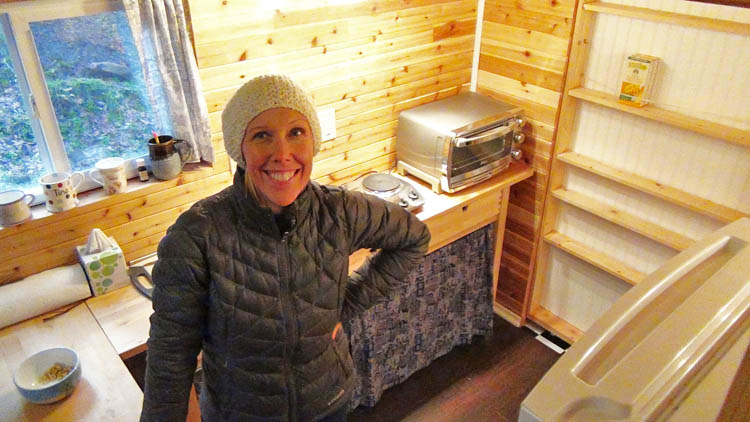
Tina Gallion and her family are instead preparing for an ambitious New Year’s resolution – downsizing from their 2,500 square foot house to move into a tiny house measuring just 182 square feet. Tina, husband Darren, and sons Quinn, 5, and Cole, 7, plan to live for a year in the tiny house in Underwood, Washington while they build a house on the same property. Because of Darren?s 6’7″ height, they had to have it custom built–at a total cost of roughly $32,000.

Tina’s inspiration for moving into a tiny house came from a book by Dee Williams, who started the tiny house movement. “She [Dee] had gone to Ecuador, I believe, and stayed with a family who lived in 84 square feet, so then she thought, Hey, why can’t I live in 84 square feet?

Tina wanted to try tiny living to save money as they built a new smaller home, but she also considered environmental reasons. Their move to the tiny house in Underwood brings them significantly closer to their jobs and kids’ school; they’ll use less gas and spend less time commuting. Building smaller decreases environmental impact it needs fewer building materials. Additionally, preliminary data from the Oregon Department of Environmental Quality show that building smaller reduces the carbon footprint of a house by dramatically reducing heat and electricity related emissions over time. Although energy efficiency measures can play an important role in new house construction, the savings from just building smaller are significant. Reducing home size by 50 percent can give you a 36 percent reduction in total emissions over the lifetime of the house.

The Gallions are now working on lifestyle changes to minimize not only consumption of water, electricity, gas, but also their possessions. Downsizing can be difficult for anyone, but it’s a particular challenge with small children. When Tina broke the news that the big stuffed bear toys and the giant monster trucks couldn’t come to the tiny house, the kids protested with a distinct “No!” When 5 year old Quinn was asked if he is excited about moving to the tiny house he shook his head ‘No’. Tina uttered a worried, “Uh-oh.”

Tina is sad and a little worried herself about not having her oven to cook with and other appliances like her washer and dryer as “the kids will be outside getting dirty all the time.”

This process is not without sacrifice, but Tina says, “Downsizing is something everyone should do; consumerism has gotten out of control.”

“What you start noticing is what you really use, and you really only use a few items out of a drawer. I’m finding that I don’t use even half of what I own! It feels lighter to get rid of all that stuff, especially when you know that you really haven’t used it.” This holiday season Tina is thinking twice about every item she buys, “I think you fill your space, you fill what you have.”

When designing their new house, Tina and Darren have been carefully considering their needs and negotiating about their ideal space. “The hardest part,” Tina says, “has been to figure out how big you go, because 2,500 square feet is the average house size here, but I felt like a slave to that house because there was so much to do. It is always managing the stuff or managing the cleaning.”

The Gallions are putting some larger items, such as furniture, into storage and donating the rest to charity. Tina had a difficult time downsizing her wardrobe, particularly shoes, “Where are we going to put the shoes and boots and how many different pairs are you going to bring?”

To help smooth the transition, Tina and her kids are thinking of it as an extended camping trip. They plan to be outside more, take more time to play games, and spend more time in the community. Tina is an optimist, “It’s going to be an adventure, no doubt.”


Advertisement

 Thank you to our  Advertisers!


Idle Time

By Miko Ruhlen. Nov. 28, 2016.

My younger son loves to backseat drive. Several weeks ago, I explained that from now on, I’ll turn the car off while waiting for big brother, rather than let the car idle. He happily took on the job to be my personal ‘policeman’ when I forget.

It helps to have accountability when trying to break a habit.

I’m pretty conscientious about not letting the car idle for long periods, but I’d started noticing that the 30 seconds that I thought it took for my son to run back for a book he forgot, actually took 5 minutes. The 60 seconds to run into and leave something at a friend’s house (and wind up chatting) took another 5 minutes.

While a few minutes of vehicle idling seems like a negligible impact, cumulatively, all those minutes add lots of carbon dioxide to the environment and to the air we breathe.

For every 10 minutes I spend not idling, I prevent one pound of carbon dioxide from being released. Carbon dioxide is the primary contributor to global warming.  We Americans, as a whole, may be burning as much as 3.8 million gallons of gas idling every day. Annually, idling adds 1.4 billion gallons of gasoline and 13 million tons of carbon dioxide. 

Children are the most sensitive to vehicle exhaust due to their developing lungs and more rapid breathing–leading to inhaling more pollutants per pound of body mass than adults. Since many children need to be picked up from schools by bus or parents, idling is common in school loading zones.

img_20150507_120856

Sign in front of Whitson Elementary School, White Salmon

The White Salmon Valley School District bus drivers’ training includes a video about vehicle exhaust, the negative health impacts to children, and the district’s anti-idling policy. “After initial safety inspections are complete, if they [the buses] are to sit more than two minutes they need to turn their bus off,” says Susan Tibke, District Transportation Supervisor. Passenger loading zones are near the school’s air intakes, so vehicle exhaust can enter the classrooms–one reason they are vigilant.

They installed signs designating no-idling zones in 2007 on streets adjacent to the school buildings. Tibke recalled that when former transportation director Sharon Schalk went to a transportation conference that year, “…the next thing I knew, this guy from the conference was pulling these signs out of his trunk and giving them to us, and so we had the maintenance guys put them up.”

Tibke said that initially people obeyed the signs, but as with a lot of things, people stop seeing it after a while. Ray Fazer, the crossing guard at Whitson Elementary, says he lets people know they shouldn’t be idling, whenever he can, “Most people obey the sign, but there are probably some new ones that don’t know, so I tell them–unless they are across the street, and I can’t get to them in time.”

In 2011, the district received an idle-reduction grant from the Washington Department of Ecology. The grant paid to have fuel-operated heaters installed on 12 buses. These heaters turn on a timer a half hour before running to help them warm up without idling, The heaters use about a tablespoon of diesel.

Wasco County School District also has an anti-idling policy for buses. Debbie Park, the transportation director there says, “It’s [idling] hard on the buses and hard on the environment. We have had a non-idling policy for buses for quite some time. When buses are parked and waiting in a loading zone, they are to be shut off. ”

Some school districts, such as Hood River County School District, do not have a school board policy, but they have “in-house practices that are self-governed and established in the department,” according to Don Benefield, transportation supervisor for the district. Under normal conditions, the district does not allow idling, however when it is really cold, buses may idle for a short time if needed to keep the bus temperature habitable.

Neither Wasco or Hood River County school districts have policies against idling for parents dropping off and picking up children.

Over 13 states have recognized the impacts of idling and have anti-idling campaigns. There are also anti-idling initiatives in other countries such as Japan, Canada, and Great Britain. Because of the impact on children, a lot of anti-idling campaigns focus on schools.

connor-ev

Author’s son charging electric car.

Getting children involved is a great way to make an impact on local idling policies. The EPA has a toolkit available for kids to start a student-run (or parent/teacher led) awareness campaign in their school or community or a related science project. It comes complete with a cute logo and slogan: ‘Turn your key. Be idle free.’

As for myself, I plan to make myself a sticker chart with rewards every time I save the planet 10 pounds of carbon dioxide, because I idled 10 minutes less than before. Or maybe I will treat myself to 10 minutes of yoga and meditation instead. My son now prefers to skip the whole thing and just ride in my husband’s new electric car charged by rooftop solar panels for a better solution. Plus as he says, “Dads are cooler.”


as-a-rule-of-thumb-if-parked-for-more-than-30-seco


Our Planet in Every Decision

“What we need to do is find a way of putting the planet in every decision that we take however small.”  -Andreas Philippopoulos-Mihalopoulos.

With permission from David Bollier, we share this short film Re-Imagine the Future published September 26, 2016.  This film gives perspectives on how to overcome the crises of our time with new ways of thinking, acting and being.

It echoes the thread of many EnviroGorge stories: about people taking personal initiative in our Gorge community taking care of our environment one action at a time – through personal responsibility and by putting the environment first.

About 4 minutes into this film, Andreas Philippopoulos-Mihalopoulos states, “What we need to do is find a way of putting the planet in every decision that we take however small – and really there is no other alternative…what you are going to change, though, is your neighborhood, is your garden… small revolutionary steps.”

David Bollier cites ways that some of the changes are already present in our communities: the slow food movement, re-localization of our economy, citizen science efforts, but the challenge is that they are not always recognized by public policy or supported by laws and our culture at large.

Bollier states, “After all, the answers are not going to come from somewhere else; they have to start with us, personally and locally, and expand outward.  We need to re-imagine the future.”


By |2018-11-30T13:50:22-08:0011/14/2016|Features, More, Old Articles|0 Comments

Let the Leaves Fall

[media-credit name=”Photo by Jurgen Hess” align=”alignleft” width=”450″]jurgenedited-1[/media-credit]

“Let the leaves fall where they may.”

By Miko Ruhlen. Nov. 3, 2016.

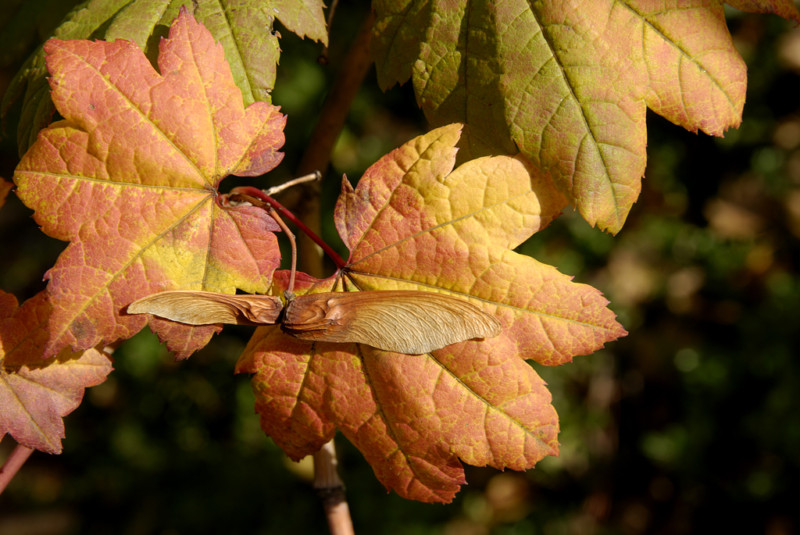
Kids love to jump into giant piles of leaves – the first joy of fall season. Adults seek spectacular displays of red and orange fall foliage, but seldom enjoy braving the cold clammy weather to clean up the leaf ‘litter’ and dead plants in their yards. The good news is that there are ecological benefits to skipping some fall yard cleaning.

Dead plant stalks, decaying plant debris, and leaf piles are nurseries for insects that in the springtime will pollinate flowers, keep pests in check, and create a balanced and sustainable garden. Birds will be sustained through harsh Gorge winters by seed heads and fermenting berries, and utilize brush piles or dead trees for forage and cover. Leaf piles protect roots from winter freezes and amend the soil as they break down; at the same time they shelter and nourish small overwintering creatures like toads, newts, earthworms, and beetles.

[media-credit id=21 align=”alignright” width=”175″]beetle05[/media-credit]

On the topic of beetles and yard clean-ups, “Carabid beetles, Carabid beetles and Carabid beetles!” emailed Drew Merritt of Humble Roots Farm and Nursery in Mosier, Oregon. “This large family (Caraboidea, 2000 species in North America) of insects is composed of some of our best pest controlling beneficial insect species. These ground beetles will eat any invertebrate they can overpower and are very effective for many orchard pests. The most familiar species in our area are black and shiny and you can usually find them under rocks or in decomposing vegetative matter, especially the thatch left by grasses, which is why it is important to leave a bit of a mess around the garden. Also many species will lay their eggs in the hollow canes of spent herbaceous plants such as Goldenrod and Fireweed as well other pithy centered plants. Remove all the ‘debris’ from your garden and you could be removing the nursery grounds for the next generation of a very important component of a balanced garden ecosystem.”

Consider balance in your backyard ecosystem and your busy schedule. Spend more time watching the leaves change colors or with the kids romping in piles of leaves. Spend less time raking, cutting, shoveling, or hauling. Let the leaves fall where they may.

Tips for fall yard ecosystem enhancements:

compost1. Make a leaf pile several inches thick in a corner of the yard. This will invite hibernating critters and the leaf mold can be used as a soil amendment in the spring.

2. When clearing paths for safety, Instead of raking leaves and just throwing them away, use them in your garden beds as mulch, compost them or bring them to a local recycling center that accepts yard trimmings.

3. Instead of cutting plants down to the ground, leave the stalks standing a foot or two high. Many butterflies, mason bees, and predatory insects (like ladybugs) hibernate in leaves and stalks. Predatory insects help maintain a balanced insect population reducing unwanted infestations.

4. Leave fermenting berries and fruit, seeds, and seed heads for wintering birds and small animals to eat. Leave dead trees standing to provide shelter and nesting cavities for birds and bats.

brush-pile5. Make a small brush pile with fallen or pruned branches and leaf litter to provide cover and foraging areas for birds, reptiles, and insects.

6. Fall is also a great time to plant natives in your yard. The rainfall this time of year helps give them regular water to establish, reducing irrigation needs in the spring or summer, therefore conserving water.


Thank you to our advertisers and sponsors!

Layout 1


By |2018-11-30T13:50:39-08:0011/03/2016|News, Old Articles, Plants, Waste Management|6 Comments

© Copyright 2013-2025 Columbia Insight. All Rights Reserved.

As a 501(c)3 nonprofit organization, all donations to Columbia Insight are tax deductible to the full extent of the law. Our nonprofit federal tax-exempt number is 82-4504894.