Stay Updated Subscribe today for the latest research + reporting about environmental news. Subscribe Now

Stay Updated Subscribe today for the latest research + reporting about environmental news.

Subscribe Now

Miko Ruhlen

Miko Ruhlen

About Miko Ruhlen

Miko Ruhlen, Associate Editor. Miko graduated from U.C. Berkeley and worked in California and the Columbia Gorge for well over a decade as an avian field biologist with non-profits, government agencies, and private consulting firms. She and her husband live in Hood River, Oregon. They own Hood River Hobbies and volunteer for local citizen science bird surveys and lead bird walks in their spare time.

Gorge Scientists Part 1: Tim Counihan


Part 1 of a series profiling Gorge Scientists highlights Tim Counihan of U.S.G.S.

By Miko Ruhlen. Apr. 3, 2017. Tim Counihan’s interest in aquatic systems started at age eleven. He found pond water fascinating.  “It looks like water, seems like water, but when you look at through a microscope it is teeming with unusual creatures.” He says he still loves being in, on, and around water. For 24 years it has been a focus of his career at  U.S. Geological Survey, where he is Lead Research Fishery Biologist.

Although some of his work is in the field, a typical day in the life of Tim Counihan involves working collaboratively with colleagues and other scientists, and using computers for writing and communication as well as to analyze data.

?I am essentially pioneering. Looking at issues that haven?t been looked at before in ways that haven?t been done - it is mentally stimulating.

“Right now I am working with scientists from across the country to look at the relationship between human induced activities and the function of aquatic ecosystems,” said Counihan. His work involves not only the Columbia River, but other large rivers including the Colorado, Illinois, and Mississippi Rivers. As part of this study he uses multi-variate statistics and modeling to analyze long-term monitoring data that has been collected for over 50 years to understand changes in fish communities. “Sometimes kids ask me: What good is math? I tell them I use it each and every day.”

Counihan studies invasive species such as Quagga and Zebra mussels, which have the potential to infest the Pacific Northwest–the last area of the contiguous United States that has yet to be invaded with these organisms. He is looking at ways to prevent these highly invasive mussels from establishing in the Columbia basin as well as some Canadian Provinces by helping develop early detection and monitoring systems.

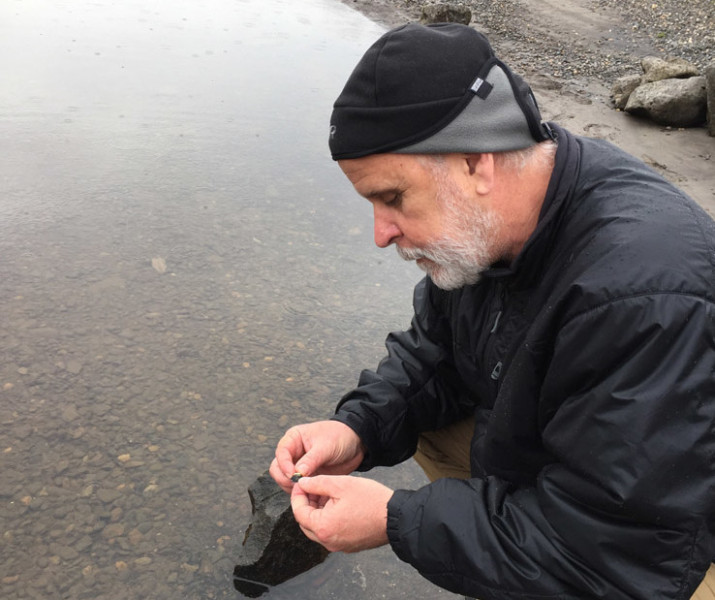
Tim Counihan examines a non-native clam

Quagga and Zebra mussels are biofoulers that clog water intakes and infest dam infrastructure. Controlling these pests could cost hundreds of millions of dollars annually in addition to the potential ecological risks to native salmon and steelhead recovery efforts.
 
Contaminants in the Columbia River are also part of Counihan’s work. He has studied the distribution of sediments and contaminants using advanced sampling design and modeling techniques. In one of his peer-reviewed papers his study suggests that sediment contamination in the Columbia River may contribute to bioaccumulation in resident birds and fish. Bioaccumulation is the gradual buildup over time of a chemical in a living organism.
 
Counihan’s work is multi-faceted and what he likes best about his work is that, “I am essentially pioneering. Looking at issues that haven’t been looked at before in ways that haven’t been done. It is mentally stimulating. For everything we learn, new questions are raised as part of the scientific process. If the questions are important enough and of value to the public, then we look at them.”
 
Science is important, Counihan explains, “because it provides a rational basis for examining things. It is not how you feel about things, but it all goes through a standard process of formulating hypotheses, testing them, and then reporting what the weight of evidence suggests in an unbiased way.”
 
“What I have always wanted to do is be a public servant and serve the public in a meaningful way by providing service as a federal employee, you know, ask not what your country can do for you but what you can do for your country; we take that responsibility very seriously.”

A sign posted at a Columbia River boat ramp in Rowena about another invasive species, the New Zealand Mudsnail. When boating or rafting, observe signs and precautions to help stop the spread of invasives.


Support Our Work!
Enjoy this series celebrating the work of Gorge scientists? Help us continue by contributing the price of a lunch out or just a cuppa joe! If everyone contributes a little bit now and then, we can continue our work. Support free press with original content - Support EnviroGorge! Use paypal (Visa accepted) or check (send checks to EnviroGorge, P.O. Box 163, Hood River, OR 97031)
Support Our Work!

Paid Advertisement:


Spotting Peregrine Falcons

By Miko Ruhlen. Apr. 3, 2017. My son asked me yesterday, “Do you know which is faster a car or a Peregrine Falcon?” I hesitated. Proudly, he proclaimed that the correct answer is the falcon which can dive at speeds over 200 miles per hour; he learned this in his fourth grade class work.

[media-credit name=”World Bird Sanctuary Photo” align=”alignleft” width=”400″][/media-credit]

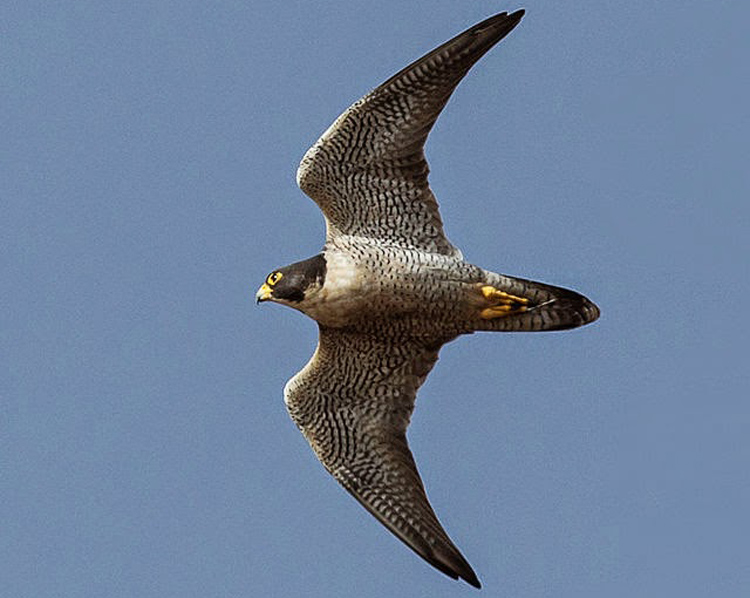
Few birds tickle our imagination as much as the mysterious Peregrine Falcon. Although they nest in the Columbia River Gorge, there are many who have never positively identified one in the wild. They are fast and one needs to have binoculars at the ready. My son once observed one with me at the Catherine Creek trail head, it was diving defensively at a Bald Eagle. What a thrill.

I spent two seasons trying to find and monitor Peregrine Falcon nests in the Gorge. It sounds glamorous tracking the fastest species on earth along forest cliffs. In reality, I spent many frustrating hours just trying to find the sneaky birds.  

In order to determine that a nesting territory was unoccupied, two or more visits of four-hour duration during specific time periods were required. Sounds easy. Not. Required? Yes. Repeatedly watching a single cliff side for four hours straight. Sometimes seeing nothing but ravens and bright spots in my eyes from staring through binoculars. Massaging my neck, strained from looking upwards. Ears strained from listening for distant calls.

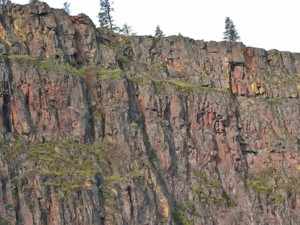
Peregrines nest on ledges of cliffs similar to this one in the Gorge. A typical view from a ground survey. Can you see any falcons? If one is there, they can see you! Try staring at it for four hours straight (a minimum survey period). Don’t get distracted and let your eyes wander or you may miss it – they are fast.

Sometimes I tried alternate vantage points. Some were too close and could disturb the birds. Others so far away I needed a high-powered spotting scope. Scope and tripod in hand, I could make out chicks as white specks looking at cliffs on the other side of the Columbia River. Once, I accidentally followed the movements of another cliff-dwelling falcon, the Prairie Falcon, for an hour from a distance through binoculars.

I hate to complain because of minor inconveniences, because I love being outside. It does take a lot of patience, perseverance, and dedication to gather accurate data and to find nests of secretive birds. And what I gained by spending hours in the field at the same location repeatedly, is a new perspective. Now I don’t view these places a merely as a place to hike through soaking up forest smells and getting some cardio. Each territory is a home to the native creatures. Sometimes one that has been passed on through generations.

And the generations before me saved this magnificent bird.

Return from the Brink of Extinction

In 1970 there were no longer any peregrines known to nest in Oregon. In 1980, there were only five pairs known in the entire state of Washington. The catastrophic decline in this species in North America was primarily due to the pesticide DDT which caused eggshell thinning and breeding failure.

Due to the banning of the pesticide and habitat protections provided by the Endangered Species Act, their populations have recovered dramatically. By 2009 there were 154 peregrine breeding sites in Oregon. In 2016 biologists estimated 148 peregrine falcon nesting sites in Washington.

The U.S. Fish and Wildlife Service removed the Peregrine Falcon from the Federal list of threatened and endangered species in 1999. Success. And it continues to receive protection under the federal Migratory Bird Treaty Act.

Researchers and land managers worked relentlessly to reestablish populations of peregrines at historic sites in the Pacific Northwest. In addition to detailed monitoring and habitat protections, more than 120 young falcons were ‘hacked’ or re-introduced into the wild at a dozen sites in the Cascades and Eastern Washington. The first hacking site in the Columbia River Gorge was at Beacon Rock in 1982.

Yet, now that these fast falcons are thriving in the Gorge, some hikers and climbers—unaware of their history are upset at the inconvenience of losing access to their favorite recreation spots seasonally during the nesting and chick-rearing season (between February and July).

Trail Restrictions

Despite their recovery, “the State delisting of Bald Eagles and Peregrine Falcons does not directly affect seasonal closures and restrictions. Closures are in place at specific locations, because of the impact that recreation has on nesting birds,” said Stephanie Bergh, wildlife biologist for Washington Department of Fish and Wildlife. Bergh also noted that, “if for some reason the birds completely change where they are nesting, then the seasonal closures and restrictions could be reevaluated.”

Land managers sometimes list Peregrine Falcon nesting habitat as a specific reason for a trail closure, for example at Cape Horn (lower sections of trail closed seasonally) or Beacon Rock (climbing access closed seasonally). Other times the reason for such a restriction may not be disclosed to the public to due to risk of poaching, or because there are multiple reasons combined in a sensitive habitat.

Trails may also be closed or re-routed for reasons that have nothing to do with wildlife such as to protect cultural resources, for public safety, fire danger, erosion, or maintenance issues. Sanctioned trail closures are rare in the Gorge; more common are unleashed dog restrictions and decommissioning of user-built trails.

User-built trails are created by someone clearing a new trail either intentionally, or by wandering off the main trail eroding a path that is followed by others. They are created without consideration for sensitive wetlands, fragile plants, or nesting birds. Rachel Pawlitz of the Columbia Gorge National Scenic Area suggests staying on the main trail, checking the trailhead for signs posted on kiosks, or reviewing websites to learn of restrictions before heading out for your hike.

Most of us are programmed to think of land in terms of property rights and how the land can serve our needs for building, farming, or recreating. But immersion into a wild habitat and observing the wildlife in detail reminds me that I am but a visitor, and I should tread lightly, and help keep Peregrine Falcons flying in the Gorge.

Can you find the Peregrine in this photo? This is one of a pair that has nested for years on this cliff, which is adjacent to a visitor center parking lot along the Oregon Coast. The pair are unusually tolerant of the public. I snapped this picture with my smartphone from the parking lot. A few individuals like this can be more tolerant of disturbance than others. But most perceive humans as a threat. Biologists determine safe distances from nests relative to the reaction of birds in each specific circumstance. Found it? It’s in the shadows just above the ledge where it nests.


Subscribe

Get new stories in your inbox!

You can also find us on Facebook, Instagram, and Twitter.
Subscribe


Paid Advertisement:


Ready. Set. Bag!

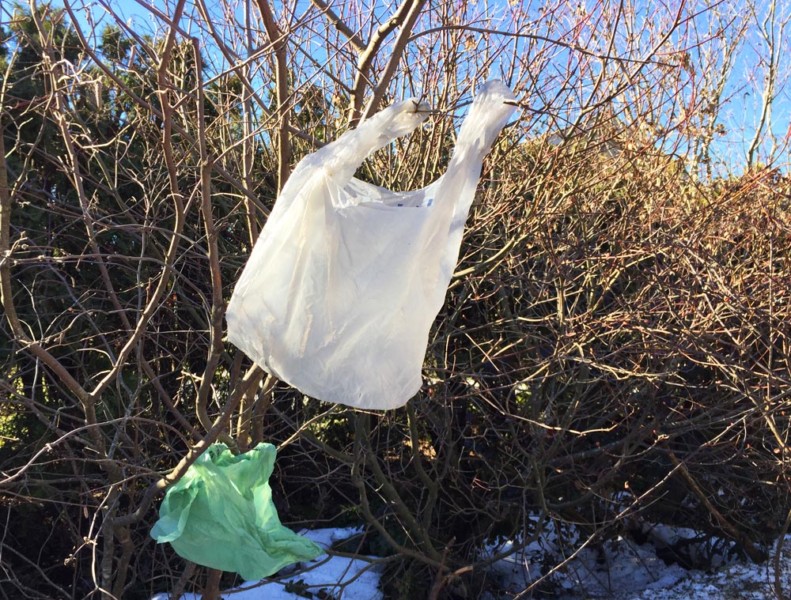
By Miko Ruhlen. Feb. 23, 2017. “Right now we are already out of plastic bags, but we aren’t charging a fee for paper bags yet,” said Rosauers Store Manager Steve Morgan in mid-February.

A fee for paper bags starting March 1?  While many shoppers and retailers heard that plastic bags will be banned, some were not aware of restrictions on paper bags.

“It is amazing how many people didn’t know about it (the bag ban),” said Morgan. “One of the reasons that we ran out early is so that we can prepare customers.”

On January 9, 2017, Hood River City Council voted to adopt Ordinance 2030 to ban plastic checkout bags and impose restrictions on other single-use bags.

But why a bag fee?

A source of confusion has been the regulations for paper bags including the 5 cent minimum fee for larger paper bags (grocery-sized).

It is about human nature and ‘loss aversion.’ Studies have found that people are more likely to change behavior: changes to avoid a penalty fee, ticket, or tax than to gain incentives. Even though many stores offer a discount if people bring their own bag, this method has not achieved significant reductions in single-use bags. Data from bag bans in other places have found significant declines in single-use checkout bag use after fees were imposed.

This ordinance is not just about decreasing plastics, but it aims to decrease all types of single-use bags, including paper which also impacts the environment. “If all you do is shift people to paper bags, you are causing an increase in the use of paper shopping bags and increase in pulping which causes acidification to the marine environment,” said David Skakel, Tri-County Hazardous Waste and Recycling Program Coordinator.

Does the ordinance affect all paper checkout bags?

If shoppers still choose to take single-use paper bags at the checkout, they will soon be more environmentally friendly due to requirements that all paper checkout bags be 40% post-consumer waste content and recyclable (meeting ASTM standards).

EnviroGorge’s January article, Bag Ban stated that Ordinance 2030 would not affect smaller paper bags, but that is incorrect (our apologies). This ordinance requires that by July 1, all retailers shift their bag buying so that all smaller paper bags (less than 12x7x13 in. or 1,100 to 1,600 cubic inch capacity) given at checkout also meet the post-consumer waste requirements. Not affected are any bags given out in other places besides checkout: produce, meat, pharmacy, bulk aisle. The ordinance also does not affect food establishments (i.e. restaurants and food carts).

How to choose a reusable bag?

Ideally, Hood River shoppers will get used to bringing reusable bags, but if they forget them, this ordinance also requires retailers to sell some reusable bags at a ‘reasonable cost.’

What kind of reusable bag to pick? Bags can be made of a variety of materials: cotton, canvas, nylon, polyethylene plastic, polypropylene plastic, compostable plastic, or recycled content. There has not been a comprehensive study on the carbon footprint of all types of reusable bags over their life cycle. Although, a study in California did find that reusable polyethylene bags (made with 40% post consumer recycled polyethylene plastic) have a lower environmental impact than a reusable polypropylene bag.

Then there is durability. All reusable bags have a better environmental impact if used over 8 times, but ideally they should be able to withstand use over 26 times (once a week for 6 months). Shoppers will have to consider whether a reusable bag can be mended if it breaks, and how many wash cycles it can withstand.

What to do with a bag when it can no longer be used? Some reusable bag manufactures claim that their bags can be recycled. Currently there is no recycling drop off or facility that can take reusable bags in the Columbia River Gorge according to the Oregon Metro Regional Government recycling hot line.

Reusable bags that carried dairy and meat products can harbor bacteria (including e coli and coliform bacteria). Using washable bags for these types of products, perhaps even a color coding system, can help to prevent cross contamination—use red bags for meat and green bags for produce.

The most important thing may be picking the bag that you will actually use and remember. “My favorite bag is a re-purposed locally made bag,” said Skakel. “The bag I have is made out of my old windsurfing sail.”

It’s all in in the details

A technical read of Ordinance 2030 implies that consumers will not be able to bring their own bag that does not meet the specifications of a reusable bag made of cloth, washable material, or durable plastic that is at least 2.25 mils thick.

“As a practical matter we are not going to prosecute someone who brings in their own paper bag,” stated Steve Wheeler City Manager of Hood River in an interview. In some stores, incentives to bring your own bag of any type will continue. At Rosauers, Morgan says, “Customers will still get a five cent discount for bringing their own bag of any kind, cloth, plastic or paper.”

There are still details of the bag ordinance that may need to be clarified to business owners over the next several months, especially for small second hand stores, small stands at the farmer’s market or other scenarios that may fall between the cracks.

Wheeler made it clear that the goal of the ordinance is not to create a lot of work for enforcement and impose fines. Goals set forth in the ordinance are to reduce environmental and energy related costs and impacts related to single-use bags, and to encourage the use of reusable bags.

Many people have already made the switch to reusable bags, this saves businesses money and helps the environment. Avoid the hassles and ease the transition. Start bringing reusable bags to the store now.


RELATED POSTS:

Bag Ban

Plastic Bag Ban

Piece by Piece


Support Our Work!
Support Free Press - Support EnviroGorge! We are an independently funded environmental news magazine. Contribute any amount so we can continue to publish original stories. Use paypal (Visa accepted) or check - ask us about being a business sponsor (send checks to EnviroGorge, P.O. Box 163, Hood River, OR 97031)
Support Our Work!


Paid Advertisement:


By |2018-09-30T12:03:31-07:0002/23/2017|News, Old Articles, Waste Management|4 Comments

Dams Do Not Last Forever

[/media-credit] Removing the Odell Creek Dam

By Miko Ruhlen. Feb. 16, 2017. “The big picture is we put it back to what it was. The stream was returned to its original path, vegetation was planted to mimic the surrounding area,” said Cindy Thieman, Hood River Watershed Group coordinator. It took six years to obtain permits, funding, partners, and contractors to remove the Odell Creek Dam. The dam was removed and stream and habitat restoration work was completed by late September 2016.

THIRTY-SIX YEARS PRIOR, in 1980 Fred Plog got the idea of installing a dam on Odell Creek from staff at a booth on hydro power at the Oregon State Fair. Due to a worldwide oil shortage, in 1980 President Jimmy Carter proclaimed a national energy shortage. States responded by promoting renewable energy projects: wind, solar, geothermal, and hydro power. The Plog’s dam became a part of this effort.

It took five years for Fred and Wilma Plog to obtain permits from 14 different agencies, a contract for the energy, funding for the project, and for construction to be completed on the dam and infrastructure.

“I got a good start on a bedspread sitting through all those meetings,” Wilma Plog told the Ruralite with a laugh in March of 1986 (Code 26- March 1986 -17).

[/media-credit] Odell Creek Dam and Fish Ladder

Five years to install the dam. Six years to remove it and put it back to what it had been before.

IN THE 25-YEAR INTERIM, this 12-foot high and 30-foot wide dam restricted passage of fish to upper Odell Creek. It was estimated the dam would generate one million kilowatt-hours of electricity a year to sell to Pacific Power and Light (Ruralite March 1986).

Odell Creek Dam was built near the mouth of Odell Creek just above its confluence with the Hood River. This dam had a half acre pond behind it, a fish ladder and screen, 1,500 feet of pipe/penstock from the dam to the power house, and three turbine generators licensed to generate 225 kW.

Power generation commenced in 1985. It is unclear whether the Plog’s ever sold enough energy to pay for the cost of installing the dam, but the dam operation lease was sold twice after it was installed. The property was sold in 2010. Jim Jans was the dam operator and dam leaseholder in 2010, but did not own the property.

[/media-credit] Fish Ladder Odell Creek (original)

EVERYTHING CHANGED IN 2010 when the Oregon Water Resources permit expired.

In order to renew the permit, Jim Jans had to ensure that the dam met current, more stringent, fish passage and screening standards. This creek was identified as important potential habitat for Lower Columbia winter steelhead (threatened), as well as populations of resident rainbow trout and coastal cutthroat trout (Oregon listed sensitive species) by the Oregon Department of Fish and Wildlife.

Juvenile steelhead and smaller resident fish were unable to jump the ladder because the 12-inch increment baffle heights were too high. In 2010, 6-inch increments were part of the requirements. Additionally, small fish could get stuck on the intake screen, because the hydro project did not meet modern screening criteria.

[/media-credit] Fish Screen (former) Odell Creek Dam

The dam leaseholder, Jans sought help from Steve Stampfli, Hood River Watershed Group coordinator in 2010. An economic evaluation determined that upgrades to the dam and infrastructure would cost more than future net power revenues. Power prices in 2010 were about a third of what they had been in 1980s. In 2013, the dam leaseholder and the landowner decided that the dam should be removed due to the economics and negative environmental impacts to the creek.

DAMS DO NOT LAST FOREVER. Concrete cracks and crumbles, sediment builds up, equipment ages, turbines chip or crack. Dams are neither easy nor cheap to update or remove.


[/media-credit] Removing Odell Creek Dam

A study of several hundred North American dams revealed that hydro dam operating costs rise dramatically around 25-35 years. In some cases, the project owner pays for removal or upgrades. But some older small dams in the United States have simply been abandoned by their owners due to lack of funding. Some of these have been washed away with storms, but others have had to be removed through taxpayer dollars.

Fortunately for Odell Creek, The Hood River Watershed Group assisted in obtaining $450,000 for dam removal and habitat restoration. Funding for this project was provided by the Oregon Watershed Enhancement Board ($342,732) which receives a percentage of Oregon lottery revenues. Additional funding came from Oregon Department of Fish and Wildlife ($65,000), and the Confederated Tribes of the Warm Springs ($35,000).


[/media-credit] Restoration of Odell Creek

RESTORING THE CREEK back to its original state was a long, arduous process. Permits were needed from multiple agencies: Federal Energy Regulatory Commission, Division of State Lands, U.S. Corps of Engineers, and Hood River County. River Design Group designed the dam removal and stream restoration, while the Hood River Watershed Group hired a contractor with heavy machinery to remove the concrete structure, divert the stream through a bypass pipe during construction, and remove over 2,500 cubic yards (approximately 210 dump truck loads) of sediment accumulated from behind the dam. To replace the former irrigation diversion, a concrete vault with a fish screen had to be installed at the edge of the channel to accommodate an existing irrigation water right for 18 acres of adjacent orchard land.

The challenge to restoring Odell Creek meant excavating a new channel, and placing large boulders and cobbles to create the ‘backbone.’ To replicate a natural stream bed, small cobbles, gravel, and sand were added, and large wood was placed along the edge of the channel to improve fish habitat and protect the bank from high stream flows. A total of 750 native trees and shrubs were planted to mimic the surrounding habitat including vine maple, western red cedar, sword fern, and snowberry.

Although this portion of Odell Creek is still private property, the hydro power water right for this portion of Odell Creek has been converted to an in-stream flow right held by the State of Oregon. “The hydro power right is different than an irrigation right,” says Thieman.


Steelhead

SINCE THE DAM REMOVAL, rainbow trout and coastal cutthroat trout now have permanent upstream and downstream passage, and steelhead can access four and a half miles of upstream habitat with potential for spawning and rearing in upper Odell Creek. “This project was successful for re-establishing connectivity,” said Ted Wise, Oregon Department of Fish and Wildlife East Region Hydro power Coordinator. “It is very exciting to see what happens in response to the barrier being removed.”

The good news for fish is that “..Odell Creek Dam was somewhat unique in its scale for the area,” said Wise, “While there are some much smaller dams on private property in the Gorge, fish passage on the smaller dams is easily solved.”

The Odell Creek Dam was the last hydro power dam listed in the Lower Columbia Recovery Plan projects deemed essential for recovering salmon, steelhead and bulltrout populations in the Hood River Basin. Since 2000, 27 fish passage projects have been completed in the Hood River basin, including the 2010 removal of the Powerdale Dam.

While there are no other hydro power dams pending significant overhaul or removal in the Hood River Basin, the Lower Columbia Recovery Plan lists a number of future projects short-listed to help fish recovery: in-stream habitat restoration, delivery and distribution pipelines, on-farm irrigation efficiency, riparian habitat restoration, and fish passage (culverts). If all Hood River Basin recovery projects planned to recover fish species were funded and implemented over the next 25 years, the total cost would be $66 million. One key source of funding for some of these projects comes from the Confederated Tribes of Warms Springs.

Recovering steelhead, salmon, bull trout and their habitat is a complex undertaking relying on water conservation projects, economic incentives, and legal mechanisms. As the Hood River Watershed Group stated in their report: “Perhaps more difficult will be ingraining a sense of necessity and personal responsibility for water conservation.”


[/media-credit] Odell Creek after restoration efforts

RECENTLY, THE ENVIRONMENTAL PROTECTION AGENCY listed several Gorge rivers as potentially water quality impaired due to pollution. Odell Creek was one of those listed. “In all streams, if we have ‘ag’ use, there is always the potential for pesticide run off,” said Wise, “and nutrient run-off into the streams. So working with land owners to look at ways to prevent run-off and to manage livestock in riparian areas is really advantageous to stream health.”

Odell Creek is one of six strategic implementation areas in the State. Oregon Department of Agriculture (ODA) recently did a survey of agricultural land in the Odell Watershed to evaluate agriculture’s impact on water quality, according to Jordan Kim of Hood River Soil and Water Conservation District. Surveys focused on livestock near creeks, manure storage, quality of streamside vegetation, and sources of water pollution from agricultural use. As as result, “The ODA is offering landowners assistance to protect habitat along Odell Creek with an open house on February 21, 2017,” says Kim. Technical assistance from staff at Hood River Soil and Water Conservation District may be available as well as opportunities for financial assistance.


Support Our Work!
EnviroGorge is an independently funded environmental news magazine. If you like our original stories, please support our work so we can continue. Contribute any amount via paypal or check or ask us about being a business sponsor (send checks to EnviroGorge, P.O. Box 163, Hood River, OR 97031)
Support Our Work!


RELATED POSTS:

Columbia River Dams and Salmon

Irrigating our Future in the Midst of Climate Change


Paid Advertisement:


Count the Birds!

By Miko Ruhlen, Feb. 16, 2017. This winter was hard on the Columbia River Gorge’s native birds. With snow and ice covering natural food supplies, Dark-eyed Juncos flocked to feeders, American Robins and Varied Thrushes scavenged frozen fruit, Anna’s Hummingbirds struggled to find unfrozen feeders. And people who fed backyard birds struggled to keep water and food thawed and available.

[/media-credit] American Robin trapped under the ice in a January Gorge ice storm.

How will the winter’s long cold effect regional bird populations? With little funding available for bird counts, researchers increasingly rely on citizen science to discover and document trends.

The Great Backyard Bird Count (GBBC) is a fun, easy way for everyone to gather data to help conserve birds. The 20th annual count will be held nationwide Friday, Feb. 17 through Monday, Feb. 20, 2017. If you don’t have a yard, visit your favorite park or trail. It only takes 15 minutes.

To participate:

  1. Count birds for at at least 15 minutes on one or more days of the count Feb. 17-20, 2017. Estimate the number of individuals of each species you see during your count period. Sometimes this can be tricky if you have a huge flock. Just take the largest number you can see at one time – a snapshot.
  2. Enter your list online at the Great Backyard Bird Count. If this is your first Cornell Lab citizen-science contribution, you will need to create a free account. After signing in, click Submit Observations (on the GBBC or eBird websites or App). Submitting data is often the most difficult part for people, but it is one of the most important ways that you can contribute to science.

THE GOAL OF THIS CITIZEN SCIENCE EFFORT is to take a real time snap shot of bird populations, learn more about how birds are doing, and how to protect them and our environment. The GBBC was launched in 1998 by the Cornell Lab of Ornithology and the National Audubon Society and has been growing since – last year more than 160,000 people contributed information to the public database.

Wonder if your small contribution matters? The 2014 Great Backyard Bird Count data gathered showed effects of warm weather patterns on bird movement and a large irruption of Snowy Owls across the northeastern and mid-Atlantic areas of the United States. In 2016 GBBC, data detected a southward movement of Varied Thrush along the West Coast of the U.S. possibly in response to the drought. It can also alert wildlife managers to species or habitats that may need conservation action.

Disoriented and fluttering in an entry way of a  Hood River restaurant during a December cold snap.  What bird is this? Check the photo ID below. Photo: Miko Ruhlen

You can go on the GBBC website to find out what birds to expect in a given area. On the site you can learn about particular birds and explore publicly available data and maps. Due to diverse habitats–coastal, forest, mountain, and desert–both Oregon and Washington made the U.S. top-ten list of the most species reported on the GBBC for over a decade. Last year over 2,000 checklists were submitted in Oregon including over 200 from Portland. The Gorge is a critical habitat for a wide variety of birds, yet typically less than 100 checklists are submitted every year. It is important for more Gorge residents to join in citizen science efforts to gather data on our local bird populations.

ARE YOU A BEGINNER, unsure of a bird identification, or want a fun project for the kids? There are many paperback bird identification guides available or  you can also go online to the All About Birds website for bird identification help.

If you have a smart phone, you can download a free App called Merlin Bird ID which is great for identifying backyard birds. There is a series of questions that helps narrow down possibilities – location, size, color, behavior – and the App provides photos and even recordings of songs and calls.

JUST LAST YEAR A PHOTO IDENTIFICATION APP was launched, Merlin Photo ID, which is a free add on to Merlin Bird ID. If you take a photo on your phone, it gives you a list of possibilities. You can pick from the options provided. Look at details of each bird on the App to help puzzle out the species identification. It is a new App and does not identify species correctly 100% of the time, but the better the photo, the better it works. The final identification is up to you.

The process of photographing, puzzling out identification, then learning facts about each species is a great project for kids, too. If you take any great shots or have a confusing identification, please share them with us via email and we can post them on the EnviroGorge facebook page.

(Photo no longer available)


Subscribe

Get new stories bi-monthly in your inbox!

You can also find us on Facebook, Instagram, and Twitter.
Subscribe

Paid Advertisement:


By |2018-09-30T12:17:45-07:0002/16/2017|News, Old Articles, Wildlife|0 Comments

News Notes – February

CFC Climate Resilience. Hood River impaired rivers. Event listings.

Cascade Forest Conservancy recently published a guidebook for Climate Resilience

Climate change is expected to impact many species and habitats in Washington’s South Cascades. With potential increases in wildfires, insects, high flow events, and mortality from drought, as well as shifts to plant and animal communities, climate impacts pose a threat to both aquatic and terrestrial ecosystems. Their recently published Wildlife and Climate Resilience Guidebook outlines strategies and recommendations to improve resilience and help ecosystems and communities adapt to the impacts of climate change.

“Biodiversity is one of the main features of old forests that provide long-term protection in the face of disturbance and climate impacts. Biodiversity represents a ‘library of possibilities’ for local ecosystems and enables landscapes to have inherent resilience in the face of threats.”  The full guidebook can be downloaded here.
 

EPA considers ‘impaired’ quality listings for Hood River

The Environmental Protection Agency has listed several local rivers, including sections of the Hood River and Columbia, as potentially ‘impaired,’ or at a limited water quality due to pollution. EPA staff and local volunteers gathered data, which led to the agency finding more than 1,055 waterways with limited quality in Oregon. The federal agency’s report, released in December, includes new listings for pesticides, heavy metals, and other toxic pollutants that can damage water quality and endanger fish. Those 303(d) listings spur Oregon Department of Environmental Quality to develop river improvement plans. Among the local sites EPA has proposed as additions to the ‘impaired’ category are: the Hood River, Neal Creek, Indian Creek, Lenz Creek, Odell Creek, Threemile Creek, and Chenowith Creek. Read the full article by the Hood River News here.

“The Environmental Protection Agency’s (EPA) new listings for Oregon’s polluted streams reads like a laundry list of environmental worst actors: Dichlorodiphenyltrichloroethane (DDT), Arsenic, Chlordane, Chlorpyrifos, Dieldrin, Heptachlor epoxide, and Malathion. Read the full blog post about Columbia Riverkeeper’s volunteer efforts to detect pollution in local rivers here.


Remember to check out the EnviroGorge events page. Listings this month include native plant sales, workshops about landscaping for natives and beneficial habitat for farms, and solar opportunities for business. If you have information to add, please email us your listings at susanh(at)envirogorge.com


By |2018-10-10T16:21:47-07:0002/06/2017|Climate Change, News, Old Articles|0 Comments

© Copyright 2013-2025 Columbia Insight. All Rights Reserved.

As a 501(c)3 nonprofit organization, all donations to Columbia Insight are tax deductible to the full extent of the law. Our nonprofit federal tax-exempt number is 82-4504894.