Test Your Food IQ
[qsm quiz=11]
Stay Updated Subscribe today for the latest research + reporting about environmental news. Subscribe Now
Stay Updated Subscribe today for the latest research + reporting about environmental news.

[qsm quiz=11]
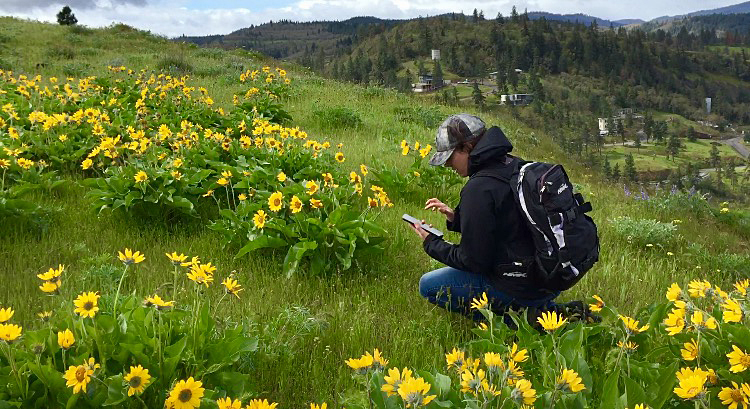
[media-credit name=”Photo: Miko Ruhlen” align=”alignleft” width=”450″] [/media-credit]
By Miko Ruhlen. Jun. 1, 2017. “My favorite part of my job is that I am always learning something new. And to me, the best scientists,” said Sara Woods, “are the best students, because we are always having to adjust, realign, to start moving forward, then get another piece of the puzzle.”
Since 2015, Woods began the lead role in stewardship and restoration of the Friends of the Columbia Gorge land trust properties. “We have over 1,000 acres of land within the Columbia Gorge National Scenic area,” she said. “Most of my job is stewarding that land. What that means is managing it, improving it, and restoring it the best we can.”
Sara Woods is scientist and student. She completed both an A.S. in Ecology and a B.S. in Environmental Science. After settling in the Gorge in 2003, she completed a Master’s degree in Environmental Management at Portland State University. Her lust for learning shows in her diverse field work studies: southwest willow flycatcher, spotted owl, raptor banding, pine martens and fishers, Washington ground squirrels, salmon, bull trout and lamprey, botany, weed eradication, wildfire, GIS, teaching ecology to school children.
Please enjoy the video below featuring Sara Woods.
This is Part 3 of the Gorge Scientists series of videos by EnviroGorge.
Wood’s job at Friends of the Columbia Gorge involves a variety of tasks including collecting baseline data on species presence, working on management and restoration plans, coordinating volunteers native seed collection, trail maintenance, and weed pulls. “Invasive weeds are one of our main issues,” she said. “They are everywhere and they are always going to be here, but when we have special places that we want to preserve we try to focus on those areas. Mosier plateau is such a gorgeous, beautiful, biodiverse area that is one place we focus our efforts. Also on the Washington side at the Lyle Cherry Orchards.”
“The problem with non-native invasive plants is that they out compete the native species and potentially form a mono-culture or a single species covering the landscape. Why that’s a problem is that it limits biodiversity. A native species can also be invasive, but typically they are more in balance with the native species. Why non-natives and invasives tend to be a problem is that they don’t have all the other parts of their ecosystem that they come from that keep it in check. So it is allowed to reproduce without having any check or balance.”

She uses education and signs to explain that it’s important to stay on the marked trails. In some areas, hikers have veered off trails to get a view or photo, trampling sensitive plants. She also suggests that hikers and volunteers use a boot brush to clean shoes and gear to help stop the spread of noxious weed seeds.
Why preserve native habitat?
“A functioning, healthy, biodiverse ecosystem offers ecosystem services,” Woods said. “For example: plants filter water and clean air, the roots of trees stabilize banks from erosion, bees pollinate flowers. All of those offerings the ecosystem gives humans, go away when biodiversity goes away.”
RELATED POSTS
One Year in a Tiny House Part 2 – Video and Story by Miko Ruhlen. May 1, 2017.
In January 2017 the Gallion family embarked on a tiny adventure. Tina, Darren, Cole, and Quinn spent the holiday season downsizing. They moved from a 2,500 square foot house into a house that measures 182 sqare feet. I visited them just before they moved to their new spot in Underwood, Washington. Now in late March, I’ve come to see how the four fared over the three winter months.
Catching sight of the tiny green house as I drive up their long dirt driveway, I admit feeling a bit apprehensive. Winter storms in January and February brought unrelenting snow and ice. I wonder, in the harsh winter, if they were ever snow-bound or had to evacuate due to lack of heat, electricity. Or got cabin fever?

As I approach, I see Tina filling a plastic jug with water from a newly installed spigot. She is cheery and excited. She says at last she can access water near the house, rather than driving to town. They delayed installing water to the house over the winter, because of the potential of freezing pipes.
On the bright side, Tina says, this process made them aware of how much water they use, and they learned ways to conserve water. Tina is a ‘glass half-full’ type person.
She tells me they had power all winter, and their heater kept them toasty warm. However, the small electric space heater, was not without drawbacks.
“I assumed, because it was such a small space, it wouldn’t take much to heat it,” Darren emailed me. “Our previous 2,500 square foot house was well designed (passive solar) and we used wood heat. Granted we had a pretty extreme winter this year, but our electric bill in the tiny house was more than our 2,500 sq. ft. house, which was surprising to me considering we don’t have laundry facilities or hot water.”
I ask Darren, who is 6’7″, if the tiny house height creates special challenges. “With the loft in our house, it feels pretty big. The biggest challenge is working in the kitchen under the loft, so I try to leave most of that for Tina :). The other thing I run into (literally) is the shorter door frame. Overall though, the smaller space, just pushes us outside more.”

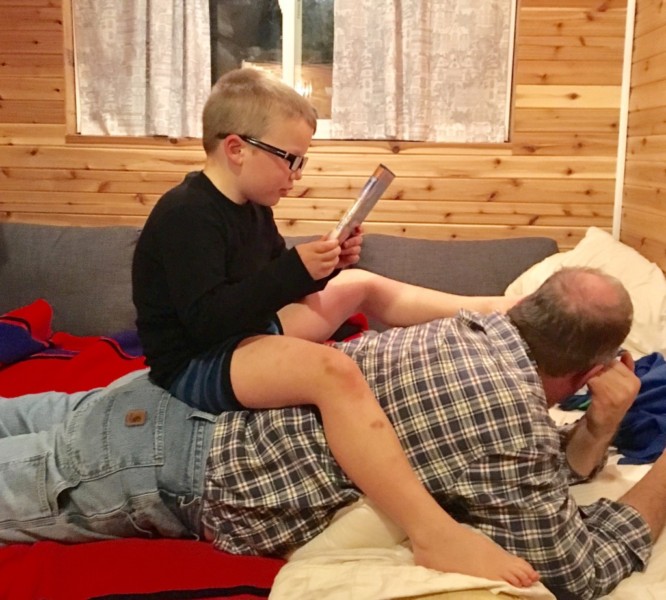
Quinn sits and read on top of Darren
“I was apprehensive trying this with a wife and two kids,” he writes. “The small space makes for a tight-knit family. I found the kids are really adaptable. In a tiny house, there’s no where to go, which, at times, can be a double-edged sword.”
The kids, Quinn (6) and Cole (8) seem to have transitioned well from having a big closet full of toys to the few that fit into a couple of drawers. Tina says they enjoy playing with the neighbor kids, climbing trees, and spending more time with she and Darren. The bone of contention seemed the lack of WiFi for streaming movies.
I ask Darren if he would recommend tiny and minimalist living. “For me this is do-able because there is an endpoint in sight: where we move into a moderate sized house with a garage. For the long term, I think a tiny house is fine for a single person, especially considering housing prices in the Gorge these days. If our kids were much older, I think this would be pretty challenging.”
Each of the Gallions seems optimistic about living the rest of this year in their tiny house while they build their new house. Darren is also optimistic about catching lots of fish, “Hardest part is probably coming up. Spring Chinook are arriving, and I don’t have place to keep gear dry or (hopefully) freezer space.”
Thank you to our Sponsors for making our work possible:
RELATED POSTS
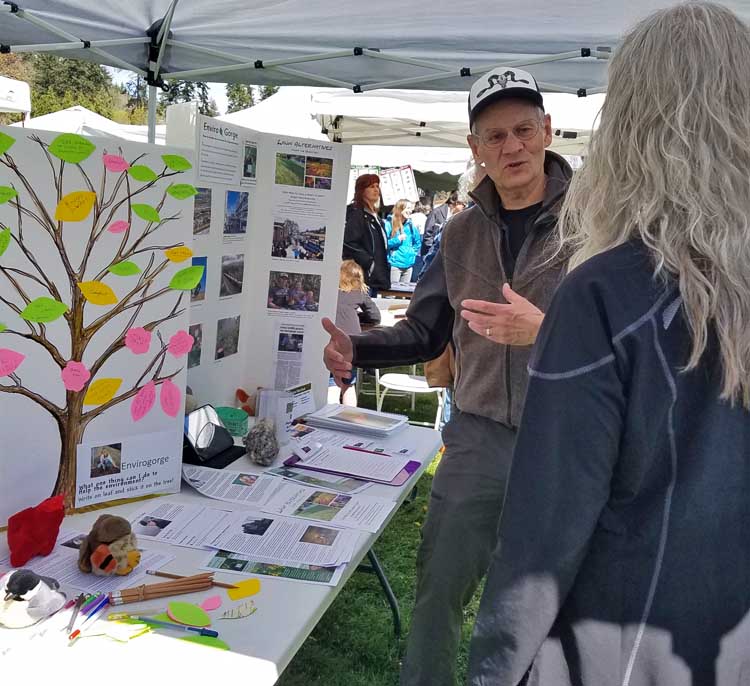
Jurgen Hess doing outreach for EnviroGorge at the Science Fair in White Salmon
For Earth Day this year (April 22, 2017), EnviroGorge participated in a science fair in White Salmon, Washington. March for Science – White Salmon sponsored this event, a satellite for the Washington D.C. March. Over 300 people gathered to celebrate science.
EnviroGorge asked visitors two questions. What concerns you about the Gorge environment, and what can you do to help the environment? Small children, youth and teens, men with babies on their backs, women carrying signs for the march, almost everyone asked wanted to voice their concerns or solutions. Their responses were written on paper leaves and added to our tree and later portrayed in graphics below.
[media-credit name=”Graphic by Miko Ruhlen” align=”aligncenter” width=”750″] [/media-credit]
[media-credit name=”Graphic by Miko Ruhlen” align=”aligncenter” width=”750″] [/media-credit]
EnviroGorge asked these same questions last year at the 2016 Earth Day celebration hosted by Gorge Owned. If you are curious to read those responses, see the article we posted after that event at this link.
Feel free to add a virtual leaf to our tree by adding a comment to this post. We love to hear from our readers. Make your voice heard and concerns known.
(Photos No longer available)
Related posts:
Paid Advertisement:
By Miko Ruhlen. Apr. 17, 2017. “Investing in your own town instead of the stock market—it feels so much safer somehow,” said Kate McBride. She and a room full of people came to hear Oregon Clean Power Cooperative (OCPC) explain an investment opportunity April 14 at Remedy Juice Cafe.
The OCPC and City of Hood River has secured partial funding for the $72,000 project to put solar panels (30kW) on the Hood River Public Works building roof, but they need investors to provide the remaining $22,000 in funds. The minimum investment per person is $1,000 and there is a 2 percent return rate and a 10-year term. Joining the co-op for $75 is required to participate. Investors must reside in Oregon, but not necessarily Hood River County.

Presenter Dan Orzech on the left, to his right Marla Harvey, Hood River County Energy and Sustainability Coordinator.
If you ever picked stocks, exchange-traded funds, mutual funds for a retirement account or other investment, you probably encountered options for socially responsible investments. These alternatives to traditional Wall Street investments give people a way to invest without contributing to things they don’t believe in such as tobacco, drugs, child labor, or weapons. Green investing is a form of socially responsible investing, where finances are invested in environmentally friendly products or practices.
Rather than investing in publicly traded ‘green’ stocks, or bank CDs, people can keep dollars locally in Oregon by putting their money in community financed renewable energy projects.
“We are really pioneering something here in Oregon and Hood River,” said Dan Orzech, General Manager of Oregon Clean Power Cooperative (OCPC). The co-op model of funding a project with community investors has been used in Canada and parts of Europe, and even Fukushima Japan, but in the United States this will be the first of its kind.
Private investors in renewable energy historically put money into California or East Coast projects, where higher energy prices are higher than the Pacific Northwest. In 2014 a bill, SB1520, passed in the Oregon legislature allowing Oregonians to form cooperatives to finance community renewable energy projects–without the lengthy, complex and expensive process of filing a financial prospectus.
OCPC formed the next year. It has several community solar projects in the works: Hood River Public Works, Mazamas Mountaineering Center in Portland, First Unitarian Church of Portland, and Corvallis High School. More projects are in the discussion phase: in Hood River, Medford, Lakeview, Baker, and Bend. Investors in any of these projects must live in Oregon, but do not need to live within the community that the solar project is located.
City of Hood River Public Works Solar Project
Installing solar panels on the City’s Public Works building is projected to save more than $11,000 in electric costs in the first ten years. In 25 years, it could save $97,000. If financed, it will be installed by local installer Common Energy in partnership with the OCPC. The project, a 30 kilowatt solar array, will allow the Public Works to get more than half its electricity from the sun.

City of Hood River Public Works building
OCPC is seeking investors to purchase preferred stock in the Hood River Public Works solar project: $1,000 minimum increments for a 10 year term and a 2 percent annual return. Investors must pay a $75 co-op membership fee to participate. This is a one-time lifetime membership and allows the member to invest in multiple projects through OCPC.
A $22,000 community investment is needed within a one-year time frame for the project to proceed. Orzech already has a commitment for a third of that and is optimistic that the rest will come through in the next few weeks. If funded quickly, construction could start as early as late May or June.
The full cost of the project is $72,000. In addition to the community investment, Energy Trust of Oregon will grant $16,567. “That money comes from me and you,” said Orzech. “If you look at your energy bill, you’ll see a Public Purpose Charge.”
Common Energy will both install the solar panels and own a portion of the project to cover the remaining $33,433; they will take advantage of the tax credits to help finance it. They will sell it to the city for $2,034 in 10 years—after investors have been paid back. OCPC will take $3,600 in fees for the project to pay for staff time and expenses coordinating the project and the 10 years of bookkeeping. A full disclosure is available on the OCPC website.

Dan Orzech explaining the financial details
“This is not a get rich project for anyone involved. It is something we are all doing because we believe in community solar,” said Orzech. “Like any investment, it is not guaranteed. You could lose your money.” Although he explained that he is not a financial advisor, Orzech believes this project probably has a fairly low risk. “The primary risk would be if the City of Hood River stops paying the loan from OCPC within the next 10 years.”
All investors will be paid back after 10 years. The City of Hood River will own the system outright and continue to reap savings for the life of the panels. Orzech stated that although solar panels now generally are warrantied for 25 years, they have been know to last with some maintenance for up to 60 years. Although the solar panels do not generate 100 percent of the energy needed for the building, they are estimated to produce well over half of the power now used.
[media-credit name=”Photo Courtesy of OCPC” align=”aligncenter” width=”450″] [/media-credit]
Benefits of Investing Locally
The savings in electricity for the City of Hood River is projected to be $97,000 over the course of 25 years. Although City Councilor Kate McBride could not comment on exactly where these savings would be allocated, she said some of it would likely be “directed to the highest priority on their list, which for the last three years has been affordable housing.” The priorities for budget are determined during City Council meetings which she encouraged people to participate in.
McBride noted that Mark Lago had another location in mind for a renewable energy project—the Hood River Sewage Treatment Plant which has a high energy bill. If community solar projects enable the city to save money that can be allocated elsewhere “we can do the things we want to instead of paying electricity bills,” said McBride. This is one benefit community members receive from investing locally.
“Oregon sends $12 billion out of state each year to pay for fossil fuels through Pacific Power. Now we can keep some of that money right here at home,” said Orzech. He also noted that by helping this project get off the ground, “investors will help the City harvest clean energy from the sun rather than from coal.”
Energy efficiency standards for the building will be reviewed by Energy Trust of Oregon as part of the process. “You need to conserve first and put panels on second,” said McBride.
More to Come
Although Orzech feels that tax credits for renewable projects are pretty secure at the moment, they are projected to decrease in three years. At that point “it will then be our responsibility,” he said, “at state and local levels to invest in clean tech.” He thinks pioneering this type of project is important model for the future.
“We can do not just solar, but wind, micro hydro, biomass and we hope to do all those things,” said Orzech. “The solar industry employs more people than coal.”
One response from the audience: “I heard that even Arby’s (fast food restaurant) employs more people than coal.”
Times are changing. People are seeking ways to adapt and create greater resilience and sustainability in their communities for the future. If you are interested in learning more about this project, contact Dan Orzech of Oregon Clean Power Cooperative.
Thank you to our EnviroGorge sponsors. Contact us if you are interesting in becoming a business or individual sponsor and help us continue our work!

Paid Advertisement:
Cathy Flick and Bird Banding
Part 2: Gorge Scientists. Highlighting scientists who live and work in the Columbia River Gorge.
By Miko Ruhlen. Apr. 13, 2017. Wildlife biologist Cathy Flick has spent most of her career doing scientific research on native song birds, bald eagles, peregrine falcons, bats, native and invasive plants. She recently retired from the U.S.D.A. Forest Service, Columbia River Gorge National Scenic Area.
For the Gorge Scientists series, we’re focusing on one of Flick’s volunteer projects: the bird banding she does at the St. Cloud banding station on the Washington side of the Gorge.

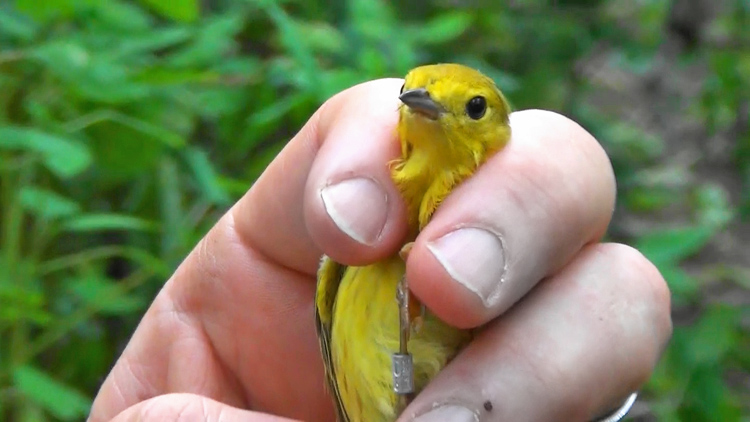
Yellow Warbler with silver USFWS leg band.
Approximately every 10 days in spring, early summer, and fall monitoring periods, Flick sets up mist nets at dawn to catch and band birds (with a uniquely numbered USFWS metal leg band). Carefully untangling a bird from the net, she notes the bird’s age, sex, body condition, reproductive status, bands it and finally releases it unharmed.
She sends the information to a program called MAPS, Mapping Avian Productivity and Survivorship, run by the Institute for Bird Populations (IBP). Flick often uses the assistance of other trained volunteers including local bird expert Stuart Johnston. In this video Flick is joined by Zed Ruhlen, former biologist for IBP, and his children.
MAPS sets the standard protocols for use at the over 1,200 mist-netting and banding locations in the United States and Canada. Flick’s data is added to their huge database. With more than two million bird capture records going back over 25 years, scientists can answer questions about avian ecology and make predictions about impacts to birds caused by a variety of conditions: including habitat changes and climate change.
Results of these long-term monitoring studies help land managers prioritize actions and use limited funding where most needed. As the MAPS manual explains, operation of a banding station is a commitment. Standardization protocols implemented over at least five consecutive years are necessary to provide reliable indices, but 10 to 20 years are often needed to obtain reliable trend information. Cathy Flick has been running the St. Cloud station since 1999.
Recently, scientists have discovered how to unravel the mysteries of bird migration though genetic mapping. They use feathers collected by pulling one feather from certain species (not harming the bird) at some MAPS banding stations. By analyzing data from feather archives gathered from long-term monitoring, migration patterns of an individual can be mapped by the DNA in one feather. As this technology develops, it has the potential to aid bird conservation efficiently and on a broad scale.
In this era of budget cuts, long-term monitoring is difficult to fund. Biologists and their projects are limited in scope by lack of financing. Scientists like Cathy Flick who work as volunteers are becoming increasingly important for gathering data needed from wide geographic areas.
Volunteers like Cathy are working as citizen scientists, although few have her expertise. Citizen science has a long history. One example is the Christmas Bird Count started in 1900—volunteers comb backyards, farm fields, forests, grasslands, deserts, ocean shores counting the kinds of birds they see and hear. Data gathered by volunteers fills gaps in scientific knowledge or capacity by mobilizing large numbers of volunteers. Mobile apps (like eBird, iNaturalist) further help by streamlining the transfer and accuracy of data.
Citizen science is science. It utilizes scientists like Cathy Flick for data collection, coordination, and analysis, as well as non-scientist volunteers to gather and record data. Citizen science can also educate and empower members of the community to be stewards of their environment.
RELATED POSTS:
Paid Advertisement:


© Copyright 2013-2025 Columbia Insight. All Rights Reserved.
As a 501(c)3 nonprofit organization, all donations to Columbia Insight are tax deductible to the full extent of the law. Our nonprofit federal tax-exempt number is 82-4504894.

Subscribe for free weekly updates on climate, water, wildlife, land use and energy in the Pacific Northwest.
We do not share our lists with anyone.
Already a subscriber? Click here for other ways to support Columbia Insight.