Stay Updated Subscribe today for the latest research + reporting about environmental news. Subscribe Now

Stay Updated Subscribe today for the latest research + reporting about environmental news.

Subscribe Now

Kendra Chamberlin

Kendra Chamberlin

Kendra Chamberlain

About Kendra Chamberlain

Columbia Insight contributing editor Kendra Chamberlain is a freelance journalist based in Eugene, Oregon, covering environment, energy and climate change. Her work has appeared in DeSmog Blog, High Country News, InvestigateWest and Ensia.

On I-5, Oregon will get its first wildlife overpass

ODOT has been awarded $33 million to construct a bridge for animals over one of the state’s most perilous sections of highway
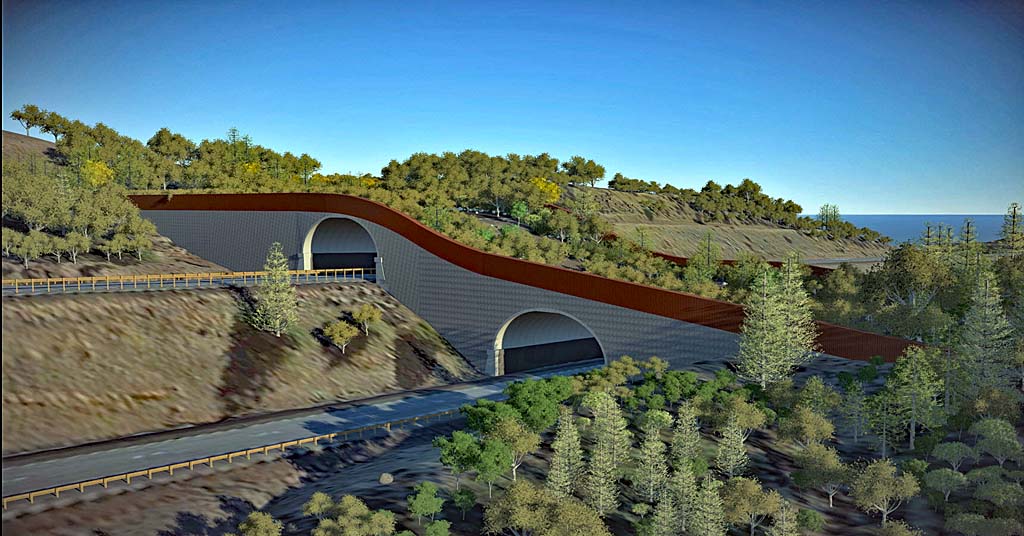
Wildlife crossing over I-5 in southern Oregon, artist's rendering

Movin’ on up: Artist’s rendering looking southeast at a proposed wildlife crossing over I-5 in southern Oregon. Several locations for the project are being considered under a feasibility study. Image: ODOT

By Kendra Chamberlain. January 8, 2025. The terrain south of Ashland, Ore., stretching to the California border sits at an incredible intersection of ecological systems.

Here, the ancient Siskiyou Mountains meet the volcanic Cascades, the high desert of the Great Basin, the Klamath Mountains and the oak woodlands of Northern California.

Dubbed an “ecological wonderland” and home to an impressive list of flora and fauna, the area was designated as the Cascade-Siskiyou National Monument in 2000.

Plowing through all that biodiversity is Interstate 5, which carries 17,000 vehicles per day. The four-lane interstate essentially severs the monument into two.

Animals don’t have an easy time getting from one side of the road to the other. Due to its location, however, the area is a hotbed of wildlife activity and considered a “red zone” for vehicle collisions.

“The traffic volume on most portions of I-5 would be considered to be a permanent barrier to wildlife movement,” Tim Greseth, executive director of the Oregon Wildlife Foundation, tells Columbia Insight. “The oddity with this particular location is it’s smack dab in the middle of the Cascade-Siskiyou National Monument, which was established primarily because of the biodiversity of the region.”

Now there’s good news, for wildlife and motorists alike.

The area will soon get a lot safer thanks to a $33 million federal grant to the Oregon Department of Transportation (ODOT) to construct a massive wildlife crossing over I-5 just north of the Oregon-California border.

“The grant award will allow ODOT to construct a wildlife crossing over Interstate 5 in southern Oregon in the Cascade-Siskiyou National Monument,” according to the ODOT website. “This will be the first wildlife overcrossing for Oregon and for the entire stretch of I-5 between Mexico and Canada.”

Announced in December, the grant award for the Southern Oregon Wildlife Overcrossing is the result of years of work and collaboration spearheaded by the Southern Oregon Wildlife Crossing Coalition, which formed in 2021 to push for animal crossings in the monument.

ODOT will provide another $3.8 million in matching funds that will come from a pot of money created by the 2021 Oregon Legislature to support wildlife crossings across the state.

Construction is expected to begin in 2028, according to ODOT.

Overcross vs. undercrosss

Each year in Oregon, officials document about 6,000 vehicle collisions with deer and elk.

Wildlife crossings are effective at reducing such collisions.

Oregon’s six existing wildlife undercrossings—tunnels constructed beneath roads—have resulted in an 80-90% decrease in vehicle-wildlife collisions in impacted areas, according to ODOT and the Oregon Department of Fish and Wildlife.
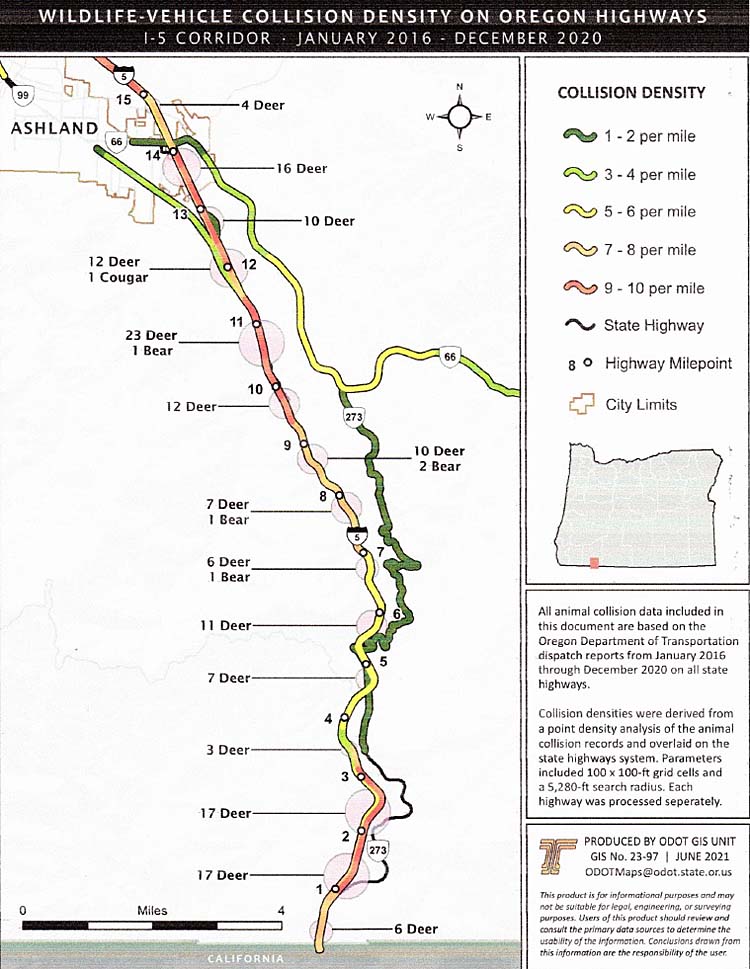
Chart shows Wildlife Vehicle Collision Density on southern Oregon

Vehicle collisions with wildlife on I-5 south of Ashland, Ore., between January 2016 and December 2020, included accidents involving 159 deer, five bears, one cougar and many unknown animals. The average cost of a deer collision in Oregon was $9,068. The average cost of collisions with elk was $24,006. Chart: ODOT/Southern Oregon Wildlife Crossing Coalition

“There’s a real advantage to doing overcrossings versus undercrossings,” says Greseth. “Overcrossings get a lot more diversity of species use. If you think about an underpass—and think about even people and how we might approach something where we’re going underneath a busy road—each of us individually would probably approach that with some trepidation. Animals aren’t going to be different.”

The proposed I-5 overcross will consist of soil, vegetation and landscaping elements to make the crossing feel safer to wildlife. It will include retaining walls and sound walls along its length to dampen interstate noise and shield wildlife from light on the road.

Dense plantings of vegetation will offer cover from predators for smaller animals, while open paths along the crossing will give animals using the bridge the ability to see their destination, according to ODOT spokesperson Julie Denney.

ODOT’s landscape architect and a multidisciplinary subgroup are planning which plants to use on the bridge. The team is “focusing on the plants that will help make the crossing the most attractive for the species we expect to utilize the crossing,” says Denney. Those species include deer, elk, bear, cougar, birds and even insects.

Potential plants for the crossing include sugar pine, desert gooseberry, deer brush, Oregon white oak, dwarf Oregon white oak, rubber rabbitbrush, antelope bitterbrush and spreading dogbane.

The structure will span northbound and southbound lanes, and have fencing stretching two-and-a-half miles in each direction and on either side of the interstate. The fencing will help funnel wildlife onto the bridge.

“Our goal is to provide an environment for the crossing to be as natural as possible, hopefully in a way that the wildlife are unaware they are crossing a major interstate,” says Denney.
By |2026-01-13T11:23:48-08:0001/08/2025|Transportation, Wildlife|1 Comment

Largest solar power farm in US coming to Oregon

The Sunstone Solar Project will cover more than 14 square miles and feature almost 4 million solar panels

Farms and solar panels

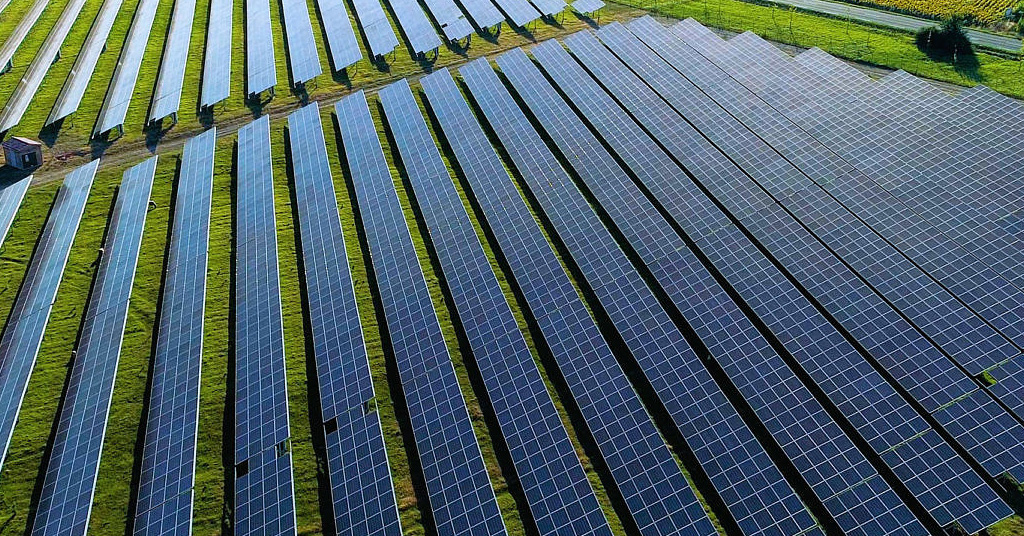
Lightening the load: Not yet built, the coming Sunstone Solar Project is approved to include up to 7,200 MW hours of battery storage capacity, six substations and up to 9.5 miles of 230-kilovolt (kV) overhead transmission lines. File photo: Farm and Energy Initiative

By Kendra Chamberlain. December 26, 2024. Utility developer Pine Gate Renewables received approval in November from the State of Oregon’s Energy Facility Siting Council to construct what it says will be the nation’s largest solar farm.

The North Carolina-based company projects its new Sunstone Solar Project will feature about 4 million solar panels and produce 1.2 GW of power, enough to power about 800,000 homes or 10 very large data centers annually.

The facility will be constructed on a strip of land previously used for dryland wheat farming near the Columbia River in Morrow County, about 185 miles east of Portland, next to the Boardman Bombing Range, used by the United States Navy.

The enormous installation will be built in six phases of 200 megawatts each. Construction is planned to begin in 2026 and will take at least 10 years to complete.

The company said Sunstone Solar will interconnect with Bonneville Power Administration distribution and that it is in talks with local utilities about purchasing the power.

Morrow County is quickly becoming a clean energy hub in eastern Oregon, and the land selected for the site is considered a sweet spot for solar development.

The Sunstone Solar site is approved to take up 9,442 acres (14.75 square miles) of private land zoned for agriculture. According to The Oregonian, a third of the land comes with water rights.

Project surveys reportedly found no conflicts with wildlife or habitat, and the project thus far has faced no organized opposition from locals.

The State of Oregon restricts solar development on prime farmland, but the Sunstone Solar Project was granted an exception due to economic benefits it is expected to provide.

Local impact

Logan Stephens, vice president of project development for Pine Gate Renewables, told Columbia Insight in an email that the company reached out to several Tribes about the project including the Confederated Tribes of the Umatilla Indian Reservation (CTUIR).

“Pine Gate Renewables and the CTUIR signed an agreement to mitigate any adverse effects of the project on historic property of religious and cultural significance to the CTUIR,” wrote Stephens. “The CTUIR provided a letter to the [Oregon Department of Energy] stating that its concerns had been mitigated and that it has no further concerns with the project.”

The company will pay more than a thousand dollars per acre of agricultural land that’s being converted into an agricultural mitigation fund administered by Morrow County.

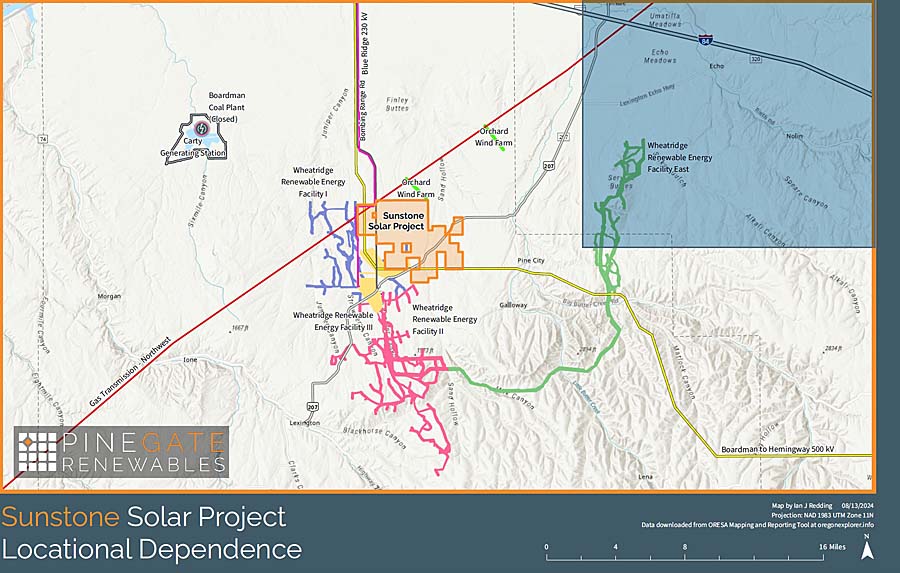
Sunstone Solar energy project map

The proposed Sunstone Solar Project will be located about 185 miles east of Portland International Airport. Map: Pine Gate Renewables

“Early on in our engagement efforts, impacts related to the conversion of cultivated land to solar was identified as a key concern for several stakeholders,” wrote Stephens. “The idea to create an agricultural mitigation fund to address these impacts emerged collaboratively through our engagement efforts with local [and] state officials and dryland wheat farming interest groups.”

He added that the money will “more than offset the negative adverse impacts that would result from the conversion of cultivated land for use by the proposed facility.”

The county office has not responded to Columbia Insight’s inquiries about the fund.

Morrow County is betting big on renewables. The county is home to the Shepherds Flat Wind Farm and Wheatridge Energy Facilities, as well as the Wagon Trail Solar Project, which will become the second largest solar facility in the state after Sunstone is completed.

Energy demand in the Pacific Northwest is exploding.

The Portland-based Pacific Northwest Utilities Conference Committee released a report earlier this year predicting electricity demand will increase 3% each year over the next decade.

The surge in demand is being driven by the proliferation of data centers in the state, many of which are slated for construction in eastern Oregon.

By |2026-01-13T11:27:40-08:0012/26/2024|Energy, News|2 Comments

Push is on to finalize Columbia River Treaty before Trump takes office

Six years and 19 rounds of negotiations to nail down an updated treaty are at stake with the change of administrations

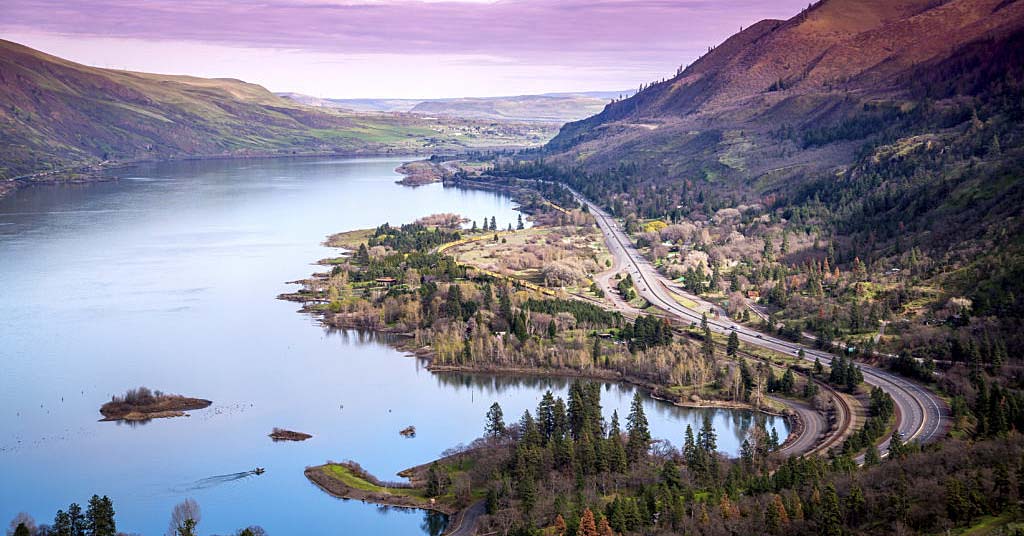
Columbia Gorge at Rowena in Wasco County

Rising concern: Among other provisions, an updated Columbia River Treaty would impact flood control in the Gorge. Assuming it’s ratified. Photo: U.S. Dept. of State

By Kendra Chamberlain. December 12, 2024. Officials in the United States and Canada are scrambling to finalize the Columbia River Treaty before President Joe Biden leaves office on Jan. 20.

Canada’s Minister of Foreign Affairs Mélanie Joly told reporters in Lima, Peru, last month that she and U.S. Secretary of State Antony Blinken spoke about getting the treaty across the finish line before the next administration takes over in the United States.

However, with Congress focused on must-pass, end-of-the-year legislation, including funding the federal government, the prospect of getting the treaty ratified before Jan. 20 seems unlikely.

The Senate would need to vote on the final text of the agreement sometime in the next month, and it would need a two-thirds majority to be approved. Before the Senate can consider a new treaty, the president must submit it for formal consideration, something President Biden has not yet done.

Even so, Minister Joy seemed hopeful that bipartisan support for the agreement can be found in Congress in her comments in November.

“We think it’s a win-win situation for both sides of the border. British Columbia is on board, First Nations are on board and we know we have the support of key senators, also on the American side,” she said, according to The Canadian Press.

Sec. Blinken echoed Joy’s commitment to finalizing the deal in a statement, but didn’t mention any bipartisan support for the agreement.

“The Columbia River is the lifeblood of our region. It has been more than 60 years since the Treaty was agreed to, and updates are critically needed as our communities have evolved and the challenge of climate chaos has intensified,” Sen. Jeff Merkley of Oregon told Columbia Insight. “I will be working with my colleagues and the incoming administration to update the Columbia River Treaty, which is needed to boost our local economy, honor the sovereignty and leadership of the Tribes who have been stewards of the Columbia Basin since time immemorial, and increase renewable energy production to help us meet our clean energy goals.”

Lengthy process, uncertain future

The two countries have been working at finalizing an updated version of the treaty for six years. It took 19 rounds of negotiations between the parties during that period, but in July the two countries finally announced an agreement in principle, laying out some of the details of the new treaty that cover flood management and hydroelectric power sharing across the border.

The updated treaty will see a 50% reduction in power the United States sends to Canada by 2033.

The United States will have access to “reservoir storage space” behind Canadian treaty dams for flood management, but will have to fork over roughly $37 million over the next 20 years, according to the Government of British Columbia.

Several flood management provisions expired in September. The United States and Canada are currently operating under an interim agreement until the new treaty is ratified.

Stakeholders in the United States say the update doesn’t go far enough to protect salmon, as previously reported by Columbia Insight.

How an unfinished treaty would fare under the Trump administration is unclear.

Both the United States and Canada brought tribal nations to the table for the first time in the treaty’s 63-year history. That input aimed to steer the two countries toward a more equitable compromise—for both Tribes and the ecosystems involved.

Bob Heinith, who served as a technical advisor on the treaty for the Columbia River Inter-Tribal Fish Commission (CRITFC), pointed out some bright spots for Tribes.

“The agreement in principle is a good thing because it gives Indigenous nations a fair chunk of storage—between 4 and 7 million acre feet—and they get to decide how they want to use that, in terms of enhancing flows for [salmon],” Heinith told Columbia Insight.

The update establishes a new tribal and Indigenous-led body to offer recommendations on how to better support Indigenous cultural values, and commits to sustaining “healthy” salmon populations by maintaining minimum flows during dry years to ensure salmon can complete their annual migrations.

But in the United States, the Columbia River Treaty Non-Governmental Organization Caucus and CRITFC have called for ecosystem-level function to be included as one of the primary purposes of the agreement, arguing that the current update doesn’t change much for salmon. Heinith said more could have been done to increase water flows for fish.

“I’m not sure what happened with negotiations, but it seems like particularly the U.S. should have been negotiating for more water,” he said.

How an unfinished treaty would fare under the Trump administration is unclear.

Given president-elect Trump’s comments about the Columbia River being a “large faucet” of the Pacific Northwest, the incoming administration could attempt to renegotiate parts of the treaty before signing off on it.

Senate Republicans could also derail the update by simply refusing to bring it to a vote.

By |2026-01-13T11:34:48-08:0012/12/2024|News, Rivers|0 Comments

Boise Airport is now 100% solar powered

The city is making real progress on its renewable energy goals, at the airport and beyond

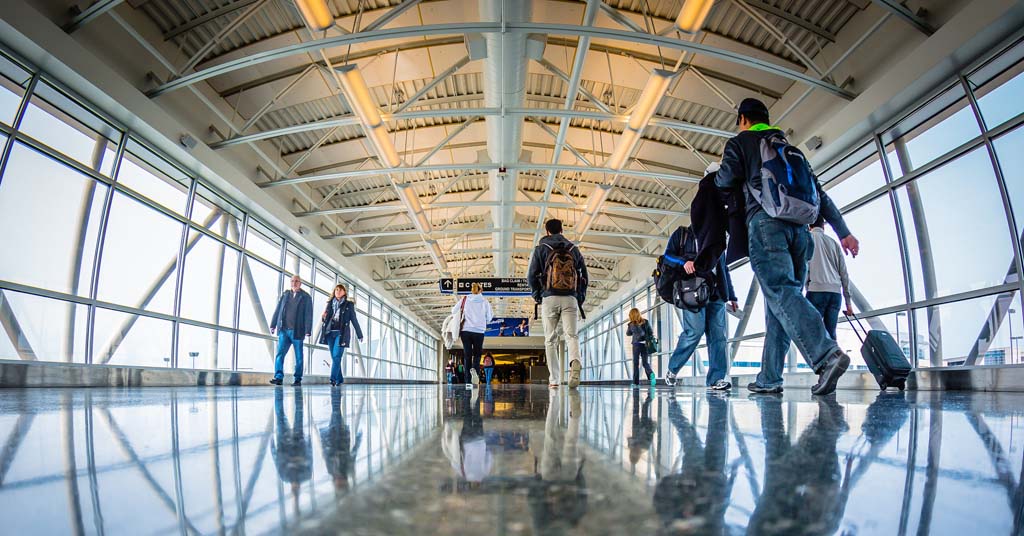
Travelers walking through airport terminal

Bright future: Air travelers in Boise are getting a boost from the sun. Photo: Thomas Hawk/Flickr

By Kendra Chamberlain. December 2, 2024. The city of Boise is steadily marching towards its goal to power 100% of municipal government functions with renewable energy by 2030.

The city’s airport and one of its wastewater treatment plants are now powered 100% by solar energy, according to the Idaho Capital Sun. The paper attributed the news to Steve Hubble, climate action manager for the city of Boise.

The city is buying solar energy from the Black Mesa Energy solar project located in Idaho’s Elmore County through a renewable energy program offered by Idaho Power. The facilities—two of the city’s three biggest energy users—bring Boise’s renewable energy share up to 25%.

The State of Idaho doesn’t have any renewable energy transition goals enshrined in law, but clean energy is proving popular among some of the state’s communities. The City of Boise adopted its 100% renewables mandate unanimously in 2019.

East of Boise, Blaine County (home to Sun Valley ski resort), along with the cities of Bellevue, Hailey and Ketchum, have pledged to transition to 100% clean energy for municipal energy use by 2030, and to provide 100% clean electricity for the Blaine County community by 2035.

Boise is the first city to participate in Idaho Power’s optional renewables program, which the Boise City Council approved unanimously in 2023.

In August, the Idaho Public Utilities Commission approved a 20-year contract for Idaho Power and the City of Boise to purchase 10 megawatts of power from the Black Mesa Energy solar farm to cover the energy requirements of the airport and the wastewater facility.

Meta is working on a similar deal with Idaho Power and solar builder rPlus Energies to cover the energy demands of its Kuna-based data center with 100% renewable energy.

Idaho Power itself has a stated goal of supplying 100% of power to its customers with renewable energy by 2045.

The majority of Idaho Power energy comes from hydroelectric dams, but nearly a quarter of the energy delivered is generated through coal burning. Idaho Power is investing in a web of wind and solar farms equipped with battery storage to eventually displace that coal, along with a new transmission line meant to carry clean energy from Oregon to Idaho.

An abandoned mine in Idaho is now prime habitat for bats

Collaboration between government agencies and a mining company has transformed a dangerous but valuable property

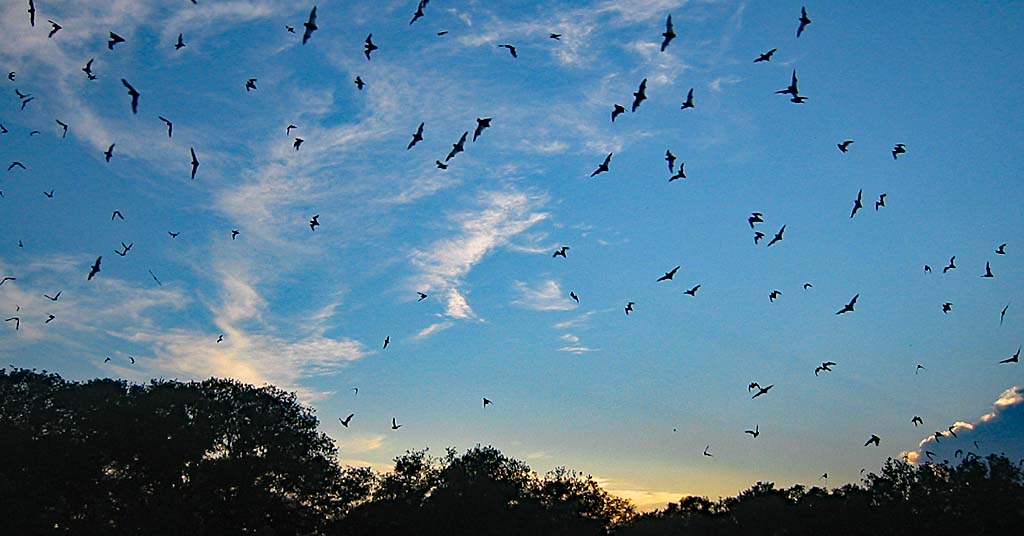
Bats in the air emerging from a cavern. Location unknown

Flying high: Bats in Idaho have a new home. File photo: Paul Cryan/USGS/Flickr

By Kendra Chamberlain. November 18, 2024. The bats of Bear Lake National Wildlife Refuge have a new roost to call home this winter.

An orphan mine, located on protected land around Bear Lake in southeast Idaho, was sealed up years ago to protect humans from wandering in. That meant the mine was also off limits to wildlife like bats.

The U.S. Fish and Wildlife Service (USWS) partnered with Idaho Department of Environmental Quality, the Bureau of Land Management, Idaho Department of Lands and the mining company Synesco to open the mine entrance so that bats can roost in the mine’s long, twisting tunnels.

The mine was officially opened to bats on Oct. 21.

Today, bat habitat is at a premium. North America’s 154 species are facing extreme population declines due to habitat loss, climate change and even wind turbines. Of those 154 species, 47 hibernate and so are also potentially susceptible to population declines  from the scourge of white-nose syndrome.

That’s made old mines an attractive prospect for bat conservation efforts. Orphan mines are being repurposed across the country for bat habitat.

But USFWS biologist Daniel Nolfi told Columbia Insight the Bear Lake project was especially intensive because it required reopening a mine that was no longer accessible.

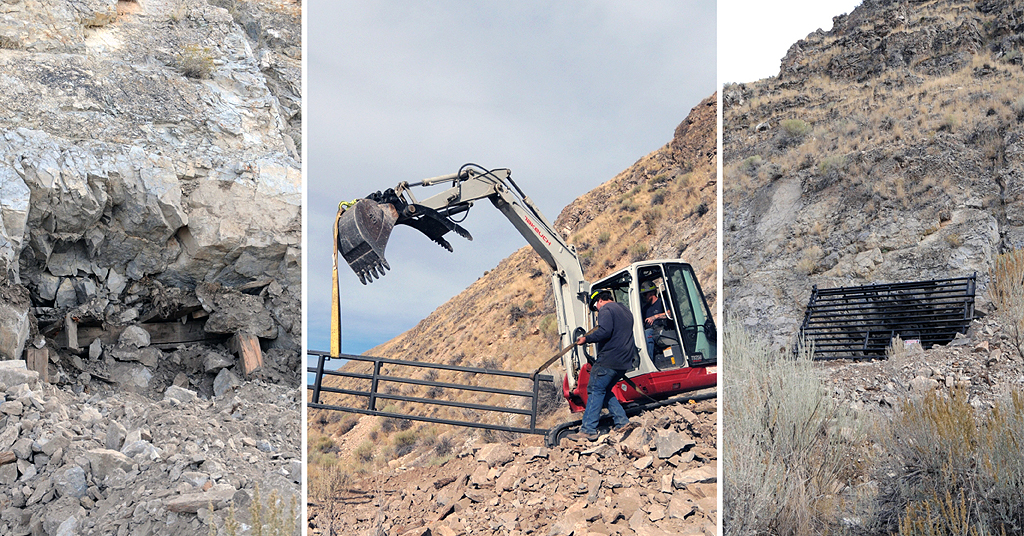
The entrance was excavated and then fit with a gate to keep humans out, but allow bats in. Synesco owns the claim on the mine and covered the cost of the project.

Turning a mine into a bat sanctuary

Making a bat cave: Sealed mine at Bear Lake National Wildlife Refuge (L); bat-friendly gate being lifted into place (C); bats can get in, people can’t. Photos: Dan Nolfi/USFWS

Mines may also help stave off the spread of white-nose syndrome (WNS), a disease that has ravaged bat populations across the United States.

WNS infects hibernating bats, rousing them from their sleep and causing them to burn all their stores of fat before winter’s end. Infected bats—often entire colonies—die of starvation.

The disease was first detected in New York in 2006, and has since spread west from state to state, killing an estimated 6.7 million bats along the way.

The fungus that causes the disease, Pseudogymnoascus destructans, or Pd, was first detected in Idaho’s Minnetonka Cave in 2022. That cave is right next door to Bear Lake National Wildlife Refuge.

“Research suggests that the temperature of hibernation sites may affect the severity of WNS,” Nolfi told Columbia Insight in an email. “Artificial habitat, such as mines, allow for more intensive control measures for WNS. Opening mines to bats can be done in such a way that desired temperature conditions are created, potentially leading to reduced WNS impacts to the bats that use these habitats.”

Nolfi said up to eight different bat species use Bear Lake National Wildlife Refuge, including little brown bats, a species that has seen significant population declines across North American due to WNS. [An earlier version of this story inaccurately stated that little brown bats are a federally endangered species. —Editor]

The USFWS’ Idaho office is engaging other mining companies for similar projects on both federal and private land in southeast Idaho, a region known for phosphate mines.

“The goal is to evaluate opportunities to provide bat habitat while maintaining closures for human safety,” said Nolfi.

By |2026-01-13T12:45:41-08:0011/18/2024|Wildlife|2 Comments

Amazon wants to power data centers in Pac NW with nuclear energy

The company is investing in small nuclear reactors to power big data generators in eastern Oregon

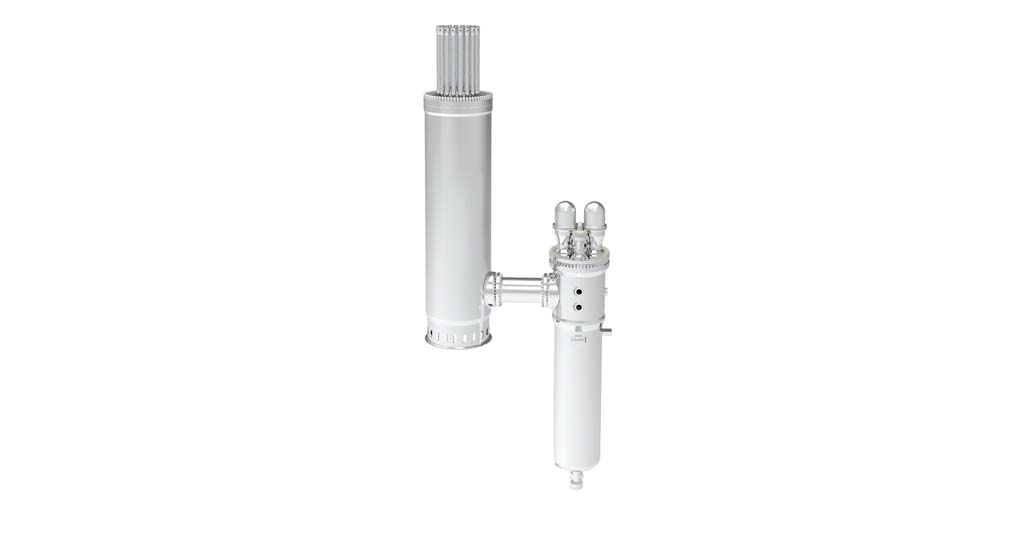
X-Energy Xe 100 reactor

Power packed: According to X-Energy, its Xe-100 is an 80 MWe reactor that can be scaled into a “four-pack” 320 MWe power plant with a modular design. Image: X-Energy

By Kendra Chamberlain. November 5, 2024. Amazon announced an agreement with Energy Northwest, a consortium of 29 utilities in Washington, to build four small nuclear reactors (SMRs) at the Columbia Generating Station in Richland, Washington.

The four reactors will be built by Maryland-based X-Energy and generate 320 MW of energy by the early 2030s.

Amazon will be the primary customer of that power, and likely use it to power its data centers located in eastern Oregon, according to OPB.

Oregon state law prevents building new nuclear energy generation in the state without voter approval. The new SMR project would be located next to Energy Northwest’s existing nuclear generation plant near the Columbia River.

SMRs are touted by the nuclear industry as a better way to deploy “clean” energy across the United States to help transition the nation’s grids off fossil fuels. SMRs have much lower associated greenhouse gas emissions.

Still, the reactor design has struggled to gain a foothold in the United States.

Amazon recently led a $500 million investment round in X-Energy, which CEO J. Clay Sell told CNBC proved to be a boon for the burgeoning SMR industry.

“The biggest gaping hole we had to fill was the capital to build new projects,” said Sell. “Amazon stepping up and saying we will provide the capital, hundreds of millions of dollars to construct these projects and get them online, that’s one of the most transformative announcements our sector has seen.”

Energy Northwest said it’s been interested in X-Energy’s reactors since 2020, though the company will need to win approval for its designs from the U.S. Nuclear Regulatory Commission and will need to acquire approval from Washington State’s Energy Facility Site Evaluation Council before construction can begin.

Amazon will fund the initial two-year feasibility phase of the SMR project. That’ll include environmental, safety, permitting, licensing and risk analyses, according to Energy Northwest.

If Amazon and Energy Northwest decide to go ahead with the project, Amazon will provide an offtake agreement that would allow the project to be financed. But that decision is years away.

Up to eight more SMRs could be added to the site in future phases of the agreement, generating an additional 640 MW.

Some of that energy could eventually power homes and businesses—if any of Energy Northwest’s 29 members want to participate in the project.

Ballooning costs

There are only three existing SMR plants in use today, two in Russia and one in China. A fourth plant is being built in Argentina.

There are no SMR plants in operation in the United States.

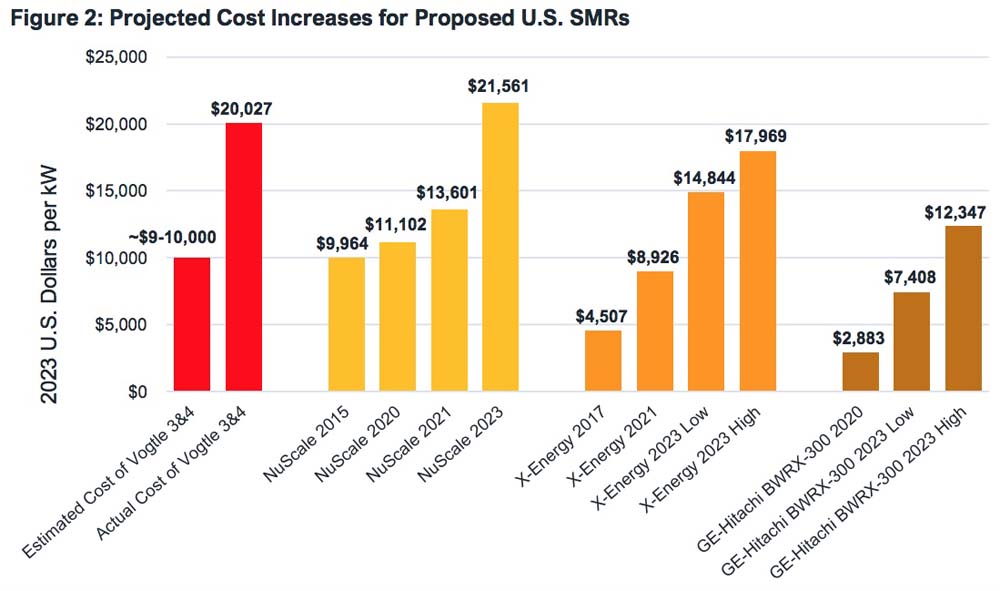
SMR projects have a track record of ballooning budgets and protracted timelines, which has made seeing its projects to completion a challenge in the United States.

Small Nuclear Reactor cost increases chart

Spiraling costs have made it tough to complete SMR projects. Source: IEEFA

To date, only one reactor design has been approved by the U.S. Nuclear Regulatory Commission. That design, owned by Oregon-based company NuScale, was part of a pioneering SMR project in Idaho that collapsed in late 2023, after costs rose so high that customers began pulling out of the project, as reported by Columbia Insight.

Energy Northwest told Columbia Insight funding for the actual reactors hasn’t been secured yet, but Amazon intends to provide an “offtake agreement” that would allow the project to be financed.

‘There is no plan to ask the public to provide any sort of project funding or loan guarantee for the project,” Energy Northwest spokesperson Kelly Rae wrote in an email.

She added that member utilities that want to participate “would be expected to sign an offtake agreement that would back financing as well.”

None of the utilities have yet committed to joining.

What about waste?

As with all nuclear power, there’s the thorny issue of what to do with the toxic waste nuclear reactors generate.

Rae told Columbia Insight that the waste generated by the small nuclear reactors will be stored on-site “until a permanent repository is provided by the federal government.”

David Schlissel, director of resource planning at the Ohio-based Institute for Energy Economics and Financial Analysis (IEEFA), isn’t sold on SMRs, given the technology’s shaky track record.

“We’re now in the hype stage,” Schlissel told Columbia Insight. “Until there’s an actual order, and a contract, who knows what they’re going to do.”

The risks remain the same, he added, pointing to the massive project cost increases and extended timelines associated with the existing SMR projects.

“How much is it going to cost, how long is it going to take?” he said. “Who bears the risk of costs is a big unanswered question.”

By |2026-01-13T12:47:20-08:0011/05/2024|Energy, News|6 Comments

© Copyright 2013-2025 Columbia Insight. All Rights Reserved.

As a 501(c)3 nonprofit organization, all donations to Columbia Insight are tax deductible to the full extent of the law. Our nonprofit federal tax-exempt number is 82-4504894.