Stay Updated Subscribe today for the latest research + reporting about environmental news. Subscribe Now

Stay Updated Subscribe today for the latest research + reporting about environmental news.

Subscribe Now

Kendra Chamberlin

Kendra Chamberlin

Kendra Chamberlain

About Kendra Chamberlain

Columbia Insight contributing editor Kendra Chamberlain is a freelance journalist based in Eugene, Oregon, covering environment, energy and climate change. Her work has appeared in DeSmog Blog, High Country News, InvestigateWest and Ensia.

Idaho’s Clearwater River Basin added to ‘most endangered’ list

American Rivers sounds the alarm as a new management plan opens the area to logging, dredge mining and dams
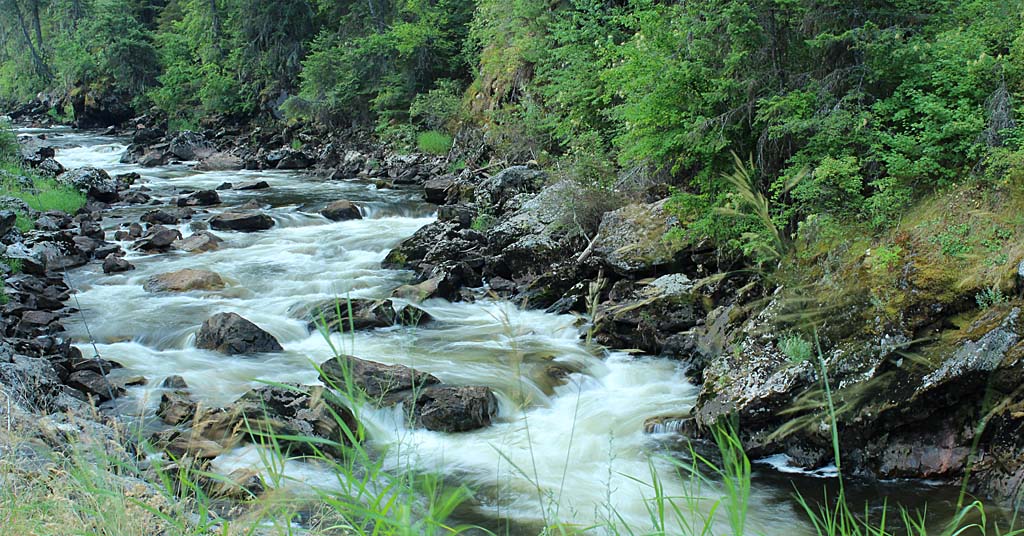
South Fork Clearwater River

Wild decisions: A tributary of the Snake River, the South Fork Clearwater River runs for 62 miles through north-central Idaho. A new federal plan might imperil its health. Photo: Lisa Ronald

By Kendra Chamberlain, April 28, 2025. The Clearwater River Basin, dubbed a Noah’s Ark for chinook salmon, steelhead and native trout by the conservation group American Rivers, has been added to group’s annual list if Most Endangered Rivers.

The move comes after a controversial U.S. Forest Service land management plan stripped protections for 700 miles of river corridors in north-central Idaho’s Nez Perce-Clearwater National Forest.

Nearly 10 years in the making, the forest plan took a surprise turn in 2024 when the Forest Service released a suitability analysis that removed interim protections from 17 rivers in the Clearwater River Basin.

The new plan, finalized in January, makes the Nez Perce-Clearwater National Forest the only forest in the Pacific Northwest in the last decade to see a decrease in river protections under a new management plan, as reported by Columbia Insight. The plan also includes a four-fold increase in logging in the national forest, and opens up previously protected areas for dredge mining and dam building.

The basin is home to the Lochsa, Selway and Middle Fork Clearwater rivers, each designated as Wild and Scenic and permanently protected. But the headwaters of the Lochsa, as well as the North and South Forks of the Clearwater River—all of which were deemed eligible for Wild and Scenic designation in the 1980s—lost its interim protections under the new forest management plan, before the permanent designation process could be completed.

River corridors identified as eligible for Wild and Scenic status are afforded interim protections until a designation is made official by either Congress or the Secretary of the Interior. That process can sometimes take decades. But taking river corridors off the eligibility list isn’t a standard practice in land management plan updates.

Conservationist groups like American Rivers are ringing alarm bells.

“Before this [Trump] administration, the Nez Perce-Clearwater National Forest was the exception, not the rule,” Lisa Ronald, American Rivers’ associate conservation director for western Montana, told Columbia Insight, referring to the loss of protections.

With the Trump administration’s directive to increase logging and other extractive industries across national forests, Ronald said there’s a real danger that this could set a new norm for forest plan updates.

Idaho Rivers United has also been raising awareness about the issue.

Nick Kunath, Idaho Rivers United conservation manager, said the Forest Service’s decision to remove protections while also increasing logging and other extractive activities will likely have huge implications for the entire Clearwater River Basin, and may imperil the health of the three rivers that are currently being protected.

“The reduction in protections to Wild and Scenic Rivers, it really [is] a new precedent, something that has national implications,” Kunath told Columbia Insight. “The combination of loss of protections and dramatically increasing the amount of areas that have previously been restricted, as well as just the volume that they intend to log, those things often lead to degraded water quality, [degraded] habitat conditions and a lot of the things that these protections that were lost were aimed to prevent from happening.”

The Clearwater River Basin is particularly important to fish seeking cold water.

“These are the rivers that are going to provide the coldest water 20, 30 years from now,” said Ronald.

By |2026-01-09T10:36:39-08:0004/28/2025|Rivers|0 Comments

Big changes are coming to the way Oregon manages mule deer hunts

The iconic species is in decline. New data is helping game managers address the problem

Mule deer Malheur USFWS

On the road again: A group of mule deer bucks moves across Oregon’s Malheur National Wildlife Refuge. The state is watching. Photo: Barbara Wheeler/USFWS

By Kendra Chamberlain. April 16, 2025. As mule deer populations continue to decline across the West, the Oregon Department of Fish and Wildlife (ODFW) says it will use better data to manage its annual mule deer hunts.

Specifically, the department wants to update the state’s mule deer hunting units to track population changes.

“Mule deer are struggling across the western United States,” ODFW’s spokesperson Michelle Dennehy told Columbia Insight. “So this is very urgent, because we want to see the species continue to thrive, but they’re in troubled times. And that’s not just the case in Oregon—it’s the case all over the West.”

Hunters and conservationists alike have bemoaned the decline of the big-eared ungulate. But researchers are having a hard time understanding why exactly mule deer populations are suffering.

In Oregon, a 2022 count pegged the population at 162,600 animals, just over half of the 300,000 estimated in the 1980s.

Mule deer populations have always been variable year to year. But since the early 2000s, the state has seen a steady decline in the species, mirroring a larger trend throughout the West.

Habitat degradation

ODFW, like other state wildlife departments in the region, has spent the past decade conducting research to better understand why mule deer populations are struggling.

The department began deploying GPS radio collars on mule deer in 2014 to get a better sense of how herds move across the state. That research has led to stronger population models to monitor the species, incorporating data on herd composition, movements and survival rates.

In Oregon, at least, habitat degradation and loss appear to be the driving factors in mule deer declines. The species is struggling to find enough nutrition to support larger populations.

“Some of it’s related to changes in forest management. And we have invasive species like Medusa head rye that come up after fire—that’s reduced nutrition,” said Dennehy. “We’ve also seen that the growing season is shorter than it used to be, and that’s reduced their nutrition.”

Last year, the department adopted a new mule deer management plan to address population declines. The plan noted that it’s not just that the amount of habitat has decreased, but that the carrying capacity of the landscape (how many mule deer the remaining habitat can support) has decreased, too.

Oregon’s mule deer are likely suffering from “chronic nutritional stress in response to long term declines in carrying capacity,” the plan states.

Development also plays a role. Roads and fences can impact mule deer access to food and interfere with migration routes, the knowledge of which mule deer pass on from mother to offspring, generation after generation.

Renewable energy development is another rising threat to mule deer in eastern Oregon, as reported by Columbia Insight.

Updating obsolete boundaries

Oregon uses wildlife management units (WMUs) developed in the 1950s to control mule deer and other big game hunting. These units were designed to spread hunter distribution, but they don’t actually reflect how mule deer move across the state throughout the year.

ODFW has proposed updating unit boundaries to better reflect herd movements, rather than rely on the artificial boundaries enshrined in current WMUs.

Among other things, the change would allow the department to track population responses to actions aimed at helping the species recover.

“If we do something [such as] habitat improvement, we want to be able to measure the response accurately. And if we’re misaligned on our data, that makes it harder to detect the response,” said Dennehy.

Oregon mule deer migration routes map

Mule deer migration routes map: ODFW

The new hunting units will need to be approved by the Oregon Fish and Wildlife Commission later this year, and if approved won’t go into effect until the 2026 hunting season.

If approved, the change would present a major shift in mule deer hunting units in Oregon, said Dennehy. The units will be larger than the current WMUs and likely have different names.

“Changing it for hunters is a big deal because they’re accustomed to this hunt structure. There are hunters out there who’ve been putting in for years for a particular hunt and that’s part of the reason we’re getting out a year in advance,” she said. “We know how important this is to hunters.”

Not to mention mule deer.

By |2026-01-09T10:42:47-08:0004/16/2025|Wildlife|15 Comments

Experts say Trump logging mandate would increase wildfire damage

The Forest Service says the best way to save forests is to cut them down. Will the courts agree?

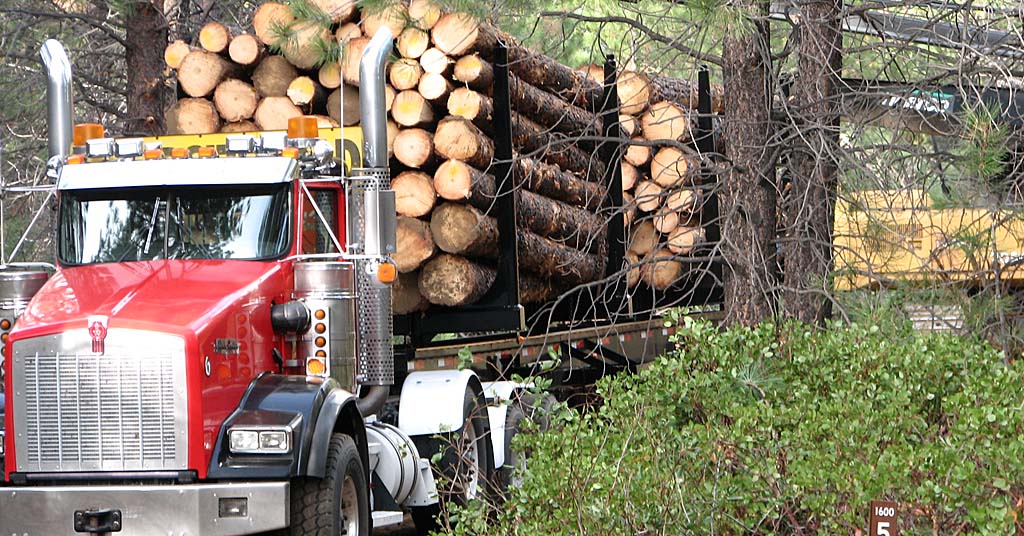
Logging truck in Deschutes National Forest

Wellness check: The best way to keep trees from burning is to cut them down … right? Photo: Oregon Department of Forestry

By Kendra Chamberlain. April 10, 2025. The Trump administration has issued a jaw-dropping proposal to open up nearly 60% of National Forest land for logging under the guise of wildfire mitigation—but it won’t help reduce wildfire risk in the Pacific Northwest.

In fact, it will likely make forests—particularly dry forests—more vulnerable to high-intensity wildfire.

President Donald Trump’s Secretary of Agriculture, Brooke Rollins, released a secretarial memo on April 3 that declares an “emergency situation” across 113 billion acres of national forests in the United States. The word “emergency” appears 28 times in the six-page memo.

It directs the U.S. Forest Service to limit environmental analysis and judicial review of logging projects in favor of ramping up timber production to address what it calls a wildfire and forest health “crisis” in national forests.

The memo follows an executive order Trump issued on March 1 that calls for an immediate expansion of timber production.

“National Forests are in crisis due to uncharacteristically severe wildfires, insect and disease outbreaks, invasive species, and other stressors whose impacts have been compounded by too little active management,” the memo states. “Immediate action is needed to mitigate risk, protect public health and safety and critical infrastructure, support local and rural economies, and mitigate threats to natural resources on NFS lands. We can do more to contribute to American prosperity and protect our national and economic security.”

Christopher French, acting associate chief of the Forest Service, followed up with his own letter, addressed to regional foresters and deputy chiefs, touting the “new era” of USFS-aided logging and calling for forest managers to develop five-year strategies to increase timber volume “leading to an agency wide increase of 25% over the next 4-5 years.”

Conservationists and forest ecologists agree that federal forestlands are in dire need of better management strategies to reduce the risk that high-intensity wildfires pose to communities in the Pacific Northwest.

But as Nick Cady, legal director of the conservation group Cascadia Wildlands, points out, logging is not a silver bullet solution to mitigating wildfire risk.

In fact, it’s part of the problem.

“The reason we have the problem that we’re dealing with is because these federal agencies maximized timber volume in the Pacific Northwest in the past,” Cady told Columbia Insight. “What Trump’s executive order calls for is maximizing timber volume—which is going to create more of the problem that we are now trying to correct.”

Not science, not legal

The connection between logging forests and fire risk is well established. Research dating the 1940 indicates that logged forests experience more severe wildfire.

Logging projects tend to harvest larger-diameter trees that are typically more fire-resistant than smaller-diameter trees.

Clear-cutting patches of forested land alters the microclimates of the landscape, allowing more sunlight to reach the ground, amplifying brush growth and drying out the soil, which creates even more dry fuel.

Clear-cut patches also generate more wind, which helps wildfire spread more quickly across logged landscapes.

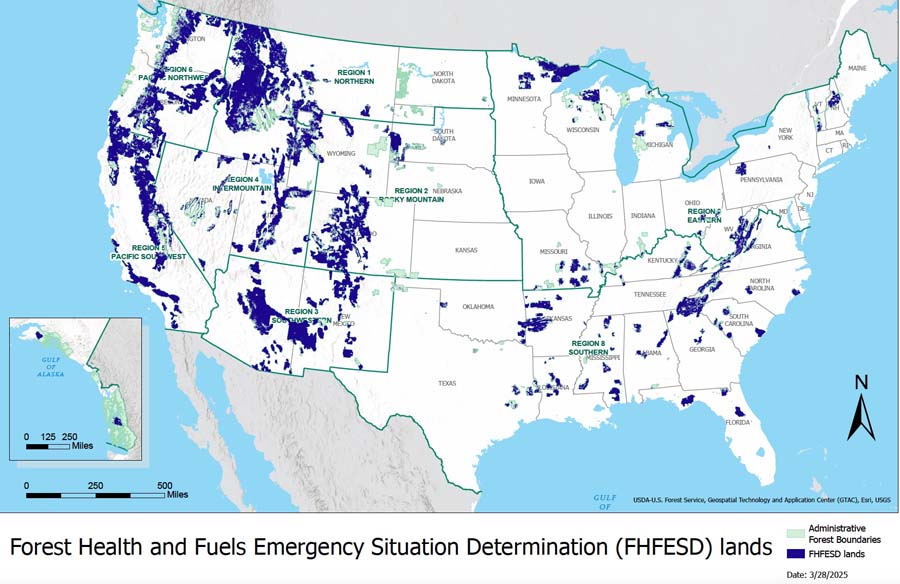
Map of Forest Health and Fuels Emergency Situation Determination (FHFESD) lands

Purple indicates areas targeted for more logging under the pretense of “forest health.” Map: USDA/USFS

“There’s a lot of modeling on how fire will interact with different areas, but when they’ve observed areas that have burned, and especially in the Pacific Northwest … the more intensely it was logged, the more intensely it burned,” said Cady.

As the adage goes, we can’t log our way out of wildfire.

Trump’s directive appears to be based on fundamental misconceptions of forest and fire ecology.

It also flies in the face of federal land management law. The administration’s attempts to limit environmental and judicial review of logging projects will likely be challenged in court.

“It’s unclear how this will play out on the ground, because NEPA is a statute; the Endangered Species Act is a statute, and our Federal Land Policy and Management Act is a statute, and the National Forest Management Act—these are all statutes,” said Cady. “You can’t just executive order your way past a statute. That’s not how the law works.”

By |2026-02-09T10:23:38-08:0004/10/2025|Government, Wildfire|3 Comments

New bill seeks to dismember protections for endangered species

A push to strip the Endangered Species Act pits survival against economic interests. More than 50 Pacific Northwest species are at risk

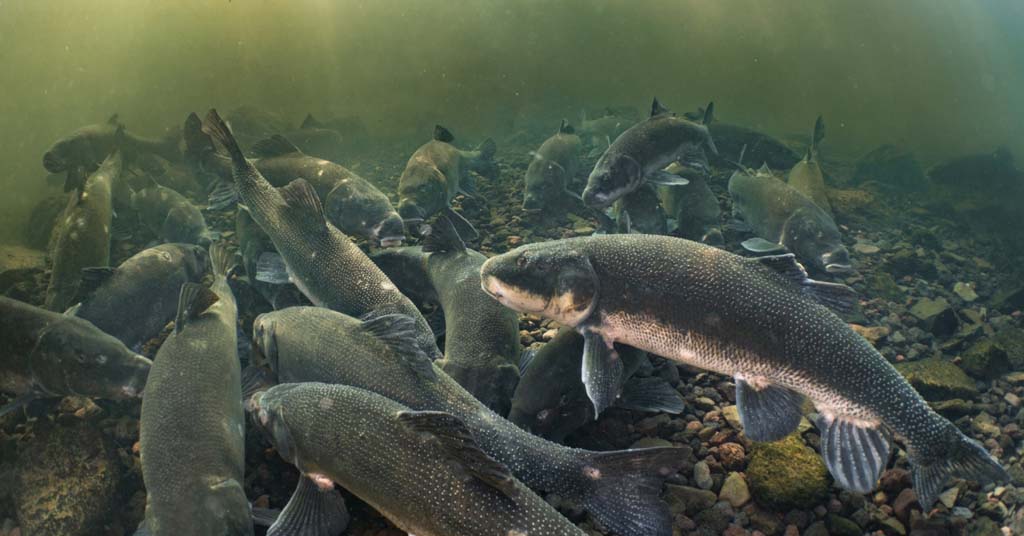
Shortnose suckers are an imperiled species found in the Klamath Basin

Wrong direction: Shortnose suckers are an imperiled species found in the Klamath Basin, and nowhere else in the world. Since 2001, the abundance of the species has decreased by nearly 85%. Habitat degradation is the primary cause. Photo: Jason Ching/UW

By Kendra Chamberlain. April 2, 2025. United States House Committee on Natural Resources Chairman Bruce Westerman (R-Ark.) has introduced legislation that would gut the Endangered Species Act.

Westerman’s bill, called the ESA Amendments Act of 2025, would require an economic impact analysis to be part of any endangered species listing decision.

That would spell trouble for the future listing of any imperiled species in the Pacific Northwest, whose recovery needs are often at odds with existing industry (such as hydropower generation) and coming development.

The bill would also alter how the federal government’s different departments consult with one another to ensure actions taken by one department aren’t negatively impacting recovery efforts. If approved, changes to that process would ease energy-project approvals on public lands that mioght harm important habitats for threatened or endangered species.

The bill would shift some conservation management from the federal government to states and landowners, while easing some permitting processes.

It would also slow down the process for listing a species, and speed up the process for delisting a species.

The bill is the latest in a wave of legislation introduced in Congress with the aim of altering how conservation and industry interests are balanced in endangered species listing decisions.

A similar bill, proposed by Rep. Dan Newhouse (R-Wa.) and co-sponsored by Cliff Bentz (R-Ore.) was introduced in 2024.

Pacific Northwest Dems will negotiate

Fifty-nine species are listed as threatened or endangered in the Pacific Northwest. Some, like gray wolves and the Columbia Basin pygmy rabbit, are on the road to recovery; for other listed species, like the shortnose sucker fish or South Selkirk caribou—the only caribou population to ever roam the contiguous United States—any type of recovery at this point feels out of reach.

Westerman claimed in a statement that the Environmental Species Act has “consistently failed to achieve its intended goals and has been warped by decades of radical environmental litigation into a weapon instead of a tool.”

The Environmental Species Act, which received strong bipartisan support at the time it was signed into law by President Richard Nixon in 1973, is considered one of the strongest conservation laws in the world.

But success is an elusive metric for the law.

A 2019 study found the law has had a 99% success rate in preventing the extinction of animals and plants that are listed.

But preventing extinction isn’t the same thing as fully recovering. Critics of the ESA often point out that only a small percentage of listed animals, somewhere between 1-3%, have recovered enough to be delisted.

Critics of Westerman’s new bill say the changes it proposes would have disastrous ramifications for imperiled species.

“The Endangered Species Act is the backstop for our nation’s wildlife already at the brink of extinction and this bill would sanction their swift descent into nothingness,” said Ellen Richmond, senior attorney for national conservation group Defenders of Wildlife, in a statement.

Still, some Pacific Northwest Democrats have signaled they’d be interested in negotiating support for the bill.

Sen. Ron Wyden (D-Ore.) told E&E News that he’d be open to talks with Westerman if it could result in advances in clean-energy permitting.

“I’ve always felt that expediting permitting is key and that it can be done without throwing the environmental laws in the garbage can,” said Wyden.

The bill will have to make it out of the House Natural Resources Committee before being voted on by the House of Representatives.

By |2026-01-09T12:17:04-08:0004/02/2025|Conservation, News|2 Comments

Illegal wolf killings continue in Oregon, the latest near Sisters

Reward money for finding poachers is increasing, as well. For the recent killing the bounty is over $30,000

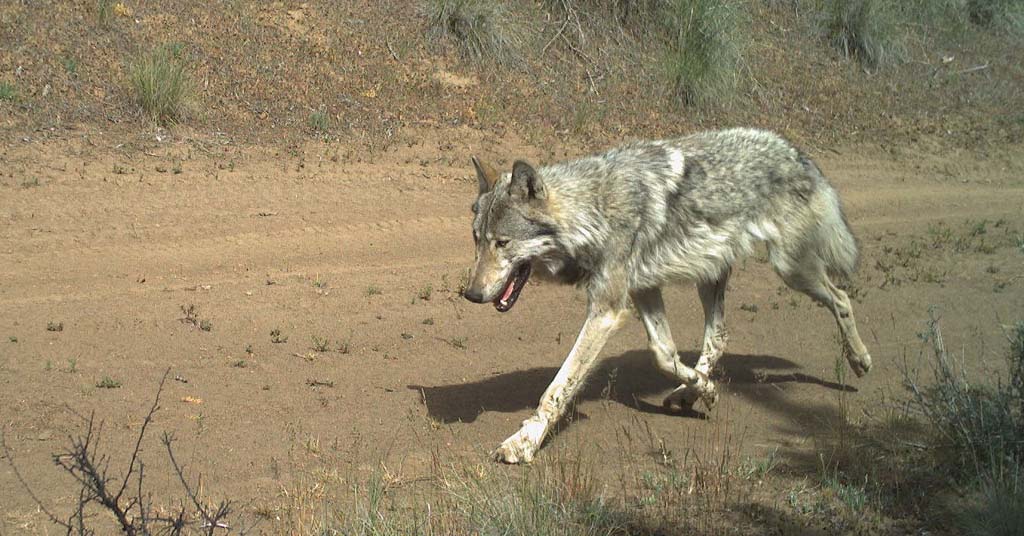
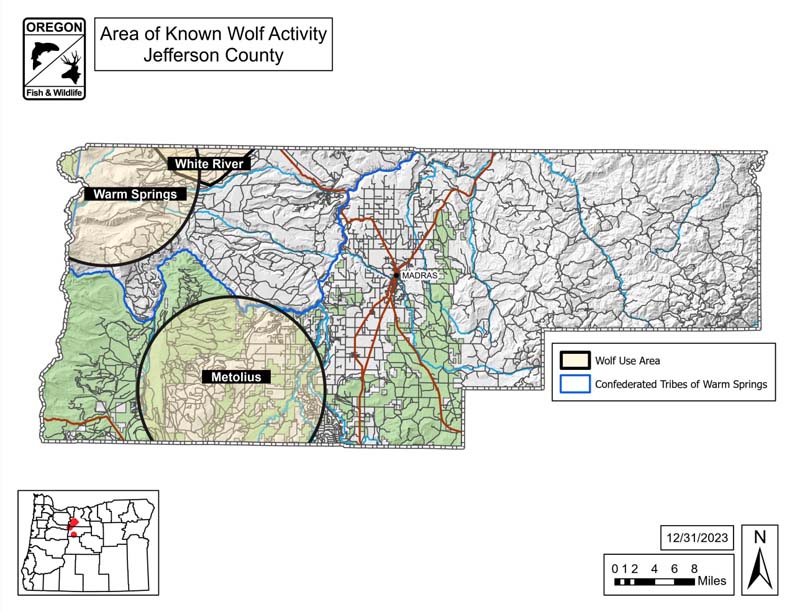
A Metolius wolf trots past a trail camera in Jefferson County. The Metolius wolves spend most of their time in Jefferson County, adjacent to Deschutes County, where the latest killing took place. Photo: ODFW

By Kendra Chamberlain. March 27, 2025. Federal and state wildlife agencies and conservation groups are all pitching in to find out who killed a gray wolf in early March.

The death, reported near Sisters, Ore., is the latest in a string of illegal wolf killings in Oregon over the past four years.

The dead, adult male wolf was reported to officials on March 10. The Oregon Department of Fish and Wildlife (ODFW), Oregon State Police Fish and Wildlife Division and U.S. Fish and Wildlife Service (USFWS) each responded to the report.

But officials aren’t sharing much information about the incident.

The gray wolf was found near Sisters, where the species is federally listed as endangered under the Endangered Species Act.

Sisters is located roughly 20 miles inside the state’s west wolf management area. The wolves in this area are managed for conservation under Phase 1 of the state’s wolf management plan.

Under the plan, the west wolf management zone needs to reach four breeding pairs for three consecutive years before transitioning to Phase 2.

In 2022, for the first time, the west wolf management zone contained four breeding pairs. That number dipped to three breeding pairs in 2023. ODFW will release the latest wolf count in April.

The exact location of the wolf, how it had died or even how long it had been dead, is being kept under wraps.

“All the details about the investigation that can be provided are in the news release,” USFWS spokesperson Megan Nagel told Columbia Insight in an email.

Big reward

What is known is that the wolf was the male half of a breeding pair known as the Metolius wolves.

The pair took up residence in the area in 2022, and had just had its first litter of pups, giving the family pack status.

Now, the female will have to fend for herself and her offspring. Wolves are extremely cooperative when raising pups, so the loss of the adult breeding male could be devastating for the survival of the rest of the pack.

Map wolf activity in Jefferson County, Oregon

Map: ODFW

The poached male was known to state wolf biologists. During his brief tenure in the area, he’d been captured on trail cameras ODFW uses to monitor wolf populations in the state.

“It’s just so devastating that they were so close to being a real family. And then this happened,” Susan Prince co-founder of the Wolf Welcome Committee, told Columbia Insight.

Prince and others launched the Wolf Welcome Committee in central Oregon in the fall of 2021, just before the Metolius pair arrived.

Prince said public education is one of the best methods to combat poaching.

“Even before there were wolves here, we were doing a lot of public education about the value of wolves and predators in the ecosystem,” she said. “We realize there’s a lot of embedded fear in this country about predators specifically.”

In July 2024, after the birth of the pair’s litter of four pups, The Nugget Newspaper, based in Sisters, published a story beneath the headline, “Metolius wolf pack triples in size.” The article noted that the actual number of wolves statewide has not increased year-over-year, and that the number of documented packs in the state is actually decreasing.

The USFWS is offering a $10,000 reward for information that leads to an arrest and conviction in the wolf’s death.

The Oregon Wildlife Coalition has a standing reward offer of $10,000 for wolf poaching; and the Center for Biological Diversity is putting up another $10,000. The Wolf Welcome Committee, is chipping in $500.

That puts the total reward at $30,500.

By |2026-01-09T13:45:33-08:0003/27/2025|Wildlife|1 Comment

BPA ready to join new Southwest energy market

Critics denounce a BPA draft decision to leave the Western energy market, possibly threatening renewables growth at home

Transmission lines in field

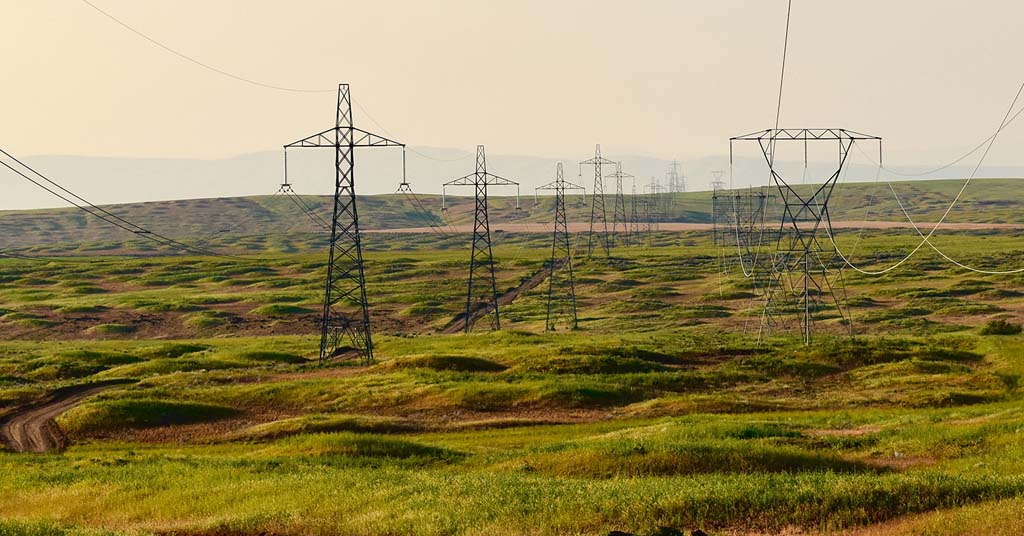
Market shift: The Bonneville Power Administration is turning its back on California and sending itd power elsewhere. Image: BPA

By Kendra Chamberlain. March 13, 2025. The Bonneville Power Administration (BPA) announced last week that it intends to join a new electricity trading market rather than participate in a similar market being developed by California’s electricity market CAISO.

The news has resulted in cheers from public utilities and outcry from consumer advocates.

It also raises concerns about the continued growth of renewable energy sources in the Columbia River Basin.

Utilities across the West are considering how to move toward day-ahead markets, which operate in conjunction with real-time markets and allow utilities to lock in electricity prices in advance.

CAISO began developing its Extended Day Ahead Market (EDAM) in 2019. In 2022, the Arkansas-based Southwest Power Pool (SPP) began work on its own day-ahead market, called Markets+. SPP operates grids in all or parts of Arkansas, Iowa, Kansas, Louisiana, Minnesota, Missouri, Montana, Nebraska, New Mexico, North Dakota, Oklahoma, South Dakota, Texas and Wyoming.

UPDATE: On March 18, 2025, the BPA adds: “While based in Arkansas, SPP is standing up a newly designed market specifically for the western part of the U.S. This western market is not intended to transact with SPP’s already existing and operating eastern markets.”

The BPA says it has evaluated opportunities to join a day-ahead market, and then looked at which market would be the most advantageous to join.

In its draft decision, BPA—which participated in the development of both day-ahead markets—emphasized that the SPP’s Markets+ would offer an independent governance mode that BPA staff believes will help it realize more long-term benefits than CAISO’s EDAM.

“Bonneville concluded that joining a day-ahead market is in the best interest of the agency and its customers from an economic perspective,” wrote in its Day-Ahead Market Draft Policy paper.

Many of the utilities served by BPA are on board with the decision.

“BPA’s decision to move forward with Markets+ underscores the strength of the SPP Markets+ option which was designed by diverse stakeholders across the West,” Scott Simms, CEO and executive director of the Public Power Council (PPC), said in a statement. The Public Power Council is an industry group representing consumer-owned utilities in the Pacific Northwest that purchase power from BPA.

The BPA will still be legally obligated to supply power to the 140 consumer-owned utilities in the region first, and will continue to sell its excess power to other utilities in the Pacific Northwest.

Environmental implications

Some of the larger power companies in the region, like PacifiCorp and PGE, have said they’ll stick with CAISO’s EDAM for now. Other companies may follow BPA’s lead and move to Markets+.

The Northwest Energy Coalition (NWEC), a group of 100 environmental and civic organizations, utilities and businesses across the Pacific Northwest, says that many studies—including one commissioned by BPA itself—show the decision will lead to increased costs, less reliability and more difficulty in adding renewable energy sources to the grid.

NWEC senior policy associate Fred Heutte told Columbia Insight that the decision to join SPP’s day-ahead market is confusing.

The move would result in two markets operating atop the same grid in the Pacific Northwest, and would reduce diversity of power sources in each market.

There’s also limited transmission between the Northwest and SPP’s other participating grids.

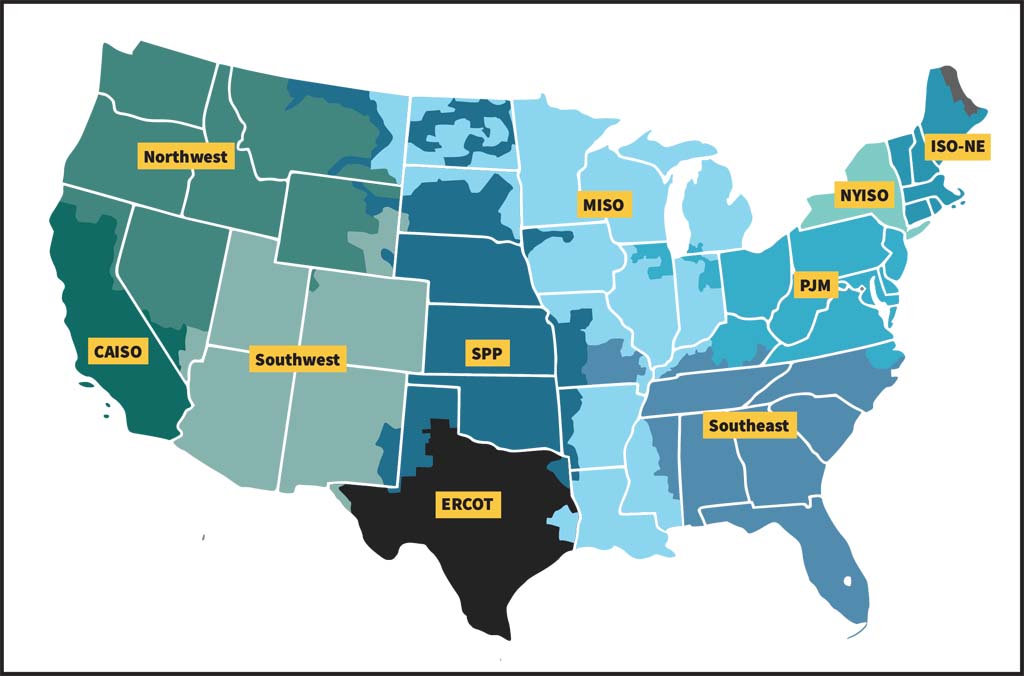
U.S. electric power markets map

U.S. electric power markets: Traditional wholesale electricity markets exist primarily in the Southeast, Southwest and Northwest. Federal systems include the Tennessee Valley Authority, Western Area Power Administration and the Portland-based Bonneville Power Administration. Map: FERC

The emergence of two markets in the region could have big implications for renewable energy integration in the Pacific Northwest.

It could complicate coordinating renewable energy development and new transmission projects within the region, said Heutte, and will create “seams” between the two markets that will generate new costs related to managing power flows and coordinating transmission at the boundaries of two organized markets.

It could also impact efforts to remove the Lower Snake River dams in support of salmon recovery in the river.

A major settlement agreement 22 years in the making and released in 2024, calls for up to $1 billion in investments along the Lower Snake River over the next decade for salmon recovery and renewable energy build-outs to facilitate the removal of four dams along the river. The agreement is between the Confederated Tribes and Bands of the Yakama Nation, Confederated Tribes of the Umatilla Indian Reservation, Confederated Tribes of the Warm Springs Reservation of Oregon and the Nez Perce Tribe, along with the states of Oregon and Washington and several nonprofits.

The proposal to remove the four dams hinges on replacing the power those dams generate with renewables.

“A single market would make it easier to develop and transmit replacement renewable energy—much of which can be developed in the area around those dams and use existing transmission,” said Heutte.

The four dams on the Lower Snake River are “run of the river” dams, meaning they don’t offer much storage of water and so can generate power based only on what’s coming down the river.

The dams produce the most power during the spring run-off season—at a time when hydropower in the region is at a surplus—and produce much less power during other parts of the year.

“A balanced, clean-energy replacement portfolio for the Lower Snake River dams will have a better fit to seasonal power demand in the Northwest, especially in mid-winter and late summer when flows in the Snake River are low,” said Heutte.

Who will pay more?

Not everyone is convinced the move will benefit consumers.

“Every power customer in the Northwest is at risk for higher costs on their monthly bills,” NWEC said in a statement.

“Bonneville’s own commissioned study by E3 shows that the likely outcome of being in Markets+ would be plus or minus around $100 million a year of net losses compared to where they are now in the Western Energy and Imbalance Market,” said Heutte. “Just on the cost side, this doesn’t make much sense at all. Why would an agency do this, even though their own study says it’ll [lose money]?”

BPA has admitted its analyses show joining EDAM would offer financial benefits to BPA and its customers.

But BPA’s Rachel Dibble told reporters during a press briefing that it sees SPP’s governance model of the day-ahead market as a key benefit.

“We have really significant beliefs about the importance of governance, the importance of an open stakeholder process, and while those cannot be quantified, those are qualitative elements that we hold as very high priorities, and we do believe in the long run, they will result in positive quantitative benefits,” Dibble said, according to Utility Dive.

BPA has long been critical of CAISO’s decision-making. The system is governed by a board appointed by the Governor of California, and is beholden to California’s state laws, and its ratepayers, a fact that BPA staff believes have left BPA in a less than ideal position as a participant.

BPA said in its draft decision that it still felt it was playing second fiddle to California interests during the development of EDAM.

NWEC’s Heutte isn’t buying that argument.

There’s already an initiative underway to address CAISO’s governance, he said. The Pathway Initiative, which aims to increase transparency and include more stakeholders in governance decisions “sets up a new governance structure that’s better than what anybody has right now,” Heutte said.

“Let’s get real here. What is motivating this? This is the big question. Why?” Heutte said. “We don’t really know.”

By |2026-01-09T13:51:09-08:0003/13/2025|Energy, News|0 Comments

© Copyright 2013-2025 Columbia Insight. All Rights Reserved.

As a 501(c)3 nonprofit organization, all donations to Columbia Insight are tax deductible to the full extent of the law. Our nonprofit federal tax-exempt number is 82-4504894.