Stay Updated Subscribe today for the latest research + reporting about environmental news. Subscribe Now

Stay Updated Subscribe today for the latest research + reporting about environmental news.

Subscribe Now

Kendra Chamberlin

Kendra Chamberlin

Kendra Chamberlain

About Kendra Chamberlain

Columbia Insight contributing editor Kendra Chamberlain is a freelance journalist based in Eugene, Oregon, covering environment, energy and climate change. Her work has appeared in DeSmog Blog, High Country News, InvestigateWest and Ensia.

Can eastern Oregon become a hotbed of geothermal energy?

BLM is auctioning land in Malheur County for geothermal development. Sagebrush, steppe and grassland ecosystems are involved

Neal Hot Springs geothermal power plant

Malheur power: Oregon’s first commercial geothermal power plant, at Neal Hot Springs in Malheur County, came online in 2012. Photo: Wikipedia/U.S. Geothermal

By Kendra Chamberlain. July 9, 2025. The Bureau of Land Management is holding a geothermal lease sale across more than 5,000 acres of public land in southeastern Oregon.

BLM is putting up two parcels of land for auction on July 10. The two parcels are located just outside of Vale, Ore., near the Idaho border.

Bidding starts at $2 per acre. Half of the proceeds from the lease sale and any future royalties earned on the parcels will go to the state of Oregon and 25% will go to Malheur County. The rest will go to the federal government.

Geothermal energy production taps into underground reservoirs of water heated by the earth and uses that heat to either warm things like houses or greenhouses directly, or to generate electricity. The energy source is considered one of the more reliable forms of renewable energy, as it can generate a steady amount of power throughout the day and night.

But geothermal resources remain largely undeveloped in the state because it’s difficult—and expensive—to locate viable hydrothermal reservoirs underground.

Eastern Oregon is thought to have vast geothermal resources that have gone untapped. Some estimates put the state’s geothermal energy generating potential at 2,200 megawatts.

The Neal Hot Springs power plant, one of the state’s only two existing geothermal facilities, is located adjacent to the parcels going up for auction. That facility generates 22 megawatts of electricity, enough power to supply the energy needs of about 15,000 homes, that is provided to Idaho Power.

Wildlife abundant in area

The lease-sale area also provides important habitat for wildlife. The parcels contain sagebrush, steppe and grassland ecosystems, providing habitat for animals like mule deer, pronghorn and bald eagles, according to the environmental assessment BLM conducted for the sale.

Large portions of both parcels have been classified by the state as Priority Wildlife Connectivity Area Regions.

The area is also home to many species that BLM considers “sensitive,” including four bat species, five bird species and two bumblebee species.
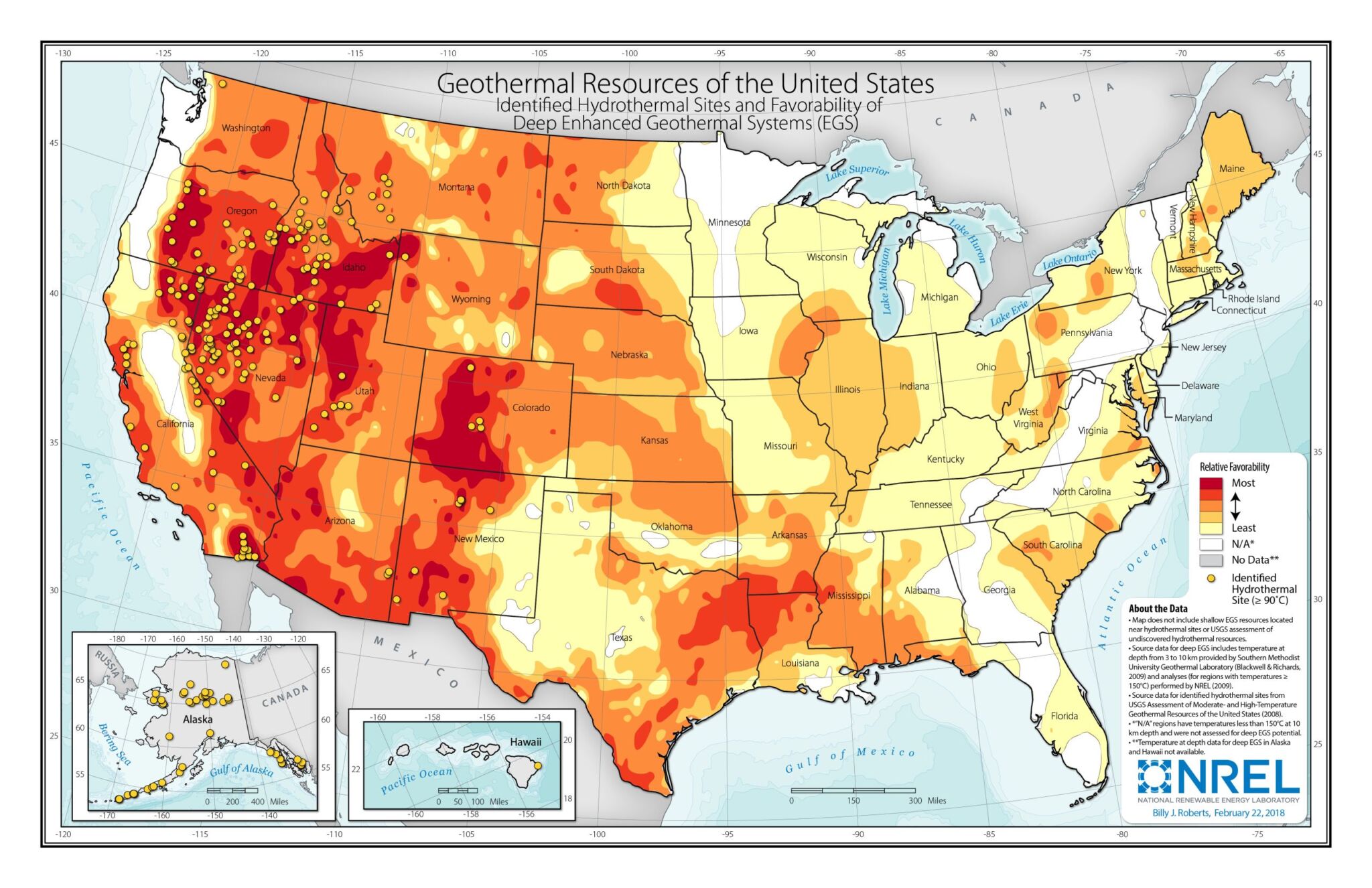
Geothermal Resources of the United States map as of 2018

Western power: This 2016 map represents American geothermal energy potential. Map: BLM/National Renewable Energy Laboratory

Large-scale development on the parcels, including road building, surveying and construction of geothermal energy facilities, will certainly disturb the habitat and impact wildlife in the area.

The parcels offer winter habitat for mule deer and year-round habitat for pronghorn, two species that are particularly vulnerable to habitat fragmentation.

BLM said any future development on the land will need to be restricted during winter to minimize disturbing these species.

The July 10 lease sale is administrative, and won’t include approvals for any land-disturbing activities.

BLM said plans for exploring geothermal opportunities on the parcels or eventually building out energy-generating facilities will need site-specific environmental analyses to help minimize or mitigate impacts to wildlife and habitat.


By |2026-01-08T13:19:04-08:0007/09/2025|Energy|Comments Off on Can eastern Oregon become a hotbed of geothermal energy?

‘Lab-grown’ coho salmon debuts in Portland restaurant

The company behind “seafood without the sea” says its cultivated salmon is good for the environment and consumers

Wildtype cultivated salmon

Wild idea: This coho salmon fillet wasn’t raised in a hatchery or caught in the wild. The San Francisco company Wildtype produced it. Photo: Wildtype

By Kendra Chamberlain. July 1, 2025. At the Portland, Ore., Haitian restaurant Kann, diners are able to sample a world’s first: commercial salmon grown in a lab.

The fish is produced by San Francisco food-technology startup Wildtype. In June, the company received approval from the United States Food and Drug Administration to sell the product.

Although “lab-grown” may be a bit of a misnomer.

“It’s not as weird as it might sound,” Justin Kolbeck, co-founder and CEO of Wildtype, told Columbia Insight.

There are two steps to the process of producing the cultivated fish fillets.

First, salmon cells are grown in large, stainless steel tanks, similar to the kind used in breweries. In fact, the company’s only facility is located in a former brewery in San Francisco.

Then, the fish cells are combined with other plant-based ingredients to create the final product, a saku cut (a block cut of skinless, boneless seafood) of salmon that can be eaten raw as sushi or sashimi.

“[The last step] we do is in a very standard commercial kitchen. It looks like any commercial kitchen you’d see, stainless steel, tables, mixers, ovens, things like that,” said Kolbeck.

So no lab is actually involved.

Wildtype is producing just one species: coho salmon, populations of which are listed as threatened in the Columbia River Basin under the Endangered Species Act.

All of Wildtype’s fillets are cultivated from a single sample of cells collected from a juvenile coho. According to the company’s website, the cells were extracted “several years ago. We provide these cells with nutrients similar to those they would get inside a fish—amino acids, sugars, fats, and minerals—and coax them to continue growing and replicating.”

“We wanted to work on the species that are native to this part of the world,” said Kolbeck.

Expansion, conservation

The company’s website provides few details about its founders, saying only that the two old friends “were deeply influenced by their years of service in medicine and international relations” and “inspired by breakthroughs in stem cell research, and witnessing firsthand the impact of global food insecurity in places such as Pakistan and Afghanistan.”

The company plans to expand its production to other species of salmon, and hopes to eventually make cultivated fish available to the public at price points lower than the high-end sushi market delivers.

Wildtype founders Justin Kolbek (L) and Arye Elfenbein

Wildtype co-founders Justin Kolbek (L) and Arye Elfenbein. Photo: Wildtype

Wildtype says it has partnered with The Conservation Fund in a handful of projects aimed at protecting salmon habitat, including a recent project along the White Salmon River in south-central Washington.

The company argues its cultivated salmon is good both for the environment and for consumers. For one thing, Kolbeck says, its manufactured salmon is free from any of the heavy metals, toxins and microplastics that plague waterways and oceans.

And nothing is actually being fished out of the water.

“I think we all agree that it would be amazing if there was another source of salmon that didn’t require us to farm it or to wild catch it, right?” said Kolbeck. “The salmon returns have been shrinking over the years, and so anything we can do to help alleviate some of that pressure is a good thing.”

By |2026-01-08T13:21:56-08:0007/02/2025|Salmon|Comments Off on ‘Lab-grown’ coho salmon debuts in Portland restaurant

Oregon nonprofit heads to DC to fight firefighter consolidation plan

A proposed Federal Wildland Fire Service is receiving critical reviews from many in the firefighting community

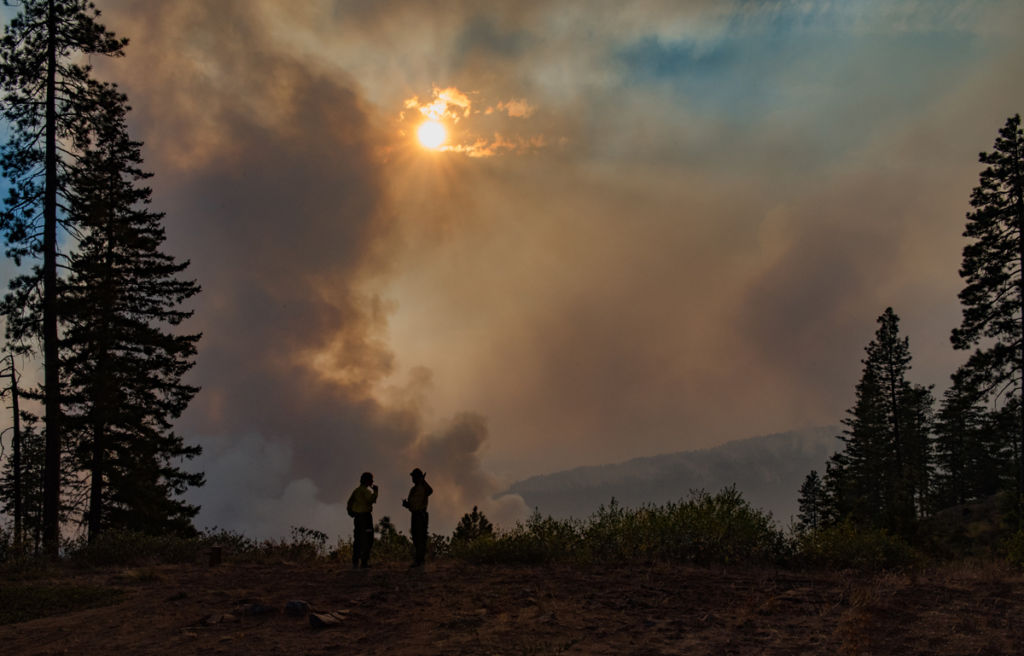
Specter vision: The future of firefighting management is unclear. Photo: Jurgen Hess

By Kendra Chamberlain. June 4, 2025. A quiet proposal to drastically restructure the nation’s wildland firefighting capabilities is gaining steam, and that has wildland firefighting experts in the Pacific Northwest concerned.

A scrappy wildland firefighter nonprofit based in Eugene, Ore., is raising alarm over a Trump administration directive to consolidate federal wildland firefighting into a single super-agency.

Timothy Ingalsbee, executive director of the Firefighters United for Safety, Ethics and Ecology (FUSEE), says the proposal has gone largely unnoticed outside of the firefighting community.

Ingalsbee traveled to Washington, D.C., this week to raise awareness about the issue his organization believes could be catastrophic to wildfire response across the country.

The proposal was first mentioned in the Fix Our Forests Act, and later included in the President’s budget bill.

“It’s been riding below treetop level, and is just now starting to pop up. Many [congressional] offices [I spoke with] were not even aware of this, because it’s been almost on stealth mode,” Ingalsbee told Columbia Insight. “In Trump’s executive order, it was the very last item; and in the skinny budget, the very last item. So that was my mission here, to make these offices aware that this is happening.”

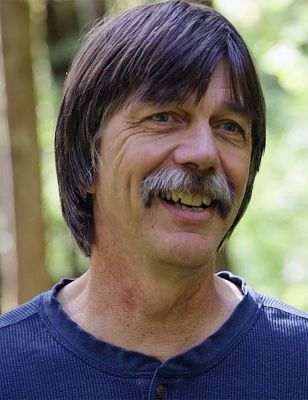
Tim Ingalsbee heof the Firefighters United for Safety, Ethics and Ecology, headshot

Timothy Ingalsbee. Photo: Timothy Ingalsbee

The proposal would strip wildland firefighting management from the five federal land management agencies (United States Forest Service, Bureau of Land Management, National Park Service, United States Fish and Wildlife Service and Bureau of Indian Affairs) and form a single consolidated Federal Wildland Fire Service, under the Department of Interior, to focus exclusively on fighting fires.

News of the administration’s plans shocked many in the firefighting community, which is already reeling from DOGE-led firings, forced retirements, resignations and budget cuts.

Ingalsbee, a senior wildland fire ecologist and former federal wildland firefighter, said the idea of creating a single firefighting agency, independent of other land management strategies like stewardship and conservation, is a big step in the wrong direction—into the 1950s, he joked.

Fire management needs to be further integrated with land management, not severed from it, he said.

“Without a land base, without a conservation mission, the fear is this is just going to be all suppression, all the time,” said Ingalsbee. “And that’s a big part of the problem we’re having with wildfires. We’re burning through the fuels that could have been nicely managed by previous fires if we had managed them instead of suppressing them.”

FUSEE published a policy paper in May rebutting most of the arguments being used to push for a consolidated firefighting agency. The paper points to ecological, operational and logistical issues of a single federal firefighting force, as well as cost concerns.

It warns that steering fire management back toward suppression and away from land stewardship flies in the face of current, western place-based science and Indigenous knowledge.

The Pacific Northwest saw one of its most costly wildfire seasons on record in 2024, and is facing what’s expected to be an above-normal year for wildfire potential in 2025.

“This one thing has got the wildland firefighting community very alarmed. This could be a catastrophe,” said Ingalsbee. “There’s a lot of demoralization happening in the wildland fire community.”

By |2026-01-08T14:46:51-08:0006/04/2025|Wildfire|Comments Off on Oregon nonprofit heads to DC to fight firefighter consolidation plan

Proposed pipeline would cut through roadless area in Caribou-Targhee National Forest

A Wyoming energy company says it needs to move natural gas through habitat used by grizzlies, lynx and sage grouse

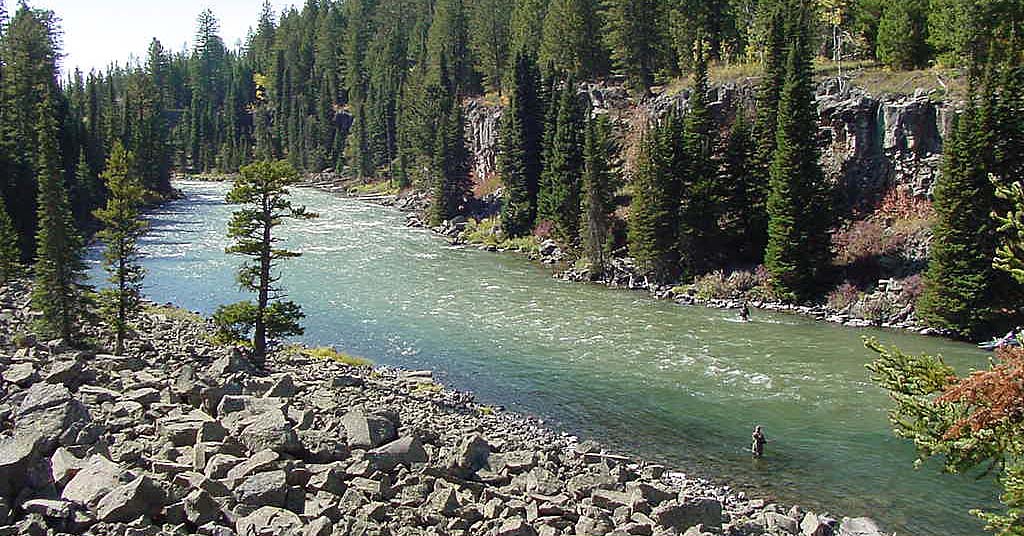
Fishing on the Caribou-Targhee National Forest.

A pipeline runs through it? The Forest Service calls the Caribou-Targhee National Forest “a world of wild beauty.” It takes in parts of southeastern Idaho, western Wyoming and northern Utah. File photo: USFS

By Kendra Chamberlain. May 29, 2025. At the far eastern reach of the Columbia River Basin, a Wyoming-based energy company has received approval from the U.S. Forest Service to pipe natural gas through 18 miles of national forest from Montpelier, Idaho, to the town of Afton, Wyo., and nearby Star Valley.

The construction would clearcut a 50-foot-wide right-of-way through Caribou-Targhee National Forest land, leaving behind a permanent, 20-foot utility corridor along the proposed route for maintenance of what would be an eight-inch-diameter, low-pressure pipeline.

The Crow Creek Pipeline’s path traverses six areas of the national forest designated as inventoried roadless areas (IRAs).

The Forest Service said in 2018 the project would impact six IRAs, but argued that it wouldn’t require building roads within those areas, though it would build “utility corridors” where none exist.

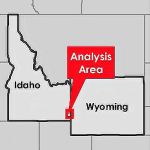
Crow Creek Pipeline proposed area

Area of proposed Crow Creek Pipeline. Map: Stantec Consulting Services

“Normally what happens when that occurs is other people drive on it,” Mike Garrity, executive director of the conservation nonprofit Alliance for the Wild Rockies, told Columbia Insight. “People like to drive on roads on national forest [land] and wildlife avoid roads because they associate roads with people. That’s one of the reasons roadless areas are so important.”

The route will travel through habitat of imperiled species such as greater sage grouse, grizzly bears, lynx and wolverine.

Greater sage grouse seems particularly vulnerable to the project, said Garrity. He said the proposal does not adhere to the national forest’s own greater sage grouse management plan, with construction coming too close to sage grouse leks.

The Alliance for the Wild Rockies, along with fellow conservation group Yellowstone to Uintas Connection, has filed a lawsuit against the Forest Service for approving the project.

The company behind the proposal, Lower Valley Energy (LVE), currently transports roughly 163 truckloads of natural gas per year the 140 miles from Opal to Afton in Wyoming. The company’s CEO, Jim Webb, said trucking the gas to customers is becoming too difficult as demand for gas has increased, and inclement weather becomes more common.

LVE wants to tie into an existing pipeline in Montpelier, Idaho, and build out the pipe across state lines to Afton. The pipeline would run 50 miles in total, with 18 of those miles traversing national forest land.

“We have just grown to the point that it is no longer feasible and we need reliability. If a road closes it has an effect,” Webb told the Star Valley Independent in 2023. “Once we get the pipeline in, we can get into other parts of the valley and grow.”

The Forest Service approved the project in 2019, but later pulled its decision after meeting with litigation. The agency reissued its approval in late 2024 after completing a supplemental Environmental Impact Statement.

By |2026-01-09T09:15:04-08:0005/29/2025|Energy, Public Lands|Comments Off on Proposed pipeline would cut through roadless area in Caribou-Targhee National Forest

Repubs, Dems agree: Wetlands need urgent action

A bill sponsored by Idaho’s Mike Crapo and Oregon’s Ron Wyden would allocate $50 million for wetlands across the Columbia River Basin

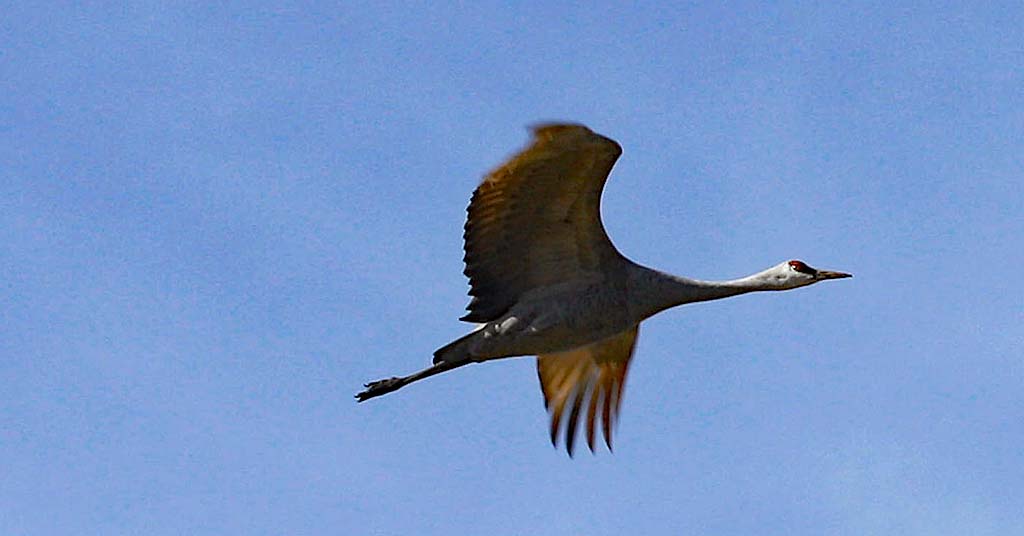
Sandhill crane in flight

Looking for a pit stop: After wintering in California, thousands of lesser sandhill cranes migrate through Oregon and Washington along the Pacific Flyway on their way to breeding grounds in Alaska. Photo: Kathy Munsel/ODFW

By Kendra Chamberlain. May 14, 2025. Each year, hundreds of bird species take flight through the Pacific Flyway. Stretching from northern Alaska to Patagonia, it’s one of the main migration routes for waterfowl and other bird species in the western Americas.

Now U.S. Senators Ron Wyden, D-Ore., and Mike Crapo, R-Idaho, have introduced bipartisan legislation aimed at supporting wetlands habitat restoration across the entire Columbia River Basin and along the Oregon and Washington coasts.

The bill calls for $10 million for each fiscal year from 2026 through 2030 to carry out the pilot program.

The aim is to ease the journey for birds moving through the Pacific Northwest by creating and sustaining pockets of wetlands habitat across an area that, over the last century or so, has been drained and put to use through agriculture or commercial development.

“Most waterfowl and migratory birds in our region fly from Alaska to Mexico, sometimes further,” Matt Little, western region director of public policy at Ducks Unlimited, told Columbia Insight. “They’re dependent on water being put on farmers’ fields and ranchlands, even temporarily, during the migration.”

Little has been working on the bill on behalf of Ducks Unlimited for the last three years.

“There’s a lot of concern that there’s not enough funding to do good, on-the-ground, restoration work,” said Little. “And there are needs of water infrastructure and fish-friendly water infrastructure, especially along the coast. That’s where the idea [for the bill] came from.”

Map of waterfowl migration routes in the Pacific Flyway.

Waterfowl migration routes in the Pacific Flyway. Map: USGS

The Northwest Wetlands Voluntary Incentives Program Act offers grants and technical assistance to government agencies, Tribal entities, farmers, ranchers and nonprofits for wetlands restoration and enhancement projects. The bill would also provide assistance to farmers and ranchers for water infrastructure projects that support migratory birds as they make their seasonal journeys.

Bipartisan conservation bills are a growing rarity in Congress, but Little said he believes this bill is popular enough to get momentum in Congress.

“All bills take a while, and in this environment where everything’s being cut, I think it will take longer,” said Little. “But this is a huge, big step, and to make it a bipartisan bill, with these two senators, is a huge step forward.”

The bill has backing from groups like the Idaho Wildlife Federation, Pacific Birds Habitat Joint Venture, Coalition of Oregon Land Trusts and Oregon Agricultural Trust.

“Preserving critical wetland habitat is vital to protecting open landscapes for the diverse species—including numerous varieties of birds and fish—that call Idaho home,” Crapo said in a statement. “Investments in public-private partnerships in Idaho and the Pacific Northwest will help keep wild spaces wild.”

“Restoring our wetlands is about more than just providing habitat for birds and other wildlife living along the Pacific Northwest coast,” Wyden said in a statement. “It is about investing in the watersheds where Tribes, farmers, and other local Pacific Northwest communities have maintained their way of life for generations.”

By |2026-01-09T09:19:03-08:0005/14/2025|Birds|0 Comments

Federal government appears ready to roll back salmon protections, shelve deal with Tribes

President Biden promised to restore salmon runs in the Pacific Northwest. President Trump isn’t having it

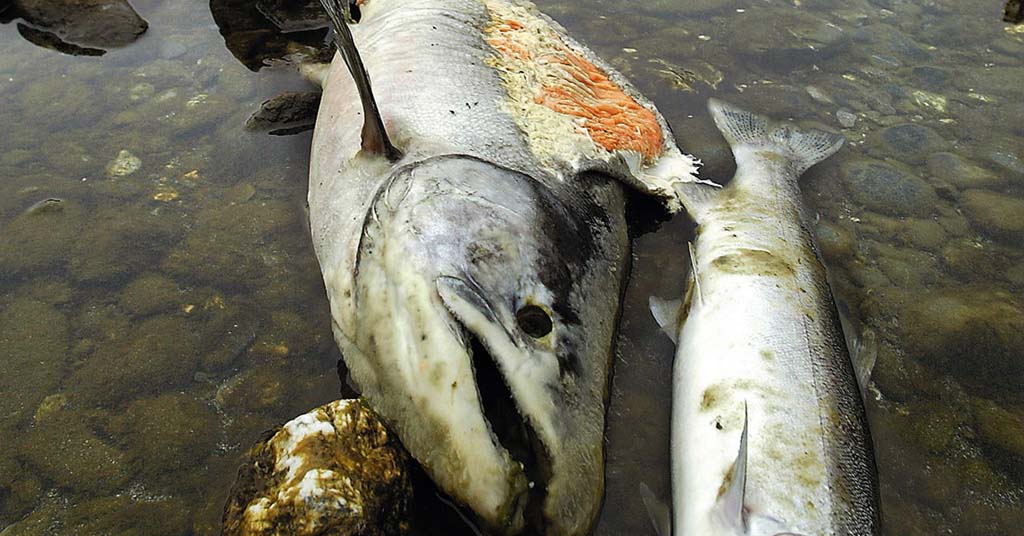
Dead salmon in Klamath River

Dead in the water? The federal government is waffling on a deal it made with Pacific Northwest Tribes. File photo: AP Photo/The Herald and News, Ron Winn

By Kendra Chamberlain. May 7, 2025. Two federal agencies have decided to push back a public comment period on an issue related to the breaching four Lower Snake River dams.

The move has sparked concerns that the Trump administration may be working to undo—or at least bury—the historic settlement agreement between a group of Pacific Northwest Tribes and the federal government to restore salmon populations that have been harmed by dam operations in the Columbia River Basin.

The settlement, and a suite of related agreements, initiatives and studies championed under the Biden administration represent the culmination of 22 years of conflict across four different lawsuits between tribal nations and environmental groups and five federal agencies over the impacts of dams on salmon.

It also laid out a pathway for four controversial dams operating on the Lower Snake River to be breached, pending congressional approval.

That all now seems unlikely under a new administration that’s shown itself to be hostile toward conservation issues, and, in particular, has vowed to put “people over fish.”

Kurt Miller, CEO of the Northwest Public Power Association, told The Daily News of Longview, Wash., that the Trump administration “does not like” the wider salmon recovery initiative.

The Army Corps of Engineers and Bureau of Reclamation said in a May 1 announcement that they’d paused their environmental review in order to figure out how to proceed after the White House’s Council on Environmental Quality rescinded the mandated implementation of National Environmental Policy Act (NEPA) regulations.

The two agencies extended the public comment period to August 15, and have promised to hold public meetings on the review at some point this summer. But neither dates nor details have been released.

In the meantime, there are only breadcrumbs to follow.

The National Rural Electric Association (NRECA) has called on Congress to rescind parts of the initiative. The group recently praised the Trump administration for indefinitely delaying the review and promised to continue working with the administration on “ensuring the dams are protected for years to come.”

By |2026-01-09T09:21:32-08:0005/07/2025|Salmon|1 Comment

© Copyright 2013-2025 Columbia Insight. All Rights Reserved.

As a 501(c)3 nonprofit organization, all donations to Columbia Insight are tax deductible to the full extent of the law. Our nonprofit federal tax-exempt number is 82-4504894.