Stay Updated Subscribe today for the latest research + reporting about environmental news. Subscribe Now

Stay Updated Subscribe today for the latest research + reporting about environmental news.

Subscribe Now

Kendra Chamberlin

Kendra Chamberlin

Kendra Chamberlain

About Kendra Chamberlain

Columbia Insight contributing editor Kendra Chamberlain is a freelance journalist based in Eugene, Oregon, covering environment, energy and climate change. Her work has appeared in DeSmog Blog, High Country News, InvestigateWest and Ensia.

To save spotted owls, a new plan paints a target on barred owls

The eastern owls have made the Pacific Northwest home at the expense of native species
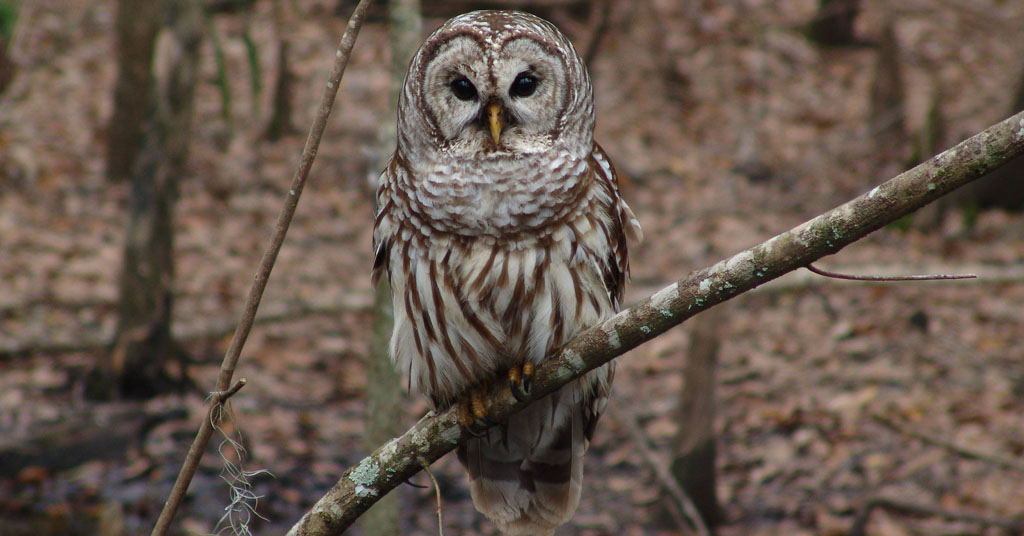
Barred owl

Pretty problem: Barred owls aren’t always as attractive as they seem. Photo: Mark Musselman/USFWS archive

By Kendra Chamberlain. December 13, 2023. Barred owls have migrated across the country and made the Pacific Northwest home over the past 50 years.

Now, the U.S. Fish and Wildlife Service (FWS) wants to cull thousands of the large birds in the region in hopes of saving a cousin: the beleaguered northern spotted owl.

Announced in November, the management plan proposes the birds be lured with recorded “who cooks for you” owl calls, and that agency hunters shoot the birds that show up.

FWS hopes to remove between 10,00-20,000 owls per year if the plan is approved. FWS is currently accepting public comments on the proposal.

In the 1990s, when the northern spotted owl was officially listed as threatened, experts believed logging to be the raptors’ greatest threat to survival—spotted owls are considered old growth forest obligates, meaning their habitat and survival is tied to the preservation of old growth forests with large, mature trees.

But even after a massive overhaul of land management and logging practices aimed at protecting the birds, northern spotted owl populations have steadily declined, and are now nearing a point of no return.

In the United States, northern spotted owl populations have declined over 65% since the 1990s. In British Columbia, only a single female remains in the wild.

Desperate times call for desperate measures, and the northern spotted owl is in an emergency situation, according to Joe Leibezeit, assistant director of statewide conservation at Portland Audubon

“There is a real possibility of the northern spotted owl going extinct in vast portions of its range,” Leibezeit told Columbia Insight. “Therefore we reluctantly support some level of lethal removal of barred owls in some critical places for the short term until better management options are available.”

Displacing spotted owls

Barred owls are native to the northeast but began expanding their range over the last half century. No one is sure exactly why.

Researchers believe European settlers—and their habits of meddling with the ecosystems they explored—are likely culprits.

The emergence of trees in towns and neighborhoods in places like Kansas and Nebraska allowed the barred owl to hop across what was previously a natural prairie border to their habitat, according to David Weins, supervisory research wildlife biologist at the USGS Forest and Rangeland Ecosystem Science Center in Corvallis. Weins has authored a number of studies on northern spotted owls.

“Unlike spotted owls, barred owls are commonly found in urbanized settings. Downtown Portland and my backyard in the middle of Corvallis are examples,” Weins told Columbia Insight in an email

The extirpation of bison and beaver by settlers, and the legacy of fire suppression across the country, also helped the barred owl expand its range.

Their arrival has pushed spotted owls to the brink.

Gif: USGS

Barred owls are larger, more competitive and more territorial than spotted owls.

They will establish territory in forests and then protect that territory, often aggressively.

“There is evidence that barred owls physically exclude [chase] spotted owls from their old-forest territories,” Weins said.

Researchers have recorded anecdotes of barred owls attacking and killing spotted owls.

Barred owls also reproduce faster than spotted owls; in addition, the two species are close enough to interbreed, creating owl hybrids that may or may not survive the FWS’s culling program.

Studies have consistently shown that removing barred owls from spotted owl territory is effective.

One study found spotted owls returned to their territory just one year after a group of barred owls were removed.

While there’s consensus that killing one owl to save another is an uncomfortable solution, lethal removal of barred owls is “the only population reduction method that is proven to work in reducing barred owl populations,” according to FWS’s management plan, unfortunate as that may be for the barred owls.

Columbia Insight’s reporting on biodiversity in the Columbia River Basin is supported by the Autzen Foundation.

By |2026-02-18T15:56:54-08:0012/13/2023|Wildlife|2 Comments

No-brainer of the year: Wolverines get protections

Wildlife biologists cheer the federal decision even if it may be a case of too little, too late

wolverine Cascades

Waiting on a friend: This juvenile male wolverine in Washington’s South Cascades has a limited cohort. But now at least now he has federal protection. Photo: Kayla Shively

By Kendra Chamberlain. December 6, 2023. It’s a good time to be a wolverine. The University of Michigan is entering this season’s College Football Playoff as the number-one seed.

And last week, after decades of litigation, six legal challenges and new science, the last 300 lonely wolverines in the lower 48 states secured federal protection under the Endangered Species Act.

The U.S. Fish and Wildlife Service officially listed the species as threatened on Nov. 29.

For decades, the federal government’s slow response to the species’ decline has frustrated … just about everyone.

Conservationists first asked the USFWS to list the species in 1994, to no avail.

In 2022, a judge in Montana vacated a 2020 USFWS finding that the species wasn’t in danger of extinction.

That decision forced the agency to redo its assessment of the species.

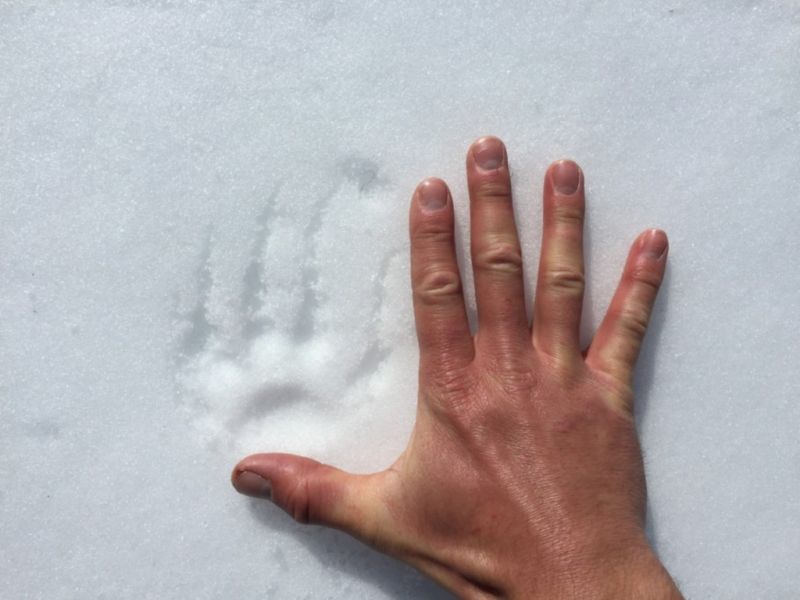
Wolverine track

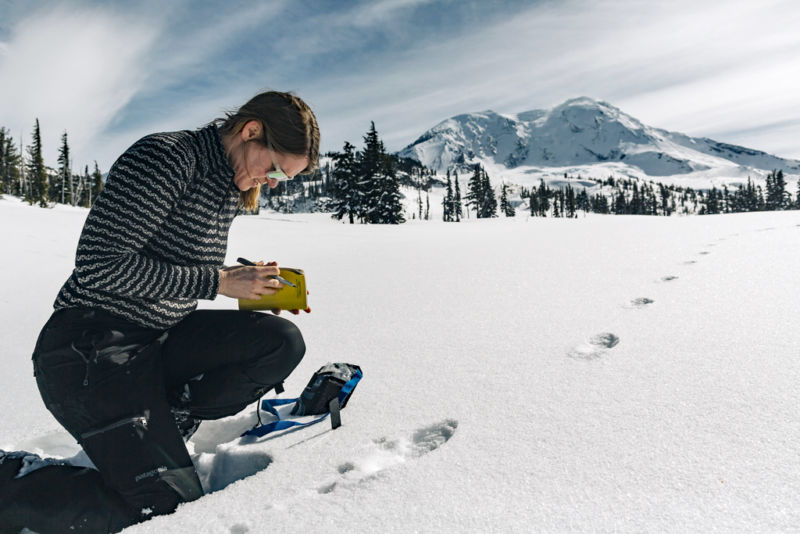
Looking for a wolverine? These are the tracks to follow. Photo by Scott Shively

In September, the agency released an addendum to its assessment, citing updated information on climate change, habitat connectivity, trapping, snow, population density and impacts on genetic diversity that now warrant the species more protection.

Wolverine protections have long been opposed by a coalition of the American Petroleum Institute and agricultural and snowmobiling groups.

Montana U.S. Representative Matt Rosendale quickly criticized the new wolverine protections.

“Unfortunately, this decision was based on unanswered questions and old or non-existent data,” Rosendale said in a press release response to the ruling. “This decision … incentivizes the federal government to establish additional regulations and limitations on Montanan’s private property and the recreational use of federal lands under the guise of conservation and protection of a species that may very well be thriving.”

Recovery a long way away

Wildlife biologists say wolverines are by nature elusive and therefore hard to study, but after a century of trapping, poisoning and deforestation, the animals have been pushed to the brink of extinction.

Experts estimate the total wolverine population at 300 animals in the contiguous U.S., spread mostly across Idaho and Montana.

A much larger and more stable population is located in Alaska.

There are only two confirmed reproducing dens in Washington’s Cascades, and just one documented wolverine, lovingly called “Stormy,” in Oregon.

Wildlife biologist Jocelyn Akins is cheering the decision to list wolverines as threatened.

Cold comfort: Jocelyn Akins is seeing years of hard research pay off. But wolverines still face an uphill climb. Photo: Cascades Carnivore Project

Akins, founder of the Cascades Carnivore Project, wrote in Columbia Insight about her work tracking and recording the wolverine population in and around Mount Rainier National Park in Washington.

As it is for all larger carnivores, wolverine habitat is shrinking.

Snowpack is declining across the Pacific Northwest, and wilderness areas continue to be sliced up by roadways. In Washington, vehicle collisions are “a huge source of mortality” for wolverines, according to Akins, who has been working for years to document and protect wolverines.

Declining snowpack in higher altitudes is spelling big trouble for the species as the climate warms, Akins told Columbia Insight in an email.

“They are adapted to a cold climate and use a deep snowpack to protect their young kits in snow dens and cache food, which is critical for females during the denning season,” she wrote. “The wolverine has a tenuous hold in the Cascade Range. While they have naturally returned to Washington during the past three to four decades, there remain very few individuals.”

Akins said the new protections don’t mean the end of challenges for wolverines.

“I remain wary that adequate resources will be brought to understanding what drives their decline and what management tools can be developed to ensure they persist for the next generation,” she said.

For his part, Rep. Rosendale vowed to work to revoke threatened species status for wolverines.

The Pacific Northwest’s only nonprofit, non-advertiser-driven news source devoted to environmental issues affecting the Columbia River Basin, Columbia Insight depends on support from readers like you. You can help us continue investigating critical stories by donating here.

By |2026-02-18T16:05:12-08:0012/06/2023|Wildlife|1 Comment

Condit Dam is gone. The fate of the land around it remains in question

The Lower White Salmon Coalition is pushing a new plan for conservation of fish and wildlife habitat. Will its PacifiCorp landowners listen?

Rafting on White Salmon River

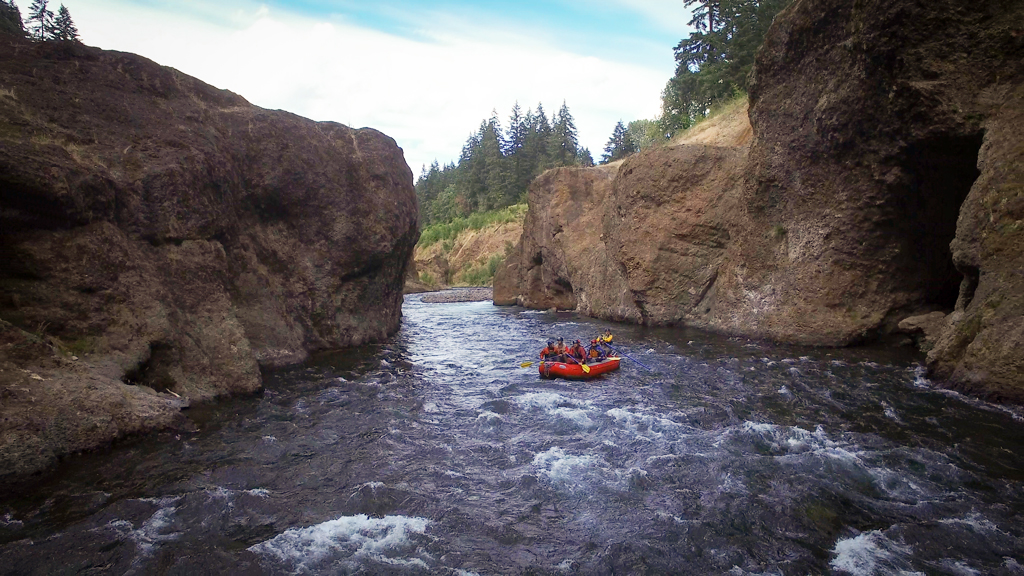
Land ho! Removal of the Condit Dam opened sections of the White Salmon River to recreation. But left decisions about surrounding property unresolved Photo: Wet Planet

By Kendra Chamberlain. November 27, 2023. Even before PacifiCorp began removing the 125-foot-tall hydroelectric Condit Dam in southwest Washington in 2011, speculation ran rampant about how the power company would dispose of the approximately 500 acres of land along the White Salmon River where the dam stood.

The dam’s removal left behind a giant, dried lakebed after the waters of the Northwestern Lake reservoir behind it were sent downriver.

Since then, questions and anxiety about the future of the land have only increased. PacifiCorp has yet to announce a decision regarding its intentions.

The lakebed and six-mile stretch of river in question, surrounded by protected Wild and Scenic designated land, has become popular among recreationalists: the newly restored river offers some of the best whitewater paddling in the state, and the area contains an established trail system.

Now, the Lower White Salmon Coalition (LWSC) has released a community-backed Vision Plan for the land. Not surprisingly, conservation is the group’s top priority.

Condit Dam

Gone, not forgotten: Condit Dam created electricity and blocked fish and other passage on the White Salmon River for a century. It was demolished in 2011. Photo: Wikimedia Commons

The LWSC was formed in 2016, amid concerns about how and when PacifiCorp might divest its land holdings in the Washington counties of Skamania and Klickitat. Its more than a dozen member organizations include Friends of the Columbia Gorge, Mid-Columbia Fisheries Enhancement Group, Mt. Adams Resource Stewards and Underwood Conservation District.

PacifiCorp had previously offered land leases for the construction of lakefront cabins. After the dam’s decommissioning, the lake is gone and cabin owners aren’t sure what PacifiCorp plans to do with the land underneath the cabins.

In 2019, the coalition was caught by surprise when PacifiCorp sold a 39-acre parcel to a developer that clear-cut a wooded area and built residential housing.

“No one knew that parcel existed except them,” LWSC member Pat Arnold told Columbia Insight, adding that the parcel contained high-value habitat. Arnold is also Chair of the Board of the Friends of the White Salmon River.

Lake bed land a priority

The LWSC has spent the intervening years developing its own plan for the land, with the hopes that the group will have a seat at the table of future decision-making.

The planning process included developing committees, conducting public surveys, holding discussions with adjacent landowners and meetings with stakeholders to identify a broad community-backed strategy for the land.

The LWSC received a technical assistance grant from the U.S. National Park Service’s Rivers, Trails and Conservation Assistance Program to help with the process.

PacifiCorp has already agreed to a Right of First Offer with the Yakama Nation for up to 289 acres from the former dam site south to the mouth of the river. Yakama Nation Fisheries staff, who have begun habitation restoration in parts of the lake bed, participated as observers in LWSC’s planning process and offered feedback to the coalition.

Lower White Salmon River map

Map: NPS Rails, Trails, Conservation Assistance Program

The LWSC would like to see the return of native riparian vegetation along the river corridor and salmon spawning areas protected. It also wants assurances that public access and recreational use of the area will remain in the future.

Arnold said the coalition is particularly concerned with the lake bed parcels, because that land would most likely draw developer interest.

“It’s very important for the coalition overall to see those parcels go into conservation ownership,” said Arnold. “The plan has areas where we feel we had a strong consensus and then some areas where we might not have such a strong consensus. But the conservation of those lake bed parcels is absolutely imperative [for the community].”

PacifiCorp has no obligation to take LWSC’s Vision Plan into consideration. But the groups have been in contact.

“We were in communication with PacifiCorp at the beginning of our NPS technical assistant grant,” said Arnold. “We needed to make sure we could access the land for the purpose of the developing the Vision Plan. They were okay with that. We met a couple of times. … We have asked to meet with them to discuss the Vision Plan, but do not have a date yet.”

Despite the lack of commitment, the LWSC remains cautiously optimistic.

“For no particular good reason, we feel that PacifiCorp is on board with the conservation emphasis of the Vision Plan,” said Arnold. “They did their due diligence years ago about finding which parcels could be sold profitably, and apparently after they sold the 39 acres there were not any more, without short platting and such. … We’re just hoping that we can continue to be a voice for what we feel is a pretty clear consensus as discussions go on.”

The Pacific Northwest’s only nonprofit, non-advertiser-driven news source devoted to environmental issues affecting the Columbia River Basin, Columbia Insight depends on support from readers like you. You can help us continue investigating critical stories by donating here.

By |2026-02-18T16:20:38-08:0011/29/2023|Conservation|1 Comment

A new idea could ease tensions between farmers and solar energy developers

Agrivoltaics integrates solar power and crop cultivation to the benefit of both. An OSU prof thinks it could be the future

Agrivoltaic farm

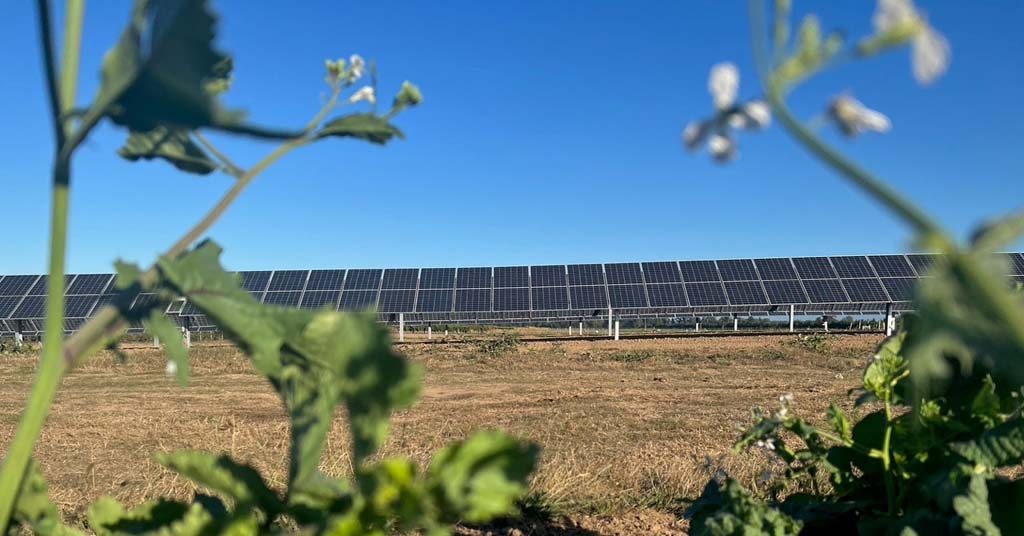
Farm friendly? Agrivoltaics project at Oregon State University’s North Willamette Research and Extension Center in Aurora, Oregon. Photo: Dan Orzech

By Kendra Chamberlain. November 23, 2023. Solar energy and agriculture can play nice—in fact, solar panels might actually allow farmers to produce better crop yields.

It sounds counterintuitive, but that’s what Oregon State University Professor Chad Higgins is hoping to prove with a pilot agrivoltaics project in the Willamette Valley.

His project runs contrary to prevailing narratives in rural areas, where encroaching renewable energy facilities are seen as a threat to agriculture.

Higgins spoke about the project during a two-day conference held earlier this month in Corvallis by the nonprofit Sustainable Northwest.

“It’s not that the solar panels are impeding farm progress,” Higgins told the audience. “They are literally farming equipment that is used to manage a farm resource—light.”

Solar Harvest, the agrivoltaics collaboration between Oregon Clean Power Coop and OSU’s College of Agriculture, is the first field-scale research station aimed at studying whether solar panels can improve things like soil health, water use and crop yields.

It’s also part of a community solar program serving electricity to OSU’s North Willamette Research and Extension Center.

Solar Harvest just completed its first growing season after coming online in April.

Higgins said his group celebrated with a big harvest meal.

Throwing shade

Vast tracts of open land make agricultural areas a great place to place solar arrays.

But can large panels coexist with crops or livestock?

Chad Higgins, associate professor in the College of Agricultural Sciences at Oregon State University

Sunny outlook: Chris Higgins. Photo: OSU

Higgins calls sunlight the “forgotten resource” on agricultural land.

“It’s the one that is least likely to be managed,” said Higgins, adding that sunlight is always in excess on a farm.

“It’s uncommon to realize how much energy is in sunlight. There’s so much energy in sunlight that the plants can’t take it all,” he said.

Placing solar panels on agricultural land can serve a dual purpose.

The panels generate energy that can be used by the farm—or delivered to residential homes.

Panels can also help plants and animals survive the hottest, driest parts of the year by providing shade. Shade can translate into reduced water demand.

“What is the plant to do when it gets too much energy? It heats up. What’s the only thing a plant can do to cool down? Drink water,” said Higgins. “So all of that excess solar that goes onto the plants is translated one-to-one to water draw from the ground—that goes into nothing productive. All you have to do is shade the plants and you save a proportional amount of water.”

Extra shade offers other benefits to the crops: cooler soils, increased humidity, less stress on plants and potentially increased crop yields.

The Solar Harvest project is testing a range of shade and water conditions to see what works best, “because somewhere—and I don’t know where it is, because no one’s studied this—somewhere there is the perfect combination of light and water to make the plants grow the best,” said Higgins.

Atypical array

There are limits to how much shade plants will tolerate—and not all plants can be optimized using shade.

But for crops such as alfalfa, beets, bok choy, cabbage, carrots, lettuce, spinach, sweet potatoes, turnips and yams, farmers could shade their plants up to 50%, depending on the species, with little consequences on output.

There’s nothing revolutionary about providing shade to crops. But farmers receive an additional bonus by using solar panels instead of more traditional means, such as shade cloth.

“Why not shade it with something that creates a tertiary farm product?” asked Higgins. “This is where you get into agrivoltaics: you engineer a system such that it removes the excess sunlight to optimally manage your farm resource for the benefit of the crop.”

Solar array and sheep

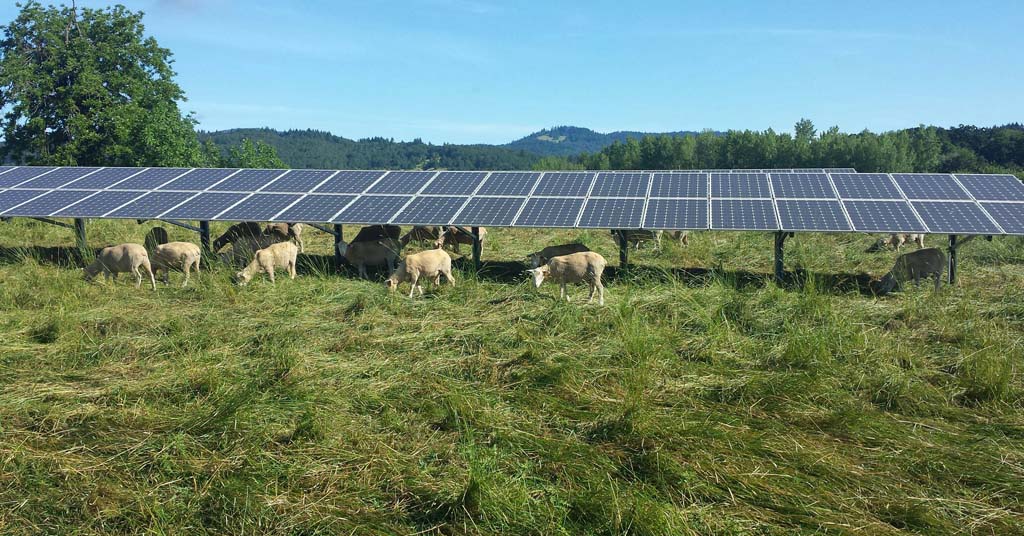
Shady acres: Sheep graze under the 35th Street Solar Array at Oregon State University. Photo by Mark Floyd/OSU

Solar Harvest is a 120 kW array. It uses bifacial solar panels that let some amount of light through to the ground, but provide enough shade to help plants cool off.

“These systems don’t look exactly like a standard solar array,” said Higgins.

The solar panels tilt upwards to allow farming equipment to pass between the rows, preserving 95% of the farm footprint.

Farmers can manage sunlight by moving the panels into different configurations, some up some down, for example, to reach specific outcomes.

“If you are at a deficit of 30% water, you can take 30% of the light away and not have to suffer,” said Higgins.

Some research shows that crops can actually help increase the efficiency of the solar panels, too. The panels operate better in cooler conditions, just like the plants do.

Taking agrivoltaics mainstream

Solar Harvest, which will provide research over a 20-year period, is one of the first pilot projects of its kind in the country. Higgins hopes his research will pave the way for more acceptance of solar energy among rural communities.

Nationally, the agrivoltaics industry is still nascent.

There are only a handful of commercial agrivoltaic installations across the country. But with wider adoption, the sector could help the nation meet its decarbonization goals.

An OSU study from 2020 estimates widespread adoption of agrivoltaics could put a dent of 330,470 metric tons in the agriculture sector’s greenhouse gas emissions annually.

There are obstacles to overcome.

In Oregon, permitting is one of the largest barriers. Under Oregon state law, areas with better soils for agriculture are not typically permitted for renewable energy installations.

“Willamette Valley is a Goldilocks zone for agriculture,” said Higgins. “It’s actually a fantastic place to do agri-solar, if the community wants it.”

The Pacific Northwest’s only nonprofit, non-advertiser-driven news source devoted to environmental issues affecting the Columbia River Basin, Columbia Insight depends on support from readers like you. You can help us continue investigating critical stories by donating here.

By |2026-02-18T16:23:07-08:0011/23/2023|Agriculture|1 Comment

Corps of Engineers proposes largest of its kind ‘fish vacuum’ on Willamette River

The federal agency says simply interrupting dam operations so fish can pass would negatively impact hydroelectric customers

Floating surface collector for salmon.

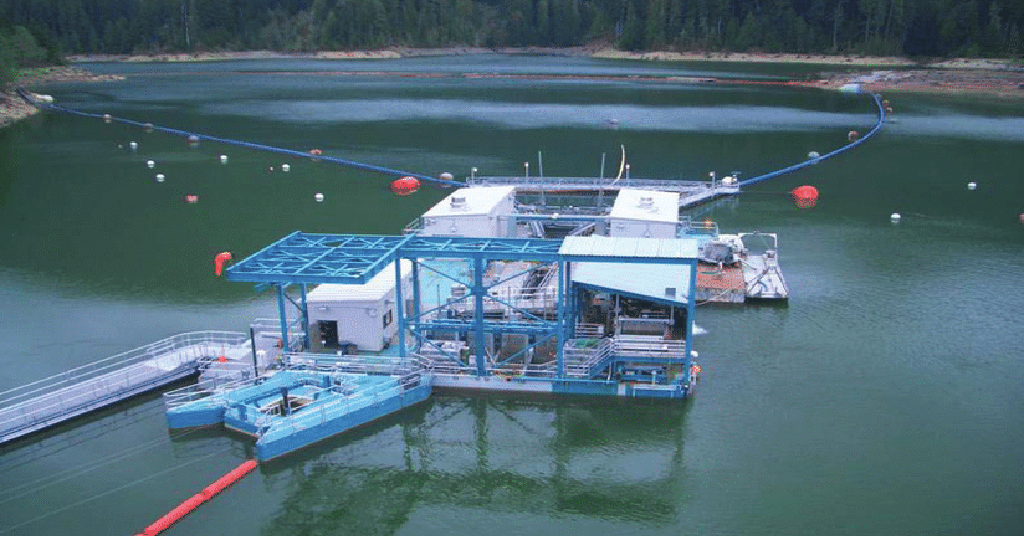
Suck it up: This floating surface collector is used to capture out-migrating juvenile sockeye salmon on Washington’s Baker Reservoir. Photo: Puget Sound Energy

By Kendra Chamberlain. November 21, 2023. The U.S. Army Corps of Engineers’ new plan to help fish move through two dams on the Willamette River using so-called “fish vacuums” is raising eyebrows following an October report on the plan published by ProPublica and Oregon Public Broadcasting.

The USACE wants to build “a floating vacuum the size of a football field with enough pumps to suck up a small river,” according to the report.

Young salmon caught by the vacuums—called “floating surface collectors”—would be moved into massive storage tanks then trucked around dams and dumped downstream. The estimated cost for the fish collectors is up to $450 million each.

Nothing of the size of the installations proposed by the USACE has ever been attempted.

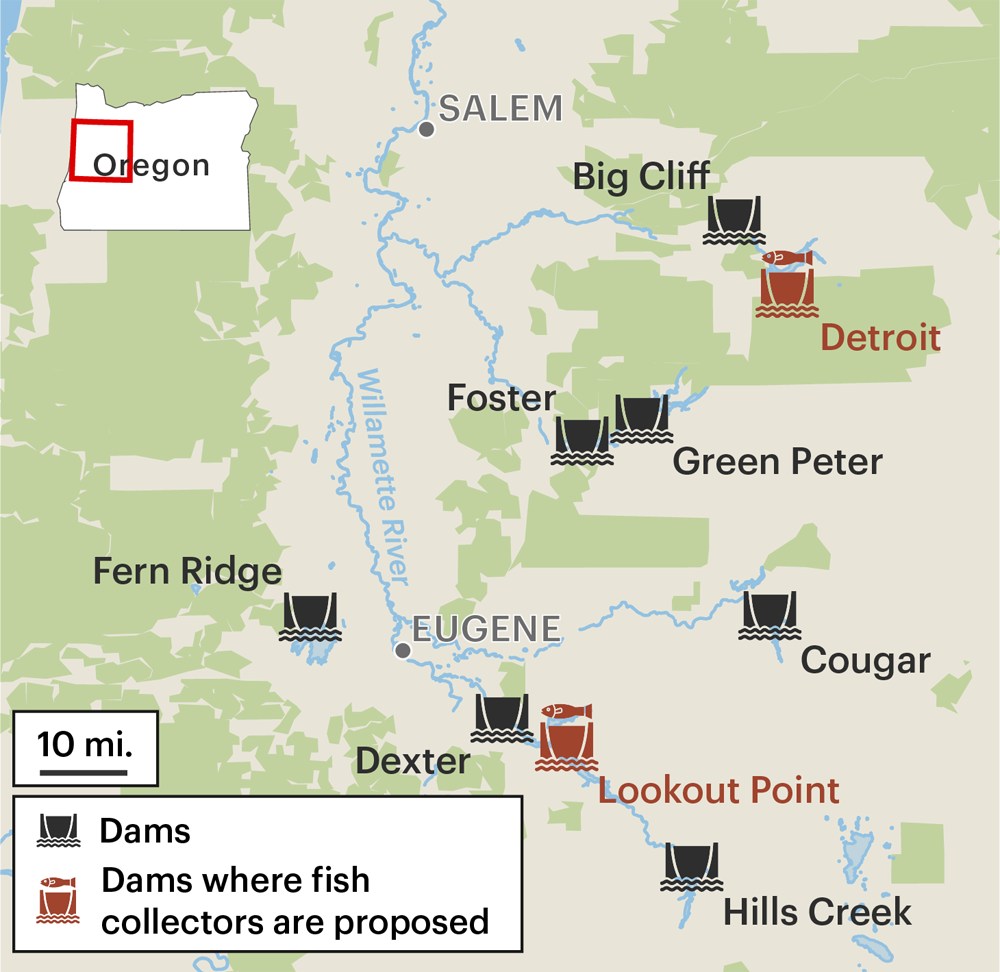
The new fish collectors would be located at Detroit and Lookout Dams on the Willamette River.

Floating surface collectors can be found at dams across the Pacific Northwest.

The massive installations float upstream of a dam, and divert fish into a series of gates, “raceways,” holding cells, fish hoppers and transport tanks that fish are pushed through before being transported downstream either by truck or pipeline.

Salmon chute

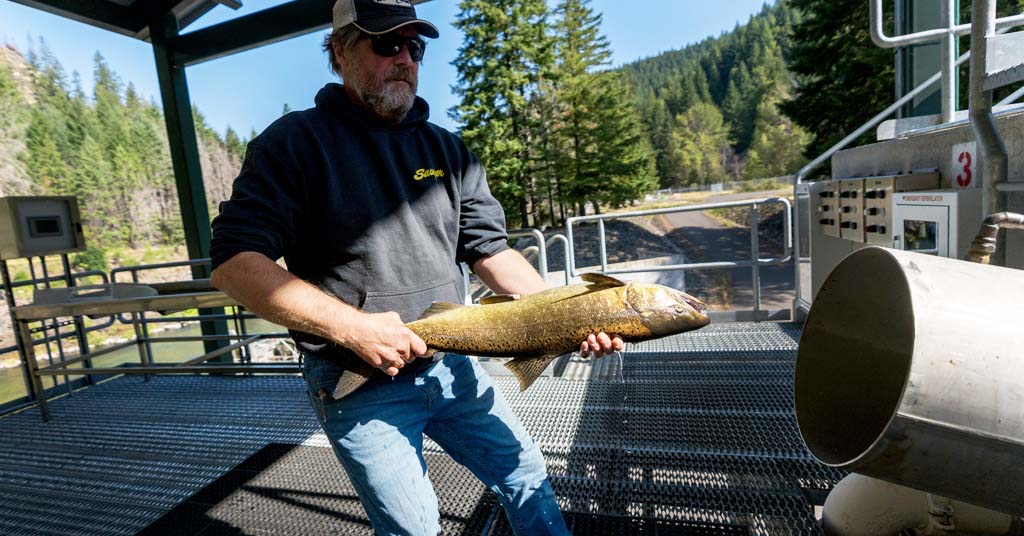
Salmon chuter: Army Corps biologist Doug Garletts loads an anesthetized chinook salmon in a chute. It’ll slide into a holding tank before being drained into a tanker and trucked to the other side of Cougar Dam. Photo: Kristyna Wentz-Graff/Oregon Public Broadcasting/ProPublica

The USACE proposal is unprecedented in scope, but floating surface collectors can be successful in increasing juvenile fish passage.

In 2015, Portland General Electric installed the 147-foot-by-65-foot North Fork Floating Surface Collector at its Clackamas Hydroelectric Dam, along with a seven-mile-long pipe to transport fish over the dam and downstream. The results in fish passage were immediate and impressive: researchers saw a threefold increase in chinook juveniles, a fourfold increase in coho juveniles and new records for steelhead and lamprey migrating downstream of the facility.

PacifiCorp launched its own $60 million collector at Swift Reservoir in 2012 along the Lewis River in Washington. The out-migrating fish there are trucked 30 miles downstream and released below Merwin Dam.

More floating surface collectors are located at the Rocky Reach Dam on the Columbia River and the Round Butte Dam on the Deschutes in Oregon; and the Baker Dam in Washington.

However, the USACE’s current proposal has drawn criticism.

“Some leading scientists have said the project won’t save as many salmon as the agency claims,” according to the ProPublica/OPB report, which also cited a 2017 scientific review that concluded such projects to artificially assist salmon migration will “only prolong their decline to extinction.”

Map of Willamette River dam, 2023.

Map: Lucas Waldron/ProPublica

The success of fish collectors is determined by a range of conditions.

Research conducted by the U.S. Geologic Survey found that the efficacy of the systems varies from year to year, and across species, and is influenced by factors such as water temperature, river and dam conditions and collector design.

The collectors proposed by the U.S. Army Corps of Engineers would be the largest ever built, according to ProPublica’s report, and there’s no certainty that the proposed installations would be as effective as the Corps hopes in these particular areas of the Willamette River.

“Each drainage and river system and dam—or set of dams—is unique and needs to be considered on its own merits,” Joseph Bogaard, executive director of the Washington-based nonprofit Save Our Salmon, told Columbia Insight. “There are some places where fish collectors or trap-and-haul systems are a good option, or, at least in the near term, the only or best option.

“This is just a highly expensive project where it seems there are more effective, more certain alternatives that the Corps should be prioritizing and pursuing and working with local communities.”

The Pacific Northwest’s only nonprofit, non-advertiser-driven news source devoted to environmental issues affecting the Columbia River Basin, Columbia Insight depends on support from readers like you. You can help us continue investigating critical stories by donating here.

By |2026-02-18T16:20:56-08:0011/21/2023|Salmon|1 Comment
Read More

Pipeline ruling was controversial within federal agency that approved it

Commissioner of the Federal Regulatory Commission criticized methods used in OK’ing GTN Xpress natural gas pipeline project

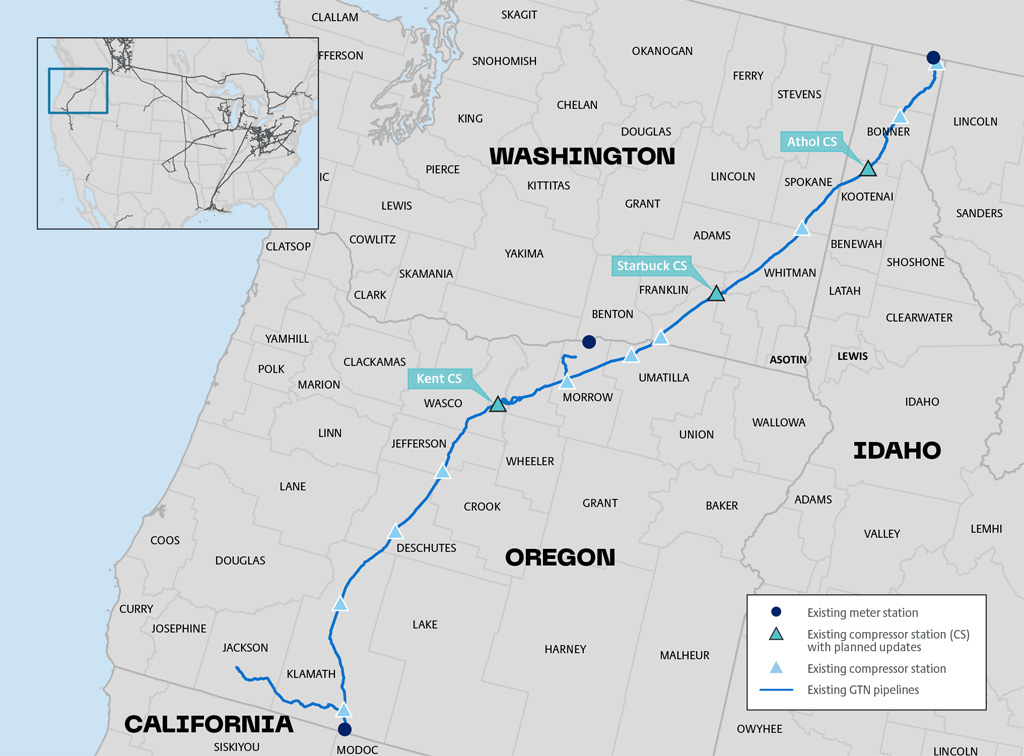
GTN Xpress pipeline map

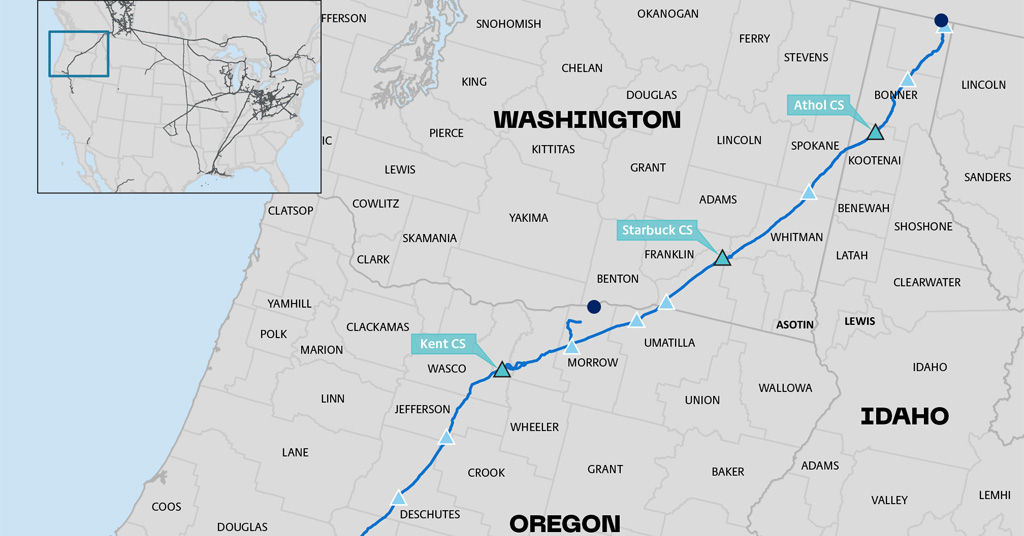
The GTN Xpress pipeline brings Canadian natural gas to consumers in the Pacific Northwest. Map: TC Energy

Kendra Chamberlain. October 31, 2023. Last week, the Federal Regulatory Commission (FERC) created a furor when it approved expansion of the GTN Xpress natural gas pipeline, which will bring more fracked natural gas to the Pacific Northwest.

The pipeline runs through Washington, Oregon and Idaho. The new project will entail upgrades to three compression stations along the existing pipeline in order to deliver an additional 150 million cubic feet of fracked gas per day.

FERC’s approval of a proposal by Calgary-based TC Energy flew in the face of widespread opposition to the project among state officials and residents across Washington, Oregon and California.

Washington Gov. Jay Inslee, in particular, has been a staunch opponent of the project. He’s argued in the past that the project doesn’t serve a public need or interest, that evidence suggests it will harm consumers and that it will leave ratepayers in his state on the hook for a carbon-emitting energy source well after the state will have decarbonized its electricity generation systems.

“This fight isn’t over,” Inslee said in a statement last week. “We are more resolved than ever to keep this pipeline from increasing fossil fuel use.”

TC Energy told federal regulators the upgrades are needed to meet increased demand for natural gas in markets in the Pacific Northwest.

But Inslee has taken issue with that assumption, pointing to state mandates in Washington that require transitions to 100% carbon-free energy generation by 2045 and reduction of greenhouse gas emissions by 95% by 2050.

[perfectpullquote align=”full” bordertop=”false” cite=”” link=”” color=”” class=”” size=””]Klickitat County residents may be forgiven for feeling Inslee is getting a taste of his own medicine.[/perfectpullquote]

Oregon similarly plans to reduce greenhouse gas emissions by 100% by 2040.

Oregon Gov. Tina Kotek also opposes the project, as do the members of Congress from both states, attorneys general from Oregon, Washington and California and the Columbia River Inter-Tribal Fish Commission.

Idaho politicians have largely supported the project, arguing that it would bring much needed expanded natural gas capacity to Idaho customers. Idaho hasn’t set any clean energy or greenhouse gas emissions reductions goals.

Environmental groups Columbia Riverkeeper and Rogue Climate say they plan to file a petition for a hearing for the decision to be reconsidered. Those petitions are due in November.

“The Biden administration needs to take a hard look at how FERC is doing business overall—and needs to change the course of this agency which is pushing fracked gas into a region that doesn’t want it and doesn’t need it,” Dan Serres, advocacy director at Columbia Riverkeeper, told Columbia Insight. “The approval of GTN Express is a stark example of how out of touch FERC is with the work that is happening in the West to try to diminish pollution from fracked gas.”

Whose voice counts?

The decision underscores how disparate federal, state and local perspectives can be on matters of energy policy.

Increasingly, local residents’ concerns about large-scale energy projects are ignored over notions of serving the greater good.

FERC’s commissioners themselves couldn’t agree on whether local laws on decarbonization should be considered when approving projects like GTN Express.

Commissioner Allison Clements published a criticism of the Commission’s finding, arguing that FERC’s approach to determining the “need” of a project is too simplistic given the patchwork of decarbonization policies across the United States.

“[T]he Commission’s approach is becoming increasingly untenable as a combination of market forces and federal, state and local climate protection policies signal potentially flat or declining demand for natural gas over time,” Clements wrote in a partial dissent of FERC’s order, adding that the commission failed to ask for market studies looking at the future demand for natural gas in the region.

Washington has its own history of overriding local concern in favor of big energy projects, as Columbia Insight has reported.

The state’s Energy Facility Site Evaluation Council (EFSEC) recently drew criticism from residents in Klickitat County over the approval of a large-scale solar farm on state land, despite opposition from locals.

No matter which side of the pipeline issue they’re on, residents of Klickitat County may be forgiven if they feel Inslee and others are now getting a taste of their own medicine, with a more powerful government agency bigfooting their authority.

By |2026-02-20T11:29:15-08:0010/31/2023|Energy|1 Comment

© Copyright 2013-2025 Columbia Insight. All Rights Reserved.

As a 501(c)3 nonprofit organization, all donations to Columbia Insight are tax deductible to the full extent of the law. Our nonprofit federal tax-exempt number is 82-4504894.