Stay Updated Subscribe today for the latest research + reporting about environmental news. Subscribe Now

Stay Updated Subscribe today for the latest research + reporting about environmental news.

Subscribe Now

Kendra Chamberlin

Kendra Chamberlin

Kendra Chamberlain

About Kendra Chamberlain

Columbia Insight contributing editor Kendra Chamberlain is a freelance journalist based in Eugene, Oregon, covering environment, energy and climate change. Her work has appeared in DeSmog Blog, High Country News, InvestigateWest and Ensia.

Home Depot fined $1.6 million for selling toxic products in Wash.

But the retail behemoth will barely feel any pain over a penalty that amounts to a fraction of what it might have been

Hydrofluorocarbons

Not really that green: Hydrofluorocarbons are potent greenhouse gases used in refrigeration and air conditioning systems. Photo: The State Energy & Environmental Impact Center

By Kendra Chamberlain. July 3, 2024. Washington’s Department of Ecology has issued a $1.6 million fine to The Home Depot for selling products containing HFCs after the state banned them.

Hydrofluorocarbons (HFCs) are commonly used in air conditioning and refrigeration systems and in some consumer aerosol sprays.

Washington is one of a growing number of states taking action to phase out HFC refrigerant use and production.

The Washington legislature passed legislation banning certain HFC products in 2019 and again in 2021.

The state’s Ecology department began reaching out to companies in late 2021 to inform them of the new rules and how to comply with them.

The new rules included a ban on companies selling R-134a canisters at retail stores. R-134a is an HFC refrigerant used in automotive air conditioning.

The state banned retail sales of the product in hopes of forcing consumers to rely on automotive shops to handle repair and maintenance of A/C systems.

Automotive repair businesses are better able to “collect and recycle the old refrigerant, preventing it from escaping into the atmosphere,” the department said in a news release.

The state says it caught The Home Depot offering products such as R134a on its website, despite the department’s outreach.

The department said it even held “technical assistance meetings” with the company’s website software and compliance teams in 2022 and was assured that “the identified products would not be available for purchase in Washington and that no new prohibited products would be added to the website,” according to the statement.

Department of Ecology officials found The Home Depot still selling the banned products on its website in July 2023, spurring the fines.

The Home Depot declined to comment on the ongoing litigation.

The Department of Ecology said it could have fined the company roughly $10.6 million for the violations, but opted to reduce the penalty due to the company’s “prompt disclosure of units sold.”

The Home Depot made about $50 billion in FY2024, meaning the $1.6 million fine will cost the company about 16 minutes of business operation.

Global warming impact of HFCs

HFCs are synthetic molecules developed in the 1990s to replace ozone-harming chlorofluorocarbons (CFCs).

CFCs were targeted in the Montreal Protocol of 1987, the global agreement in which countries pledge to protect the ozone layer by phasing out “ozone-depleting substances” (OSDs).

But the increased use of HFCs worldwide has caused its own set of problems.

Since then, these gas molecules have begun accumulating in the atmosphere, worrying researchers about their global warming impact.
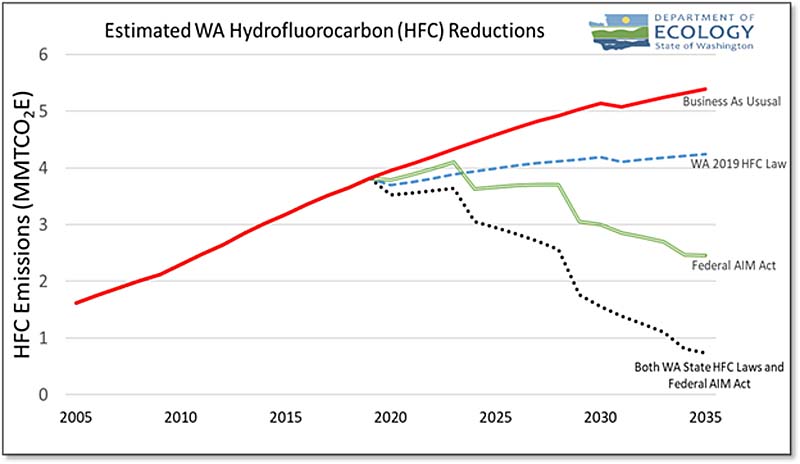
Hydrofluorocarbons

Graph: Washington Department of Ecology

HFCs can trap thousands of times more heat in the atmosphere than carbon dioxide, and are now the fastest growing greenhouse gas emission in the world.

In 2016, HFCs were added to the Montreal Protocol under the Kigali Amendment.

Since some versions of the compound trap more heat than others, regulatory agencies like the U.S. Environmental Protection Agency are currently supporting phasing out the use of some HFCs in order to be replaced by other HFCs—but the goal is to end their use entirely at some point.

So far, 24 states have pledged to phase out the use of HFCs, though only half of those states, including Washington, have actually enacted legislation to do so.

Washington hopes to reduce its HFC emissions by 75% by 2035 as part of the state’s emission reduction goals. The state estimates the chemical accounts for 4% of the state’s overall emissions.


By |2026-01-26T11:59:26-08:0007/03/2024|News|0 Comments

UPDATE: EPA says there’s not enough data to support salmon-killing tire chemical rule

But advocates call new federal guidelines for chemicals used in tires an important step in ending “urban stream syndrome”

Seattle I-5 looking south

Snail’s pace: All those tires are shedding chemicals. Governments are taking notice. Slowly. Photo: Tony Webster/Flickr

By Kendra Chamberlain. June 20, 2024. Years after a breakthrough 2020 study linked mysterious coho salmon die-offs to a ubiquitous tire chemical, the U.S. Environmental Protection Agency took its first step in addressing the contaminant—sort of.

Earlier this month, the EPA finalized screening values for the chemical 6PPD and one of the components it breaks down into, 6PPD-q.

The “aquatic life screening value” is a voluntary and non-enforceable standard of exposure that states and Tribes can use in their own water quality programs.

It sets rough parameters for lethal limits of exposure to the chemical for aquatic life, but has no teeth in terms of enforcement.

Endangered species of salmon, particularly coho salmon, experience massive mortality events when entering urban areas.

Stumped researchers dubbed this “urban stream syndrome” and “urban runoff mortality syndrome.”

For decades, no one knew what exactly was causing the deaths, but many suspected that a chemical found in cities was making its way into waterways.

Researchers at Washington State University finally pinpointed the culprit in 2020 as the chemical known as 6PPD, which breaks down into 6PPD-q when exposed to ozone.

The chemical has been used since the 1950s to help protect rubber used in tires, and tends to degrade into “tire dust” on roadways. Those particles then wash into waterways through storm water runoff.

The study received widespread national media attention, including in a June 2023 story in Columbia Insight.

But with just a few years of research on 6PPD-q, the EPA says there simply isn’t enough data available to establish precise regulatory limits for the chemical.

The aquatic life screening value offers a baseline that enables state and federal agencies to get on the same page while awaiting more research.

One small step

While there’s no enforcement mechanism associated with the exposure standard, it’s an important first step to better understanding and regulating 6PPD-q in the environment, according to Dr. Alan Kolok, professor of ecotoxicology at th University of Idaho.

Kolok does toxicological work in the Columbia River Basin.

“It’s definitely something that we should be praising,” Kolok told Columbia Insight. “It really is just a step in the process—it’s a really important step in the process—but it’s a step in a process of ratcheting down our understanding based upon the information available.”

Alan Kolok, Ph.D.

Alan Kolok. Photo: University of Idaho

Salmon advocates say the end goal is to stop using the chemical entirely in tire manufacturing, but first manufacturers need to find an alternative.

Tire makers say removing the chemical without replacing it would cause tires to degrade much faster, increasing safety concerns and ultimately sending more tires to the landfill.

In 2023, the Center for Biological Diversity issued a notice of intent to sue the federal and California Departments of Transportation (Caltrans), the Oregon Division of the Federal Highway Administration, the National Marine Fisheries Service (NOAA) and the Secretary of Commerce for violations of the Endangered Species Act. That same year, The Institute for Fisheries Resources (IFR) and the Pacific Coast Federation of Fishermen’s Associations (PCFFA) filed suit against U.S. tire manufacturers over the use of the chemical.

In the meantime, state governments are tackling the problem in their own ways.

Washington is working on solutions for filtering out the chemical from urban water runoff, while California is requiring tire manufacturers to look to alternatives to the chemical if they want to sell tires in the state.

Emily Jeffers, senior attorney at the Center for Biological Diversity, agrees with Kolok that the screening value is a good start, but says more needs to be done.

“What we really need are enforceable water quality criteria that will lead to real limitations on this toxic chemical in our waterways,” Jeffers told Columbia Insight in an email. “Ultimately, a ban on 6PPD is the only way to truly protect salmon and other critters.”

By |2026-01-26T12:01:07-08:0006/21/2024|Salmon|0 Comments

Poisoning of wolves ‘becoming an epidemic’ in Oregon

The state’s wolf population has stagnated amid increase in killings. Scavengers are coming to harm, as well

Wolf in Oregon

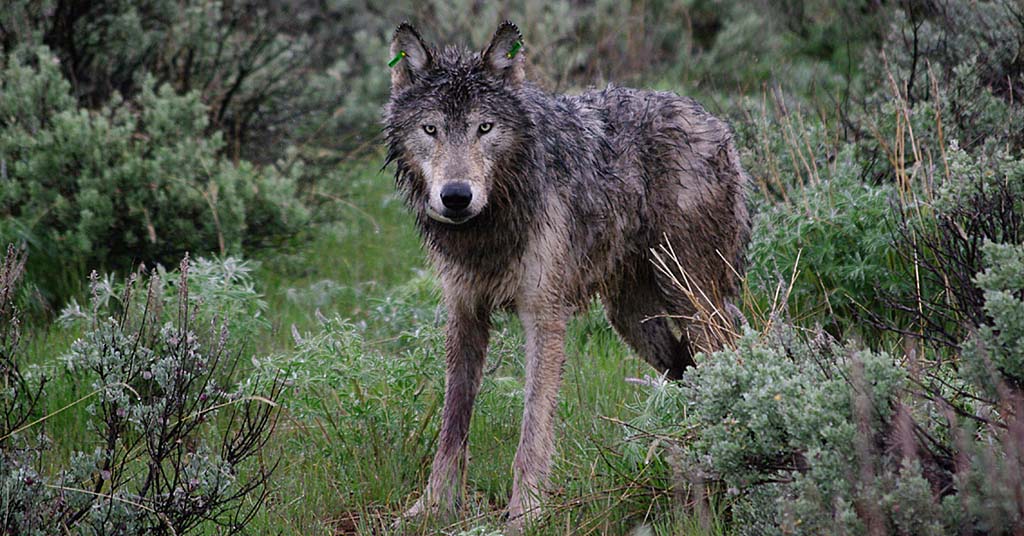
Now-so-warm welcome: State game managers aren’t the only ones tracking wolves in Oregon. Photo: ODFW

By Kendra Chamberlain. May 28, 2024. For the past two years, Oregon has documented just 178 known gray wolves after wolves from Idaho and Yellowstone National Park arrived in the state in 2008. [An previous version of this story incorrectly stated wolves had been reintroduced to Oregon. —Editor]

The state expected the wolf population to grow 30% annually during the early phases of recovery, but over the last eight years growth has averaged 6.3%, according to ODFW.

The state actually lost two breeding pairs and two packs between 2022 and 2023.

What’s behind the low numbers?

An unprecedented amount of wolves were killed in 2023, according to the Oregon Department of Fish and Wildlife’s (ODFW) annual wolf report. Sixteen wolves were killed legally, twice as many as ever before, while 12 wolves were poached.

A handful more wolves died due to other causes.

The increase in wolf kills, and the number of subsequent wolf deaths, come as livestock depredation increased 27% in eastern Oregon last year. But statewide, depredation actually decreased in 2023.

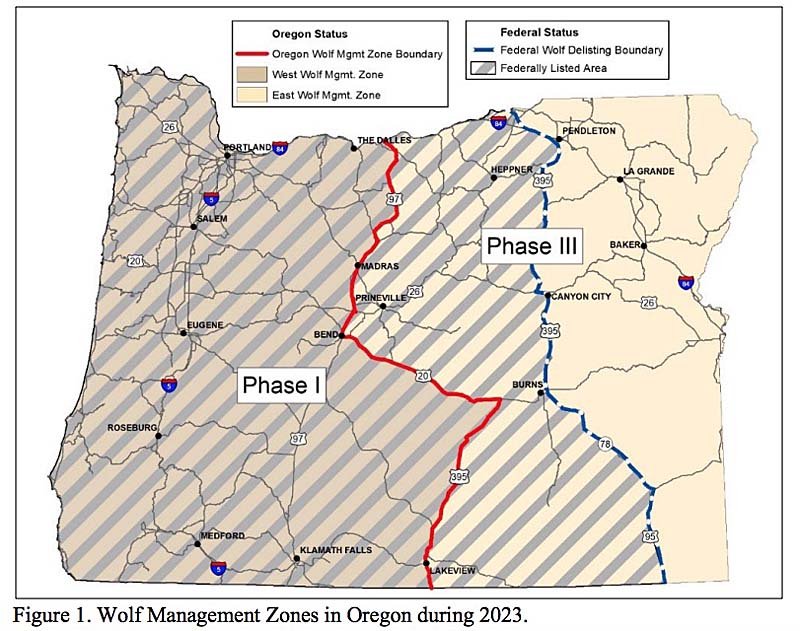
The easternmost third of the state, where the majority of wolves reside, is managed under Phase III of the recovery plan, which allows more wolves to be killed in response to livestock depredation than in other parts of the state.

Meanwhile, wolf poaching in the state has ticked upward, too.

Earlier this year, three wolves, two eagles, a coyote and a cougar died after scavenging on a cow carcass laced with poison.

That’s a recent episode in a grim trend of wolf poisonings in the state, according to Amaroq Weiss, senior wolf advocate at the Arizona-based Center for Biological Diversity.

“This is now becoming an epidemic in Oregon,” Weiss told Columbia Insight.

Nineteen wolves have been poisoned since 2015, but 18 of those died in the last three years.

Wolf recovery zones in Oregon

Wolves west of Highways 395/78/95 in Oregon are listed federally listed and managed by the USFWS. Wolves in the East Wolf Management Zone continue to be managed under Phase III which allows more flexibility to address wolf conflict. Source: ODFW

Weiss said it’s common for poaching to increase when legal wolf killings increase.

“There’s a whole body of research that’s been done on this both in the United States and in parts of Europe,” said Weiss. “It seems to send a message to the public that wolves are not so valuable after all, and therefore we can just go out and kill a bunch of them.”

Of the 12 instances of poaching in 2023, 10 were the result of poisoning. In 2021, eight wolves were poisoned.

Four wolves have been poisoned so far in 2024.

“This is an incredibly aggressive and disturbing trend that we’re seeing in Oregon,” said Weiss.

The recent case of poisoning occurred in the Lightning Creek drainage, a tributary of the Imnaha River in the Hells Canyon National Recreation Area.

The U.S. Fish and Wildlife service, along with Oregon State Police and ODFW, are offering a $25,000 reward for information on the poisoning.

Oregon State Police declined to provide additional information about the poisonings, citing the ongoing investigation.

By |2026-02-09T10:52:01-08:0005/28/2024|Wolves|2 Comments

Massive new power corridor proposed for central Oregon

The federal plan could boost renewable energy generation across central and eastern Oregon. But there’s a November catch

Wind power in the Gorge

Powerful idea: The West needs more efficient electricity distribution. The government has a plan. Photo by Sheila Sund/CC

By Kendra Chamberlain. May 21, 2024. The U.S. Department of Energy is proposing to designate a new “national interest” transmission corridor in an area that stretches from central and eastern Oregon to Nevada. Such designation would unlock federal financing tools for future transmission projects within the corridor’s boundaries. 

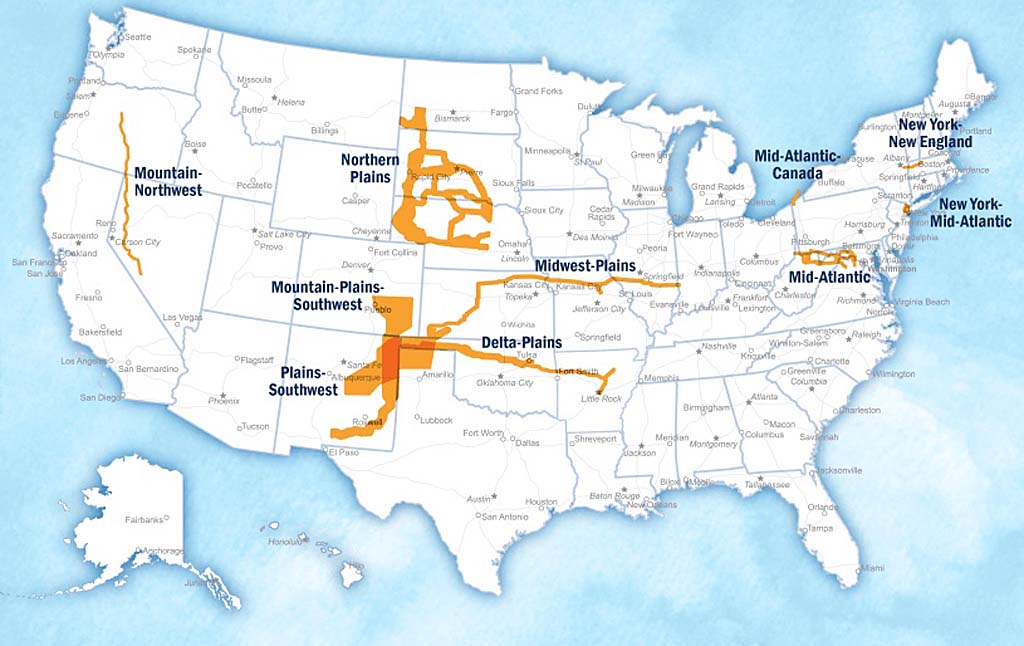
The Mountain-Northwest corridor, one of 10 National Interest Electric Transmission Corridors (NIETC) proposed across the country by the DOE, stretches 500 miles from central Oregon south into Nevada. 

The proposal is the latest piece of President Biden’s energy strategy and could boost renewable energy generation across central and eastern Oregon.

But its completion will likely depend on Biden’s reelection. Presumptive Republican presidential nominee Donald Trump is expected to kill the proposal if he wins the election in November. 

NIETC designation is not related to any specific transmission project. Instead, the designation enables developers to access special funding tools while proposing transmission line projects within the boundaries of the NIETC. 

Dr. Adria Brooks of DOE’s Grid Deployment Office said in a May 16 information session that the Mountain-Northwest corridor is co-located within Bureau of Land Management land and follows existing infrastructure. 

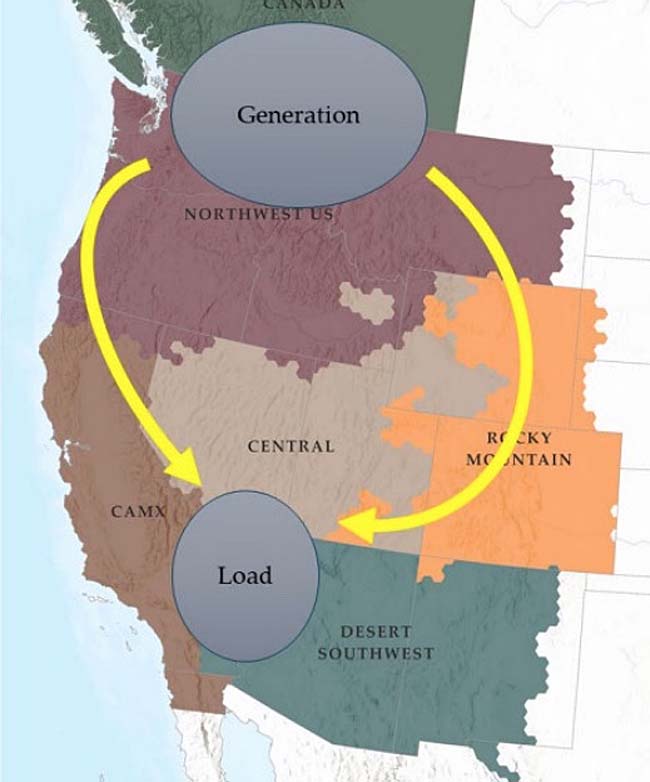
Map: Western Electricity Coordinating Council (March 2021)

Transmission projects within the corridor would offer inter-regional connections between the Pacific Northwest and Mountain regions and neighboring California grid systems. 

California’s ISO (CAISO) system is often plagued by congestion along transmission lines between the southern and northern parts of the state, and between it and the PNW (Northwest) grid systems. A DOE analysis determined congestion charges tripled between 2019 and 2020 to reach $236 million due to congestion on the two major interties linking CAISO with the Northwest. 

The department said inter-regional transmission lines between Oregon and Nevada could help ease congestion between Oregon and California by offering alternative pathways for energy to travel between the three grid regions.

Energy generated in the Pacific Northwest is sent to California to meet soaring demand there. 

Power demand in eastern Oregon is set to soar, too. Amazon alone is planning to build at least 10 more data centers in eastern Oregon, according to reporting by The Oregonian/OregonLive

Brooks said transmission projects within the corridor could also help integrate new renewable energy sources in the region and could even help increase grid resiliency in the face of increasing wildfire risks.

Preliminary pathways for National Interest Electric Transmission Corridor. Map.

Preliminary pathways for National Interest Electric Transmission Corridor designation. Map is an approximation for illustrative purposes only. Map: U.S. Department of Energy

DOE has identified 10 areas across the country for NIETC designation. Each proposed corridor will need to undergo public comment and environmental review before being officially designated. 

Brooks said the boundaries of the proposed NIETC aren’t set in stone and may change after public input and environmental reviews have been completed. That process is expected to take about two years. 

By |2026-01-26T14:14:29-08:0005/21/2024|Energy|1 Comment

Is it time for ODFW to ‘reform’? Can it?

With a new director ready to be hired, enviro groups hope to see “hook and bullet” agency evolve toward conservation

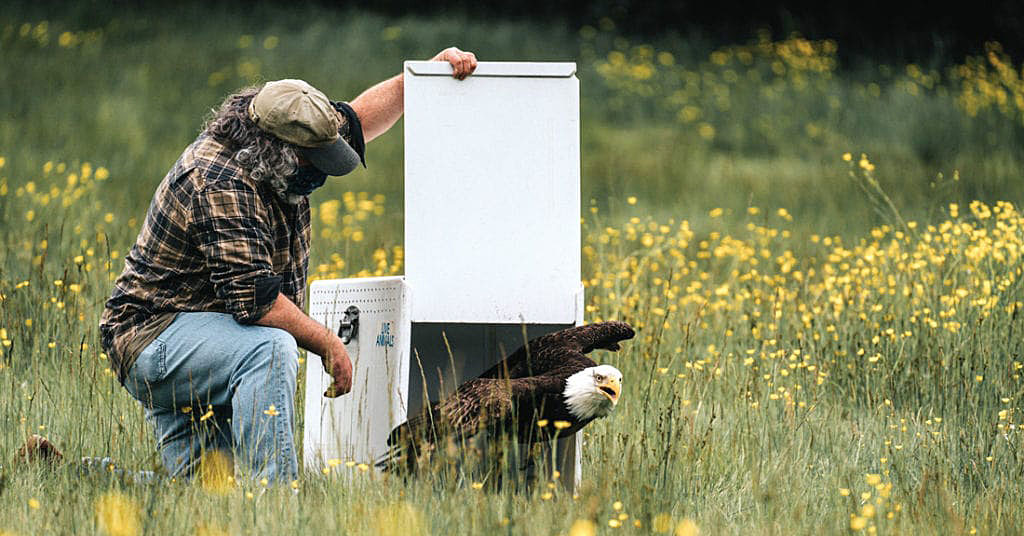
Bob Sallinger releases eagle

New beginning: Bob Sallinger of the Bird Alliance of Oregon releases an eagle into the wild. Sallinger is one of a group of conservationists hoping for changes within the Oregon Department of Fish and Wildlife. Photo: Ashlie Rene-Gonzales/Bird Alliance of Oregon

By Kendra Chamberlain. May 8, 2024. It’s a pivotal moment for Oregon’s Department of Fish and Wildlife.

The department’s director of 10 years, Curt Melcher, retired in April, and the Fish and Wildlife Commission is down to the wire picking a replacement.

Conservationists like Bob Sallinger are hoping the new hire will steer the department toward a more holistic approach to managing the state’s biodiversity. Sallinger is executive director of Bird Conservation Oregon and urban conservation director with Willamette Riverkeeper.

Talk of reform at the agency has gained steam in recent years.

Both hunting communities and environmental groups agree that the state’s wildlife are facing increasing pressures from climate change, drought, wildfire risk and water contamination.

The Fish and Wildlife Commission has narrowed the field of applicants to two finalists: Debbie Colbert, currently ODFW deputy director of Fish and Wildlife Programs; and Kaitlin Lovell, a former attorney for Trout Unlimited currently with the Portland Bureau of Environmental Services. [UPDATE: On May 10, 2024, the Oregon Fish and Wildlife Commission voted unanimously to select Dr. Debbie Colbert as the new ODFW Director.]

Environmental groups in the Pacific Northwest are increasingly interested in reforming how state wildlife managers steward land, at times coming in conflict with hunters and anglers.

Broad changes in policy, especially surrounding wildlife, can become freighted with tension.

Recent efforts by Washington’s Fish and Wildlife Commission to reform the state’s wildlife management policies became so contentious the efforts were put on hold indefinitely.

In ODFW’s case, reform “may be too much of a loaded term,” Sallinger told Columbia Insight.

He said the agency has already done a lot of the groundwork for tackling the biodiversity and climate crises.

“The basic building blocks are there. And I think the mission is there, I think the plans are there,” said Sallinger. “The question is whether the agency commitment is there and the funding is there.”

Broadening the base

Funding has remained a perennial problem for ODFW.

The department relies heavily on revenue generated from hunting and angling, while many conservation and stewardship priorities are consistently underfunded.

Former director Curt Melcher inherited a $32 million budget shortfall when he took the reins of the department in 2014, according to the Statesman Journal.

Former ODFW Direct Curt Melcher

Out and About: Retired ODFW Director Curt Melcher. Photo: ODFW/Curt Melcher

But he was able to stabilize the agency’s finances—for the near term, at least—as well as expand funding for some conservation initiatives such as in-stream water rights and habitat connectivity.

Sallinger believes more needs to be done, and sooner rather than later.

“We have a biodiversity crisis. We have a climate crisis. And ODFW in the next couple of years—not right now, but in the next few years—is going to have a budget crisis as well. And all of those things speak to a need to broaden the mission and broaden the base [of the department].”

That last point—broadening the base of the department—is a tall order.

In order to take on more stewardship programs, it’s going to need to find new revenue streams, Sallinger said.

He pointed to a 2023 legislative proposal for a hotel tax that could go toward ODFW. The initiative had support from both hunting groups and environmental groups, but ultimately failed to pass the state’s legislature.

“I think it’s a really great idea. A lot of people come to Oregon to see its wildlife,” he said.

But any proposal to raise more funds for ODFW will need widespread public support.

“The legislature is not going to take action without public support. And so you’re going to have to build a base for that,” he said.

It’s not just about getting the hunters and conservationists to work together, either. In the face of drought, climate change and increased wildfire risk, that’s happening already.

There’s also a need to bring in more interest and support for conservation from urban and suburban populations of the state.

“The degraded river habitat in Portland undermines all the work in the Willamette River system that goes on upstream for salmon, for example,” said Sallinger. “So I think really engaging a broader population not just to increase the funding base but to create a sense of stewardship and shared responsibility [is important].

“The challenge for ODFW as it hires a new leader is going to be to really bring these different constituencies together—whether it’s traditional constituencies hunting and angling, tribes, conservation groups, bridging the urban and rural divide—all of those things are going to be essential if we’re really going to step into these challenges.”

The Commission is hoping to make its decision on May 10.

By |2026-01-26T14:21:50-08:0005/08/2024|Conservation, Government|1 Comment

Can ‘two-eyed seeing’ save our forests?

The Forest Service is becoming open to integrating Indigenous land management practices into its own work

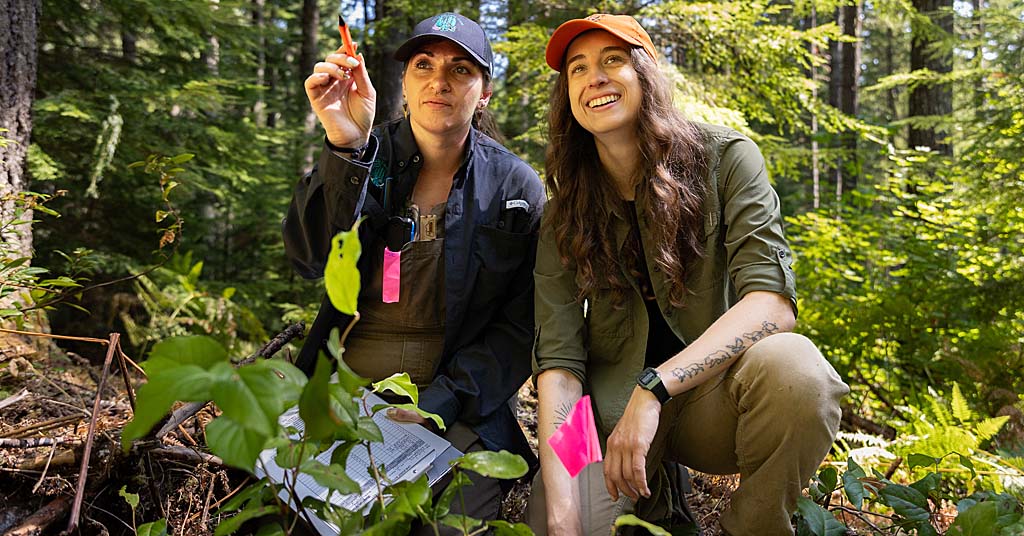
Ashley Russell (left) and Tessa Chesonis survey an Oregon forest.

Joining forces: Using western science and Indigenous knowledge, Ashley Russell (left) and Tessa Chesonis survey an Oregon forest. Russell is the interim director of culture and natural resources for the Confederated Tribes of the Coos, Lower Umpqua and Siuslaw Indians. Chesonis is an OSU graduate student. Photo: OSU

By Kendra Chamberlain. April 24, 2024. Land management in the United States will need a paradigm shift to survive climate change and a legacy of mismanagement.

A team of scholars and practitioners across North America are calling for a “two-eyed seeing” approach to land management. This means genuine collaboration between Indigenous and western governments.

The policy recommendations were outlined in a report released April 10. The report was co-led by Oregon State University professors Cristina Eisenberg and Michael Paul Nelson; and fire ecologists Susan Prichard of the University of Washington and Paul Hessburg of the U.S. Forest Service’s Pacific Northwest Research Station.

Forest management in the United States is at a crucial juncture, and agencies such as the Forest Service are more open to integrating Indigenous knowledge and practices of land stewardship.

“We are very interested in understanding how Indigenous Knowledge can be used in combination with western science to improve our management of all forest conditions including old growth,” Forest Service Deputy Chief Chris French said in a press release. “This report is a big step in improving our understanding of how to do that.”

In the Pacific Northwest, two-eyed seeing in part addresses misconceptions about fire and conservation.

For starters, it requires forests to be treated as dynamic and not static landscapes—this includes old-growth forests and protected areas.

“Change is constant in nature,” says OSU’s Eisenberg (Rarámuri and Western Apache), Oregon State University’s associate dean for Inclusive Excellence and Maybelle Clark Macdonald Director of Tribal Initiatives in Natural Resources. “Change is a key element of Indigenous knowledge, acknowledging it. And then what comes with that change is we need to pay attention to what the natural world is telling us.”

Eisenberg says Indigenous practices emphasize place-based land management strategies, where decisions are reflective of what each specific area needs.

“We steward the forest the way we would steward a family, taking care of everybody, our elders, our youth, making sure everybody has what they need and is respected,” says Eisenberg. “Each one has its own needs, the way each family has its own needs. And you learn from the forest and the forest tells you what it needs.”

Trail blazers

Many forests in the Pacific Northwest are actually “maladapted” ecosystems that have emerged under a 100-plus year regime of fire suppression, according to the report.

They’re denser than they should be, and need to be thinned out in order to restore them to health.

Cristina Eisenberg (Rarámuri and Western Apache) is Oregon State University’s Associate Dean for Inclusive Excellence

Cristina Eisenberg. Photo: OSU

Historically, fire has played an important role in forest ecosystems of the Pacific Northwest.

The report notes that both natural and human-ignited fire “is a fundamental process across nearly all ecocultural systems of this region.”

Indigenous ecocultural fire practices will need to be reintroduced—albeit carefully—to help these ecosystems regain resilience in the face of climate change.

The role of fire varies significantly across ecosystems and Indigenous cultural practices, and needs to be rooted in nuanced, place-based knowledge of specific landscapes.

This idea runs contrary to current federal forest policies around prescribed burning, which use more of a one-size-fits-all approach.

“Applying a concept that is universally measured the same way across all forests in the United States, doesn’t work because each forest is different,” says Eisenberg. “The native way is we burned ridges sometimes, sometimes we would burn over streams.

“It depended and the elders would say, ‘Well, gee, we think you should think about this area. I think it needs some tending with fire.’ And so it was very place-based and situation-based.”

Experts from four Tribes, 10 universities, the Forest Service and a handful of environmental firms contributed to the report.

By |2026-02-09T11:05:37-08:0004/24/2024|Conservation, Forestry|1 Comment

© Copyright 2013-2025 Columbia Insight. All Rights Reserved.

As a 501(c)3 nonprofit organization, all donations to Columbia Insight are tax deductible to the full extent of the law. Our nonprofit federal tax-exempt number is 82-4504894.