Stay Updated Subscribe today for the latest research + reporting about environmental news. Subscribe Now

Stay Updated Subscribe today for the latest research + reporting about environmental news.

Subscribe Now

Jim Drake

Jim Drake

Jim Drake

About Jim Drake

Jim Drake is a freelance writer and media consultant living in Hood River, Oregon.

Night skies are getting brighter. This group is pushing back

DarkSky Oregon is lobbying Columbia River Gorge communities to adopt policies that would reduce nighttime illumination
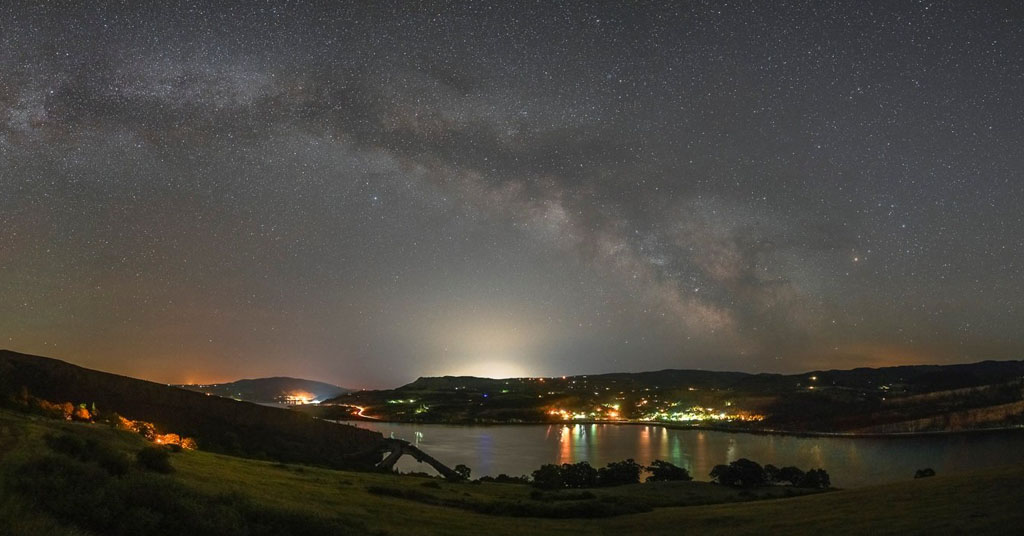
Columbia River Gorge night sky

Night lights: Looking east from Burdoin Mountain across the Columbia River at the lights of Mosier, Ore. The bright, white glow on the horizon (center) is the light dome over The Dalles, Ore. The bright spot to the left at river level is Lyle, Wash. The orange glow on the horizon left of Lyle is from Goldendale, Wash., 30 miles distant with a contribution from Washington’s Tri Cities, 120 miles distant. Photo: Mike McKeag

By Jim Drake. July 18, 2024. Two Gorge residents in Oregon are trying to convince officials that light pollution is on the rise and that adopting “dark sky” policies for outdoor lighting will help bring traditional nighttime back to the Columbia River Gorge.

Mike Hendricks of Hood River and Michael McKeag of Mosier have been organizing community outreach programs and collecting years of nighttime sky-quality data to promote the work of DarkSky Oregon, a chapter of DarkSky International, dedicated to reducing light pollution “for the health, safety and well-being of all life.”

According to Hendricks, the view of the night sky is better in Hood River than in big cities, but he’s afraid if rural communities don’t act now to reduce the ever-expanding impact of lighting at night, the beauty and majesty of the Milky Way will fade from view.

Generations will be left without an opportunity to be inspired by the stars.

Hendricks started a local advocacy group, DarkSky Gorge, to raise awareness, and is encouraged by the 85 members so far.

“I joined in this effort because I love the dark sky at night, it’s really nothing more complicated than that. I’m lucky enough to have a view of the sky from our deck and when you look at it, you understand your place in the universe,” says Hendricks.

How lights impact wildlife

It turns out light pollution causes more problems than just having a negative impact on viewing the night skies.

Scientists have amassed a body of research showing that unintended consequences of Artificial Light At Night (ALAN) is creating a host of environmental problems.

Michael McKeag of DarkSky Oregon

Michael McKeag. Photo: Michael McKeag

These include interfering with bird migrations, significant decreases in insect populations, changes in nocturnal animal behavior and sleep patterns, throwing normal predation/prey relationships into imbalance, decreasing nighttime pollination processes, disrupting aquatic populations and even changing the foliage cycles for trees.

“My colleague, John Barantine at DarkSky International, has compiled a database of more than 5,000 papers on ALAN research, and he produces a yearly summary of major findings,” says McKeag.

Humans aren’t immune to changes in the nighttime sky.

Extra exposure to light during what should be dark nighttime conditions can affect melatonin levels, important in many hormonal body functions.

And in a sort of ironic technological twist, modern LED lights, which account for energy savings, can produce a spectrum of light that has higher levels (than previous bulbs) of blue light, which is the normal color of daylight.

Studies show that exposure to blue light (420-440 nanometer wavelength) from LED bulbs can suppress melatonin production, interfering with natural sleep cycles and circadian rhythms in humans and animals.

Monitoring Gorge skies

Efforts to measure and document the nighttime sky conditions affected by light from cities, buildings, streetlights and other outdoor lighting sources are being led by groups like DarkSky International and their state chapters.

DarkSky International has an interest in returning the night sky to conditions that allow a clear view for all to see.

Today’s nighttime view is impacted by light domes that emanate from cities and can have an impact hundreds of miles away.

Stray light and light from upward facing fixtures can be reflected by clouds and interact with dust particles creating “skyglow.”

With the use of satellite data and monitoring stations on the ground, a picture of light pollution impact is being developed.
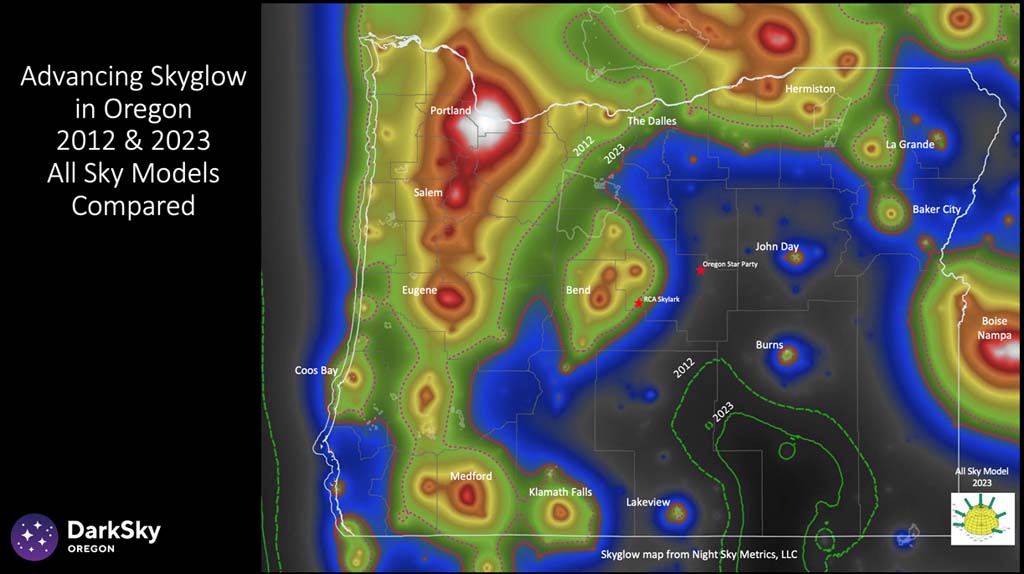
Oregon sky glow graphic

Comparison of the shift of the boundaries between light polluted and relatively pristine night sky between 2012 and 2023. Source: DarkSky Oregon

The DarkSky Oregon Chapter has been collecting, analyzing and charting light pollution data for at least five years.

Since 2019, DarkSky Oregon co-founder Bill Kowalik and McKeag have worked on the chapter’s Sky Quality Meter Program. An estimated 10 million data points have been collected pertaining to overall night brightness for 53 locations in Oregon.

By combining remote sensing information from satellites and data from a network of Sky Quality Meters, McKeag and colleagues were able to summarize measurements from 2012 to 2020, showing a 30% increase in “uplight” in the Columbia River Gorge National Scenic Area.

McKeag says at least three years of data is needed to measure a statistically significant trend among Gorge communities.

“At the top of the list [for artificial light at night] is The Dalles, and second is Hood River,” says McKeag.

More data will be collected in 2024.

“DarkSky Oregon will be extending our statewide network of night sky monitoring stations to include sites at intervals the length of the Columbia River Gorge National Scenic Area, with installations starting this year,” says McKeag.

Promoting dark skies

In past years, McKeag has worked with the city of Mosier to get a Dark Sky Community Certification, presented his Sky Quality Meter data to the Gorge Climate Action Network and spoken with staff from the Gorge Commission (in charge of overseeing policies for the Columbia River Gorge National Scenic Area) about sky-quality data.

“There was interest from the Gorge Commission to look at the sky-quality data as it pertains to Key Viewing Areas, and the commission admitted that they didn’t really think about how the KVA would look at night,” says McKeag.
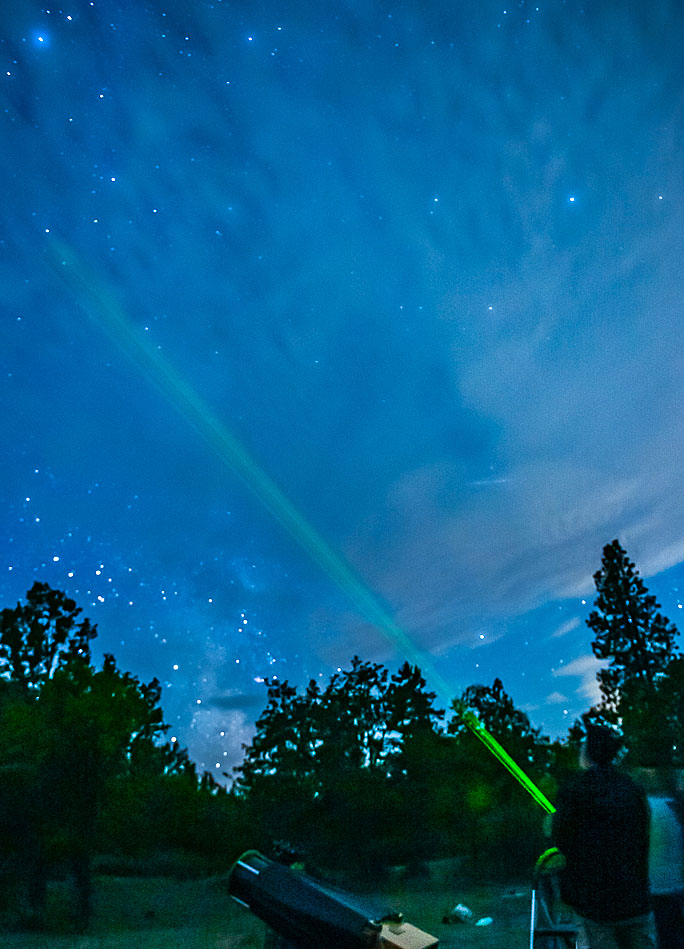
Mike McKeag uses a laser pointer during a presentation in Hood River, Ore.

Seeing stars: Michael McKeag (bottom right) uses a laser pointer during a night-sky presentation in Hood River, Ore. Photo: Jurgen Hess

McKeag visited with staff at Timberline Lodge on Mount Hood in order to get the facility to turn off the ski slope lights during a Rose City Astronomy stargazing event.

“It was a chore for them to even try and figure out how to turn them off, but they did it, and people got to experience the transition of what you could observe in the sky when the lights went out. It was educational on how different it was,” he says.

McKeag says Travel Oregon is vigorously promoting dark sky tourism in rural areas.

“One of the resources they have is dark skies, and they could even be darker if they made changes to their outdoor lighting,” he says. “Urbanites are aware of the rewards, and they’re willing to travel and spend money when they do.”

Changing lighting codes

An additional byproduct of light pollution is wasted energy.

DarkSky organizations say one-third of all outdoor lighting is useless because the light is not directed at the right place. It’s common to have too much light switched on for an intended purpose—the use of dimmers and timers could result in significant savings.

The group calculates that the planet became 9% brighter at night from 2012-19.

That’s a good reason to urge the City of Hood River to take a look at adopting Dark Sky outdoor lighting requirements, says Mike Hendricks.

Mike Hendricks of DarkSky Oregon

Mike Hendricks. Photo: Mike Hendricks

He points to the recent adoption of outdoor lighting codes by the city of Sisters, Ore., which incorporates Dark Sky lighting recommendations and has a five-year timeline for getting all public and private outdoor lighting up to DarkSky codes.

The codes allow temporary lights for holiday decorating and provide exemptions for security purposes, but eliminate upward-pointing light fixtures, searchlights and laser-light devices that extend past property boundaries.

“Right now, our codes in Hood River don’t really address outdoor lighting,” says Hendricks. “I’ve been having talks with our city planner and they have a copy of the recent outdoor lighting code [adopted in Sisters].”

“We’ve even approached the Hood River-White Salmon Bridge Authority, and particularly its Bridge Aesthetics Committee, on lighting for the new bridge, and from recent public meetings their aesthetics committee has incorporated some of our Dark Sky lighting language into account. It will be interesting to see their report, which is due in coming weeks.”

McKeag is an avid photographer and is involved with regional astronomy clubs that rely on dark skies for star parties and other community outreach events.

“I’ve taken long-exposure photographs from the Dalles Mountain looking across the light pollution from The Dalles and you can see the light dome of Portland,” says McKeag. “It’s so large, you can see it from central Oregon. In fact, I was just looking at a photograph that a person had taken from the south rim of Crater Lake looking across Wizard Island. Looking to the northeast you can see a conspicuous yellow blob on the horizon.”

He believes communities can work together to make dark skies a reality for the Gorge.

“Light pollution isn’t stored in the atmosphere or water or soil, so it really is the easiest form of pollution to address. It’s really just the flick of a switch, and it’s getting people to stop and think about it,” says McKeag. “We’re making arguments against light pollution based on evidence, not just opinion, and we’re trying to provide people with the firsthand experience of a dark sky, hoping to turn them into advocates. In turn they should tell their public officials that Dark Sky policies are a good idea.”

Jubitz Family Foundation logoColumbia Insight’s reporting on environmental issues in Oregon’s Hood River Valley is supported by the Jubitz Family Foundation.
By |2026-01-13T15:38:31-08:0007/18/2024|Natural Resources|4 Comments

4 ways the Columbia River Gorge is being impacted by climate change

Takeaways from a recent conference include confirmation of higher temperatures and increasing calls for environmental justice

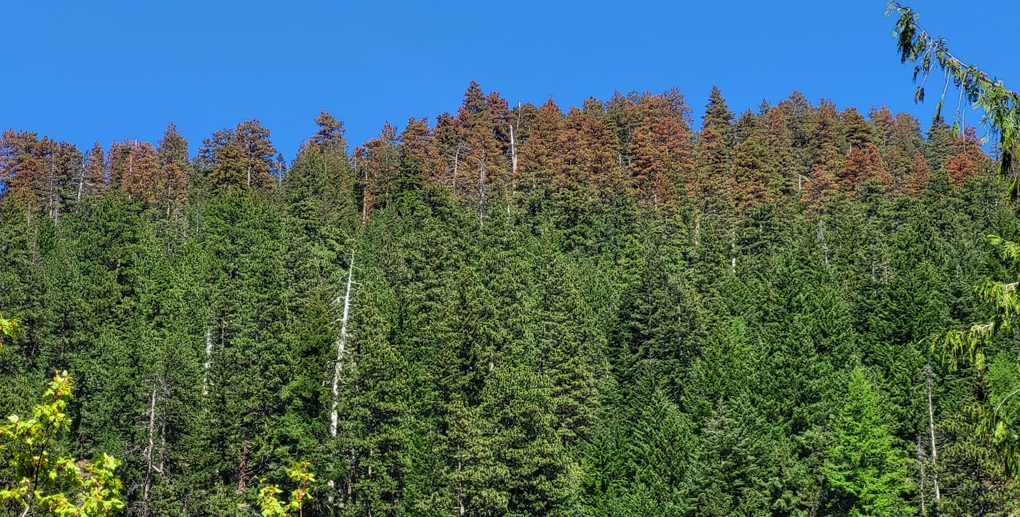
Dying trees in Oregon

Growing problem: Instead of regeneration, these treetops near Hood River are showing signs of decline. Photo: Jurgenhessphotography

By Jim Drake. June 15, 2023. “Climate change” is a problem. Not just the basic concept. Even the terminology is problematic.

So much so that Arnold Schwarzenegger recently recommended getting rid of the phrase altogether.

“As long as they keep talking about global climate change, they are not gonna go anywhere. ‘Cause no one gives a s— about that,” Schwarzenegger told CBS Sunday Morning. “Let’s rephrase this and communicate differently about it and really tell people—we’re talking about pollution. Pollution creates climate change, and pollution kills.

A May 20 conference in the The Dalles, Ore., didn’t go quite that far. But in staging “Adapting to Climate Change in the Gorge” at the Columbia Gorge Discovery Center & Museum, organizers by and large succeeded in framing a sometimes abstract issue as a pressing concern at home. 

Over the course of the day, a dozen or so experts and over 100 attendees discussed the effects of warming water temperatures on fish runs in the Columbia River, how climate change has already led to revisions in the Columbia River Gorge National Scenic Area management plan and changes in local wildlife populations and vegetation in the Gorge.

“We’ve been about action since 1976, and tackling a problem like climate change is analogous to removing invasive weeds,” said Pat Arnold of Friends of the White Salmon River. “We hope this conference helps in building a network for local action, and uses diversity and environmental justice as the core values.”

Over the course of the day, four primary themes emerged.

The Gorge will get even hotter. And drier

The conference began with a discussion of current climate change impacts on the Cascade Range, and what to expect over the next half century.

Dr. Oriana Chegwidden, a hydrologist and research scientist at CarbonPlan (a nonprofit that contributes science and data for climate action) specializing in civil and environmental engineering, said global temperature increases won’t spare the Gorge.

“Our data shows that the Pacific Northwest will get warmer, likely a 5-10 degree increase, and wetter,” she said. “By 2080, snow accumulation will be gone. A lot of places won’t have snow anymore. Precipitation that used to fall as snow will fall as rain.”

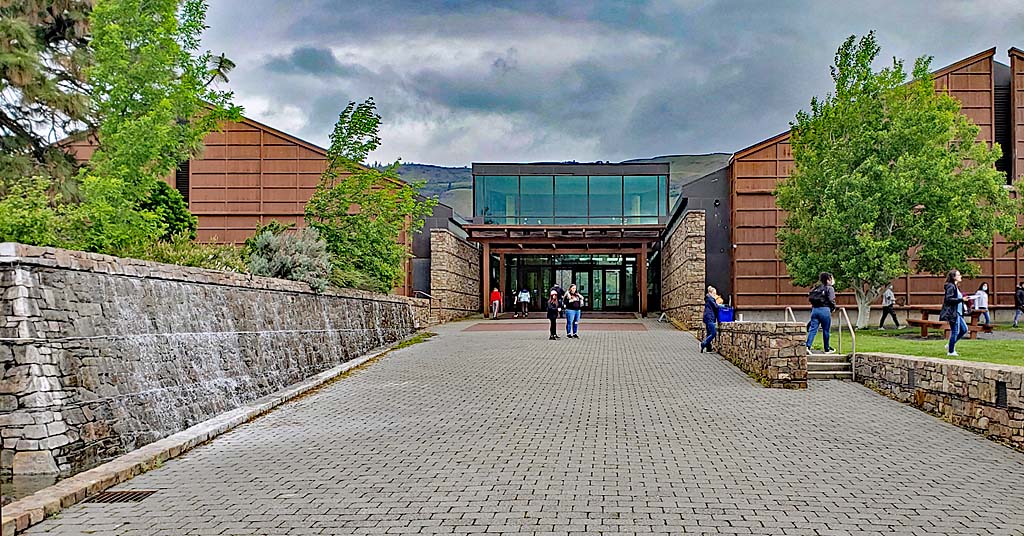
Columbia Gorge Discovery Center & Museum exterior

Building issues: Adapting to Climate Change in the Gorge drew over 100 attendees to the Columbia Gorge Discovery Center & Museum in The Dalles. Photo: Jurgenhessphotography

The lack of snowpack will impact everything from salmon runs to energy production to agriculture in a region that relies on hydroelectricity from dams.

“Snow is a reservoir of water that we’ve relied on for providing cold water for fish throughout the year,” said Chegwidden. “And, of course, the U.S and Canada rely on snow as a source of water for hydroelectric power generation.”

Chegwidden said as snowpack dwindles, changes will be reflected in wildlife habitats, recreational uses, stream temperatures and increased in fire risks.

Cold water refuges will take on greater importance

As water temperatures increase, cool spots in rivers and streams—often created at the confluence of mountain streams and the main stem of the Columbia River—are increasingly used by migrating fish.

Scientists call these areas of naturally occurring thermal relief “cold water refuges” or CWR. They’re sometimes referred to as “thermal refuges,” “thermal sanctuaries” or simply “refugia,” but each term describes the same thing.

Several speakers addressed the need to rehabilitate Gorge streambeds and riverbanks to provide a temperature-controlled waterway necessary for salmon survival.

“We know 60,000-70,000 steelhead will use cold water refuges in August and September,” said biologist Bill Weiler, adding that tree-planting on the Sandy River near Portland has helped the salmon population there. “Creating cold water refuges increases survival rate by 10 times.”

“Climate change is yet another factor in how fish populations are affected,” said stream ecologist Pat Connolly. “The question of survival depends on how we take care of the watersheds, and that includes the Pacific Ocean. Will we be able to fix enough of the stressors in their environment?”

Orchardists will stop burning old trees

“An orchard has a lifespan—about 25 years,” according to Dr. Ashley Thompson, of the Mid-Columbia Ag Research Station, an OSU Extension service that offers guidance on orchard management.

Orchardists are constantly pulling out trees at the end of their lifespan and replanting with new stock. Thompson is working with orchardists in the Gorge to find alternatives to making burn piles of trees and other orchard debris that needs to be disposed of.

Apple harvest at Draper Girls' Country Farm

Oregon’s Hood River Valley. Photo: Oregon Taste

“Burning is a cheap way for disposal, but trying to mitigate and adapt to climate change is pressuring us to reduce the amount of CO2 back into the air,” said Thompson. “We’re looking at ways of keeping the carbon sequestered.”

One procedure is called “orchard mulching.”

“Orchard mulching is a heavy-duty, wood-chipping type machine that uses diesel fuel, but it’s a way of returning carbon to the soil,” said Thompson. “There’s even a mulch-in-place machine, which travels along a path and deposits the material as it goes along. But right now, that’s an expensive option.”

Another experimental method is the creation of “biochar.”

Using extremely high temperatures, orchard waste material undergoes pyrolysis (decomposition brought about by high temperatures) to form a charcoal-like material that sequesters carbon, and may hold more nutrients and water in the soil.

But some studies indicate soil chemistry may be changed by the creation of biochar and nutrient uptake by some crops may be affected.

“Right now, the EPA is saying biochar creation is in itself a point source of pollution,” said Thompson. “And it’s mega-expensive. A biochar machine is not in the budget of a single-family orchard. But I’ve always wondered about the possibility of farms coming together to buy one.”

Environmental justice will be front and center

A session titled “Climate Change and Environmental Equity” presented perspectives from both the Yakama Nation and the Gorge’s Latino community.

Elaine Harvey, a Yakama tribal member and environmental coordinator for the Yakama Nation Fisheries, told the audience her tribe has been aware of climate change effects for decades, because tribal members actively collect food in ways that date back before encountering the Lewis and Clark expedition in 1805.

Elaine Harvey speaks at climate change conference in The Dalles

Historic concerns: Elaine Harvey addresses the conference. Photo: Jurgenhessphotography

“The fishing, root and berry harvest seasons are no longer consistent and are a reflection of a changing climate,” she said, reading a statement from tribal members.

But the real message was in Harvey’s voice, which reflected a passionate connection to the land.

“Climate change is happening already. We are there everyday. I’m speaking on behalf of the species, the water and the land. We’ve gotta protect these things for the unborn,” said Harvey.

Harvey said the Yakama tribe’s Climate Adaptation Plan from 2021 focuses on tracking fish, water quality issues, huckleberry strategies and works to protect treaty-reserved species.

“We really need to work with the Washington Department of Natural Resources to bring beaver back to the watershed areas,” said Harvey.

Ubaldo Hernandez, an activist in the Latino community and outreach coordinator for Columbia Riverkeeper, took on the topic of bringing social justice in line with the movement to adapt to environmental changes. Having grown up in an activist family in Mexico City, Hernandez said communities need to be open and welcoming to the views of people of color to prevent inequality.

“We want to be part of the discussion and have a place to speak up,” he said.

Speaking about farmworker issues, including the risks of farmworkers to pesticide use and not having access to forums to voice concerns, Ubaldo said his work at Columbia Riverkeeper has demonstrated how important the river is to all of us.

“But we have to talk about social justice when it comes to climate change, and we have to tell you how we feel about this from the perspective of the farm worker community,” he said. “We can’t just be told that we have to be concerned. In order to change, we need to have a conversation.”

By |2023-06-15T07:37:42-07:0006/15/2023|Climate Change|1 Comment

Venta de madera SDS: mientras los lugareños se preocupan, las empresas evaden las preguntas

La falta de información conduce a un malestar cada vez mayor a medida que una empresa de inversiones de Nueva York se muda para manejar la venta de un elemento importante de tala de Columbia Gorge

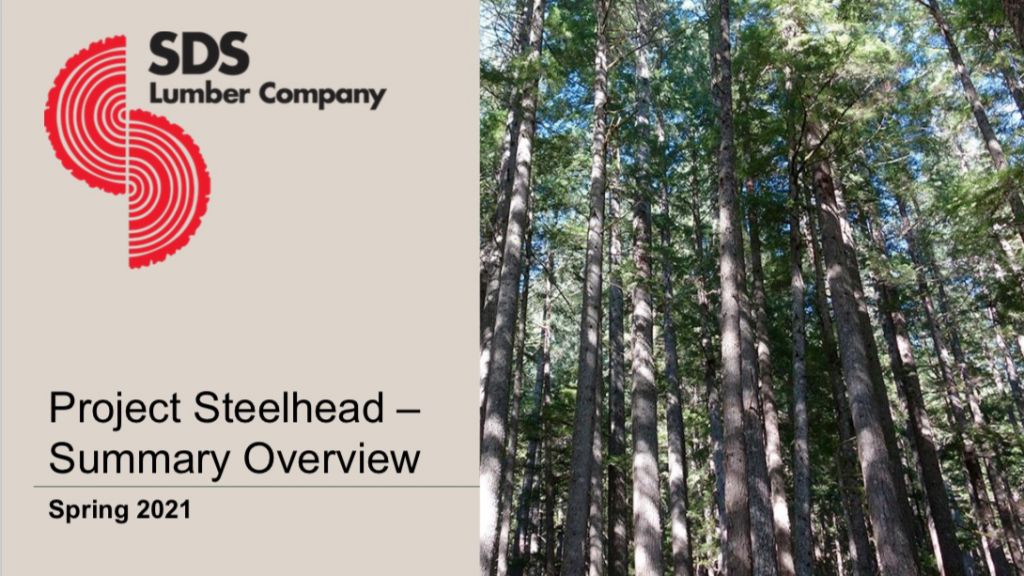
SDS Project Steelhead Brochure Cover

Perella Weinberg Partners, con sede en Nueva York, ha preparado este folleto para facilitar la venta de las participaciones de SDS Lumber Company.

Por Jim Drake y Chuck Thompson. Durante 75 años, SDS Lumber Company con sede en Bingen, Washington, ha estado administrando 100,000 acres de los principales recursos forestales del noroeste del Pacífico, así como las operaciones de los aserraderos locales en el corazón del río Columbia Gorge. En septiembre de 2020, un comunicado de prensa de SDS anunció que los accionistas de la empresa habían decidido explorar la venta de sus propiedades forestales y molinos.

El presidente de SDS, Jeff Webber, dijo en ese momento que la compañía y sus diversas propiedades (incluidas las operaciones de transporte por carretera, marítimas y de bienes raíces comerciales) podrían venderse en su totalidad o venderse por partes a múltiples compradores.

SDS fue fundada en Bingen en 1946 por Wally Stevenson, Frank Daubenspeck y Bruce Stevenson. Las operaciones de su molino emplean actualmente a unas 350 personas.

La noticia del posible cambio de propiedad hizo sonar las alarmas en toda la región. Las preocupaciones en torno a la venta se han centrado en gran medida en saber si un nuevo propietario podría proporcionar el tipo de administración comunitaria, que se cree que ha hecho de la propiedad local de SDS un dueño justo, no solo de la tierra que tala sino de las comunidades dentro del ámbito de sus operaciones.

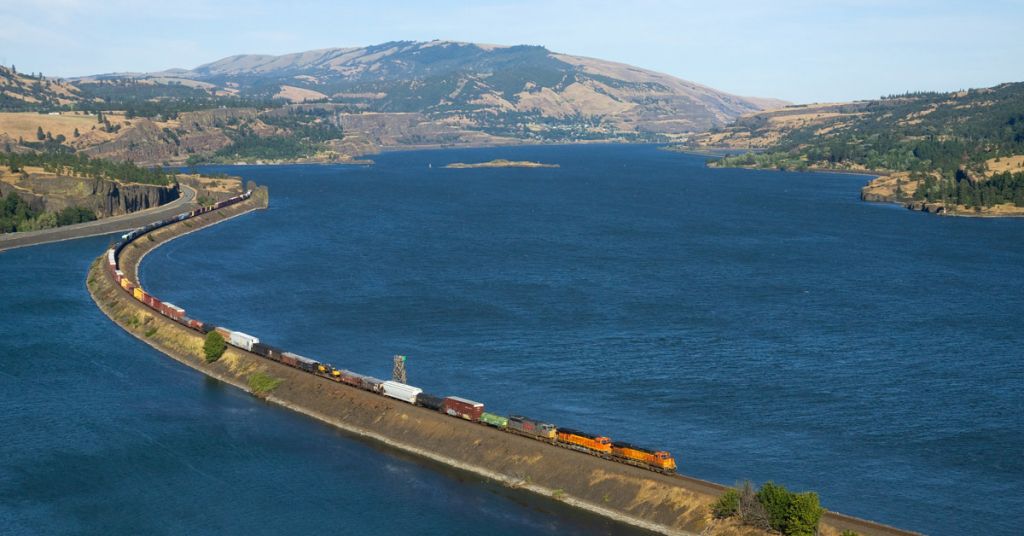
Columbia River between Lyle and Bingen WA Photo by David Gubler

Este tren de carga que viaja entre Lyle y Bingen, Washington, es un recordatorio de que el comercio compite con la conservación en Columbia River Gorge. Foto de David Gubler / Creative Commons

Por solo un ejemplo, entre las muchas parcelas grandes que posee, SDS posee tierras adyacentes al río White Salmon, al que se le ha otorgado el estatus de Salvaje y Escénico y ha experimentado cambios significativos debido a la remoción de represas en la última década. El aumento de la tala en el área por parte de un nuevo propietario podría revertir décadas de trabajo de los ambientalistas para proteger el corredor del río.

“Ese comunicado de prensa fue simplemente asombroso, porque no esperabas que una empresa que está tan profundamente arraigada aquí hiciera eso y fue como si algo estallara en nuestras caras”, dice Pat Arnold, quien dirige Friends of the White Salmon River, un grupo con sede en White Salmon, Washington, que ha estado defendiendo la protección de los recursos de las cuencas hidrográficas desde 1976.

Arnold dice que las prácticas de gestión de la madera de SDS superan las que siguen otras empresas.

“Creo que SDS es bastante único en este sentido. Hay una rotación de madera promedio en el estado de Washington de 35 años, pero SDS parece funcionar a un plazo mucho más largo ”, dice. “La integración vertical que tienen con su molino y la tierra es única”

“Proyecto Steelhead”

Las preocupaciones sobre la venta se han convertido en una absoluta paranoia en algunos círculos en las últimas semanas con el anuncio de que SDS ha contratado al banquero de inversiones con sede en Nueva York Perella Weinberg Partners (PWP) para negociar su venta.

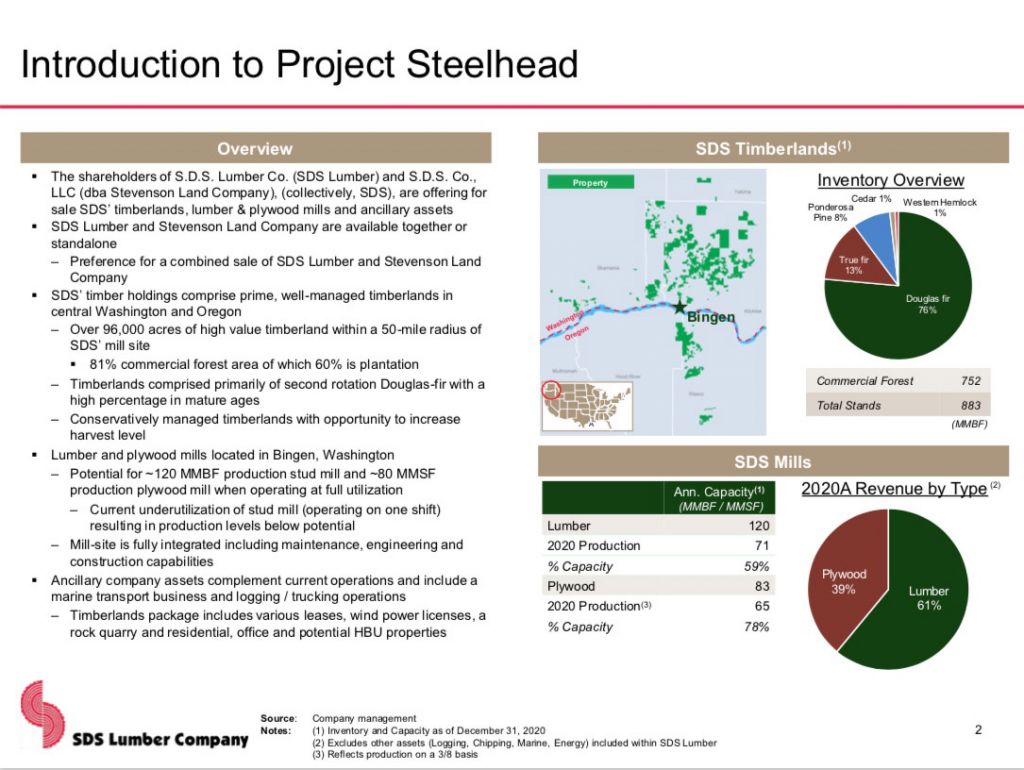
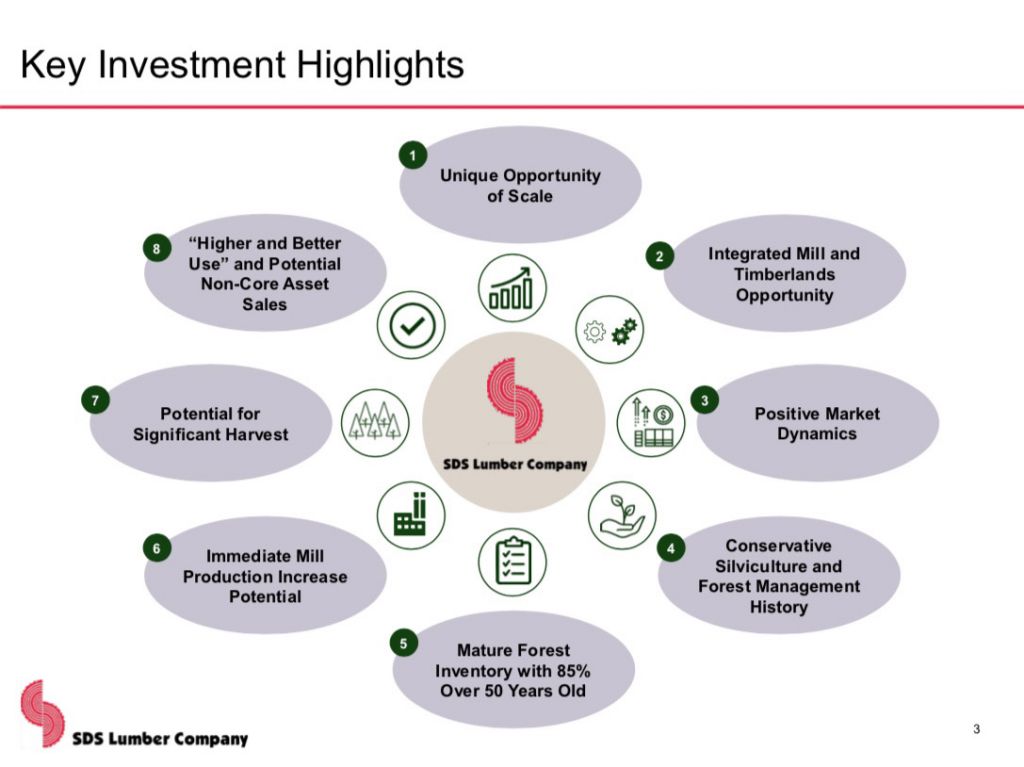
PWP está llamando a su campaña para deshacerse de los activos de SDS “Proyecto Steelhead” (no está claro si ese nombre es intencionalmente irónico o simplemente el torpe intento de una empresa de inversión de la Costa Este de asociarse con un ícono de la Cuenca de Columbia) y ahora está circulando un folleto para inversionistas potenciales que promocionan aspectos clave de la inversión “. Estos incluyen un “inventario de bosques maduros con un 85% de más de 50 años” y “potencial de aprovechamiento significativo” con “potencial de aumento inmediato de la producción de la planta”. Traducción: capacidad para talar muchos árboles viejos, rápido.

Project Steelhead brochure Page 2

Project Steelhead brochure Page 3

Folleto del Proyecto Steelhead producido por Perella Weinberg Partners.

“La actual rotación de cosecha de 60 años, que se traduce en 1,700 acres por año, podría acelerar a una rotación de cosecha de 45 años más frecuente, produciendo 2,200 acres de cosecha por año, un aumento de casi el 30%”, escribió este mes, The Goldendale Sentinel.

“‘Proyecto Steelhead’ de hecho”, se lee en un comunicado de prensa de Friends of the White Salmon River que siguió a la circulación del folleto de PWP. “El folleto de ventas deja absolutamente claro que el resultado serán los máximos beneficios para SDS y para los inversionistas, al precio que el resto de nosotros pague. Se queja con nosotros”.

¿Beneficios a corto o largo plazo?

La carga financiera de una nueva empresa que probablemente se endeudará para adquirir SDS es otra preocupación. Arnold cree que quienquiera que compre la tierra probablemente tendrá que utilizar un modelo de negocio que busque ganancias a corto plazo para satisfacer a los accionistas.

“Lo más probable es que alguien entre y lleve la madera a otro aserradero y cierre este”, especula Arnold. “No se puede imaginar a nadie que intervenga y continúe con lo que está haciendo SDS. Probablemente ni siquiera sea factible “.

En ausencia del tipo de compromiso con la rotación de cosecha de madera a largo plazo con el que SDS ha operado, las prácticas de tala podrían tener graves impactos negativos en el hábitat de la vida silvestre y las tierras vecinas, y crear problemas de acceso a las carreteras públicas debido a la remoción inadecuada de árboles y la degradación de la calidad del agua en los peces. con arroyos debido a zonas de amortiguamiento inadecuadas. En el peor de los casos, dice Arnold, los nuevos propietarios podrían volver a zonificar parcelas forestales existentes en lotes residenciales, algo que, según ella, sería económicamente atractivo para una empresa que busca obtener ganancias rápidas.

Pat Arnold of Friends of the White Salmon River

Pat Arnold de Friends of the White Salmon River. Foto de Jim Drake

Sin embargo, existe otra posibilidad, planteada por The Goldendale Sentinel.

“A diferencia de los esfuerzos anteriores para vender SDS a las principales operaciones madereras del noroeste, el nombramiento de Perella Weinberg apunta más hacia la creación de una operación de gestión de inversiones en madera que será propiedad de ‘inversionistas-propietarios’ que puedan permitirse los horizontes de inversión a largo plazo ideales para el industria maderera ”, escribió el periódico. Goldendale es la sede del condado de Klickitat, donde se encuentra Bingen.

La película analiza las prácticas de SDS

En un esfuerzo por informar al público sobre la venta y la conexión de SDS con las comunidades a las que sirve, Friends of the White Salmon River se asoció con Joel Roth, un estudiante de secundaria local cuya familia está involucrada con el grupo Friends. Su interés en la realización cinematográfica lo llevó conversar sobre la creación de un video informativo.

Ese esfuerzo resultó en Uprooted, una película de nueve minutos que explora las prácticas de manejo forestal de SDS y los posibles impactos ambientales y económicos de su venta.

Con entrevistas con ex empleados del Departamento de Recursos Naturales del Estado de Washington, así como con un arqueólogo que trabajó para la Nación Yakama, el video analiza las prácticas de manejo forestal de SDS, los problemas del hábitat de la vida silvestre y las experiencias con el ahorro de los recursos culturales de los nativos americanos en tierras programadas para la tala.

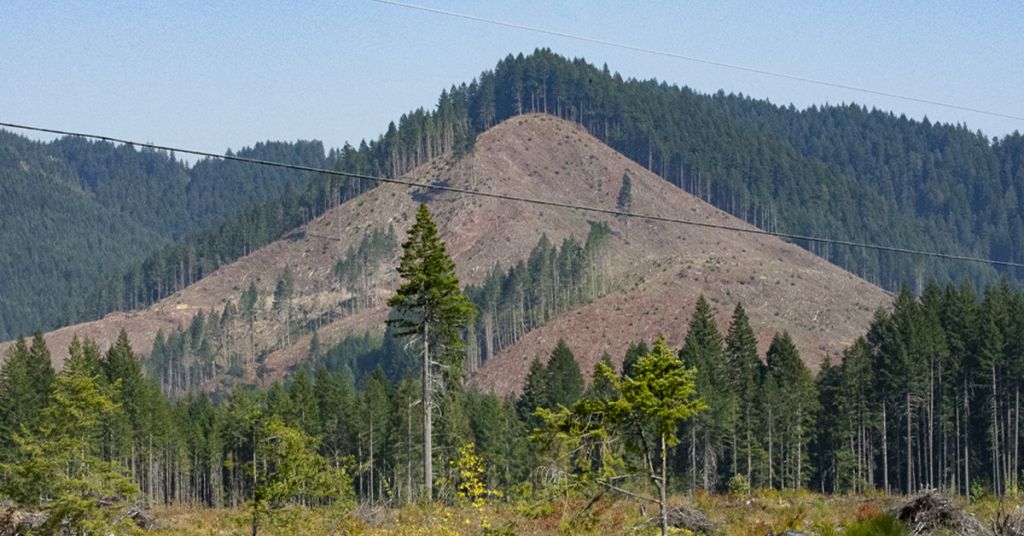
Clear cut in White Salmon River drainage

Los talados recientes, como este en el drenaje del río White Salmon, son parte del paisaje alrededor del río Columbia Gorge. Foto de Jurgen Hess

Según el video, los propietarios de tierras de hoy operan más como una empresa financiera que como una empresa centrada en la estabilidad ambiental a largo plazo.

“El comunicado de prensa de SDS indica que hay muchas personas nuevas en la junta directiva, la mayoría de las cuales probablemente no están relacionadas con el condado de Klickitat y no tienen ningún vínculo con nuestra área local”, dice Arnold. “Uno de ellos es un especialista en rescate empresarial de Portland”.

Según un artículo de octubre de 2020 publicado por Forest Economic Advisor, un sitio web de noticias sobre los mercados de la madera, los nuevos miembros de la junta (anunciados en septiembre) incluyen a Sandy McDade, una ejecutiva de Weyerhaeuser de 34 años con amplia experiencia en los mercados internacionales de madera, y Clyde Hamstreet, “ un especialista en cambios corporativos con sede en Portland “.

Preguntas de esquivar

Si Arnold y otros desconfían de la venta pendiente, las empresas involucradas no se desviven por mantener informadas a las comunidades locales sobre los desarrollos.

Columbia Insight ha realizado múltiples intentos de comunicarse con SDS, PWP y sus firmas afiliadas de relaciones con los medios para solicitar información o entrevistas sobre la venta de SDS.

En el caso de PWP, cuando finalmente se contactó por teléfono con una persona en la oficina comercial de la compañía en Nueva York, ella no se identificó y respondió a una solicitud para ponerse en contacto con un portavoz de PWP o un representante de los medios diciendo: “Podemos dar información de nuestra empresa “. Luego transfirió la llamada a un buzón de correo de voz que no funcionaba.

Las llamadas telefónicas a las oficinas de PWP en Los Ángeles y San Francisco (y, a veces, Nueva York) llegan a “Agility”, una unidad de subcontratación de CIO de $10 mil millones dentro de PWP que se especializa en estrategias de inversión para empresas externas como fondos de pensiones y fondos de cobertura.

Antes de unirse a Agility en 2009, el socio y director ejecutivo Chris Bittman fue director de inversiones de la Fundación de la Universidad de Colorado. En julio de 2020, Clarence Herbst, ex presidente de la Fundación de la Universidad de Colorado, demandó a la organización, alegando incumplimiento del deber fiduciario y violación de la ley estatal, según BusinessDen, un sitio web de noticias comerciales con sede en Denver. Aunque la demanda no nombró a Bittman o PWP como demandados, la demanda de Herbst afirmaba que “la Fundación CU ??comenzó su caída” con el nombramiento de Bittman como CIO y cuando contrató a PWP para administrar sus inversiones.

Según BusinessDen, Bittman dejó la fundación en 2009 para convertirse en socio de PWP, después de lo cual la fundación contrató a PWP para administrar sus inversiones.

“La Fundación CU ??no negoció los porcentajes de honorarios y costos que pagaría a PWP y otras firmas de administradores activos contratadas por PWP para ‘administrar’ los activos de la Fundación CU, y no lo ha hecho en los últimos diez años”, cita BusinessDen en la demanda. . “La Fundación CU ??realizó una transacción privilegiada con el Sr. Bittman y PWP”.

New York-based Julian Garratt, executive director, Perella Weinberg Partners

Julian Garratt lidera el equipo que gestiona la venta de SDS. Foto Perella Weinberg Partners

El 19 de mayo, en respuesta a un correo electrónico enviado al socio de PWP Jonathan Prather y al director ejecutivo Julian Garratt (ambos figuran como contactos en el folleto de ventas del Proyecto Steelhead) preguntando ampliamente sobre la venta de SDS y el papel de Agility en ella, Columbia Insight recibió un correo electrónico respuesta de Kara Findlay, directora general de PWP.

Dejando a un lado los saludos, el correo electrónico de Findlay dice en su totalidad: “Gracias por su correo electrónico. Nos negamos a comentar “.

La portavoz de SDS, Liz Fuller, de Gard Communications, con sede en Portland, que maneja las consultas de los medios sobre SDS Lumber, respondió a las consultas de Columbia Insight, aunque se negó a proporcionar actualizaciones o información sustantiva sobre el proceso de venta.

“Las puertas están abiertas de par en par para un tipo de manejo de la madera completamente diferente”, dice Arnold, resumiendo una preocupación cada vez más común en el río Columbia Gorge.

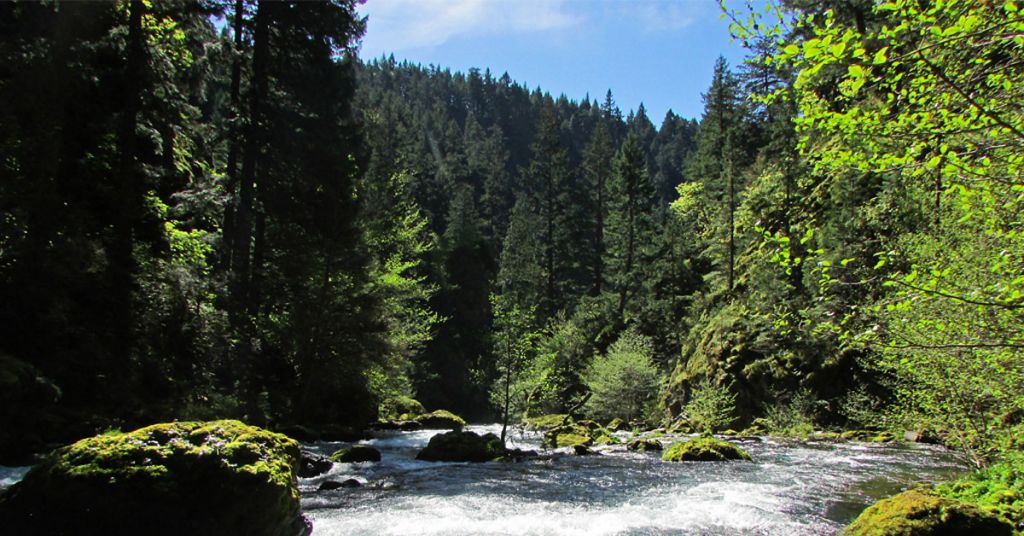
Spirit Falls Trail on Little White Salmon River in WA photo by Jeff Hollett

A los lugareños les preocupa que un comprador fuera del estado no comparta su consideración por lugares arbolados como esta a lo largo del sendero Spirit Falls en el río Little White Salmon. Foto de Jeff Hollett / Creative Commons

“Es un tema enormemente complejo y estamos haciendo todo lo posible para no convertir esto en algo en el que la gente esté de un lado o del otro. Lo único en lo que creo que la gente debería tomar una posición es en pedirle a SDS que comparta más información. SDS dijo en su comunicado de prensa, que se preocupan por la comunidad. Dijeron eso, así que veámoslo. ¿Cómo puede esto avanzar en la dirección que sea buena para todas las partes interesadas? ”

Jim Drake es un escritor independiente y consultor de medios que vive en Hood River, Oregon.

By |2021-10-05T15:02:30-07:0007/07/2021|Uncategorized|0 Comments

Canyon video: Critical habitat saved as part of landmark deal

Rare owl among species that inhabit newly designated, 11,000-acre Klickitat Canyon Conservation Area in Southwest Washington


Video highlights of the newly established Klickitat Canyon Conservation Area. Courtesy of Columbia Land Trust

By Jim Drake. July 30, 2020. More than a decade of work by one of the largest conservation land trust agencies in the Columbia River Basin was finalized last week with the purchase of a 4,900-acre parcel of land along the Klickitat River in Klickitat County in Southwest Washington.

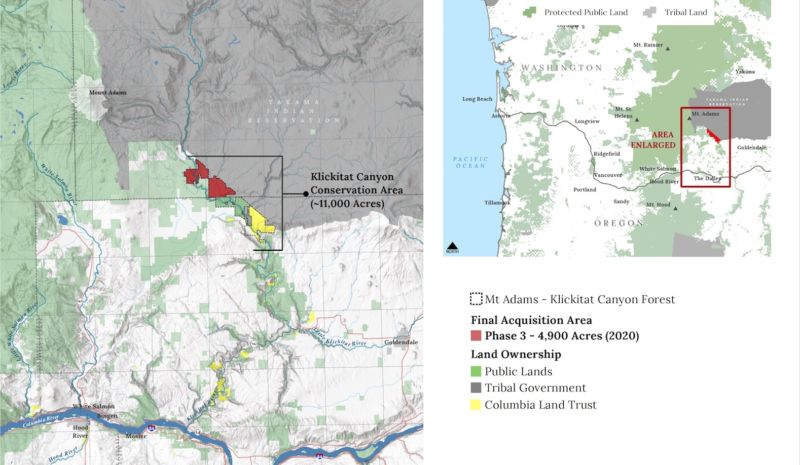
The purchase represents the third and final phase of a project led by Cherie Kearney, forest conservation director for the Columbia Land Trust. It establishes the Klickitat Canyon Conservation Area at 11,000 acres—the largest land holding in the Vancouver, Washington-based organization’s portfolio.

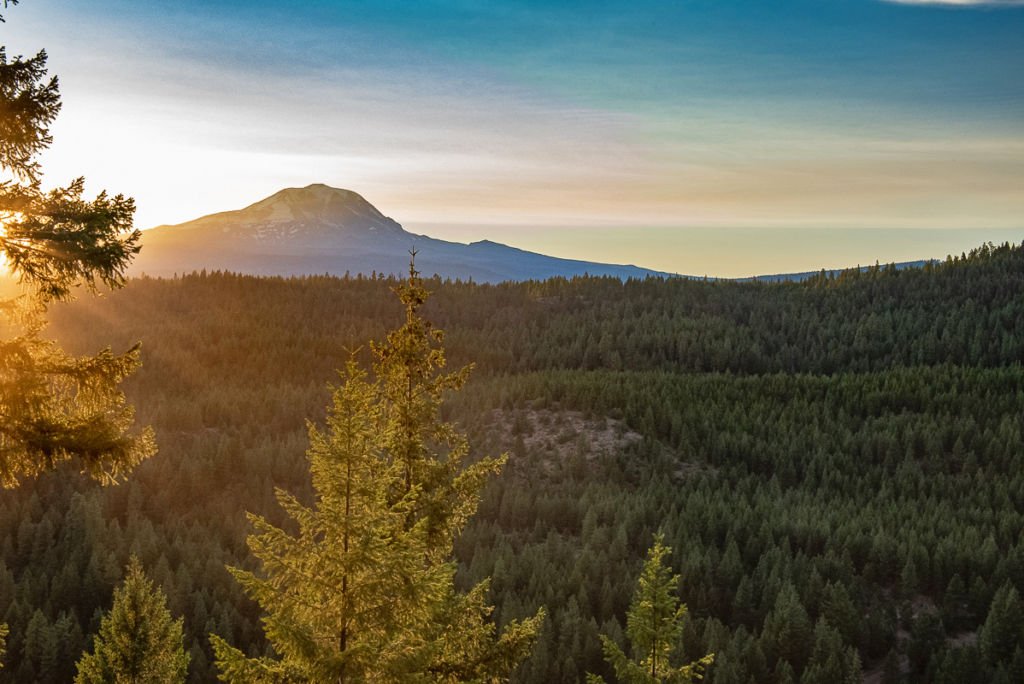
The wild and scenic riverfront property is home to storied salmon runs, dramatic basalt walls and ponderosa pine forests. Now that Columbia Land Trust are stewards of the area, the stunning wildlife habitat will be protected from development.

“This is the biggest piece of land we’ve ever bought,” says Kearney. “The other thrill for me is the bipartisan, diverse support that we’ve been able to enjoy over many years, working with the county commissioners, the community, the SDS Lumber Company, local ranchers and certainly with the Yakama Indian Nation.”

Perseverance rewarded

The Klickitat Canyon Conservation Area has been described as “a miniature Grand Canyon.”

“There are breathtaking vistas with sheer, jagged columnar basalt cliffs,” says Columbia Land Trust communications director Jay Kosa. “It’s prime elk and deer habitat. People raft and kayak through the canyon, and there are great sightseeing opportunities.”

The organization credits the success of the project to years of dogged determination, patience and a willingness to negotiate common ground with all parties involved.

The bulk of the land was owned by SDS Lumber and the property borders the Yakama Nation Reservation.

Washington’s newly designated Klickitat Canyon Conservation Area is just southeast of Mt. Adams. Courtesy of Columbia Land Trust

“We cooperatively worked with SDS, who has always had a priority of buying timberland for their regional mill,” says Kearney. “For years the trust has had conversations with them about us purchasing that area for conservation, allowing SDS to reinvest in higher-grade timberland.”

Columbia Land Trust’s staff of 33 has conserved just over 49,000 acres in Washington and Oregon. Kearney and the Columbia Land Trust have been working to conserve land on the Klickitat River since 1997. The canyon area has been atop their top priority list from the start.

“We’ve worked hard to protect this wild and scenic river because of the fact that it’s undammed, at least half of it flows through protected reservation or national forest, and the lower portions are so important for the oak and pine forests, and the salmon and steelhead,” says Kearney. “Being able to keep the canyon from converting to development or having bridges or things coming into it was a high priority.”

Diverse habitat

Funding for Columbia Land Trust’s purchase came from Washington State’s Wildlife and Recreation Program, grants from the Endangered Species Act and the Federal Land and Water Conservation Fund.

“We got a total of $5 million dollars from the Endangered Species Act, which requires the buying of habitat as part of the approach to saving endangered species,” says Kearney. “We now have the responsibility to manage bull trout and the northern spotted owl, which are on the property as you go east toward the reservation.”

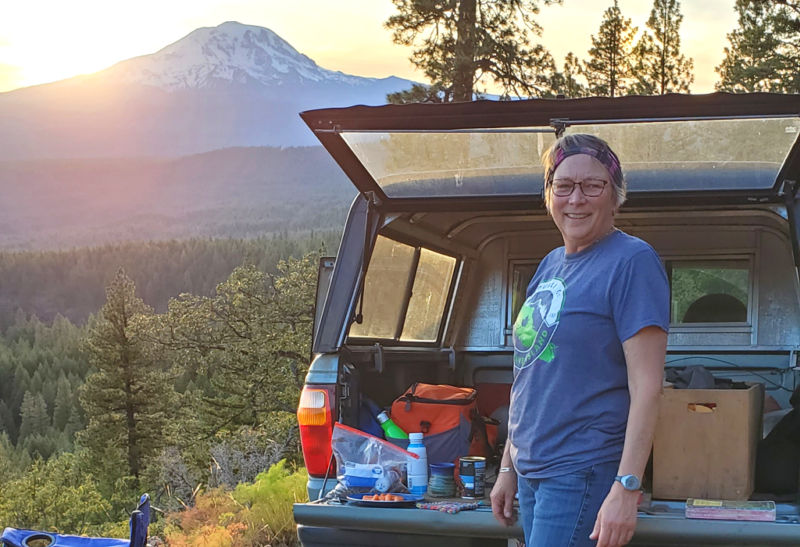
Peak partner: For more than a decade, Cherie Kearney patiently brought stakeholders together. Courtesy of Columbia Land Trust

The Klickitat Canyon Conservation Area is a special environmental region of the state because of its topographic variety and climate resiliency. Due to its sprawling landscape and variegated topography, the area is unique for several reasons.

“Climate resiliency means it has a lot of diversity for habitat, low, cool river areas, high, hot exposed areas … if you were walking across it you would continue to be surprised by what you’d find,” says Kearney. “We’ll manage the Klickitat property from a forestry conservation angle—so that’s less than a timber company would do for revenue—but we still need to work on fire management because we want to be good neighbors and good citizens.

“And of course we want to manage wildlife habitat.” 

Bird discovery

A crew from Columbia Land Trust recently spent a few days at Klickitat Canyon on a special mission. An overnight camping trip to do research connected to a grant from the American Bird Conservancy.

The mission? Find the elusive flammulated owl.

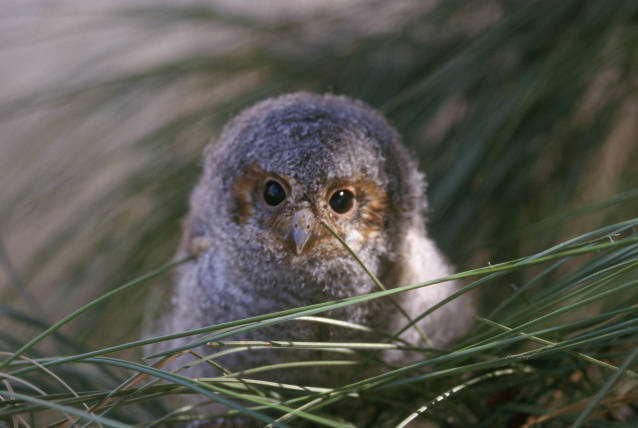
Reddish-brown flammulated owls, which migrate from Central America and Mexico, spend most of their time near the tops of pine or fir forests. The owls are tiny—typically no more than 6 inches long—and tricky to spot. But their soft, low-pitched hoot, which suggests a much larger bird, is distinctive.

They’re there: You might not see them because flammulated owl nests are usually 15 to 40 feet above ground. Young leave the nest after about 25 days. Photo by Dave Menke, USFWS

“The conservancy had a grant that wasn’t able to be used for the Deschutes Land Trust, and they asked us if they could apply it here if we had flammulated owls, and we weren’t sure,” says Kearney.

She accepted the responsibility of doing the required surveys.

It turns out the Klickitat Canyon has another unexpected ecological niche—habitat for neo-tropical migratory birds.

“You basically have to go out at night and use your voice to hoot for these owls. My husband and I were the last team, and we heard their distinctive call,” says Kearney. “We surveyed all night until one o’clock in the morning and I just thought ‘what a thrill it is in life to find these owls.’ … That, for me, is very gratifying.”

Canyon access

The Columbia Land Trust will maintain public access to the Klickitat Canyon Conservation Area. Located near Glenwood, Washington, and the Conboy Lake National Wildlife Refuge, the Conservation Area is adjacent to the Klickitat Canyon Community Forest and Natural Resources Conservation Area, and the tribal government land of the Yakama Indian Reservation.

“As with all of the Conservation Area, the property has historically been managed for timber so there are no hiking trails,” says Kosa. “Columbia Land Trust does intend to maintain existing public access, however, for recreational activities including rafting, wildlife watching, hunting and fishing.”

Big drop: Locally known as “colliding waters,” the junction of the Klickitat River (left) and White Creek (right, through tree) is just one of the area’s dramatic sights. Photo by Jurgen Hess

There are also several quality hiking trails and camping options a few river miles down on the lower Klickitat, according to Kosa.

Roads onto the property from the public Mt. Adams Highway are walk-in only and access may be restricted during fire season in cooperation with neighboring landowners.

The Glenwood Highway has some turnoffs with stunning vistas of the canyon.

Jim Drake is a freelance writer and media consultant living in Hood River, Oregon.

By |2023-05-02T15:05:11-07:0007/30/2020|Conservation, Forestry, Uncategorized|1 Comment

© Copyright 2013-2025 Columbia Insight. All Rights Reserved.

As a 501(c)3 nonprofit organization, all donations to Columbia Insight are tax deductible to the full extent of the law. Our nonprofit federal tax-exempt number is 82-4504894.