Stay Updated Subscribe today for the latest research + reporting about environmental news. Subscribe Now

Stay Updated Subscribe today for the latest research + reporting about environmental news.

Subscribe Now

Dac Collins

Dac Collins

Dac Collins

About Dac Collins

This author has not yet filled in any details.
So far Dac Collins has created 71 blog entries.

Quarry in Washougal incites quarrel over land use regulations

Dec. 13, 2018. It appears that the 14-month long controversy over a rock quarry in Clark County, Wash. will spill over into next year, as Friends of the Columbia Gorge says it will sue the executive director of the Columbia River Gorge Commission if she allows the mining operation to continue. 

On Nov. 27, Friends joined forces with a coalition of 15 private landowners who live near the quarry to send two letters to director Krystyna Wolniakowski. Each letter gives her 60-days notice of their intent to sue for failing to act to stop the mining operation. One letter references the Endangered Species Act, while the other focuses on language from the Columbia River Gorge National Scenic Area Act, which was established in 1986 “to protect and provide for the enhancement of the scenic, cultural, recreational and natural resources of the Gorge.”       

The controversy began in October of 2017, when the Nutter Corporation started mining gravel on Judith Zimmerly’s property. The property, which lies just within the western boundary of the Columbia River Gorge National Scenic Area, is located off SE 356th Avenue in Washougal, a couple blocks north of Steigerwald Lake Wildlife Refuge.
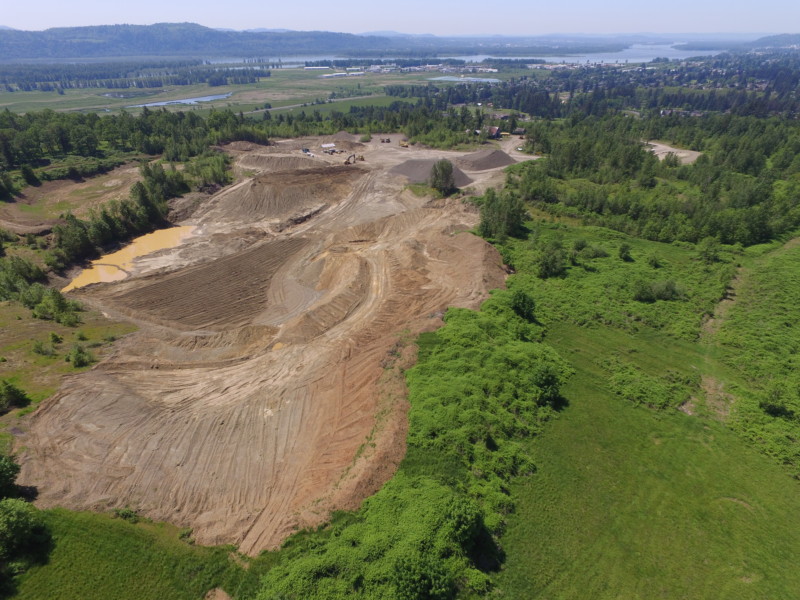
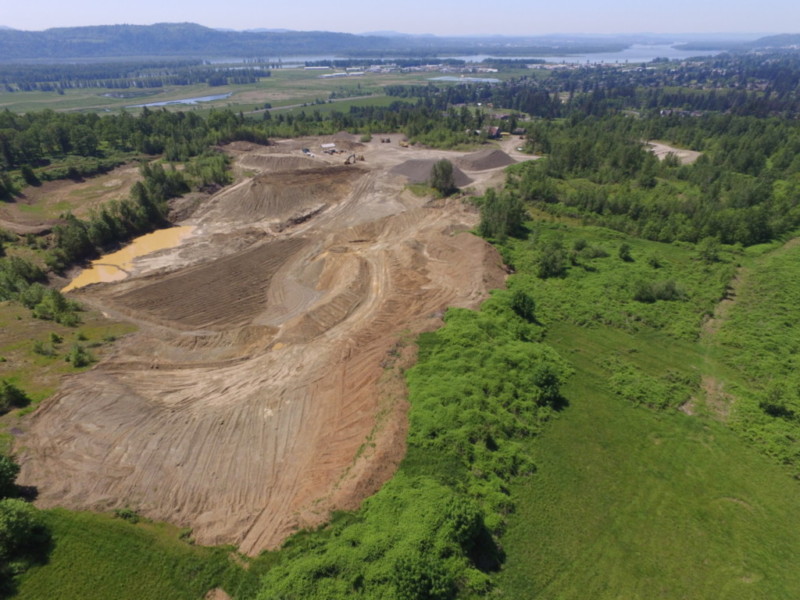
Opponents to the project have raised concerns about the quarry’s proximity to neighborhoods, schools and environmentally sensitive areas such as Steigerwald Lake Refuge, which is visible in the background (upper left-hand corner). Photo courtesy of Friends of the Columbia Gorge.

And while the gravel pit’s close proximity to local schools and neighborhoods has sparked hundreds of complaints from nearby residents, it is the property’s inclusion within the National Scenic Area that opens up the possibility of a lawsuit. The Scenic Area has its own stringent set of rules regarding land use—rules that the conservation and watchdog group says are being violated by the Nutter Corporation and the Zimmerly family.

Nathan Baker, a senior staff attorney with Friends of the Columbia Gorge, calls the operation “the largest ongoing land use violation in the history of the National Scenic Area.”

The Nutter Corporation did not respond to requests for comment, but the Vancouver-based civil contractor has maintained on several occasions that it is operating in full compliance with the Scenic Area’s land-use regulations. And a decision made by Clark County Hearings Examiner Joe Turner backs up that assertion.

In Turner’s Aug. 7 order, he determined that the operation can continue because the Gorge Commission approved surface mining operations at the Zimmerly property in 1993.

That decision didn’t sit very well with the project’s opponents. Reflecting on what happened in 1997—when Judith and David Zimmerly were fined $100,000 by the Gorge Commission for discharging sediment-laden runoff from the quarry into Gibbons Creek (a salmon-bearing stream) and Steigerwald Lake—Baker says part of their concern is that history could repeat itself.

So Friends of the Gorge teamed up with citizens of Clark County to submit formal appeal letters to the Gorge Commission on Oct. 9. The appeals challenge Turner’s decision, pointing out, as Turner himself admitted, that he lacked the jurisdiction to determine whether the permit granted by the Gorge Commission in 1993 is still in effect. 

“Those appeals are pending,” Baker says. “Eventually the Gorge Commissioners, in that appeal, may be able to resolve some of the issues in dispute, in particular whether that 1993 permit is still in effect or not.”

“But, there is a much quicker path to addressing the violations on the property,” the attorney explains, referring to the 60-day notice letters that went out on Nov. 27. “So we hope to engage in a dialogue with the director of the Gorge Commission and resolve our concerns without actually litigating.”

Wolniakowski, however, believes the current appeal of Clark County’s decision to the Gorge Commission will be the next step in settling the million dollar question of whether the Zimmerly’s permit is still valid. And while she is unable to discuss the particulars of the 60-day notice letters—other than the fact that she has received and acknowledged them—the director maintains that “there seems to be an incomplete understanding of the role of the executive director and the role of the Gorge Commission.”

“The important thing here is that we’re an administrative court,” Wolniakowski explains. “The National Scenic Area Act gives us the authority to be that ‘neutral appellate body’, or judge, when there is a land-use permitting dispute in the Gorge. But the operative word there is neutral, since the Commission must be fair, impartial and transparent—which means settling the appeal of this dispute without prejudgment.”

She says the Commission is working with all of the parties involved to get the information they need, and that there will be a hearing on the appeal in front of the Gorge Commission sometime in early 2019.

Until then, Wolniakowski says, “I don’t know how to express this complicated administrative role that we have in a way that people who are angry about gravel trucks will understand. I understand the concern,” she continues, “but there is a process in place and we’re following that process.” 
Coleman Oil fined for spilling biodiesel into the Columbia River

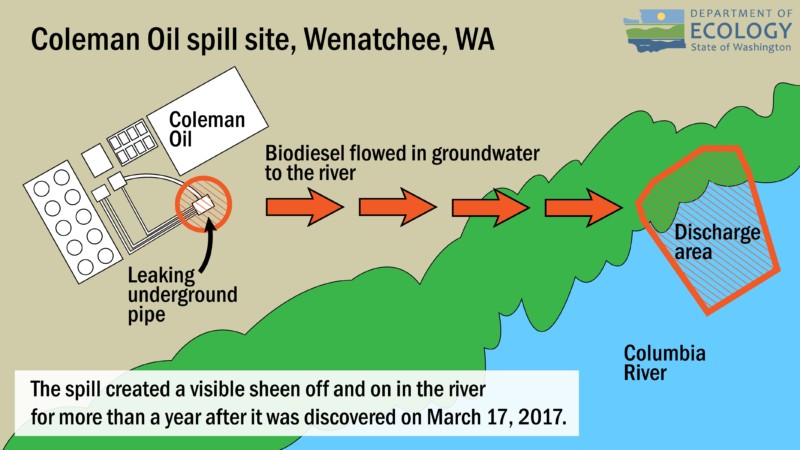
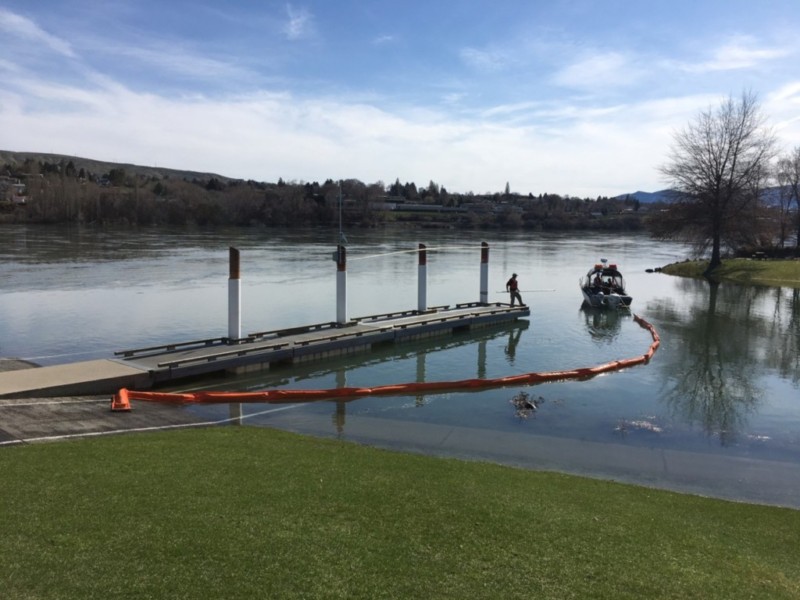
Dec. 6, 2018. A Lewiston-based fuel retailer faces at least $189,000 in fines for spilling biodiesel into the Columbia River. According to the Washington State Department of Ecology, which also seeks $213,400 in reimbursement for costs related to spill response, Coleman Oil’s negligence allowed 3,840 gallons of biodiesel to leak from a corroded underground pipe at its storage facility in Wenatchee.

The Department says the unchecked leak contaminated nearby soil and groundwater, eventually making its way into the Columbia and “creating a visible sheen” on the river’s surface. Although the fines were levied on Nov. 27, Department of Ecology spokeswoman Sandy Howard says the oily sheen was initially reported by a member of the public on St. Patrick’s Day of last year.

Howard says it only took a few days for lab results to reveal the source of the sheen as biodiesel. The spill response team was then able to trace the product to a 20,000 gallon above-ground storage tank at the Coleman Oil facility, which is situated only a block away from the Columbia at 3 Chehalis St. “We found that Coleman Oil was the only facility in town that was selling biodiesel, so it was a pretty easy answer once we found out what type the fuel was,” she explains.

Howard says the company has been very cooperative in the clean-up process that is still underway.

In the 21 months since that process began, Coleman Oil’s Operations Manager Jim Cach has coordinated what he calls a “vigorous response to the release”.

In addition to maintaining the absorbent booms and curtains that are still deployed on the river’s surface, “we moved all the fuel from the bulk plant,” Cach says, “and all those plants have been decommissioned. We demolished and removed three buildings to make it easier to try and chase the path of where this fuel is going. We’ve excavated and disposed of approximately 750 tons of impacted soil, and we’ve installed 38 monitoring and recovery wells.”

“To date,” he continues, “we’ve spent approximately $2.6 million on environmental remediation and investigation.”

And that figure, which doesn’t include the fines imposed last week, is likely to grow, as the area surrounding 3 Chehalis St. is still considered a toxic cleanup site by the Environmental Protection Agency. The federal agency is currently working with the Department of Ecology to investigate whether or not sediments in the river were contaminated, and they will continue to take samples from groundwater monitoring wells. Any contaminants discovered in the groundwater at this point will be pumped out before they reach the river.

The EPA will also conduct its own resource damage assessment, which will dictate how much more Coleman Oil has to pay for environmental restoration and enhancement projects.

By |2019-02-27T14:33:31-08:0012/06/2018|Natural Resources, News, Old Articles, Water|1 Comment

BLM approves prospecting permits in the upper Green River Valley

This is a follow-up of a story we published back in July: “The Last Place for a Mine: USFS green-lights exploratory mining in the upper Green River valley”

Dec. 6, 2018. This summer, Columbia Insight published a story about a proposed mining project near the headwaters of the Green River, which are located just outside of the Mt. St. Helens National Volcanic Monument. The proposed open-pit mine has been a subject of contention for nearly a decade, pitting environmental groups like the Cascade Forest Conservancy against Canadian prospecting company Ascot Resources, which seeks to drill 63 holes from 21 drill pads in order to locate deposits of gold, copper and molybdenum.

Despite the risks that many groups say the operation would pose to the upper Green River, which is a state-designated “Wild Steelhead Gene Bank” and a source of clean drinking water for residents of the Cowlitz Valley downstream, the U.S. Forest Service announced in February that it found no significant impacts during its environmental assessment of Ascot’s exploratory drilling plan, and the agency gave consent to the Bureau of Land Management to issue prospecting permits.

Since then, opponents of the exploratory mining project have been awaiting the BLM’s inevitable stamp of approval. (Because the USFS owns the land and the BLM owns the mineral rights, receiving a hard-rock prospecting permit is a two-step process. But the two agencies generally support one another’s decisions, and it is rare for the BLM to deny permits, especially those allowing resource extraction, after the USFS gives its consent.)

In a decision that was announced earlier this week, the federal agency said it would grant two prospecting permits to Ascot. That decision, however, is subject to a 30-day appeal period that closes Jan. 2, 2019.

National Climate Assessment sheds light on climate change in the Northwest

Nov. 29, 2018. The 2018 National Climate Assessment is now available online. The fourth such Assessment conducted since 1990, it is the most thorough study of our climate to date. The detailed report looks closely at the impacts of climate change on the United States, summarizing its current effects and projecting how those effects might play out in the future.

Released to the public this year on Black Friday, hundreds of experts from 13 federal agencies contributed to the report. And their findings were unanimous: “Global average temperature has increased by about 1.8 degrees F from 1901 to 2016, and observational evidence does not support any credible natural explanations for this amount of warming; instead, the evidence consistently points to human activities, especially emissions of greenhouse or heat-trapping gases, as the dominant cause.”

Unfortunately, even though this conclusion is universally accepted by scientific communities around the world (including our own National Academy of Sciences), the subject has become a partisan debate in this country. So while our current President might not agree with its findings, The National Climate Assessment is here to remind us that floods and tsunamis are neither red nor blue, and a wildfire will thoroughly and indiscriminately torch both sides of the aisle.

The most alarming conclusions presented by the federal report are related to the potential future effects of a changing climate. These projections are based on complex scientific models and ongoing peer-reviewed research, and they vary depending on which region of the country you’re looking at. In chapters 18-27, the Assessment predicts ways that climate change will wreak havoc on specific regions of the country if we fail to adapt our infrastructure and substantially reduce our emissions.

In the chapter focusing on the Southeast, for example. scientists describe how rising sea levels coupled with more frequent extreme rainfall events will increase flooding in coastal cities. While the chapter on the Midwest examines, among other things, how higher summer temperatures will reduce agricultural yields.

The Pacific Northwest has its own chapter, in which scientist note that “warming and related changes in climate are already affecting aspects of the Northwest’s identity such as its natural resource economy and its cultural heritage that is deeply embedded within the natural environment.”

Organizing them into five key areas (called “key messages”), authors of the report give some examples of “future climate change relative to regional risk” that give us an idea of what we might expect in the future:

  • Natural Resource Economy: “Projections for increased stream temperatures indicate a 22% reduction in salmon habitat in Washington by late century under a high emissions future (the A1F1 scenario). This habitat loss corresponds to more than $3 billion in economic losses due to reductions in salmon populations and decreases in cold-water angling opportunities.”
  • Natural World and Cultural Heritage: “Increasing wildfire frequency and intensity are changing foraging patterns for elk and deer, and increased prevalence of invasive species and disease will likely diminish both wildlife and foraging for traditional plants, berries, roots and seeds.”
  • Infrastructure: “By the end of the century, the upper sea level rise projection of 4.3 feet would impact significant infrastructure investments throughout the Northwest, particularly in the low-lying urban areas of the Puget Sound and Portland.”
  • Health: “Mid-century climate in Portland, Oregon, under a mid-high scenario (RCP6.0) may result in more than 80 additional heat-related deaths per year, although this figure does not account for future population growth or possible adaptations.”
  • Frontline Communities: “Northwest tribes directly depend on natural resources, both on and off the reservations, and are among the first to experience climate impacts…The loss or reduced availability of First Foods can have broad physical, cultural and spiritual impacts, including diabetes, heart disease, mental health impacts and loss of cultural identity.”

Read the full chapter to learn more about climate change’s effects on the Northwest. 

By |2019-02-27T14:33:56-08:0011/29/2018|Climate Change, News, Old Articles|1 Comment

Aging dam gets repaired: Newport Avenue Dam fortified with steel

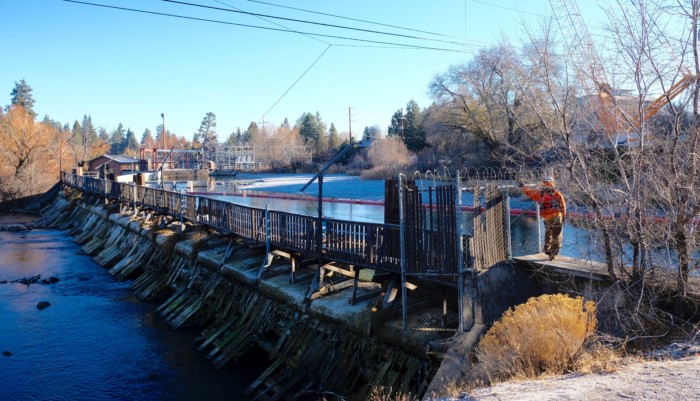
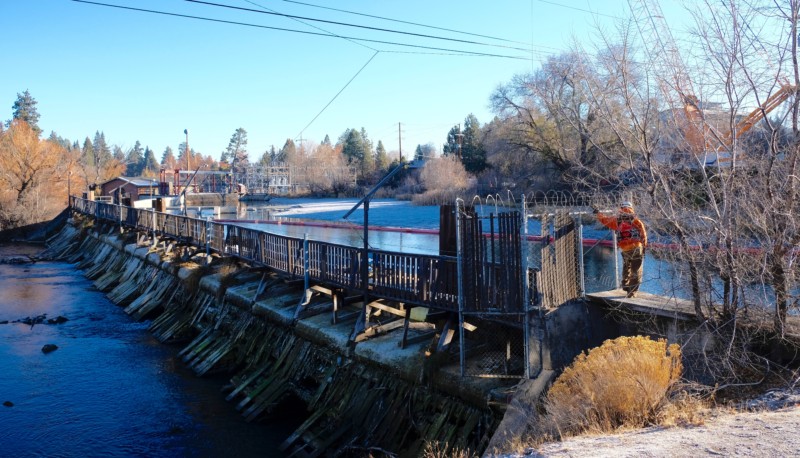
Nov. 22, 2018. Repairs to the Newport Avenue Dam in downtown Bend are now complete. Aiming to fix a small leak that was discovered on Oct. 10, construction crews started work on Nov. 13 and they finished this Wednesday, the day before Thanksgiving.

Pacific Power, which owns and operates the 108-year-old dam, says that the leak “posed no safety risk and does not impact the structural integrity of the dam,” but that it made it difficult to maintain normal water levels for Mirror Pond. As for the source of the seepage, the utility company blames an old wooden panel that was installed 25 years ago to seal an outlet that is no longer used.

It’s not all that difficult to picture a leak forming here and there, especially when looking at the wooden structure from the downstream side. Some of the boards are rotten, others washed away for good. But, dilapidated as it may look, the dam has become an integral part of the landscape.

Built in 1910 by the Bend Water, Light and Power Company, it was the town’s initial source of electricity and the first project of its kind in Central Oregon. It still produces hydropower, but not much. Of the six hydroelectric power plants operated by PacifCorp (Pacific Power’s parent company), the output of Newport Ave. Dam is negligible, providing about one-tenth of one percent of the whole system’s power potential. The dam’s real benefit—perhaps it’s only benefit, some would argue—is that it backs up a stretch of the Deschutes River to form Mirror Pond, one of the most emblematic landmarks of downtown Bend.

Of course the iconic shallow pond faces the same problem as any other man-made urban reservoir: siltation. A century and more of silt continues to build on top of itself, making the pond shallower each year. The City Council has brought up the idea of dredging it, perhaps redesigning it. Pacific Power has even considered ditching the pond altogether. Why? Because the aging dam that impounds it tends to leak.   

First in 2008, then in 2009, 2013 and 2014, and now again in 2018, the wooden face of the dam continues to show its age, springing leaks as seeping sunspots and dripping wrinkles are exposed. Playing the part of plastic surgeon, Pacific Power has continued to update and overhaul the structure. Their strategy over years has been to cover up these blemishes with interlocking steel sheets, known as “sheet pile”. And so far, the utility company says, that technique has worked.

In order to properly install the sheet pile, the utility first lowered the level of Mirror Pond by about three feet and assembled a large crane on site. Workers then used the crane to install the long, interlocking pieces of steel on the upstream side of the structure, effectively shielding the weakened wood from the river’s perpetual attempts to slip through.

Tom Gauntt, a spokesman for Pacific Power, says that the utility took all the necessary steps to secure state-issued permits for the project, and that they did not expect it to have any serious environmental impacts on either Mirror Pond or the stretch of river downstream. “There is a third-party inspector monitoring turbidity and all of that,” Gauntt says, “and during re-fill, they’ll have a biologist on site to watch for any fish strandings.”

The utility company is confident that this will be the last repair of its kind on the dam because, as Gauntt told the Bend Bulletin last week, “this is the last section of dam that hasn’t had [the sheet pile] installed.”

Gauntt says that construction workers finished installing the sheet pile ahead of schedule on Wednesday, and that Pacific Power will start re-filling the pond next Monday after the long holiday weekend.

By |2019-08-05T13:34:48-07:0011/22/2018|Energy, News, Old Articles, Renewable Energy|0 Comments

What do the midterms mean for the environment?

Nov. 8, 2018. Well, it depends on where you live.

In Washington State, voters rejected Initiative 1631, a carbon-fee initiative that would have imposed fees on the state’s biggest polluters and used those dollars to build new clean energy infrastructure. The initiative would have been the first of its kind in the country, but only three of the state’s 39 counties (King, Jefferson and San Juan) voted “yes”. A similar carbon-tax initiative also failed to garner support in the 2016 election, meaning that proponents of clean energy still have a ways to go if they want to convince Washingtonians to hit polluters where it hurts…in their pocketbooks. And if they want to be successful, it looks like they’ll have to shift their focus away from Seattle and toward the rest of the largely rural state.

Washington voters supported Advisory Vote 19, which calls on the state to repeal a tax on crude oil and petroleum products. The tax was implemented this Spring, and it applies to oil and petroleum products transported by pipeline. However, since an Advisory Vote is “non-binding” according to state law, the legislature is under no obligation to act on it.    

Meanwhile, Portlanders approved a measure that will create the city’s first clean energy fund. Measure 26-201 will put a 1% revenue tax on retailers that make more than $500,000 gross revenue in the city (or $1 billion nationally). Those tax dollars will go toward funding clean energy projects, and proponents say the measure could bring in as much as $30 million dollars a year. That’s a lot of solar panels.

Looking at other news from across the Beaver State, Rep. Greg Walden will keep his seat in Congress, and Kate Brown will remain Oregon’s governor for another four years. Brown defeated challenger Knute Buehler, who billed himself as a “fiscally responsible, pro-choice moderate with an independent streak”. Supporters of Brown’s environmental agenda hope the newly re-elected governor will continue to push back against the Trump administration’s continued rollbacks of environmental protections. 

By |2019-02-27T14:34:38-08:0011/16/2018|More, News, Old Articles|0 Comments

© Copyright 2013-2025 Columbia Insight. All Rights Reserved.

As a 501(c)3 nonprofit organization, all donations to Columbia Insight are tax deductible to the full extent of the law. Our nonprofit federal tax-exempt number is 82-4504894.