Stay Updated Subscribe today for the latest research + reporting about environmental news. Subscribe Now

Stay Updated Subscribe today for the latest research + reporting about environmental news.

Subscribe Now

Dac Collins

Dac Collins

Dac Collins

About Dac Collins

This author has not yet filled in any details.
So far Dac Collins has created 71 blog entries.

Emerald Systems Brings Rural Recycling Program to the Gorge

By Jim Drake. May 9, 2019. With a vision of keeping tons of material out of the landfill, Emerald Systems is working with customers in the Columbia Gorge to divert a multi-faceted waste stream into a viable recycling system — one that creates jobs, profitability and a path to environmental sustainability.

“It really entails us all working together and coming together as a community, because we’re kind of on an island out here,” says Julie Tucker, Emerald Systems’ founder and sustainability consultant.
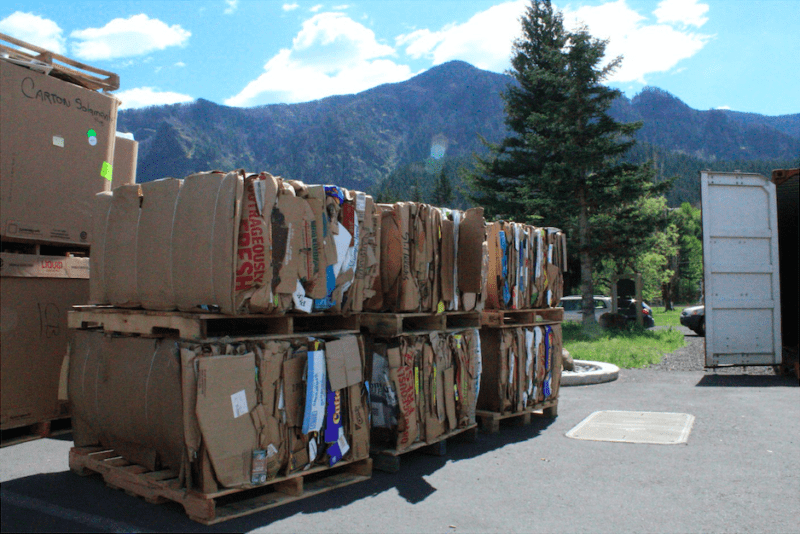
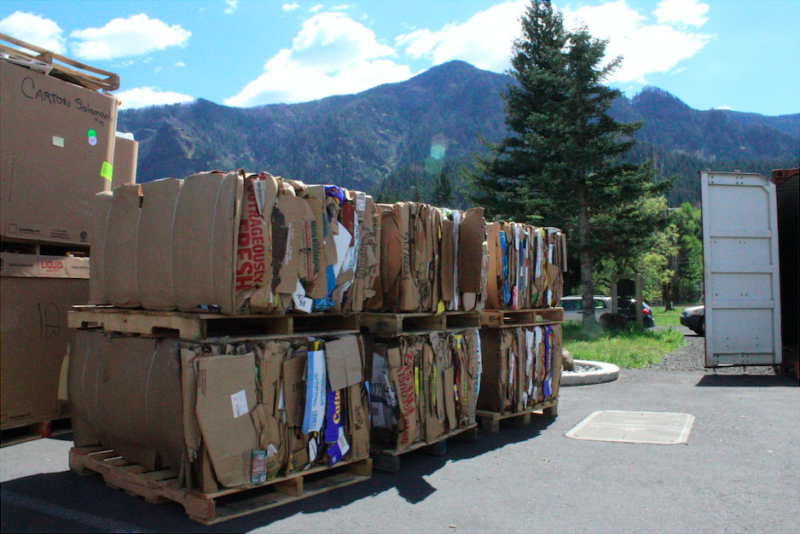
Cardboard is a high volume material for Emerald Systems, and the company recycled approximately 1,191 tons of it last year. Photo courtesy of Emerald Systems

Tucker says she has been enamored with the recycling process since 1987. During her first job at a Portland container recovery facility, she saw the sheer enormity of material being diverted from the landfill. Now, after ten years of helping businesses like Azure Farms become self-sufficient in making their farms and warehouses zero-waste entities, she has landed Emerald Systems at the Port of Cascade Locks, with a 3,000 sq. ft. facility to collect, store and sort raw material for the recycling market.

“We pick up cardboard, glass, paper, plastic, foam, metals, rubber and other hard to recycle items. And then we work hard to find outlets for these materials. For example, one of our customers, I can’t say the name, but it’s a data center in The Dalles, provides us with particle board spools.”

According to Tucker, these spools, which once held wire for computer servers, represent 60 tons that stayed out of the landfill in 2018.

“The first thing we like to do is educate our customers on reducing what they are using, or help them figure out how to reuse it. I have customers that use these spools for art projects, and we can have them chipped for boiler fuel, which is an option for wood that can’t be reused,” she explains.

Emerald Systems started in 2017 in a warehouse in Tygh Valley, Oregon (30 miles south of The Dalles). Tucker says she had customers almost immediately, as the community welcomed the availability of a rural recycling depot.

Although that facility closed due to expenses, Emerald Systems maintains a pilot project depot in Dufur, where anyone can bring materials during operating hours. An operator is on hand during those hours to make sure the materials are properly cleaned and source separated.
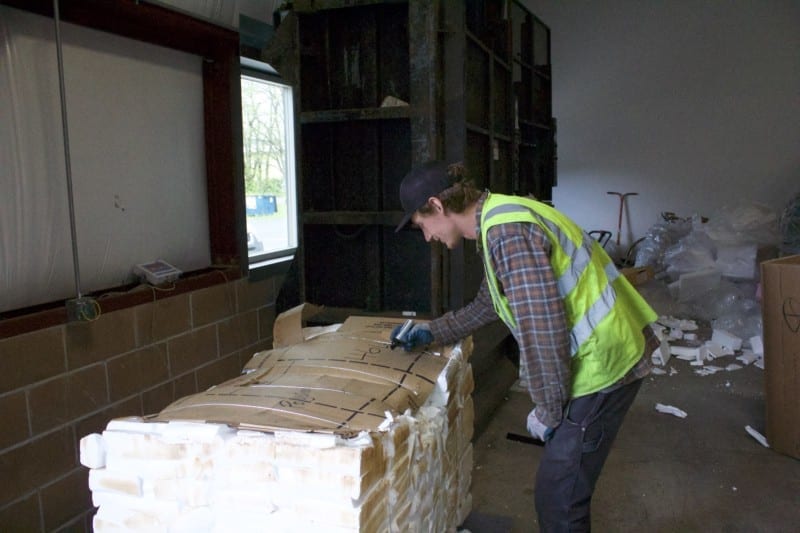
Isaiah Arnold labels a bale of recycled foam at the Cascade Locks location. Photo courtesy of Emerald Systems

“Our goal is to set up a depot in Maupin, Morrow, Grass Valley, Lyle, Klickitat…all these rural areas that don’t have a lot of access to these kinds of facilities. Each place could create a part-time job, and when it’s done right, these depots could actually create a profit for the community,” Tucker explains.

And one of the key components of making recycling profitable, she says, is producing a waste stream that is made up of clean, uncontaminated, source-separated material. In fact, due to the company’s guidelines on what they can and can’t collect, Emerald Systems guarantees that 95% of the collected material will not go to a landfill.

“The reason the recycling industry is shutting down is because of the contaminated co-mingle issue. China doesn’t want contaminated co-mingle. There’s still outlets for source separated material,” Tucker says.

“Big garbage companies don’t make money on recycling, and that’s part of what the hype is. They still want to be able to collect the money for co-mingle recycling, so they’re charging all these extra fees and they are going to limit your recycling because they can’t keep it clean. And that’s a shame because it’s not the garbage company’s fault.”

[perfectpullquote align=”full” bordertop=”false” cite=”” link=”” color=”” class=”” size=””]”But there is a market for recycling. There’s just not a market for dirty co-mingle. And I think that’s very difficult for people to understand.”[/perfectpullquote]

In 2018, Emerald Systems collected more than 1,500 tons of fiber, metal, glass, plastic, and wood (along with 80,000 cubic feet of polystyrene type foams) from approximately 45 customers. And even though the company hasn’t been advertising, local agencies, namely the Tri-County Hazardous Waste & Recycling Program, are paying attention.

“We’re excited because we just received a $23,000 grant from Tri-County,” Tucker says.

“This grant will allow my company to get a lot more organized. When I had my first customer, I had to borrow $400 from my mom to rent a U-Haul. We’ve been just scraping by, piece by piece, week by week, and we finally got to the point where we could say this is a viable business.”
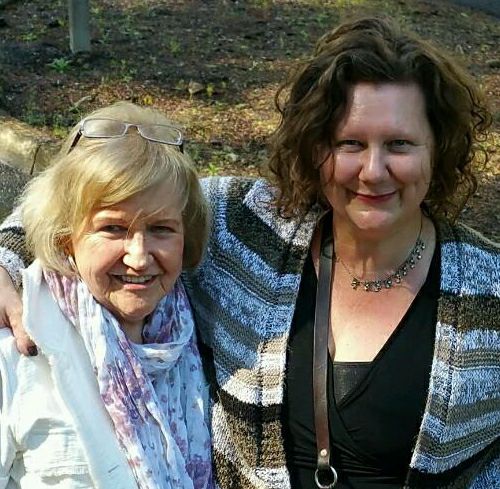
Julie Tucker (right), founder of Emerald Systems, pictured here with her mom.

Tucker’s customer base grew dramatically last year, partly due to the closing of a local recycling facility in The Dalles. Also affecting her business are the market conditions for recycling materials, which she says are currently on a downswing (as far as material value). Portland companies that used to pick up materials in the Gorge are now calling her to do it, because it’s too expensive for them to drive out to the Gorge.

“The way that we run our business is that we broker people’s materials. Due to the market value of the materials, we sometimes have to factor in the cost of transportation for some of our customers. Other customers that pack, sort and clean the material properly can actually make money by the time we’re done,” Tucker says.

In a typical week, Emerald Systems employees pick up materials from customers in the company’s 26-foot Penske truck, and in many instances, they can take the material directly to a buyer, usually in the Portland area. And although Emerald Systems can accept materials that are normally picked up by curbside recycling programs, they cannot infringe on the franchise right of a hauler.

“For example, I can’t pick up household materials from residences in Hood River, or anywhere where there’s a franchise agreement. We have a recycle depot in Dufur because there’s no franchise agreement there,” she explains.

Large shipping containers (also known as intermodal containers) are staged outside of Emerald’s warehouse. Inside, an industrial horizontal baler with a ramp and scale can produce cardboard bales weighing a ton. And in 2018 alone, Emerald Systems processed over 1,100 tons of cardboard.

“We have to call in a flatbed for 50 bales, and we can’t store that inside our warehouse. In the Gorge, we pick up grocery store sized bales from Insitu, an aerospace company, which are between 700 and 800 pounds.”

Tucker says that the variety of businesses in the Gorge will keep Emerald Systems busy in coming up with a strategy for diverting the waste stream. The presence of breweries and wineries, for example, could eventually turn into a whole other pickup route.

“Breweries have a lot of the same waste streams, even down to the detail of grain bags, which are a polyethylene that can be lined with film plastic,” Tucker says.

“A majority of those are being put in the landfill. But if we can schedule a route one day where we can be picking up from the breweries, and a day when we pick up from the wineries, it’s another example of working with the community and getting this to work together.”

Other companies have approached Tucker about how to deal with their waste streams and, looking toward the future, she hopes to get certified for proprietary e-cycle capabilities.

“A sailboard company just contacted us and we’re working on finding an outlet for their materials. Some aerospace companies need to dispose of circuit boards that need to be ground up – we would need to be bonded and install special security measures to do that.”
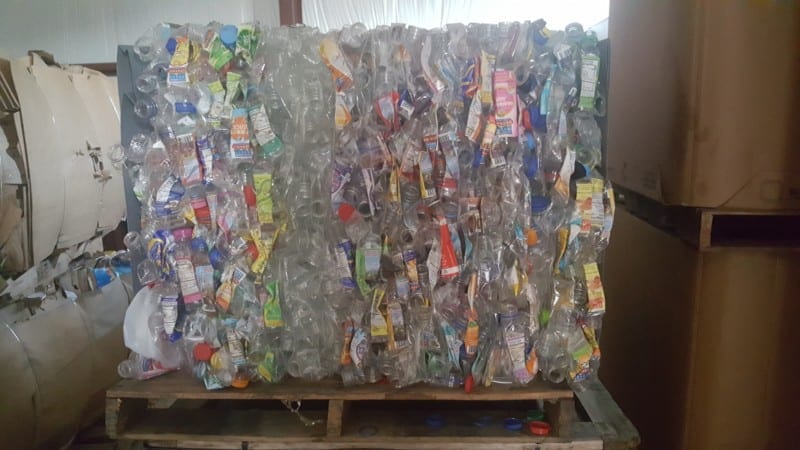
The company was able to keep approximately 270,360 lbs of plastic out of the waste stream last year. Photo courtesy of Emerald Systems

Tucker says that Emerald Systems is ready to roll out an updated website that allows customers to schedule pick ups, and she has hired a business consulting firm to help with marketing. The next six weeks will be a critical development time for the company.

“It’s been a rough road keeping this going, but I believe this will work. I know how to work with customers and how to train people to sort their materials correctly, and I feel like it’s all coming together now, especially with this grant,” Tucker says.

All of this means that Emerald Systems will be prepared when the recycle market trend reverses into an upswing.

“I believe the market value and the co-mingle issue for recyclables is going to change drastically because people are going to start building domestic outlets for it. And then you’ll have an upswing. In the future, you’ll be able to make money from these different materials because they’ll be commodities,” Tucker says.

Tucker, who credits the support of her Hood River family for a successful business start, says that her vision of streamlining the Gorge’s recycle process into a cohesive system is really just part of her job. She mentions that she recently helped with the community cleanup day in nearby White Salmon, Wash., where the community collected over 7,000 pounds of electronic e-cycle waste.

“It’s really to help protect this part of the earth. It’s a hard job, but I feel like this is what I should do.”

The Emerald Systems recycling facility is located at 50 Northeast Herman Lane, Casade Locks, OR 97014. For more information about dropping off recyclables, email info@emeraldsystems.org


WHAT DID EMERALD SYSTEMS RECYCLE IN 2018?

Fiber: 1,235.9 tons

Cardboard: 1,191 tons

Mixed paper: 19.6 tons

Office Paper: 17.8 tons

Newspaper: 2 tons

Cartons: 4 tons

Books: 1.5 tons

Glass: 62.5 tons

Metals: 96.4 tons

Stainless steel 304: 54,000 lbs

Aluminum old sheet: 3600 lbs

Baled tin: 14 tons

UBC (Beverage Cans): 6480 lbs

Copper Wire: 1200 lbs

Communications Wire: 1200 lbs

Insulated Copper Wire: 1200 lbs

Computer Wire: 1200 lbs

E-cycle (electronics): 48 tons

Plastics: 135 tons

Plastic Barrels: 18,320 lbs

Plastic Buckets: 13, 840 lbs

Clear Film (shrink wrap): 57,000 lbs

Colored Film (shrink wrap): 28,500 lbs

Sorted Misc. Plastics 1-7: 43,000 lbs

#1 Bottles: 30,800 lbs

#1 Mixed: 15,300 lbs

Clear #2: 22,000 lbs

Colored #2: 41,600 lbs

Total amount recycled: 1,529.8 tons
 

By |2023-03-20T15:18:28-07:0005/09/2019|Energy, News, Waste Management|4 Comments

Waiting on a Cleaner Willamette: An update on the Portland Harbor Superfund Site

By Dac Collins. April 25, 2019. It’s no coincidence that Oregon’s most contaminated (and endangered) river happens to flow through its three most populated cities. Proximity breeds pollution, or so it seems. And aside from the million or more residents of Eugene, Salem and Portland who use or depend on the Willamette in some way, industrial development in the Portland Harbor has been particularly unkind to the river.

Over the course of the 20th century, these shipyards, factories and chemical plants created hundreds of jobs, ushering the port city into a new era of wealth and prosperity. But they left behind a toxic legacy, one that lives on in the surface water, groundwater and sediment of the urban waterway.

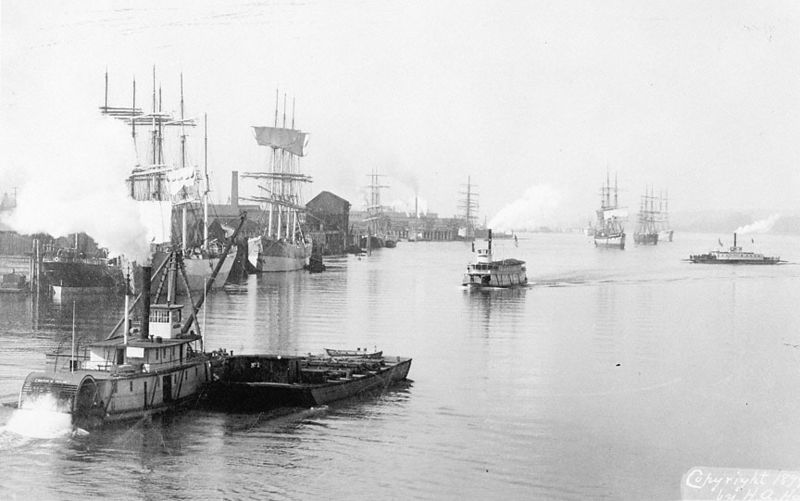
Ships fill the Portland Harbor at the turn of the 20th century. Photo courtesy of Wiki Commons

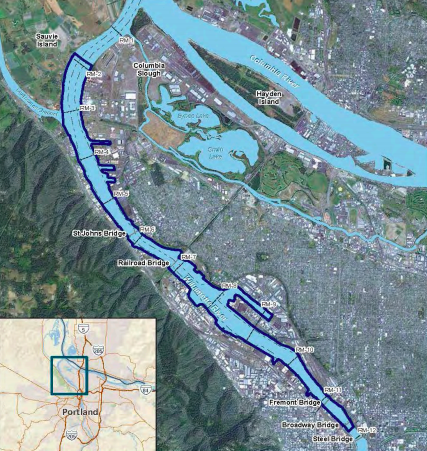
PCB’s, heavy metals, dioxins and mercury…lead, PAH’s, petroleum and pesticides. These and other harmful pollutants have settled at the bottom of the broad, slow-moving river, and they present significant health risks to humans and the environment. They are also the primary reason that the 2,000+ acre, 10 mile stretch of the lower Willamette — from the Broadway Bridge to its confluence with the Columbia — was designated as a Superfund Site in 2000.

17 years later, the Environmental Protection Agency issued its plan to clean up the Site.

Known as the Record of Decision, the agency’s plan lists over 150 companies and agencies as Potentially Responsible Parties (PRPs) and because Superfund law dictates that polluters are held liable, these parties are responsible for implementing the cleanup and footing the bill. The plan involves dredging millions of cubic yards of sediment, capping large areas of the river bottom and banks, and monitoring other areas as they recover naturally. When completed — which, according to the EPA, will take a decade or more and cost approximately $1 billion — the cleanup will theoretically reduce the human health risks for Portland residents and improve the overall ecological health of the river.

But looking at this costly mess now, in 2019, a couple of questions come to mind…namely: What is the status of the cleanup today? And why does it seem to be taking so long?

Designing the cleanup

Suzanne Skadowski is a public affairs specialist with the EPA’s Region 10 office. She explains that when it comes to a site as large and complex as the Portland Harbor, there is no single solution for the contamination problem. There are instead a number of strategies that work better in certain situations. And because of the dynamic nature of a river, even these strategies can change shape over time.

A general overview of the Superfund Site. Map courtesy of EPA

“That’s part of designing the cleanup,” Skadowski says. “It’s a dynamic system, so you don’t just come up with a plan and then a few years later go for it. What we’ve been doing since we proposed this clean up plan is getting out on the river and in the water and river bottom sediments, and either confirming or updating our earlier data to see what has changed.”

She explains that progress has been made at some of the highly contaminated “hot spots” — also known as “early action cleanup areas” — throughout the 10 miles of river. She points to Rivermile 11 East, where PRPs such as the CBS Corporation, Cargill Inc. and Glacier Northwest Inc. have already come up with a design for how to move cleanup operations forward.

But she acknowledges that “the bigger-picture, long term site wide cleanup designs are still in the works.”

Skadowski says this big-picture plan is guided, in part, by what the agency calls a “community involvement plan”. This living document is the product of years of public engagement and continued interactions between the EPA and local communities.

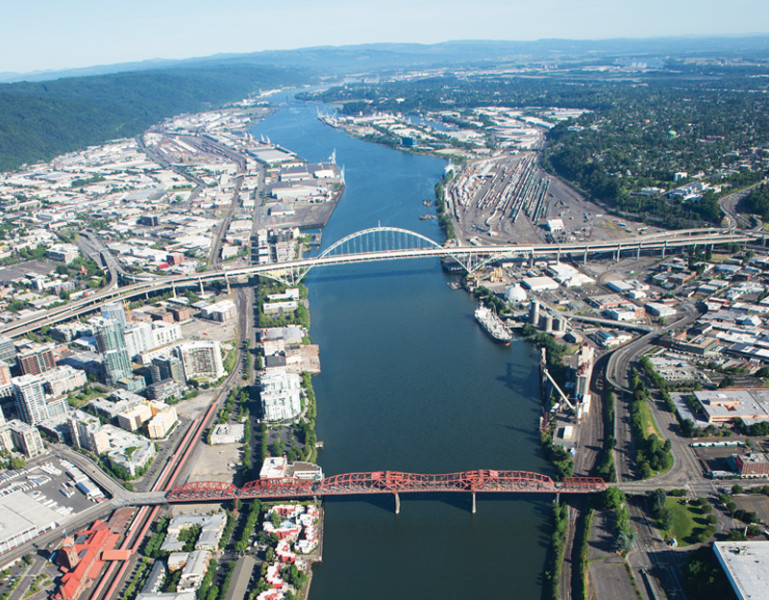
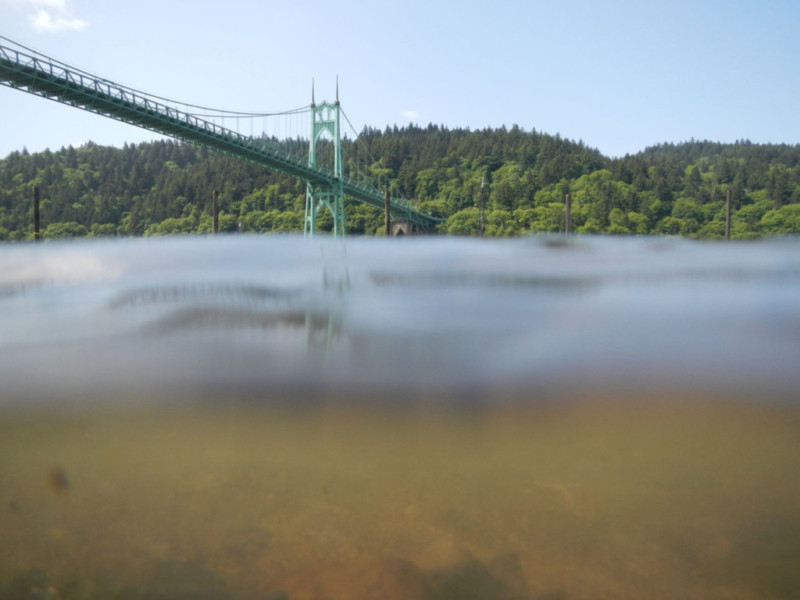
The Willamette winds its way through Bridgetown. Photo courtesy of the Port of Portland

“We are now re-upping, revising and expanding that community plan,” she says. “We heard from community members that they wanted to sit down with us and have an opportunity to ask questions more often and hear what’s going on. So last week we held one of several quarterly forums with the community to give them the opportunity to come by and ask questions.”

During that forum, which took place at Portland State University on April 17, the EPA provided a general update of the work that is currently being done.

Skadowski says the next public forum is planned for June 12 (location TBD). She says that, in addition to hosting these forums, the EPA will continue to talk and meet with individual community groups and leaders to hear their feedback and concerns.

Cleaning up versus covering up

As the executive director of Willamette Riverkeeper, Travis Williams has been involved with this cleanup process since it began in 2000. And over the course of these 19 years, Williams has learned a lot about politicizing, strategizing and finger-pointing. But perhaps his biggest takeaway from the process is that the act of cleaning something up can be interpreted different ways by different people.

“I think what people too often get lost in is this isn’t really a clean up,” Williams says. “It’s a risk reduction exercise.”

Because of the sheer size and scope of the Superfund Site, it’s easier to look at it as a series of individual sub-sites. Each sub-site has a unique set of problems or health risks, as well as an entity (PRP) who is responsible for solving those problems…or, in Williams’ words, reducing those risks.

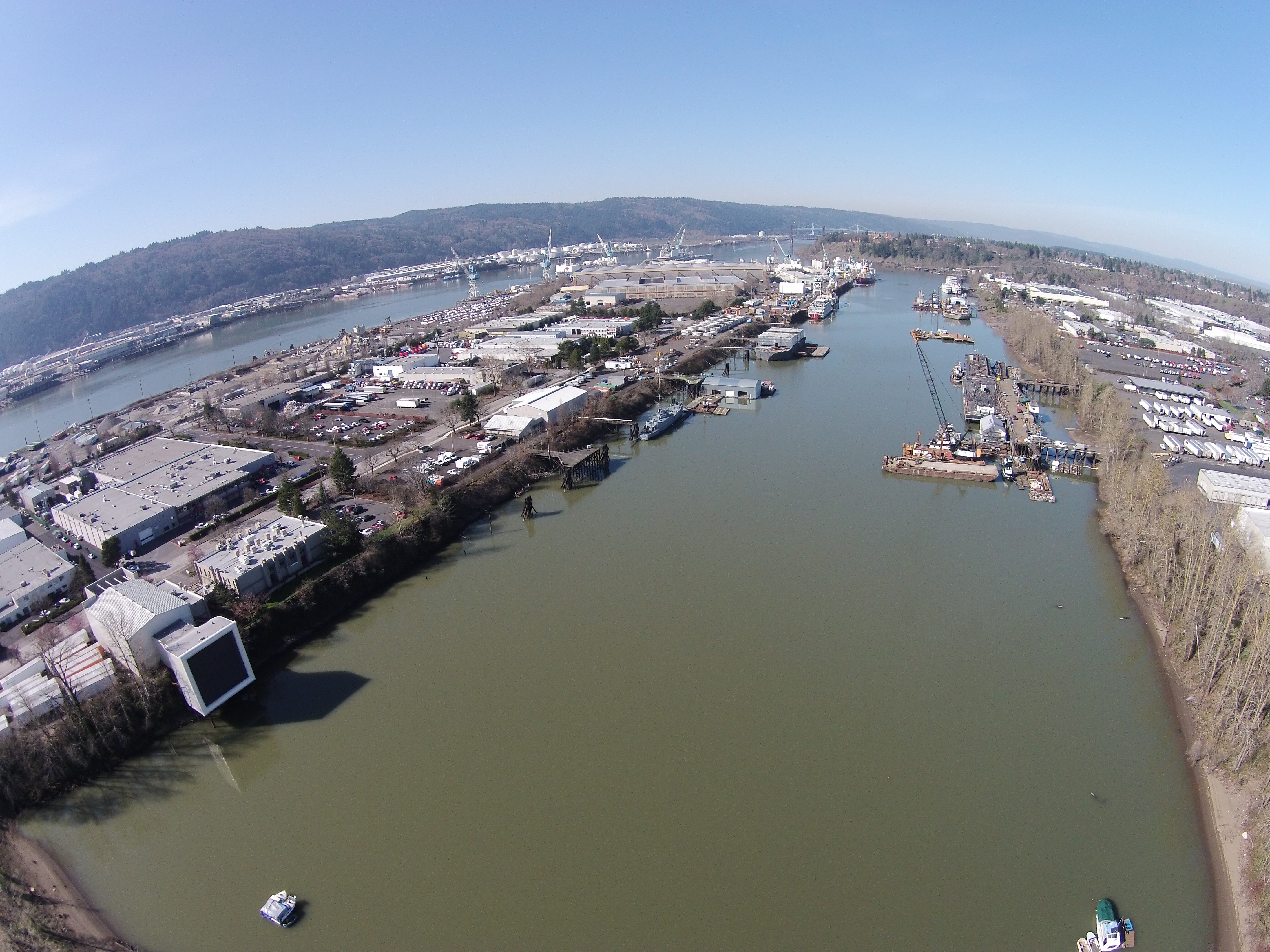
A bird’s eye view of the Swan Island industrial area. Photo by Travis Williams

“Right now we’re in a bit of a holding pattern as different entities negotiate with the EPA to move forward at individual sub-sites,” he says. He uses the same example that Skadowski points to when explaining how PRPs like Cargill and CBS (River Mile 11E) are, in a sense, ahead of the curve.

“Then you have others who haven’t really done much,” Williams says. “And they are just kind of…for whatever reason, stalling.”

According to Skadowski, the majority of PRP’s (100+) have yet to initiate any sort of cleanup design. She says the EPA sent out a letter in March of 2018 asking those entities “to organize and step forward to conduct 100% cleanup design for 100% of the site,” but that “as of December 2018, we had gotten no offers to perform cleanup design, only additional sampling and in very small areas.”

This, of course, speaks to why the cleanup process continues to drag on. By filing formal disputes with the EPA or choosing to ignore to the agency’s requests, or by arguing that certain studies have to be repeated, a number of PRPs have ensured that timelines are extended and initial actions are postponed.

Complicating matters further is the fact that, nearly two decades after calling attention to the contamination problem, the EPA is still looking at a variety of different ways to address it.

One way is to dredge huge swaths of the riverbed, which means scooping up the toxic sediment and burying it in a disposal site (usually a permitted landfill) located far away from the river.

Another method is to “cap” the contaminated areas with concrete, gravel or some other material…which, by definition, is more akin to covering up the mess than cleaning it up.

Skadowski, however, explains that the capping process is more complicated, and that “capping can look a little different in different places.”

She says that in certain areas, where natural sedimentation is already covering up some of the contaminated riverbed, “we’re just helping it along.” In other places, though, she says “you might want to have several layers to make sure that you’re putting clean material down and it will stay down to contain the contamination away from river bottom organisms and fish.”

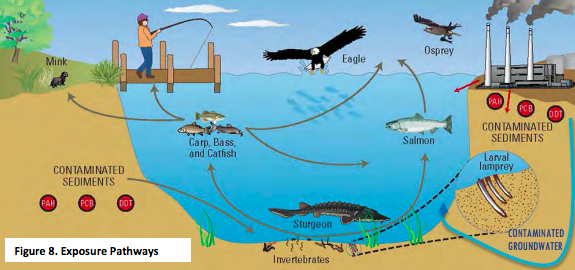
The general idea, Skadowski says, is that organisms living on a river bottom establish themselves on the upper layer of sediment. And “the deeper the [contaminated] sediments are, the better,” she continues, “especially in terms of the organisms that are living and feeding on that sediment.”

The cycle of contamination affects every link in the food chain. Photo courtesy of EPA

A third strategy is what the EPA calls “monitored natural recovery.” And while it is defined in the Record of Decision as the use of “ongoing, naturally occurring processes to contain, destroy or reduce the bioavailability or toxicity of contaminants in sediment”, it really just amounts to sitting back and taking water samples while the river cleans itself.

Of course this strategy of action by inaction leads to a slippery slope where explanations take the place of implementation. And the proposal that acting EPA administrator Andrew Wheeler put forward last fall is a perfect example of this.

Explaining that the change is meant to “ensure that the cleanup plan is current with the latest science to protect people’s health and the environment,” Wheeler announced in October that the agency is considering reducing the cleanup area around Portland’s Terminal 4 and NW Natural’s Gasco property. The modification of this particular sub-site would cut costs by approximately $35 million, and the “latest science” that Wheeler refers to is the consensus reached by a number of agency officials that benzo(a)pyrene (or BaP) is less risky — or less likely to cause cancer — than they initially thought.

(Skadowski says the agency is still deliberating and reviewing over 1,000 public comments received, and is expecting to issue a final decision on this proposal by the end of the year.)

And while environmental and human-health advocates worry about the implications of this particular announcement, there is more baseline sampling currently being done. One example is looking at the effectiveness of river flow and sedimentation from clean sediments upstream and flood events (like the one that occurred earlier this month) in flushing out and covering up some of the river’s toxic sediments.

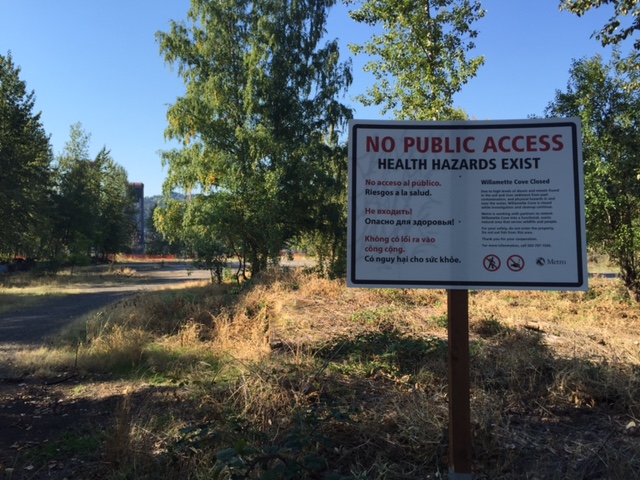
A sign at Willamette Cove warns the public of the health hazards of swimming in or recreating near the river. Photo by Travis Williams

“Then the question is to what degree will the EPA make that information available,” Williams says. “Because there is a fear that some people who are sponsoring these baseline studies will come back and say: ‘Well the contamination based on our assessment is less than it was 5 years ago…therefore, the river is already on its way to recovering itself.’”

His concern is if that were to happen, the Record of Decision could open back up and the years-long process of soliciting input from PRPs and formulating a cleanup plan would start all over again.

“If that doesn’t happen,” Williams says, “what we hope to see is that those individual sites that have already come to agreements with the EPA will demonstrate to others that they need to do the same thing. And maybe we will begin to see barges in the water during the next low flow work window.”

[perfectpullquote align=”full” bordertop=”false” cite=”” link=”” color=”” class=”” size=””]“I think what frustrates a lot of people in this process is we haven’t seen much of that yet.”[/perfectpullquote]

The frustrations that Williams and other cleanup advocates feel are warranted, especially when you think about everything else that we as a society have accomplished in the past 19 years.

We’ve witnessed the rise of smartphones, which have revolutionized the ways that people share information and interact with one another. We elected the first black president of the United States and we legalized gay marriage. We saw the first electric sports car hit the market…a model that now seems outdated compared to the spaceships Musk and his team are currently working on.

In the last twelve months alone, a researcher in China created the world’s first genetically edited babies. We also found signs of liquid water on Mars and generated the first ever image of a black hole.

But we’re still working on a plan to clean up the Willamette.

Oregon’s Cap and Trade Bill Tours the Basin

By Dac Collins. April 4, 2019. Apparently having a baby on your hip while speaking at a public hearing increases the likelihood that people will actually listen to you. Undeniably charming and helpless, babies have the unique (and coveted) ability to evoke sympathy. If they could only talk into a microphone, they’d have the room in an instant.

So it comes as no surprise that during the weeklong series of hearings that were held across the state of Oregon to gauge public support of House Bill 2020 — also known as the Cap and Trade Bill or the Clean Energy Jobs Bill — the babe-on-the-hip strategy was employed on more than one occasion.

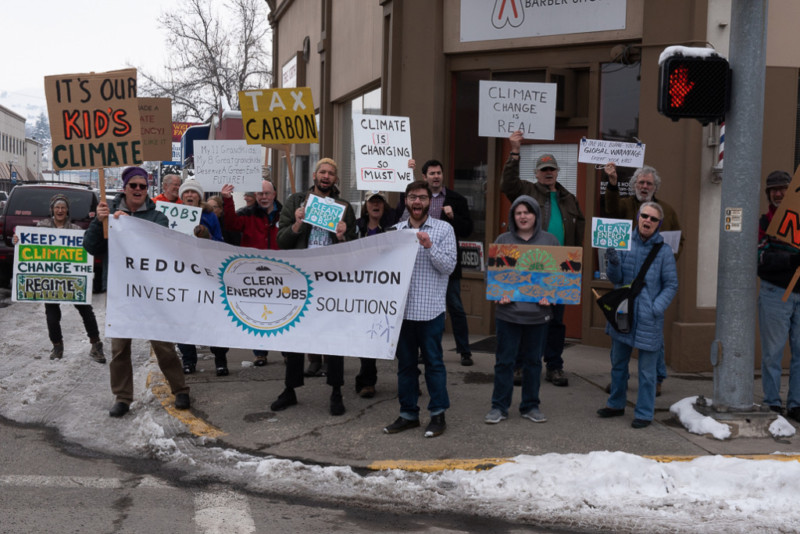
A group of HB2020 supporters rally in front of the Dalles Civic Auditorium on May 1. Photo by Jurgen Hess.

One of the more contentious pieces of legislation coming out of Salem this year, HB2020 aims to drastically reduce the state’s overall carbon emissions by setting a cap on those emissions by 2021. That’s the “cap” piece.

The state would then sell allowances to the largest polluters (those emitting more than 25,000 tons of greenhouse gases each year) for each ton of pollution they emit. If they end up with more allowances than they need, companies could then trade those allowances amongst themselves. That’s the “trade” piece.

The money generated by this carbon marketplace would then be funneled into renewable energy and climate adaptation projects, theoretically funding Oregon’s transition to a cleaner and greener economy. Which is why some proponents of the legislation are referring to it as a “cap and invest” bill.

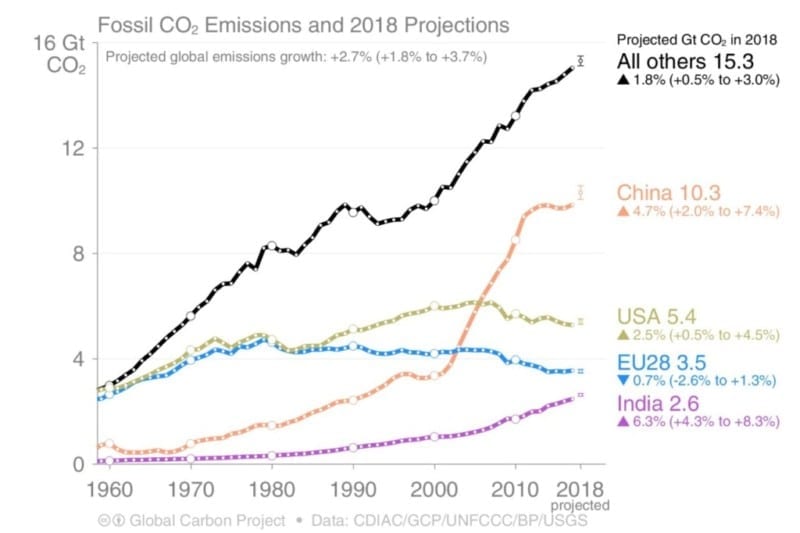
Detractors claim that HB2020 would drive up the prices of fossil fuels and electricity, and would consequently increase the overall cost of living for working class families. They say that even if Oregon is able to bring its carbon emissions down to practically zero, that would still only account for approximately one percent of the country’s overall carbon emissions. And making the age-old “drop in a bucket of water” argument, they point to China, whose carbon emissions are almost double those of the United States…and rising.

This chart shows the rise in global carbon emissions from 1959 to 2017, and projects a growth in global carbon emissions of approximately 2.7 percent. Courtesy of the Global Carbon Project.

Because of this polarization amongst Oregonians, the last iteration of the Clean Energy Jobs Bill failed during the 2018 legislative session. This year, however, with the full support of Governor Kate Brown and other top democrats in Salem, it seems likely that Oregon will become the second state in the nation (behind California) to put a price on carbon. 

Under the leadership of House Speaker Tina Kotek (D-Portland) and Senate President Peter Courtney (D-Salem), the Joint Committee on Carbon Reduction announced in February that it would hold a series of five public hearings across the state, allowing citizens to comment on the proposed legislation. Two of those hearings were in Newport and Medford. The other three were held within the Columbia River Basin.

Springfield

The first stop on the Cap and Trade tour was in Springfield on Feb. 22. According to the Register-Guard, roughly 100 people showed up to speak at the City Hall, many of whom spoke in favor of the bill.

69-year old Karen Fielder said she was there to represent her grandsons, who would benefit from a transition to cleaner sources of energy.

“Clearly, the status quo is not working,” Fielder said.

Opponents to HB2020 included Marie Bowers, whose family grows ryegrass in the Willamette Valley.

Her 3-month-old baby boy in tow, Bowers said the legislation would disproportionately burden family farms, making it all but impossible for her son to carry on the tradition. She said that farmers are already doing everything in their power to conserve fuel and operate efficiently, and that “this bill doesn’t recognize the efforts we’ve made.”

These same concerns would be repeated time and time again as the Committee traveled to the east end of the state in Baker City, then on through the Dalles and down to Bend.

Baker City

The Argus Observer reported that over 200 people showed up to the Feb. 25 hearing in Baker City, and that the vast majority of those who testified opposed the Cap and Trade Bill.

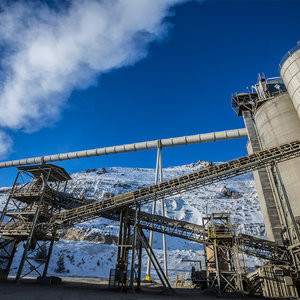
The Ash Grove Cement Plant is located approximately 27 miles southeast of Baker City. Photo courtesy of Ash Grove Cement.

“Cap and trade will devastate Ontario,” said Ontario Mayor Riley Hill. He explained that some of the businesses there would simply move to Idaho to avoid the onerous regulations imposed by HB2020.

With 115 employees, Ash Grove Cement in nearby Durkee is the biggest employer (and the single biggest source of air pollution) in the county. An overwhelming number of Ash Grove’s representatives and employees showed up in Baker City to testify, and many of them echoed Mayor Hill’s concerns that they were better off moving the operation next door to Idaho. Some referred to State Rep. Findley’s (R-Vale) previous claims that “if the manufacturing capacity at the Durkee, Oregon Plant is lost to Chinese competition because of the proposed carbon law, global emissions of carbon will increase by more than 417,000 tons per year.”

Bend

The testimonies that were heard in Bend on March 2 were more evenly balanced according to Bend’s Channel 21 News.

“It’s not just gas for your car,” Jefferson County resident Sue Rahi said. “It’ll be our heating costs, it’ll be our food costs. Somebody even testified it would increase the cost of our garbage collection. It’ll increase the cost of living, period.”

Other testimonies urged their fellow Oregonians to look at the bigger picture, and implied that living in a changing world means that we all have to make sacrifices.

“You can be concerned about your own personal gains and losses or you can be concerned about the big picture. And I think it’s really important that we all work together to find big picture solutions,” said Shannon Sbarra of Volcano Veggies in Bend.

The Dalles

An equally divided crowd of approximately 150 people showed up to the Dalles Civic Auditorium the day before (March 1). A show of hands at the beginning of the hearing revealed the room to be more or less split down the middle.

Mosier Mayor Arlene Burns was one of the first to testify, and she referred to climate change as “the crisis of our time.” She said that while HB2020 might not be a perfect bill, it would represent the start of a worthy effort to address this crisis.

Hood River resident Mark Johnson, on the other hand, argued that the bill was far from perfect. Referring to one of the goals proposed in section 7 of the bill, which aims for a 45% reduction in carbon emissions by 2035, Johnson asked: “Are these goals even achievable? And if they are, at what cost?”

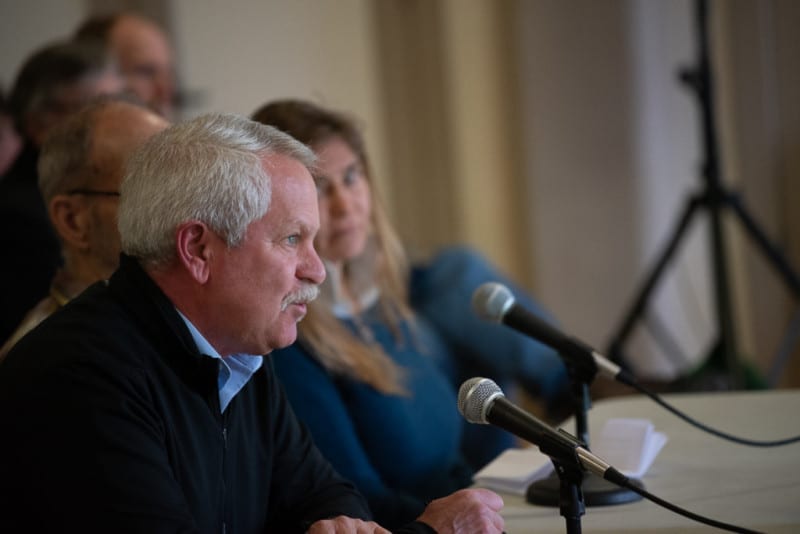
During the public hearing in the Dalles, Mayor Burns (right) looks on as Mark Johnson testifies in opposition to the proposed legislation. Photo by Jurgen Hess.

Herb Stall, a farmer from Hermiston, spoke directly to those costs, saying the projected 16 cent increase in fuel prices would effectively “kill small family farmers.”

Other farmers made similar arguments, restating that rural Oregonians would bear the brunt of increased energy prices.

And Mike Oates, Hood River orchardist and Chair of the Hood River County Board of Commissioners, said that since orchardists are in the business of growing trees, which pull carbon dioxide from the atmosphere, they should receive some sort of exemption from the state.

Conversely, Parkdale fruit grower Paulette Whitwir spoke to the long-term costs of climate change, explaining that “in the long run, it will cost us all more if we don’t pass carbon legislation.” She spoke of the damaging effects that climate change has already wrought on the industry, from shrinking snowpack driving up the cost of irrigation water to seasonal irregularities resulting in shorter blueberry harvests. 

Thomas Morning Owl, representing the Confederated Tribes of the Umatilla Indian Reservation, and Donald Sampson, Chief of the Walla Walla Tribe, both traveled from Pendleton to attend the hearing. Striking a more emotional chord with his testimony, Morning Owl said that “when you’re mother is being attacked, you must help her.”

“Earth is crying,” he said solemnly. “Let us hear her.”

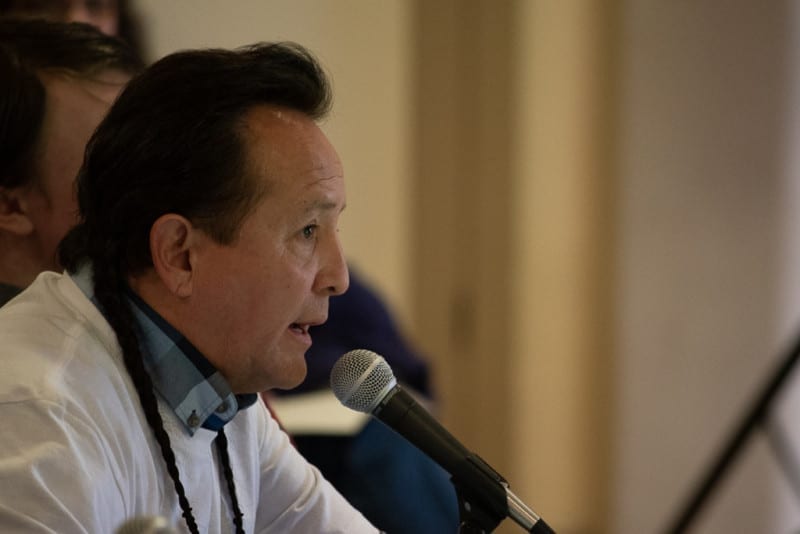
Tribal Chief Donald Sampson speaks in favor of HB2020. Photo by Jurgen Hess.

And Sampson explained how a greener economy would benefit tribes across the state, as many of them are already working to restore salmon runs and improve the overall health of ecosystems.

Then there was Sarah Carlberg, a Forest Grove resident who brought her baby along. Her testimony focused on the growing intensity of wildfires that some climate scientists say are symptomatic of a changing climate.

Carlberg brought up the Camp Fire that devastated California last November and said that since then, her children have been asking her when their house is gong to burn down.

“I respect the opposition,” she said, “but I perceive a threat to my family and my home.”

Reminding legislators that “what we take today we borrow against the future,” Carlberg’s testimony triggered a round of applause from the audience. And while a number of people weren’t clapping, everyone in the room seemed to be listening.    

By |2019-04-11T09:55:21-07:0004/04/2019|Climate Change, News|2 Comments

Morrison Park: Where habitat and housing collide

By Dac Collins. March 21, 2019. The City of Hood River aims to rezone Morrison Park in order to develop affordable housing on the property. Elected officials in favor of the development are calling it a compatible compromise between those in need of affordable housing and those in favor of preserving open space. Residents of Hood River who oppose the rezone are calling it a short-sighted land grab that could set a dangerous precedent for how parks are managed by the city.

This clash of opinions set the stage for the contentious and impassioned City Council meeting that took place on Monday, March 11.

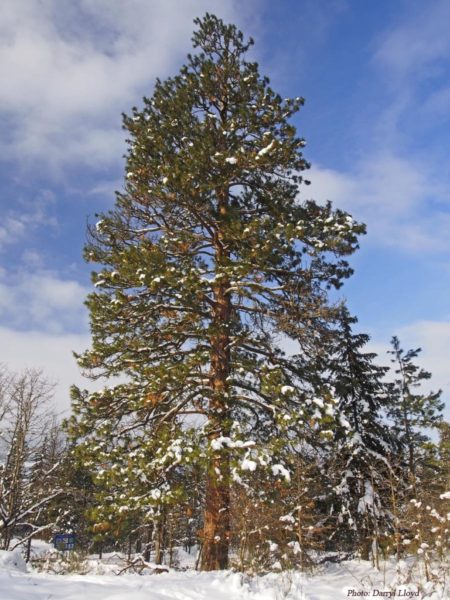
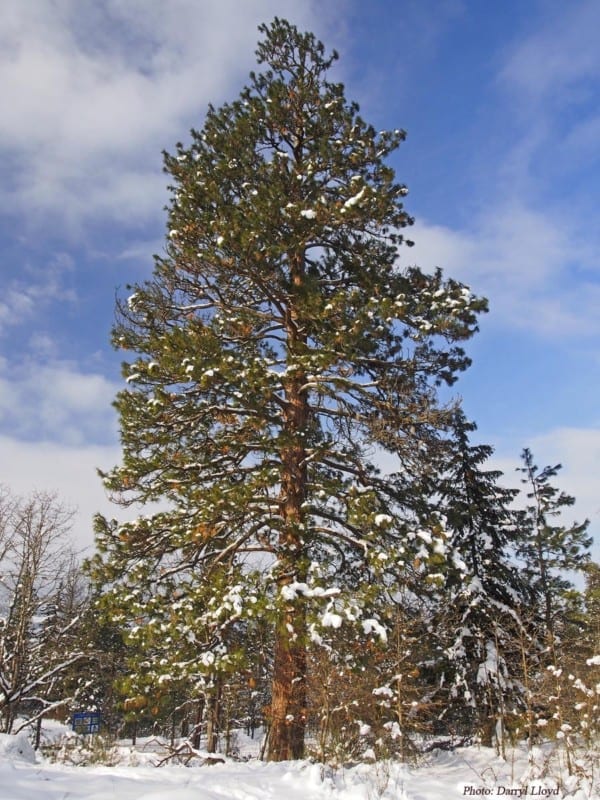
A ponderosa pine stands watch over Morrison Park. Photo by Darryl Lloyd

During the four-hour public hearing, 26 citizens testified in opposition to the rezoning of Morrison Park, officially known as “Tax Lot 700”. One citizen testified in support of rezoning, along with two representatives from the Mid-Columbia Housing Authority, which currently has an executed option agreement with the city to purchase the property for $1.

“The only reason we’re giving this a passing thought, let alone struggling to figure out if we felt that there was a rational, reasonable pathway forward, is because of the importance of housing,” says Mayor Paul Blackburn.

He explains that Tax Lot 700 is “far and away the most feasible parcel for affordable housing” because it is centrally located, there are public services nearby and the city already owns it.

“The ODOT parcel, which is on Cascade above the skate park, is also an excellent location. It could work, but we would have to reimburse ODOT for relocating…and the early numbers I saw for something like that was 6 or 7 million dollars.”

“Okay. So, that would be a great spot,” he says. “If we had 7 million dollars.”

Blackburn was elected to his third term last November, and he has served as an elected official (previously as a city council member) since 2004. In that time, he explains, building affordable housing has become the city’s top priority.

That’s because in 2004, the number of people living within the city limits of Hood River hovered around 6,383. Today, that number is closer to 7,700.

This increase (of approximately 20 percent) correlates to the upsurge in median home prices over that same period of time. Jumping from $205,000 in 2004 to $459,100 in 2019, the median home price in Hood River has more than doubled over the past fifteen years.

And the rental market is even more prohibitive and unaccommodating. A report issued by ECONorthwest in September of 2015 found that “nearly one-third of Hood River’s households are unable to afford their current housing, with roughly 40 percent of renters unable to afford their housing.”

Predicting that the city’s population will continue to grow at a rate of approximately 2 percent a year, a key question from the 2015 study is “whether housing prices will continue to outpace income growth, [as] it seems likely that without public intervention, housing will become less affordable in Hood River.”

This is what a housing crisis looks like.

And it helps explain why Blackburn and other elected officials see affordable housing as their number-one priority when working to develop a sustainable future for the city.

Pitting housing against parks

Josh Sceva lives caddy-corner to the park. He has been involved with attempts to save Morrison Park since the city first tried rezoning the property in 2016. That was around the same time, Sceva says, that Hood River Parks and Rec. started cutting back on its maintenance of the park.

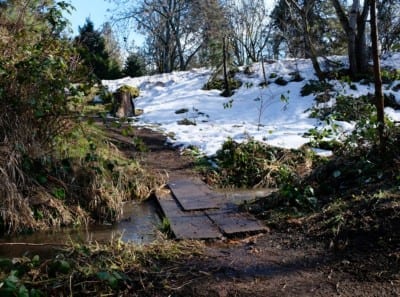
“Do you see a garbage can anywhere?” he asks while walking across a makeshift wooden bridge spanning the unnamed, perennial creek that winds through the property.

Photo by Dac Collins

“Now it’s pretty much up to the people, and when they see garbage they pick it up themselves,” Sceva says, now standing on the other side of creek.

Sceva sees the property’s potential as a westside hub for a citywide network of pedestrian trails and bike paths. Pointing to Jaymar Road, which passes underneath Interstate-84 and heads down toward the Columbia River, he says: “To me, it’s just seems so natural that you would have a path coming down from the westside through here, then on to the waterfront and downtown.”

For Sceva, the park is a valuable asset to the local community — a tranquil and wooded open space that provides solace for people, as well as habitat for wildlife and native trees, including Oregon white oaks, big leaf maples and ponderosa pines.

And for avid disc golfers like Devin Carroll, Morrison Park is literally the only game in town. In a place that’s become synonymous with extreme sports like kiteboarding, skiing and mountain biking, all of which require expensive gear, Carrol says disc golf is “the most accessible sport that I know of.”

“You don’t need thousands of dollars worth of gear…just a couple discs. It’s free to play the course and a lot of people don’t have to get in their car to drive here.”

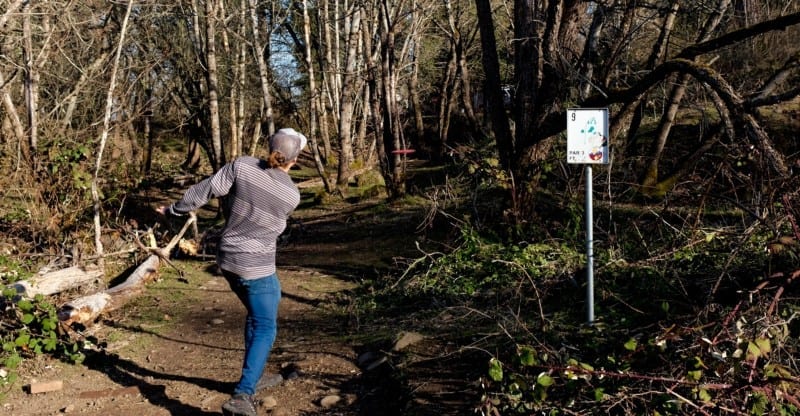
Carroll tees off on the 9th hole. Photo by Dac Collins

Carroll plays disc golf year round. And as much as he appreciates the course, he says what sets Morrison Park apart from the other parks around town is that it’s an “urban forest”…an intact, natural woodland in the heart of Hood River.

He says its unfortunate that attempts to rezone Morrison Park have pitted housing advocates against park supporters because “we’re all huge advocates for affordable housing.”

“We’re all for it. We just believe that it should not come at the expense of our park. Or any park. Ever.”

As it turns out, there are quite a few people in Hood River who share those beliefs.

One of them is Susan Crowley, who says of the city’s continued attempts to rezone the parcel: [perfectpullquote align=”full” bordertop=”false” cite=”” link=”” color=”” class=”” size=””]“They’re doing good work. Its just that they’re doing good work in the wrong place.”[/perfectpullquote]

She says her biggest concern is that the rezone could set a precedent for other parks, ostensibly making the city’s park system a land bank for potential development.

“There’s really no compromise for these kinds of resources. Having accessible places to connect with the natural world is so precious at this stage of our development, and when you lose parks they don’t come back.”

“Well, ultimately they come back,” she quips, “when we self-destruct as a species.”

These concerns led Crowley, an inactive member of the Oregon State Bar, to file an appeal with the Land Use Board of Appeals (LUBA) after the City Council first approved the rezone in May of 2017. LUBA upheld the Council’s decision in January of last year.

Crowley then took her case to the state Court of Appeals, which overturned LUBA’s ruling in September. The Court remanded the decision, finding the city’s reasons for rezoning “implausible” because they were in direct conflict with Goal 8, Policy 1 of the city’s Comprehensive Plan.

This forced the city to revisit the issue, and to serve as the impartial arbiter in deciding whether the applicant (the city itself) should be able to move forward with the rezone of Morrison Park.

Which brings us to the March 11 City Council Meeting.

Five minutes apiece

The underlying question of the public hearing that took place ten days ago was whether or not the city’s move to rezone Tax Lot 700 is in accordance with the stated intentions of Goal 8, Policy 1 of the city’s Comprehensive Plan:

Goal 8 — Recreational Needs: To satisfy the recreational needs of the citizens of the community and visitors to the area.

Policy 1: Existing park sites will be protected from incompatible uses and future expansion alternatives at some sites will be developed.”

In other words, is developing affordable housing on an existing park a compatible use for that park?

Morrison Park in the spring. Photo by Darryl Lloyd

26 Hood River residents thought not, and they were each given five minutes to say their piece.

A number of those testimonies honed in on the key words of Goal 8, Policy 1.

Crowley focused on, among other things, the word “existing”. She pointed to the city’s Recreational Resource Inventory from 1983.

“I’ve attached the actual inventory of parks in Hood River and it has Morrison Park in it. You can see the acceptable uses, the expected uses, the anticipated uses for Morrison Park. And housing ain’t nowhere on there.”

“I support affordable housing,” Crowley said, “but you don’t put it on parks”

And resident Linda Maddox brought up the fact that “if you look at Policy 1, the meaning of ‘protect’ is to save from loss, destruction or injury.”

“If an existing park site is to be saved from loss, destruction or injury, as stated in the Comprehensive Plan,” Maddox continued, “then the construction of 67 housing units on top of Morrison Park is in no way a compatible use. Absolutely no way.”

Rio Bella Heights is an affordable housing development located in the Heights neighborhood of Hood River. Photo courtesy of Mid-Columbia Housing Authority

Scott Baker lives in Hood River but works in the Dalles. As the Director of the Northern Wasco County Parks and Recreation District, he explained, he spends a lot of time analyzing and implementing Comprehensive Plans.

“The Plan is a legal document and a statement of public policy, and as such it is a guiding document for all land use decisions” he noted.

Baker asserted that any attempt to modify the language in the Plan would undeniably set a precedent for how parks are managed in the future.

“It’s important that we follow the process and we don’t amend our Comprehensive Plan. Once a Plan is interpreted a certain way, it becomes the interpretation. It will become the interpretation for all of our parks, and this is not limited in scope to Morrison Park.”

Other testimonies focused on the property’s value as habitat and its importance as a wildlife corridor. One resident referred to Morrison Park as a “natural urban oasis”, and another held up her smartphone during testimony to show photos of the three hummingbirds she had seen in the park that afternoon.

On the other side of the debate was Joel Madsen, Executive Director of the Mid-Columbia Housing Authority. During his testimony on March 11, Madsen argued that with proper planning and consideration for the natural elements of the parcel, the goals of development and preservation could be mutually inclusive.

“We see this development, while protecting park space, as also a viable option for us to achieve our mission in housing some our most vulnerable community members,” Madsen said.

In a separate conversation preceding the public hearing, Madsen discussed how the decision was reached to convert approximately half of Tax Lot 700 into a “mixed income development” and preserve the remaining acreage.

“We have been looking at this site pretty intensely for the last year and a half or so, and getting a better understanding of just exactly how much of the site can be preserved while also developing a nicely thought-out affordable housing development,” said Madsen.

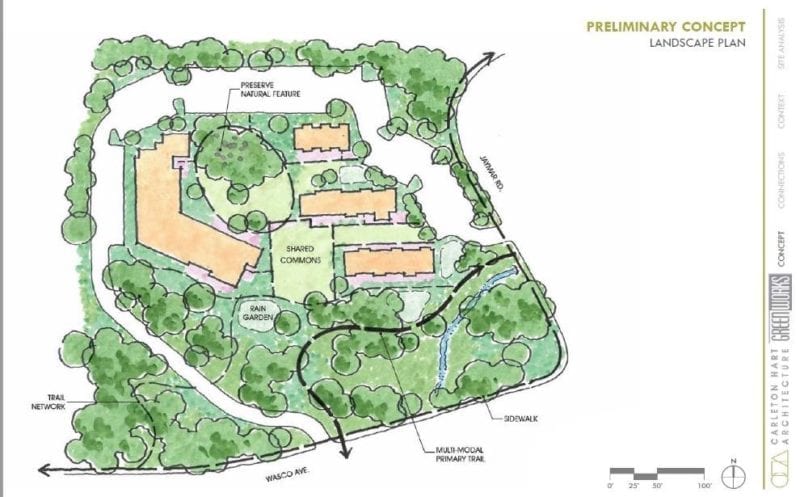
A preliminary sketch of the proposed development. Courtesy of Mid-Columbia Housing Authority

“A few of the units would be affordable up to 80% area median income. A few units would be affordable up to 50% area median income, and a few at 30% area median income.”

“We want to champion that preservation of the park space,” he continued, but explained that roughly half of the parcel would have to be developed to make the project financially viable.

In the end, after nearly three hours of testimony and an hour of delegation, Council Member Erick Haynie moved to reject the rezone, arguing that the reason Goal 8, Policy 1 was established was “not to protect portions of an existing park, but the whole thing.”

Haynie’s motion did not get a second.

Council President Kate McBride — whose husband, Rich McBride, is on the board of the Mid-Columbia Housing Authority, as former council member Susan Johnson pointed out at the beginning of the hearing — then moved “to approve the rezone with no more than 55 percent (approximately 2.76 acres) of the tax lot to be developed as affordable housing; maximum 45 percent shall be set aside to incorporate park and recreational amenities and public facilities. The 55 percent that shall be developed as affordable housing shall be contiguous.”

Council Members Mark Zanmiller and Jessica Metta seconded the motion, while Tim Counihan and Erick Haynie voted against it. Mayor Paul Blackburn cast the tie-breaking vote (4-2) to rezone the 5.3 acre parcel from Open Space and Public Facilities (OS/PF) to Urban High Density Residential (R-3).

Morrison Park in the fall. Photo by Darryl Lloyd

“There’s a lot of people that weren’t in that room,” Blackburn said after the public hearing had concluded. “The testimonies, in my opinion, did not broadly represent the residents of Hood River, and it’s very important for us to keep that in mind. It’s very important for the elected officials to listen carefully to all the residents and to represent all the residents.”

“We try to receive all of it with the best grace we can and make the best decision we can.”

Crowley, however, confirmed that she will be appealing the City Council’s decision to LUBA.

“The city has proposed trying a rezone again knowing that it’s going to be appealed, and is choosing to waste public money and effort on litigation that will benefit only lawyers,” she said after the hearing.

She explained that, as before, “if LUBA supports this rezone attempt, it will then be appealed to the Oregon Court of Appeals.”

By |2019-03-21T11:08:25-07:0003/21/2019|Conservation, News, Public Lands|6 Comments

Yakima Valley Blizzard: Anomaly or harbinger of climate change?

By Dac Collins. March 7, 2019. Over 1,800 cows died last month when a blizzard of unprecedented proportions hit the Yakima Valley. And with a number of local farmers claiming they’ve never experienced such a severe winter storm, some people are wondering if this was simply a freak occurrence or if it somehow correlates to the volatility of a changing climate.

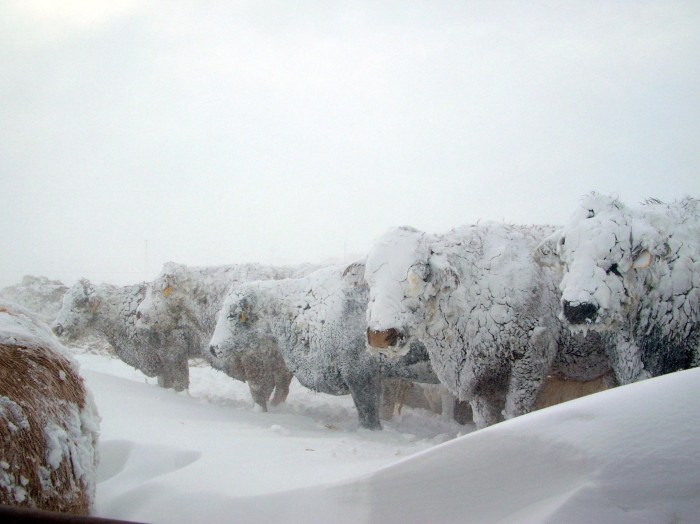
The Lower Valley received the brunt of the storm, which struck on the evening of Feb. 8. Yakima Mayor Kathy Coffey declared a state of emergency the following afternoon, and by the end of the weekend 14 dairy farms had reported losses of cattle.

“In all my years, I’ve never been a part of a blizzard like this,” Jason Sheehan, owner of J and K Diary, told the Spokesman Review.

“If we would have gotten the snow without the wind, we would have been fine,” Sheehan continued. “Even if we got the wind without the snow, we could have figured something out. But when you put the two together, it was like nothing I have ever seen.”

Sheehan and other dairy operators were wholly unprepared for a storm of this magnitude. Because of the dry desert climate in the Yakima Valley, many of the cows there are either left outside during the winter months or kept in open-sided shelters.

And with wind gusts of 80 mph, snow accumulations of up to two feet and temperatures plunging to 20 below zero, some of those cows froze to death before farmers could move them into barns and improvised shelters.

Hundreds more of the animals were trampled by one another as they tried to escape the wind by cramming into the corners of pens.

All told, representatives from Washington’s dairy industry reported that 1,830 cows (an estimated $4 million worth of dairy products) were killed in the storm. And while it doesn’t make up for these losses, the State has already provided $100,000 to help remove some of the dead cows.

Dave Bennett is the Communications Manager for the Washington Department of Ecology’s Solid Waste Management Program, which was tasked with coordinating the proper disposal of the animal carcasses. He says they finished with that operation two weeks ago.

“Most of the carcasses were managed appropriately by the farmers themselves,” Bennett says. He explains that only about 500 of them had to be taken to a landfill in Oregon. The rest were either rendered or composted by farmers, which means the carcasses had some beneficial use associated with them.

Bennett refers to the disposal operation, and to the blizzard itself, as “unprecedented and very unusual.”

“This is not something that we look forward to…or prepare for. It’s something that we respond to,” he says. “This was not easy for anyone.”

There is, however, another more theoretically challenging component of this storm: the notion that these devastating weather events could become more commonplace if the climate continues to warm at its current rate.

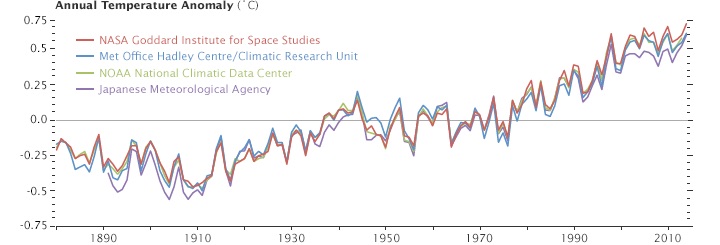
This graph shows the increase in average global temperature between 1880 and 2014. Courtesy of NASA’s Earth Observatory.

Climatologists are still grappling with this idea, and many would consider it a stretch to try and draw direct correlations between one unusually severe winter storm and climate change. But that hasn’t kept some of them from trying. A 2018 study seeks to explain how a warming Arctic could be responsible for some of the brutally cold weather that we are witnessing in the northeastern United States.

Karin Bumbaco, Assistant State Climatologist with the University of Washington, falls somewhere between the two camps when answering the sticky (and increasingly politicized) question of whether or not harsher winter storms could be a result of a warming climate.

“I wouldn’t say that one cold or snow event would link to climate change. I just don’t think there’s enough evidence there,” Bumbaco says. “But it’s an area of research that has ramped up over the past several years, and it seems like there’s evidence on both sides.”

She says that although Feb. 9 was the first time the National Weather Service has ever issued as blizzard warning for the Yakima Valley, “I wouldn’t use this [storm] as a poster child for climate change.”

“But on the other hand,” Bumbaco continues, “our climate in Washington State has been warming. Our temperatures are going up in all seasons. And whether you look at it seasonally, on an annual basis or as a long-term trend, these sorts of events have become more usual.”

Bumbaco points to studies that focus specifically on the effects of climate change on the agricultural industry.

The University of Washington’s State of Knowledge Report from 2013 has an entire section devoted to agriculture. In this section, the researchers’ biggest concerns are related to warmer summer temperatures and reductions in summer streamflows combined with an increasing demand for irrigation water.

“In the Yakima Basin, for example, water shortage years are projected to increase from 14% of years historically (1979-1999) to 43 to 68% of years by the 2080s,” the report finds.

And while it doesn’t mention blizzards (or even snowflakes), the report does project an increase in extreme weather in the future, even under low and medium greenhouse gas scenarios.

The more recent and comprehensive National Climate Assessment reaches similar conclusions regarding extreme weather events in the Northwest.

“Extreme events, like heavy rainfall associated with atmospheric rivers, are anticipated to occur more often,” according to the Assessment, which similarly finds that: “severe winter storms are also projected to occur more often, such as occurred in 2015 during one of the strongest El Niño events on record.”

In summary, it is scientifically debatable to link an isolated weather event to the climate, as they are separate phenomena. But as our climate continues to warm, we seem to be feeling the effects.

By |2019-05-30T16:45:27-07:0003/07/2019|Climate Change, News|3 Comments

© Copyright 2013-2025 Columbia Insight. All Rights Reserved.

As a 501(c)3 nonprofit organization, all donations to Columbia Insight are tax deductible to the full extent of the law. Our nonprofit federal tax-exempt number is 82-4504894.