Stay Updated Subscribe today for the latest research + reporting about environmental news. Subscribe Now

Stay Updated Subscribe today for the latest research + reporting about environmental news.

Subscribe Now

Dac Collins

Dac Collins

Dac Collins

About Dac Collins

This author has not yet filled in any details.
So far Dac Collins has created 71 blog entries.

A Tale of Two Cultures

Yakama, Lummi Nations call for the removal of three Lower Columbia dams.
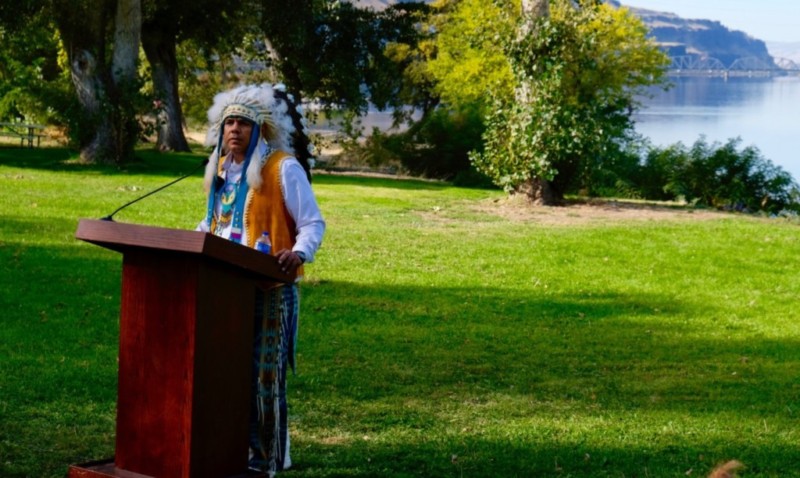
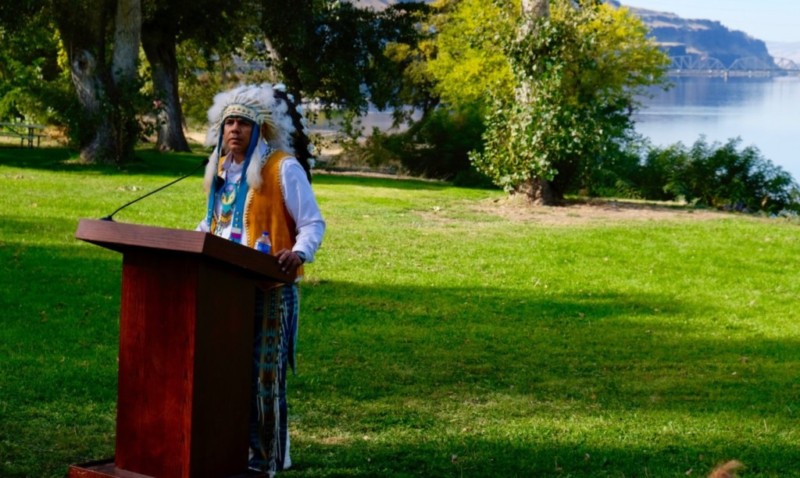
Yakama Chairman Joe DeGoudy speaks at Celilo Park on Oct. 14. Photo by Dac Collins

By Dac Collins. Oct. 17, 2019. Tribal leaders and elders from the Yakama and Lummi Nations gathered at Celilo Park on Monday, Oct. 14, in honor of Indigenous People’s Day. News cameras rolled and shutters clicked in the foreground as they spoke at length to the crowd that was gathered there.

They spoke of a broken system rooted in the Doctrine of Discovery, of water that is too hot for salmon, and a worldview that favors progress and profits above all else.

Behind them, the big, sleeping pool of a river was dead calm, and its surface shone like glass. (And while everyone present knew and acknowledged what lie buried beneath that giant pool, only a few of them had ever seen it with their own eyes.)

Yakama elders Karen Jim Whitford, Wilbur Slockish Jr. and Johnny Jackson spoke, as did Celilo Village Chief Olson Meanus. Jay Julius, Chairman of the Lummi Nation, travelled all the way from Bellingham to represent the people of the Salish See. But it was Yakama Chairman Joe DeGoudy who gave the first speech of the day. And his words carried weight.

DeGoudy focused on the history of the colonization, and what he called the subsequent domination, of the Columbia River Basin — a thread that begins with Cristopher Columbus’ “discovery” and Captain Robert Gray’s placement of the American flag on the North bank of the Columbia, and continues through a series of landmark U.S. Supreme Court cases and re-negotiated treaties to the present-day actions of Congress.

As he spoke, his voice was occasionally drowned out by the raucous, rattling sound of a passing train.

Every now and again he would point to the river that stretched out behind him. “It almost looks like a lake,” he said at one point, referring to the water that for the past 62 years has been held back and effectively yoked by a wall of highly engineered concrete further downriver.

It wasn’t until the latter half of this history lesson that DeGoudy arrived at the point in time when the first dam was constructed on the main stem of the Columbia River. From there, he talked about the dam-building era that flourished during the mid-20th century, citing the series of decisions made (and Acts passed) by Congress that transformed the free-flowing river that his ancestor’s knew into the mechanized body of water that we now utilize.

“So here’s the question of today’s day,” DeGoudy said, his voice building with momentum like a wave in deep water.

“What legal basis did the United States have to dam the Columbia River, the Nch’i-Wána, and to impair the Yakama Nation’s treaty-reserved fishing sites at all usual and accustomed places without first obtaining Yakama Nation’s free, prior and informed consent? Under what basis did that happen?”

“…and what will we collectively do about the understanding of what the truth is of history?” he asked.

“The truth,” he repeated, his voice now a visible swell that rolled toward the silent crowd.

[perfectpullquote align=”full” bordertop=”false” cite=”” link=”” color=”” class=”” size=””]“Because these actions of the assertion of so-called original claim, title, domination have never been repudiated. They still govern today. They still rule today…and the Native people’s way of life has faded, and something else has been developed.”[/perfectpullquote]

With these words, the wave crested. And for a brief moment — time enough for a pregnant pause — it seemed to hang over the crowd before the weight of the Chairman’s next statement brought it crashing down.

“Today,” he said, “Yakama Nation, with its allies, are calling upon the United States for the removal of Dalles Dam. For the removal of Bonneville Dam. For the removal of John Day Dam.”

Meanwhile, roughly 9 river miles downstream of Celilo Park, a steady flow of water rushed through the turbines of the Dalles Dam, generating electricity for a power-hungry culture that had long forgotten how to exist without it. At the same time, a westbound barge filled with Idaho-grown wheat passed through a navigation lock on its way to an export terminal, where the bushels of grain would eventually be shipped off to Asian buyers on the far side of the Pacific.

And up in the control room, a crew of U.S. Army Corps. of Engineers employees ensured that this whole process ran smoothly while a number of their co-workers took a paid holiday in honor of Columbus Day.
White Salmon Checkout Bag Ordinance Likely but Uncertain

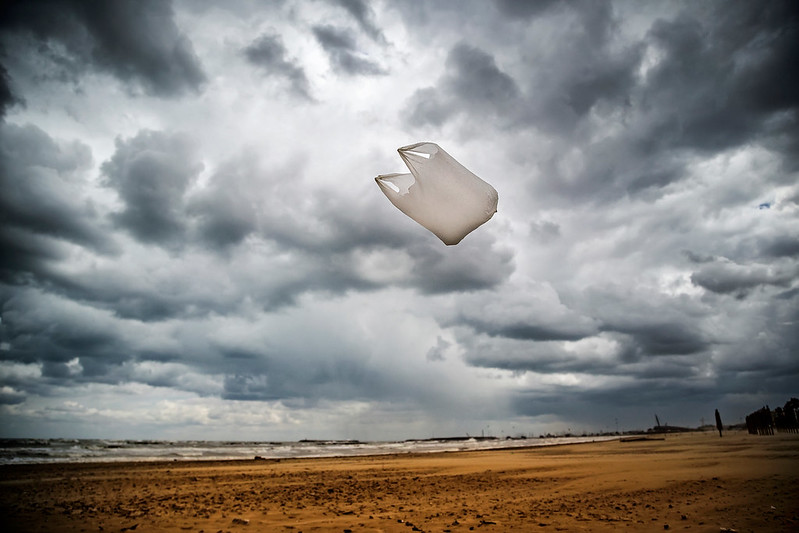
Photo courtesy of Flickr

By Dac Collins. Oct. 10, 2019. It seems likely that the City of White Salmon will be the 34th municipality in the State of Washington to enact some variation of a plastic bag ban. The vast majority of local residents and businesses support the idea, as most people can agree that getting rid of singe-use plastic bags is a sound waste management strategy and an important step toward decreasing the overwhelming amount of plastic currently disrupting our environment.

But due to a sticking point over how the policy should be implemented, the passage of the Checkout Bag Ordinance is still not a certainty.

During a public hearing that took place on Oct. 2, Mayor David Poucher threatened to veto the City Council’s unanimous decision to pass the ordinance, arguing that he was speaking up for the silent majority that did not attend the hearing. The mayor has until the close of business on Friday, Oct. 11, to decide whether he will veto the City Council’s decision or sign the ordinance.

Taking shape

This unexpected twist came as a shock to the nearly 30 people who showed up to the hearing to support the ordinance. That group included Becky Miles, who founded the group Community Upcycle in January in order to combat the growing problem of single-use plastic and push for some commonsense legislation around the issue.

Miles says their push for a local bag ban was initially put on hold as the Washington legislature considered a more expansive bill that would ban single-use plastic bags statewide. But when Senate Bill 5323 died in the House during the eleventh hour of the legislative session, Miles says the group “kicked right back into action.”

“We started drafting an ordinance,” Miles explains, “and we worked really closely with the Washington Industry Food Association and Zero Waste of Washington.”

The Checkout Bag Ordinance, as it is currently written, is not an all-out ban on plastic bags. Instead, it increases the criteria for the paper and plastic bags that are made available to consumers, requiring that both paper and plastic bags are recyclable, are made of at least 40% recycled material, and (in the case of plastic) are sturdy enough to be reused at least 125 times. The ordinance would also require shoppers to pay a 10 cent fee for each bag used during checkout.

“The idea is to raise the bar so that the products offered are made of more recycled content and are more reusable. It’s a good waste management strategy,” explains Anne Stringer, another member of Community Upcycle. “And then the fee comes in because that is a market-based incentive proven to reduce consumption. So it all works together.”

“And once we got that done, our next concern was: ‘how is this going to impact our local businesses?’”

Stringer and Miles then began meeting with local business owners and found that nearly all of them supported the idea. And after discussing these results with the White Salmon community development board, they went back out and gathered signatures from 28 of those owners.

Miles says she first reached out to Jeff O’Neal, the owner of Harvest Market, “who just happens to have a store in San Francisco. So he’s been through this and he’s totally supportive. 100 percent.”

She received similar responses from other businesses in town, and “there was not one business in White Salmon that I spoke to that had to be convinced,” she adds.

So going into the Oct. 2 public hearing, the two were optimistic that the ordinance would pass — especially considering that the City of Bingen passed what is essentially the same ordinance the night before.

But one city councilman, Jason Hartmann, was running late. And while the council members held the vote and discussed the proposed ordinance amongst themselves, the mayor announced that, should they decide to pass the legislation, he would veto the decision.

The City Council then voted unanimously (4-0) in favor of the Checkout Bag Ordinance, at which point Mayor Poucher said he would take the full 10 days allotted to him as part of the veto process to decide whether or not to officially veto their decision.

Moving forward

“I’ve never vetoed anything in 12 years,” Poucher says, “and I still haven’t vetoed this one. I have until close of business on Friday to make up my mind.”

The mayor explains that while he staunchly supports the banning of single-use plastic bags, he has trouble with the 10 cent charge imposed on consumers.

“I think White Salmon is so different than the rest of Oregon or Washington,” he says. “We’re not a big city, we know virtually all of our people, and I honestly think that the vast majority of people would comply without using the stick— the ten cents. I always think if you can do something softer, you’re always a lot better off doing it that way.”

Stringer and Miles disagree, arguing that a pass-through charge is critical, and the only way to change people’s behavior. “It encourages reuse,” they say, “and avoids the transfer of the environmental burden to paper or thicker plastic.”

And they compare ordinances that have been implemented in other places as proof of this theory. California’s statewide ordinance (ban plus 10 cent charge), for example, resulted in customers bringing their own bags 84% of the time, and paper bag use dropped by 61%. By contrast, Portland enacted a ban without a charge in 2012, and the use of paper bags skyrocketed, increasing by almost 500%.

The dramatic uptick in paper bag use was seen in Hood River as well. Miles says she spoke with the COO of Rosauer’s, who confirmed that after the plastic bag ban was implemented in 2017, the grocery store used an additional 100,000 paper bags within the first year.

Mayor Poucher explains that he now regrets pulling the veto card at the last minute, saying: “It was a miscue on my part, and I wish a had a reset button so we could go back and say ‘let’s hold off and give this another reading.’”

“But, basically,” he continues, “I had a lot of people that had talked to me previous to the meeting and they were against the mandatory charge. And I felt like there were a large number of people that for some reason or another just didn’t show up.”

Poucher is now waiting to hear back from residents who oppose the 10 cent charge, and he says the amount of written responses he gets will dictate whether or not he decides to veto the City Council’s Oct. 2 decision. If he does veto, the city council will have to vote on the ordinance again, and a supermajority would be required for it to pass. If not, he will sign the ordinance into law — but even then, he says he is considering tacking on a resolution that would prevent the 10 cent charge from kicking in until 6 months to a year down the road.

It’s not entirely clear if the City Council would accept that resolution, but either way, the mayor has until the end of the day tomorrow to decide how to move forward.

By |2019-10-10T11:18:09-07:0010/10/2019|Energy, Waste Management|1 Comment

Bringing salmon back to the Upper Columbia

Oct. 3, 2019. In the second audio edition of Columbia Insight, we take a deeper look at the efforts that are currently underway to re-introduce salmon above Chief Joseph and Grand Coulee Dams. Featuring interviews with Colville tribal leader Rodney Cawston, UCUT committe coordinator John Sirois, and Vince Bryan, the CEO of Whooshh Innovations, we discuss the history of salmon in the Upper Columbia and what it will take to bring the fish back after a nearly 80-year absence…  

By |2023-05-11T07:19:43-07:0010/03/2019|Natural Resources, Podcasts, Wildlife|0 Comments

“A Virtuous Circle”: Gov. Inslee Applauds HW Hill Renewable Natural Gas Facility

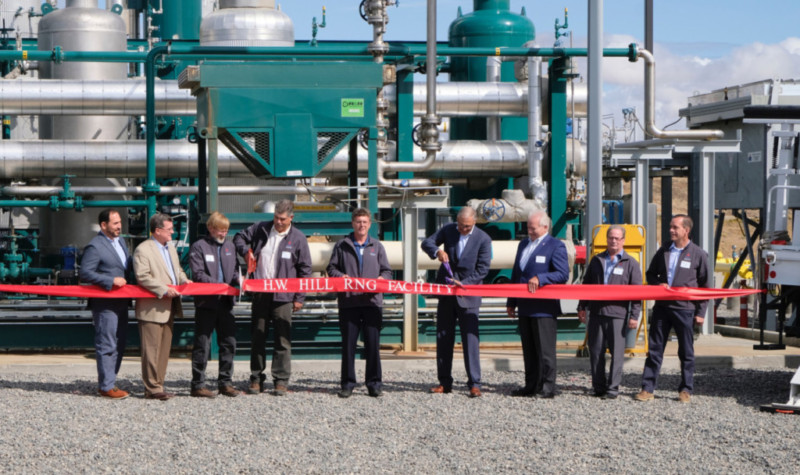
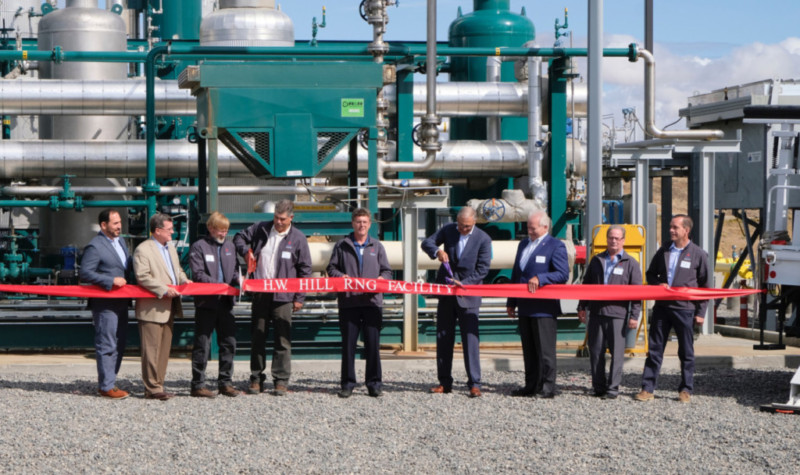
Standing alongside other supporters and developers of the renewable energy project, Klickitat PUD Commissioner Dan Gunkel joins Gov. Inslee in cutting the ribbon. Photo by Dac Collins 

By Dac Collins. Sept. 19, 2019. A crowd of roughly 135 people gathered at the Roosevelt Regional Landfill on Wednesday, Sept. 18, to celebrate the dedication of the HW Hill Renewable Natural Gas Plant. That group included legislators, lobbyists, regional stakeholders and residents of Klickitat County, as well as the engineers, contractors, commissioners, managers and other employees who have worked together since 2014 to make the innovative renewable energy project a reality.

The HW Hill facility started producing renewable natural gas (RNG) in November of last year. This process requires Republic Services, the owner and operator of the landfill, to harvest the methane, nitrogen, carbon dioxide, oxygen, water and other volatile organic compounds (VOCs) that are released during the anaerobic decomposition of garbage. Klickitat Public Utility District then scrubs and filters out most of those elements, resulting in a compressed form of natural gas that is made up of 98 percent methane. This EPA-approved cellulosic biofuel can then be used for transportation, replacing diesel in heavy duty engines and thereby reducing the greenhouse gas emissions of those vehicles by at least 60 (and up to 100*) percent.

The facility is designed to produce around 5,701 MMBTU’s of energy per day. To put that in perspective, a gallon of diesel fuel has an energy content of around 139,000 BTUs. So the 5,062 MMBTUs that were produced at the H.W. Hill facility on Jan. 2, for example, are equivalent to roughly 36,482 gallons of diesel.

Looking at this rate of production over a longer period, the HW Hill facility can produce the energy equivalent of 14 million gallons of diesel per year.

For the time being, the gas is being piped via the Williams Northwest Interstate Pipeline to California, where there is more advanced natural gas infrastructure and, accordingly, a higher demand for the fuel. After arriving in California, the gas is then utilized by different transportation sectors, including public transit buses, Over The Road trucks, airport shuttles… even garbage trucks.

To say that garbage trucks running on re-purposed garbage is exciting would be an understatement. And the sustainable, closed-loop system that facilities like the HW Hill gas plant can help create is the main reason why Gov. Jay Inslee travelled halfway across the state to share his support for the project.

Before performing the official ribbon cutting, Inslee gave a speech commending what he called a “visionary accomplishment”. Senator Curtis King also spoke, as did Klickitat PUD Comissioners Dan Gunkel and Doug Miller, Klickitat PUD General Manager Jim Smith, Republic Services’ VP of Government and Regulatory Affairs Dan Jameson, and Johannes Escudero, the CEO and Executive Director of the California-based Renewable Natural Gas Coalition.

Senator King alluded to the 2015 legislation that made it possible for public utilities to produce and distribute renewable natural gas. He also thanked Republic Services “for operating a state-of-the-art landfill.”

“That might not sound like much,” King said, “but let me tell you, it is. It is probably one of the best landfills in our country, and we need to recognize that today.”

Klicktat PUD General Manager Jim Smith also shared his appreciation for Republic Services’ long-term vision and commitment to renewable energy, which was critical in allowing the public utility district to utilize the methane harvested from the landfill.

“This is truly a great day for Klickitat County,” Smith said before calling attention to the wealth of people who made the project possible. He applauded the tenacity and drive of Kevin Ricks, who led the RNG team, as well as the “plant operators, engineers, purchasing, meter shop technicians, mechanics, contractors, accountants, finance, customer service representatives, crews” and countless other employees who played a vital role in the project’s inception and implementation.

[perfectpullquote align=”full” bordertop=”false” cite=”” link=”” color=”” class=”” size=””]“We are both lucky and blessed with dedicated and skilled employees, and are very, very proud of their efforts in accomplishing something that even larger utilities would struggle to do.”[/perfectpullquote]

Johannes Escudero spoke to the larger implications of the HW Hill facility, and what this technology means for a society that is now forced to come to terms with the tremendous amount of waste it generates on a daily basis.

“The reality is so long as human and animal life populate our planet, and consume and digest organic materials, those organics will need to be disposed of,” Escudero said.

“And regardless of how or where, or who pays for the diversion, those organics will eventually decompose through a natural process called anaerobic digestion and produce methane gas. We know methane is a short-lived climate pollutant, and that it’s many times more potent and harmful than carbon as a greenhouse gas. So what we do as a society with methane matters.”

Escudero added that the state-of-the-art facility should serve as an example for the additional 2,000 landfills located throughout the country — as well as the 8,000 large dairies and 17,000 wastewater treatment plants — that are mostly burning off and wasting the methane they generate instead of converting it into a “domestically produced, ultra-low carbon transportation fuel.”

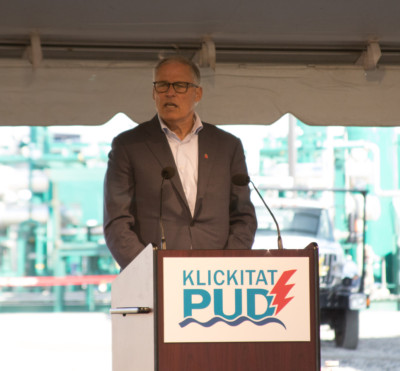
Gov. Inslee speaks at the dedication ceremony on Sept. 18. Photo by Kathi Ricks, Kat Ricks Photography, LLC

But it was Gov. Inslee’s speech that kicked off the event, and it was his presence, in part, that drew a crowd topping 100 people. He shared his overwhelming support for the project and pointed out that “this can be done in many, many forms across the state of Washington.”

The governor summed up the environmental benefits of the HW Hill facility — and the technology’s role in a more sustainable future — by singling out one type of trash that can be found in most landfills: rotting fruit.

“We’re bringing up oranges from California, and we’re enjoying and eating those oranges. Then we’re taking the rotting orange peels and turning them into a transportation fuel and shipping it back to California,” Inslee said.

“That is a virtuous circle if I’ve ever seen one.”

*According to the Vice President of Clean Energy Fuels, which buys some of the RNG produced at the HW Hill facility: “When you factor in both the criteria pollutants and the emissions reductions associated with greenhouse gases, your greenhouse gas emissions reductions with renewable natural gas are typically upwards of 100% when compared to your diesel footprint.”

By |2019-09-19T10:49:43-07:0009/19/2019|Energy, News, Renewable Energy|0 Comments

Friends of the Gorge, neighboring landowners seek injunction against Washougal Rock Pit

This is a follow-up on an article that Columbia Insight published in December, 2018: Quarry in Washougal incites quarrel over land use regulations

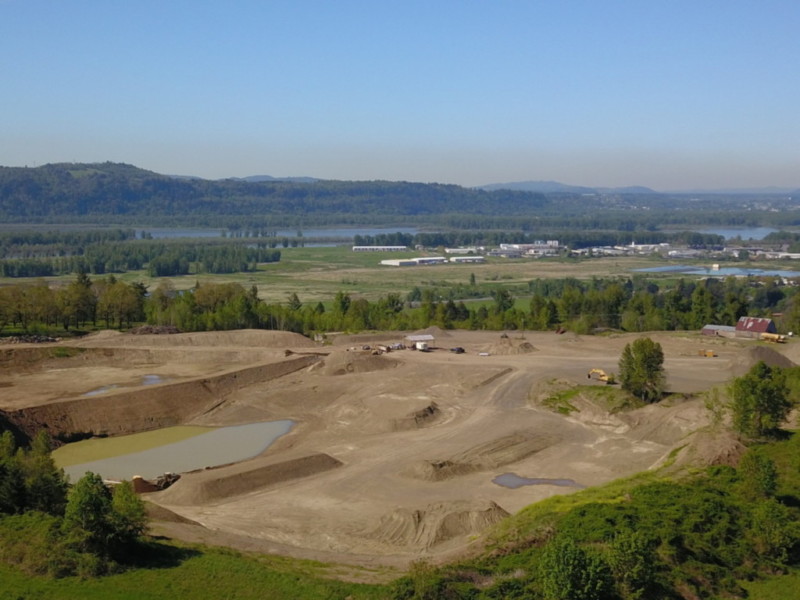
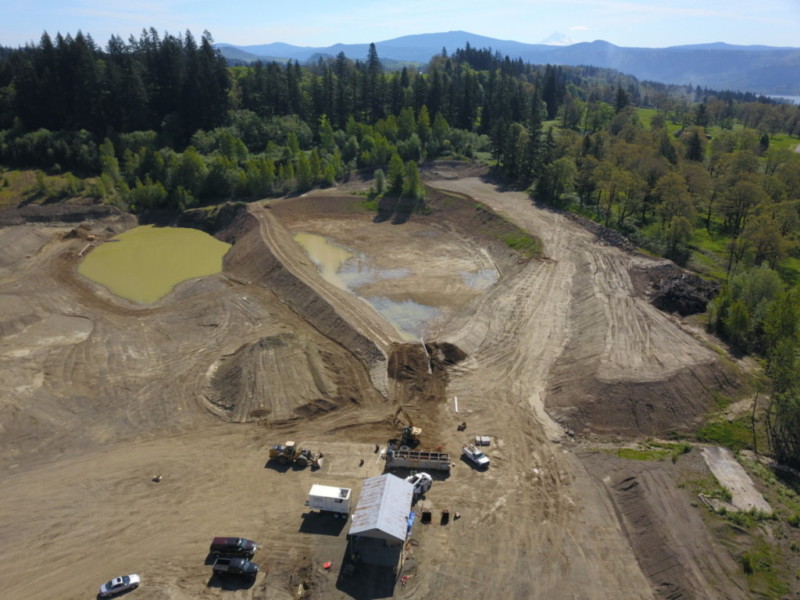
An aerial view of the Washougal Rock Pit, which is located just within the western boundary of the Columbia River Gorge National Scenic Area. Photo courtesy of Friends of the Gorge

By Dac Collins. Sept. 5, 2019. Jody Akers was one of a number of Washougal residents who felt vindicated by a ruling that the Gorge Commission handed down on Aug. 13. That ruling reversed a decision made by Clark County Hearings Examiner Joe Turner the previous August, which allowed mining operations to continue at the Washougal Rock Pit.

“Initially, I thought, ‘Yay, we’ve made some headway,’ and that some things would change,” Akers says.

But soon after the Gorge Commission determined (by a vote of 10-1) that the rock pit was operating illegally, Akers and the other private landowners living near the quarry noticed that the “illegal” mine was not only still operational…it was moving even more gravel than before.

“It seemed to me like the next day after that ruling came, we actually noticed an increase in traffic,” Akers explains. “It was kinda like, ‘Oh man, they’re going to town because whatever they’re doing, they want to get as much done as they possibly can before they might be shut down.’ That’s what I noticed. And I work from home so I am here quite a bit of the time. ”

“A Pyrrhic victory”

Nathan Baker is the Senior Staff Attorney for Friends of the Columbia Gorge, an environmental advocacy and watchdog group based in nearby Portland. Along with attorney Gary Kahn, who represents Akers and the other affected neighbors, Baker has been directly involved in litigation against the landowner, Judith Zimmerly, and the Vancouver-based Nutter Corporation that is operating the quarry.

Baker says that aside from the inherent risk that the rock pit poses to public safety and the environmentally sensitive areas of nearby Gibbons Creek and Steigerwald Wildlife Refuge, the quarry has been operating without the proper permits since October of 2017. For this reason, he refers to the Washougal Rock Pit as “the largest ongoing land use violation in the history of the National Scenic Area.”

And referring to the Aug. 13 hearing, Baker says: “In one sense it’s a Pyrrhic victory. Because even though the mining has been deemed illegal, the government entities with enforcement powers, including the Gorge Commission’s Executive Director and Clark County, have not stepped up and enforced.”

In light of this alleged inaction, Friends of the Gorge joined Akers and the other disgruntled neighbors in filing a new motion on Aug. 29. It asks the Gorge Commissioners to issue an injunction prohibiting Nutter and Zimmerly from conducting any further mining (or related activities) unless or until a valid Scenic Area permit is obtained.

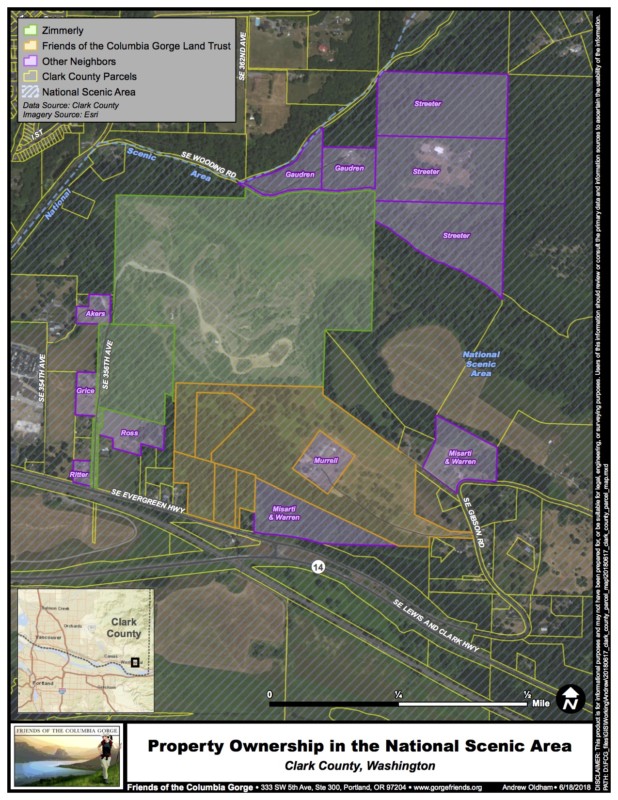
This map shows the property locations for the neighbors currently seeking an injunction against the un-permitted rock pit. Map courtesy of Friends of the Gorge

In a declaration supporting that motion, Akers writes: “Despite the decision of the Gorge Commission on Aug. 13, 2019, the mining and related violations on the property have continued since that date. Six days per week (every day except Sunday), in both the morning and afternoon, the mining activities have continued, and the mining trucks have continued to haul mined material from the Zimmerly property, past my property.”

“I do not understand how or why the violations are being allowed to continue, even after a ruling that the mining is illegal,” Akers continues.

This is certainly a valid concern. But as it stands now, there seems to be a major disagreement over who should be responsible for enforcing the Gorge Commission’s decision.

Whose court is the ball in?

Baker argues that the Gorge Commission “has much stronger powers than Clark County does for enforcement.”

Furthermore, he says the Commission has a mandate to enforce the rules of the Columbia River Gorge National Scenic Area, which were established to protect the scenic, cultural, recreational and natural resources of the Gorge.

“Unfortunately the Gorge Commission staff have not been complying with that mandate,” Baker says. And he points to language from the Gorge Commission’s enforcement rules authorizing the Commission’s Director to issue a stop-work order:

[perfectpullquote align=”full” bordertop=”false” cite=”” link=”” color=”” class=”” size=””]“Where an imminent threat exists to resources protected under the law and/or to public health, safety or welfare, the Director may issue a summary order requiring the alleged violator to promptly stop work or take other necessary action pending a notice of alleged violation.”[/perfectpullquote]

But the Executive Director of the Gorge Commission, Krystyna Wolniakowski, disagrees with Baker’s interpretation of the rules. She explains that when they decided to reverse the finding of the Clark County Hearing Examiner on Aug. 13, the Commission effectively put the ball back in Clark County’s court because the county administers the ordinance for permitting in the National Scenic Area.

Explaining that the Commission serves as a “neutral appellate body” when someone files an appeal to the Commission, Wolniakowski says: “That’s what the Gorge Commission’s role is, and that’s what we did.”

Now, she says, it is up to Clark County to work with Zimmerly and the Nutter Corporation in order to issue a new permit, which is required to bring the rock pit into compliance.

“This is the type of relationship that we have with all five counties in the Gorge that have adopted the NSA management plan into their ordinances,” she continues.

Drone photography shows that the operators have constructed two new mining reservoirs over the past few months, heightening concerns that the quarry could have adverse effects on nearby Gibbons Creek and Steigerwald Wildlife Refuge. Photo courtesy of Friends of the Gorge

Clark County officials, however, seem to be in no rush to issue a stop-work order or file any sort of injunction against Zimmerly and the Nutter Corporation.

According to Clark County’s Community Development Director Mitch Nickolds: “It’s not known whether they have applied for a new permit or not, but it is our hope that an application is on its way at this time.”

Nickolds says that the county has not taken any immediate action on the Gorge Commission’s recent decision because “there’s a lot of decisions yet to be made here.”

“This is a very large, very cumbersome, very challenging set of circumstances,” Nickolds explains. “And you cannot rush into something this substantial in a hurry. Making haste can be problematic.”

Next steps

This practical explanation doesn’t sit well with Baker, Akers and the other neighbors. They believe that unless there are significant governmental enforcement actions taken against the property owner and the operators of the rock pit, the two parties will continue to blatantly disregard the regulations of the National Scenic Area just as they have for the past 23 months.

“It’s essential that the mining stops immediately,” Baker says. “Mining is an allowed use in this zone, and Friends’ goal is not to stop mining at this site forever. We recognize that it is an allowed use. But it can’t be completely unregulated as it is now.”

Neither Zimmerly nor the Nutter Corporation responded to requests for comment, but Wolniakowski has a simple and straightforward message for Zimmerly and the Nutter Corporation.

“They should pro-actively engage with the neighbors and agree on the safest way to operate in the neighborhood, while working quickly with Clark County to get their permit to operate and be in compliance with NSA rules and the Commission’s decision.”

Regarding the next steps, Wolniakowski says that Jeffrey Litwak, the Gorge Commission’s attorney, will draft a written Final Order of the Commission’s Aug. 13 decision by Nov. 12. After that, anyone who wants to challenge the Commission’s written decision can file an appeal within 60 days.

Cruse-ing through Hood River

Portland-based nonprofit announces it will bring electric car sharing program to Hood River in 2020.

Photo courtesy of Forth Mobility

Dac Collins. Sept. 5, 2019. On Tuesday, Aug. 20, Forth Mobility announced that it will receive federal funding to start a pilot project in Hood River. The Clean Rural Shared Electric Mobility Project also known as CRuSE will provide an electric car sharing service to residents, visitors and businesses in town.

Round trip plug-in electric vehicle (PEV) car share programs have already taken root in major cities along the West Coast. Successful companies like ZipCar, as well as newly launched programs such as BlueLA in Los Angeles and Gig Car Share in Sacramento, are proving that the concept works well in urban settings, where increased traffic and carbon emissions are becoming serious problems — especially when viewed within the larger context of climate change.

But will the concept work in rural areas and small towns like Hood River?

According to a press release that was issued on Aug. 20: “Forth hopes this project will demonstrate the feasibility of carsharing in rural areas while also providing cleaner and more efficient mobility options to Hood River and its visitors.”

The town’s small size, as well as its reliance on agriculture and tourism, make Hood River an ideal site for this type of pilot project, says the Portland-based nonprofit organization.

Forth plans to commit to a three-year demonstration program, and they anticipate that the program will start sometime next Spring.

CRuSE will feature five Honda Clarity’s stationed throughout town. American Honda is donating the EV’s, and local utility Pacific Power will partner with OpConnect to install charging stations. Envoy Technologies will provide the car sharing platform, allowing drivers to reserve, access and pay for the use of EV’s with their smartphone.

Envoy will also provide a Spanish translation of its app, which will include tiered pricing structures, enabling different prices to be charged to different user groups.

Other supporting partners include Hood River Columbia Area Transit, the Port of Hood River, Ride Connection and the Mid-Columbia Economic Development District.

“I am thrilled to partner with the Hood River community to shape this project and provide learnings that can be applied in rural communities across the country,” says Kelly Yearick, Forth’s Program Manager on the project.

By |2023-03-03T21:09:28-08:0009/05/2019|Uncategorized|1 Comment

© Copyright 2013-2025 Columbia Insight. All Rights Reserved.

As a 501(c)3 nonprofit organization, all donations to Columbia Insight are tax deductible to the full extent of the law. Our nonprofit federal tax-exempt number is 82-4504894.