Stay Updated Subscribe today for the latest research + reporting about environmental news. Subscribe Now

Stay Updated Subscribe today for the latest research + reporting about environmental news.

Subscribe Now

Dac Collins

Dac Collins

Dac Collins

About Dac Collins

This author has not yet filled in any details.
So far Dac Collins has created 71 blog entries.

Corps of Engineers Investigates Oil Leak at the Dalles Dam

By Dac Collins. April 5, 2018. On March 28, the U.S. Army Corps of Engineers initiated spill prevention protocols at the Dalles Dam because of a potential oil spill. An investigation into what caused the spill is currently underway.

According to a press release from the Corps, approximately 470 gallons of oil leaked from one of the generating units at the dam.

The Corps was first notified of the oil leak on March 18, when the generating unit in question sent an indication of low oil to the control room. A mechanic inspected the unit and added oil, and, as a precaution, the Corps staff began monitoring the Columbia River for any evidence of oil downstream of the Dalles Dam.

Workers reassessed the condition of the unit on March 22 and found that the oil level appeared to be even lower. It was de-watered, isolated and removed from service the following day.    

Tom Conning, who serves as Public Affairs Specialist for the Corps of Engineers, says the Corps is still investigating the incident.

“We still haven’t found the cause [of the leak], or the specific area where it leaked from,” Conning says. “There is no evidence that the oil went into the Columbia,” Conning adds, “but we’re still looking into what exactly happened.”

According to Conning, the generating unit is still de-watered as of April 5, and it will remain out of commission until the investigation is complete.    
By |2019-02-27T14:44:54-08:0004/05/2018|Energy, News, Old Articles, Renewable Energy|0 Comments

“Be There for The Gorge” Raises Over $100 Thousand to Benefit Local Trails

March 29, 2018. “Be There for The Gorge”, a crowdfunding campaign sponsored by Oregon’s Kitchen Table, came to a close on March 15 after successfully raising nearly $150 thousand to benefit trails around Multnomah Falls that were affected by the Eagle Creek Fire.

Organizers of the campaign are extremely grateful for everyone who participated — from REI and Danner Boots, who contributed Buffs and hiking boots, to local organizations like Friends of the Columbia Gorge and the hundreds of individuals that donated their own funds to the cause. The money raised will go toward restoring the Angel’s Rest trail and parts of the Wahkeena Falls trail. The goal is to have these trails open to the public by sometime this summer.

Those still wanting to support the restoration of trails within the Eagle Creek burned area can do so by donating to the Eagle Creek Fire Restoration Fund.  


By |2019-02-27T14:45:19-08:0003/29/2018|Climate Change, News, Old Articles, Wildfire|0 Comments

Kingsley Reservoir to Expand as Mountain Snowpack Shrinks

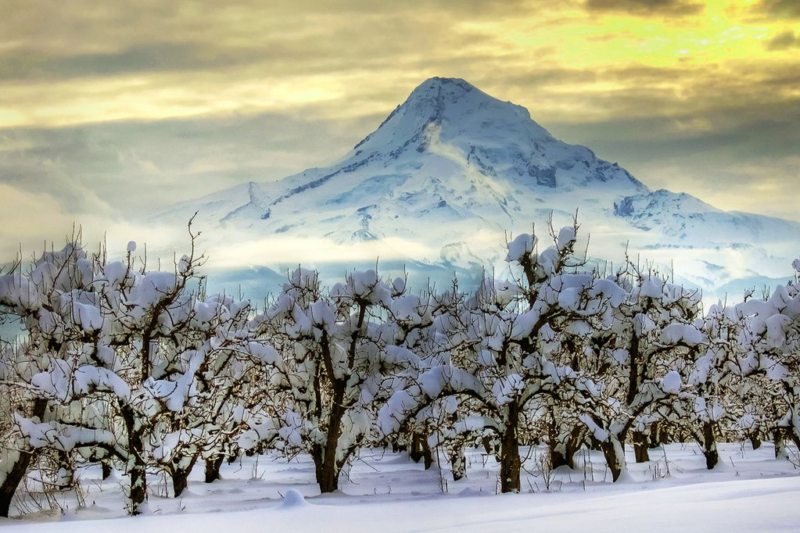
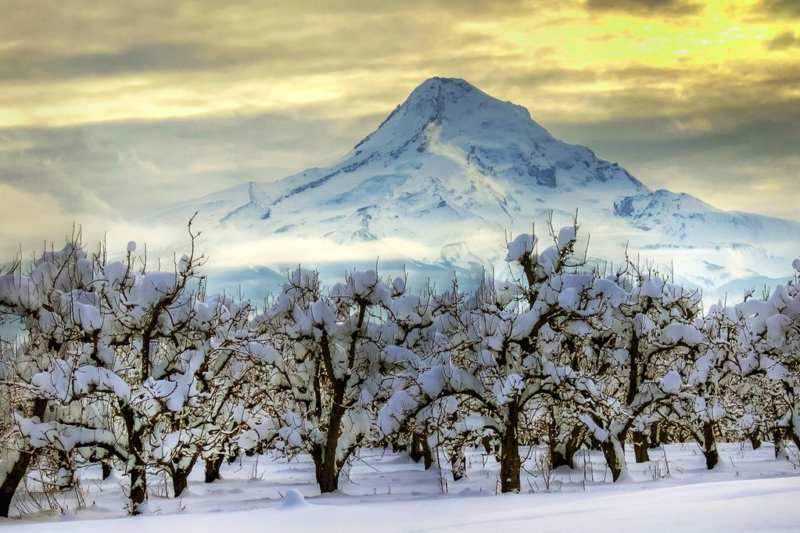
More snow on Mt. Hood means more water for local orchardists. Photo courtesy of USFS.

By Dac Collins. March 29, 2018. Snow. It is nature’s most elegant way of storing water. By accumulating at higher elevations during the cold winter months and then flowing down streams as meltwater during the warmer, sunnier months, mountain snowpack slakes the thirst of parched valleys throughout the Pacific Northwest.

And in the time since European immigrants settled these valleys in the mid-19th century, we have grown accustomed to, even dependent on, this natural cycle of accumulation and ablation. We’ve built vast irrigation networks and storage reservoirs that allow farmers to continue watering their fields even during the driest spells of summer.

But what happens if it stops snowing?

As the Earth continues to spin and our species advances further into the Anthropocene, water managers in the West are asking themselves this very question.

A study published by the Oregon Climate Change Research Institute (OCCRI) earlier this month takes a good, hard look at snowpack levels in the West today. In the study, researchers examined data gathered over a 100-year period (1916-2017) at 1,766 snow monitoring (SNOTEL) sites across the region. And looking specifically at the measurements taken on April 1 (usually the highpoint for snowpack in most areas) they noticed an obvious and disconcerting downward trend.

The study, entitled ‘Dramatic declines in snowpack in the western US’, reveals that over 90% of the snow monitoring sites throughout the region show declines in snowpack. Philip Mote, the study’s lead author, writes that “declining trends are observed across all months, states and climates, but are largest in spring, in the Pacific states, and in locations with mild winter climate.”

“The decline in average April 1 snow water equivalent since mid-century,” Mote continues, “is roughly 15-30% percent, comparable in volume to the West’s largest man-made reservoir, Lake Mead.”

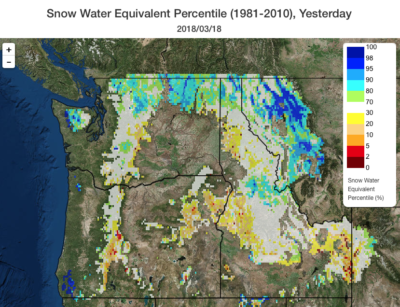
This map of the Pacific Northwest takes the amount of snow water equivalent (the amount of liquid water you would get if you melted the snow) as of March 18 and compares it to the average amounts measured on that same date from 1981-2010.

Of course there are always exceptions to the rule, as evidenced by the current above-average snowpack levels in parts of the Northern Rockies, but these small spikes have a negligible effect on the overall warming trends that define most mountain ranges in the American West. Also called ‘snow droughts’, these trends are perhaps most pronounced in the wetter and milder Cascade Range, where the amount of winter precipitation has more or less stayed the same but temperatures have warmed to the extent that what used to fall as snow now tends to hit the ground as rain.

“The year 2015 was a really good illustration of that,” Mote says. “Oregon had close to average winter precipitation, but it was about five degrees warmer than average, leading to record low snowpack at most sites in Oregon.” Hood River County declared a drought emergency that same year. 

2015 was also the year that the US Bureau of Reclamation released a Hood River Basin study. The study found that “there is already a lack of adequate streamflow in the basin during the summer months to meet the competing demands for water,” and that “this imbalance is expected to be exacerbated by climate change.”   

With findings like these, climate researchers like Mote find it difficult to maintain a certain level of optimism.

“It’s kind of depressing,” Mote says ruefully. “I hate to think what the story will be ten years from now.”

Until then, the only thing we can do is adapt. This means adjusting the ways we think about and manage our water, especially in terms of irrigated agriculture, which uses an estimated 85 percent of the water diverted for out-of-stream use in Oregon. 

Farmers Irrigation District (FID) supplies irrigable water to growers on the westside of the Hood River Valley. And as manager of the district, Les Perkins is fully aware that the natural cycles we have built our infrastructure around are changing drastically. So he’s changing our infrastructure.

As part of a significant expansion project funded with grants from the Oregon Water Resources Department’s Water Supply Development Account and the DEQ’s Clean Water State Revolving Loan Fund, FID has made plans to raise the level of Kingsley Reservoir by 11 feet, effectively doubling its storage capacity.

The Kingsley Reservoir Rehabilitation Project involves the construction of another, larger dam behind the one currently in place, as well as a new earthen dam on the upstream side of the reservoir. This structure—also called a ‘saddle dam’ — will keep the newly raised reservoir from spilling over its banks. Last fall, FID completed the first phase of dam construction, which involved removing the 80-year old steel outlet pipe at the bottom of the dam and replacing it with a stronger, more efficient pipe made of high-density polyethylene. The district also updated 2.2 miles of the Lowline pipe, which feeds the middle part of the district.

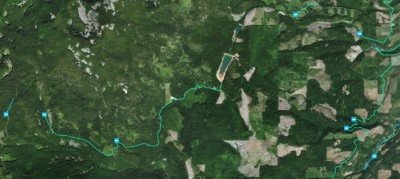
Aerial imagery of Kingsley Reservoir highlights the district’s network of pipes, including the Stanley Smith pipe (bottom left) that feeds the reservoir. Photo courtesy of FID.

With the new pipes in place, FID partnered with local contractor Crestline in order to construct the new dam this summer. However, delays in the permitting process have pushed that project back until the summer of 2019.

Perkins, a Hood River local who has served as County Commissioner for the past seventeen years, sees the Kingsley project as just one piece of the water management puzzle. He says updates to the district’s irrigation infrastructure have been underway for well over a decade.

By piping over 70 miles of open irrigation ditches, establishing a sprinkler exchange program with local farmers to replace outdated impact sprinklers with micro-sprinklers, and by building a centralized water pumping and filtration system, FID has vastly increased its conservation potential. “We can serve our farmers with half as much water as we did 30 years ago,” Perkins says proudly.

“And then our district produces about 25 million kilowatt hours a year through our two facilities,” Perkins adds. “We recently did our carbon footprint analysis, and we have enough renewable energy credits offsetting our vehicle usage so that we’re actually carbon neutral.”

Perkins’ focus on renewable energy speaks volumes to how he perceives his role as a water manager. He might represent the growers in an official capacity, but he sees other water users in the valley as equally important— especially the fish that require enough water left in their native streams.

And by utilizing more stored water for irrigation purposes, Perkins’ district will be able to get away with pulling less water out of streams like Green Point and Dead Point Creeks.

“There’s a big fish component here,” he says. “We spent quite a bit of time with ODFW and Confederate Tribes of Warm Springs going over what they wanted to see, and they both wrote letters of support for the project.”

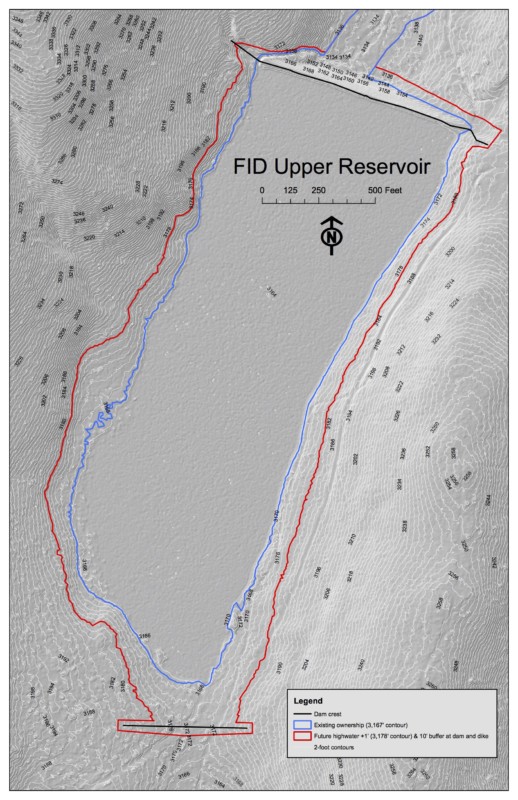
This drawing of Kingsley Reservoir shows the current (blue) and future (red) high water lines. Photo courtesy of FID.


Referring to the project’s inception, Perkins explains: “What we looked at was: what is our conservation potential and what would stream flows look like if we added some additional storage. If we don’t do anything, stream flows are obviously heavily impacted—and they are already incredibly low. If we focus on conservation alone, that brought [stream flows] pretty close to where they are now. So we looked at storing some of the increased winter flows and using that rather than stream flow later in the year.”

“With that,” Perkins continues, “we’re actually able to come up above where our stream flows are now, even with population increase and climate change.”

Although construction of the new dams will not begin until next summer, the district has plenty of work to do in the meantime, including developing a rock source for the project and logging the area that will be inundated—an area that incorporates the campground currently located on the eastern bank of the reservoir.

Plans for the new and improved campground are already in place, however, and FID is working hand in hand with Hood River County Forestry to try and open the area to the public by the summer of 2020. The plans feature a new boat ramp, twice as many camp sites, a larger day-use area and five times as many bathrooms.

The campground renovation project illustrates how the district’s adaptive approach to water management can benefit community residents while also meeting the needs of the fish and farmers that play a vital role in this valley’s future. 

“Our growers have gotten by, even in drought years,” Perkins says. “But it’s a little unnerving just seeing what’s happening with drought cycles becoming more intense. This [project] gives our growers some certainty that they will have the water they need in the future.”

Multnomah Falls Lower Viewing Platform Re-opens

March 22, 2018. The Columbia River Gorge National Scenic Area announced on March 19 that the lower viewing platform at Multnomah Falls is now open to the public. The platform, which gives visitors a close-up view of one of Oregon’s most popular natural wonders, has been closed since Sept. 4 — two days after the start of the Eagle Creek Fire.

In the months since, the U.S. Forest Service has conducted a significant amount of repair work, including rebuilding a rock catchment fence above the platform and removing hazardous trees and loose rocks. Now that the fence project is complete, visitors can once again view the Falls safely from up close.

Much of the surrounding area remains closed, however, until additional repair work is completed.

The trail to Benson Bridge, which spans the upper and lower falls, will remain closed until the Shady Creek Bridge is replaced and the lower Larch Mountain Trail is cleared and stabilized. The CRGNSA hopes to complete most of this repair work by sometime this summer, but there is no projected timeline for re-opening the trail to the Upper Viewing platform.

The USFS will continue mitigation and repair work within the Eagle Creek Burned Area and will continue to re-open trails, roadways and recreation sites as soon as it is safe to do so.

“The oil terminal is dead, long live the oil terminal”

March 15, 2018. On January 29 of this year, fossil fuel opponents and environmental activists throughout the Pacific Northwest celebrated Washington Gov. Jay Inslee’s decision to reject Vancouver Energy’s proposal to build the nation’s largest crude-by-rail oil terminal at the Port of Vancouver.

The governor’s decision represented the culmination of a dispute spanning nearly five years. The clash pitted Big Oil against local residents and environmental advocacy groups, who were concerned about the impacts of transporting 360,000 barrels of oil through the Columbia River Gorge daily. In the end, Gov. Inslee sided with the state’s Energy Facility Site Evaluation Council, which unanimously opposed the proposal to build a $210 million oil terminal.

Reacting to this monumental decision, the editorial staff at the Columbian published a story about how “the saga has provided a defining moment for Clark County.”

“Stamping Vancouver as an oil town would damage our potential as an environmentally conscious region ready to embrace the economy of the future,” the staff writes.

Read the full story here…   

By |2019-02-27T14:46:06-08:0003/15/2018|Energy, News, Old Articles, Transportation|0 Comments

Permits required to hike Dog Mountain this spring

The U.S. Forest Service is introducing a new permit system at the Dog Mountain Trailhead. Starting this spring, hikers visiting the trail system on the weekend during peak season—from March 31 to July 1—will be required to purchase a permit in advance.

This move by the USFS comes as a response to safety concerns along State Route 14. The Dog Mountain Trail System, which includes the Dog Mountain Trail (#147 and #147C), the Dog-Augspurger Tie Trail (#147A) and the lower portion of Augspurger Trail (#4407), has always been a haven for wildflower viewers on the Washington side of the Gorge, and its popularity has only increased in recent years. Because of this surge in popularity, the lot at the trailhead fills up quickly during wildflower season, forcing hikers to park and walk along the narrow shoulder of SR 14. This creates a hazardous situation for pedestrians and motorists alike. 

The USFS also expects the fire-related trail closures on the Oregon side of the Gorge to push more hikers onto Washington’s trail systems this summer. While they want to encourage visitors to use these trails, they also want to keep them safe and prevent overcrowding. 

There are two ways for hikers to obtain permits. One is to utilize the shuttle service operated by Skamania County on weekends from March 31 to July 1. Seats will be available on a first come, first served basis, and will cost $1 per trip or $2 roundtrip. Bus drivers will then provide hiking permits (valid for one individual on the day it is issued) to passengers upon arrival at Dog Mountain Trailhead.

The other way to reserve a permit is though the national online reservation system, www.recreation.gov. There will be 165 permits available per day, and each non-refundable permit will cost $1.50. However, parking at the trailhead is limited and a permit does not ensure a parking spot. 

“We’re hoping this new approach will offer a win-win by encouraging visitors to use the county shuttle service while also making SR 14 safer for visitors,” said Skamania County Commissioner Chair Tom Lannen when asked about the new permit system.

For more information, call 541-308-1700 or visit http://www.fs.usda.gov/goto/crgnsa/hikedogmountain.

By |2019-02-27T14:46:27-08:0003/08/2018|Conservation, News, Old Articles, Public Lands|0 Comments

© Copyright 2013-2025 Columbia Insight. All Rights Reserved.

As a 501(c)3 nonprofit organization, all donations to Columbia Insight are tax deductible to the full extent of the law. Our nonprofit federal tax-exempt number is 82-4504894.