

Stay Updated Subscribe today for the latest research + reporting about environmental news. Subscribe Now

Stay Updated Subscribe today for the latest research + reporting about environmental news.

Subscribe Now

Dac Collins

Dac Collins

Dac Collins

About Dac Collins

This author has not yet filled in any details.
So far Dac Collins has created 71 blog entries.

Nobody, Anybody and Everybody: A modern-day water crisis

Nobody, Anybody and Everybody
By Charlie Bloomer

Nobody thought this would happen,
That Cape Town would be in such distress.
Nobody could have predicted
That there would be this drought.
Nobody was prepared
For what was to come.

Anybody could be in such trouble,
To only use 13 gallons of water.
Anybody could have this happen,
To have to let all your plants die.
Anybody could have known,
But no one did.

Everybody can make an impact,
They can donate, they can change.
Everybody can save their community,
They can conserve water, they can help.
Everybody can try,
Because everybody can.


Currently hovering around 10 percent capacity, the level of Theewaterskloof Dam, Cape Town’s primary municipal water source, continues to drop as citizens of Cape Town experience the most severe water shortage in the city’s history. The coastal metropolis of nearly 4 million could very well be the first modern major city to shut off its taps. Photo courtesy of 6000.co.za licensed by CC BY-NC-ND 2.0.


This poem is about the Cape Town water crisis. There are three sections to this poem, past present and future. The first section is past because nobody did know this would happen and no one was prepared. The second section is the present because this could have happened to anybody but Cape Town just has so much people that the water ran out quickly. The third section is the future because everybody can contribute and everybody can help.


Julia Motlagh, Charlie Bloomer and Liam Givens, Oregon Trail Academy, 5th Grade
By |2019-02-27T14:42:41-08:0005/03/2018|Features, Kids, More, Old Articles, Water|2 Comments

“Screenagers” Viewing Scheduled for May 9

The Underwood Parks and Recreation District (UPRD) is thrilled to bring “Screenagers” to the big screen on Wednesday, May 9 at 6:30 p.m. It will be the only screening in the area of this highly engaging film, which explores the complicated issue of children’s engagement with screens and the challenges of parenting in a digital world.

Believe it or not, the average American kid spends about 6.5 hours a day looking at a screen in one form or another.

This shocking statistic led physician and filmmaker Delaney Ruston to delve deeper into the concept of “screen time”, and to explore the struggles over social media, video games, academics and internet addiction. The result? A documentary that reveals how screen time can impact a child’s development, and one that offers solutions on how adults can help their children find a balance in this digital age.

“As a physician, I became increasingly anxious to know how our new tech world affects children’s development,” Ruston says of her initial inspiration to make the documentary. “I started finding new research on the impact of video gaming and social media on self-esteem, empathy, social skill development, academics and brain development. As a mom, I wanted to examine how we can better manage screen time in our homes and schools. What does science teach us about teaching self-control? How can we best encourage youth to find their own ways to achieve balance? What limits and rules are reasonable and how do we implement them?”

UPRD’s screening of “Screenagers” is part of the documentary’s new model of distribution known as a “community viewing model”, which highly recommends that a moderated discussion by local citizens follows directly after the screening. The UPRD is seeking a moderator and one to three panel members to facilitate this discussion. Contact the district for more information.

By |2019-02-27T14:43:07-08:0005/03/2018|Kids, More, News, Old Articles|0 Comments

Laurance Lake Closed for the Summer

By Dac Collins. Apr. 26, 2018. The U.S. Forest Service announced on April 12 that Laurance Lake Reservoir will be closed to the public for the 2018 summer season. This closure includes Forest Road 2840 from the gate above the settling pond to the Pinnacle Trailhead. It also includes Kinnikinnick campground and all of the dispersed campsites surrounding the reservoir.

The closure will allow Middle Fork Irrigation District to conduct important monitoring and maintenance work on Clear Branch Dam. MFID, which manages the reservoir for irrigation purposes, has already initiated a 30 to 40-foot drawdown in order to conduct required maintenance on the secondary spillway and its drainage system on the downstream side of the dam.

According to a press release from the Hood River Ranger District, “The drawdown will dramatically reduce the size of the lake and expose steep and rocky shoreline, posing a safety risk for lake users.”

The drawdown could also have repercussions on fish living in the lake—effects that would only be exacerbated by fishing pressure. For that reason, there will not be an open fishery in Laurance Lake until 2019, when, according to the USFS, the reservoir will re-open to the public as usual.

The USFS encourages the public to explore fishing and camping opportunities at other lakes on the Mt. Hood National Forest such as Lost Lake, Clear Lake, Rock Creek Reservoir, Timothy Lake, Harriet Lake and Trillium Lake.

Dispatch From the Trail: A volunteer’s perspective

By Dac Collins. April 19, 2018. Jacob Keltner woke up earlier than usual last Saturday, around 6 o’clock. With a bagel in one hand and his daypack in the other, he hopped into the 2010 Ford Focus that would take him east down I-84 and into the Gorge. It was really a pretty common routine for many Portlanders going hiking on the weekend, except Keltner wasn’t going for a hike. (Not unless you consider spending most of your day logging out charred, fallen trees with a crosscut saw hiking.)

He got to the Herman Creek Work Center a few minutes before 8 a.m., and it was there that he met up with four other volunteers with the Pacific Crest Association?s Mt. Hood Chapter. After a quick safety briefing, they caravanned to the Gorton Creek Trailhead.

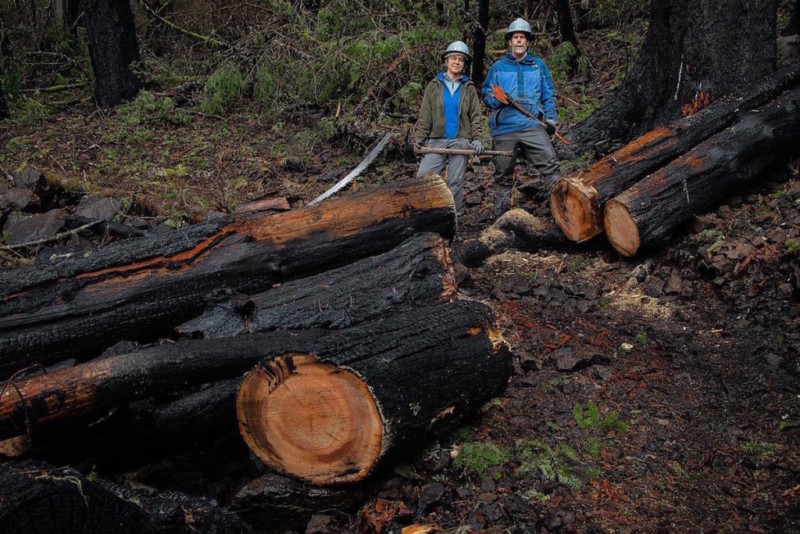
The crew came across their first obstruction of the day about two miles up the trail, and they spent the next four hours bucking the blackened log. More akin to charcoal than firewood, the bark had to be stripped with an axe before workers could take turns running a crosscut saw through the lifeless trunk.

When it finally gave way, the obstruction now cleared, they marched ahead and rounded a corner, only to find another log blocking the path. Looking beyond it, they spotted another. And another. And another.

Four logs cleared in a 100-yard stretch. That?s not bad for a day’s work.

Ethan and Winston Rall watch as David Roe, a PCTA Caretaker and experienced sawyer, runs a crosscut saw through a large diameter Douglas fir with the help of another volunteer. Photo by Terry Hill. 

The Pacific Crest Trail Association’s Mt. Hood Chapter is currently working to restore roughly 29 miles of trails within the Eagle Creek burn area. And like most of the other groups allowed to work in the closed-off wilderness area, the PCTA?s crews are made up almost entirely of volunteers.   

“The volunteer response has just been amazing,” says Roberta Cobb, chair of the Mt. Hood Chapter.

As the designated caretaker of the section of PCT between Bridge of the Gods and Herman Bridge Trail, all of which lies within the Eagle Creek burn area, Cobb has worked alongside trail crews in the burn area more than a dozen times over the past few months. And during the eight or so years since she began watching over this stretch in an official capacity, she says she has never seen such a powerful response from volunteers.

The Mt. Hood Chapter’s first trail crew hiked into the burn area on January 17. In the time since, crews have continued restoration projects on trails leading out of the Herman Creek Trailhead, including the roughly eight-mile stretch of the PCT from Cascade Locks south to Teakettle Springs. Any further than Teakettle Springs, Cobb says, and you’re above the snow line, where merely assessing the condition of the trail is next to impossible. It will be weeks, perhaps a month or more, until crews can begin working on the section of trail from Teakettle Springs to Wahtum Lake, the southernmost boundary of the closed portion of the PCT.     

Spring snows have not hampered their ability to work at lower elevations, however, and volunteers have made significant headway doing tread work, brushing and removing rocks along the PCT and other connecting trails. While there is still no guarantee that this short but steep 14-mile section of the 2,650-mile-long trail will open to the public this summer, crews remain optimistic.

Blooming trillium gives hope to volunteers working in the burn area, and reminds us that the forest has already begun to renew itself. Photo by Terry Hill.   

“When I bring people out, we stop for lunch hour and we ask people who haven’t been in the burn area what their feelings are. And mostly their response is: ‘Well it’s dark, but it’s not as bad as I imagined.'”

Of course having the right attitude is essential when doing grueling, manual labor in a hazardous wilderness area. And although Cobb does not want to deter anyone from helping, she wants people signing up with the Mt. Hood Chapter of the PCTA to know exactly what they’re getting themselves into.

“I think it’s really important for people to know that these days are really long. These are long, hard days of work that we’re putting in right now because we’re having to hike so far in to get to the work. We’re leaving at 8 in the morning and getting back to the car at 5:30 p.m. or later. And it’s steep hills, ’cause it’s the Gorge.

“And good, sturdy boots are absolutely required,? she continues. ?We?ve already had to send people home because they show up in trail runners.?

Cobb says that aside from these warnings, the most important thing to share with potential volunteers is that ?the work is just so rewarding.”

PCTA Regional Representative Dana Hendricks echoes that sentiment. Hendricks, whose territory covers about 300 miles of the Pacific Crest Trail, continues to be inspired by the positivity of volunteers.

“They are just unstoppable,” she says. “I have never seen people so excited…they are just really honored to be part of this recovery effort.”

One of Hendricks’ primary responsibilities is to work with experienced crew leaders—all of them volunteers—to prepare them for the hazards of working in a post-fire landscape. And although she spends much of her time teaching at training events, Hendricks has already joined work crews in the burn area twice this spring.

PCTA Regional Representative Dana Hendricks and crew leader Frank Jahn take a well-earned break after clearing two sizable logs from the Gorton Creek Trail last Saturday, April 14. Photo by Terry Hill.

“We’re interested in any of the side trails that are part of the network that connect to the PCT,” Hendricks explains. “There’s about 14 miles of the PCT in the burn area, and another 15 or so of connected trails that we?re working on.”

As for the hazards associated with these trails, she says that rockslides are the most worrisome—and the most time consuming.

“In some areas there are just a few rocks that need to be thrown or kicked off [the trail], and in other areas there is a five-foot deep slide of dirt and rock that has buried the trail. You could put four or five people on a slide like that and they could spend all day just trying to get back down to where the trail used to be.”

Hendricks also mentions the burnt-out holes along the trails that lie hidden underneath the debris, and the charred trees and logs that have fallen across the trail.

Angie Panter de-barks a Douglas fir while David Roe and Rob Heyman get the saw ready. Photo by Terry Hill.

“The charcoal on the burnt bark really dulls the saws,” she explains. “So we have to spend some extra time de-barking the logs before we can cut through them; you have to de-bark really carefully before you put your crosscut to that wood.”

Now that crew leaders have undergone the necessary training and have experience on particular trails, Hendricks says the organization is looking to add more inexperienced volunteers to their work crews. 

Those looking to volunteer with the local PCTA chapter should either check their event calendar or sign up for their email notification list. Hendricks recommends visiting the Gorge Stewardship and Trails Resilience Facebook page to find additional information regarding work crews and the status of trails in the Eagle Creek burn area.  

Potential volunteers should also recognize that there are other groups working in the burn area as part of the Gorge Trails Recovery Team. Groups like Trailkeepers of Oregon, Friends of the Columbia Gorge and Washington Trails Association will also be organizing work crews in the coming months, and they are all looking for volunteers to step up and help with this effort.

Quagga Mussels Discovered Near Ashland

By Dac Collins. April 19, 2018. In light of the feature story we published last week, entitled “Musseling In: Invasives a threat to the region’s waterways”, the editorial staff at EnviroGorge felt it appropriate to share a timely and relevant article published in the Mail Tribune on April 16.

The article, entitled “Invasive quagga mussels found during boat inspection”, confirms writer Susanne Wright’s fears that the invasives are an imminent threat to the Columbia River Basin. It tells the story of a trailered yacht headed for the Columbia River that stopped at the Ashland port-of-entry on I-5 for a mandatory boat inspection. Inspectors with the Oregon Department of Fish and Wildlife found quagga mussels stuck to the boat’s hull, trim tabs and ski platform.

According to the Mail Tribune’s story, the owner of the boat was a Portland resident who had bought the boat down in Texas. He cooperated with ODFW and the boat was decontaminated with high-pressure hot water in about an hour.

This incident serves as a reminder of just how serious this invasive threat is to the region’s waterways.

Scarier still is the fact that this is only one of four incidents involving quagga mussels in Oregon over the past few months. The Mail Tribune reports that two boats were successfully decontaminated earlier this year after being stopped in Ontario, and another decontamination crew was sent to Reedsport where yet another mussel-infested vessel was discovered.

So please remember to CLEAN, DRAIN and DRY your watercraft and equipment after a day on the water, especially when moving it from one water body to another. The health of our rivers and lakes depends on it.

Buyer Beware: Rubber Mulch

By Dac Collins. April 12, 2018. A report published by Nature’s Way Resources, an organic compost and mulch supplier based in Conroe, Texas, warns consumers of the dangers of using rubber mulch in their yards and gardens. This type of mulch, which is made primarily from recycled tires, is sold at gardening and home improvement stores across the country.

There are a number of alleged benefits to using rubber mulch that are advertised wherever it is sold. The report cites independent studies and outside research to disprove these allegations.

For example, a number of rubber mulch suppliers state that the product is good for playgrounds and safe for children. Responding to this claim, the report alludes to one study which found “that the surface temperature of rubber tire mulch can exceed that of a black asphalt parking lot, even reaching as high as 172 degrees in one day.” The report cites another study by the Ohio State University Agricultural Technical Institute, which “discovered rubber mulches to be a considerable fire hazard,” but “found that organic mulch fires were not common.”

Another alleged benefit, according to rubber mulch manufacturers and tire companies, is that the product is safe for flowers, plants and pets. Responding to this allegation, the report cites research conducted at Bucknell University, which “found that the leachate from ground tires can kill entire aquatic communities of algae, zooplankton, snails and fish,” and that, “even at low concentrations it can cause reproductive problems and precancerous lesions.”

The comprehensive, eight-page report addresses over a dozen additional claims made by rubber mulch manufacturers seeking to push their product on unsuspecting consumers, concluding that the mulch is both toxic and dangerous.

By |2019-02-27T14:44:36-08:0004/12/2018|Natural Resources, News, Old Articles, Plants|0 Comments

© Copyright 2013-2025 Columbia Insight. All Rights Reserved.

As a 501(c)3 nonprofit organization, all donations to Columbia Insight are tax deductible to the full extent of the law. Our nonprofit federal tax-exempt number is 82-4504894.