Stay Updated Subscribe today for the latest research + reporting about environmental news. Subscribe Now

Stay Updated Subscribe today for the latest research + reporting about environmental news.

Subscribe Now

Chuck Thompson

Chuck Thompson

Chuck Thompson

About Chuck Thompson

Chuck Thompson is editor of Columbia Insight.

Renowned wilderness guides lose homes, equipment in Jasper fire

A call is out to aid two Canadian adventurers whose lives have been upended by an unprecedented fire in the Alberta national park
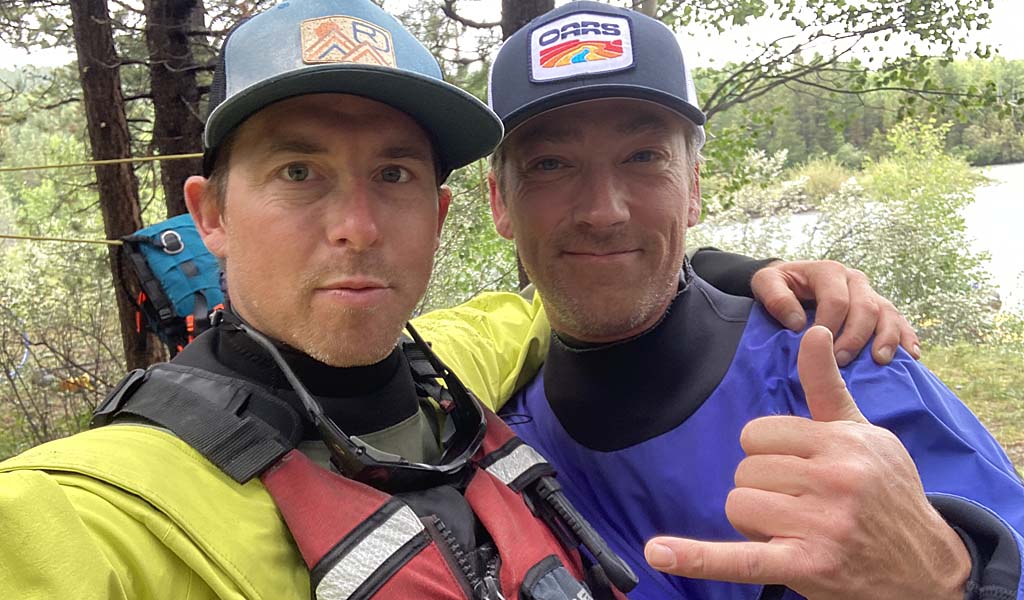
Canadian wilderness guides

Brothers in arms: Ryan Titchener (left) and Jimmy Gillese. Photo: Ryan Titchener

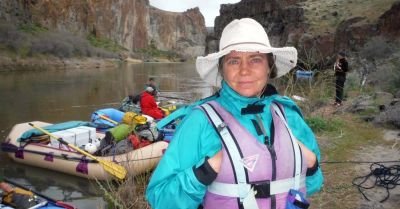
There’s a custom at Columbia Insight board meetings called Mission Minute. This is when board members share things they’ve done or experiences they’ve had outside the boundaries of official Columbia Insight business that nonetheless connect them to CI’s mission. Taking part in an organized litter collection event or just going on a hike to reaffirm one’s bond to the natural environment are examples. I didn’t conceive of the weeklong raft trip I recently took in British Columbia as a Mission Minute. But it ended up providing a powerful reminder of the personal impacts of the wildfires that have become so distressingly commonplace in our part of the world. —Editor

By Chuck Thompson. August 1, 2024. One of the pleasures of extended backcountry trips is unplugging from the world. In the wireless wilderness you remain happily unaware of major events. You might worry about things at home, but then you return and realize the world has gotten along fine without you.

Usually.

On July 26, veteran Canadian adventure guide Jimmy Gillese returned from a six-day rafting expedition through British Columbia’s remote Chilcotin wilderness to learn that while he’d been away the house he and his wife had been in the process of building was completely destroyed by the massive fire that swept through the town of Jasper in Alberta, Canada. Just prior to the trip, he’d taken the final draw on a building loan to complete the new house.

The largest blaze ever recorded in Jasper National Park—it’s expected to burn for the next three months—has destroyed at least half of the historic town of Jasper’s 1,113 structures. Gillese’s wife and three children, between two and seven years, were among the more than 20,000 people safely evacuated.

Over the course of the Chilcotin trip, the irrepressible Gillese emerged as a favorite among guests. Supremely gifted on the water, he was also the guide who rallied the troops on a rainy day on the river with songs and a dead-on Mitch Hedberg routine.

One evening, Gillese and I sat in front of my tent talking until late. After years of guiding visitors around western Canada—skiing, climbing, kayaking, rafting—Jimmy purchased Stellar Descents in 2013, an adventure travel company specializing in backcountry ski trips and whitewater rafting. Under his hand, the small business rapidly built a loyal following.

Then Covid hit. With the U.S.-Canada border closed for 19 months, bookings dropped 500%.

In 2022, he made the painful decision to sell his company.

On the final night of the Chilcotin expedition, guides and guests sat in a circle sharing favorite moments from the trip. Gillese’s contribution was characteristically optimistic.

“Each of us has a different background, but we’re all here because we love the river and cherish this environment,” he said of a group from four U.S. states and three Canadian provinces. “That common ground is so important.”
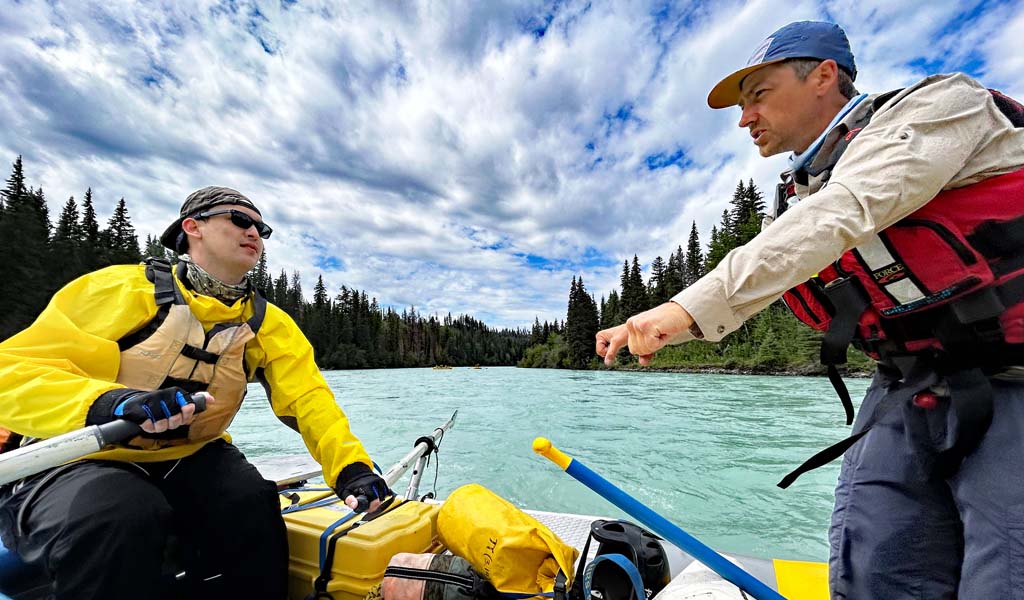
Rafters in British Columbia on Chilko River

On the job: Veteran guide Jimmy Gillese instructs a young paddler on British Columbia’s Chilko River. Photo: Chuck Thompson

Gillese is also a longtime safety consultant and instructor for rafting companies and guides. By extension he’s contributed to the secure returns of untold thousands of adventure travelers. When the leader of our Chilcotin trip sustained a nasty foot injury, Gillese was the one to jump for the first aid kit, pull on surgical gloves, stop the bleeding and dress the wound.

The Jasper fire didn’t just obliterate homes.

It destroyed career collections of camping equipment, climbing gear, bikes, kayaks, rafts and supplies.

ROAM Adventures—the B.C.-based company Gillese was working for when his house burned down—has set up a GoFundMe page and offered housing and other assistance to Gillese, as well as to another renowned, Jasper-based adventurer, Ryan Titchener, who also lost everything he owns in the fire, including a $10,000 sit-ski and custom kayak.

Titchener, a top Rockies climber who survived a horrible climbing accident that left him paralyzed from the waist down, “has been pumping out sit-ski and kayak missions to show others what you can do despite disabilities,” according to ROAM Adventures founder Brian McCutcheon.

“So many are scared to go back and see what really happened,” Titchener told me this week. “Fear might be a mile wide but it’s only an inch think. We will rebuild.”

Guests on the recent Chilotin trip have set up a separate GoFundMe page to aid Gillese.

The hope in both cases is that the outdoor community will step up to help a pair of brothers who have given so much to the outdoor community.
By |2026-01-13T15:32:40-08:0008/01/2024|Recreation, Wildfire|1 Comment

UPDATE: Southwest Wash. no longer has a wolf pack

Even so, the state’s overall wolf population increased in 2023, fueling a debate on removing ‘endangered’ status

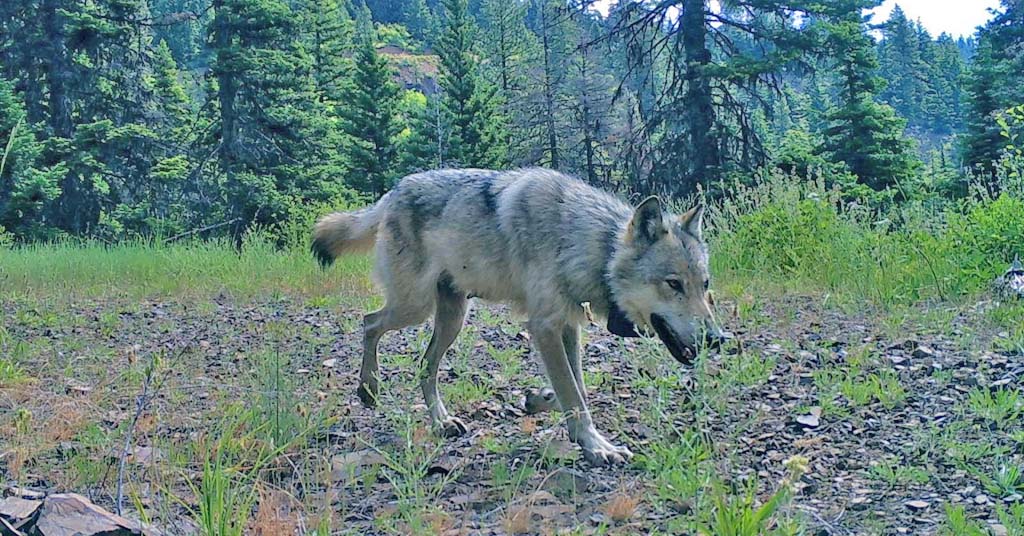
Wolf in Washington

Recovery road: Wolves in Washington are thriving in some areas, faring worse in others. This wolf is from the Teanaway Pack, which was confirmed in 2011. In 2023, just one Teanaway wolf remained. File photo: WDFW

By Chuck Thompson. April 25, 2024. In February, Columbia Insight reported that a female wolf—half of the two-wolf Big Muddy Pack in southwest Washington—had mysteriously disappeared.

In April 2023, the Washington Department of Fish and Wildlife had confirmed the new pack’s existence, the first southwest Washington pack in a century. (Two wolves are enough to meet the agency’s minimum requirement to be recognized as a pack: two or more wolves traveling together in winter.)

That female wolf—the presumed mate of a collared male known as WA109M—remains missing.

In its Washington Gray Wolf Conservation and Management 2023 Annual Report, released last week, WDFW confirmed that the area no longer has a pack, much less a breeding pack.

“Although the first pack to recolonize the South Cascades and Northwest Coast recovery region only had one wolf during the year end counts in 2023, we have observed multiple collared wolves south of Interstate 90 in the last year,” said WDFW Director Kelly Susewind. “This likely means it is only a matter of time before new packs begin to establish in that recovery region.”

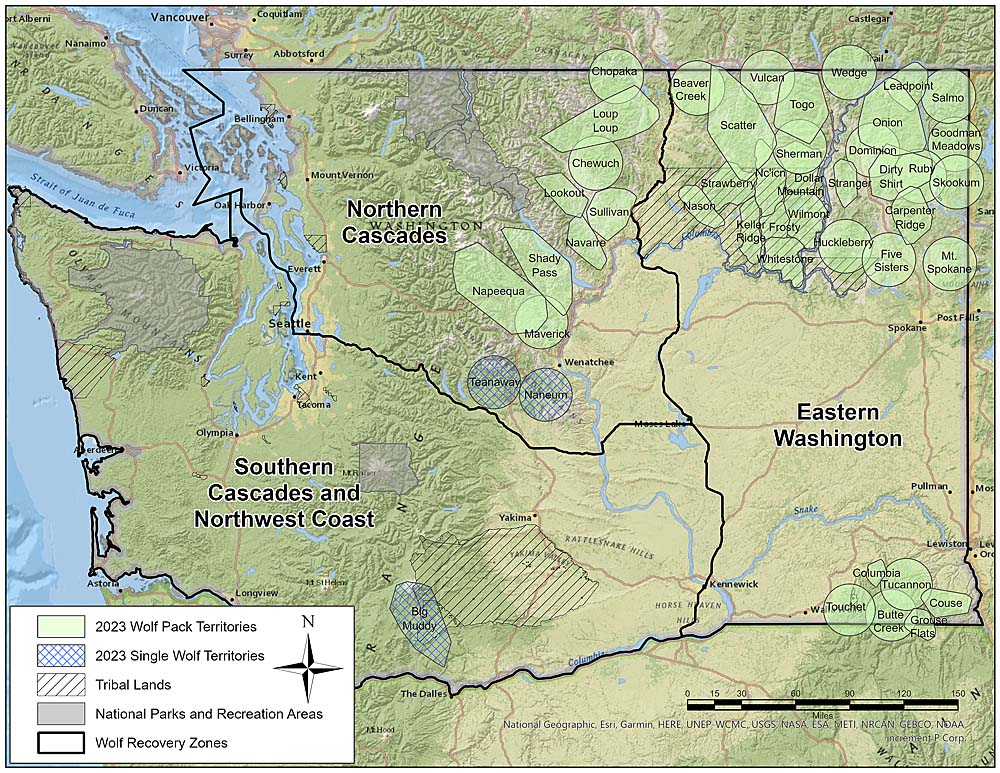
WDFW didn’t wipe Big Muddy off the map altogether. Its area is now labeled as a “single wolf territory” rather than a wolf pack territory.

Downlisting decision

Wolf populations are increasing statewide.

In a press release accompanying its annual report, WDFW said the state’s wolf population grew for the fifteenth consecutive year.

“The report shows a 20% increase in wolf population growth from the previous count in 2022,” according to WDFW. “As of Dec. 31, 2023, WDFW and partnering tribes counted 260 wolves in 42 packs in Washington. Twenty-five of the packs were successful breeding pairs that raised at least two pups through the end of the calendar year. These numbers follow the previous year’s count of 216 wolves in 37 packs and 26 breeding pairs.”

Wolf pack map for Washington 2023

Washington wolf pack distribution in 2023. Map: WDFW

Pack sizes range from two to 11 wolves. Most packs contain four to six individuals.

Three areas contain just one wolf maintaining a territory—the former Teanaway Pack area, the former Naneum pack area and the former Big Muddy pack area.

In July, the WDFW Commission is expected to decide on a proposal to downlist wolves from endangered to sensitive, “based on significant progress toward recovery objectives.”

WDFW, however, has changed the goalposts on recovery, because one of its original recovery objectives was to have two breeding packs in the Southern Cascades and Northwest Coast region.

By |2026-02-09T11:04:01-08:0004/25/2024|Wolves|3 Comments

Oil trains in the Gorge: Are we ready for a spill?

Toxic cargo rumbles through the National Scenic Area every day, worrying officials and alarming critics

Oil train Drano Lake by Justin Franz

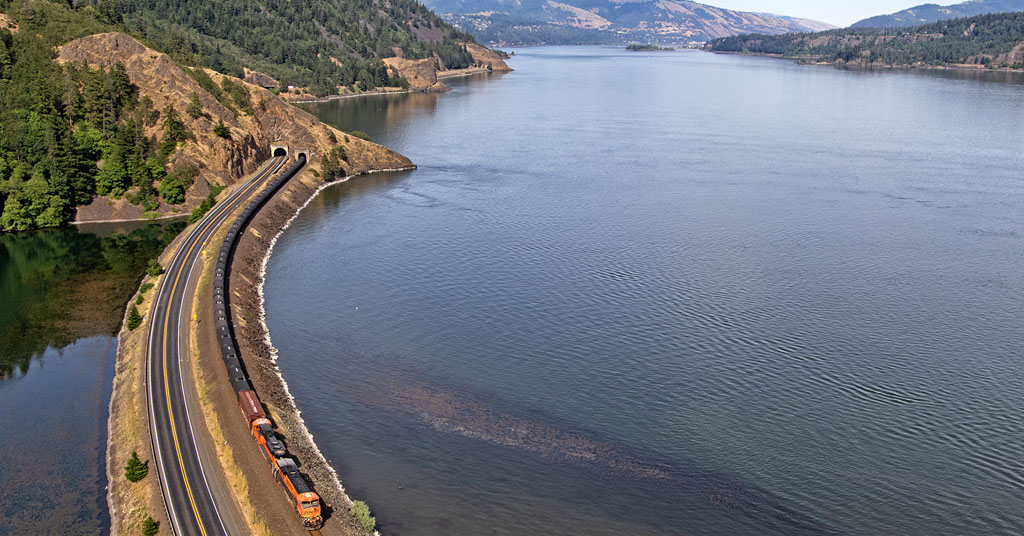
Near thing: Crude oil trains running mere feet from the Columbia River, like this BNSF train passing Drano Lake (left) in Washington, have become commonplace in the Gorge. Photo: Justin Franz

By Chuck Thompson. March 14, 2024. On June 13, 2023, shortly after 9 a.m., Wasco County Sheriff Lane Magill was among the first to receive the report of an event everyone in the Columbia River Gorge dreads.

An oil train with 23 tank cars carrying 540,000 gallons of crude oil had derailed near the confluence of the Columbia and Deschutes Rivers in Oregon. Crude oil was gushing into the Deschutes and threatening the Columbia.

Magill took stock of his on-duty staff—top to bottom, deputies to office staff—then started mentally checking through tasks set out under the National Incident Management System (NIMS).

“We determined who the incident commander was going be, that falls under NIMS, and we just rolled right into that,” recalls Magill of the episode last summer. “We all moved into our own spots.”

If you’re wondering why you haven’t heard of a major oil spill in the Columbia and Deschutes last summer, it’s because it never happened.

The imaginary “report” Magill and others received was part of a two-day “discharge train derailment scenario” emergency response drill held at the Fort Dalles Readiness Center in The Dalles, Ore.

The multi-agency simulation—which included more than 150 people from federal, tribal, state, county and municipal agencies, and BNSF Railway—is a legal requirement in Oregon per a 2019 law that requires railroads that transport oil to prepare and practice spill response plans.

Part of the goal was to refine Oregon’s mandated Geographic Response Plan to a train derailment.

Worst Case Train Derailment Discharge exercise conducted in June 2023 on Deschutes RIver, Oregon

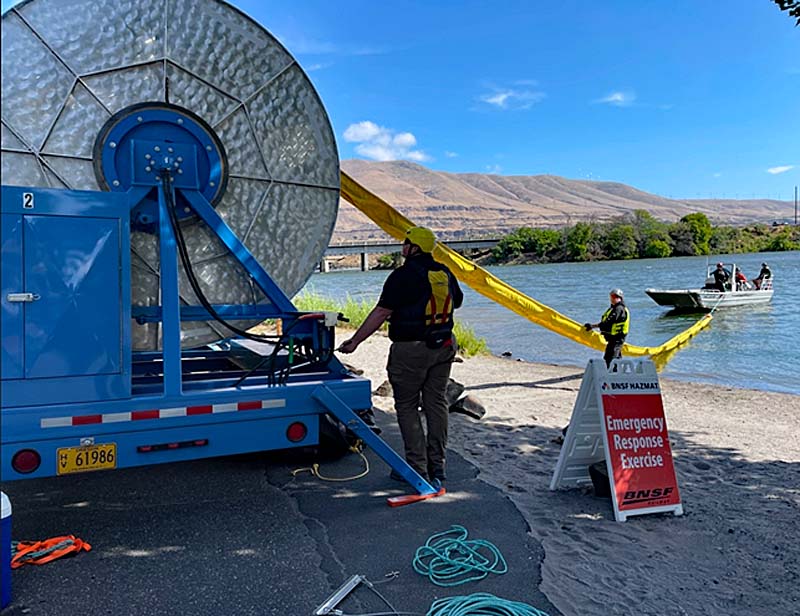
Reel incident: Emergency responders set a boom in Oregon’s Deschutes River as part of a train derailment exercise conducted in June 2023. Photo: Richard Franklin/EPA

The first day was a tabletop exercise in which agencies reacted on paper to the fictitious incident scenario and broke into different groups, such as logistics, planning, finance and operations.

“It’s not laid back,” says Magill. “Maybe people make an assumption when we have these types of exercise, ‘Oh, it’s just a bunch of government officials sitting around a table eating donuts and drinking coffee.’ But when you walk in that room you better be ready to go. We have the mindset that this is actually happening. You have to think that way because if you don’t you’re already behind the eight ball.”

The second day was a field deployment exercise.

“The Geographic Response Plan helps responders immediately assess an incident location and tells them, for instance, what kind of fish, birds or endangered species are in that area,” says Sheridan McClellan, emergency management services manager for Wasco County, who also participated in the exercise. “Wherever an incident happens, responders can open up the plan and find [pre-determined] strategies for each area, such as where to place booms for collection points based on the flow of the river in certain spots.”

Though it was Oregon’s first large-scale training exercise designed to help the state better prepare for a major oil spill from a railroad, the June 2023 exercise was just one of multiple drills that have become commonplace in the Columbia River Gorge since 2016, when a train traveling through the Gorge actually did derail and spill crude oil in Mosier, Ore.

Many residents believe another derailment is inevitable in the Columbia River Gorge National Scenic Area, an 80-mile-long stretch shared by Oregon and Washington.

“It’s not a matter of if trains are going to derail again, it’s where and when,” says former Mosier mayor Arlene Burns.

“Russian roulette” on the Columbia

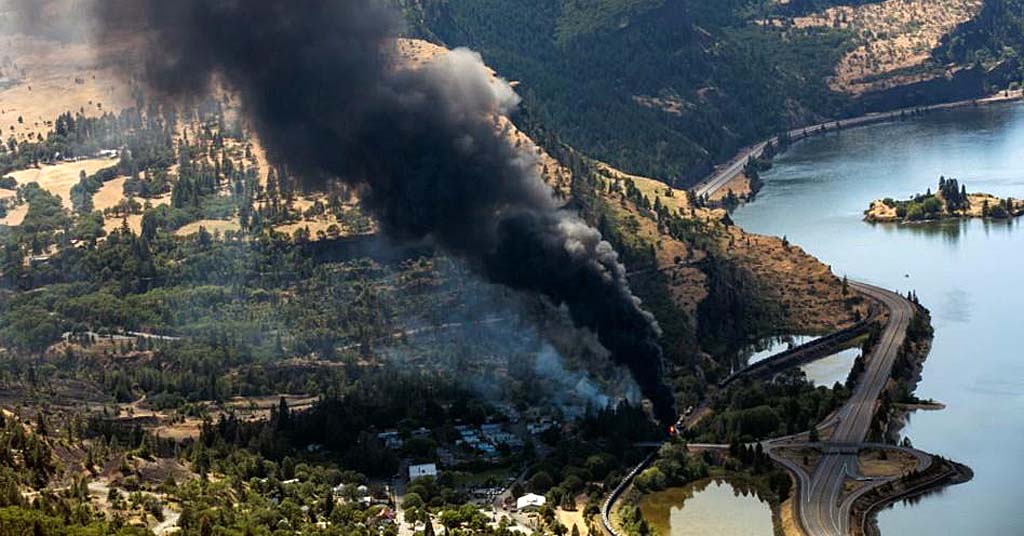
On June 3, 2016, a Union Pacific Railroad train carrying crude oil derailed and caught fire in the Columbia River Gorge community of Mosier, a town of fewer than 500 residents about 70 miles east of Portland.

Traveling at 24 mph, 16 oil tank cars jumped the tracks some 800 feet from the river, spilling thousands of gallons of Bakken crude oil.

Three rail cars burst into flames. Firefighters worked for 14 hours to put out the blaze.

Mosier, Oregon derailment June 3, 2016

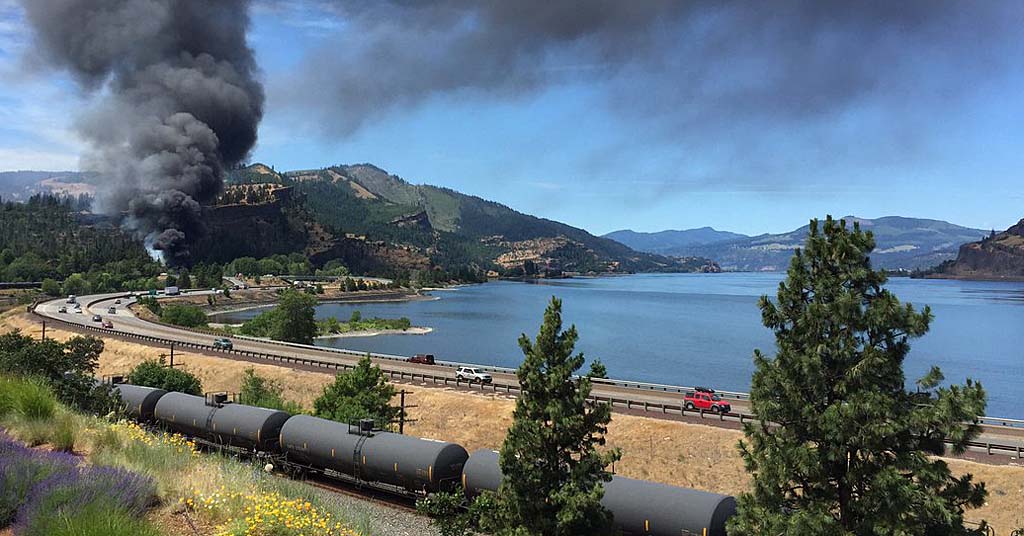
Black mark: A Union Pacific train derailed in Mosier, Ore., on June 3, 2016. Photo: Oregon DEQ

But for a rare lack of wind that day, the entire town could have been engulfed. Average wind speed in the Columbia River Gorge, where steep walls act as a funnel, is 10 mph, and sustained winds of 20 mph or faster are common.

“Lack of wind was the reason Mosier and everything to the east wasn’t wiped out,” says Burns, who was Mosier’s mayor from 2015 to 2022. “Our entire city limits were in the blast zone had there been an explosion.”

According to the EPA, only a “minor amount” of oil reached the Columbia River. The agency calculated that of the 47,000 gallons of oil spilled, 16,000 gallons burned or vaporized; 13,000 gallons collected in a nearby wastewater treatment plant; and 18,000 gallons discharged to soil.

The Mosier derailment was a wakeup call for officials responsible for disaster response in the Columbia River Gorge.

Federal, state and local agencies say they’re now better prepared to respond to unexpected incidents.

Crude oil train cars derailed in Oregon 2016

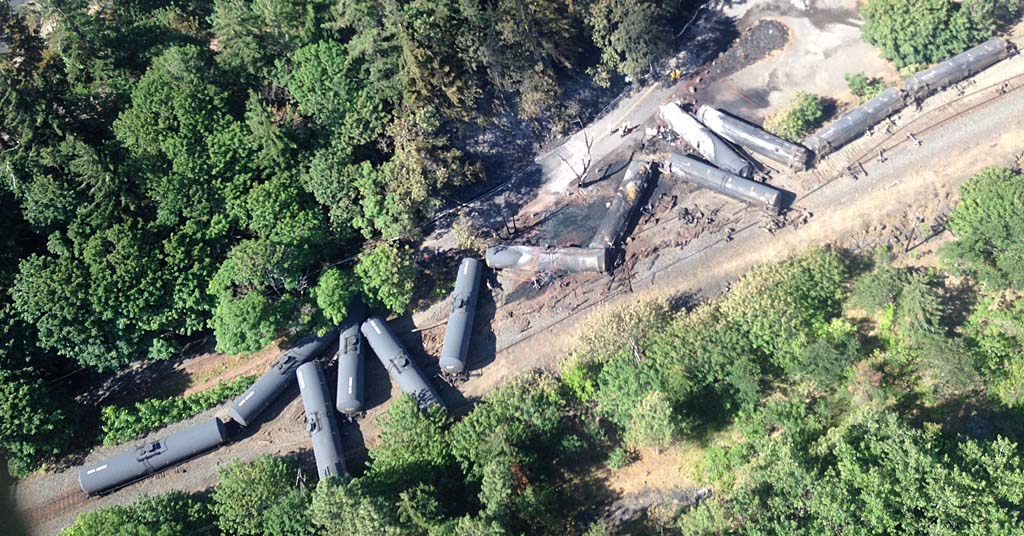
Lucky break: Although 16 cars derailed, little oil actually spilled into the Columbia River during the 2016 Mosier incident. Photo: Wash. Dept. of Ecology

But the risk of another derailment remains.

And though oil train traffic has decreased in recent years, the number of cars carrying crude oil through the Columbia River Gorge more than doubled in the years following the Mosier spill.

What’s more, spring and summer months mark the height of train traffic on both Washington and Oregon tracks. These months also coincide with peak wildfire danger, creating the possibility of a train derailment causing a wildfire with exponentially greater risks of destruction.

“I’ve been living in the Gorge for 30 years,” says Burns. “The last 10 years every summer is just like Russian roulette if our town is going to burn down from a fire. It was never like that before. The hotter days have gotten hotter, the periods of hotter days have gotten longer.”

Crude rules

Prior to 2012, rail transport of crude oil through the Columbia River Gorge was virtually nonexistent.

That year, however, volume surged—eventually reaching 60 million gallons per week—thanks to increased fracking of oil and gas from the Bakken Formation, a vast rock expanse in North Dakota.

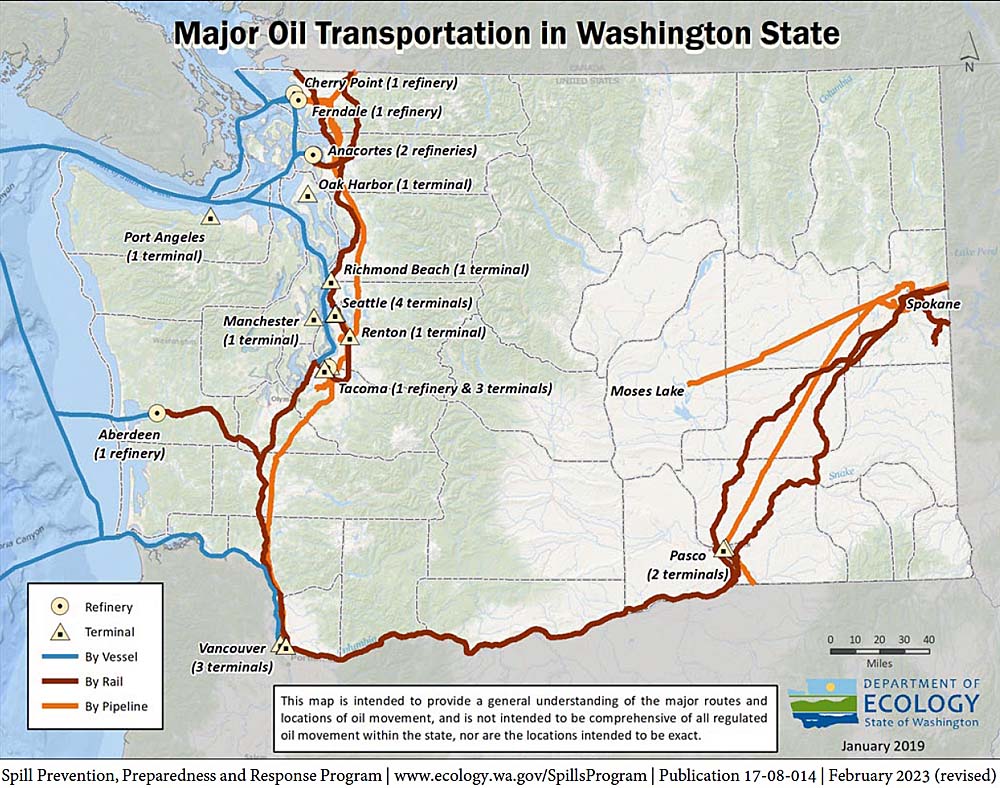
For railroads, the Columbia River Gorge emerged as the go-to route to move oil from producers in North Dakota to refineries in Anacortes, Cherry Point, Ferndale and Tacoma, Wash., as well as California.

“Crude by rail is shifting to the West Coast in a big way,” wrote RBN Energy, an energy market analytics firm, in a 2013 blog post. “As the crow flies the distance from North Dakota to Washington State makes the Northwest a closer refining center than the East Coast.”

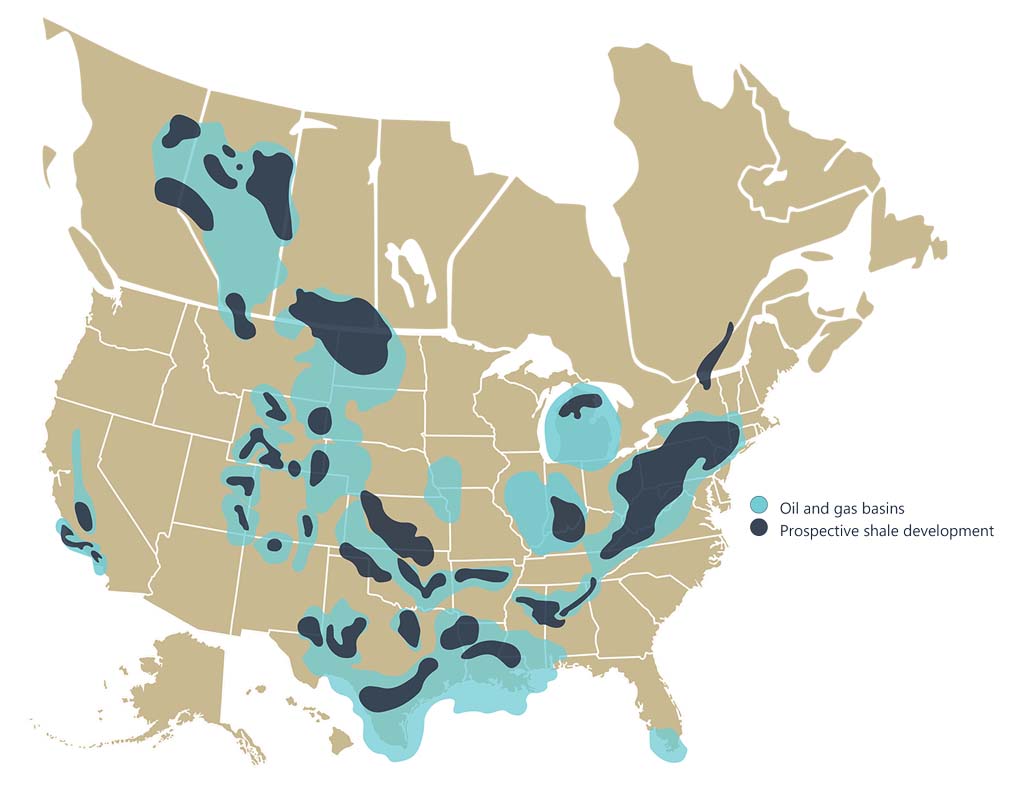
Oil and Gas Basins and Shale Development in United States map.

Oil and gas basins and prospective shale development in the U.S. and Canada. Map: Oregon Dept. of Energy

As the only sea-level crossing through the Cascade Range, the Gorge quickly became what critics call “a superhighway for fossil fuel transport.”

Lawmakers took note.

Following the July 2013 Lac-Mégantic rail disaster—when a 73-car Montreal, Maine and Atlantic Railway train carrying Bakken crude oil derailed in the Quebec town, killing 47 people and destroying the downtown area in a massive inferno—legislators in Washington directed the state’s Department of Ecology to create rules targeted at the two major railways operating in the Columbia River Gorge: Burlington Northern Santa Fe (BNSF), which operates on the Washington side of the Columbia River Gorge, and Union Pacific, which operates on the Oregon side.

The new rules required the railroads to provide the state with emergency plans and proof they have the financial resources to respond to a derailment. The Washington Utilities and Transportation Commission also began inspections on railroad crossings located on crude oil routes every 18 months and documenting incident data.

With a major push from environmental advocates, Oregon adopted a law in 2019 requiring railroads that own or operate high hazard train routes to have oil spill contingency plans approved by state’s Department of Environmental Quality.

Oregon’s “spill bill” put railroads hauling crude oil or liquefied natural gas under the purview of the state’s oil spill planning program, established fees of up to $20 on each oil tank car entering Oregon or loaded in the state, plus a small annual fee on railroads’ gross operating revenues in Oregon.

The fees help fund Oregon DEQ’s work, including the creation of two rail planner positions within the agency.

Washington outpaces Oregon

Many of the rules in Oregon’s response program have been adopted from Washington.

Washington’s Department of Ecology—which responds to oil spills and other environmental incidents—has traditionally been better staffed and better funded than its counterparts at the Oregon Department of Environmental Quality.

Although the 2016 Mosier spill took place on the Oregon side of the river, far more emergency responders to the event came from Washington across the river.

A state cannot use safety as a pretext for inhibiting market growth.” —U.S. Department of Transportation

“Ecology has more money, they drill and exercise their own staff way more than Oregon does. Washington by itself, it’s pretty well prepared,” says Richard Franklin of the EPA Region 10 office in Portland. “If we have an incident on the river, both states will respond again. The state of Oregon has brought in some new staffing positions to handle this, they’ve increased their training, so they will be better.”

While Oregon DEQ has expanded its response capacity, the agency will still depend on Ecology and the EPA for support in the event of a disaster.

“The joint Washington and Oregon partnership is so important,” said Kyrion Gray, one of Oregon DEQ’s high hazard rail planners, after the June 2023 exercise in The Dalles. “These events really solidify our dual responsibility and capability.”

How about no crude at all in the Gorge?

The Yakama Nation was one of the first governments to respond to the 2016 Union Pacific derailment in Mosier, bringing resources from its environmental program.

Even before the accident, however, the Yakama Nation and other Tribes opposed the transportation of fossil fuels through the Gorge.

“We should not have any fossil fuels coming through our ancestral homeland, especially along the river,” said Austin Greene, tribal chairman for the Confederated Tribes of Warm Springs, after the 2016 Mosier derailment.

“We’ve been a very strong advocate of the fight of a fossil fuel superhighway coming through this Columbia River Gorge,” said JoDe Goudy, chairman of the Yakama Nation at the time of the Mosier incident.

Former mayor of Mosier, Oregon, Arlene Burns

Current effort: Former Mosier mayor Burns continues to advocate for safer waterways. Photo: Arlene Burns Archives

Tribes argue that transporting toxic materials through the Columbia River Gorge impacts natural and cultural resources. They want trains re-routed.

But they aren’t alone in wanting crude oil train operations curtailed in the Gorge.

In 2019, Wash. Gov. Jay Inslee signed a bill that allowed the state to turn away trains not meeting state-sanctioned vapor pressure thresholds—a measure aimed at reducing the volatility of transported crude oil.

In 2020, however, the Trump administration blocked the Washington law, saying the state was illegally attempting to dictate the commodities other states can transport to market.

“A state cannot use safety as a pretext for inhibiting market growth or instituting a de facto ban on crude oil by rail within its borders,” wrote Paul Roberti, chief counsel of the Transportation Department’s Pipeline and Hazardous Materials Safety Administration.

Montana Attorney General Tim Fox called the court decision “a victory for … oil-rich states.”

The decision coincided with an all-time high for crude oil train traffic in the Gorge, nearly 115,000 cars in one year.

In lieu of a total ban on crude oil trains, many residents think more could be done to ensure future safety.

Burns would like to see trains travel at slower (i.e., safer) speeds through the Gorge. And for railroads to implement seasonal shipping measures.

“Couldn’t we find a way to ship crude oil for the eight months of the year when it’s moist and rainy and not have that oil shipped at a time when there is tremendous fire danger?” she says. “That would enable us to feel a lot safer.”

Risky business

While crude oil train traffic on both sides of the Columbia River has declined since 2020—Washington sees about twice as many crude oil train cars as Oregon—an average of 2.5 unit trains carrying crude oil still chug through the Gorge each day. (“Unit trains” are freight trains carrying a single commodity from origin to destination.)

No matter how much crude oil moves through the Gorge, critics say the risk of another derailment defies the historic agreement through which the tracks were approved in some places just a stone’s throw from the river.

“The railroads were given land everywhere the tracks are by eminent domain, and that was based on the public trust,” says former Mosier mayor Burns. “When you start carrying explosive and toxic materials on these railroad lines it’s in defiance of that public trust. Back when they gave them the land that bisected our city and took away our access to the river it was for corn and lumber and supplies and things that provided for the larger good.”

Washington oil transportation routes

Map: Wash. Dept. of Ecology

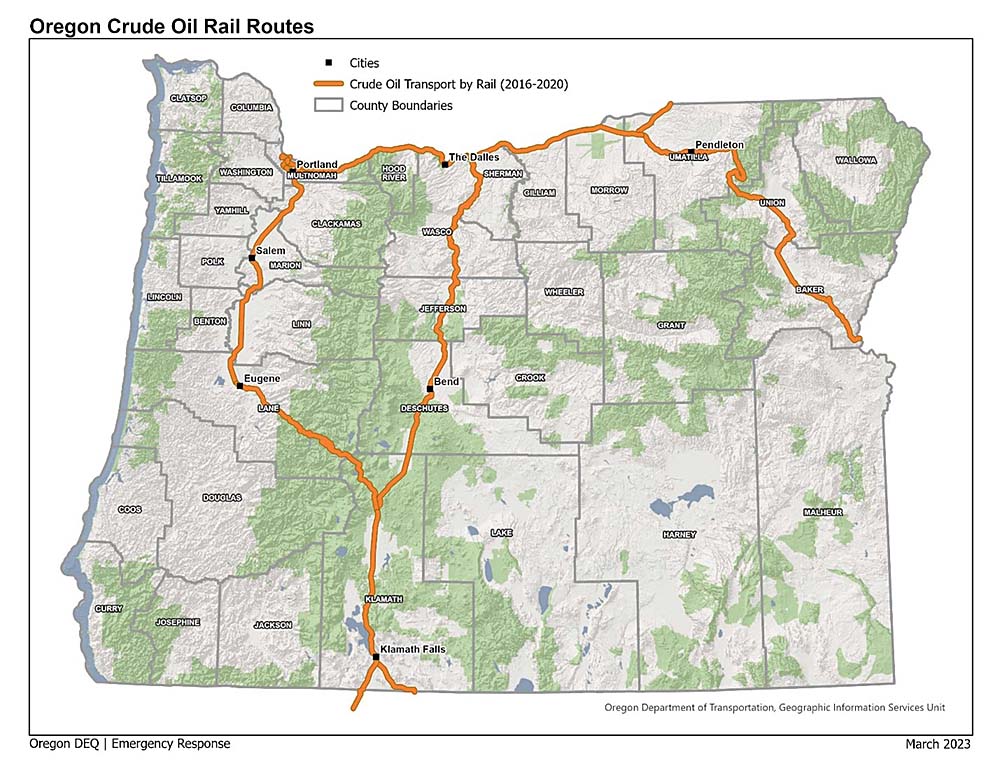
Oregon Crude Oil Train Routes

Map: Oregon DEQ

But it’s not just crude oil that concerns residents.

Some of the foam substances firefighters use to extinguish toxic fires contain PFAS (aka “forever chemicals”) that can also be extremely harmful to soil and groundwater.

And other toxic substances—chlorine, hydrochloric acid, ammonia—regularly move by rail through the Gorge.

“What the public has failed to maybe appreciate is if we have one car of chlorine that gets punctured, and in a residential area or town it can be worse than crude oil. It can be death and destruction,” says Franklin of the EPA. “People die. It doesn’t take much.”

“One of the funny things that the railroad guys said to me during [the 2016 Mosier incident] was, ‘you’re lucky it wasn’t chlorine gas.’ I thought, ‘Oh, thanks, then,’” says Burns. “We all have been living in oblivion. I think people have no idea what’s moving through the Gorge.”

Challenges in the Gorge

Richard Franklin was the federal official in charge of coordinating the response to the 2016 Union Pacific spill in Mosier.

Richard Franklin is the EPA Region 10 oil program coordinator

Oil and water: EPA On-scene Coordinator Franklin. Photo: Richard Franklin/EPA

As the on-scene coordinator from the Environmental Protection Agency Region 10 (Pacific Northwest) office in Portland, his job was to establish a unified command as prescribed by the Northwest Area Contingency Plan.

This isn’t always easy amid the infamous tangle of stakeholders in the Columbia River Gorge.

Jurisdictional entities in the Gorge include federal agencies like the EPA, Department of Interior (and its sub-agencies such as the U.S. Fish and Wildlife Service and U.S. Geological Survey) and U.S. Forest Service, the states of Oregon and Washington (their responses being led by Oregon’s DEQ and Washington’s Ecology), counties, municipalities and Tribes, including the Confederated Tribes of the Warm Springs, Yakama Nation, Nez Perce Tribe and the Confederated Tribes of Umatilla Indian Reservation.

When Franklin arrived in Mosier—after being delayed in traffic on Washington State Route 14 due to the closure of I-84 on the Oregon side of the river—the situation was already chaotic.

Early on, differing reports from various media outlets led to confusion for responders and the public.

Ultimately, the EPA helped form a joint information center with other agencies.

But in the early hours Franklin was mostly busy pulling together available resources, systems and tools with state, tribal and federal counterparts.

Response teams from the Washington Department of Ecology and Union Pacific Railroad staged floating containment barriers and absorbents (oil boom) on the Columbia River; sprayed 2 million gallons of water on the fire; excavated nearly 3,000 tons of contaminated soil; and deployed air monitors throughout the incident site and the community to check for public health risks.

Post-Mosier preparedness

Franklin has spent 27 years as an on-scene coordinator with the EPA, 15 of them in the South Central Region 6. He’s worked on numerous crude oil spills in Texas, Oklahoma and Louisiana, and was an on-scene coordinator for the 2003 Space Shuttle Columbia, which disintegrated over Texas and Louisiana as it re-entered the atmosphere.

In the last 15 years, he’s worked on high-profile oil spill and hazardous material responses in EPA Region 10 (Oregon, Idaho, Washington, Alaska).

He’s now an EPA Region 10 oil program coordinator, a position that helps guide response to crude oil spills.

So, what’s different in the Gorge since the 2016 disaster in Mosier?

“We’re definitely better prepared for several reasons,” says Franklin. “We had the experience of Mosier. We learned from that. We’ve done a lot better on how we pull together all those resources. One of the lessons we learned was how to better integrate Tribes into incident response and command.

“We also learned lessons about what went right. The Bakken crude oil behaved as the models predicted, so we handled that appropriately. The techniques that were used for that worked really well.”

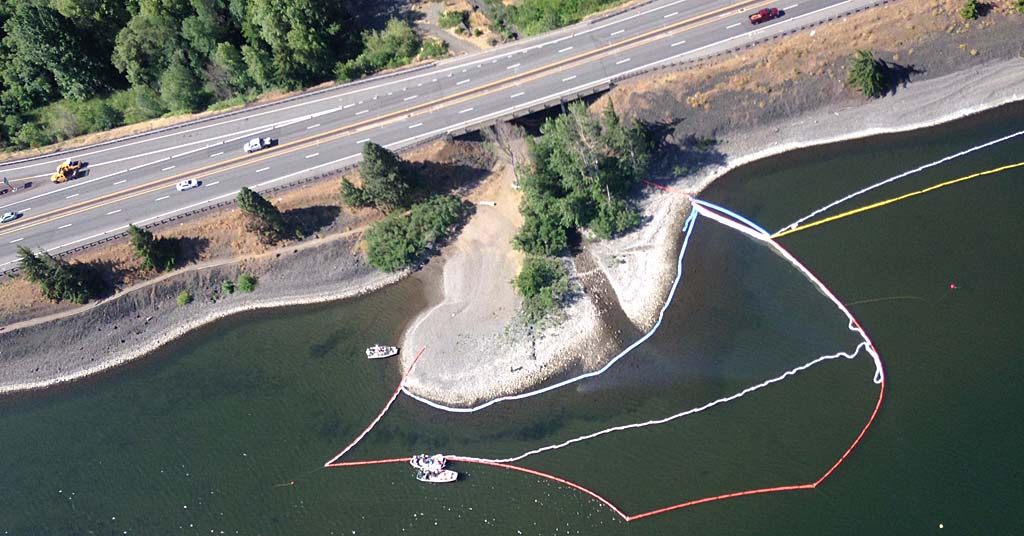
Boom in Columbia River to contain oil spill

Stop the spread: This boom was placed in the Columbia River to contain oil spilled from the 2016 derailment of a Union Pacific train in Mosier, Ore. Photo: Wash. Dept. of Ecology

Post-Mosier, the Coast Guard has also partnered with the EPA to conduct exercises, practicing with skimmers and other types of vessels. Practice runs test how long it will take to move equipment and resources upriver and through the locks to get to an incident scene.

Both Union Pacific and BNSF say they’ve increased emergency response preparation.

“Union Pacific (has) trained more than 2,300 Oregon emergency responders in rail-related response processes and played a major role in the formation of state policy impacting oil train safety,” said Union Pacific in a statement to Columbia Insight. “For example, we work with the Oregon Department of Environmental Quality (DEQ), Oregon State Fire Marshall and other agencies, applying lessons learned regarding cleanup, planning and preparedness.”

“BNSF files a response plan with the state of Oregon and participates in annual response drills with leaders from the state Dept. of Environmental Quality (DEQ) and other state, federal and local agencies,” said BNSF in a statement to Columbia Insight. “The railroad also trains and coordinates with local first responders to ensure a robust response to any event occurring along the railway. … BNSF works closely with regulators and leaders in both states to ensure a robust and rapid response.”

Although BNSF doesn’t operate on the Oregon side of the Columbia River Gorge, the company operates elsewhere in the state, including along the Deschutes River.

Future response

So, what might the response to a future derailment look like?

The EPA maintains 15 on-scene coordinators in the Pacific Northwest: nine in Seattle, two in Portland, two in Boise and two in Alaska.

In the event of a train derailment on the Columbia River, the on-scene coordinator would likely be dispatched from Portland, provided the derailment occurred upriver of the Bonneville Dam. (From the Bonneville Dam to the Pacific Ocean, the U.S. Coast Guard has federal jurisdiction for oil spills in the Columbia River. West of the Bonneville Dam boundary any response effort would be led by the Coast Guard; the EPA calls the shots on river disaster response from the Bonneville Dam to the Canadian border.)

This still might not be easy, if only because the Gorge has limited points of access.

“What nobody factored in [in 2016] is if the freeway is closed how do people get there? The traffic jam, the fire trucks had to come from Portland and they were stuck in this 30-mile backup of traffic on I-84. That was a nightmare,” says Burns. “That’s always going be a factor in the Gorge. A huge amount of our support is coming on the very road that might be compromised by the event.”

“Any large incident is always chaotic at the beginning,” says Franklin. “It’s scary. It’s emotional. You get varying reports. The media is descending, wanting information right now. Our job as federal, tribal, state and local agencies is to work through that chaos and pull together a plan and implement it and turn it into an efficient response.”

Mosier train derailment 2016 aerial

Tricky position: The narrow Gorge presents access challenges. Photo: EPA

The federal response plan envisions a small team at the top led by the EPA (or Coast Guard downriver of the Bonneville Dam), two state commanders, local incident commanders, tribal commanders and the responsible party (such as the railroad) who will ultimately pay for the response effort.

All of this effort is applied under the Northwest Area Contingency Plan, a subset of the National Oil and Hazardous Substances Pollution Contingency Plan.

The groups work as a team, but the EPA (or Coast Guard) gets 51% of any vote.

“If something does happen, it’s going to take some time to get to (the location) and start booming it up and cleaning it up,” says Franklin. “In the Portland area we have response resources we have to move upriver. We have resources in the Tri-Cities. Depending on the site, it could take an hour or two or five or ten to get to it. In those first few hours, we’re not going to be able to stop a spill. Later on, yes. There are a lot of dynamics.”

The EPA on-scene coordinator will also follow a 96-hour checklist, developed after Mosier, to remind them of the tools and subject matters they need to consider.

To cover immediate costs, the EPA (and Coast Guard) has access to a $50 million emergency fund from the Oil Spill Liability Trust Fund (a fund worth over $1 billion created after the 1989 Exxon Valdez oil spill in Alaska) to dispense to Tribes and local agencies. The spill’s responsible party would, theoretically, eventually reimburse those costs.

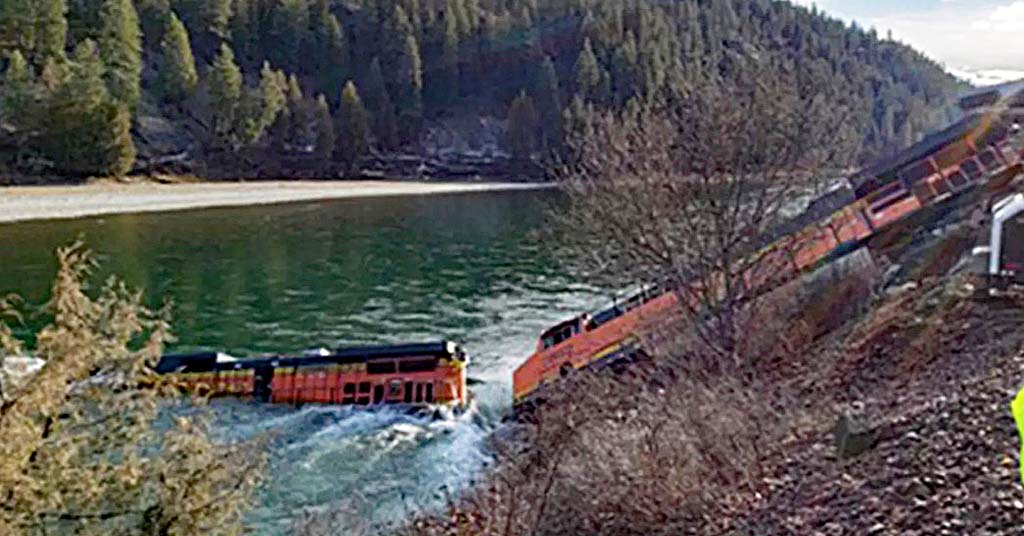
BNSF train jumps tracks and winds up in Kootenai River

It happens: In January 2020, a BNSF lead locomotive, two other train engines and six empty rail cars ended up in the Kootenai River near Bonners Ferry, Idaho. Diesel fuel spilled into the river. Photo: Boundary County Emergency Management

From behind a desk or during a field drill, all of this might feel like a comforting response strategy for a future derailment.

That still doesn’t make the transportation of crude oil and other toxic substances through the Gorge 100% safe.

“It’s like trying to prepare for a water leak when there are thousands of bits of pipe everywhere. How to do you prepare for when and where a pipe is going to break?” says Burns. “Our [Mosier] derailment was caused by a rusty bolt. The track was inspected a few days before the derailment and they did not detect the rusty bolt.”

Over the last decade, an average of about 1,300 trains derailed each year in the United States, according to USA Facts. In 2022, there were at least 1,164 derailments—that’s more than three derailments per day, though few of these resulted in major disasters.

So, how likely is another train derailment and toxic spill in the Columbia River Gorge?

“The railroad companies have statistics on how many tons of cargo have gone how many miles without an incident and when you look at those statistics it looks pretty good,” says Franklin. “But accidents occur or I wouldn’t have this position.”

By |2026-02-09T13:04:30-08:0003/14/2024|Energy, Industry|7 Comments

10 biggest environmental stories of 2023

Wolves, water, wildfire. Extremes kept on getting more extreme


By Chuck Thompson. December 26, 2023. In May, Aja DeCoteau, a citizen of the Yakama Nation, became the first Native American to serve on the National Park System Advisory Board.

In July, a cougar was spotted on Haystack Rock at the Oregon Coast.

In December, Washington purchased 20,000 acres of logging lands west of Longview, the state’s largest timberland acquisition in more than a decade.

And this photo of the Tunnel 5 Fire in the Columbia River Gorge taken by Columbia Insight board member and in-house photographer Jurgen Hess was chosen as a finalist in the Professional Photographers of America’s International Photographic Competition (winners will be announced in January). 

Important events, for sure, but each was edged out by 10 others on our annual list of the year’s biggest environmental stories.

Photo: WDFW

No matter the month, wolves made news. In April, Washington biologists confirmed the existence of a wolf pack on the western flank of Mount Spokane. In July and August, Oregon wildlife officials killed six gray wolves in eastern Oregon—after preying on livestock, the wolves were caught with foothold traps then shot by U.S. Department of Agriculture’s Wildlife Services staff. In November, conservation groups filed a petition to stop the U.S. Forest Service from hunting wolves from helicopters in Idaho, and Washington’s Klickitat County Sheriff Bob Songer ginned up fears by claiming wolves were being introduced into his county (they aren’t). In spite of the agitation, wolves continue to rebound—in December five wolves captured in Oregon were released into the wilds of Colorado as part of that state’s recovery program.


Roundhouse CEO Stephen D. King addresses Cascade Locks residents. Photo Nathan Gilles

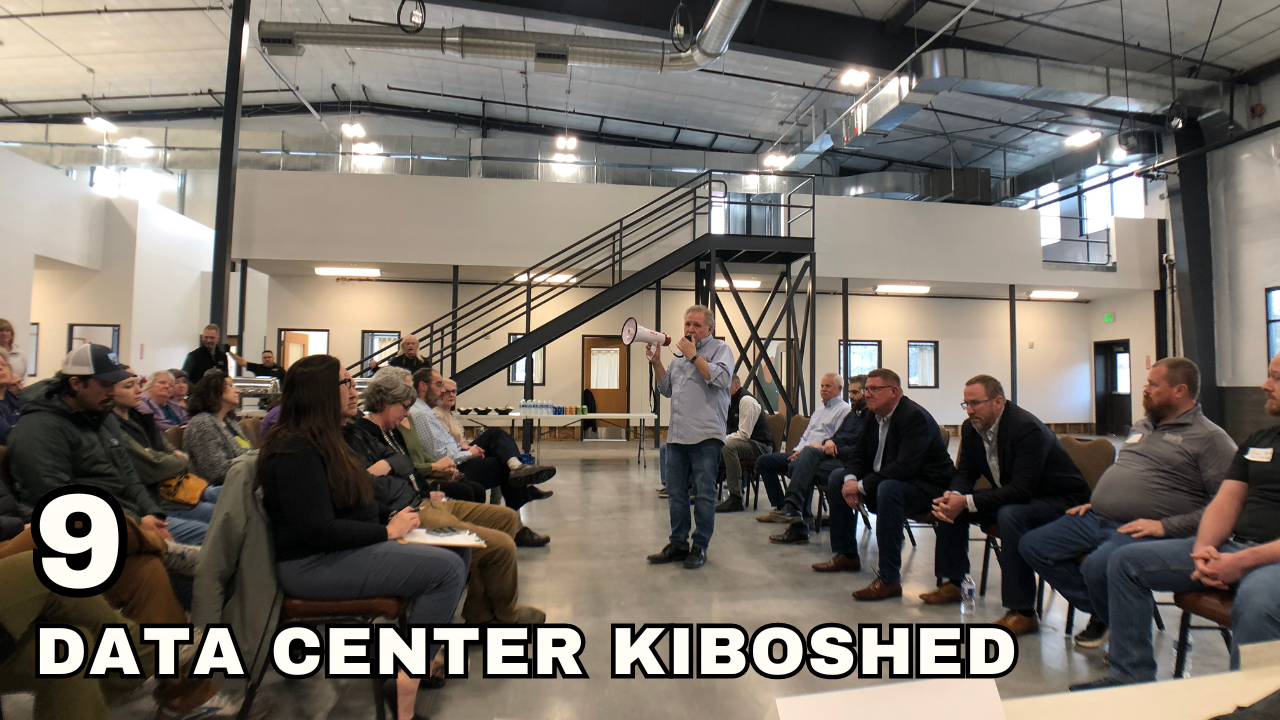
In March, Columbia Insight reported on a $100 million data center proposed by a startup company called Roundhouse in the Columbia River Gorge town of Cascade Locks, Ore. Many locals expressed concerns about the company, the checkered past of its CEO Stephen D. King and the financial and environmental impacts of the data center set on the banks of the Columbia River. In July, after intense local pushback, the Port of Cascade Locks and Roundhouse jointly announced the decision to discontinue the project.


Photo: Quagga mussels. Photo: Andrea Miehls/USGS

In October, the Idaho State Department of Agriculture launched a comprehensive treatment plan to eradicate invasive quagga mussels from the Snake River, first detected near Twin Falls in September. “If nothing were done, quagga mussels would quickly take over waterways. They would irreparably harm water use in Idaho,” said the ISDA. The obliteration effort involved dumping a highly toxic chelated copper product called Natrix into the river that was expected to kill most of aquatic life, plants and fish along a six-mile stretch of water. “The Snake River is Idaho’s lifeblood, and we are doing everything we can to eradicate quagga mussels from our waters,” said Idaho Gov. Brad Little. Officials won’t know if the $3 million purge was successful until spring, when water warms up and sampling surveys resume.


Photo: Saddle Mountain, Oreon. Photo: Richard Felley

In August, the extent of the past two decades of clear-cutting in the Oregon Coast Range was revealed in a report produced by nonprofit Oregon Wild and NASA DEVELOP. The cuts, which remove vital forest canopies, have had a detrimental effect on drinking water across 80 watersheds along the coast. “Logging operations are widespread across the Oregon Coast Range and conventional logging practices pose a risk of contamination to surface water quality,” according to the report summary.


Fire suppression practice, Yakima Training Center. Photo: U.S. Army

Popularly known as “forever chemicals” or “PFAS,” per- and polyfluoroalkyl substances have been in commercial production since the 1950s. They’re everywhere, including in our water, clothes and cookware. But concerns about their link to health risks—including kidney and testicular cancer, hormone disruption, liver and thyroid problems and abnormal fetal development—exploded this year after major exposés in national media including The Washington Post. Regionally, outlets such as the Yakima Herald-Republic and The Seattle Times doggedly raised awareness, tracking PFAS contamination of water from the San Juan Islands to Spokane; reporting on its legacy use at Seattle-Tacoma International Airport; and following the State of Washington’s legal battle with the U.S. Army to clean up sites where it’s used PFAS firefighting foams in training exercises.


Photo: TC Energy

In October, the Federal Energy Regulatory Commission (FERC) approved expansion of the GTN Xpress natural gas pipeline, which will bring more fracked natural gas to the Pacific Northwest. The pipeline runs through Washington, Oregon, Idaho and northern California. FERC’s approval of the proposal by Calgary-based TC Energy ignited fierce opposition among state officials and residents. In November, state attorneys general in Oregon, Washington and California pressured federal energy regulators to reconsider their approval of the project.


Photo: Office of Energy Efficiency and Renewable Energy

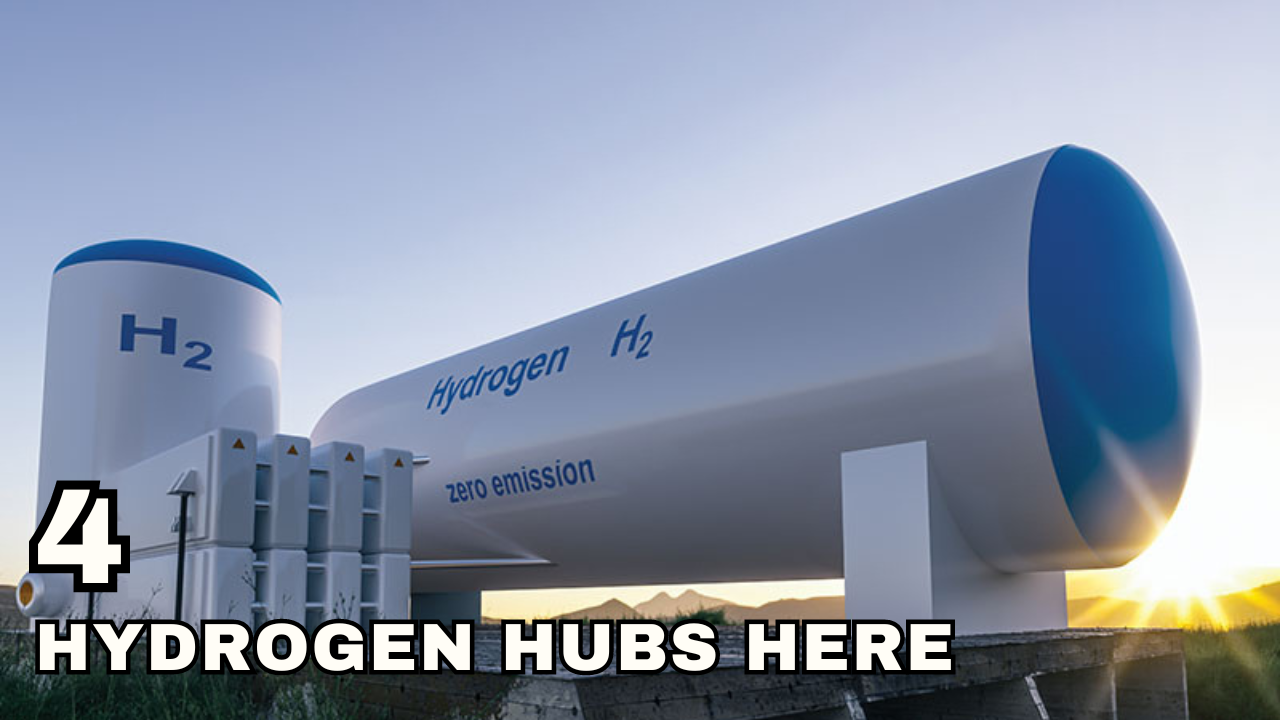
In October, after a fiercely contested national competition, Oregon, Washington and Montana were announced as recipients of $1 billion in federal funds to build eight hydrogen production sites. The Pacific Northwest will become one of seven hydrogen hubs across the country. Advocates say hydrogen could replace natural gas to heat buildings and power trucks and ships. Production sites will include Bellingham, Centralia, East Wenatchee and Kennewick in Washington; Portland, Boardman and Baker City in Oregon; and St. Regis in Montana. According to The Seattle Times, these “nodes” will provide access to hydrogen along transportation corridors, like Interstates 5 and 90 and Interstates 82 and 84 in Central Washington and Oregon.


Ice Harbor Lock and Dam. Photo: USACE

In December, the White House released a highly anticipated agreement with states, Tribes and enviro groups to boost salmon recovery in the Lower Snake River and develop renewable energy in the Columbia River Basin. While the agreement doesn’t call for breaching four controversial dams on the river—only Congress can authorize that—it clearly supports the idea. The deal—the culmination of 22 years of conflict encompassing four different lawsuits—calls for up to $1 billion in investments along the Lower Snake River for salmon recovery and renewable energy development to replace hydropower lost from the dams. “President Biden understands that the Columbia River System is the lifeblood of the Pacific Northwest, and for the first time under his direction, federal agencies are putting all hands on deck to support regional and Tribal efforts to restore wild salmon in the region,” read the White House announcement.


Tunnel 5 Fire: Photo: Jurgenhessphotography

Just when we thought we’d gotten used to “fire season” (aka summer), May ushered in record-setting fires in western Canada—twice as bad as any other season on record—that The New York Times dubbed a “Canadian Armageddon.” By August, half of Washington and large swaths of Idaho and Oregon were blanketed by unhealthy air caused by those and other wildfires. In July, the Tunnel 5 Fire raged in the Columbia River Gorge National Scenic Area, prompting an inspection visit from Washington Gov. Jay Inslee. Throughout the summer, highways were closed and evacuations were ordered from Washington’s Okanogan County to Oregon’s Deschutes County. No story brought the West’s wildfire epidemic into sharper relief than that of 53-year-old Mary Kaneko, who lost two homes to wildfire within 10 days—one in Spokane County and one a vacation rental in Lahaina, Maui.


Dry grazing field near Klamath Falls, Oregon. Photo: Associated Press

Due to early snowmelt and lack of rain, Washington declared a drought in 12 counties while Crook County, Ore., declared a drought emergency and asked the state for disaster-relief funds … in January. So began a water-challenged year that included Seattle Public Utilities, in desert Southwest fashion, asking customers to conserve water by taking fewer showers and refrain from watering lawns. The Oregon Senate passed a historic bill in July placing strict water regulations on large livestock operations—under the bill, meat, dairy and egg farms will no longer have unlimited access to water and must submit detailed water supply plans as part of their permit applications. As reported by Oregon Capital Chronicle, Justin Iverson, a groundwater manager with the Oregon Water Resources Department, told an Oregon House Committee that if permitting rules don’t change, it’s possible up to 50,000 Oregon wells that are 50 feet below the water table or less could go dry. The water agency is seeking to update rules of the state’s 1955 Groundwater Act. Many of the Pacific Northwest’s groundwater basins are being sucked dry faster than water can be replaced.

The Pacific Northwest’s only nonprofit, non-advertiser-driven news source devoted to environmental issues affecting the Columbia River Basin, Columbia Insight depends on support from readers like you. You can help us continue investigating critical stories by donating here.

By |2023-12-26T08:01:32-08:0012/26/2023|News|0 Comments

EXCLUSIVE: Investigation finds BNSF railway at fault for Tunnel 5 Fire

‘Fire danger along the tracks in this general area should have been known to BNSF,’ reads report

BNSF Engine

A Washington DNR report has found that debris from this locomotive engine (here in Great Falls, Montana, 2007) may have started the Tunnel 5 Fire. Photo: Robert Thompson/Flickr


By Chuck Thompson. September 11, 2023. On July 2, just east of Burlington Northern Santa Fe (BNSF) Tunnel 5 in Skamania County, Wash., a blaze eventually designated as the Tunnel 5 Fire was ignited.

Burning adjacent to heavily traveled Washington State Route 14 in the Columbia River Gorge National Scenic Area, the fire consumed more than 500 acres and destroyed 10 structures, most of them private residences.

Now a State of Washington Department of Natural Resources wildland fire investigation report obtained by Columbia Insight has pinpointed debris from brakes and carbon emission particles from a BNSF locomotive engine as the cause of the blaze.

“A BNSF train travelled through the origin area of the Tunnel 5 fire at aprx 1053 to 1100 hours on Sunday, 07/02/23,” reads the DNR report. “This train emitted some object(s) which started fire in 3 areas over an aprx 690-foot distance, all on the North side of the tracks and East of Tunnel 5

“No probable evidence of another Human fire cause was located in the origin areas.”

The 22-page report includes photographs taken by citizen onlookers, surveillance video, witness testimony and interviews with BNSF officials.

“After eliminating other probable causes for this fire, the Wildland Fire Investigation determined this fire was started by Human means: Railroad Operations; Right of Way Vegetation Maintenance; Wheel Lubrication Parts; and Exhaust Particles,” the report concludes.

DNR approved the report on August 25.

According to the InciWeb page, the Tunnel 5 Fire is still under investigation. InciWeb is a multi-governmental, interagency all-risk incident information management system.  

Older engine may be to blame

As stated in the report, DNR investigators focused on BNSF operations as the cause of the fire for a variety of reasons.

One of the the more compelling sections of the report focuses on testimony from a pair of train enthusiasts, a man and his son, who happened to be photographing trains moving through the Gorge on the morning of the fire.

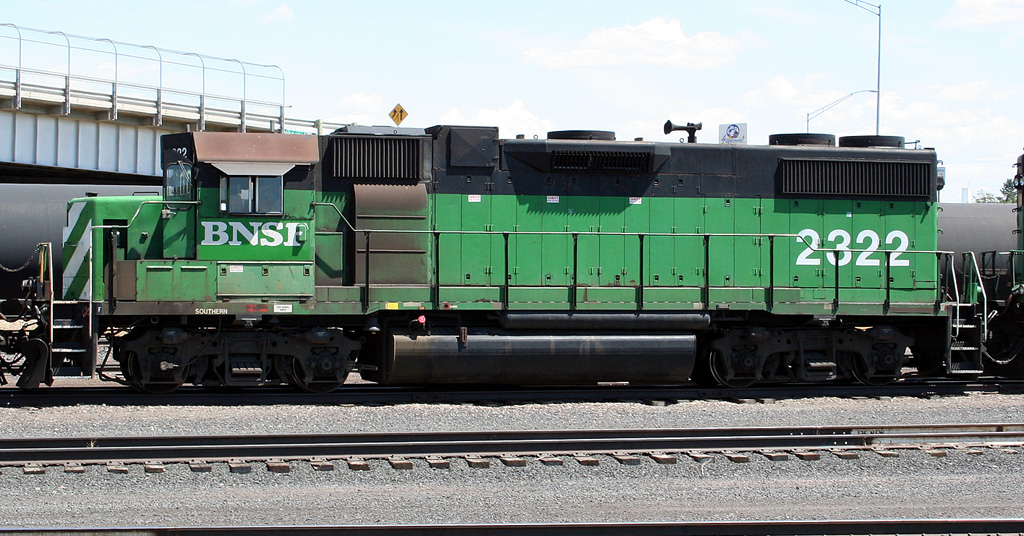
“They spotted an old BNSF green and white locomotive leader engine with a newer orange and black engine behind it. The older lead engine had the number 2322 on it, and the newer orange and black engine had the number 2600. These engines were pulling 12-15 loaded cars which appeared to have lumber on them. This train was WB [westbound] from White Salmon, going toward Vancouver, WA,” reads the report.

Tunnel 5 Fire location of start

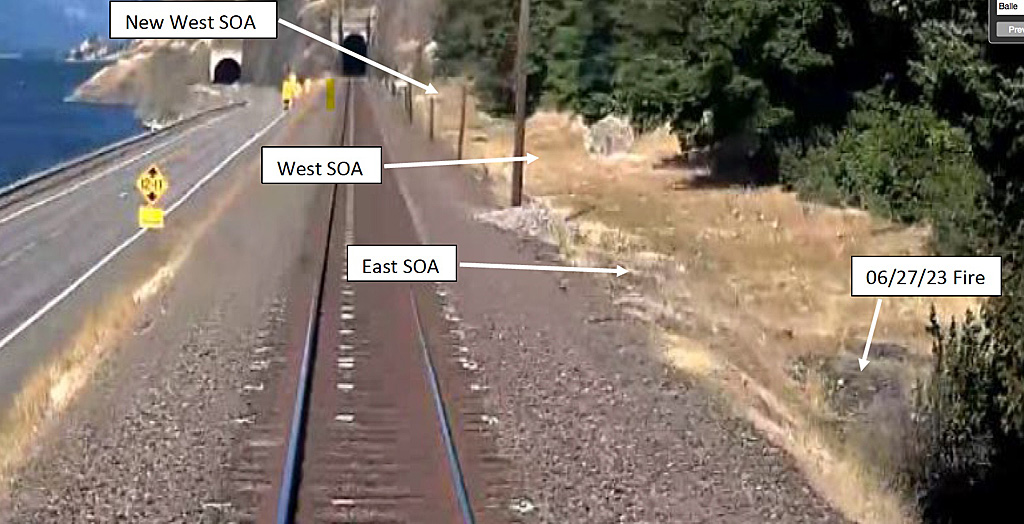
This image was captured by an Amtrak train’s forward-facing camera about two and a half hours before the start of the Tunnel 5 Fire. SOA indicates “Specific Origin Area” of the fire. A note in the bottom right corner indicates the area where a small fire burned just days before the Tunnel 5 Fire. Photo: Wash. DNR

According to the man interviewed, who happens to be a railroad employee, the green and white engine (2322) was possibly more than 40 years old and was likely non-turbocharged.

“In his experience with Union Pacific (UP) this green and white engine is not commonly used on open tracks in the Columbia River Gorge area,” reads the DNR report. “Being a non-turbocharged engine, it has a high likelihood of emitting diesel carbon emissions from the exhaust which could start a fire. [The man] added that it was UP practice to not use these older non-turbocharged engines in the Columbia Gorge during summer months due to their propensity to start fires. UP primarily used these older engines within train yards/depots, and not out on open tracks in summer months.”

While conducting an on-the-ground inspection after the fire, the lead DNR investigator “noticed a lot of what appeared to be metallic pieces of varying size, many of which had sheared off or had sharply cut fine shiny edges.

“I later learned from the BNSF that these shiny metallic looking pieces were a solid polymer lubricating pad which rubs against the moving train wheels … I collected a total of 72 solid polymer pads and 2 possible carbon emission particles.” [This original wording of this passage has been slightly amended. —Editor]

Smaller railroad fires just days before

The DNR report includes photographs and testimony from numerous witnesses who called 911 within minutes of the start of the blaze.

The report digs deeper into railroad operations in the general and specific areas of where DNR says the fire began.

And it identifies other fires started by the railroad in the same area in the week leading up the Tunnel 5 blaze.

Tunnel 5 Fire house burning

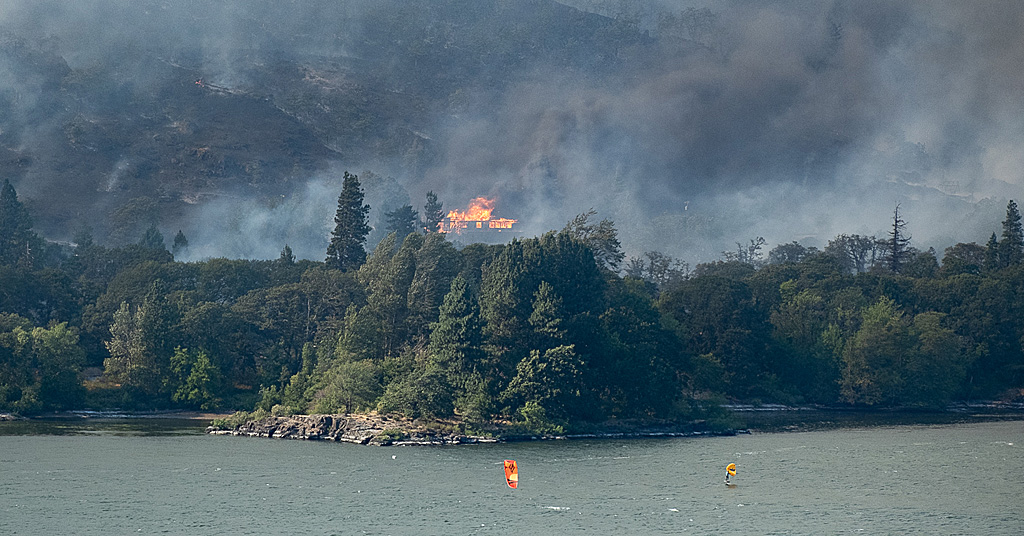
Hilltop house burns above Columbia River during the Tunnel 5 Fire in July 2023. Photo: Jurgenhessphotography

“Additionally, BNSF track maintenance activities had ignited two other fires in the same vicinity just 5 and 8 days earlier. These two track maintenance fires occurred during hours of darkness when temperatures would have been cooler and humidity higher. A localized fire danger along the tracks in this general area should have been known to BNSF,” reads the report.

DNR says that its Tunnel 5 Fire report is preliminary.

In 2007, the Broughton Fire burned 200 acres and seven structures (including five houses) in the precise location as the Tunnel 5 Fire.

That fire was determined to have been caused by the BNSF Railway Company’s grinding of nearby railroad tracks.

“Track grinding” or “rail grinding” repairs deformities and corrosion of rail tracks due to heavy use. The process creates sparks that can lead to fires, especially in the dry brush that lines the tracks in summer.

By |2023-09-18T14:02:22-07:0009/11/2023|Wildfire|14 Comments

Wildlife poaching update: Bite follows bark

In Oregon, officials dole out killer punishment after prosecuting a “wildlife crime spree”

Poaching evidence, skulls, rifle

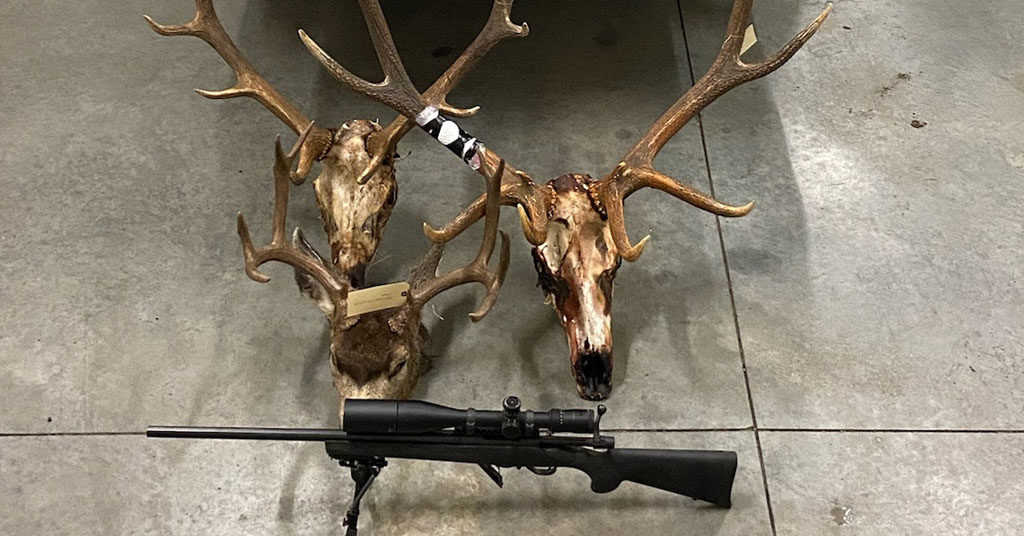
Taken: Evidence representing some of the animals poached by a Pendleton man convicted this week of wildlife crimes. Photo: Oregon State Police

By Chuck Thompson. August 29, 2023. In July 2022, Columbia Insight reported on the sentencing of two Oregonians convicted of slaughtering seven elk while spraying bullets into a fleeing herd.

We asked then if the poachers had received a harsh enough punishment—six days in jail for the main perpetrator and a combined $2,500 fine.

That story was framed in the context of a May 2022 story in which we reported on Oregon’s announcement that it was planning to get tougher on wildlife poaching, in part by hiring a new special wildlife anti-poaching resources prosecutor, Jay Hall, to tackle wildlife crimes.

We’ve been waiting. And watching.

Now we can report that the state’s plans and promises finally seem to be coming to fruition.

On August 29, the Oregon State Police (OSP) and Oregon Department of Fish and Wildlife announced a poacher will pay $75,000 in fines and serve significant jail time after killing numerous deer and elk near Pendleton in what officials are calling a “wildlife crime spree.”

Walker Erickson, 28, of Pendleton, pleaded guilty to 22 charges including illegally killing deer and elk and leaving game animals to waste.

Jay Hall Oregon Dept Justice

Poaching prosecutor: No tags? Jay Hall has a tag line for you. Photo: Oregon Dept. of Justice

After receiving a tip in summer 2020, OSP began gathering information that led to a search warrant of Erickson’s residence in December 2021.

“Troopers seized six sets of deer antlers, three sets of elk antlers including those of a 7×7 trophy bull elk, a rifle, a bow and meat. The investigation led Troopers to additional instances of poaching,” according to a joint OSP/ODFW press release.

Erickson will serve 14 days in jail during elk hunting season for the next three years.

“Elk season is now jail season,” said Hall, an assistant attorney general with the Oregon Department of Justice who prosecuted the case on behalf of the Umatilla County District Attorney’s office.

The case reflects the first significant application of new sentencing guidelines established by the Oregon Legislature in 2018. Passed in 2018, HB 3035 created stiffer penalties and allows prosecutors to elevate poaching crimes from a misdemeanor to a felony.

“All of this conduct, if it had occurred only a year before, before the legislature created these felony-level poaching crimes, he would be facing only misdemeanor sentencing,” said Hall.

“Poaching poses a direct threat to Oregon’s precious fish and wildlife populations,” said Yvonne Shaw, ODFW Protect Oregon’s Wildlife Turn In Poachers campaign manager. “In 2022 alone, nearly 5,000 animals were poached in Oregon—that we know of.”

We’ve called out the state in the past for its less-than-robust response to wildlife crimes.

This week, all of those involved in prosecuting this poaching outrage deserve applause—and encouragement to keep up the good work.

If you know of or suspect crimes against fish, wildlife or habitat, report to the Turn In Poachers (TIP) Line. 1-800-452-7888 or dial *OSP (*677) from a mobile phone. Or email: TIP@osp.oregon.gov.

The views expressed in this article belong solely to its author and do not necessarily reflect the opinions of anyone else associated with Columbia Insight.

By |2023-09-05T08:29:07-07:0008/31/2023|Wildlife|3 Comments

© Copyright 2013-2025 Columbia Insight. All Rights Reserved.

As a 501(c)3 nonprofit organization, all donations to Columbia Insight are tax deductible to the full extent of the law. Our nonprofit federal tax-exempt number is 82-4504894.