
Only one thing will preserve post-COVID environmental gains
The ecological legacy of the coronavirus remains unclear. We should be a part of creating it
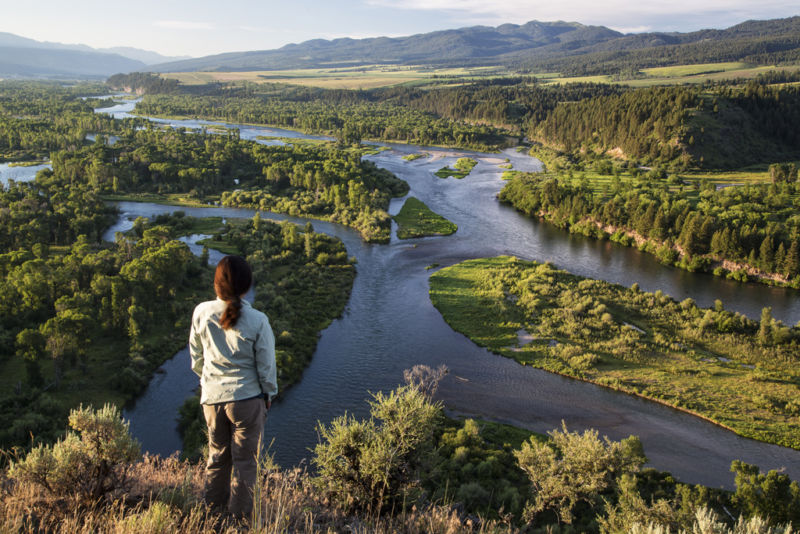
There’s something out there. Just not as much as before. South Fork Snake River. Photo by Bob Wick, BLM
Chuck Thompson, May 7, 2020. Six mule deer bucks. Four mountain goat. Three wild turkeys. Two chukars. One river otter. And dozens of eagles, hawks, geese, ducks, sparrows, squirrels, snakes and other furry, feathery and scaly citizens of the day-to-day campground critterverse.
That was my tally of wildlife sightings in just a 36-hour period around the Snake River and Umatilla National Forest in mid-April.
Granted, it’s spring, human activity is down and I was up with the dawn. But even for a place as relatively untrammeled as the Oregon-Idaho border, it seemed like a lot of near encounters.
Especially since I hadn’t been looking that hard.
Aside from the largest goat—a billy so white and broad that from certain sunlit angles he might’ve been mistaken for a polar bear—the bucks and river otter left the deepest impressions.
The deer came all at once, six of them arranged in perfectly unison single-file, racing down a hill and across a flat stretch of land not 50 yards from where I was boiling water. Bringing up the rear, the largest had the size of rack normally spotted only in visitor centers and hunting magazines.
The river otter kept cruising back and forth in front of where I stood on the Idaho side of the Snake, casing the joint, complaining at me in a clearly irritated way.
Big bucks and river otter tend to be shy around humans. You can hike for years and never catch a glimpse of a set of antlers like that. Or have the chance to chirp back at an audacious otter.
Green global gains
In the wake of those sightings, I felt plugged into a global phenomenon.
By now we’ve all seen the dramatic headlines. With reduced human activity as a result of Covid-19 stay-home orders, animals of all types are ranging with a greater sense of provenance.
True, that viral story about dolphins in the canals of Venice turned out to be B.S. But black bears in Yosemite National Park really are “having a party” in the absence of the usual bumper-to-bumper traffic. Kashmiri goats have “taken over” a town in Wales. Flamingos have descended by the tens of thousands upon the waters surrounding Mumbai. And thousands of turtle hatchlings on the coast of Brazil actually made their way to the sea unmolested by humans and dogs for the first time in memory.
“The whole world is under risk,” said Herbert Andrade, an environmental manager in Brazil, in the Washington Post. “But this was a moment of happiness. It was a feeling that nature was transforming itself.”
[perfectpullquote align=”full” bordertop=”false” cite=”” link=”” color=”” class=”” size=””]Like doomed dieters after a week of celery snacks, will we squander these gains in a post-COVID splurge of “we earned this” environmental gluttony?[/perfectpullquote]
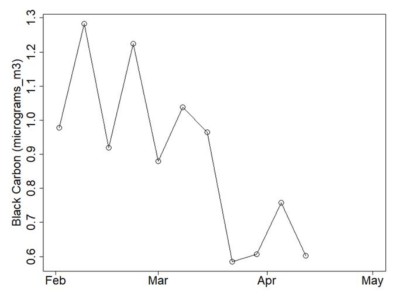
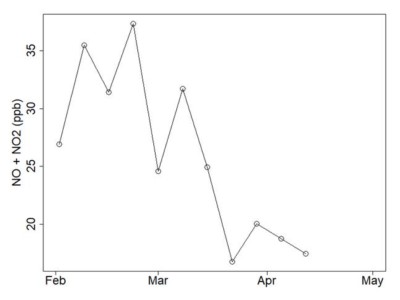
It’s not just wildlife. Another unintended outcome of worldwide shelter-in-place orders is improved air quality.
READ MORE ON CI: Two Charts Show COVID-10 Impact on Air Quality
A friend in perpetually polluted Manila recently emailed me that in that city “the air is as clean and crisp as it ever was in Oregon on its best day. We can now actually see the tops of trees on Corregidor Island from our deck over Manila Bay, which is insane.”
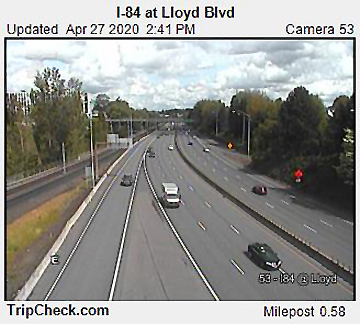
We can literally see the evidence across the Columbia River Basin, as well. With roughly 40 percent fewer vehicles on the road, Oregon Department of Environmental Quality monitors are measuring substantial decreases in airborne pollutants.
Distant Cascade peaks have rarely shone so brightly.
Excitement in conservation circles
For those who rank climate change and environmental preservation as top priorities, proof of humankind’s ability to actually bring about big green changes have boosted morale and ignited hope.
“The coronavirus opens up a whole new spectrum of political possibility that a lot of climate activists are quite excited about,” David Wallace-Wells recently told MSNBC’s Chris Hays. Wallace-Wells is a New York magazine climate columnist and author of the 2019 bestseller The Uninhabitable Earth: Life After Warming. “When you look at the planet right now it’s hard not to be moved by the expression of global solidarity and fellow feeling that is demonstrated by a literal hemisphere-wide quarantine that is being engaged in willingly by billions of people.
“That’s really the ultimate project and challenge facing us with climate change.”
The COVID-19 pandemic has shown we can accomplish a lot in a short time.
The $2.6 trillion-plus federal coronavirus response bills prove crisis funding isn’t as insurmountable as previously argued. According to Austan Goolsbee, University of Chicago economist and former advisor to President Barack Obama, adjusting for inflation that $2.6 trillion is greater than combined U.S. spending for wars in Iraq, Afghanistan, Vietnam, Korea and World War I.
Now comes the big question: in the post-COVID world will we embrace the environmental gains and lessons taken from the crisis and build upon them? Or, like doomed dieters after a week of workouts and celery snacks, will we simply squander them in a post-pandemic splurge of “we earned this” environmental gluttony?
What will be the ecological legacy of COVID-19, not just around the planet, but here in the Columbia River Basin?
Biologist Kalysta Adkins. Photo courtesy of ODFW
After my wildlife sightings around the Snake River and Umatilla Forest, I called Oregon Department of Fish and Wildlife conservation biologist Kalysta Adkins.
One of the Bend-based Adkins’ primary duties is to provide advice on conservation strategies. I wanted to know if she saw future implications in anecdotes of animals reclaiming ancient territorial jurisdiction.
“From a biological standpoint we’re not able to make population measurements in such a short amount of time,” she said. “Wildlife are getting curious and expanding into areas they previously shied away from because of human use. Spring has a lot of breeding going on so that’s a huge bright spot that could have a population effect, but it’ll probably be a year before we can see data and measure how that tracks.
“We know human recreation does have an effect on a large suite of species. Wildlife could benefit from this reduced impact if we continue it. These (recreation area) closures could have a silver lining of making us more aware of our impact.”
Policy post-pandemic
I assume the editorial reins of Columbia Insight—inheriting a high bar of excellence from inestimable outgoing managing editor Dac Collins—at an extraordinary time.
Not just because of the coronavirus. But because of how a general observance of stay-home guidelines has upended our understanding of what’s possible in terms of environmental preservation.
In an unprecedented way, we’ve seen what collective communal resolve is capable of accomplishing when marshaled against an existential threat.
Will Americans change their behavior as a result of the COVID-19 pandemic? Will communities in the Columbia River Basin emerge from the crisis with a newly conservationist mindset and adopt more responsible practices in nature?
“I am hopeful,” anthropologist Jane Goodall recently told the Washington Post. “I lived through World War II. By the time you get to 86, you realize that we can overcome these things. One day we will be better people, more responsible in our attitudes toward nature.”
I love Goodall—one of my childhood obsessions was a book about her work with chimpanzees—but a lot of people don’t share her confidence. I’m struggling not to be one of them.
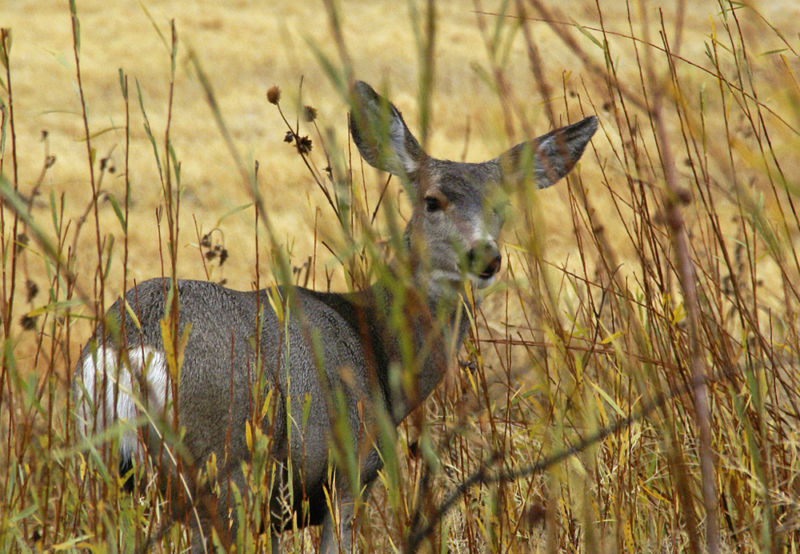
Undisturbed. For now. Photo by Jurgen Hess
“I’m not terribly optimistic about this continuing into the future once this is all over with,” says Dr. Richard Carpiano, professor of public policy and sociology at the University of California, Riverside and former co-editor of the Journal of Health and Social Behavior.
In March, I talked to Carpiano about the surprising civic cooperation (mostly) with mandated social-distancing measures.
Carpiano explained society doesn’t tend to have a long memory when it comes to disasters. Summarizing a series of interviews with crisis survivors and cognitive psychologists, science writer Shayla Love arrived at the same conclusion in a sobering April article in Vice.
Often as not, life returns to normal once a threat has been vanquished.
There are exceptions. These are often as not driven by policy changes.
“An interesting analogy is 9/11. It lit a fire under the U.S. government to get moving on things,” Carpiano told me. “We had hearings. We had a commission. Law enforcement got more modernized to deal with national security. We got better at handling terrorist threats.”
Extending Carpiano’s logic, it seems to me the only way to ensure we don’t squander the encouraging environmental gains made during the COVID-19 pandemic will be through public policy.
It’s easy for people to feel good while scrolling through newsfeed stories about cleaner air over I-84 or pictures of coastal elk strolling along the beach in front of Haystack Rock.
The challenge will be taking that good feeling and turning it into successful efforts to secure policies that make at least part of those changes permanent.
Awareness is great but only if it translates into action.
The policy needs are in front of us. Renewed excitement behind campaigns for cleaner energy. Greater public engagement in preserving and restoring habitats. Trickier to pull of, but probably necessary in our increasingly populated corner of the world, will be restrictions on individual and commercial activities that put pressure on threatened habitats.
READ MORE ON CI: Overcrowding in the Columbia River Gorge
In the post-COVID days ahead, policy debates over these and other issues will surely demand an ever-greater portion of our attention.
Just as certainly, Columbia Insight will continue to focus its energies on the most critical issues facing the Columbia River Basin.