Stay Updated Subscribe today for the latest research + reporting about environmental news. Subscribe Now

Stay Updated Subscribe today for the latest research + reporting about environmental news.

Subscribe Now

Chuck Thompson

Chuck Thompson

Chuck Thompson

About Chuck Thompson

Chuck Thompson is editor of Columbia Insight.

6 razones* la reconexión Steigerwald es un unicornio de conservación

Por Chuck Thompson. 11 de junio de 2020. El Proyecto de Reconexión Steigerwald que comenzó el 1 de junio es una anomalía ambiental.

Un proyecto de conservación de su enorme alcance y ambición generalmente atrae a una falange de escépticos legítimos, opositores legales, opositores exabruptos y aguafiestas mal informados.

Pero el proyecto que los patrocinadores llaman el mayor esfuerzo de restauración del hábitat a lo largo del bajo río Columbia goza del tipo de apoyo público extendido, generalmente reservado para la cerveza artesanal y el Día de la Madre.

Dirigido por la Asociación del Estuario del Bajo Columbia, el Proyecto de Restauración de la Planicie aluvial Steigerwald volverá a conectar 965 acres de planicie aluvial histórica con el Río Columbia. Para lograr esto, se atravesarán más de dos millas de dique a lo largo del río Columbia a unas 10 millas al este de Vancouver.

La llanura aluvial, que alguna vez fue un hábitat vibrante para peces, pájaros, plantas y otras formas de vida, ha estado aislada del río desde la década de 1960. Fue entonces cuando se construyó un gran sistema de diques a lo largo de la orilla del río en Washington.

Con el objetivo de proteger a la industria local de las inundaciones, los diques bloquearon la descarga natural de Gibbons Creek en el río Columbia. Esto creó un nuevo riesgo de inundación (agua de respaldo de Gibbons Creek) que las empresas locales y el gobierno desde entonces han luchado por contener.

El Refugio Nacional de Vida Silvestre Steigerwald Lake, de 1.049 acres, se estableció en 1987 en las afueras de Washougal, Washington. Es popular entre los caminantes, observadores de aves y otros, y atrae a unos 90,000 visitantes por año.

Pero como un remanente disminuido de una llanura de inundación que alguna vez floreció, se ha convertido en un remanso ecológico en lo que respecta al hábitat salvaje.

Formado por los gobernadores de Oregon y Washington y la Agencia de Protección Ambiental en 1995, la Asociación del Estuario del Bajo Columbia (LCEP) se asoció con la Administración de Energía de Bonneville (BPA), Friends of the Columbia Gorge y otros para atravesar por una serie de obstaculos burocráticos para revitalizar el refugio. El proyecto está financiado por el BPA y el Departamento de Ecología de Washington.

Una vez completado, el Proyecto de Reconexión Steigerwald logrará la rara hazaña de mejorar la vida de los peces, las aves, la vida silvestre, las plantas nativas, los usuarios recreativos, la industria, el gobierno y los residentes locales.

Así es cómo:

1. Aumenta las probabilidades de supervivencia del salmón
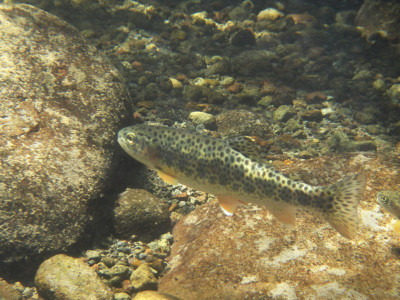
El hábitat restaurado de Steigerwald proporcionará a los viajeros, como este joven salmón Chinook, un refugio en su viaje al Pacífico. Foto de Blayne Eineichner, CTWS

¿Qué hace una llanura aluvial del río para el salmón? Le preguntamos a Chris Collins, ecólogo principal de restauración de LCEP. La mayoría de los días estará en el sitio liderando el Proyecto de Reconexión Steigerwald.

“Si puedes imaginar un salmónido juvenil migrando río abajo, está buscando y depende de las zonas de inundación, que son un entorno de menor energía con una mayor concentración de alimentos y una menor concentración de depredadores”, dice Collins. “Eso es lo que proporciona una llanura de inundación.

“A medida que los peces migran a través del Gorge, esos hábitats están naturalmente limitados y no están presentes en grandes extensiones. En el área metropolitana de Portland-Vancouver, la pérdida histórica de llanuras de inundación y humedales se siente más agudamente debido al desarrollo. Por lo tanto, la ubicación del proyecto en la intersección de esas áreas proporciona un recurso importante en el corredor de migración”.

2. Crea más superficie para las aves acuáticas
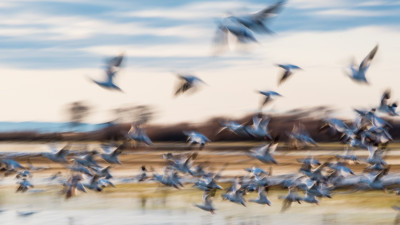
Las aves migratorias, como estos gansos de nieve, utilizan Steigerwald. Ahora deberían encontrar una escala aún más amigable. Foto de Jurgen Hess

Se espera que la reconexión de la llanura de inundación y el río expanda los humedales de Steigerwald en aproximadamente 115 acres.

Los patrocinadores enfatizan que no es sólo la cantidad, sino la calidad de esos humedales lo que hará una gran diferencia para las aves. Restablecer la conexión hidrológica natural entre el río Columbia y Gibbons Creek dará lugar a una variedad de beneficios.

Collins espera que la base de alimentos para las aves acuáticas sea “más diversa y de mayor calidad. Ciertamente veremos una mayor capacidad para esas poblaciones “.

De las más de 300 especies de aves encontradas en el condado de Clark, se han visto unas 200 en el Refugio Nacional de Vida Silvestre Steigerwald Lake. Estos incluyen aves rapaces, búhos de madriguera, cuicuacoches de salvia, avocetas, zancos de cuello negro, ganso de Canadá, pato de madera, ánade, el silbón americano, verde azulado de canela y el pato coronado.

La vida silvestre observada en el refugio incluye pumas, coyotes, linces, castores, nutrias, visones, comadrejas de cola larga, tortugas y una variedad de roedores.

3. Reafirma la vitalidad de las plantas nativas
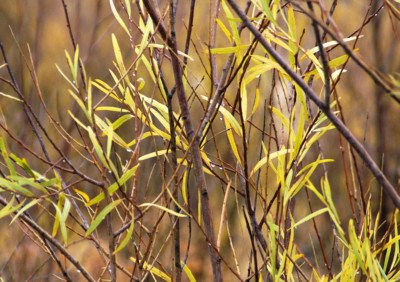
Willow (en la foto) y otras plantas nativas ya no se marchitarán a la sombra de los invasores. Foto de Jurgen Hess

Cortar la llanura de inundación del río ha ayudado a la proliferación de especies de plantas invasoras. Estos incluyen la hierba canaria de caña (el mayor culpable del área en el desplazamiento de plantas nativas), el cardo canadiense y la Reynoutria japonica.

El proyecto de reconexión Steigerwald atacará plantas invasoras en múltiples niveles. Estos incluyen eliminarlos físicamente, el uso limitado de herbicidas y la plantación de vegetación nativa.

“Vamos a hacer una gran cantidad de nivelación y bajada de la llanura de inundación, y nos estamos reconectando al río, para que obtenga los beneficios de la hidrología del río Columbia y Gibbons Creek, que inunda esa llanura de inundación durante períodos más largos del año y a una mayor profundidad “, dice Collins. “Esa inundación prolongada es lo que realmente necesita para suprimir las especies invasoras y promover las especies nativas de humedales”.

4. Mejora las oportunidades recreativas
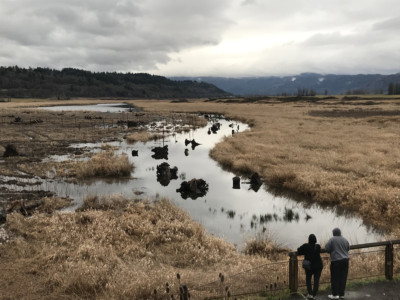
Con senderos expandidos y dos puentes nuevos, los visitantes de Steigerwald accederán a más refugios. Foto cortesía de la Asociación del Estuario del Bajo Columbia

Una vez que se complete el proyecto, los fanáticos del Refugio Nacional de Vida Silvestre Steigerwald Lake notarán grandes cambios.

El estacionamiento será reubicado y su capacidad aumentará en aproximadamente un 50 por ciento.

El sistema de senderos durará aproximadamente una milla.

Lo más importante, en lugar de simplemente caminar a lo largo del río usando el camino del dique, que constituye la mayor parte de la experiencia actual para los caminantes, los usuarios entrarán y saldrán del refugio a lo largo de un sendero que atraviesa bosques ribereños restaurados y atraviesa dos puentes que cruzan la conexión de la llanura de canals de inundación. Unos 2,000 estudiantes y voluntarios se dedicarán a las plantaciones junto al arroyo.

5. Ahorra dinero, disminuye el riesgo para las empresas, el gobierno y los locales
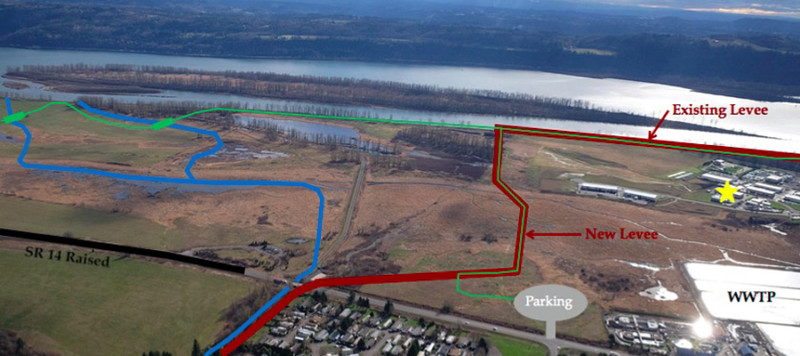
Gran plan: Las líneas verdes muestran senderos. Las líneas azules indican Gibbons Creek restaurado. Las líneas rojas muestran la reconfiguración del sistema de diques. Río Columbia en la parte superior de la foto. WWTP indica la Planta de Tratamiento de Aguas Residuales de Washougal. Foto cortesía de Refuge Stewards

Aunque el dique actual protege las propiedades adyacentes de las inundaciones del río Columbia, exacerba las inundaciones de Gibbons Creek.

Con su salida tradicional al Río Columbia bloqueada, Gibbons Creek ahora se extiende a las áreas ocupadas por el Parque Industrial del Puerto de Camas-Washougal y la Planta de Tratamiento de Aguas Residuales de Washougal. Esto requiere que el puerto mantenga un sistema de bombeo costoso e inadecuado.

“La capacidad de bombeo del puerto es bastante menor que la capacidad de inundación de Gibbons Creek”, dice Collins.

Los dos nuevos diques de retroceso del proyecto protegerán mejor el puerto, la planta de tratamiento de aguas residuales y las residencias privadas cercanas de las inundaciones.

“El Proyecto de Reconexión Steigerwald es un gran proyecto que cubre un ámbito de beneficios económicos y públicos de protección ambiental, recreativa y de inundación”, dice David Ripp, CEO del Puerto de Camas-Washougal. “El Puerto de Camas-Washougal considera que este proyecto es beneficioso, tanto para los ahorros financieros para el Puerto, como para las mejoras ambientales del hábitat natural de Steigerwald”.

6. Crea trabajos
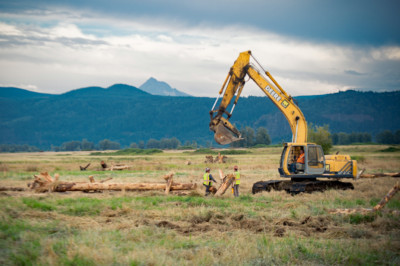
Se colocaron registros alrededor del refugio en una fase inicial del proyecto. Tendrán múltiples funciones una vez que los trabajadores caven nuevos canales para peces y vida silvestre. Foto de Gary Chandler 

LCEP estima que el Proyecto de Reconexión Steigerwald creará 503 empleos familiares y traerá $ 67.4 millones a la economía del suroeste de Washington. Rotschy, Inc. de Vancouver y LKE Corporation de Washougal construirán el proyecto.

* OK, hay algunos inconvenientes

La construcción asociada con el Proyecto de Reconexión Steigerwald requiere elevar una longitud de 1,200 pies por encima del nivel de inundacion de 500 años, adyacente a la carretera estatal de Washington SR-14. Los conductores pueden experimentar cierres intermitentes de carriles desde el 1 de junio hasta el 30 de septiembre durante la construcción en SR-14.

Como informó Columbia Insight en enero, los cazadores han expresado su oposición al Proyecto de Reconexión Steigerwald.

“El intercambio del hábitat de la vida silvestre, incluidas las aves acuáticas por el hábitat de los peces, tendrá impactos adversos para las aves acuáticas y otras especies silvestres”, dijo Albert O’Connor, portavoz de la Asociación de Aves Acuáticas de Washington y Delta Waterfowl. “Los beneficios para el salmón no se han establecido”.

Sin embargo, la evaluación ambiental del BPA señala que los administradores de refugios tienen la intención de continuar proporcionando aproximadamente la misma superficie ahora dedicada a los pastizales para los gansos que usan el área durante las temporadas de migración y anidación.

Lo más molesto para los fanáticos de Steigerwald, el refugio estará cerrado a los visitantes durante largos períodos. A partir del 1 de junio, el estacionamiento existente se cerrará permanentemente. Durante este tiempo, los visitantes pueden acceder al sendero del dique desde el parque Capitán William Clark hacia el este, hasta la Escalera de Pescado, sin embargo, los senderos interiores del refugio no serán accesibles al público. Todo el refugio (incluido el sendero del dique, que comienza justo al este de la calle Index) estará cerrado al público del 6 de julio al 2 de octubre y nuevamente a partir de abril de 2021.

Inconveniente, sin duda, pero un sacrificio que vale la pena por una ganancia clara en múltiples frentes.

“El bajo río Columbia ha perdido más del 50 por ciento de su hábitat (desde las décadas de 1880 y 1890)”, dice el director ejecutivo de LCEP, Debrah Marriott. “La apertura de aproximadamente 1,000 acres de hábitat es una contribución bastante significativa a la recuperación de especies amenazadas y en peligro de extinción”.
By |2020-06-11T11:16:45-07:0006/11/2020|Spanish translations|0 Comments

6 reasons* the Steigerwald Reconnection is a conservation unicorn

By Chuck Thompson. June 4, 2020. The massive Steigerwald Reconnection Project that broke ground on June 1 is an environmental anomaly.

A conservation project of its enormous ambition usually attracts a phalanx of lawyered-up opponents, knee-jerk NIMBYs and ill-informed wet blankets.

But the Steigerwald Reconnection enjoys the kind of widespread public support usually reserved for craft beer and Mother’s Day.

Led by the Lower Columbia Estuary Partnership (LCEP), the project will reconnect 965 acres of historic floodplain at the Steigerwald Lake National Wildlife Refuge in Washougal, Washington, with the Columbia River. To accomplish this, more than two miles of levee will be breached along the river.

Once a vibrant habitat for fish, birds, plants and other life, the floodplain has been cut off from the river since the 1960s. That’s when a large levee system was constructed along the Washington bank.

Upon completion, the Steigerwald Reconnection Project—funded by the Bonneville Power Administration and Washington Department of Ecology at an estimated cost of $25 million—will accomplish the rare feat of making life better for fish, fowl, wildlife, native plants, recreational users, industry, government and local residents.

Here’s how:

1. Increases odds of salmon survival

Steigerwald’s restored stream habitat will provide travelers, like this Chinook salmon smolt, a refuge on their journey to the Pacific. Photo by Blayne Eineichner, CTWS

What does a river floodplain do for salmon? Chris Collins, LCEP principal restoration ecologist, explains:

“If you can imagine a juvenile salmonid migrating downstream, it’s looking for and is reliant on floodplain areas, which are a lower-energy environment with a higher concentration of food and a lower concentration of predators,” says Collins. “That’s what a floodplain provides.

“As fish are migrating through the Gorge those habitats are naturally constrained and not present in large acreages. In the Portland-Vancouver metro area, the historic loss of floodplains and wetlands is felt most acutely due to development. So the location of the project at the intersection of those areas provides an important resource in the migration corridor.”

2. Creates more acreage for waterfowl

Migrating birds, like these snow geese, utilize Steigerwald. Now they should find it an even friendlier stopover. Photo by Jurgen Hess

Reconnecting the floodplain and river is expected to expand Steigerwald’s wetlands by about 115 acres. Backers stress it’s not just the quantity, but the quality of those wetlands that will make a dramatic difference for birds. Re-establishing the natural hydrologic connection between the Columbia River and Gibbons Creek will lead to a variety of benefits. Collins expects the food base for waterfowl to be “more diverse and higher quality. We’ll certainly see greater capacity for those populations.”

Of the 300-plus species of birds found in Clark County, about 200 have been seen at Steigerwald Lake National Wildlife Refuge. These include raptors, burrowing owls, sage thrashers, avocets, black-necked stilts, Canada goose, wood duck, gadwall, American wigeon, cinnamon teal and bufflehead.

3. Reasserts vitality of native plants

Willow (pictured) and other native plants will no longer wilt in the shadow of invaders. Photo by Jurgen Hess

Cutting off the floodplain from the river has aided the proliferation of invasive plant species. These include reed canarygrass (the area’s largest culprit in displacing native plants), Canada thistle and Japanese knotweed.

The Steigerwald Reconnection project will attack invasive plants on multiple levels. These include physically removing them, limited use of herbicides and planting of native vegetation.

“We’re going to do a lot of grading and lowering the floodplain—and we’re reconnecting to the river—so you get the benefits of hydrology from the Columbia River and Gibbons Creek, which inundates that floodplain for longer periods of the year and to a greater depth,” says Collins. “That prolonged inundation is what you really need to suppress invasive species and promote native wetland species.”

4. Enhances recreational opportunities

With expanded trails and two new bridges, Steigerwald visitors will access more of the refuge. Photo courtesy of the Lower Columbia Estuary Partnership.

Once the project is complete, longtime fans of the Steigerwald Lake National Wildlife Refuge will notice big changes.

The parking lot will be relocated and its capacity increased by about 50 percent.

The trail system will be about a mile longer. Most importantly, instead of simply hiking along the river using the levee road—which constitutes most of the current experience for walkers—users will weave in and out of the refuge along a trail that passes through restored riparian forests and across two bridges spanning floodplain connection channels. Some 2,000 students and volunteers will engage in stream-side plantings.

5. Saves money, diminishes risk

Big plan: Green lines show trails. Blue lines indicate restored Gibbons Creek. Red lines show reconfiguration of levee system. Columbia River at top of photo. WWTP indicates Washougal Wastewater Treatment Plant. Photo courtesy of Refuge Stewards

Although the current levee protects adjacent properties from flooding from the Columbia River, it exacerbates flooding from Gibbons Creek.

With its traditional outflow to the Columbia River blocked, Gibbons Creek now spills over into areas occupied by the Port of Camas-Washougal Industrial Park and Washougal Wastewater Treatment Plant. This requires the Port to maintain a costly and inadequate pumping system.

“The Port’s pumping capacity is quite a bit lower than the flood capacity of Gibbons Creek,” says Collins.

The project’s two new setback levees will better protect the Port, wastewater treatment plant and nearby private residences from flooding.

“The Steigerwald Reconnection Project is a great project which covers a realm of economic and public benefits from environmental, recreation and flood protection,” says David Ripp, CEO of the Port of Camas-Washougal. “The Port of Camas-Washougal sees this project as win-win for both the financial savings to the Port and the environmental improvements for the natural habitat of Steigerwald.”

6. Creates jobs

Logs were placed around the refuge in an initial project phase. They’ll serve multiple functions once workers dig new stream channels for fish and wildlife. Photo by Gary Chandler

LCEP estimates the Steigerwald Reconnection Project will create 503 family-wage jobs and bring $67.4 million to the Southwest Washington economy. Rotschy, Inc. of Vancouver and LKE Corporation of Washougal will construct the project.

*OK, there are a few drawbacks

Yes, problems exist. And not just that “Steigerwald Reconnection Project” may be the least sexy name since the invention of SEO.

Construction associated with the effort requires raising a 1,200-foot length of adjacent Washington SR-14 above the 500-year flood level. Drivers may experience intermittent lane closures from June 1-Sept. 30 during construction on SR-14.

As Columbia Insight reported in January, hunters have raised objections.

“Trading wildlife habitat, including waterfowl for fish habitat, will have adverse impacts to waterfowl and other wildlife,” said Albert O’Connor, spokesman for both the Washington Waterfowl Association and Delta Waterfowl. “The benefits to salmon have not been established.”

The BPA’s environmental assessment, however, notes that refuge managers intend to continue providing about the same acreage now devoted to grassland for geese that use the area during migration and nesting seasons.

Most annoying for fans of Steigerwald, the refuge will be closed to visitors for lengthy periods. Beginning June 1, the existing parking lot will be permanently closed. During this time, visitors can access the dike trail from Captain William Clark Park east to the Fish Ladder. However, the refuge’s interior trails will not be accessible to the public. The entire refuge (including the dike trail, beginning just east of Index Street) will be closed to the public July 6-Oct. 2 and again beginning in April 2021.

Inconvenient, for sure, but a worthwhile sacrifice for clear gain on multiple fronts.

“The lower Columbia River has lost over 50 percent of its habitat (since the 1880s and 1890s),” says LCEP executive director Debrah Marriott. “Getting about 1,000 acres of habitat opened is a pretty significant contribution to the recovery of threatened and endangered species.”

By |2020-07-02T15:50:38-07:0006/03/2020|Plants, Uncategorized, Water, Wildlife|0 Comments

Landowners take FERC to court in hopes of blocking LNG pipeline


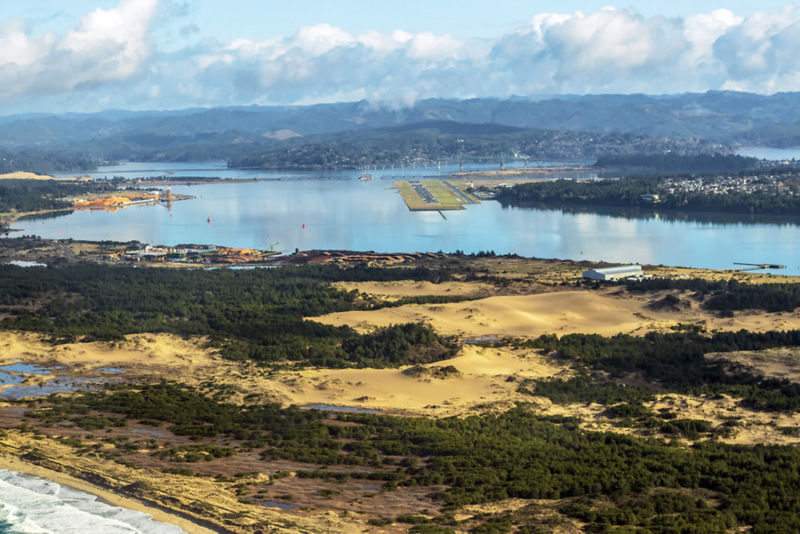
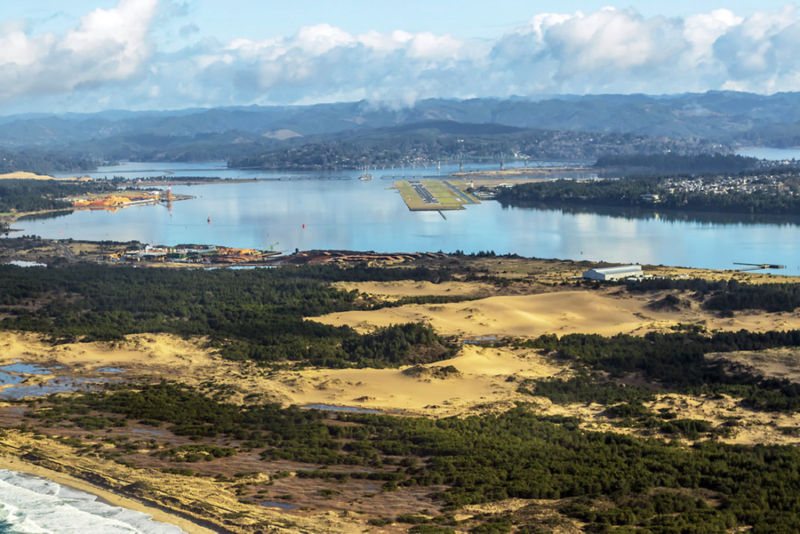
Terminal situation: Jordan Cove (left foreground) on Coos Bay’s North Spit remains under dispute as the end point of a planned LNG pipeline proposed by Canadian corporation Pembina. Photo by Rena J. Olson, with support from Lighthawk

By Carisa Cegavske, The News-Review, June 1, 2020. A group of landowners is taking the Federal Energy Regulatory Commission to court over a controversial proposal to build a natural gas pipeline and liquefaction plant at Jordan Cove in Southern Oregon.

FERC approved a permit for the project in March, and in May denied opponents’ request for a rehearing.

On May 27, Pacific Connector Pipeline opponents—including many landowners whose properties the project would cross—challenged FERC’s decision by filing a joint petition for review in the U.S. Court of Appeals for the District of Columbia.

Landowner Stacey McLaughlin of Myrtle Creek, one of the petitioners in the lawsuit, told The News-Review on Tuesday she believes FERC did not follow the law when it rejected the request for a rehearing.

“I am hopeful that the rule of law is not dead in this country, and the court will see this for what it is,” she said.

The project involves creating a 36-inch pipeline that would cross 229 miles in four southwestern Oregon counties, including Douglas County, to transport natural gas to a Jordan Cove liquefaction plant in Coos Bay. From there, the gas would be loaded onto ships for export to Asian markets.

McLaughlin said Canadian developer Pembina hasn’t shown there’s a market for the gas, so it doesn’t make sense the company is pushing forward with the project.

She said the FERC decision, if it stands, would allow Pembina to use eminent domain to take her property even without the required state permits.

She said it’s a hardship on the landowners to fight the decision when many are struggling financially due to the economic impact of the COVID-19 pandemic.

The landowners are represented by Washington, D.C.-based Niskanen Center, a think tank that supports environmental and civil rights causes.

Niskanen attorney Megan Gibson said in a press release that the petition was filed on behalf of affected landowners to challenge what she said was FERC’s misuse of its powers to approve the project.

FERC had previously twice denied permits to the project, and she said it should have been denied again.

“FERC is authorizing a foreign company to take our citizens’ land for foreign profit. There is no legitimate public use of this project, which will destroy many landowners’ properties, as well as the environment. It is our hope that the courts will see through the facade of alleged public use used by FERC and put a final end to the project,” she said.

Columbia Insight is publishing this story as part of the AP StoryShare program, which allows newsrooms and publishing partners to republish each other’s stories and photos.

By |2020-07-02T15:55:39-07:0006/02/2020|Uncategorized|0 Comments

¿Necesitó matar al oso Creswell?

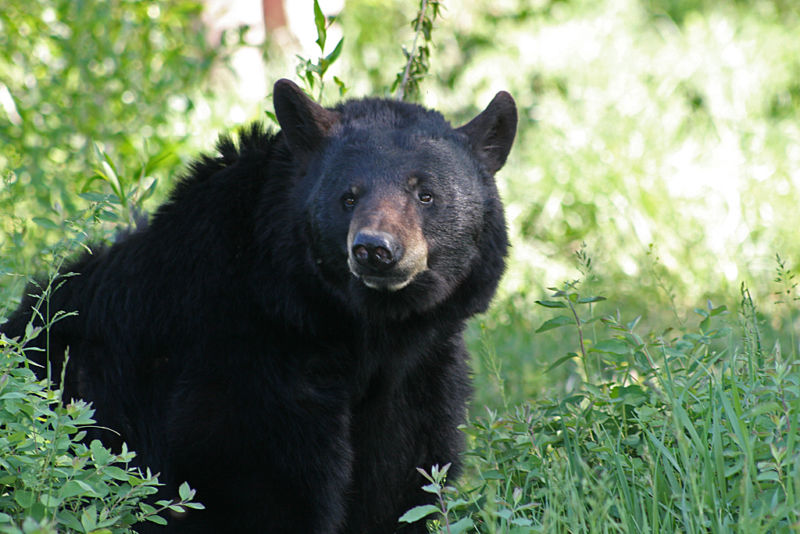
Los osos negros generalmente evitan a los humanos. Por buena razón. Foto de archivo por Casey Brown

Por Chuck Thompson. 1 de junio de 2020. Las historias sobre animales salvajes que son rastreados y asesinados después de un encuentro con humanos nunca son agradables. Pero el que salió de Creswell, Oregon, en el mes de mayo se siente particularmente trágico.

E innecesario.

Los conceptos básicos, proporcionados por un comunicado de prensa del Departamento de Pesca y Vida Silvestre de Oregon (ODFW), son bastante simples.

El 10 de mayo, alrededor de las 12:20 p.m., un hombre de 72 años y su perro, caminaron por un camino forestal en una propiedad de la empresa maderera al oeste de Creswell y se encontraron con un oso negro.

El perro ladró y cargó contra el oso. El oso derribó al perro. Estaba encima del perro cuando su dueño se acercó, gritando y agitando los brazos en un intento de ahuyentar al oso.

En cambio, el oso se apartó del perro y cargó contra el hombre, tirándolo al suelo. El hombre se defendió. Después de un corto tiempo, el oso dejó la escena.

El hombre y el perro caminaron aproximadamente una milla de regreso a su residencia antes de ser llevados a recibir atención médica.

El hombre sufrió laceraciones en el torso y la cabeza, así como laceraciones y pinchazos en el antebrazo. Después de recibir tratamiento por sus heridas, fue dado de alta del hospital. El perro fue tratado por un veterinario.

Se espera que ambos se recuperen por completo.

El oso fue menos afortunado.

ODFW, la Policía Estatal de Oregón y los Servicios de Vida Silvestre del USDA respondieron al incidente después de ser notificados por el Sheriff del Condado de Lane. El hombre involucrado describió al oso como maduro y de color negro con un hocico de color crema.

Aproximadamente a las 5:30 p.m., solo cinco horas después del episodio, se encontró un nuevo cartel de oso alrededor del área del incidente. Los sabuesos de los Servicios de Vida Silvestre lo persiguieron brevemente para hacer trepar un arbol a un oso macho grande y maduro con un hocico de color claro.

El oso fue asesinado a tiros.

¿Reunir a los sospechosos habituales?

El comunicado de prensa de ODFW describió al hombre como una “víctima” seis veces. Sin duda sobrevivió a una terrible experiencia horrible y aterradora; la pesadilla de cada excursionista y nada que nadie deba soportar.

Pero la caracterización del evento por parte del departamento está abierta a interpretación. El oso parece haber sido el que más sufrió.

Por cuenta del hombre, su perro instigó el ataque. Una vez que la agresión canina se encontró con una fuerza superior, el hombre, comprensiblemente, acudió al rescate de su perro al abordar al oso. Podría ser que todos seamos tan valientes.

El hombre y el perro sufrieron graves consecuencias. Tuvieron suerte de no haber sufrido peor.

¿Pero su terrible experiencia justificó la destrucción de un oso?

El artículo indefinido en la oración anterior es intencional. Eso es porque, trágicamente, la historia solo empeora.

Las autoridades no pueden estar completamente seguras de que mataron al oso correcto.

“Existe una muy buena posibilidad de que el oso que fue asesinado sea el que hirió al hombre, pero esta área también es un buen hábitat para los osos y el hogar de muchos osos”, dijo Brian Wolfer, gerente de la cuenca ODFW South Willamette.

Pautas confundidas

El Plan de gestión oficial del oso negro de ODFW establece que un oso que “muestra poco o ningún temor a las personas” y “muestra un comportamiento agresivo cuando está en contacto con las personas” puede considerarse un peligro para la seguridad humana.

El estatuto ORS 498.166 permite matar a cualquier oso o puma que “represente una amenaza para la seguridad humana”.

Por otro lado, ORS 498.006 establece que “ninguna persona perseguirá, hostigará, molestará, preocupará o perturbará a la vida silvestre”, excepto cuando esté legalmente pescando, cazando o atrapando.

El caso Creswell parece caer en algún lugar dentro de las tres restricciones.

Sin embargo, incluso si el oso técnicamente cumplía con los criterios de ODFW para el comportamiento agresivo, ¿realmente se elevó al nivel de una amenaza para la seguridad humana?

¿Los empleados públicos sopesaron los detalles del encuentro antes de decidir matar a un oso?

“Cuando tenemos un encuentro real, lo consideramos un riesgo para la seguridad humana, punto”, dijo la portavoz de ODFW, Michelle Dennehy, a Columbia Insight. “No vamos a reubicar a un animal así. En nuestra opinión, es un riesgo para la seguridad humana. … Este oso tuvo contacto físico real con ese hombre, y lo hirió “.

Según Dennehy, ODFW tuvo cuidado de no caracterizar el episodio como un “ataque”. Sin embargo, Wolfer parecía ver las cosas de manera diferente.

“Este fue un incidente muy grave y la víctima tomó los pasos correctos al tratar de asustar al oso y luego defenderse cuando fue atacado”, dijo.

La mayoría de los medios locales siguieron ese ejemplo, enmarcando la historia como un “ataque” de oso.

En cuanto al oso que fue destruido, Dennehy dijo, “creemos que es una posibilidad bastante buena” que las autoridades mataron al oso involucrado en el incidente. Ella reconoció la dificultad de hacer el reclamo con absoluta certeza.

“No sé si vamos a poder vincularlo con este oso específico”, dijo. “Eso es muy difícil de hacer”.

Hora de reevaluar la política

Los incidentes con osos humanos son raros en Oregón.

“Las poblaciones de osos negros son entre 25,000-30,000 en todo el estado, pero solo ha habido cuatro incidentes reportados previamente en el estado desde 1988, ninguno de ellos fatal”, según ODFW.

Sin embargo, el Plan de gestión, del departamento, del oso negro publicado en 2012, dice que “reconoce las quejas por daños al oso negro y las preocupaciones de seguridad pública están aumentando en Oregon”.

By |2020-06-01T12:30:29-07:0006/01/2020|More, Spanish translations|0 Comments

Video: Airplane raised from Columbia River

Environmental impact deemed minor after a private plane ditched into the river at Cascade Locks


Chuck Thompson, May 23, 2020. On May 17, a single-engine Beechcraft Bonanza J35 airplane crashed into the Columbia River. The pilot and sole passenger managed to swim to safety, sustaining only minor injuries.

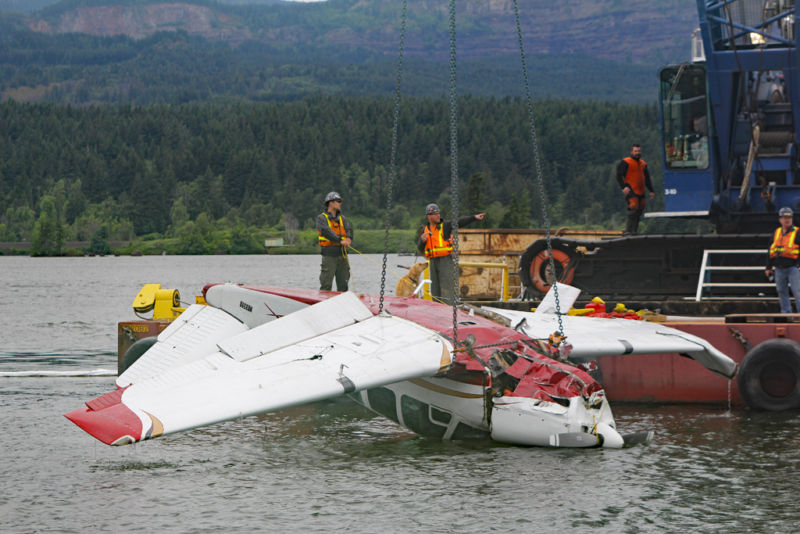
On May 23, the plane, which sunk after the accident, was removed from the river. It was hauled up near where it went down in front of the Port of Cascade Locks Marina on the Oregon side of the Columbia Gorge, less than a mile upriver from the Bridge of the Gods.

According to the Oregon Department of Environmental Quality, the plane was submerged in about 15 feet of water.

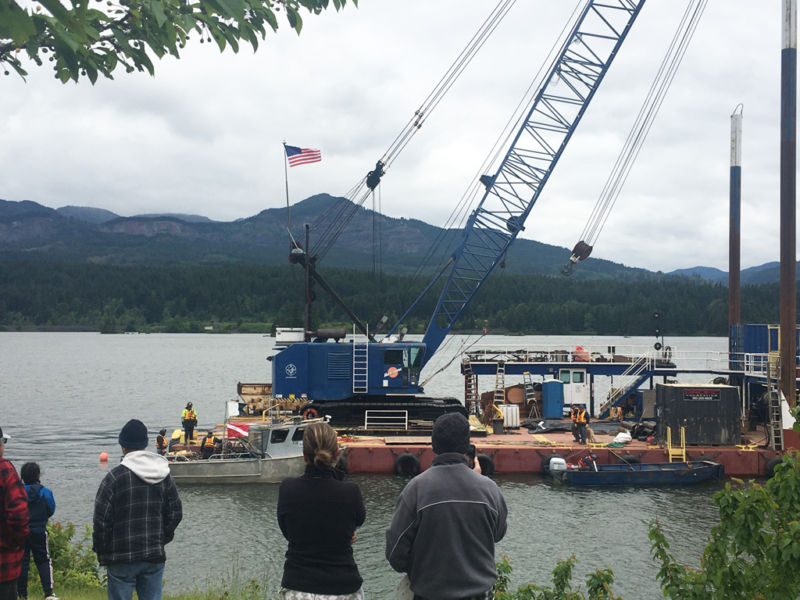
Using a barge and crane, the extraction effort was undertaken jointly by Advanced American Construction of Portland, and NU Venture Air Services of Dallas, Oregon.

The salvage, which took place less than 50 yards from shore and drew a small gathering on onlookers, got underway early Saturday morning. At about 10:15 a.m., a single diver entered the water to assess the aircraft and affix chains connected to a crane cable. Just after 11 a.m., the tail section broke the surface as the plane was slowly lifted out of the water.

The aircraft emerged in one piece. At 11:21 a.m. it was gently placed on the deck of the barge.

According to NU Venture Air Services owner Mike Dowd, the salvage operation went smoothly, with the removal crew encountering no unexpected obstacles.

“There is no run of the mill job, especially with something submerged,” said Dowd. “There’s never one that’s just routine. We plan and plan and try to account for any possibility.”

NU Venture Air Services has experience recovering aircraft in a variety of terrain and circumstances. In June 2019, it recovered a Maule M-7-235B seaplane that crashed into the Deschutes River in Sunriver, killing one.

Environmental impact light

According to Oregon DEQ, the United States Coast Guard reported the accident on May 17 through the Oregon Emergency Response System, estimating a potential spill of 4.87 gallons of aviation fuel. Intertribal police soon placed buoys around the crash scene to prevent accidents with other river traffic.

“Catch booms were put out right away after the crash,” said Sgt. Pete Hughes of the Hood River County Sheriff’s Office.

“Because there’s a low potential for release we don’t have responders out there,” Oregon DEQ spokesperson Laura Gleim told Columbia Insight on May 22. “There’s such a small potential for significant fuel release, it falls to the insurance company (to take care of).”

The salvage operation, which lasted about four hours, attracted a small group of onlookers. Photo by Chuck Thompson

Dowd said his company hadn’t been made aware of any environmental issues with the crash prior to beginning salvage operations.

No cause of the crash has been determined, though witnesses said the plane’s landing gear did not properly descend during its landing approach at the Cascade Locks Airfield.

With the aircraft now recovered, the National Transportation Safety Board (NTSB) will conduct an investigation.

“COVID-19 is slowing things down a bit,” said Southern California-based NTSB investigator Eliott Simpson, who is assigned to the case. “We have travel restrictions.”

By |2020-05-23T17:27:48-07:0005/23/2020|Conservation, Uncategorized|1 Comment

Did Creswell bear need to be killed?

Black bears typically avoid humans. For good reason. File photo by Casey Brown

A violent encounter shows murky thinking in the way we assess interaction with wildlife

Chuck Thompson, May 13, 2020. Stories about wild animals being tracked down and killed after an encounter with humans are never pleasant. But the one that came out of Creswell, Oregon, this week feels particularly tragic.

And unnecessary.

The basics, provided by an Oregon Department of Fish and Wildlife (ODFW) press release, are simple enough.

On May 10 at about 12:20 p.m., an unnamed 72-year-old man and his dog, hiking on a forest road on timber company property just west of Creswell, came upon a black bear.

The dog barked and charged the bear. The bear knocked down the dog. It was atop the dog when its owner approached, yelling and waving his arms in an attempt scare the bear away.

Instead, the bear turned from the dog and charged the man, knocking him to the ground. The man fought back. After a short time, the bear left the scene.

The man and dog then walked approximately one mile back to his residence before being taken to receive medical care.

The man sustained lacerations to his torso and head, as well as lacerations and punctures on his forearm. After receiving treatment for his wounds he was released from the hospital. The dog was treated by a veterinarian.

Both are expected to fully recover.

The bear was less fortunate.

ODFW, Oregon State Police and USDA Wildlife Services responded to the incident after being notified by the Lane County Sheriff. The man involved described the bear as mature, and black in color with a cream-colored muzzle.

At about 5:30 p.m., just five hours after the episode, fresh bear sign was located around the area of the incident. Wildlife Services hounds gave a short chase before treeing a large, mature male bear with a light-colored muzzle.

The bear was shot and killed.

Round up the usual suspects?

The ODFW press release described the man as a “victim” six times. No doubt he survived a horrific and terrifying ordeal; every hiker’s nightmare and nothing anyone should endure.

But the department’s characterization of the event is open to interpretation. The bear seems to have been the one to suffer the most.

By the man’s own account, his dog instigated the attack. Once canine aggression was met with superior force, the man, understandably, came to his dog’s rescue by accosting the bear. Might that we all be so courageous.

Man and dog suffered grievous consequences. They were lucky not to have suffered worse.

But did their ordeal justify destroying a bear?

The indefinite article in the previous sentence is intentional. That’s because, tragically, the story only gets worse.

Authorities can’t be completely sure they killed the right bear.

“There is a very good chance that the bear that was killed is the one that injured the man, but this area is also good bear habitat and home to many bears,” said Brian Wolfer, ODFW South Willamette watershed manager.

Muddled guidelines

ODFW’s official Black Bear Management Plan states that a bear that “exhibits little or no fear of people” and “displays aggressive behavior when in contact with people” may be considered a human-safety hazard.

Statute ORS 498.166 allows the killing of any bear or cougar that “poses a threat to human safety.”

On the other hand ORS 498.006 states, “No person shall chase, harass, molest, worry or disturb any wildlife” except while legally fishing, hunting or trapping.

The Creswell case seems to fall somewhere within all three strictures.

Yet even if the bear technically met ODFW’s criteria for aggressive behavior, did it really rise to the level of a threat to human safety?

Did public employees weigh the details of the encounter before deciding to kill a bear?

“When we have an actual encounter we consider it a human-safety risk, period,” ODFW spokesperson Michelle Dennehy told Columbia Insight. “We’re not going to relocate an animal like that. In our mind that is a human-safety risk. … This bear did have actual physical contact with that man, and injured him.”

According to Dennehy, ODFW was careful to not characterize the episode as an “attack.” Yet Wolfer seemed to see things differently.

“This was a very serious incident and the victim took the right steps by first trying to scare the bear off and then fighting back when he was attacked,” he said.

Most local media followed that lead, framing the story as a bear “attack.”

As for the bear that was destroyed, Dennehy said, “we feel that it is a pretty good chance” that authorities killed the bear involved in the incident. She acknowledged difficulty in making the claim with absolute certainty.

“I don’t know if we’re going to be able to tie it to this specific bear,” she said. “That is very difficult to do.”

Time to reassess policy

Human-bear incidents are rare in Oregon.

“Black bear populations number between 25,000-30,000 statewide but there have only been four previously reported incidents in the state since 1988, none of them fatal,” according to ODFW.

Yet the department’s Black Bear Management Plan—published in 2012—says it “recognizes black bear damage complaints and public safety concerns are increasing in Oregon.”

The statements are contradictory. Are black bear incidents rare? Or increasing?

Dennehy says ODFW has received an increase in complaints from around the state about bears getting into garbage, being seen in residential neighborhoods during daylight hours and killing pets.

Even so, as humans encroach evermore into wildlife habitats, conflicting points of view within public agencies make policies surrounding encounters with wild animals worth a second look. If not an overhaul.


By |2025-12-03T15:04:23-08:0005/13/2020|Opinion|6 Comments

© Copyright 2013-2025 Columbia Insight. All Rights Reserved.

As a 501(c)3 nonprofit organization, all donations to Columbia Insight are tax deductible to the full extent of the law. Our nonprofit federal tax-exempt number is 82-4504894.