Stay Updated Subscribe today for the latest research + reporting about environmental news. Subscribe Now

Stay Updated Subscribe today for the latest research + reporting about environmental news.

Subscribe Now

AP StoryShare

AP StoryShare

AP StoryShare

About AP StoryShare

Columbia Insight is publishing this story as part of the AP StoryShare program, which allows newsrooms and publishing partners to republish each other’s stories and photos.

Breaking: Money now growing on trees

Well, sort of. A Portland company says it can help tree owners get a toehold in the carbon-offset economy
 

Tree leaves generic

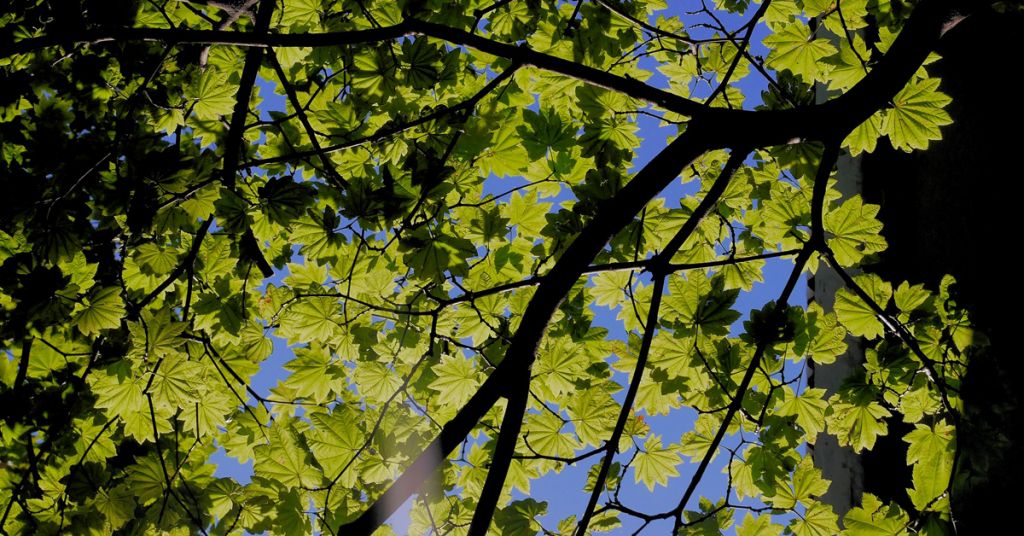
Can you believe it? A promise to turn photosynthesis into virtual money. Photo: Tom Donald/CC

 
By Chris McGinness, KGW News. August 15, 2022. Portland start-up Cascadia Carbon says it can help people connect the trees in their yards to the lucrative carbon-offset market while fighting climate change.
 
In short, you could get paid for the good care you take of your trees.
 
“Eighty percent of Fortune 500 companies have committed to either go net zero or net negative,” says Alex Wick, the founder of Cascadia Carbon. 
 
Because most of these companies cannot remove all of the carbon from their process, they buy carbon offsets. A carbon offset negates the greenhouse gas emissions by producing an emission reduction elsewhere.
 
Here’s a simple analogy: Company “XYZ” creates 1,000 tons of CO2 each year, so they pay company “ABC” to plant a million trees. Trees are some of nature’s best carbon captures.
 
“The voluntary carbon offset market has been around probably since the late ’70s, but historically, individuals, homeowners [and] small landowners have been unable to participate because it costs too much to verify and list your offsets for sale,” says Wick. “We’re the Airbnb for offsets. We allow individual homeowners to take that carbon stored in their trees and sell it to corporations.”
 

Oh, yeah, NFTs are involved

To participate, people must document their tree, including the species, size, health and location.
 
Then Cascadia Carbon creates a digital certificate of authenticity.

 
Alex Wick

Cascadia Carbon founder Alex Wick. Photo: Cascadia Carbon

The non-fungible token, or NFT, becomes an NF-Tree. Then any growth of the tree—which is mostly carbon—goes onto the carbon-offset market. As the tree grows, so does the vestment.  
 
According to its website, Cascadia Carbon’s nature-based cryptocurrency is called $CODEX.
 
Because the trees are individually validated every year for their carbon-capturing ability, it’s possible these offsets are of higher value than what’s currently on the marketplace. But of course, it’s not just about the money. 
 
“The idea behind tokenization is that it allows you to verify and validate that you and your family are doing something to stop climate change,” says Wick. “There are so few things an individual can do just in their daily life that are carbon negative. There’s actually one thing you can do that’s carbon negative and that’s photosynthesize.”
By |2023-01-28T16:27:04-08:0008/15/2022|Climate Change|0 Comments

We’re gonna have to wait a little longer on that big report

A study on Snake River dams commissioned by Washington’s Inslee was supposed to have landed by now. 

Lower Granite Dam, Washington, Snake River

Big job: Lower Granite Dam is one of four dams on the Snake River under (delayed) scrutiny. Photo CC/NikonFDSLR

By Eric Barker, Lewiston Tribune (Idaho). August 3, 2022. A report that could push Washington Gov. Jay Inslee and Sen. Patty Murray to officially support breaching the four lower Snake River dams will be a few weeks to a month late.

The final version of the Lower Snake River Dams: Benefit Replacement Report was scheduled to be unveiled at the end of July.

A draft released in June found breaching the dams as a means to recover Snake River salmon and steelhead could cost between $10.3 billion and $27.2 billion.

Inslee and Murray commissioned the report last year to help them solidify their position on salmon recovery and determine if dam breaching is necessary. Mike Faulk, a spokesperson for Inslee, said in an email that the final version is now expected to be released in mid-to-late August.

“The governor and senator understand the impact these final recommendations would have and intend to be thorough before making a decision. It’s crucial to collect all the pertinent information we need from stakeholders and to have time to study and contextualize it relative to the initial report’s findings. That’s all still being done.”

Biden onboard

Fisheries scientists have long said breaching the four lower Snake River dams would increase the survival of threatened and endangered Snake River salmon and steelhead.

Earlier this month, the Biden administration said in another draft report that the dams need to be breached if wild salmon and steelhead are to be restored to fishable levels.

The dams slow the river and increase the travel time of juvenile fish during their migration to the Pacific Ocean. They can also cause the river to warm to levels lethal to adult salmon during July and August.

But breaching them would come at a hefty cost. The dams produce an average of about 900 megawatts of electricity per year and allow for tug-and-barge transportation of wheat and other commodities between Lewiston, Idaho, and the Tri-Cities in Washington.

Just how much it would cost to replace the power and find alternative ways for farmers to get wheat to West Coast ports has been the subject of intense debate.

Rep. Mike Simpson unveiled a concept last year estimating the cost at $33.5 billion. The draft report from the Biden administration said replacing the power would cost $11 billion to $19 billion but under some scenarios could balloon to $75 billion.

A court-approved stay to salmon-and-dams lawsuit pitting the federal government against the Nez Perce Tribe, Oregon and a coalition of environmental groups is scheduled to expire at the end of July. Last fall, both sides asked for the timeout so they could pursue a long-term solution that will restore salmon, honor tribal treaty rights and meet the needs of the region.

WSU/PSU team up to study extreme weather

Researchers from both universities embark on a three-year project to better predict and cope with changing atmospheric patterns 

Fire

New normal isn’t normal: Years of drought have parched forests and lands in the Pacific Northwest and primed them to burn. Photo: Caleb Strough//BLM

By Joe Raineri, KGW News, July 14, 2022. Over the last couple of years, the Pacific Northwest has seen an increasing number of extreme weather events.  

From the megafires of 2020, to the hottest temperature ever recorded at Portland International Airport last summer: a high of 116 degrees on June 28, 2021. 

Researchers with Portland State University and Washington State University Vancouver are looking into the factors that cause those extremes, including a weather pattern called an atmospheric ridge. 

Paul Loikith is an associate professor of geography and the director of Portland State University’s Climate Science Lab. He has teamed up with Deepti Singh, an assistant professor for the School of the Environment at Washington State University Vancouver. Together, they’re studying atmospheric ridge patterns and the impact they have on our weather.

Atmospheric ridges, or high pressure systems, bring in calmer weather and are associated with drier and sunny conditions. They can also be responsible for heat waves during summer. 

Loikith said they’re using a combination of historical data going back to the late 1970s and computer models to better understand the reason behind some of the strong ridges.

“We want to find out what are the drivers of ridges, and potentially, how can we predict those when we want to manage extreme events. What we want to know is the predictability,” said Singh.

Loikith and Singh want to understand the factors contributing to warmer summers over the last few years. One thing they plan on paying close attention to are sea surface temperatures.

“There are relationships between our circulation and what’s going on in the central tropical Pacific, so El Nino and La Nina events can influence the circulation,” said Loikith.

The three-year project just started between Portland State University and Washington State University Vancouver, thanks in part to a federal grant from the National Science Foundation.

By |2023-01-28T16:36:25-08:0007/14/2022|Climate Change|0 Comments

Not enough seedlings, other priorities prevent replanting after wildfires

Recent fires in Pacific Northwest account for “more than twice the impact to our company as the Mount St. Helens eruption,” says Weyerhaeuser

Seedlings at Placerville nursery

Growth industry: The U.S. Forest Service’s Placerville Nursery in California provides 4 million seedlings for reforestation on lands burned in wildfires or damaged by insects. It’s not enough. Photo: The Register-Guard

By Adam Duvernay, The (Eugene) Register-Guard. February 22, 2022. An expected inability to replant seedlings after the 2020 wildfires is turning out to be not just about supply. It’s also about landowners’ readiness to begin reforesting.

Woodlands and fire recovery experts last year noted a shortage of seedlings in the wake of the wildfires that ripped across Oregon in 2020.

While that shortage was expected to stall efforts to replace scorched forests, 17 months after the fires, many areas still aren’t ready to replant, seeds or not.

“We’re not distributing nearly as many as trees as I thought we could have,” Oregon State University Extension Service Forrester Glenn Ahrens said. “The fires were such a devastating event and [people] have a lot of things to deal with, starting with their homes and their livelihoods, and reforestation of the trees are a bit lower on the list of priorities.”

Replanting a million acres

About a year ago, the Oregon Department of Forestry estimated between 80 million to 140 million seedlings would be needed for post-wildfire replanting, two to three times the usual annual need.

The 2020 wildfires burned more than 1 million acres in Oregon, with private forestland accounting for more than 400,000 of those acres.

Though large timberland owners often have big seedlings orders on reserve, small woodland owners often lack the same luxury.

But an immediate demand for seedlings from small landowners did not materialize quite the way some expected it would.

Holiday Farm Fire in Willamette National Forest, September 2020

Bad look: Holiday Farm Fire in Willamette National Forest, September 2020. Photo: ODF

The situation is now more complex than just a dearth of seedlings.

“It seems like the seedlings are available and some of the other bottlenecks are starting to play out … that we didn’t think about right away,” said Lauren Grand, a forester with OSU Extension Service in Lane County.

Many who prioritized rebuilding their homes and livelihoods over immediate reforestation found the woodlands quickly grew over with weeds and other vegetation.

Young timber trees might not survive that kind of competition, meaning many landowners aren’t ready for seedlings.

“There’s still a pending reforestation need on a given property, but now you have a bunch of competition vegetation that needs to be addressed,” Agalzoff said. “If you say, ‘I have trees for you next week,’ they say they can’t get a planting contractor on short notice or they still have a lot of work left to do to get a new canvas for their planation.”

MORE: Done fighting: Inside the ‘great exodus’ of wildland firefighters

Ahrens said many landowners haven’t yet conducted salvage harvesting because loggers are busy statewide, and replanting efforts can’t begin until burned trees are cleared.

Though resources are available, Ahrens said not all landowners know about them. 

“Right now, somewhat ironically, we have surplus seedlings from this effort that Oregon Department of Forestry and partners have undertaken. They ordered almost 400,000 seedlings in a hurry right after the fire,” Ahrens said. “We’re not able to get rid of all our trees this season because the landowners are not ready or haven’t connected with us.”

Weyerhaeuser’s reaction

Kathy LeCompte, owner of Brooks Tree Farm north of Salem, said business is strong.

“I’m still getting calls everyday. That leads me to believe a lot of people out there are hunting for trees,” she said. “We are still ramped up for large production for next year.”

LeCompte said her nursery over the past year shifted some production from Christmas trees in favor of timber trees because of their more immediate need in replanting efforts.

“The Douglas fir for this year, we were prepared to sell a lot more and we booked those orders. Our crop came in surplus with extra trees and we’re selling those,” she said.

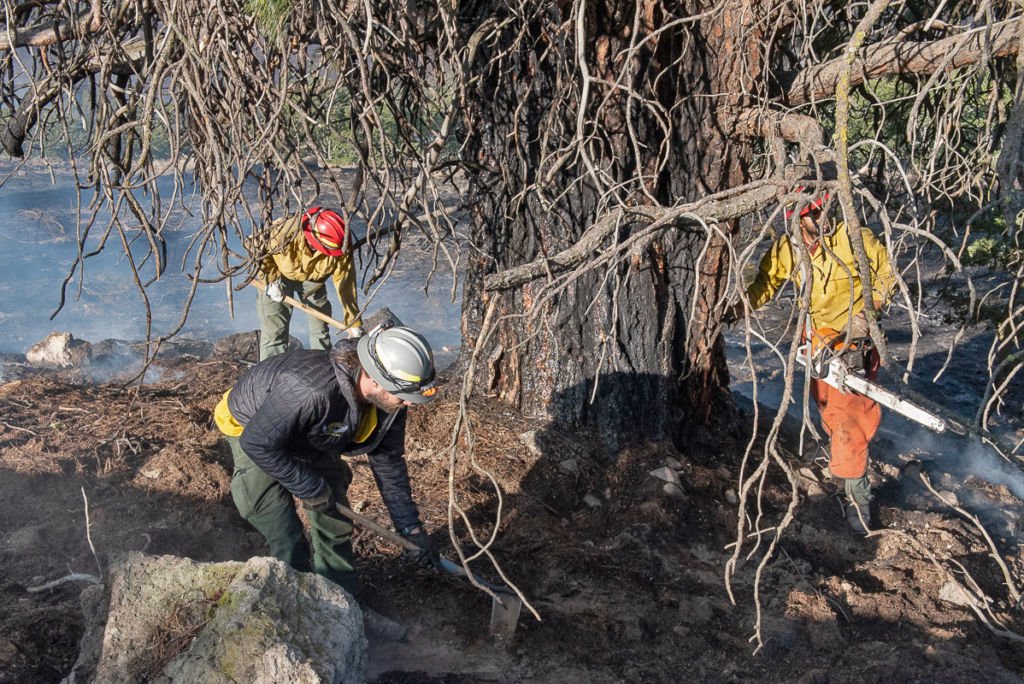
Burn victim: Forest Service firefighting crew works to save large Ponderosa pine. Photo: Jurgen Hess

Timber giant Weyerhaeuser grows its own seedlings for replanting after logging, but the 2020 wildfires left significant impacts on its timberlands, requiring seedlings be planted.

“You look at the fire itself, both in terms of acreage and seedling demand, it was more than twice the impact to our company as the Mount St. Helens eruption [in 1980]. We’re looking at 125,000 acres to reforest and somewhere between 35-40 million trees to do that,” said Jeff Mehlschau, Weyerhaeuser’s western regeneration team leader. 

MORE: Firsthand account: He evacuated. Hours later the cabin burned

Weyerhaeuser nurseries in Oregon and Washington send out about 20 million seedlings each year to customers outside the company, from small landowners to other timber companies. The nurseries supply a nearly equal amount for the company’s replanting.

Mehlschau said the company wants to have its lands reforested by spring 2024.

“We had to increase our internal production,” Mehlschau said. “Roughly half of our production that goes outside of Weyerhaeuser … we did not stop growing for somebody to grow more for Weyerhaeuser. We kept their space in our system available to them.”

Reporter Adam Duvernay wrote this story for the (Eugene) Register-Guard. Follow on Twitter @DuvernayOR.

By |2023-02-06T12:40:16-08:0002/22/2022|Conservation, Forestry, Wildfire|2 Comments

Inmates raise 42,000 sagebrush seedlings

The effort will go toward rehabilitating site of 2020 Indian Creek Fire that destroyed more than 48,000 acres

Sagebrush plants

Seeding change: Inmates at Coyote Ridge Corrections Center in Connell, Washington, cultivated these sagebrush plants. Photo: Jeff Clark/BLM

By Jason Miller, Argus Observer. January 4, 2022. The Sagebrush in Prisons Crew at Snake River Correctional Institution in Ontario, Oregon, recently wrapped up another successful year of sagebrush propagation, according to an email during the week of Christmas from spokeswoman Amber Campbell.

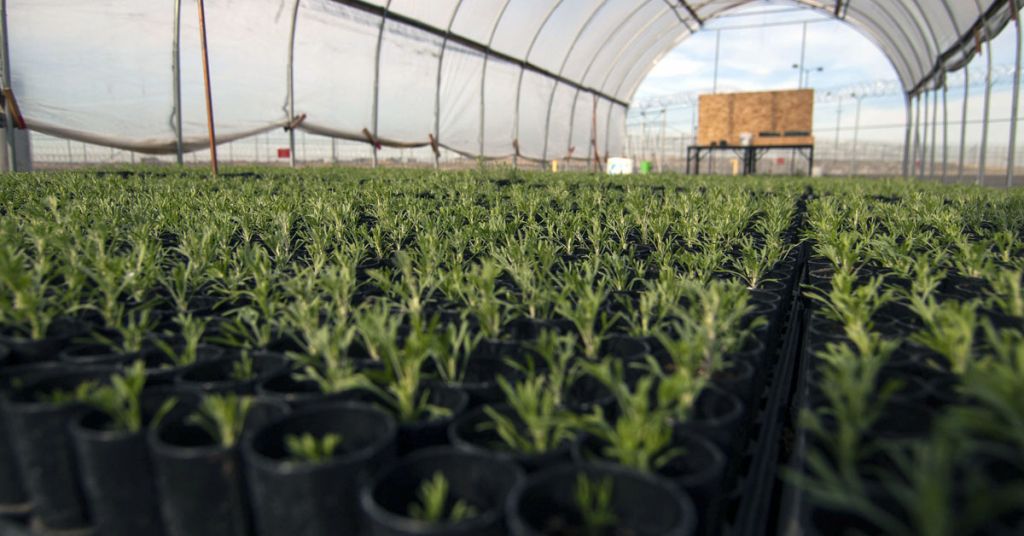
Crews were able to deliver 42,000 sagebrush seedlings to the Bureau of Land Management’s Vale District, she said.

The program was started as a pilot at SRCI in 2014. The nonprofit Institute for Applied Ecology, and the Bureau of Land Management in Washington, D.C., and in Vale, have partnered with the program in efforts to improve habitat conditions for the declining species by sowing and planting seeds.

Inmates use sagebrush plants for post-fire rehabilitation.

Long-term project

In April 2021, crews began by mixing soil and sowing tiny sagebrush seeds into cone-shaped pots.

They continued with daily care, watering and fertilizing through the long and very hot summer.

In early November, about 15 inmates helped pull the plants out of cones and box them up for planting.

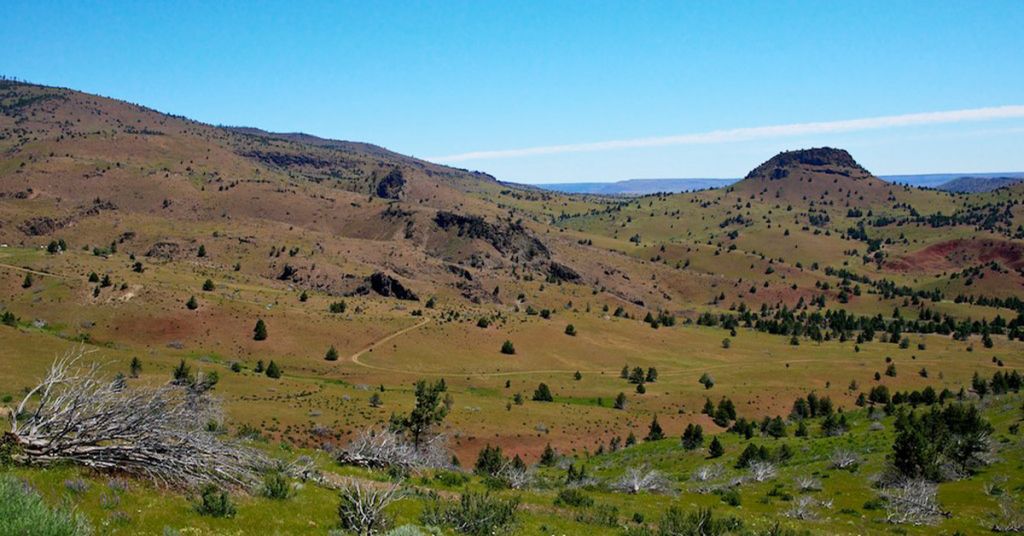
The seedlings were planted at the site of the Indian Creek Fire that chewed up more than 48,000 acres near Juntura in 2020. The blaze, which is thought to be human caused, consumed priority sage-grouse habitat on private, state and Vale BLM-managed lands in sagebrush, juniper and grassland.

The crew who worked on growing the seedlings is “hopeful for a successful restoration of the sagebrush plant community.”

Following their work, they were able to celebrate with pizza and a certificate at a gathering hosted by the Institute for Applied Ecology.

Leslie Thompson contributed to this article.

By |2023-02-06T12:18:02-08:0001/04/2022|Agriculture, Conservation, Plants|2 Comments

Biden infrastructure funds could address Warm Springs water crisis

Economic relief may finally be coming to Warm Springs Reservation, which has endured years with substandard water

Photo by Tom Almy/Creative Commons

Central issue: About 3,300 people live on the Warm Springs Indian Reservation in arid central Oregon. Photo: Tom Almy/CC

This article was updated on Dec. 14, 2021. An earlier version of the story stated that funding to improve water systems on the Warm Springs Indian Reservation had been included in the proposed Biden infrastructure legislation. In fact, inclusion of funds for Warm Springs water upgrades is still a pending piece of the end of the year spending bill. —Editor

By Michael Kohn, The Bulletin. November 16, 2021. Funding to improve water systems on the Warm Springs Indian Reservation is moving closer to reality as President Joe Biden prepares to sign his infrastructure bill next week.

The expected passage of the bill has allowed reservation leaders to begin planning an overhaul that would cost tens of millions of dollars.

“Warm Springs got my authorizing legislation in the bipartisan infrastructure bill,” said U.S. Sen. Ron Wyden, D-Ore, on the sidelines of a media event this week. “The bill that passed in the House has my bill for the fixes. We will be working to get funds in the end of the year spending bill.”

The Warm Springs water treatment plant, and the associated pipes that deliver water to customers, has failed repeatedly over the past two years, resulting in multiple notices to reservation residents to boil their water before using it.

The Confederated Tribes of Warm Springs are now looking to the federal government to help fund a massive renovation project.

Other improvements promised

Wyden, along with fellow Oregon Sen. Jeff Merkley, also a Democrat, visited Warm Springs in October and pledged to help the tribes.

The infrastructure bill contains $11 billion in funding for tribes, a cash pot that Warm Springs hopes to tap next year. Included in the funding is $3.5 billion for tribal sanitation projects.

Other funds in the bill include $3 billion for tribal transportation, $2.5 billion to address Native American water rights settlements and $2 billion for broadband access on tribal lands.

Projects that could get funded at Warm Springs include the replacement of the 40-year-old drinking water treatment plant and the installation of new underground pipes across the reservation.

WATCH: Under pressure: The Oregon community desperate for water

Louie Pitt Jr., the director of government affairs and planning for the Confederated Tribes of Warm Springs, said plans for system upgrades are gaining strength.

“We are preparing with grant people and others to be shovel ready when the opportunity comes down,” said Pitt. “We are doing the internal things that need to be done.”

Pitt added that the time is past due to start the improvements in earnest.

“Is it too much to ask to have clean drinking water throughout the year?” Pitt said. “Let’s get on it guys.”

How much? Who knows?

It’s not clear how much money will be needed to overhaul and modernize the system.

Bryan Mercier, northwest regional director for the Bureau of Indian Affairs, estimates the repairs could cost upward of $60 million. Previous estimates have suggested the total could be upward of $130 million.

But Mercier says the cost will ultimately depend on plans put forward by the tribes.

“I’m hopeful the tribe will develop a long-term sustainable plan that will ensure adequate operations and maintenance funds will be generated to maintain the system after the upcoming investment,” said Mercier. “That may mean metering and a rate structure to generate revenue for the system.”

When could the government cut the tribes a check? Wyden said he hopes to see work begin in 2022.

“I want to start seeing improvements next year,” said Wyden. “This is unconscionable, really unconscionable, that those who lived on these lands for so long would be having these boil your water days. Unacceptable, unconscionable.”

© Copyright 2013-2025 Columbia Insight. All Rights Reserved.

As a 501(c)3 nonprofit organization, all donations to Columbia Insight are tax deductible to the full extent of the law. Our nonprofit federal tax-exempt number is 82-4504894.