Stay Updated Subscribe today for the latest research + reporting about environmental news. Subscribe Now

Stay Updated Subscribe today for the latest research + reporting about environmental news.

Subscribe Now

AP StoryShare

AP StoryShare

AP StoryShare

About AP StoryShare

Columbia Insight is publishing this story as part of the AP StoryShare program, which allows newsrooms and publishing partners to republish each other’s stories and photos.

Washington officials debate future of salmon hatcheries

The state’s hatcheries management plan was developed without input from Washington treaty tribes. That may change
Salmon hatchery

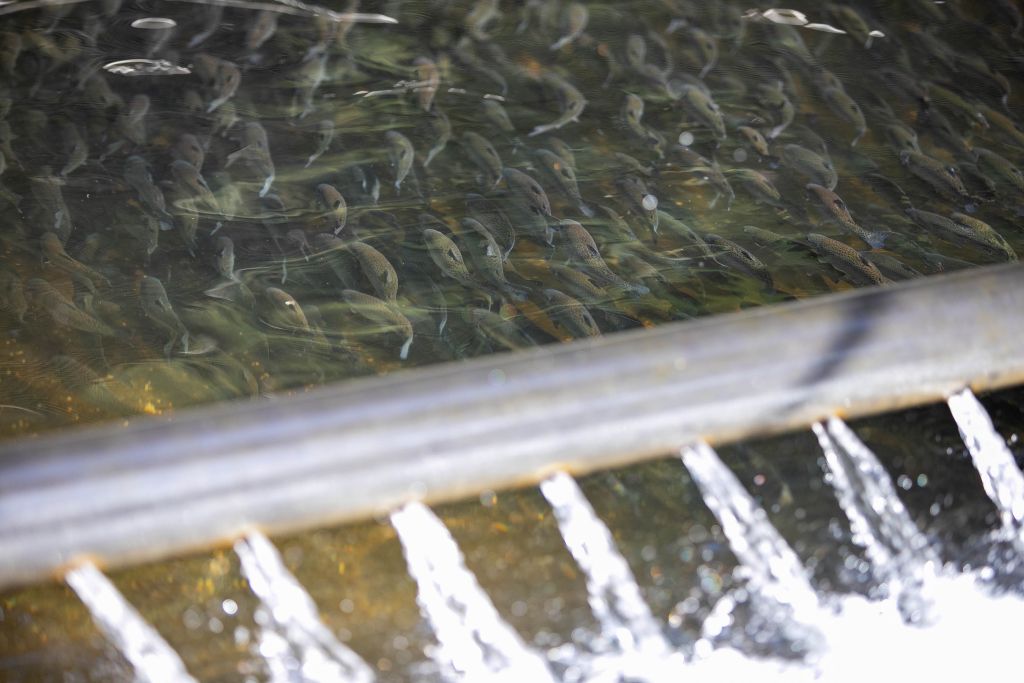
Hard to handle: Some state commissioners want changes to the management plans for hatchery fish, like these trout at Whatcom Falls Trout Hatchery in Washington. Photo: Cascadia Daily News

By Julia Lerner/Cascadia Daily News, April 19, 2023. The Washington Fish and Wildlife Commission is considering the future of hatchery management as wild salmon populations continue to struggle and hatchery-raised fish fail to meet the growing demand.

Commissioners from across the state met for four days earlier this month in Anacortes, where they hammered out planning and operations for the department for the next several months.

During an April 8 meeting, commissioners discussed hatchery operations among other topics.

Washington has one of the largest hatchery systems in the United States.

The Department of Fish and Wildlife (WDFW) operates and manages dozens of them, producing millions of fish every year.

Currently, the state has a management plan in place for anadromous salmon and steelhead fish in hatcheries—referred to as 3624—which was adopted in April 2021 after almost three years of work. Under the policy, hatcheries address three designated concerns: conservation, mitigation and fishery supplementation. Under conservation programs, the hatcheries serve to bolster “depressed target wild salmon or steelhead populations that are in need of rebuilding or recovery,” according to the plan.

That plan, though, was developed without input from Washington treaty tribes.

“In that policy—3624—there was a statement that we would work toward developing a co-manager policy,” said Ken Warheit, chief scientist at the fish program for WDFW. “We have been working on this draft co-manager policy for about a year and a half now.”

On April 8, Warheit presented details of the draft co-manager policy, answered questions from commissioners and outlined the State Environmental Policy Act (SEPA) process for the policy.

The draft policy will apply to all co-managed anadromous salmon and steelhead programs in the state, and emphasizes tribal treaty rights—in place since the 1800s and fortified by the Boldt Decision—alongside “scientifically sound” policies.

Revisions questioned

While 3624 remains in place, commissioners wondered if the co-manager policy was necessary, or if it sufficiently emphasized environmental concerns.

“Why do we need to shift to this policy, as opposed to sticking with 3624?” asked commissioner Tim Ragen, a former Western Washington University professor and marine biologist. “In 3624, it’s clear that conservation is first. In this [co-manager] policy, it’s not so clear.”

Other commissioners, including Melanie Rowland, a former attorney for the National Oceanic and Atmospheric Administration, echoed Ragen’s concerns. The two questioned how the proposed policy emphasized conservation over the economy.

Though hatchery fish help prop up salmon populations for fishing and treaty requirements, the fish can pose challenges to wild salmon, including habitat competition and illness.

Many environmental leaders are questioning hatcheries’ efficacy as new science emerges, and considering how to balance the needs of local economies, treaty rights and the environment.

“There are some commissioners that have a different opinion than other commissioners about what the policy should look like,” said Warheit. “A lot of the questions were comparing the two policies.”

Several commissioners believe 3624 emphasizes conservation and recovery, while the draft co-manager policy emphasizes harvest, said Warheit, though he added there’s a lot of nuance and history to be considered, and one plan doesn’t necessarily emphasize conservation more than another.

The co-manager plan would not necessarily replace the existing 3624 policy, said Warheit.

“The two policies can coexist, but not for a particular hatchery program,” he said.

Commissioners haven’t made any decisions about the draft policy, other than to submit it for SEPA determination through the state.

Commissioners will next meet in June.

“The theme for the June meeting [is] to talk about these risks and benefits of hatchery production,” said Warheit.
By |2023-04-19T13:31:40-07:0004/19/2023|Salmon|0 Comments

Fate of massive Washington aluminum plant remains unclear

Union cites “importance of preserving domestic aluminum industry” as Alcoa attempts to quash rumors of tear down


Aluminum smelter, Ferndale, Washington

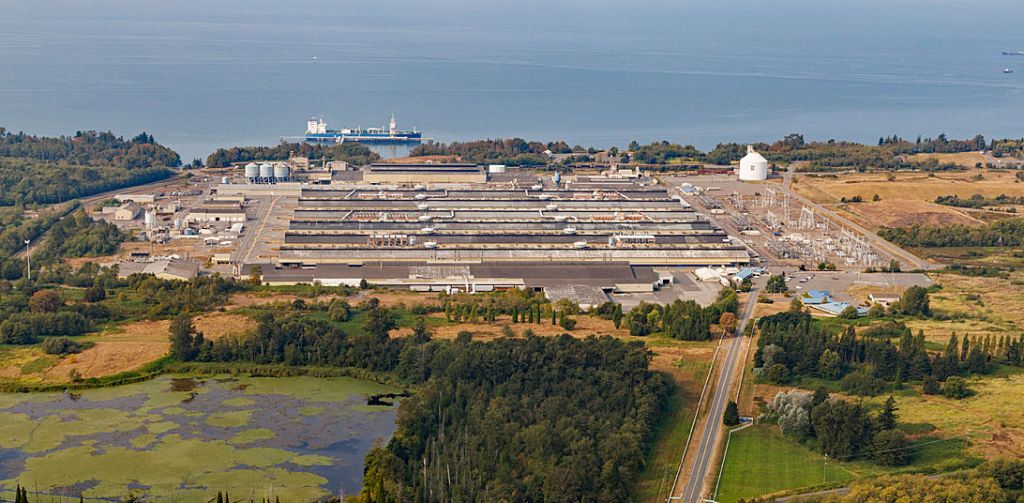
Close lines: Is this facility in Ferndale, Wash. ready to join the ranks of other retired aluminum plants in the Pacific Northwest? Depends who you ask. Photo: Cascadia Daily News

By Julia Lerner/Cascadia Daily News. January 31, 2023. Three years after Ferndale, Washington’s Intalco aluminum smelter curtailed operations, the facility may be preparing to close its doors permanently.

Since it was mothballed in 2020, the facility has been operated by a skeleton crew—about a dozen people monitoring the site, keeping the lights on, the doors locked and the equipment ready to go—in the event a restart could be negotiated.

About half of those workers have received a pink slip over the last few weeks, and the other half, according to people with knowledge of the situation, have been dismantling and shipping out equipment.

Intalco’s parent company, the Alcoa Corporation, said demolition isn’t currently planned, but rumors of a permanent closure flew when the union representing the reduced staff—the International Association of Machinists and Aerospace Workers (IAMAW)—called on the company to keep the doors open.

“I write to urge you to work with the IAMAW and all parties to pause the planned demolition of the Intalco smelter with the goal of restarting this vitally important facility,” IAMAW President Robert Martinez, Jr. wrote to Alcoa CEO Roy Harvey last week.

The union, the letter stated, has worked to assemble a coalition of supporters “who understand the importance of preserving a domestic aluminum industry in the United States and the critical role the Intalco Works smelter in Ferndale, Washington plays.”

Pac NW aluminum production fading

Restarting the Ferndale smelter would take years of work, millions of dollars, significant political will and a below-market-rate contract for operational power.

While that political will and financial support may exist, negotiations to restart the smelter were suspended last year, when potential buyer and restart proponent Blue Wolf Capital Partners withdrew from discussions after failing to secure an energy contract.

“Alcoa negotiated a possible divestiture of the plant, but the potential buyer withdrew from discussions in December 2022, citing its inability to acquire a competitive energy agreement that would be necessary to support its acquisition,” an Alcoa spokesperson said last week.

Hope remains, though, for a facility restart and the return of 700 union jobs.

[perfectpullquote align=”full” bordertop=”false” cite=”” link=”” color=”” class=”” size=””]The U.S. imports aluminum from 131 countries. Canada is its largest provider.[/perfectpullquote]

Federal legislators, including Wash. Rep. Rick Larsen (who represents portions of Snohomish and all of Skagit, Whatcom, Island and San Juan counties) have sought alternatives to restart the smelter as a “green” facility.

Options included use of the federal Defense Production Act to get the potlines running again.

Martinez wrote there is “a path forward for this facility to reopen and once again start producing strategically important domestic aluminum and put more than 700 IAMAW members back to work in Ferndale.”

Alcoa attempted to quash the rumors of demolition Friday.

“The Intalco smelter remains in a curtailed state and Alcoa continues to evaluate options for the plant, as we do with any curtailed capacity in our operations portfolio,” Alcoa said in a statement. “Decisions regarding the future of curtailed sites are based on a variety of factors, including global economic conditions, market pricing, energy prices, capital requirements and the prospects for long-term, sustainable competitiveness. Alcoa seeks viable opportunities for all its curtailed or closed sites to be returned to productive and sustainable use.”

When the facility initially shuttered its doors in mid-2020, Alcoa told employees the company could not compete in the global market for aluminum as production costs rose, aluminum prices fell and foreign competition increased.

Advocates of the smelter restart have long said the country has a dire need for locally sourced aluminum, particularly as international tensions with Russia heat up.

In 2020, the United States imported about $19.1 billion worth of aluminum from 131 countries. Canada is the largest provider, supplying more than a third of the total U.S. imported aluminum. Russia was the seventh-largest supplier, providing about 2.2% of the aluminum imports. According to a recent Congressional Research Service report, the United States now produces only 1% of the world’s aluminum.

By |2023-02-06T14:15:01-08:0001/31/2023|Aluminum, News|2 Comments

Washington law aims to break link between warming climate, food waste

The Organics Management Law brings big changes in the ways residents and businesses get rid of organic trash

Trash, garbage

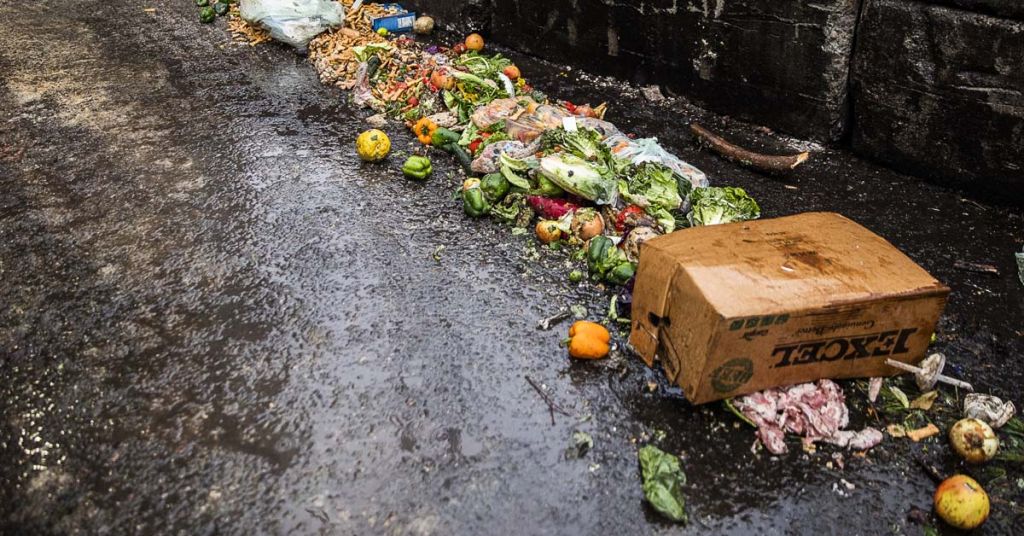
Senseless waste: Getting dumped sucks. Just remember—you’ve still got a lot to offer someone else. Photo: Olivia Vanni/The Herald

By Julie Titone, Everett Herald. January 17, 2023. Organic matter makes up 23% of the materials going into Washington’s landfills. For residential trash alone, the figure is 33%.

Much of that organic matter is food waste that was edible when it was tossed out.

Decomposing food releases methane, a heat-trapping gas that’s 25 times as potent as the carbon dioxide that spews from tailpipes. Each year, the state’s landfills produce emissions equivalent to the annual exhaust of 320,000 cars.

Meanwhile, nearly one in nine Washingtonians may suffer from food insecurity.

A new state law in Washington is taking on all of these problems.

Signed into law by Gov. Jay Inslee last year, the 2022 Organics Management Law—which went into effect on Jan. 1—is expected to eventually change food waste collection and disposal statewide.

“Food waste is the largest landfill component by tonnage. It’s heavy. And we have hungry people,” says Chery Sullivan, Washington Department of Ecology policy section manager, who oversees implementation of the 2022 Organics Management Law.

Costing $6.83 million over six years, the new law amends or adds sections to multiple existing laws. In addition to the state Department of Ecology, it involves the Conservation Commission, Department of Agriculture, Department of Enterprise Services, counties and cities, residential and non-residential customers.

Using 2015 as a baseline, the law aims to cut the amount of landfilled edible food by 20% by 2025, and cut landfill-disposed organic material by 75% by 2030.

Other organic materials, including inedible food and yard waste, will be processed at composting facilities, anaerobic digesters or used for vermiculture (worm-based composting) and emerging technologies.

The law gives state agencies through 2027 to make large changes. Ahead lies much rule-making that will affect residents, waste haulers, compost facilities, land-use plans and more.

Making giving away food easier

Embedded in the 2022 Organic Management Law is a Good Samaritan Food Donation Law. Among other provisions, it gives businesses more leeway to donate prepared meals without assuming liability.

Similar liability protections have arrived at the federal level, with passage of the Food Donation Improvement Act. Congress has yet to pass the Food Date Labeling Act, which would standardize expiration dates for perishable food.

Trash, Garbage

Not all bad: Food waste lines the edge of the tipping building at Cedar Grove Composting in Everett. Photo: Olivia Vanni/The Herald

Under Washington’s new rules, stores and distributors can contribute packaged food even if it’s beyond its “best buy” date.

It’s an important change, says Mark Coleman, media officer for Foodline.org, which serves 17 Western Washington counties. That charity, along with Northwest Harvest, manages the relationships between grocers and food banks, and between restaurants and shelters where meals are served.

“The cardinal rule of food production is you have to have enough on hand to meet demand,” says Coleman, explaining why farmers, distributors and grocers often end up with food they can’t sell.

Donating unsold inventory reduces disposal fees and provides tax deductions.

As a former meteorologist, Coleman knows the peril posed by landfill emissions: “I’m always trying to get people to think about methane.”

In addition, the new law allows packaged or prepared food to be sold at a discount (rather than given away) and still merit a tax deduction.

Trash from Puget Sound to Klickitat County

Ecology’s Use Food Well Washington Plan is a road map to building a better food system through waste reduction. It was key to passage of the 2022 Organics Management Law and is central to its execution.

Perhaps the most significant of the 30 recommendations in the 121-page food plan is the creation of the Washington Center for Sustainable Food Management.

Known simply as the Food Center, it will have a three-member Department of Ecology staff and be operational by 2024, according to Sullivan.

[perfectpullquote align=”full” bordertop=”false” cite=”” link=”” color=”” class=”” size=””]Ecology argues implementing Use Food Well recommendations will save $1 billion annually.[/perfectpullquote]

The Use Food Well plan calls for actions ranging from broad (increase markets for “imperfect” produce) to specific (require school recess before lunch, because hungry kids leave less food on their plates).

To understand how much food is wasted, Ecology uses contractors to sample and weigh trash being sent to landfills.

The latest Waste Characterization Study sampled trash from sites in 10 counties in 2020 and 2021.

The sites included Snohomish County’s Southwest Recycling and Transfer Station, where waste is collected before being shipped by trainload to Klickitat County’s Roosevelt Regional Landfill.

Local anxieties

There are plenty of legislative discussions ahead about organics and recycling in general, says Heather Trim, executive director of Zero Waste Washington.

“There are 10 to 12 waste-related bills a year,” says Trim.

Zero Waste’s 2023 legislative priorities include the Washington Recycling and Packaging Act, plus bills related to plastics reduction and battery recycling.

Trim and other environmentalists lobbied for the Organics Management Act.

Local governments, not so much. The Washington Association of Counties took a neutral stand.

Paul Jewell, the association’s policy director, objected to the lack of funding to support major changes in how and where organic material goes.

“It will require huge investments in infrastructure,” Jewell said at a Senate hearing. “Planning, siting and constructing solid waste facilities is not easy, and in any event it takes years to complete. California has had to increase fees by as much as 70% to comply” with similar requirements.

Most Washington cities and counties have access to state and federal grants in some form, says Sullivan. These may support things like solid waste management plan updates and public education.

Ecology is working on an outreach “toolkit” to spread the word about organic waste management.

Still, Sullivan agrees the Organic Management Act will burden local governments.

Ecology will ask legislators for more grant funding to help, arguing that implementing all the Use Food Well recommendations will save $1 billion annually.

Julie Titone is an Everett writer who can be reached at julietitone@icloud.com. Her stories are supported by The Herald’s Environmental and Climate Reporting Fund.

By |2023-01-26T09:55:05-08:0001/17/2023|Energy, Waste Management|2 Comments

Oregon companies are recycling aged-out wind turbines

The job is massive. Parts weighing up to 50,000 pounds are cut apart with acetylene torches then shipped to Portland

Recyling

Huge burn: It’s not easy dismantling a piece of machinery that weighs as much as an adult humpback whale. Photo: Dick Mason/The Observer

By Dick Mason, The Observer. October 3, 2022. Winds of change are generating excitement at B&K Auto Salvage and Recycling in La Grande, Ore.

The gusts are blowing in from wind farms in Arlington, 125 miles to the west, in the form of semi-trucks carrying parts from wind turbines that have been shut down due to declining condition after decades of use.

La Grande’s B&K has contracted with a wind farm-related organization to cut up wind turbine parts and send the metal to Portland for recycling.

Cutting wind turbine parts, which consist of gearboxes, main shafts and blade hubs, is difficult because of their size, according to Danny Huddleston, recycling manager at B&K.

“The gearboxes weigh 45,000 pounds, and the main shafts and the blade hubs weigh 50,000 pounds,” he says.

The metal wind turbine parts are cut with acetylene torches by a crew from an Indiana-based company called Premier Scrap Processing working with B&K.

B&K began receiving shipments from wind farms in the Arlington area on Sept. 1. As of Sept. 20, it had received 141 shipments from semi-trucks.

“We usually get 10 to 14 shipments a day,” says Huddleston.

Attention getter

On some occasions as many as three semi-trucks have arrived at B&K at about the same time, causing passing motorists to do double takes.

Huddleston says he enjoys explaining the process.

“This is definitely turning heads. People will say, ‘What is happening?’ It is nuts,” he says. “It is pretty neat to get stop-ins like this.”

Each truck carries only a gearbox, main shaft or blade hub. Trucks can’t transport more than one item at a time because of state and federal weight laws.

[perfectpullquote align=”full” bordertop=”false” cite=”” link=”” color=”” class=”” size=””]The company wants all the parts cut up before winter.[/perfectpullquote]

Once a truck arrives at B&K, a crane with a hook lifts the part and lowers it to the ground.

B&K is never sent aging blades of old wind turbines because they’re made of balsa wood, something the La Grande company doesn’t handle, according to Huddleston.

The gearboxes, main shafts and blade hubs B&K receives are all 20 to 25 years old.

Huddleston says that when the wind turbines were installed many people believed they would last about 15 years. Their longevity was probably underrated, he says, because there were a lot of unknowns 25 years ago.

“It was not known how much the turbines would be turning,” he says.

Scrap sent to Portland company

To create room for the wind turbine parts, the company removed about 100 automobiles from its storage yard. They were crushed and sent out for recycling.

B&K is working with other area companies to make sure wind turbine parts are recycled.

Huddleston says the company’s goal is to have all of the metal for the wind turbine parts cut up before winter hits because it’s harder to work then. One of the biggest challenges winter poses is the deep snow and mud it creates, which makes it easy to lose things that don’t turn up again until the spring.

The wind turbine metal parts B&K is cutting up are being sent to Schnitzer Steel in Portland. Huddleston says the metal will eventually be melted down as part of the recycling process.

Since Sept.1, B&K has sent two truckloads carrying 60,000-68,000 pounds of cut-up wind turbine metal to Schnitzer Steel.

Huddleston hopes B&K can continue to help recycle metal from old wind turbines.

“It is work. This keeps everybody busy,” he says, adding that it’s fascinating work, as well.

By |2023-01-26T10:20:17-08:0010/03/2022|Energy|2 Comments

Columbia Land Trust conservationist Bill Dygert dies at 71

He helped conserve over 55,000 acres in Oregon, Washington, including areas in Lewisville, Frenchman’s Bar, Salmon Creek, Lacamas and Washougal River

Bill Dygert

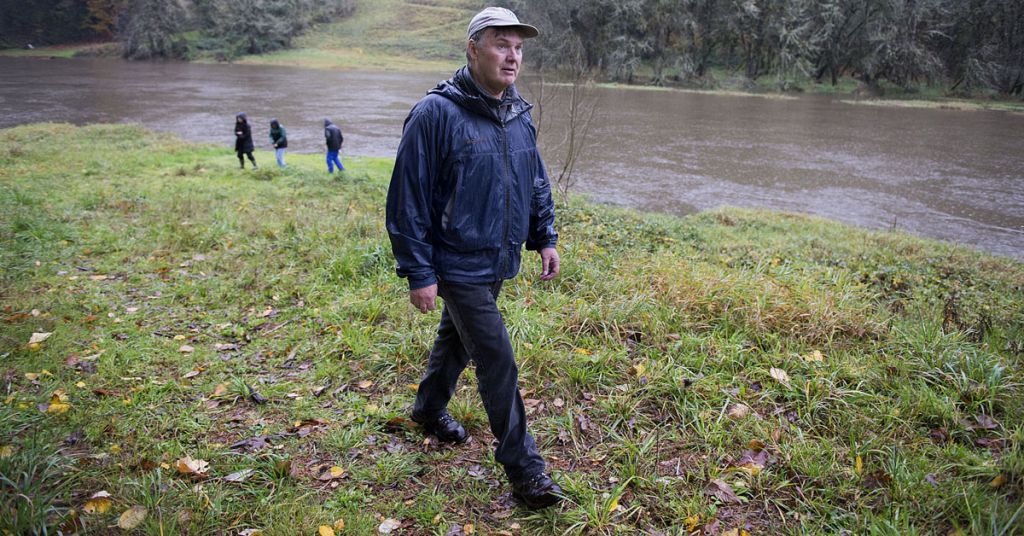
State champion: Bill Dygert strolls through land near La Center in 2015. Photo: Amanda Cowan/The Columbian

By Jessica Prokop, The Columbian. September 21, 2022. William “Bill” Dygert, a longtime land-use consultant active in conservation efforts in Southwest Washington, died Aug. 27 at his home in Astoria, Ore., from a chronic lung disorder. He was 71.

Dygert was a founding member and longtime board member of the Vancouver-based Columbia Land Trust, which has conserved more than 55,000 acres in Oregon and Washington.

“If you live, work or recreate in Southwest Washington, you have surely benefited from the work of Bill Dygert, who was instrumental in saving much of the natural beauty we enjoy today. No one has been more successful in creating parks and trails, conserving rivers and streams and maintaining farm and forest land,” the Columbia Land Trust said in an emailed statement.

“Bill’s impact comes from his direct work: facilitating the creation of park, trail and open space plans; creating citizen groups to advocate for those plans; and raising tens of millions of dollars to implement them,” the statement reads. “All of us who draw our joy and health from nature will continue to benefit from these efforts, long after his passing.”

Dygert, who was raised in Vancouver, started working for the Clark County Parks Department in 1973—first as an employee and later as an independent contractor. He negotiated with private landowners and secured funding to allow for the conversion of their private holdings to public uses.

Through his grant writing, Dygert secured millions of dollars for municipalities and nonprofits in Southwest Washington.

“If you’ve ever been to Lewisville, Frenchman’s Bar, Salmon Creek, Lacamas, Cottonwood Beach or Whipple Creek parks; walked the Salmon Creek, Lacamas or Burnt Bridge Creek trails; appreciated the glorious nature of the Washougal River, the Vancouver Lake lowlands or the East Fork Lewis River; had a picnic or thrown a Frisbee in your neighborhood park; or fished or hunted in Southwest Washington, Bill played a key role in your experience,” Glenn Lamb, Columbia Land Trust executive director, said in an email.

Lamb described Dygert as “one of the most important people in my life and for so many other people, too.”

Influenced a generation

Dygert and his business partner, George Simpson, were behind the Clark County Legacy Lands (Clark County Conservation Futures) program and acquisition of more than 5,000 acres of protected land in Clark County.

Later, he supported the development of the Astoria Riverwalk and was a longtime chair of the Lower Columbia River Fish Recovery Board, according to his obituary.

“An entire generation of conservationists learned their craft from watching Bill, studying his patient persistence and dogged focus. Bill loved nature, and he also loved the colorful people who populate our region,” the Columbia Land Trust said.

“A writer at heart, Bill would walk, take pictures and listen — and turn what he learned into grant proposals and testimonies. He took the stories of generations of people whose relationship with land ran deep and turned them into tangible conservation successes.”

Donations in memory of Dygert can be made to the Columbia Land Trust, 850 Officers Row, Vancouver, WA, 98661, and Clatsop Animal Assistance, P.O. Box 622, Warrenton, OR, 97146.

Originally published by The Columbian. Story used by permission.

By |2023-04-25T09:31:05-07:0009/21/2022|Conservation, Natural Resources|0 Comments

Scientists engineer a better air conditioner for hotter Northwest summers

You may not have heard of ‘metal organic frameworks,’ but they may be the key to future cool

summer madness

Cruel summer: Keeping cool is costly—for the environment as well as your wallet. Photo: RMS

By Chris McGinness, KGW News. September 13, 2022. Air conditioning alone consumes 6% of the total electricity produced in the United States annually. The Department of Energy said that costs Americans $29 billion a year just to stay cool.

The Pacific Northwest National Laboratory (PNNL) in Richland, Wash., wants to lower that cost by changing just one part of how cooling systems work: the compressor.

It’s the noisiest and the most expensive part of home air conditioning, consuming about 85% of the electricity used to run the system.

Switching to a chemical process called “sorbent cooling” can revolutionize home air conditioners.

“We’ve been working on this technology since about 2010,” said Dr Radha Motkuri, a chemist at PNNL. “The sorbents are called Metal Organic Frameworks, which are just metals in organic structure. It’s like a hundred-floor building, a thousand-floor building at nano-level in a small spec.”

[perfectpullquote align=”full” bordertop=”false” cite=”” link=”” color=”” class=”” size=””]Portland just endured its third hottest summer on record.[/perfectpullquote]

These tiny engineered structures are like sponges that pull refrigerant through the cooling system and the flow is self-sustaining; no pump is needed.

Essentially, the other mechanical parts in the new air conditioner would be the same, but the compression process is driven by “simple industrial waste heat, or solar or thermal; any heat can be used for the absorption/desorption process,” said Motkuri.

PNNL scientists have proven this works in the lab and say it’s now up to the industry to scale it up to study the cost efficacy. 

“It’s a new methodology, it’s more eco-friendly, longevity, self-sustaining and [at] very low cost,” said Motkuri.

Portland just endured its third hottest summer on record at PDX. August 2022 was the hottest month ever recorded at PDX, with an average temperature of 75.1 degrees.

Americans are adding about 117 million metric tons of the greenhouse gas, CO2, to create the energy needed to run to air conditioners. A way to save energy and stay cool is something we all want.

By |2023-01-28T14:25:31-08:0009/13/2022|Climate Change|2 Comments

© Copyright 2013-2025 Columbia Insight. All Rights Reserved.

As a 501(c)3 nonprofit organization, all donations to Columbia Insight are tax deductible to the full extent of the law. Our nonprofit federal tax-exempt number is 82-4504894.