Stay Updated Subscribe today for the latest research + reporting about environmental news. Subscribe Now

Stay Updated Subscribe today for the latest research + reporting about environmental news.

Subscribe Now

AP StoryShare

AP StoryShare

AP StoryShare

About AP StoryShare

Columbia Insight is publishing this story as part of the AP StoryShare program, which allows newsrooms and publishing partners to republish each other’s stories and photos.

Should outgoing President Biden be considered ‘the salmon president’?

The Biden administration engaged more in the effort to recover Columbia River Basin salmon than any in history

President Joe Biden with Arizona mountains backdrop

Fisherman’s friend: Salmon advocates taking stock of the Biden presidency have much to consider. Photo: Gage Skidmore/Flickr

By Eric Barker/The Lewiston Tribune. December 4, 2024. Call him the salmon president.

Shortly after Biden was inaugurated, Rep. Mike Simpson of Idaho unveiled his $33.5 billion plan to breach the Snake River dams and replace the important services they provide.

Simpson’s move lifted the issue to the halls of Congress from what had been a regional debate with advocates on both sides pressuring federal agencies to endorse keeping or breaching the dams.

While Simpson’s plan didn’t catch fire there, the issue found favor with members of Biden’s team, ramping it up to yet another level.

Biden selected Deb Haaland to serve as Interior Secretary—the first Native American to hold a cabinet post. Haaland was sympathetic to the efforts of tribes across the country to restore the environment and to the historic wrongs they faced.

Biden also selected other Native Americans like Jaime Pinkham, a member of the Nez Perce Tribe, and Michael Connor, a member of the Taos Pueblo, to high posts overseeing the Army Corps of Engineers.

In the fall of 2021, the Biden administration entered into talks with the Nez Perce and other Columbia Basin tribes, their allies and Oregon in an effort to settle decades-old litigation over the harm dams cause to salmon.

Those talks led to an agreement, finalized last last year, with the Nez Perce and other Columbia Basin tribes, conservation groups and Oregon, that paused salmon-and-dams litigation for up to 10 years and greenlighted studies and an alternative energy development efforts that could pave the way for future breaching of the Snake River dams.

A separate agreement advanced efforts to reintroduce salmon above Grand Coulee Dam on the upper Columbia River.

In March of 2023, Biden, speaking from the White House, pledged to work with tribal and political leaders of the Pacific Northwest to recover salmon runs that spawn in the Columbia River and its tributaries.

In September of last year, he issued a memo calling for a “sustained national effort” to honor commitments to the Nez Perce and other tribes by restoring Snake and Columbia river salmon and steelhead to healthy and abundant levels.

Under Biden, the federal government acknowledged for the first time that hydropower development on the Columbia and Snake rivers caused grave harm to tribes, in large part because the harm they caused to wild salmon runs.

The National Oceanic and Atmospheric Administration said under his watch that Snake River salmon can’t be recovered to healthy and harvestable levels without breaching—a first for the agency in charge of protecting the threatened and endangered fish.

Biden’s signature legislative victories—the Inflation Reduction Act and the Bipartisan Infrastructure Act—devoted money to fix ailing salmon and steelhead hatcheries in the basin.

“For far too long, salmon and steelhead recovery has been left on the cutting room floor of successive administrations,” said Chris Wood, president of Trout Unlimited. “President Biden is the first president in many years who took seriously our obligations to indigenous peoples and who understood how salmon and steelhead reflect the best part of America.”

This story was originally published by The Lewiston Tribune.

By |2026-01-13T11:40:20-08:0012/04/2024|Salmon|0 Comments

Washington Tribe gets $8.5 million for wildlife overpass

On Highway 20 in Skagit County, the new crossing is expected to take four years to complete

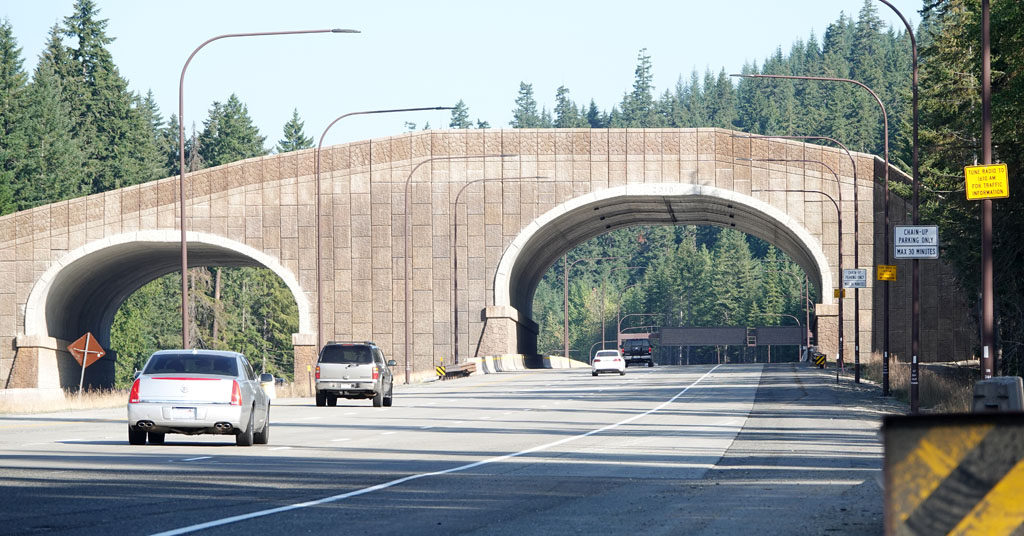
Wildlife overpass in Snoqualmie Pass along I'90 in Washington.

Safety increase: This wildlife overpass in Washington’s Snoqualmie Pass is part of a system of established and planned over- and underpasses along I-90. Photo: WSDOT/David Mosley

By Isaac Stone Simonelli/Cascadia Daily News. February 12, 2024. More than $8 million has been tagged for the Red Cabin Creek Wildlife Overpass Project slated to protect drivers and elk along State Route 20 at Milepost 76.2 in Skagit County, Washington.

The construction of the overpass will connect wildlife habitats divided by the road, protect treaty resources and reduce animal-vehicle collisions

“Elk, deer and other wildlife species are important treaty resources to the Tribes,” said Jennifer Sevigny, a wildlife program manager with the Stillaguamish Tribe. “The amount of wildlife-vehicle collisions that occur do have an impact on the sustainability of the population.”

In December, the Federal Highway Administration awarded the Stillaguamish Tribe an $8,495,000 Bipartisan Infrastructure Law grant through the Wildlife Crossings Pilot Program for the project.

Stillaguamish was one of four Tribes included in $110 million in grants for 19 wildlife crossings projects in 17 states. The project is expected to take up to four years to be completed.

As part of the same grant program, the Puyallup Tribe of Indians will receive $216,250 to complete the planning and scoping of wildlife crossing structures in partnership with the Washington State Department of Transportation, Washington State Department of Fish and Wildlife and U.S. Forest Service, and support from the Medicine Creek Treaty Tribes. That project location addresses an area of high concern due to large numbers of elk-vehicle collisions on State Route 12 across the 24-mile project corridor.

Currently there are 22 wildlife bridges and underpasses in the state, with half of those in Kittitas County.

High costs either way

Previous wildlife crossing projects in the state have ranged from about $250,000 to more than $6 million, but the Red Cabin Creek structure is coming at a time of significant inflation.

While the project price tag might seem hefty at first glance, Sevigny noted that it pencils out when taking into account the societal costs of elk-vehicle collisions.

There are millions of wildlife-vehicle collisions in the nation every year, and those involving large animals result in an estimated 200 human fatalities and 26,000 injuries, according to the U.S. Department of Transportation.

In addition to the loss of life, it’s estimated that these collisions cost the public more than $10 billion annually, including property damage, medical costs and loss of income, among others.

The Washington State Department of Transportation estimates a minimum 5,000 deer-vehicle collisions and 200 elk-vehicle collisions in the state annually, based on carcass removal data.

A 2022 Washington State University economic analysis estimated a savings of between $235,000 and $443,000 every year per wildlife-crossing structure in the state.

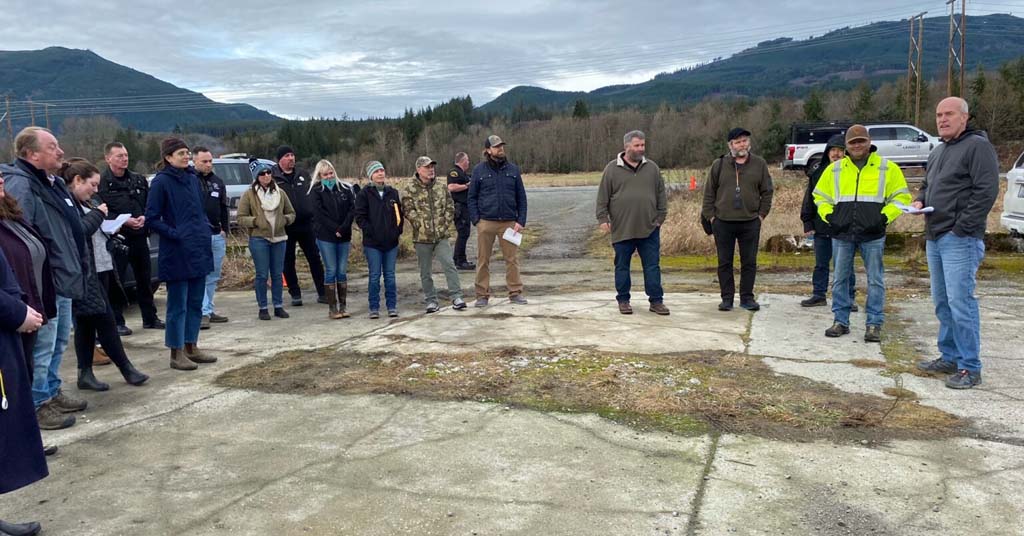
Washington Rep. Rick Larsen at wildlife overpass site

Crossing pattern: Wash. Rep. Rick Larsen (far right) speaks with representatives from Tribes and stakeholder groups on Jan. 26 at the site selected for the Red Cabin Creek Wildlife Overpass Project on State Route 20. Photo: Office of Rep. Rick Larsen

In Skagit County, resident elk herds are dependent on the high-quality riparian habitat in the valley, explained Amanda Summers, a wildlife biologist with the Stillaguamish Tribe.

“We have resident herds that actually live on the highway,” Summers said. “I mean, literally on either side of it.”

Highways and other man-made structures can divide habitat, which is particularly problematic for animals that migrate or have a large home range.

Wildlife crossings like the Red Cabin Creek Wildlife Overpass provide the habitat connectivity.

Stillaguamish Tribe, which is actively involved in managing elk in Skagit, used GPS collar data from the animals to analyze crossings, relating that data with carcass removals and reports of elk-vehicle collisions to determine the best locations for the overpass.

“Our collar data really helped us to pinpoint exactly where the elk are crossing, and so we were able to identify different hotspots on Highway 20,” Sevigny said.

Movement on the project won’t begin until the Tribe receives the awarded funds. At that point, they will have four years to design, permit and build the structure, said Sevigny.

Located between the Upper Skagit Tribe villages of Lyman and Hamilton, the Red Cabin Creek Wildlife Overpass will have the most direct impact on that Tribe.

“We receive the funding, but we’re going to be working really closely with the Upper Skagit Tribe. They’re a primary partner in this grant,” Sevigny said.

The Upper Skagit Tribe has been heavily involved with wildlife management in Skagit County for decades, including the development of the North Cascades Elk Herd Management plan and various efforts to address elk-vehicle collisions in the county, said Scott Schuyler, a member of the Upper Skagit Tribe and its policy representative.

“We’re very thankful that there’s wildlife still in this valley, and that’s always going to be our goal,” Schuyler said.

Sevigny said the grant looked at other factors outside of habitat connectivity and the potential to decrease collisions—asking applicants to factor in job creation and local sourcing of materials, among others.

“There’s no doubt that it will [create jobs],” Sevigny said.

Bipartisan Infrastructure Law funding has invested $7.9 billion in Washington state, with more than 490 specific projects identified.

By |2026-02-09T13:10:06-08:0002/12/2024|Government, Transportation, Wildlife|0 Comments

Millions of acres to manage: USFS updating plans for three nat’l forests in Oregon’s Blue Mountains

Critics are concerned that extractive interests are “jumping to the front of the line.” But the federal agency has many stakeholders to please

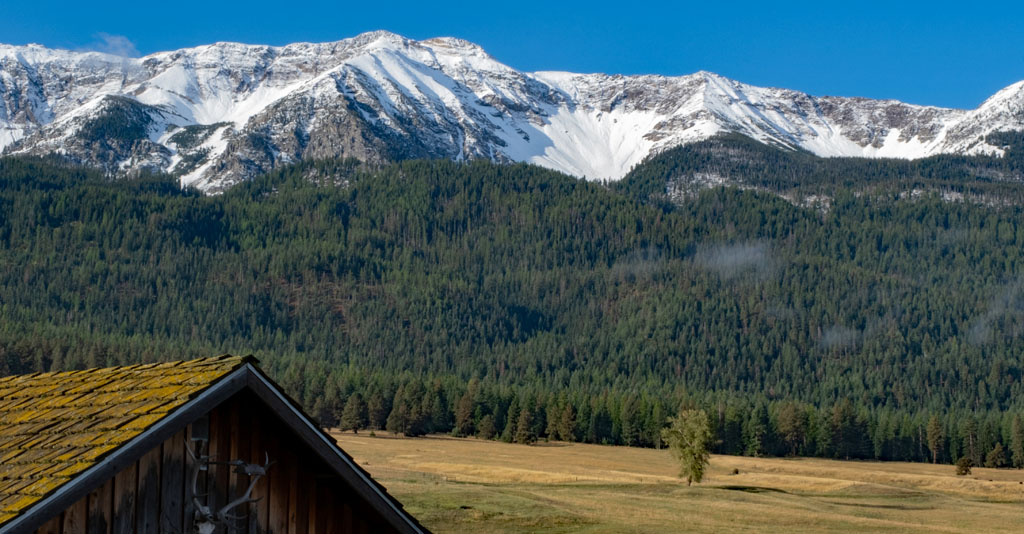
Blue Mountains

Upper management: In northeastern Oregon, plans for balancing logging, grazing, recreation and conservation interests in the Blue Mountains are being reviewed. Photo: Jurgenhessphotography


By Rick Haverinen, Jayson Jacoby. Bill Bradshaw, EO Media Group. December 4, 2023. Start with a swath of land more than twice as big as Rhode Island and Delaware.

Combined.

Carve a gorge deeper than the Grand Canyon and excise more than a dozen other rifts where major rivers flow.

Sculpt scores of peaks, more than 20 of which surpass 9,000 feet in elevation.

Cover much of this area with forests that are almost as diverse as the terrain. Stands of mature and second-growth ponderosa pine, Douglas fir and tamarack, thickets of juvenile lodgepole pine, alpine forests with whitebark pines that sprouted before Columbus sailed the seas yet are scarcely taller than a basketball hoop.

Distribute a series of meadows and sections of sagebrush steppe, and toss in a grassland that looks as though it ought to have bison grazing.

And now figure out how to manage these 5.5 million acres, all of which belong to every American, in a manner that reflects those who see in a thick ponderosa the boards that make up a home, and those who want the tree to stand for another century until nature takes it in a bolt of lightning or a gust of wind.

Consider all those factors and you’ll have a sense of the challenge facing U.S. Forest Service officials as they write new management plans for the three national forests in Oregon’s Blue Mountains.

The timeline perhaps explains best how daunting the task is.

The plans for the Umatilla, Wallowa-Whitman and Malheur national forests date to 1990. They were supposed to be replaced after about 15 years.

The Forest Service was already almost a decade behind that schedule when it released a draft version of new plans for each forest in 2014.

But after hearing complaints—from people who believed the plans allowed too little logging, livestock grazing and other uses and from others who argued that the proposals didn’t protect enough land from such uses—Forest Service officials withdrew the draft plans.

The agency released a final environmental impact statement for new plans in 2018, but that also prompted widespread concern about potential effects on how the forests are managed.

The Eastern Oregon Counties Association, which includes Baker, Grant, Union, Wallowa, Umatilla and Morrow counties, listed eight main objections: economics, access, pace and scale of restoration, grazing, fire, salvage logging, coordination among agencies and wildlife.

The Forest Service withdrew that proposal in March 2019.

Trying again

Now the revision process has started anew.

The first phase kicked off July 31, when the Forest Service published a notice in the Federal Register to start the assessment phase.

The agency held public open houses this summer to explain the process.

“Our next step is we’re going into the assessment phase, which is the current conditions of the forest,” said Michael Neuenschwander, the project leader for the revision process who reports to the three forest supervisors. “We will be bringing some materials to the public to be able to look at that.”

A draft version of the revised plans won’t be released until December 2024 at the earliest, he said.

The time required reflects both the complexity of the process and the importance of the national forests in the region’s culture and economy, said Eric Watrud, supervisor of the Umatilla, which is headquartered in Pendleton, Ore.

“The three Blue Mountain national forests really are national treasures, and they’re important to our communities from an economic point of view,” said Watrud. “They’re important from a recreation point of view. They provide important wildlife habitat, and cold and clean water that supports our fisheries and our communities.”

What’s a forest plan?

A forest plan is, in effect, an overview—a general assessment of the national forest and a broad description of the priorities for managing different parts of that forest.

“The forest plan is sort of the 30,000-foot level,” said Shaun McKinney, supervisor of the Wallowa-Whitman, which is headquartered in Baker City, Ore. “What parts of the forest may be focused on, say wilderness, which will be focused on recreation, which will be focused on timber management, those kinds of things.”

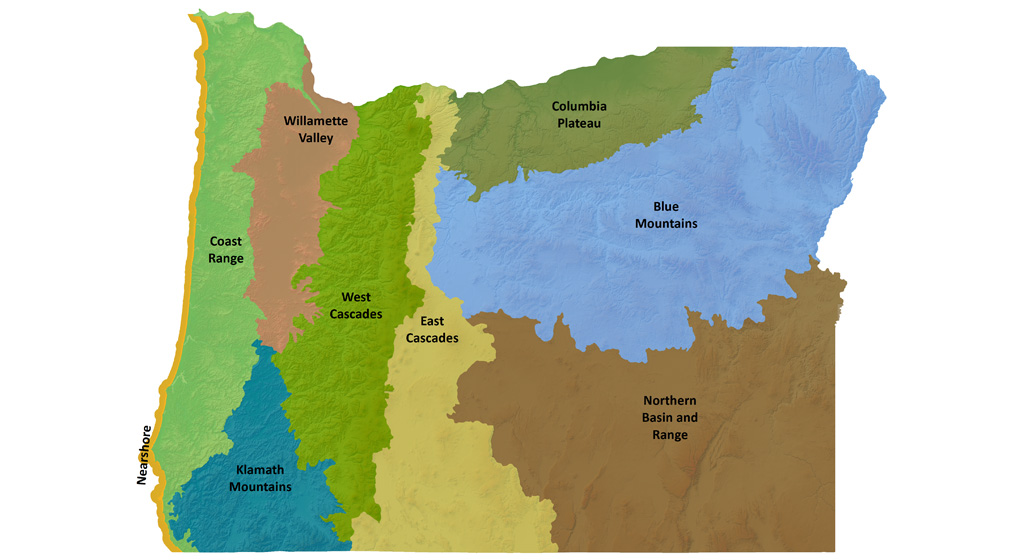
Map of 9 eco-regions in Oregon.

The Blue Mountains comprise one of nine state eco-regions recognized by the Oregon Conservation Strategy. Map: Oregon Conservation Strategy/ODFW

Forest plans do not include site-specific projects—such as timber sales, the approval of grazing or mining permits, the construction of a trail or campground or road. Those projects are proposed, studied and potentially approved through a separate process under the National Environmental Policy Act.

McKinney said a significant change from the Forest Service’s previous attempts to revise the plans for the Blue Mountain national forests is how the agency will deal with objections to the revised plans after they’re released.

In the past, he said, objections would be considered by Forest Service officials at the agency’s headquarters in Washington, D.C.

This time, each of the three forest supervisors will approve the plan, and objections will be sent to the Forest Service regional office in Portland.

Who’s writing the plans?

To draft the new plans, McKinney said the Forest Service is drawing on the expertise of its specialists in a range of disciplines including forestry, wildlife biology, cultural resources and wildfire, as well as some outside consultants.

Agency employees have been collecting data about each forest for many years, he said—what types of trees grow where, the roster of roads and trails and other recreation facilities, the extent of grazing allotments and areas permitted for mining.

Forest officials will use this information to draft several strategies for managing the forests. NEPA, the 1969 federal law, requires that agencies consider a range of alternatives.

These alternatives will be outlined in detail in the draft plans for each forest, and the Forest Service will solicit comments from the public about which alternative, or parts of alternatives, that residents prefer, or oppose.

“We definitely want the public’s engagement and input because there are going to be some folks that are going to be, you know, there’s plenty of wilderness, don’t want any more of that,” said McKinney. “And there will be other folks who say we want a ton more wilderness area. Public lands are everybody’s lands, which is wonderful. But everybody has an opinion.”

Low snowpack

Forests are changing: Parts of the Blue Mountains—like this spot near Baker City—have experienced record-dry winters in recent years. Photo: Jayson Jacoby/Baker City Herald

Wallowa County Commissioner Susan Roberts said she wants the revised forest plans to put a priority on cutting timber and expanding livestock grazing, with a goal of reducing the amount of fuel in the forest and reducing the wildfire danger.

“What we don’t believe is there’s been appropriate management (of the forest) as a whole,” Roberts said. “They don’t manage it for the benefit of the health of the forest. That’s what we’re trying to change.”

Roberts’ fellow commissioner, Todd Nash, agrees.

Nash, who deals primarily with natural resource issues for Wallowa County, said the plans need to be updated.

“We’re operating off the 1990 plan so it’s pretty old,” Nash said. “Restrictions on grazing at the current time, to protect salmon and bull trout, have restricted a lot of grazers. We have a lot more closed than active grazing allotments.”

Nash is a rancher as well as president of the Oregon Cattlemen’s Association and sympathizes strongly with those in the cattle industry, a mainstay of the Wallowa County economy.

But he also sees a need for improved forest management for the timber industry in Wallowa County.

“The sustainable, long-term cuts took out the three mills that were in existence in 1990,” Nash said. “We can’t sustain a mill under what we’re currently doing. It’s had a tremendous effect on our forests. We need to make sure we set grazers up for success and we set loggers up for success.”

Baker County Commissioner Christina Witham is, like Roberts and Nash, a member of the Blues Intergovernmental Council. The Forest Service set up that group, which includes representatives from county, state, federal and tribal agencies, after the most recent forest plan revision was withdrawn in 2019.

The BIC tracks both the forest plan revision process and other issues related to the management of public lands in the Blue Mountains.

Witham said her top priority for the new forest plans comes down to a single word—“access.”

Witham said she means not only access by motor vehicles, but also access to the forest to thin overcrowded, fire-prone forests, open grazing allotments for local ranchers, and permits for miners.

Witham wants the Forest Service to increase the rate of forest thinning—including commercial logging—to reduce fuel loadings.

“What we have right now is mismanagement on a large scale,” she said. “The forest plan shouldn’t limit us, it should help us get to a healthier forest.”

McKinney said the new forest plans, like their current 1990 versions, will delineate areas where logging and grazing will be allowed and even emphasized as management tools.

Although the new plans will focus more on restoration than purely on logging volume targets, he said logs will continue to be a product.

Definitions of what constitutes restoration vary widely.

Emily Cain, executive director of the Greater Hells Canyon Council, said the organization’s members want to ensure that the forest plan revision is a “truly inclusive process.”

“The Forest Service has a challenging task,” said Cain. “Unfortunately, after several false starts, the agency doesn’t seem to be off to a much better start this time with the exclusive nature of the BIC process having, at the very least, the appearance of extractive interests jumping to the front of the line.

“Here, locally, and across the region, our members and supporters care deeply about our forests and communities. They, and we, expect the agency to start giving equal standing to all interests. It’s only through a truly inclusive process that the Forest Service will be able to develop a defensible and durable plan.”

Cain said the mature trees that remain in the Blue Mountains play vital roles in combating climate change, through their sequestration of carbon, as well as in providing habitat for wildlife.

“In recent years, exciting new science has reinforced much of what we all already know—that our region is of global importance,” said Cain. “Our intact forests are a critical connection between the Rockies and Cascades. Our headwater streams provide water for people, fish and wildlife all the way to the Pacific Ocean. In a changing world, these values are important on their own merits and also because protected public lands support healthy, vibrant communities.”

Cain said the Greater Hells Canyon Council wants new forest plans that are “guided by science, conservation values and just transitions to more sustainable economic models,” as well as “enforceable protections that are needed for the public lands that are so important to our way of life, and for future generations.”

Forests changes

McKinney said that in some places in the Blue Mountains the forests today are quite different from those of the past.

Some stands are overcrowded, and thus more vulnerable to insects, disease and fire, due to a combination of factors. These include excluding wildfires, which previously naturally thinned forests, and historical logging that removed the older, larger trees, such as ponderosa pines and tamaracks, but left firs that can form thickets of stunted, sickly trees.

“We’ve got a condition in some cases where we have overstocked stands, and we just really want to get those back into the historic range of variability,” McKinney said. “The plan will look at timber management, range management and trying to look for ways that we can identify those areas on the landscape that need to be treated, and that will result in fiber coming off the national forest.”

He said one difference from the past, including the 1970s and 1980s when the Blue Mountain national forests were producing hundreds of millions of board-feet of timber annually, primarily mature ponderosa pines and other species, is that today’s timber sales generally yield much smaller trees.

“I think logging is just as much a need out there,” McKinney said. “But the products coming out are different.”

Umatilla County Commissioner Dan Dorran, also a BIC member, touted the socioeconomic report the council crafted showing the economic harm from potential changes to forest management, including reducing vehicle access and reducing grazing and logging.

“Not just money, but livelihoods” are potentially at stake, Dorran said. “Whether it’s grazing, timber harvest, mill operator, you name it. It will affect a lot of people.”

In addition to the public opposition to previous iterations of the revised forest plans, a controversial issue related to two of the three forests is travel management.

The Umatilla has had a travel management plan for decades. Basically, the forest has maps that designate where motor vehicles are allowed, such as the Winom-Frazier trail complex near Ukiah.

By contrast, both the Wallowa-Whitman and Malheur, which account for more than half the national forest acreage in the Blue Mountains, are “open” forests, meaning motor vehicles are generally allowed except in designated closure areas.

The Forest Service has proposed a travel management plan for the Wallowa-Whitman, but in 2012, just a month or so after unveiling the plan, officials withdrew it. The reason was much the same as with the previous forest plan revisions—widespread complaints about how many miles of roads would have been off limits to motor vehicles.

McKinney emphasized the current forest plan revision process doesn’t involve travel management on the Wallowa-Whitman or Malheur forests.

“There’s a lot of interest in it, we know we need to do it,” said McKinney. “We just want to get this first piece done and we will work on the second piece. Travel management and access management will be a subsequent analysis and process not associated with the forest plan.”

By |2023-12-05T10:54:36-08:0012/04/2023|Forestry|0 Comments

How hikers are bringing new strategies to forest protection, fight against climate change

In traditional logging hubs, a new argument: trees are more valuable when left standing than when they’re cut down

Whitehorse Mountain, Washington

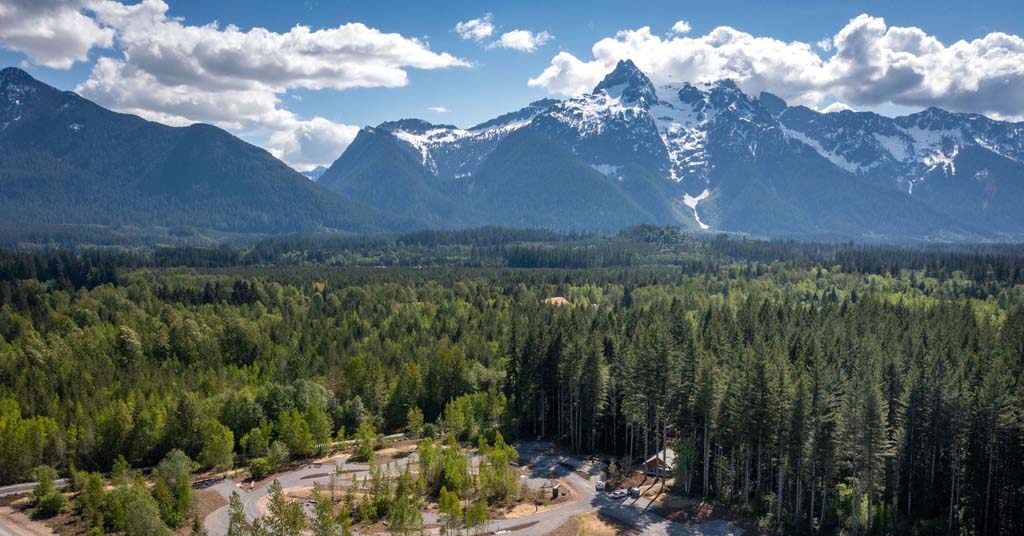
Multiple benefits: Trees around Whitehorse Mountain in Western Washington are valuable for a variety of reasons. That’s the issue. Photo: Snohomish County

By Julie Titone/Everett Herald. August 9, 2023. Some Snohomish County residents have been carrying a checklist while hiking for miles and bushwacking on steep slopes on state lands slated for logging.

What species of trees are there? Are there stumps? Is there a stream? Unusual plants? Signs of wildlife?

Stretching their arms wide and grasping tape measures, they answer a question that is top of mind for companies that would bid to log those properties: What’s the diameter of these trees? Size matters in the timber business.

Size matters, too, for these climate-concerned forest surveyors. Because the bigger the tree, scientists say, the more carbon it stores and keeps out of the atmosphere.

The surveys are part of a campaign to get Snohomish County to do what several other Western Washington counties have done: offer to work with the Department of Natural Resources to protect ecologically complex state forests.

More urgently, they want the Snohomish County Council to take advantage of Climate Commitment Act funds to put some land off limits to logging.

“We want to help the council do this work,” said Kate Lunceford, of the League of Women Voters of Snohomish County, who is leading the campaign.

This is not work council members are used to doing, or necessarily eager to tackle. They listened quietly when nine activists made their case before recent meetings of the council’s Public Infrastructure and Conservation Committee.

County Council members have yet to act on the impassioned public comment and personal visits with activists.

Victoria Tchervenski, a high school student who lives near Brier, asked the County Council in June to “please pause logging on the 6,000 acres of carbon dense, structurally complex, mature forests in the lowlands of Snohomish County.”

Bonny Headley, of Snohomish, shared her conviction that “the trees are more valuable as they stand.” She acknowledged the area’s logging heritage but also mentioned her 6-year-old grandson and concerns for the future.

Headley asked the council to join Thurston, Jefferson and Whatcom county officials in writing to Public Lands Commissioner Hilary Franz, offering to work with her to conserve select forest land.

Since her testimony, King County Council members jumped into the fray, asking the agency to pause the disputed Wishbone timber sale near Duvall.

They want Franz and the DNR board to “work with us to protect the mature legacy forests within this sale area and throughout King County for their climate and biodiversity benefits.”

There are an estimated 77,000 acres of such forests in Western Washington that aren’t already in a conservation area or protected by environmental rules, such as stream buffers.

The parcels have been logged but allowed to regenerate naturally rather than be planted with commercially valuable species.

This year, the Legislature agreed to permanently conserve 2,000 of those acres, providing money for the DNR to buy younger replacement forests.

Those exact acres haven’t been identified.

Competition for climate funds will be keen. Nominations of potentially protected lands can be made starting in August and are due by Dec. 31. They must include letters of county support.

Getting county buy-in

Lunceford and her fellow activists hope to inspire a letter like the one the Whatcom County Council sent in May to Franz and other DNR officials. It asks the state to consult with the county, tribes and other stakeholders regarding stewardship of state lands.

The county, the letter notes, isn’t even consulted when the state logs county-owned trust land. The letter also expresses support for legislative-supported forest protection programs.

The Whatcom County letter opens with a statement of support for the timber industry. That subject is top of mind for Snohomish County Council member Sam Low. He represents heavily forested eastern parts of the county.

“Snohomish County is 1.3 million acres total, about 1 million acres are trees, and two-thirds of that is already protected federal or state forest land,” he said. “Wood has to come from somewhere.”

Low is wary of promises to replace lost timber proceeds and dismissive of the words that activists use to describe not-quite-old-growth forests.

“There’s lots of ‘legacy’ forest already protected, if you want to use their terminology. The language changes, the methods change—it is still pulling more timber out of production,” he said. “There aren’t many mills still open, and even those that are open are struggling to get timber.”

Logging protestors on highway in Washington

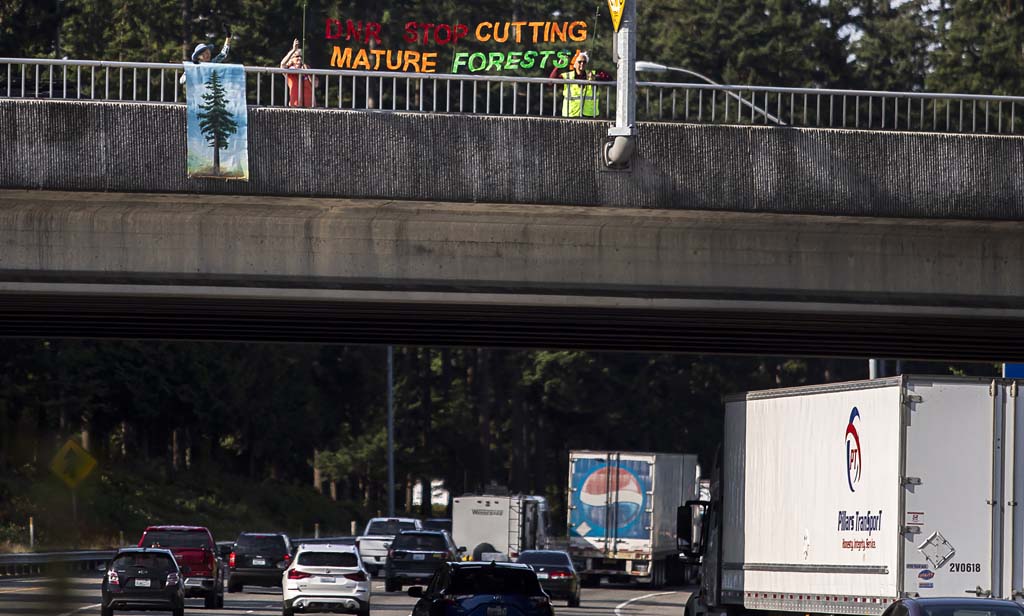
Old debate, new argument: Calls for forest protection, like this on one an I-5 overpass in Everett, Washington, now involve carbon sequestration. Photo: Olivia Vanni/The Herald

In 2021, the Snohomish County timber industry supported 6,013 jobs, according to the Washington Forest Protection Association. There are 385,126 acres available for harvest. Most of it is private land, the source of 70% of Washington’s timber.

Low recalled an unsuccessful effort to stop the 2022 Middle May timber sale near Gold Bar and Wallace Falls State Park.

On a 3-2 vote, the County Council passed a resolution supporting the sale’s progress as soon as possible.

Low, a Republican, voted for it. Democrat Megan Dunn voted no, believing it was against the wishes of residents concerned about the impact on the environment and recreation.

Still, Dunn expressed reluctance to jump into the latest state forest fray.

“The issue of the council working directly with DNR is brand new. That is not a relationship we’ve had before. That’s why we’re resistant to act,” Dunn said. “And it would undermine the tribes if we were to act without their support.”

In the Whatcom County letter, council members asked the DNR to pause logging plans for the Brokedown Palace sale along the Middle Fork Nooksack River until it could be evaluated for inclusion in the state Climate Commitment Act program, or two other programs that would protect it.

One is Franz’s new carbon project, which will lease land for carbon sequestration and storage. Another is Trust Land Transfer, in which DNR-managed forests with high ecological or public benefits go to a receiving agency such as local government, tribe or state parks.

In return, the DNR gets money to buy income-generating land.

The Snohomish County activists pinned hopes on using Trust Land Transfer to prevent the 138-acre Hog Wild timber sale, north of the Sultan River. While county support to pause the sale wasn’t required, the activists sought it. No dice. The trees will be auctioned Aug. 30, for the benefit of the Sultan School District.

Into the woods

With the end-of-year application deadline looming for the Climate Commitment Act funding, the activists are hustling, eager to identify and propose three planned timber sale parcels worthy of the program.

The nonprofit Center for Responsible Forestry is helping. North Sound Regional Coordinator Carly Lloyd told volunteers at a recent survey training session that the DNR doesn’t document the diversity of life in its mature stands before selling the timber.

To fill the void, the center created a checklist—the white printed sheets the volunteers were clutching.

They were standing in the formerly logged North Creek Forest. The Bothell-owned land has characteristics of some sites destined for state logging.

On the prowl to identify species, the volunteers wrote down plants both native and invasive, ticking off blackberries, Oregon grape, devil’s club, maples and many more. They sometimes used plant identification apps to double-check their guesses.

“Sedges have ledges,” someone reminded. They discussed the habitat value of standing dead trees and pointed out decaying “nurse logs” that nurture rows of saplings.

[perfectpullquote align=”full” bordertop=”false” cite=”” link=”” color=”” class=”” size=””]“We are at a very interesting spot in the land management landscape.” —DNR spokesperson[/perfectpullquote]

Lloyd, a Western Washington University student and former volunteer surveyor, called the training session “a reminder of how fun it is to be in the forest.”

She is motivated by the impact of climate change.

“Personally, it’s the main reason I’m doing this,” Lloyd said. “Forests are the biggest life-holders in this region and a backbone for the Salish Sea.”

Among the volunteers-in-training were Tchervenski and other members of the Climate Action Club at Bothell’s Innovation Lab High School.

Lunceford has recruited students for their stamina and enthusiasm.

Reaching remote state forests often involves long hikes past locked gates — while the land is open to the public, roads are often closed. Lunceford laments the agency’s frequent unwillingness to share keys.

“The fact that DNR is making it much more difficult to get through any of these gates is an indication that it recognizes there is a lot of advocacy going on and they don’t want people to advocate for these forests,” she said.

Kenny Ocker, communications manager for DNR, said there are several reasons the gates are locked. A road may be an easement on someone else’s land, or the state’s property has been abused or subject to timber theft. Staff may be unavailable to help.

“We leave as much stuff open as we can,” he said.

Of the 157,000 acres the state manages in Snohomish County, only half is available for forest management, Ocker said.

DNR faces dueling legal mandates of making money off public lands for public benefit, while also protecting the environment.

“We are at a very interesting spot in the land management landscape,” Ocker said.

By |2023-08-09T08:53:39-07:0008/09/2023|Forestry|0 Comments

Washington ferries plan to go all electric by 2040 gets boost

Federal government is providing more assistance, attention to plan that could save 19 million gallons of diesel fuel a year

Mukilteo Multimodal Ferry Terminal interior

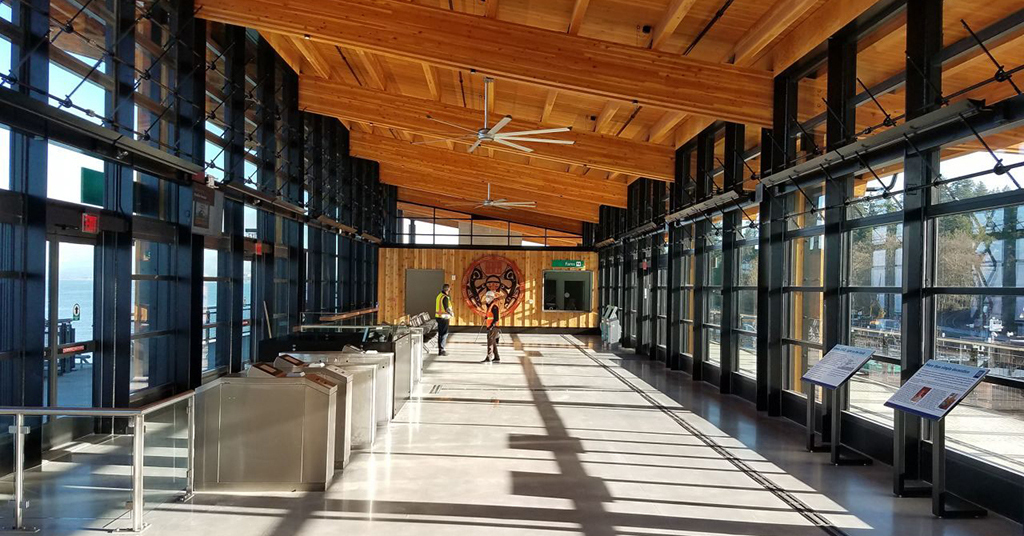
Long way to go: Opened in December 2020, the Mukilteo Multimodal Ferry Terminal replaced a long-outdated 1957 structure. It was the ferry system’s first new terminal in 40 years. Photo: WSDOT

By Sydney Jackson, Everett Herald. July 18, 2023. Washington State Ferries is the largest ferry system in the United States and the second largest in the world for vehicles carried.

With an aging fleet (as of 2021, all but 12 of its 21 auto-passenger vessels were over 30 years old) and ridership growth of 30% expected over the next 20 years, the system faces multiple challenges.

Help—and innovation—are coming.

Last year, the federal government awarded Washington State Ferries $38 million for boat maintenance and renovations, mostly from the $550 billion Bipartisan Infrastructure Law passed to fund projects across the country.

This more than doubled the year’s federal funding for the state ferry system.

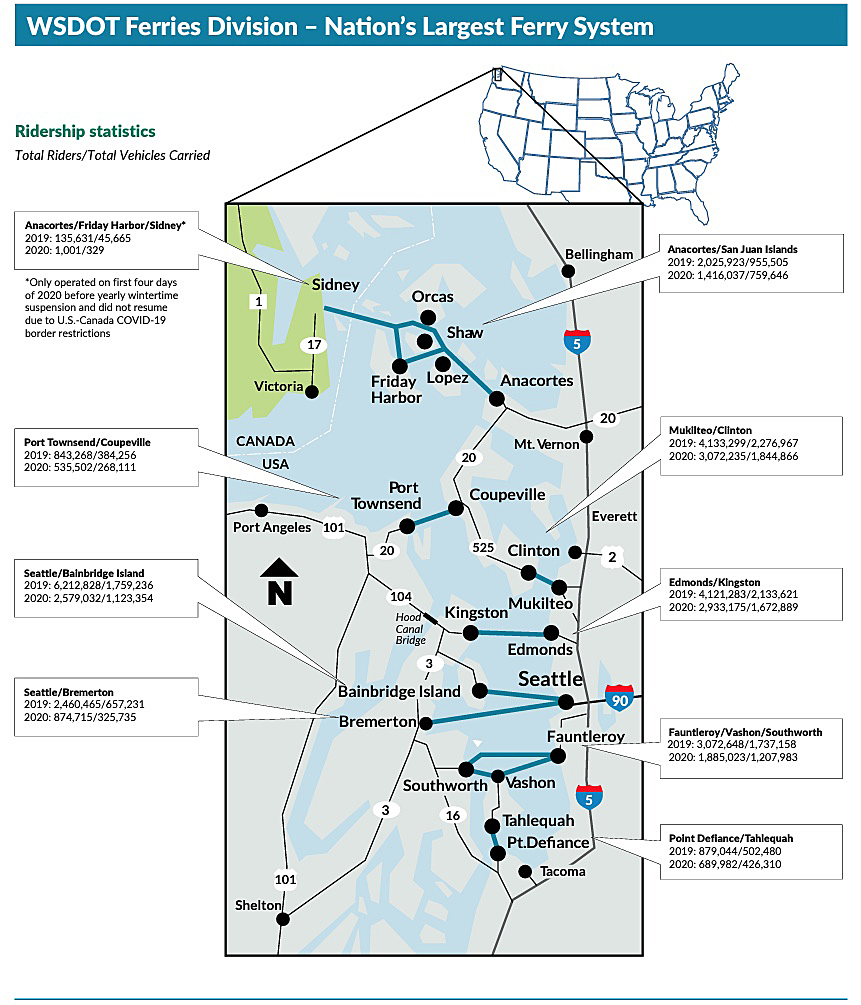
Additionally, a $4.9 million federal grant is funding the construction of a ferry charging station in Clinton on Whidbey Island. The station will charge two future hybrid-electric ferries on the Mukilteo-Clinton route.

This is all part of the ferry system’s plan to transition to an emission-free fleet by 2040, which will help curb the 19 million gallons of diesel fuel the ferry system burns through each year. The plan commenced in 2020.

The Mukilteo-Clinton route is the start of the electrification process. The state plans to have the first retrofitted hybrid ferry—replacing two diesel engines with batteries—by 2027.

The station in Clinton will charge the ferry in the 15 minutes it takes to load and unload passengers throughout the day, then charge during the night.

By 2040, the state plans to have six retrofitted hybrid boats and 16 new electric boats.

In the event of an emergency that affects the power grid, such as an earthquake, hybrid boats would continue to run.

Buttigieg visits

Located about 26 miles north of Seattle, across from the Whidbey Island port of Clinton, the Mukilteo Multimodal Ferry Terminal is the newest and greenest ferry terminal in the state. It opened in December 2020.

It has a roof that captures rainwater, operable windows that negate the need for air conditioning and cement barriers that make it resilient to seawater rise.

The terminal was designed like a modern longhouse to honor the Tribes who lived on the land and eventually signed the Point Elliott Treaty there almost 170 years ago.

Washington State Ferries route map

Map: WSDOT

On July 6, U.S. Transportation Secretary Pete Buttigieg visited Mukilteo to discuss how federal dollars are impacting Washington’s ferry system and infrastructure.

During his visit, Buttigieg noted the importance of working with Tribes “to have this kind of responsible, sustainable transportation growth.”

“We were traditionally a fishing tribe who met here,” Tulalip Tribes Chair Teri Gobin said during the visit.

Gobin said tribes used to be able to make a good living from fishing, but they now have to subsidize with other activities like crabbing. She said electrifying the ferry system will continue the fight against climate change and help restore fishing runs.

“This is a strategic point in our history to make changes to support the environment,” said Gobin.

Ferries integral to update goals

Gov. Jay Inslee, who met with Buttigieg, said ferry electrification is part of the Climate Commitment Act the state passed in 2021, which includes creating more sustainable aviation fuel and installing 700 charging stations for electric cars.

Despite criticism that the law has raised gas prices, the governor said ferry prices will remain the same.

“We can run these boats less expensively,” said Inslee. “We’re leading the nation in electrifying almost every transportation system, starting with the ferry boats.”

“Not everybody realizes that ferries are an integral part of the daily commute of so many Americans,” Buttigieg said while touring the second floor of the Mukilteo terminal that overlooks Puget Sound.

The state ferry system employs about 2,000 people, but the industry needs more workers. As of 2021, approximately half of vessel employees were 55 years old or older.

Buttigieg said his department’s Low or No Emission Vehicle Program has carved out money for workforce training, including a maritime academy.

Originally published in the Everett Herald, this story has been updated by Columbia Insight.

By |2023-07-18T08:50:09-07:0007/18/2023|Transportation|0 Comments

Zero Emissions: New breed of airplane gets a party in Washington

In race to reduce airline industry’s reliance on petroleum-based fuels, hydrogen- and electric-powered aircraft are the most promising technologies

Zero emissions airplane on display in Everett, Wash.

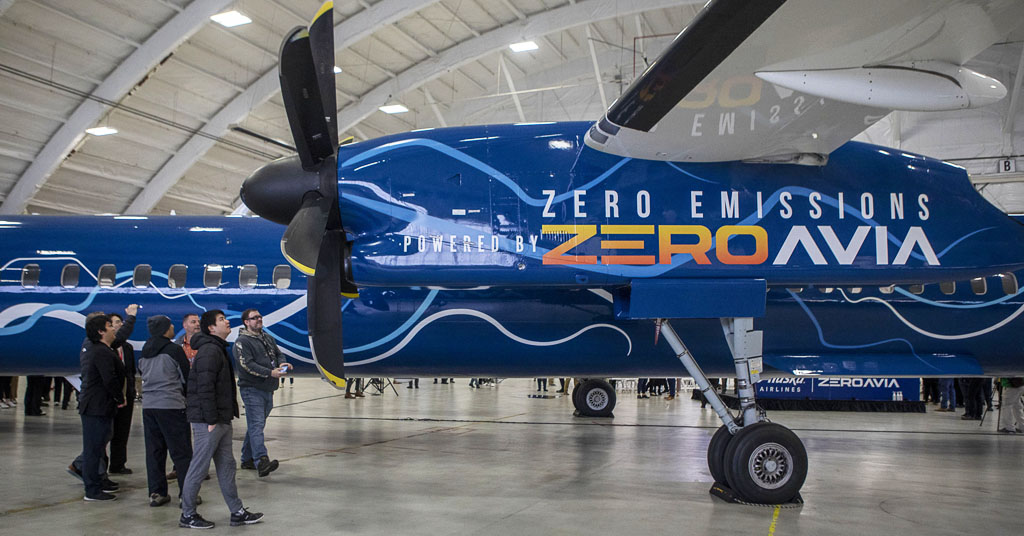
Revolution in the air: ZeroAvia is developing a hydrogen-electric propulsion system for aircraft. Photo: Annie Barker/The Herald

By Janice Podsada/Everett Herald. May 2, 2023. Keys to city, keys to the car. It’s not every day someone is handed the keys to a commercial airplane, but that’s what happened Monday at Paine Field in Everett, Wash..

Alaska Airlines CEO Ben Minicucci turned over the keys to a 76-seat Bombardier Q400 to Val Miftakhov, CEO of ZeroAvia.

The big turboprop, tail number N441QX, is a former Alaska Airlines commercial passenger plane. Now painted blue and white, it was emblazoned with a “Powered by ZeroAvia” livery and the words, “Zero Emissions.”

The aircraft, also known as a Dash 8-400, will be retrofitted with a hydrogen-electric propulsion system.

ZeroAvia is developing a hydrogen fuel-electric propulsion system large enough to power the Bombardier and other aircraft of its size some 500 miles.

The London-based company hopes to debut a commercial version by 2028.

“Our next regional airplanes are going to be green,” Minicucci said.

Alaska’s regional subsidiary, Horizon Air, operates a fleet of Dash 8s that serve large and small airports in the Northwest.

Alaska Air Group, Alaska Airline’s parent company, is an investor in the aerospace company.

Other ZeroAvia investors include British Airways, Amazon’s Climate Pledge Fund and Bill Gates’ Breakthrough Energy Ventures.

Alaska Airlines’ vow to end carbon emissions

ZeroAvia, which has offices in London and Hollister, Calif., recently opened a research and development center at Paine Field.

Founded in 2018, the aerospace company received a $350,000 Washington State Department of Commerce grant last year to remodel a warehouse at the southern end of the airfield.

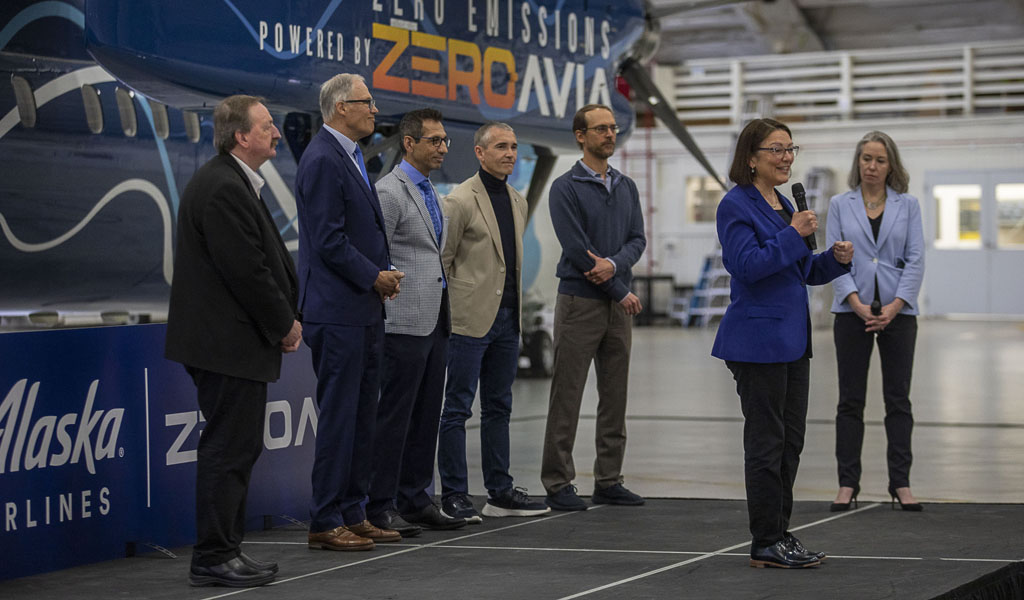
More than 100 people, including Gov. Jay Inslee, Democratic U.S. Rep. Suzan DelBene, Snohomish County Executive Dave Somers and Everett Mayor Cassie Franklin gathered inside a hangar at the Snohomish County-owned airport to witness the hand off.

“Isn’t it great the world’s largest commercial hydrogen-powered aircraft is being developed here in Washington state,” Inslee told the crowd. “A super shout out to Alaska Airlines for the use of their airplane.”

The Seattle-based airline has pledged to eliminate its carbon emissions by 2040.

U.S. Rep. Suzan DelBene speaks at event for Alaska Airlines and ZeroAvia

Power players: U.S. Rep. Suzan DelBene speaks at event for Alaska Airlines and ZeroAvia in Everett, Wash. on May 1. Photo: Annie Barker/The Herald

Monday’s event included a short, runway demonstration of the company’s ZA2000 power train. The propeller and motor assembly were mounted on a truck.

“This is the propulsion system that will be used for this Q400 aircraft and similar aircraft,” CEO Miftakhov said. “This is a full-size propeller and the propulsion system is able to deliver full power to the aircraft.”

At 107 feet in length, the Dash 8 is about the size of a 76-seat Embraer-175, which Horizon Air operates on many of its routes to and from the Everett passenger terminal.

DelBene called the partnership “critical to moving toward a cleaner energy economy.”

For 14-year-old Sydney Bottorff, a student at Raisbeck Aviation High School in Tukwila, it was “exciting to be a part of a piece of history.”

“This is a big deal,” said Bottorff, who was joined by about 20 of her classmates.

Hydrogen can either be burned as a fuel in a jet engine or it can be used to power a hydrogen fuel cell, which uses chemical energy to produce electricity.

ZeroAvia’s engine and power train are built around renewable hydrogen that is stored in tanks. During flight, fuel cells convert the stored hydrogen to electricity, which powers the airplane’s electric motors.

With a zero-emission hydrogen-electric propulsion system, the only byproduct is water vapor, the company said.

The company hopes to produce a hydrogen-electric power train with a 570-mile range by 2025 that can power a 10- to 20-seat aircraft.

By 2028, it hopes to scale up the propulsion system to support a 50- to 80-seat aircraft, such as the Dash 8.

“You need need to get away from combustion and the only way to do that is to electrify the airplane,” Miftakhov said. “Batteries do not have enough energy to power an aircraft like this one for hundreds and hundreds of miles, so you need to use a different energy carrier to produce electricity and hydrogen is the best fuel to use.”

Race is on

Should ZeroAvia or another company achieve success, the market potential is huge: nearly half of all scheduled commercial flights are 500 miles or fewer, according to OAG, an aviation and travel data firm.

About one-third of Alaska Airline flights are regional flights with a 500-mile range, the company said.

Earlier this year, ZeroAvia completed a 10-minute test flight of a 19-seat, twin engine turboprop at Cotswold Airport in Gloucestershire, England. The Dornier 228 was retrofitted with a prototype hydrogen-electric power train on the left wing.

ZeroAvia said that the test flight represented “the largest aircraft in the world to be powered by a hydrogen-electric engine.”

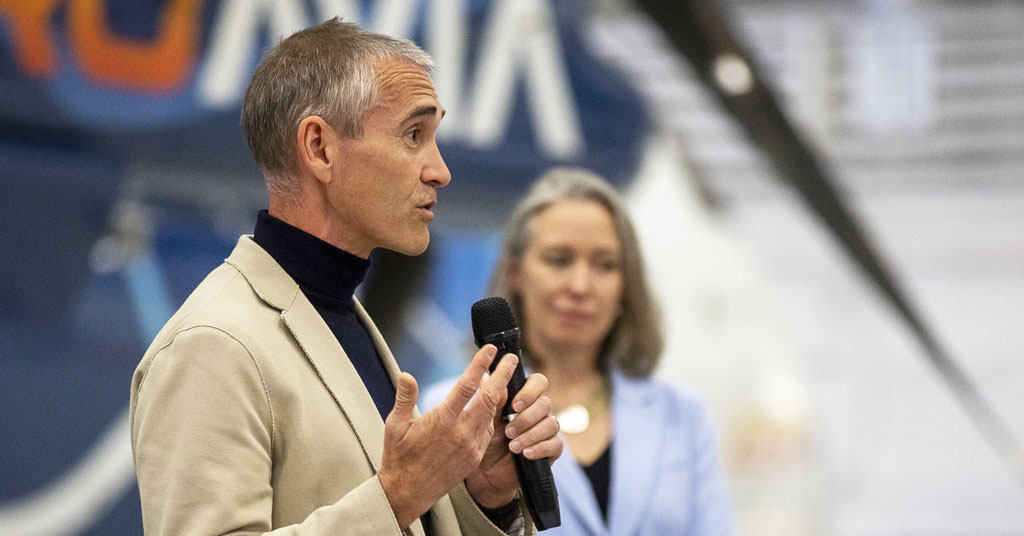
ZeroAvia CEO Val Miftakho

Here’s the pitch: ZeroAvia CEO Val Miftakhov. Photo: Annie Barker/The Herald

In recent years, a small but growing number of firms focused on sustainable aviation fuels, including magniX in Everett and Eviation Aircraft in Arlington, have located in Snohomish County. magniX and Eviation built a fully electric nine-seat commuter airplane and conducted an eight-minute test flight last fall.

The race is on to reduce or eliminate the airline industry’s reliance on conventional petroleum-based fuels. So far, hydrogen-powered and electric-powered aircraft have emerged as the most promising technologies.

Aviation is responsible for 9% of transportation emissions in the United States and 3% of the nation’s greenhouse gas production, according to the Environmental Protection Agency.

By |2023-05-04T15:50:04-07:0005/02/2023|Energy, News|0 Comments

© Copyright 2013-2025 Columbia Insight. All Rights Reserved.

As a 501(c)3 nonprofit organization, all donations to Columbia Insight are tax deductible to the full extent of the law. Our nonprofit federal tax-exempt number is 82-4504894.