Can we engineer a way out of water shortages and a looming agricultural crisis? An ISU professor is working on it
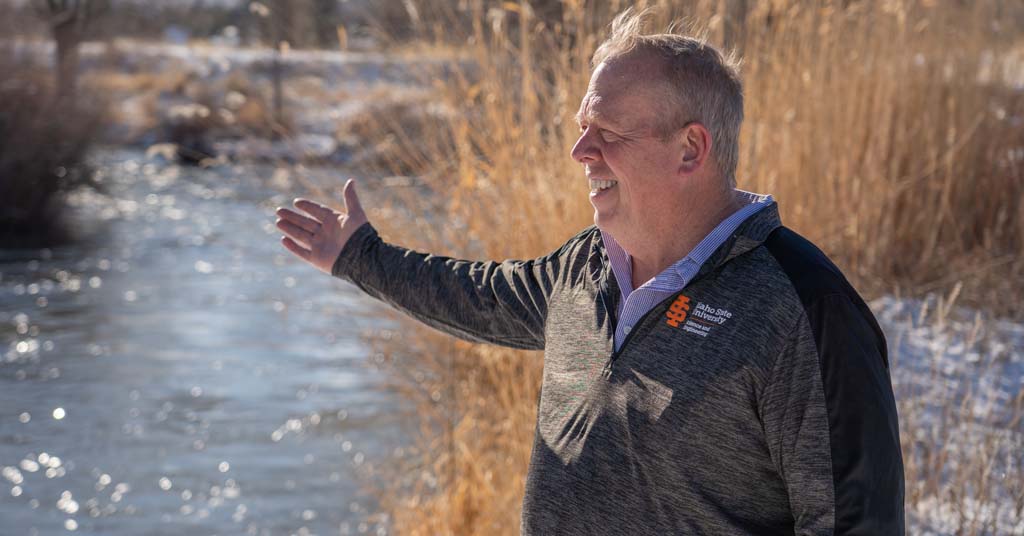
Going underground: Bruce Savage, Idaho State University chair of Civil and Environmental Engineering, is excited about subterranean water storage. Photo: ISU
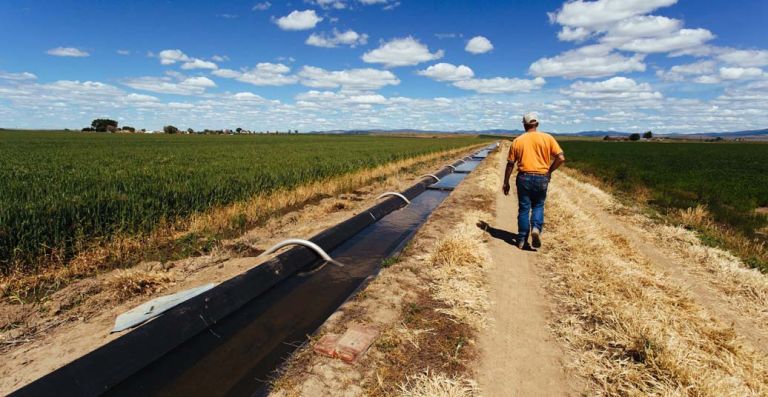
By Kendra Chamberlain. February 24, 2026. Idaho ranks third in the United States for total water use, and second in the nation for irrigation withdrawals. About 22,500 farm operations are in business around the state.
Like much of the West, its government, farmers and other residents are worried about its future water supply.
Water managers in the state are drilling wells to help recharge the Eastern Snake Plain Aquifer. They’ve hammered out a painful agreement with the agriculture industry to reduce water use in an attempt to protect the state’s farming interests.
Now Bruce Savage, professor and chair of Idaho State University’s Department of Civil and Environmental Engineering, and his team have another idea: what if excess snowmelt could be stored underground?
Savage and James Mahar, senior lecturer in the Department of Civil and Environmental Engineering, have assembled a team of researchers across ISU and Boise State University to look into bringing the idea of a massive, subterranean reservoir in Idaho into reality.
The water cycle west of the Rocky Mountains is dependent on heavy winter snowfall that generates spring and summer snowmelt that fills streams, creeks and drainages that feed into the larger rivers. Idaho captures some of that water through a system of dams and reservoirs. But once reservoirs are full, the rest filters down into the aquifers, or is carried out to the Pacific Ocean.
This year, Idaho is experiencing its warmest winter since 1934 and a dangerously low snowpack.
Savage wants to construct subsurface dams and “infiltration galleries” to help capture more snowmelt water and direct it underground where it could be stored until it’s needed in the summer months.
“If we could store it for later use, we can actually send it down through the river system,” Savage told Columbia Insight. “It’ll be a benefit to not only those that have water rights, but to the whole river system.”
Gaining ground
Underground dams are at least 2,000 years old but it wasn’t until the 1980s that the first ones were built using modern civil engineering techniques, according to International Water Power (IWP), a trade publication for the hydropower and dam construction industries.
“Since then they can be found in countries such as Japan, Brazil, India, South Korea, Mexico, Bolivia, the United States and across Europe. … With surface water resources becoming under increasing pressure due to population growth and climate change, certain schools of thought believe groundwater offers a possible way forward for the future,” according to a 2025 IWP article titled “The rise of underground dams.”
Underground dams work by constructing a watertight cut-off wall within an aquifer, effectively raising the groundwater level.
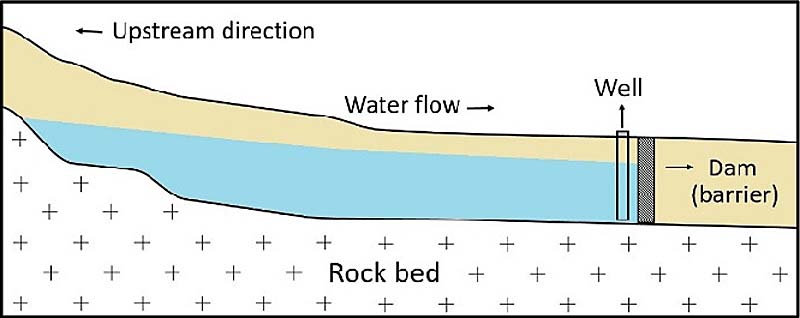
Underground dam principle of operation: Illustration: ResearchGate/Springer Nature
A major benefit to storing water underground is reduced evaporation, a persistent issue with reservoir storage. Underground dams can protect water from some contaminants. They’re a comparatively economic way of managing groundwater in semi-arid regions. Unlike surface dams, they leave the land above them unchanged.
There are environmental concerns.
Recent research in Japan has focused on underground dams’ possible effect on increasing the NO3-N concentration in groundwater. NO3-N, also called nitrate-nitrogen, is a highly mobile contaminant found in water or soil.
In Idaho, where the concept is new, proponents of building an underwater dam are facing more fundamental questions. For one, where might this subterranean reservoir be located?
“We’re looking for appropriate sites that have the geology that would support this type of concept, alluvial deposits, a lot of sand, gravel and cobbles,” said Savage.
Any underground barriers will need to strike a delicate balance between storing “excess” water without interfering with the “normal” water systems.
“What we don’t want to do is impact the natural flow of water that people are already using,” said Savage. “But there are some areas where the snowmelt comes off so fast that the water doesn’t have a chance to get down underground.”
The research, which includes a two-year study, is part of the Idaho Community-engaged Resilience for Energy-Water Systems (I-CREWS) collaborative research project, which is funded through the National Science Foundation.