
Facing an uncertain future, the Watershed Alliance of Southwest Washington explains its decision to cease operations
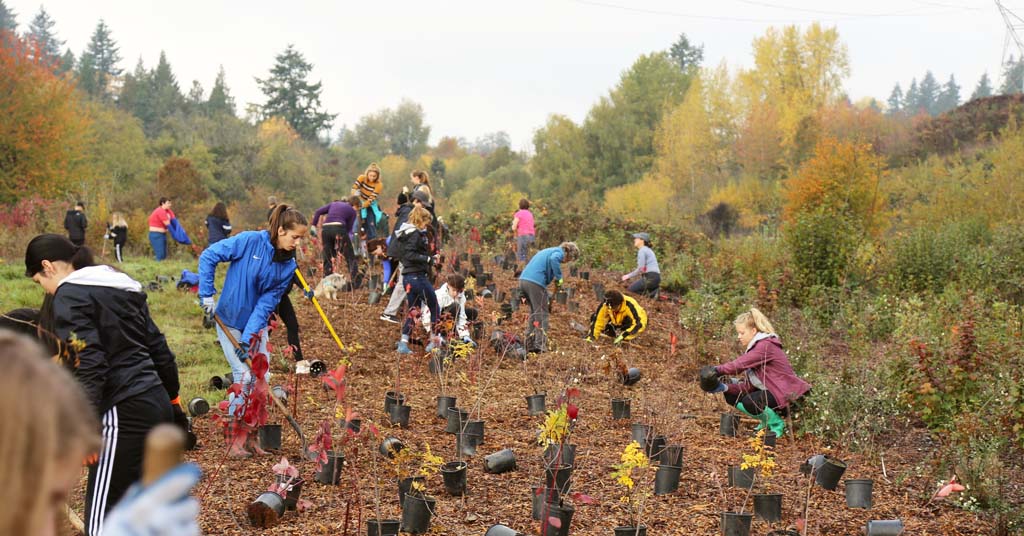
Ground zero: Watershed Alliance of Southwest Washington volunteers, like this group along Burnt Bridge Creek in Vancouver, have added hundreds of thousands of native plants to local landscapes. Photo: Watershed Alliance of Southwest Washington
By Kendra Chamberlain. October 14, 2025. For the past 17 years, the Watershed Alliance of Southwest Washington, a nonprofit organization based in Clark County, Wash., has planted hundreds of thousands of trees along creeks, streams and rivers. This year will be its last.
The organization is the latest casualty of an uncertain funding climate and local and federal budget cuts to environment-focused programs.
The group formed in 2008 as the Vancouver Watershed Alliance, focusing most of its work on habitat restoration along Burnt Bridge Creek near Vancouver, Wash. It eventually expanded operations across southwest Washington.
The group received $150,000 from the City of Vancouver each year through a contract renewed in five-year increments. But in 2024, the city faced a $43 million budget deficit, and was unable to renew its contract with the group.
That’s just part of a wave of funding challenges washing over the nonprofit.
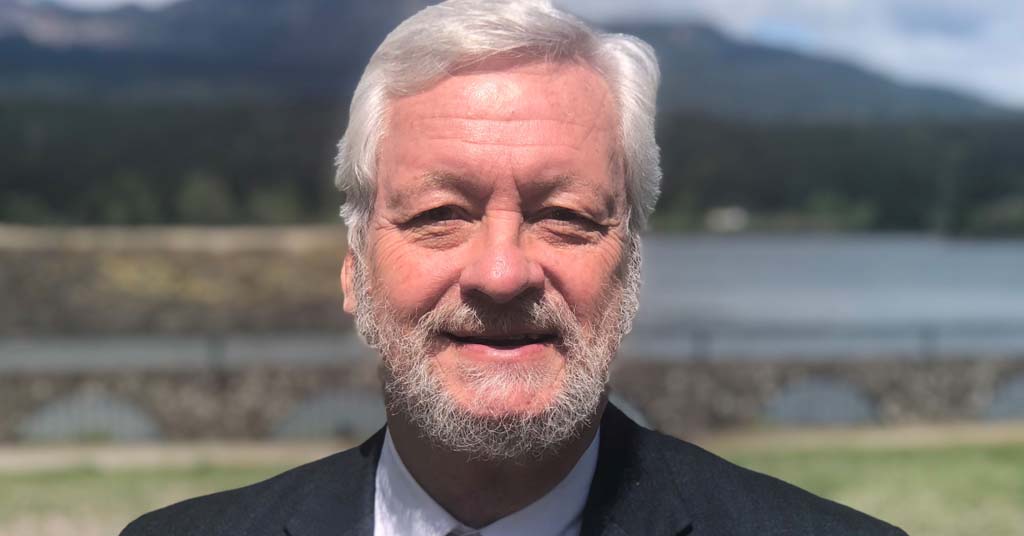
“This is not a decision we ever imagined making and it comes only after much reflection, careful consideration and countless conversations,” Sunrise O’Mahoney, executive director of the group, said in an Oct. 7 email newsletter. “In the end, shifting funding priorities and delays in key projects made it impossible for us to continue our programs into 2026.”
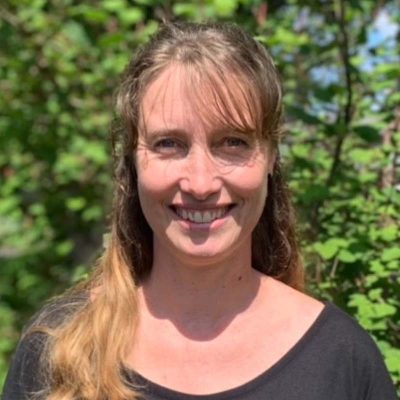
Sunrise O’Mahoney. Photo: Watershed Alliance of Southwest Washington
The Alliance conducted most of its work through volunteer events like tree planting, ivy pulling and beach litter pickup. These events, which often attracted 50 to more than 100 participants, enabled the organization to foster a strong link between communities and the land.
“We are bringing in large numbers of volunteers. We have young kids, babies, all the way up to 92. We have people of all ages and all backgrounds, and so diverse in that sense,” O’Mahoney told Columbia Insight this week. “We can put in 3,000 plants during a three-hour event.”
O’Mahoney estimates the organization has planted some 200,000 plants.
“That’s a massive number of plants. Not just plants in general, but native plants,” said O’Mahoney.
Most of that planting has been conducted in publicly owned spaces and protected areas around creeks and rivers. Those trees and shrubs will grow for decades to come as part of the legacy of the Alliance and its work.
“You can’t take that away,” said O’Mahoney.
Volunteer events will continue throughout the year as planned. The Alliance also runs a popular Backyard Habitat Certification program, which will continue under the management of the Columbia Land Trust and Bird Alliance of Oregon.
But the Watershed Alliance of Southwest Washington will officially shutter on Dec. 31, 2025.
O’Mahoney is hopeful other groups will step up to fill the void left behind.
“It’s a big loss in the community to not have the degree [of volunteer events] that we were doing,” she said. “Anytime any group leaves, it will leave a hole, no matter who they are.”






What a loss. Thank you for al the good work done.
`When the Watershed Alliance lost the $150,000 annual grant from the City of Vancouver last year, that left too big a financial hole for small donors to fill. The Watershed Alliance hung on through the recent Give More 24! community giving campaign but still wasn’t able to raise enough donations to make up the deficit. Sunrise and her team announced the decision to close soon after. It is a great loss to Vancouver and Clark County and local habitat restoration, and to countless students who used the volunteer planting events as a way to earn their community service hours.
It was not only the planting of trees and shrubs, it was the planting of the seed of love for our planet and our community. It was the most congruent organization I knew. THANK YOU WATERSHED ALLIANCE we hope to see you come back in the near future.