
A battle between conservation and commerce is underway in the National Scenic Area. At stake is the Gorge’s future
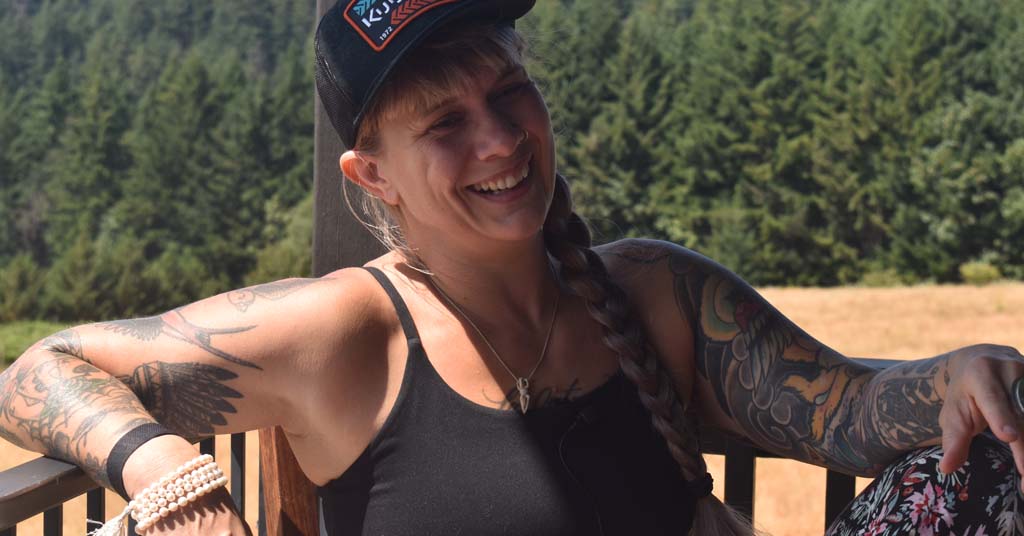
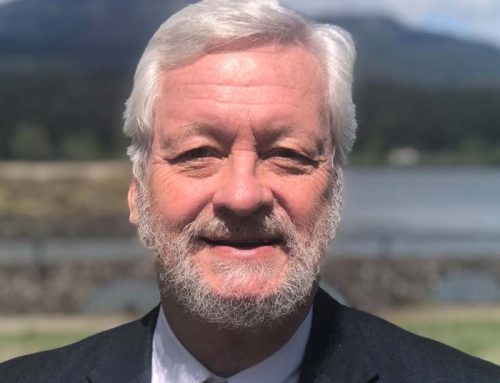
Mover, shaker: Laura Brennan Bissell bought property in the Columbia River Gorge National Scenic Area in 2021. She became a Gorge commissioner in 2024. Now she wants changes. Photo: Oregon Wine History Archive at Linfield University
By Nathan Gilles. March 4, 2026. In the summer of 2025, a conflict that had been brewing in emails and meetings at the Columbia River Gorge Commission came to a very loud and public climax when a county-appointed commissioner accused two other county-appointed commissioners of sexism.
But the dispute over who should chair a new committee was about more than sexism.
Public records and interviews conducted by Columbia Insight reveal a years-long disagreement over how the Columbia River Gorge National Scenic Area’s dual mandate—to protect the Gorge while supporting economic development—should be interpreted and enforced.
During the Gorge Commission’s July 8, 2025, meeting held in Cascade Locks, Ore., Gorge Commissioner Michael Mills, acting chair and Hood River County’s representative on the commission, read a public apology letter to Gorge Commissioner Laura Brennan Bissell, Skamania County’s representative on the commission.
The letter referred to a committee meeting held via Zoom on June 24, 2025, during which Mills, Brennan Bissell and other Gorge commissioners voted on who would lead the Commission’s new Economic Vitality Committee.
During the meeting, Brennan Bissell nominated herself for committee chair. Mills opposed her as chair, expressing reservations about her qualifications to lead the committee.
In his apology to Brennan Bissell, Mills stated that he’d acted inappropriately in his role as chair in expressing his reservations about Brennan Bissell.
“I expressed my concerns about Commissioner Brennan Bissell’s readiness to serve as chair on that committee,” Mills told the gathered room. “My disagreement with her candidacy for committee chair was never meant to diminish her expertise in agriculture and business.”
Brennan Bissell wasn’t having it.
In her response to Mills, Brennan Bissell said she was “corralled” at the June 24 meeting, describing how Mills and another Gorge commissioner, whom she did not name, opposed her for chair during the Zoom meeting.
Using the word “misogynistic,” she noted that the committee chair went to a man, who did not have to undergo the same degree of scrutiny as she did.
“It was two men who are much older than me that did this,” Brennan Bissell told the crowd after Mills read his apology letter at the July 8 meeting. “It felt like there was a lot of gaslighting … the person who received the chair position wasn’t even asked for their credentials as I had been by multiple people.”
Brennan Bissell was defended by Commissioner Valerie Fowler, Klickitat County’s representative on the Gorge Commission, who described Mills’ and other commissioners’ behavior toward Brennan Bissell as “sexist at the best.”
At the Cascade Locks meeting, Robert Liberty, Gorge commissioner for Multnomah County, acknowledged he was the other older man Brennan Bissell was referring to.
But Liberty hinted at a more complex story, telling the Cascade Locks crowd that, yes, he had lost his temper at the meeting, but that he’d opposed Brennan Bissell as chair due to “aspersions” made against him in “other public settings” when he wasn’t there to defend himself.
In an interview with Columbia Insight, Mills, a former ombudsman, described Brennan Bissell’s statements accusing him of sexism as the “worst thing I’ve ever been accused of.”
Liberty called the accusations against him “ridiculous.”
“I might as well accuse her [Brennan Bissell] of homophobia,” Liberty told Columbia Insight. “Which I did not, because it’s silly to do that. It’s a way of avoiding talking about the merits by throwing up these accusations in favor of the bully playing the victim.”
Liberty is married to a man and has been open about his relationship to the other commissioners.
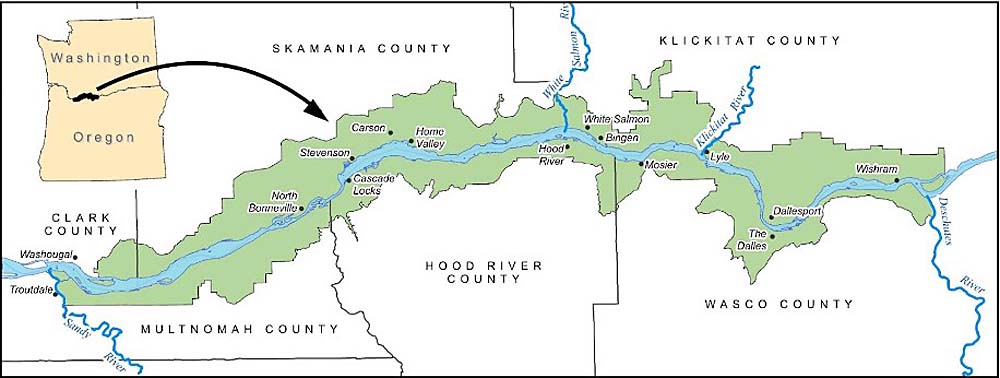
Columbia River Gorge National Scenic Area. Map: Columbia River Gorge Commission
On its surface, the July 2025 exchange appears to be about sexism, ageism and Mills’ judgment as Gorge Commission chair.
But video and audio recordings of public meetings, public documents, including emails received through a public records request, and interviews conducted for this story paint a picture of a fight between conservationists and development interests over control of the Columbia River Gorge National Scenic Area and the bi-state Gorge Commission created to protect it.
It’s a conflict rife with misunderstandings and misinformation.
In the battle for control of the Gorge Commission, Brennan Bissell and Skamania County lead the pro-development faction.
The pro-conservation faction had been spearheaded by Mills and Liberty.
Mills, 71, resigned from the Gorge Commission at the end of 2025 for reasons not associated with Brennan Bissell’s accusations.
Liberty, 72, left shortly after, stating in his resignation, “the Commission is under increasing and unceasing attacks from development interests and ideologues who are opposed to government restrictions and perhaps any government at all.”
Advancing “economic vitality”
The June 24, 2025, meeting of the Economic Vitality Committee, when Mills and Liberty opposed Brennan Bissell, was the committee’s first meeting.
Credit for creation of the committee goes largely to Brennan Bissell, according to multiple sources interviewed for this story. The idea was supported by Klickitat County Commissioner Valerie Fowler, who told Columbia Insight in an email, “I am proud to have been a strong voice calling for the restoration of an Economic Vitality Committee for the Gorge Commission.”
Creation of the committee marked a major shift pushing the Gorge Commission in a business-friendly direction.
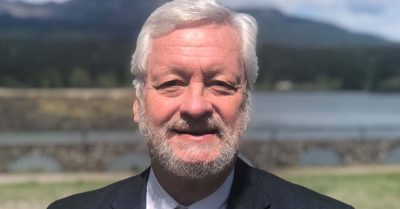
Robert Liberty. Photo: Columbia River Gorge Commission
It was also a clear win for elected officials of Skamania County, who have long argued that the county government’s coffers are stifled by the National Scenic Area’s strict land management rules.
Brennan Bissell, a winemaker from California who purchased a farm inside the NSA in 2021, has served as a Gorge commissioner since 2024, using her position to effectively push Skamania County’s agenda within the Gorge Commission, and bringing what one commissioner described as a “fiery nature.”
Liberty, a steadfast conservationist and former executive director of 1000 Friends of Oregon, while taking very different policy positions from Brennan Bissell, nonetheless credits her with putting policy back in the driver’s seat.
“One of the criticisms Commissioner Brennan Bissell made is that the commission spends its time dealing with trivia and listening to staff reports and not discussing big policy issues,” said Liberty. “I agree with her 100% on that point.”
The policy changes sought by Skamania County and being pushed by Brennan Bissell on the Economic Vitality Committee would make it easier to build within the NSA, and include loosening restrictions on auxiliary dwelling units, or ADUs.
“I support the Commission working to develop [policy change] that reflects the conditions in the Gorge today, as more small-scale farms, wineries, and cideries have joined large-scale orchards that existed when the Act was signed in 1986,” said Fowler.
Debates over potential policy changes, however, have been overshadowed by outside actions taken by both Brennan Bissell and Skamania County officials.
Records show that while representing Skamania County, Brennan Bissell has mixed legitimate county concerns with inaccurate statements about the Gorge Commission and NSA planning rules, and, Liberty says, his policy positions.
This has left the Gorge Commission’s Executive Director Krystyna Wolniakowski, to correct the record and attempt to mend relationships behind the scenes.
At the same time, Skamania County officials have launched what some described to Columbia Insight as a pressure campaign aimed at discrediting the Gorge Commission.
Pro-development coalition seizes the offensive
Criticism of the Gorge Commission reached a temporary zenith in March 2025. That’s when lawmakers in the Washington State House of Representatives passed a budget proposal that included an amendment that would eliminate the state’s funding for the bi-state commission responsible for regulating land development inside the Columbia River Gorge National Scenic Area.
The Columbia River Gorge Commission is jointly funded and operated by Oregon and Washington.
The Washington House and Senate eventually agreed to fund the Gorge Commission for the 2025–27 biennium but cut its state funding by 27%.
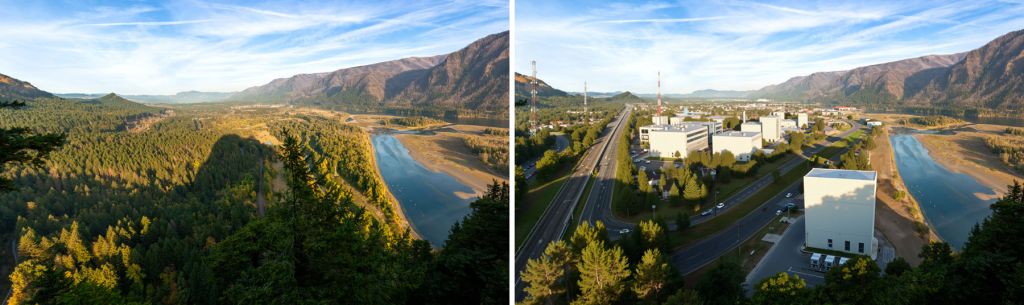
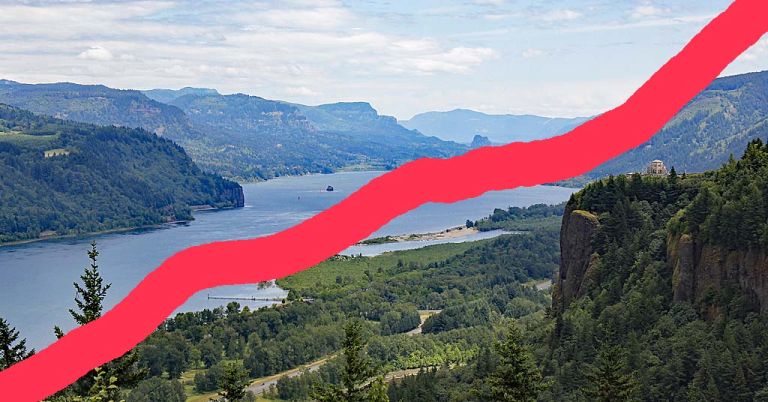
Imagine that: In 2025, Friends of the Columbia Gorge released AI-aided renderings of what the Gorge might look like without National Scenic Area restrictions. The view today (left) from the Washington side of the Gorge at Beacon Rock might be quite different. Image: Friends of the Columbia Gorge
Criticisms of the commission mixed longtime economic grievances with inaccurate information.
Misinformation or not, Skamania County and Brennan Bissell’s efforts have produced tangible results.
Under pressure from the Skamania County Board of Commissioners, the U.S. Forest Service has paused purchases of private land in Skamania County for preservation purposes.
And with the Economic Vitality Committee brought into existence, Brennan Bissell has used it to push for changes to NSA regulations that could benefit Skamania County businesses and landowners like her.
Brennan Bissell is now co-chair of the committee.
Skamania County and Brennan Bissell’s combined efforts have also forced the Gorge Commission and Friends of the Columbia Gorge, the Columbia Gorge’s leading conservation organization, into damage control over accusations of unethical cooperation between the government agency and the nonprofit.
Meanwhile, behind closed doors, emails show the Gorge Commission’s Wolniakowski working with staff at Friends of the Columbia Gorge to address “mis-information” publicly presented by Brennan Bissell.
These emails show Wolniakowski and staff at Friends of the Columbia Gorge confused by inaccurate public statements made by Skamania County commissioners.
Why any of this is happening at all requires a trip to Skamania County.
Turbulent history
The Columbia River Gorge National Scenic Area straddles both sides of the Columbia River, and includes sections of Multnomah, Hood River and Wasco counties on the Oregon side, and Clark, Skamania and Klickitat counties on the Washington side.
According to the Forest Service more than 2 million visitors recreate in the NSA each year.
Especially for young people and newcomers to the region, it’s easy to take the Gorge for granted. In thrall of its spectacular scenery, one might assume that preservation of the Gorge’s natural beauty has forever been a priority in Washington and Oregon.
This, however, is not the case.
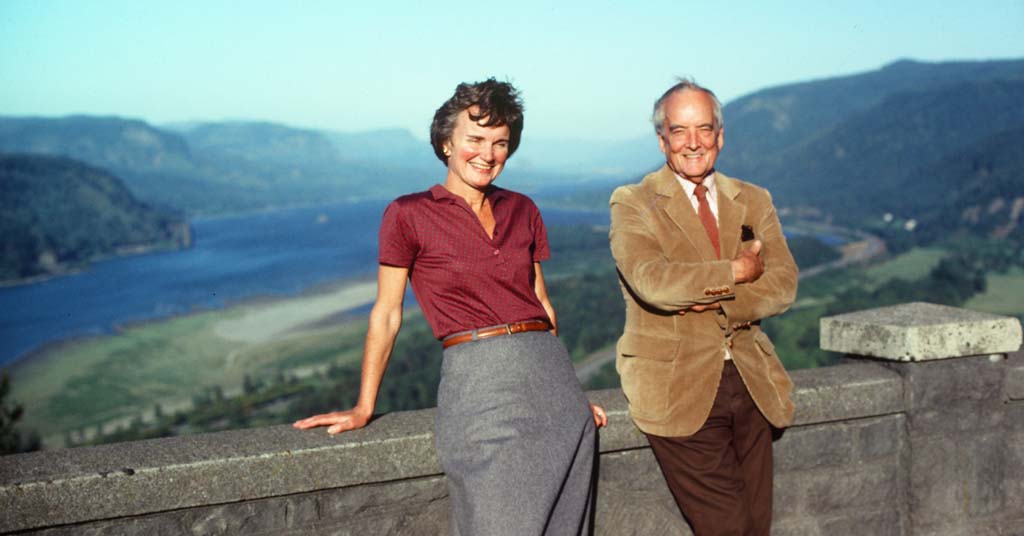
Crowning achievement: Friends of the Columbia Gorge Founder Nancy Russell and Portland architect John Yeon, whose opposition to industrialization of the Gorge began in the 1930s, were instrumental in getting the National Scenic Area established. They posed at Crown Point on the Oregon side of the NSA in 1980. Photo: Russell Archives
For most of the 20th century, the Gorge was a giant industrial corridor bearing scant resemblance to a magical getaway for hikers, bikers and wind surfers.
Smoke belched from mills that processed old-growth timber taken from the Gorge’s forested hills. A string of aluminum smelters along the Columbia River added to the noxious atmosphere. A landmark 1963 lawsuit—Martin vs. Reynolds Metals Co.—proved that airborne particles from an aluminum reduction plant in Troutdale, Ore., caused illness to humans and cattle, hastening the industry’s regional demise.
For much of the 20th century, conservation groups fought for land protections and regulations to curb extractive and other commercial activities. These efforts met fervent opposition in rural counties, most aggressively, as remembered by those on both sides of the battle, from community leaders and timber interests in Skamania County.
In 1986, conservationists achieved a long-deferred dream when President Ronald Reagan signed the Columbia River Gorge National Scenic Area Act.
Skamania County commissioners commemorated the event by having the flags in front of the courthouse in the county seat of Stevenson flown at half-staff.
Since then, opposition to federal protections in the Gorge has tamed but never come close to disappearing.
Established in 1987, the Columbia River Gorge Commission is tasked with protecting the National Scenic Area. It does this through an ability to stop development projects by overruling county planners on projects concerning land outside of urban growth boundaries but within the 83-mile-long scenic area.
The governors of Washington and Oregon appoint representatives, which includes members of local tribal governments.
All six counties within the NSA pick their representatives on the commission to advocate for policies they feel will benefit their county.
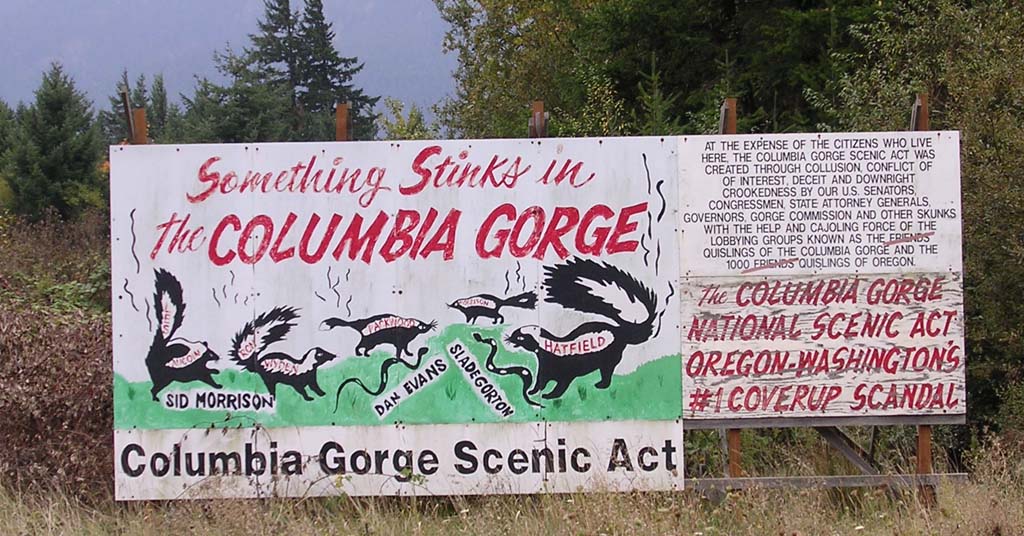
Raising a stink: Text on this 1980s billboard protesting the National Scenic Area reads: “At the expense of the citizens who live here, the Columbia Gorge Scenic Act was created through collusion, conflict of interest, deceit and downright crookedness by our U.S. senators, congressmen, state attorney generals, governors, Gorge Commission and other skunks with the help and cajoling force of the lobbying groups known as the (Friends) Quislings of the Columbia Gorge and the 1000 (Friends) Quislings of Oregon. Photo: Jurgen Hess
Skamania County has long been a focal point in conflicts over Gorge Commission regulations.
The county estimates that 80% of its area is held in federal lands, most of this in the Gifford Pinchot National Forest. The Forest Service also owns land within the scenic area, which is protected under the same legislation that created the NSA.
In addition, much of Skamania County’s remaining private lands outside its urban areas fall within the NSA and under its regulations. Or they’re timberlands that produce revenue for the county intermittently upon harvest.
As a result, as little as 5% of Skamania County is developable, according to a 2011 study from Portland State University. The county itself estimates its dependably taxable commercial and residential lands make up just 3% of the county’s total area. This can create conflict, especially when other pressures arrive.
In an interview with Columbia Insight, Skamania County Commissioner Asa Leckie described the economic problems facing his county and how many locals view the NSA with something less than enthusiasm.
Leckie noted that shortly after the Columbia River Gorge National Scenic Area Act and its restrictions on development went into effect in the late 1980s, the timber wars also hit. Fights over the Pacific Northwest’s remaining old-growth forests and the endangered spotted owl led to federal protections and the Northwest Forest Plan. This led to a drastic decline in timber sales starting in the 1990s.
For Skamania County, which had become dependent on capturing a percentage of the timber receipts from the Gifford Pinchot National Forest to fund critical services like schools, this was devastating.
“So, when we get hit with the restriction of logging and the restriction of land use in conservation, that was a double hit to Skamania,” said Leckie. “Then we were told ‘you’ve got a tourism economy now, figure it out.’”
Who is Laura Brennan Bissell?
As the contemporary avatar of Skamania County’s contentious relationship with federal regulations—and, as a Gorge commissioner, an important steward of the National Scenic Area—Laura Brennan Bissell is a curious figure.
In declining requests from Columbia Insight for an interview for this story, Brennan Bissell suggested we consult the public record to get a read on her positions. We complied.
The most extensive biographical information on Brennan Bissell comes from an August 5, 2024, video interview conducted at her Underwood, Wash., home by Oregon Wine History Archive. During the more-than-hour-long interview she recounts her career trajectory and experience in the wine business.
In the context of her protests at being questioned about her qualifications to lead a Gorge Commission committee, some of her statements are strikingly frank.
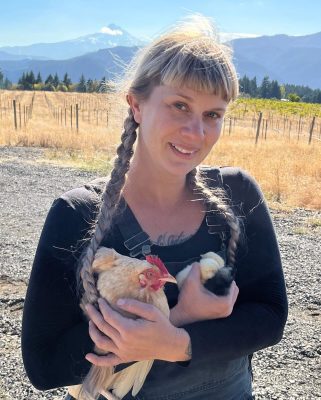
Laura Brennan Bissell. Photo: Columbia River Gorge Commission
After growing up in Virginia, she moved to the San Francisco Bay Area in the early 2000s.
“I had dropped out of high school,” she says. “I had no academic background or prowess.”
In Berkeley, she began visiting wine shops.
“I was like a black metal, punk rock kid,” she says. “People would look at me like I was gonna steal something.”
Brennan Bissell accumulated a bohemian resume, saying she worked for a time in public relations and marketing and as a bike messenger. She also played music, “solo acoustic stuff,” did performance poetry and worked as a “merch lady” running merchandise tables at concerts for touring bands.
She eventually made her way to Spain where she says she “started teaching English illegally [because she had no work permit] in Barcelona …” There her interest in wine grew, but she was unable to find work in the business.
“They’re pretty strict about letting you work in wineries in Europe if you don’t have a permit,” she says.
Returning to California, she “wrote a resume of wine experience that was completely bullshit, and I applied at a bunch of different wineries …” It paid off. She landed jobs at winemaking businesses, and in 2012 she made her first wine.
She incorporated her winemaking company Inconnu in 2014, according to California state records. Inconnu earned her a level of notoriety.
“Coming out of the gates, I’m a relatively young lady covered in tattoos, so I got a lot of attention,” she says. But within a couple of years her situation changed in a way that remains cloudy. As the Inconnu brand peaked, she refers to “this whole chapter of nondisclosure.”
Throughout the interview, Brennan Bissell is casual and candid, sharing personal details about life ambitions, romantic relationships and a willingness to fly by the seat of her pants: “As a person I actually have fucking crippling imposter syndrome and never feel like I’m good enough and never feel like I do anything well enough,” she says.
When asked by the interviewer from Oregon Wine History Archive what brought her to the Columbia River Gorge, she is less forthcoming.
“Well, that’s an interesting story. … I was invited to come up here originally. Uh, and, I can’t go into details,” she responds.
During the interview, Brennan Bissell expresses admiration for the beauty and spirituality of the volcanic soil and area around her home in Underwood. Beyond this, any philosophy she has that might relate to environmental stewardship comes across somewhat dark.
“I am a firm believer that we’re, like, in the Sixth Extinction right now,” she says. “There’s no precipice anymore. Now we’re just figuring out how to do the best in this position of decline.”
“A very, very, very respected winemaker.”
Brennan Bissell’s identity as a winemaker and farmer living and working inside the National Scenic Area has been fundamental to how she’s presented herself as a Gorge commissioner.
At the July 8, 2025, meeting in Cascade Locks, she told the crowd that she operated “an international business,” calling herself “a very, very, very respected winemaker and farmer.”
Public records show a more nuanced reality, suggesting Brennan Bissell has struggled to transport her winemaking business from California to Washington.
Brennan Bissell and her husband, Andrew, bought their property in Underwood in July 2021 for $1.4 million, according to county records.
Exactly what wine business operations take place on the property is unclear.
In August 2024, Brennan Bissell told Oregon Wine History Archive: “I’ve been here for a few years and, you know, we haven’t really been in the place where we can go plant a bunch or change a bunch. … I will plant. I haven’t planted anything yet. But I intend to plant.”

Down to business: Commercial development in and around the Gorge is always contested. Despite local protests, the 120-acre Under Canvas Columbia River Gorge glamping resort opened in 2025 in Klickitat County, Wash. Photo: Under Canvas
In a public records search, Columbia Insight found two wine businesses associated with Brennan Bissell: Aitia and Inconnu.
Aitia was registered with the Secretary of State’s Office in Washington in August 2022. It was dissolved by the state in January 2025. The company never registered with the Washington State Department of Revenue, according to state records. There are no Washington liquor licenses associated with the Bissells at their Underwood property.
Inconnu is registered in California. The company does not possess a Washington liquor license. This means it cannot manufacture, ferment, bottle or label wine in the state. Inconnu is, however, a certificate of approval holder in Washington. This allows the company to ship its wine to and have its wine sold in the state. This certificate does not allow Inconnu to partner with a Washington-registered winery to ferment Inconnu’s grapes at that winery’s facilities.
Inconnu’s federal liquor license lists a Napa, Calif., address as the company’s primary business location. The federal license lists Washington State as the location of the wine’s grapes.
Inconnu previously held a California liquor license to ferment grapes into wine at the Napa address, but this license was surrendered as of June 2025, according to records from the California Department of Alcoholic Beverage Control.
The Napa address listed on the surrendered license is the location of Falcor Wine Cellars, LCC. A person at the company, who asked that Columbia Insight not use their name, confirmed that in the past Inconnu had fermented grapes at the Napa location but was no longer doing so.
Inconnu has one active California liquor license to make wine at a Berkeley address, the same address listed for the company in the state’s business registry. The license requires that the licensee complete the first stage of the fermentation process—in which yeast consumes sugars in the grape juice, converting it into alcohol—at the location listed on the license.
Alameda County lists the Berkeley address as a single-family residential home. The property is owned by an LLC not owned by Inconnu, according to county and state records.
A person familiar with the property, who asked that their name not be used, confirmed that no wine was being manufactured at the Berkeley location.
Skamania County’s fifty-fifty strategy
As a business owner, Brennan Bissell has articulated the county’s discontent toward regulation within the National Scenic Area.
“The amount of regulation that they’re putting in to supposedly preserve land is actually going to negatively affect the people who have historically lived here,” Brennan Bissell told Skamania County commissioners during her July 30, 2024, public interview.
During the interview she also expressed personal frustration with NSA rules.
“I have a sixty-five-acre property and the hoops that I would have to jump through even to build labor housing on my property is insane,” Brennan Bissell told the commissioners. “It’s a sixty-five-acre property with thirty-five’ish farmable acres. I should be able to have a few houses on my property and lease out some of my land to other farmers or something, but I can’t because of the way the legislation works here.” (County records show that 33 of the roughly 65 acres belonging to Andrew and Laura Bissell are Designated Forest Land with no building permits available.)
Just six days after that interview, however, when asked by Oregon Wine History Archive about her vision for her business, Brennan Bissell said: “Honestly, I don’t want to make a lot of wine. I want to make like one thousand, two thousand cases a year. I’ll probably have a little tasting room up here eventually.”
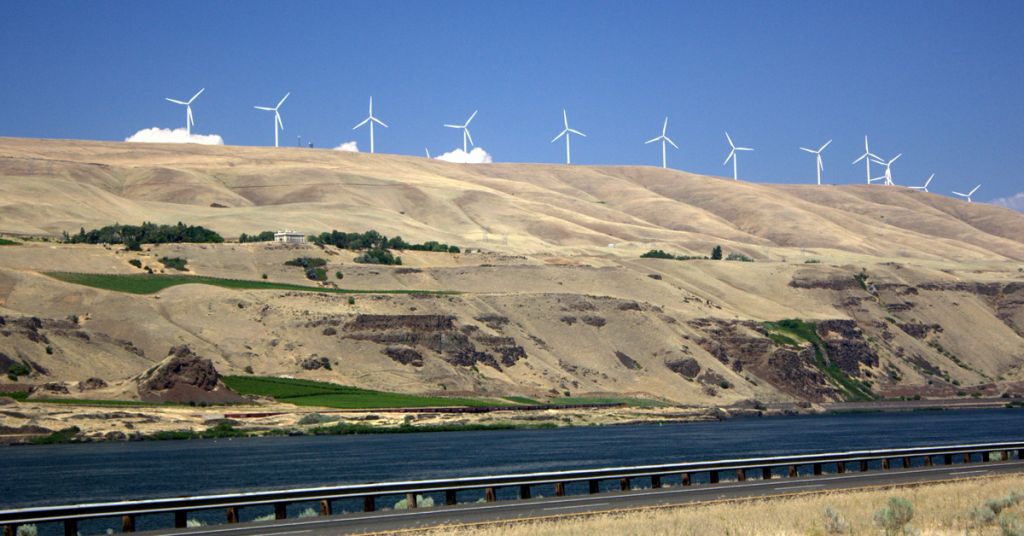
Delicate tilt: The Gorge Commission’s mandate is to preserve the National Scenic Area’s natural beauty while encouraging economic development. Photo: Sam Churchill/CC
During Brennan Bissell’s interview with Skamania County commissioners in 2024, former Skamania County Commissioner Richard Mahar outlined the county’s policy strategy on the Columbia River Gorge Commission.
“With the Scenic Act, there’s two main components,” said Mahar. “One is the preserve-the-beauty-of-it, and the other is the economic aspect. And we’ve always felt that the economic part kind of plays second fiddle and doesn’t get as much attention.”
Mahar was referring to the dual purpose of the Columbia River Gorge National Scenic Area Act.
The first is “to protect and provide for the enhancement of the scenic, cultural, recreational, and natural resources of the Columbia River Gorge.”
The second, less well-known purpose, is to encourage economic growth within urban areas in the Gorge and allow “economic development in a manner that is consistent with” the Commission’s first purpose of protecting the scenic area.
During a Dec. 17, 2024, public meeting with Skamania County, Brennan Bissell articulated Skamania County’s strategy as a “fifty-fifty mindset.”
“Going into 2025, I would definitely like to continue to push the commission and the staff to start focusing on a fifty-fifty mindset of, ‘yes, we’re supposed to be protecting the scenic beauty and the aesthetics of the area, but we’re also supposed to be protecting the economics to sustainability and agriculture of the area,’” Brennan Bissell told the Skamania County Board of Commissioners.
To accomplish this, Brennan Bissell said that Gorge Commission “money going toward just the aesthetic and quote-unquote climate change aspects of it” should instead go to local businesses.
“Why isn’t there actually money and outreach going toward helping the people here who essentially create the profit or, I don’t know, essentially create the environment that draws a lot of tourism outside of just the scenic beauty,” said Brennan Bissell. “It’s like the wineries, the artisans, the restaurants, et cetera. Why isn’t the Gorge Commission also helping that 50% of their agenda that isn’t noticed?”
In her interview with Columbia Insight, Gorge Commission Executive Director Krystyna Wolniakowski argued that the commission does, in fact, support the local economy by protecting the National Scenic Area, which drives tourism.
She also noted that the commission directly supports businesses in the NSA through letters of support and by certifying loans from a federal loan fund.
Trying to “reel in” LBB
At the June 24, 2025, Zoom meeting to elect the chair of the new Economic Vitality Committee, Liberty expressed concerns about Brennan Bissell.
A video recording of the meeting shows Liberty taking issue with how Brennan Bissell represented his positions in meetings with Skamania County.
“My concern is that my views have been misrepresented to the Skamania County Commission by you, Commissioner Brennan Bissell, unfairly, inappropriately, and you’ve also launched attacks on your colleagues during commission meetings,” said Liberty, addressing Brennan Bissell. “And for that reason, I can’t support you as chair.”
Mills was more measured, telling Brennan Bissell, “I know there’s been concerns raised at several community county commission meetings I’ve been where you’ve raised concerns about the Gorge Commission, criticized the Gorge Commission to Skamania County commissioners.”
The sentiments the two men voiced brought to the surface concerns written about in emails for months. The criticisms likely did not come as a surprise to Brennan Bissell.
In 2025, a Washington lawmaker introduced an amendment to defund Washington’s portion of the Gorge Commission’s budget.
In response to Mills’ concerns, Brennan Bissell said, “I’ve read the emails via FOIA. I know that there was an attempt to control me, essentially, or reel me in.”
The emails in question likely refer to a public records request filed with the Gorge Commission on April 7, 2025, by Skamania County Commissioner Asa Leckie.
Leckie’s request was for emails between the Gorge Commission and Friends of the Columbia Gorge. The Gorge Commission provided Columbia Insight with the emails associated with Leckie’s request.
Friends of the Columbia Gorge was instrumental in lobbying for the creation the National Scenic Area.
The nonprofit continues to lobby around issues related to the NSA. It has purchased private lands in the scenic area for preservation and is frequently the only organization to appeal building developments and other land uses under the NSA’s land management rules.
The emails reveal an effort by Wolniakowski and Renée Tkach, conservation director at Friends of the Columbia Gorge, to correct what Wolniakowski refers to in an email as “mistakes and mis-information” presented by Brennan Bissell to Leckie and other Skamania County commissioners at recorded county meetings.
The emails also reveal the inner workings of the Friends of the Columbia Gorge. This is because Tkach forwarded to Wolniakowski many of her organization’s internal emails, unwittingly placing the otherwise private emails on the public record.
Tkach provided a written comment to Columbia Insight through Kevin Gorman, executive director of Friends of the Columbia Gorge.
“One of our staff took notes of a public meeting that seemed relevant, so I passed it along,” Tkach wrote. “I later realized that it was part of a longer staff email thread. I regret that I forwarded the additional emails, but we also stand by the content of those emails 100%.”
The emails concerning Brennan Bissell’s presentations obtained through a public records request appear to start with a Jan. 29, 2025, email from Wolniakowski to Tkach in which Wolniakowski indicates she’d emailed Skamania County “to correct the statements Laura made” to county commissioners during a Dec. 17, 2024, public meeting.
“I felt really awkward doing this,” wrote Wolniakowski, “but it was the only way I could think of to get the proper information to the county commissioners. I hope my tone was respectful and informative.”
Pikas, fencing, mysterious letters
During the Dec. 17, 2024, Skamania County Commission meeting, Brennan Bissell told the county that the Gorge Commission funds pika research. This isn’t true.
She also used the December meeting to air a grievance she had related to fencing on her Underwood property and National Scenic Area rules and costs, stating incorrectly that she needed to pay the Gorge Commission for the fencing.
Wolniakowski set the record straight in a lengthy letter to Skamania County dated Jan. 28, 2025. In the letter, Wolniakowski informed the county commissioners that the Gorge Commission does not fund pika research but does participate in pika research.
Addressing Brennan Bissell’s fencing issue, she informed the county commissioners that fencing fees in Skamania County “are set by Skamania County and not the Gorge Commission,” and reminded the elected officials that their county had adopted the National Scenic Area’s management plan, which in practice means the Gorge Commission’s land management rules, including those around fencing, are the county’s rules as well.
To drive this point home, Wolniakowski provided a copy of Skamania County’s land ordinance pertaining to fencing.
In his interview with Columbia Insight, Skamania County Commissioner Leckie suggested Brennan Bissell was possibly the victim of a letter from someone claiming to be a representative of the Gorge Commission, adding that he has seen “three or four letters” that appeared to be forged by people pretending to be either from the Gorge Commission or Friends of the Columbia Gorge.
“It’s neighbors trying to influence their neighbors into doing things they want them to do,” said Leckie about the mysterious letters.
“I never meet with her alone”
Perhaps the most telling exchanges between Wolniakowski and Tkach in Leckie’s requested documents appear in a series of emails from March 2025 with the subject line, “RE: LBB Gorge Commission Updates to Skamania BOCC,” referring to Laura Brennan Bissell and the Skamania County Board of Commissioners.
In the emails, Wolniakowski and Tkach discuss inaccuracies in a March 18, 2025, public update to Skamania County commissioners given by Brennan Bissel.
“I was pretty stunned at that particular update, how much information was not accurate,” said Wolniakowski. “And so, I needed to figure out how I was going to address those issues with the Skamania County commissioners.”
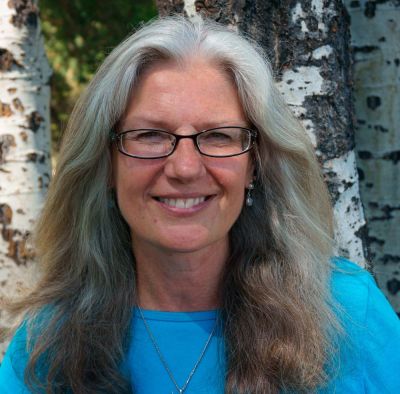
Krystyna Wolniakowski. Photo: Columbia River Gorge Commission
In one email Wolniakowski writes that the Gorge Commission chair, referring to Michael Mills, was “appalled” after listening to the audio recording of the meeting.
“I don’t know if I would’ve used the term ‘appalled,’” Mills told Columbia Insight. “But I was very concerned that misinformation was being given about the [Gorge] commission to Skamania County commissioners and the broader public.”
In the email exchange, Wolniakowski goes on to ask Tkach’s advice about how to deal with Brennan Bissell. This includes three emails sent on March 24, 2025. In one email Tkach suggests that Mills address concerns with Brennan Bissell by meeting with her in person.
“That is a good idea—probably with Amy too,” Wolniakowski writes in response, referring to Amy Weissfeld, a Washington governor-appointed Gorge commissioner, who also lives in Skamania County.
Wolniakowski ends the email, “I never meet with her alone,” referring to Brennan Bissell.
Mills told Columbia Insight he’d tried in 2025 to “reestablish or heal the relationship” with Brennan Bissell by arranging a meeting with her and Weissfeld. According to Mills this meeting was to have taken place at a restaurant in Hood River.
“And Laura Brennan Bissell didn’t attend,” said Mills. “Amy Weissfeld came and said Laura Brennan Bissell wasn’t going to make the meeting.”
In an interview with Columbia Insight, Weissfeld confirmed the meeting took place in the way Mills described it.
Weissfeld wouldn’t confirm if Wolniakowski had reached out to her to help address inaccuracies in statements made by Brennan Bissell.
Asked if she was aware of inaccurate statements made by Brennan Bissell, Weissfeld responded that she appreciated what Brennan Bissell brought to the Gorge Commission.
“The fiery nature that she brings to things, I don’t think is necessarily a bad thing,” said Weissfeld. “But, yes, information needs to be, communication needs to be respectful and accurate.”
Misinformation gets results
Concerns about misinformation during March 2025 weren’t focused only on statements coming from Brennan Bissell.
They also centered on statements from Skamania County’s elected commissioners.
During a March 11, 2025, commissioners meeting, Skamania County commissioners can be heard discussing a letter sent to U.S. Secretary of Agriculture Brooke Rollins and signed by all three commissioners.
In the letter, dated March 11, 2025, the county commissioners accuse the Gorge Commission of “ongoing efforts to acquire private property within Skamania County for incorporation into the Columbia River Gorge National Scenic Area under U.S. Forest Service management.”
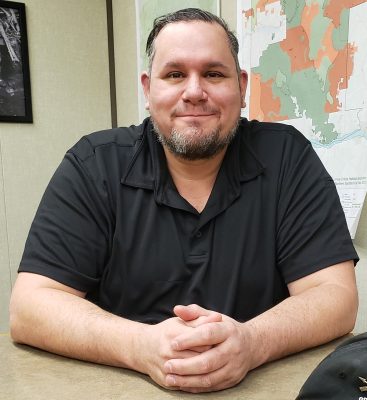
Asa Leckie. Photo: Skamania County Board of Commissioners
The Gorge Commission does not acquire private land to put under Forest Service ownership and management, but Friends of the Columbia Gorge has.
An internal Friends of the Columbia Gorge email written by Nathan Baker, senior staff attorney at the nonprofit, refers to the Skamania County commissioners’ letter as “ridiculous.”
“They apparently seem to think the Gorge Commission acquires land,” wrote Baker, “and also that the Gorge Commission somehow answers to the Secretary of Agriculture.”
In an April 7, 2025, letter, Wolniakowski offered her response to the county commissioners’ letter to Secretary Rollins.
“I am writing this letter to correct the record,” wrote Wolniakowski. “The Gorge Commission does not acquire private land.”
“She’s absolutely right,” said Leckie, acknowledging the error.
“When I wrote the letter,” Leckie continued, “it’s basically how it’s viewed as a resident is that there’s the trifecta, and the trifecta is Gorge Scenic Forest Service, the Gorge Commission and Friends of the Gorge. And so yeah, when you talk around locals, those are all conflated together.”
In an email to Columbia Insight, Skamania County Commissioner Robert Farris wrote, “I stand by the letter, with the correction that the entity identified as acquiring private land within the National Scenic Area should have been the U.S. Forest Service, not the Gorge Commission. The Board of County Commissioners has acknowledged and corrected that error on the record.”
Related to claims made about the accuracy of Brennan Bissell’s statements, he responded, “I haven’t seen any of the claims you’re mentioning.”
Skamania County Commissioner Brian Nichols could not be reached for comment.
Leckie told Columbia Insight he chalked up any incorrect information presented by Brennan Bissell to the fact that she was new to the Gorge Commission.
Misinformation or not, the county commissioners’ letter to the federal government yielded results.
Kristin Sleeper, former deputy undersecretary for the U.S. Department of Agriculture, responded to the Skamania County commissioners’ letter to Secretary Rollins in a letter dated April 16, 2025, stating that she’d asked the Forest Service’s Columbia River Gorge National Scenic Area office to “briefly pause acquisitions currently in progress while we review your request and coordinate a meeting with you and your colleagues as soon as practicable.”
In an email to Columbia Insight, a USDA spokesperson verified the authenticity of the letter, confirming there is a “temporary pause on land acquisitions in the Columbia River Gorge National Scenic Area for National Forest System purposes within the scenic area.”
Defending and defunding?
Skamania County Commissioner Asa Leckie’s public records request for Gorge Commission and Friends of the Columbia Gorge emails came during the same month as letters from both Skamania and Wasco counties highlighting what they claimed was ethically dubious behavior by the Gorge Commission in the spring of 2025 when it worked with Friends of the Columbia Gorge to reinstate funding for the Gorge Commission in the Washington legislature.
During a March 27, 2025, session of the Washington House Appropriations Committee, a Washington lawmaker not from the Gorge introduced an amendment to defund Washington’s portion of the Gorge Commission’s budget.
Funding was restored, though at a reduced rate, later that session. But had funding not been approved, it would have sent the Gorge Commission into uncharted territory.
1980s bumper sticker. Photo: Jurgen Hess
Fearing a potential threat to the National Scenic Area, Friends of the Columbia Gorge staff lobbied Washington legislators to get funding restored before the final state budget was passed later that spring.
Critically, this effort included connecting Wolniakowski with Washington lawmakers. Commissioners in Skamania and Wasco counties pounced.
In an April 7, 2025, letter to the Gorge Commission that cc’d Washington and Oregon politicians, Wasco County Commissioner and Board Chair Scott Hege wrote of his concerns of “conflicts of interest pertaining to Friends of the Columbia Gorge (FOCG) facilitating meetings with Washington legislators and Commission staff and lobbying for funding.”
Skamania County followed the next day with a nearly identical letter addressed to the commission with Washington and Oregon lawmakers cc’d. All three Skamania County commissioners signed the letter.
Both letters argued that because Friends of the Columbia Gorge is often the only organization to appeal building developments under the scenic area’s land management rules and because the Gorge Commission ultimately determines the fate of those appeals, cooperation between the two organizations to get the commission fully funded in the Washington legislature constituted a conflict of interest.
The two letters also pointed out that Friends of the Columbia Gorge was, at the time of lobbying, actively appealing a Gorge Commission decision related to property in Clark County.
“The conflict of interest at the time was that the Friends of the Gorge were suing, or they had an appeal in with the Gorge Commission. So, essentially, they were suing them,” Hege told Columbia Insight.
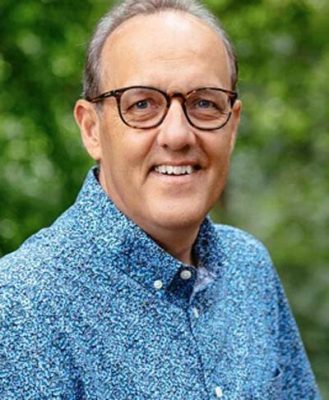
Kevin Gorman. Photo: Friends of the Columbia Gorge
In a phone interview with Columbia Insight, Friends of the Columbia Gorge Executive Director Kevin Gorman said his organization’s interaction was appropriate for a lobby organization.
“We are not a government agency. We’re a nonprofit that works to protect the Gorge,” said Gorman. “And one of the ways that we do that is supporting the commission during its budget time … we advocate, we lobby, that’s kind of what we do.”
Gorman added that it would be one thing if the executive director of the Gorge Commission were the one to rule on an appeal. That power resides not with the executive director, but with the Gorge commissioners, including county-appointed commissioners, who function during the appeal process as a quasi-judicial body.
“When we win [an appeal] it’s not like we have some magical influence, we win because we have the law on our side,” said Gorman.
Leckie declined to comment on Skamania County’s April 8, letter. Instead, he brought up concerns he has about Friends of the Columbia Gorge owning land in the Gorge.
Leckie said having access to individuals at the Gorge Commission and the Forest Service gives the nonprofit an unfair advantage over other landowners.
Upon request, Gorman provided Columbia Insight with data on the nonprofit’s properties in the Gorge and the taxes the organization pays on them. Friends of the Columbia Gorge paid Skamania County over $25,000 in taxes last year, according to the organization’s numbers.
Uncertain times for the Gorge
For the Friends of the Columbia Gorge, the counties’ April 2025 letters weren’t so much about concerns surrounding conflicts of interest as they were an effort, along with Skamania County’s letter to Secretary Rollins, to discredit the Gorge Commission at a time when its funding was imperiled.
Which is why, in addition to helping set up meetings with Wolniakowski and lawmakers, the organization launched a social media campaign to encourage Skamania County residents to write their lawmakers.
The campaign included an April 19, 2025, video posted to Facebook in which Conservation Director Tkach characterized Skamania and Wasco county’s April letters as “attacking our work at Friends of the Columbia Gorge simply because we’re collaborating with the Gorge Commission to try and restore their funding.”
In the video, Tkach refers to Skamania County’s letter to Secretary Rollins as “either an intentional lie or they don’t even understand the agency they’re trying to dismantle.”
“They were going up and fighting for their funding, and they needed a villain in their story. And that became, incorrectly, Skamania County,” said Leckie.
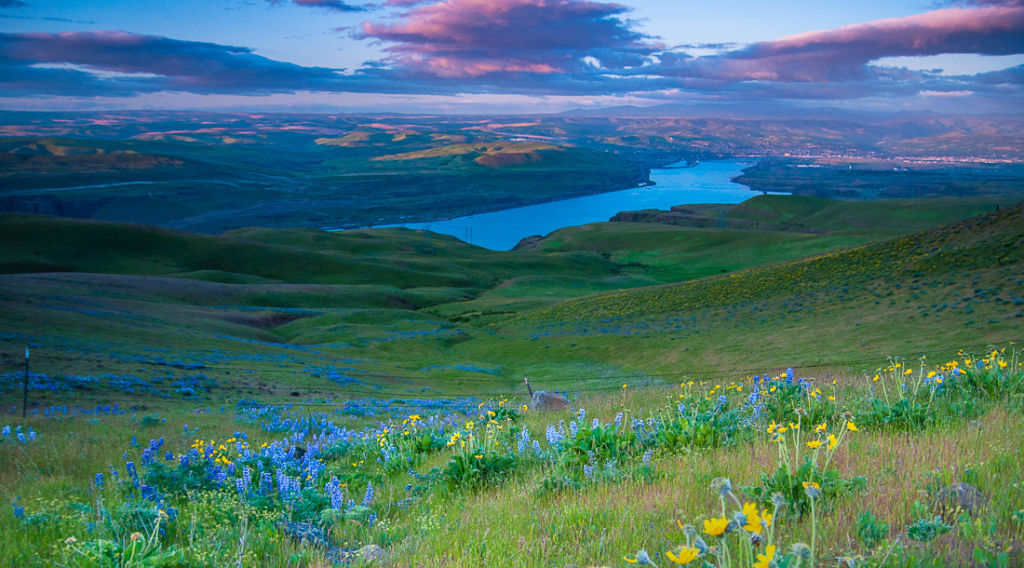
Two sides: In the Columbia River Gorge, environmentalists and developers alike see opportunity. Photo: Jurgen Hess
But rather than a story of heroes and villains, it’s more accurate to see in the ongoing Gorge Commission drama an age-old collision of interests.
On one side are preservationists wanting to more or less maintain the status quo of the Columbia River Gorge National Scenic Area as a national treasure where visitors from around the region, country and world come to recreate in and marvel at a unique ecosystem emblematic of the Pacific Northwest.
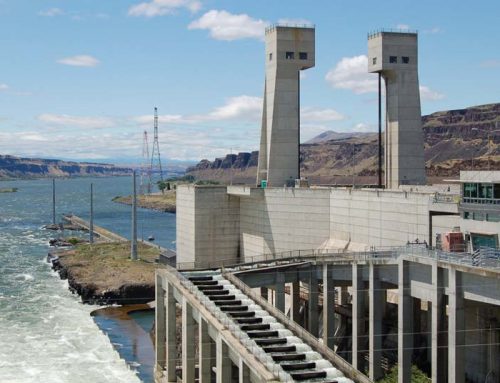
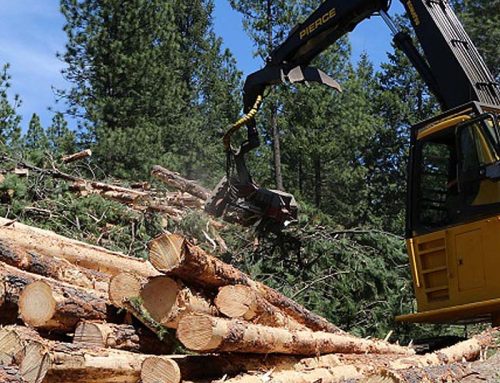
On the other side are development interests, mostly local, that want to change regulations they feel have kept rural economies and governments in the Gorge perpetually stunted.
With the departures of Mills and Liberty—and the coming 2026 retirement of Friends of the Columbia River Gorge’s longtime executive director, Kevin Gorman—the momentum seems to have shifted to Brennan Bissell and Skamania County commissioners who hope to push National Scenic Area regulations in a more pro-development direction.
While no one is suggesting a return to mills and smelters, what this shift means for the future of the Columbia River Gorge is uncertain.
What is clear is that for the first time in decades, environmentalists in the Gorge are on the defensive.






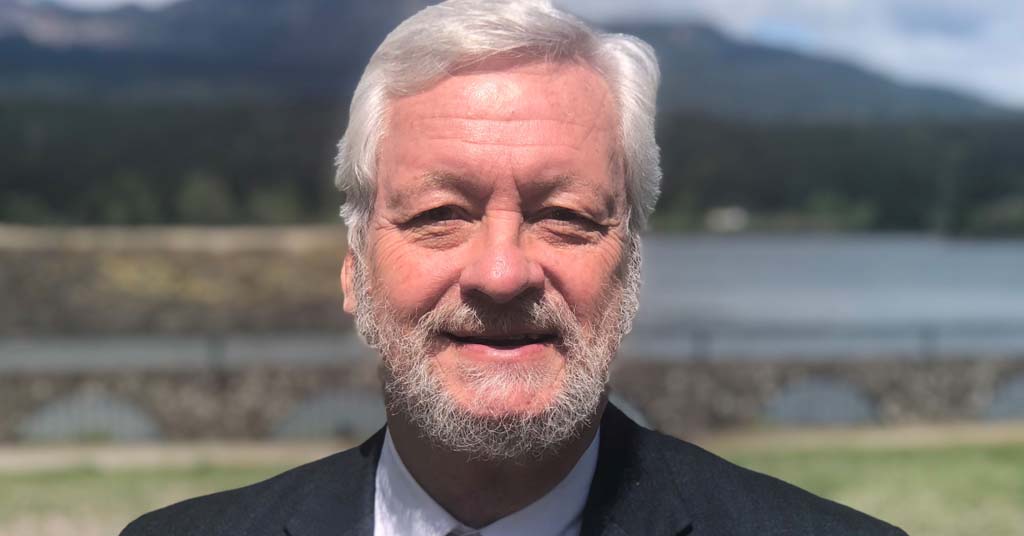
A tremendous amount of work, by Nathan Gilles, went into researching this story to accurately highlight the internal and external conflicts facing the Columbia River Gorge Commission; and, to expose threats to the National Scenic Area Act.