By Miko Ruhlen
One of our local readers, Cathy Flick, had some enthusiastic young
visitors learning about birds at her volunteer-run MAPS bird banding station.
Why Birds?
Birds appeal to us. They seem at once delicate and tenacious. Their feats of migration astound us – remind us that Earth?s creatures interconnect across national borders. Birds contribute to our well-being by pollinating plants, dispersing seeds, controlling rodent and insect populations, or scavenging carcasses. They’re sensitive indicators of environmental health, and their population trends signal the impacts of climate and habitat changes. Because they are ubiquitous and easily observed, almost everyone gets to enjoy them. Their beauty has inspired citizen scientists to record information on birds and their habitats for over 100 years, such as the Christmas Bird Count providing scientists with invaluable long-term data.
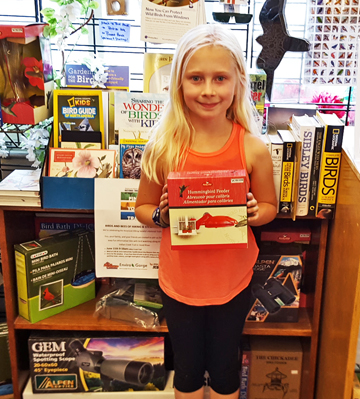
Jena Hager won a prize for participating in the Bird ID Quiz
Conservation Actions Needed
According to the State of North America’s Birds 2016 Report, a third of all North American bird species need urgent conservation action to avoid extinction. An estimated billion birds have already disappeared from North America since 1970, and the trend continues downward for most species. Birds of ocean and tropical forest habitats are the most in crisis, although species in all habitats need conservation efforts to maintain healthy populations. Some groups of birds are faring better, waterfowl for example, due to measures the North American Wetlands Conservation Act enabled to protect habitat.
Even some Columbia River Gorge species we consider common are showing declines including the American Kestrel which has dropped in population by about 50% nationally since 1966 and local data are showing similar declines. Western populations of Yellow-rumped Warbler have also shown a steady decline since 1970.
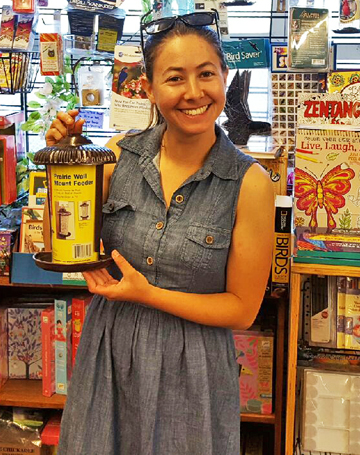
Sarah Lange won a prize from Hood River Hobbies!
Like the rest of the country, resident birds of the Gorge are the subject of controversy pitting those working to protect wildlife against the pressures of development. Examples abound: the Double-crested Cormorants culled at East Sand Island , conflicts between logging and Spotted Owls, seasonal closures of popular trails (i.e. Cape Horn) due to nesting Peregrine Falcons, raptors killed at Gorge wind farms, and the effects on bird populations by feral cats.
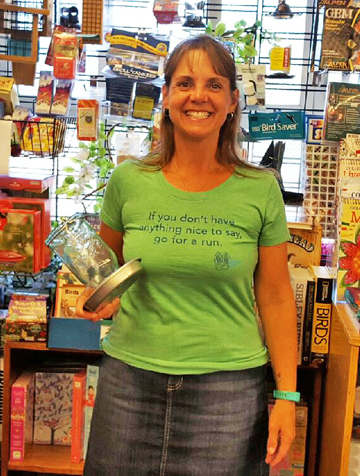
Heidi Cardoza won a prize along with (not pictured) Anne Marie Wood, Tova Tillinghast, and Sarah Richards
Habitat is critical. While some habitats are disappearing, a variety of local efforts restore native habitat–wetlands, oak woodland, sagebrush, grassland –benefiting birds and other Gorge wildlife. Columbia River Gorge populations of Bald Eagle, Peregrine Falcon, and Osprey are recovering due to conservation efforts and the ban of DDT. Other species may require further habitat conservation to increase or maintain populations, especially grassland or aridland nesting species such as grasshopper sparrow, long-billed curlew, and ferruginous hawk.
What can I do to conserve birds? Bird Quiz readers are doing a lot!
Many of our actions affect bird conservation. Some are daily choices about what coffee to buy or what to plant in our backyard; others actions may involve larger investments of time or money. Over 100 people completed the EnviroGorge Bird Identification quiz: absolute beginners to advanced bird watchers. We asked participants to tell us what they do to help birds and we were inspired by the responses. Here’s a sampling and photos of the winners of prizes donated by Hood River Hobbies.
If you missed the quiz, you can still take it just for fun (no prizes available) here.
Our readers answer: What do you do to conserve birds? (click on the boxes)
Citizen Science and Volunteering
• I compile data for the CBC & do a breeding bird survey route.
• Volunteer for winter raptor, sagebrush songbird, & breeding bird surveys.
• Submit my sightings eBird.
• I work as a bird conservationist.
Feed and House the Birds
• Provide fresh water bird bath
• I provide habitat, food, and water.
• Build birdhouses for swallows & bluebirds.
• We keep our hummingbirds warm and fed during the winter.
• I scatter cracked corn on the ground for the quail.
Native Plantings
• Planting native trees, shrubs, & flowers for nesting habitat.
• Brush piles that Juncos like.
• Working to restore 30 acres in the gorge to enhance wildlife habitat
• Our staff at Columbia Land Trust conserves land and water to protect habitat.
Create a Safe Environment
• Window decals (to prevent strikes), water, bird friendly plants, bird houses.
• Never use pesticides or chemical fertilizers.
• Pesticide free, no round-up.
• Create bird friendly habitat providing shelter & protection from domestic cats.
• I support birds by supporting organic agriculture.
Sharing with Others
• Build bird houses and introduce children & adults to the joy of birding.
• Educating friends & family about birds-getting them excited about birds.
• Educate about landscaping for wildlife.
• American Bird Conservancy is in my will.