
Seventeen years ago, Idaho opted out of the national program. Could its foresight provide a template for compromise?
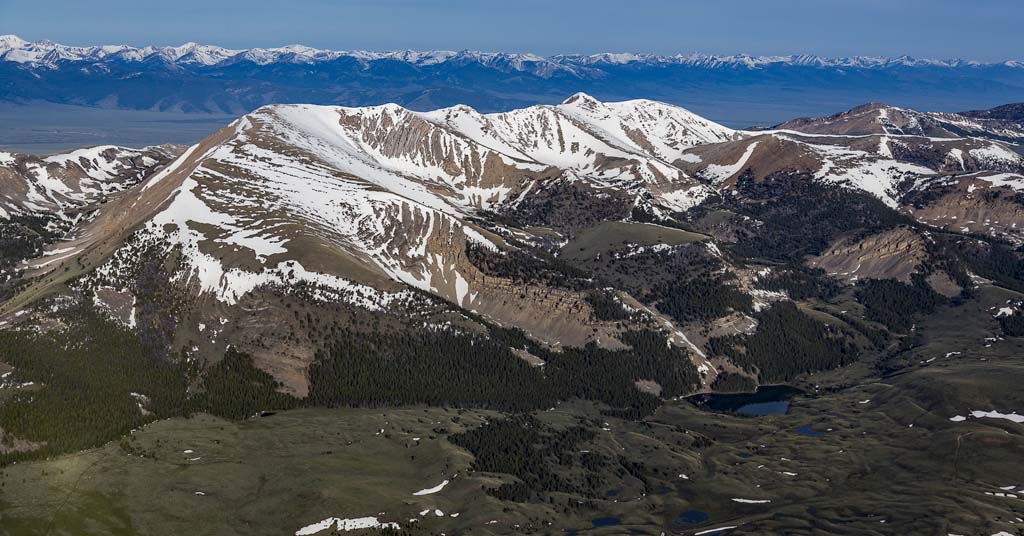
Line drawing: The 300,000-acre Italian Peaks Roadless area is located on the Idaho-Montana border. Rescinding the Roadless Rule would make lands in Montana open to development, including those in the lower half of this photo. Roadless Forest Service lands in Idaho would remain protected. Photo: Jason D.B. Kauffman
By Jason D.B. Kauffman. November 6, 2025. The Trump Administration’s decision earlier this year to do away with the 2001 Roadless Area Conseravtion Rule on national forest lands sent shockwaves through environmental and outdoor recreation communities.
According to environmentalists and an Idaho public official who has been involved in roadless rule politics since the issue’s inception, the move could transport stakeholders in the Pacific Northwest back to the rancor and political divisions of the timber war years.
The roadless rule made some 58.5 million acres of inventoried roadless lands in national forests in 39 states off limits to development. Lands protected under the rule make up nearly one-third of the 193-million-acre U.S. National Forest system.
Enacted in the final days of the Clinton administration, the 2001 rule settled decades of litigation—marked by civil disobedience and contentious public meetings—over which unroaded public lands could be used for roadbuilding, logging and other development.
“The national rule itself put the whole timber wars to bed. It really did,” said James Caswell, former forest supervisor for the Clearwater and Targhee national forests in Idaho and director of the Bureau of Land Management during the George W. Bush administration. “People climbing in trees, putting nails in trees. Cops out there. Digging up roads. Hauling people to jail. All that stuff went away.”
The rule led to conditions in which environmentalists became less combative about forest management, according to Caswell. Instead, enviros became more willing to work with timber industry and Forest Service officials on forestry projects on roaded lands within the national forest system.
Roadless areas are a recreational haven, beloved by hikers, motorcyclists and off-road-vehicle enthusiasts, birdwatchers, hunters, backpackers and anglers.
They serve as a refuge for returning runs of salmon and steelhead on the West Coast, as well as habitat for elk and deer sought after by hunters.
These biodiversity hotspots are also sources of cold, clean water for many communities nationwide.
Picking a scab
According to a Trump administration August notice in the Federal Register, eliminating the roadless rule is necessary “to return decision making for road construction, road reconstruction, and timber harvesting in inventoried roadless areas to local officials, in conjunction with Forest-level land management planning.”
The notice claims that wildfire threats and increased insects and disease on roadless lands require forest management. Over the past quarter century, natural processes have mostly dictated conditions in roadless areas.
The decision puts the forest objectives of fishermen, hunters, ATVers, bird watchers and others on the back burner.
“It is vital that we properly manage our federal lands to create healthy, resilient, and productive forests for generations to come,” said U.S. Secretary of Agriculture Brooke L. Rollins.
The implication is that the return of road construction and logging is necessary in oder to preserve the health of roadless forests.
Supporters of the roadless rule contend that rescinding it will upend a widespread consensus of approval that has developed over the future of these lands.
“This administration has just picked the scab off a deep wound,” said Caswell. “They’ve lit the candle and it’s going to blow up in their face.”
The Idaho exception
John Robison joined the staff of the Idaho Conservation League at the tail end of the timber wars of the 1980s and 1990s. At the time, many of his fellow activists were working to block roadbuilding and old-growth logging on roadless lands in Idaho’s national forests.
Among the roadless areas threatened were the Deadwood River area north of Boise, known for extensive stands of old-growth Ponderosa pine, and the Cove-Mallard roadless area adjacent to the Frank Church-River of No Return Wilderness.
Both areas had been the scene of intense disagreement over road building and logging, said Robison. Environmentalists feared that development of these areas would imperil some of Idaho’s best remaining spawning grounds for anadromous fish and native trout.
“We had seen the impacts of these types of roadless timber sales before,” he said. “You’ll have this nice hillside, you’ll gouge a road into it, and you’ve just destabilized the whole slope.”
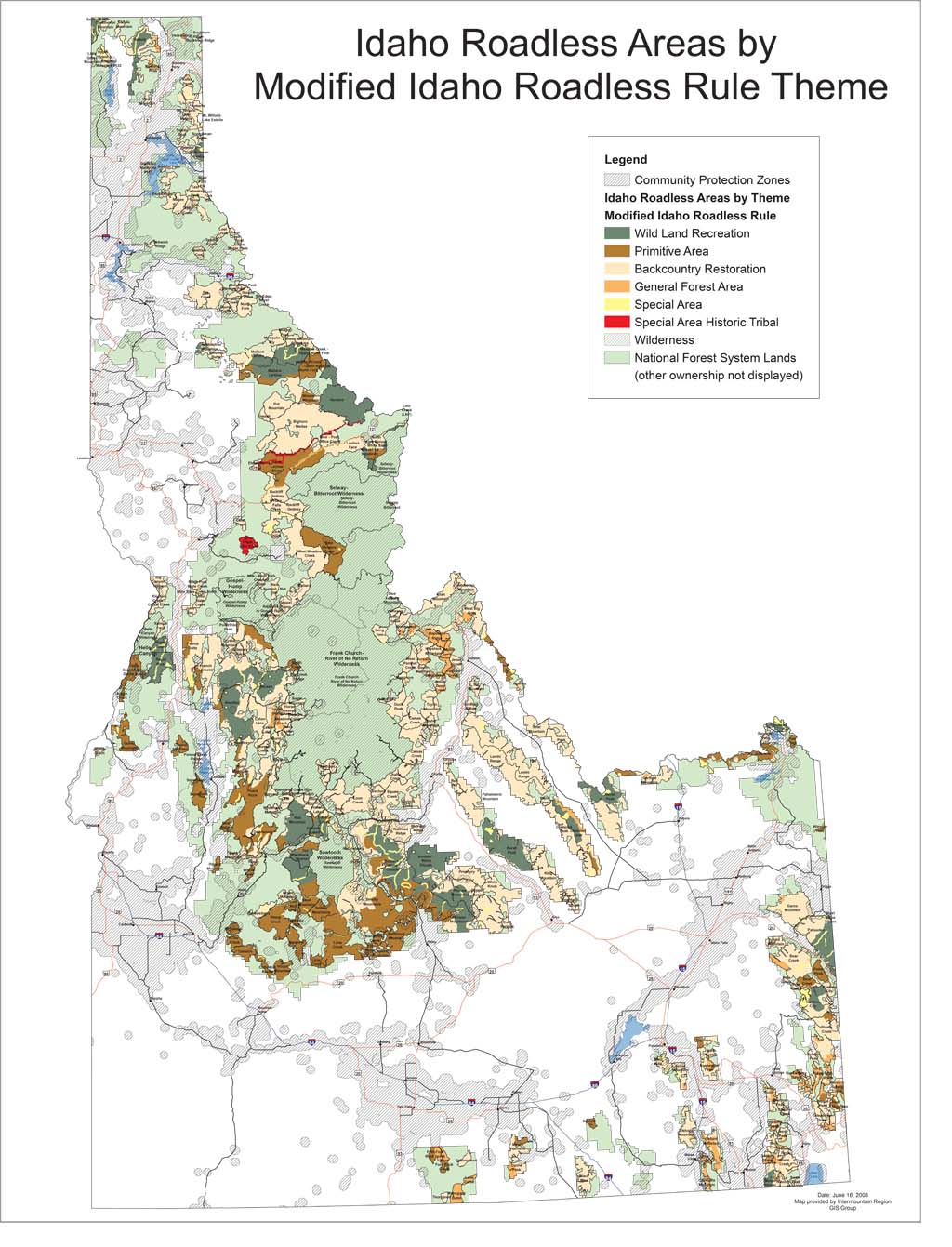
Map: USFS
For those who wanted to preserve the 9.3 million acres of remote, public forest lands that remained in Idaho, the roadless rule pushed aside many worries.
The rule allowed everyone, including environmentalists, to look proactively at issues of forest health on already roaded national forest lands in the state, according to Craig Gerkhe, former Idaho state director for The Wilderness Society.
“Okay, now we’re done fighting,” Gehrke recalled thinking after the adoption of the roadless rule. “Now let’s talk about where the logs are going to come from. Let’s talk about stream protection. Let’s talk about wildlife.
“It’s no longer, ‘No, you’re not going to log here.’”
Support for the rule wasn’t immediately unanimous. But lawsuits from timber companies, vehicle groups and others attempting to undo the roadless protections ultimately failed.
Once the lawsuits were dealt with, the George W. Bush administration invited states to work with the federal government to develop their own state-specific roadless plans under the Administrative Procedures Act.
While a number of states considered this option, only Idaho and Colorado accepted the offer.
At the time, James Caswell was head of Idaho’s Office of Species Conservation, a position appointed by Gov. Dirk Kempthorne. The office is tasked with coordinating with the federal government on the state’s actions to preserve and restore species listed under the federal Endangered Species Act.
Caswell believed the state could work with the federal government to craft its own roadless plan for federal forests in Idaho.
“I went to the governor and said, ‘Hey, we’ve got nine million acres of roadless in the state. We could develop our own state-specific rule,’” said Caswell. “‘We could play a real role in the language.’”
Commissioners from every Idaho county that held inventoried roadless lands were enlisted to help with the effort. Foreat Service officials advised commissioners on the rule-making process.
“The Forest Service did just an excellent job of that,” said Caswell. “They weren’t the decision-makers in the room.”
Representatives from environmental organizations, sporting groups and industry were invited to participate in the state’s rule-making process.
“Those meetings went off well,” said Caswell. “I attended every meeting in every county statewide that had roadless.”
Caswell’s job was to organize mountains of comments and proposals into a single plan to bring to the Bush administration.
Selecting county commissioners to run the meetings turned out to be a wise decision.
“They ran those meetings, they were the face in the room,” said Caswell. “They invited their local county constituents to come to the courthouse and said, ‘We’re going to talk about roadless in our county and what we as the people that live here want to see.’”
The roadless rule has been a success at fostering collaboration between conservation groups and industry.
In Idaho, environmental groups were split over whether they should engage with the state and take part in the process. The Boise-based Idaho Conservation League decided to join the effort, then being overseen by Gov. Jim Risch.
“From our perspective it accomplished ninety percent of our goals,” said ICL’s John Robison. “It protected the majority of the landscape and added more flexibility for some areas.”
Finding common ground with former foes was a crowning achievement of the process, and led to more progress on forest management challenges, said Robison.
“My gosh, we’re in alignment with the governor’s office,” he recalled thinking of the talks. “We’re in alignment with industry on this. We’re in alignment with the recreation community on this. This is amazing.”
National groups like The Wilderness Society, however, sat out the process over concerns about the motives of conservative officials in the state.
“TWS wanted a national policy applied uniformly across the country. We had little faith that state-adopted rules would really achieve what Clinton was trying to achieve with a uniform rule,” said Gerkhe of The Wilderness Society.
What “protection” means
In 2008, the Idaho rule was finalized and replaced the more uniform federal policy governing roadless lands.
The Idaho process ended with the adoption of five roadless area “themes” with different levels of protective status: wildland recreation; primitive; special areas of historic or tribal significance; backcountry restoration; and general forest.
Areas included in the wildland recreation theme—some 1.5 million acres on Idaho forests—are protected by the most restrictive regulations, which prohibit all new roads, road reconstruction and timber cutting.
By comparison, roadless lands included in the backcountry restoration theme allow for temporary roadbuilding and timber cutting to achieve wildfire protection aims and habitat restoration. Roads must be decommissioned once they’re no longer needed for these purposes.

Bucking up: Pronghorn antelope inhabit the 73,400-acre Pahsimeroi Mountain Roadless Area in east-central Idaho. Photo: Jason D.B. Kauffman
Since 2008, multiple timber projects with wildfire prevention and habitat restoration aims have been undertaken within areas protected under the backcountry restoration and general forest themes of the Idaho rule.
According to information provided by Michael Gibson, Idaho policy advisor for Trout Unlimited, a total of 177,655 acres saw timber cut, sold and removed inside these two roadless themes between 2010-2022.
This figure includes trees cut within an inventoried roadless area for any reason, including large portions in which cutting took place for noncommercial treatments. Of those 177,655 acres, just 5,797 acres saw trees cut that were of commercial value.
Additionally, a combined 388,683 acres of Idaho roadless areas were treated with prescribed burning; 1,140 acres inside community protection zones were subject to hazardous fuels reduction cutting.
Extending the Idaho model
According to roadless area advocates, the elimination of the national rule may not just portend a return to widespread disagreement over how roadless lands are managed. It could also put an end to collaborations that have arisen between environmentalists and the forestry industry in the years since the debate over roadless areas was settled.
The Trump administration’s decision covers about 45 million acres and doesn’t threaten to remove protections afforded by the Idaho and Colorado rules.
According to Gibson, vice chair of the Roadless Rule Commission, unroaded national forest lands represent the best of the best habitat for wild trout and returning runs of salmon and steelhead.
“It’s obviously a cornerstone for trout conservation. Cold, clean water,” he said.

Untracked: Idaho’s 130,500-acre Borah Peak Roadless Area contains seven of the state’s nine summits that exceed 12,000 feet elevation. Photo: Jason D.B. Kauffman
Gibson emphasized the national roadless rule’s success in fostering collaboration between conservation groups and industry. He said that’s helped improve forest resilience and helped protect rural communities from wildfire.
“It allowed conservation groups like Trouth Unlimited and Backcountry Hunters and Anglers and the wildlife federations to come to the table to work with industry on forest stewardship,” he said.
Gibson said Trout Unlimited has asked the Trump administration to consider revising the roadless rule with an eye toward adding aspects of what has worked well in Idaho rather than simply eliminating the rule entirely.
“Let’s not throw the baby out with the bath water,” he said. “Are there pieces of the Idaho rule that we could put into the 2001 (roadless) rule that would make it work better?”
Hikers, hunters ignored
It remains to be seen how the outdoors community—including hunters, anglers, hikers and motorized users—will react if they discover their favorite backcountry spot is the site of a proposed road or timber sale.
In Idaho that’s not a concern, at least for now.
In most other states with roadless forest lands, it is.
The Idaho rule addresses issues of forest health while taking into account the concerns of other users. And it’s done that without shrinking the state’s 9.3 million acres of roadless forest land, says Gibson.
“The focus solely on timber has left out community members who don’t work in the timber industry,” said ICL’s Robison, another member of the Idaho Roadless Rule Commission. “It’s left out fishermen, hunters, mountain bikers, dirt bikers, ATVers, bird watchers. Their objectives and desires for the forest are on the back burner with this decision.”
The desire to maintain the national roadless rule while also being open to possible revisions is a position shared by the Theodore Roosevelt Conservation Partnership, a national conservation organization representing hunting and angling interests.
Joel Webster, chief conservation officer at TRCP, stressed the importance of backcountry areas from the wildlife management perspective and for the excellent hunting opportunities they provide.
“TRCP is willing to roll up our sleeves and work to find a compromise solution, and we hope that the administration looks at that as an opportunity,” said Webster. “If there is something that they believe needs to be changed or modified with the roadless rule, it would be great to figure out how to make those changes while still maintaining those conservation measures that are really important to these places.”
Idaho proves that roadless lands need not be sacrificed for the claimed benefits of increasing forest health and increasing timber cuts.
“It’s a resource as roadless,” said Caswell, who chairs the Idaho Roadless Rule Commission. “People know about it. People care about it.”








The environmental groups are still filing lawsuits to stop timber sales that are on USFS lands designated in the USFS Planning Process for harvest. They are always open to participate in the USFS planning process but often “lay in the bushes” until a sale is sold before speaking up. Perhaps if these obstructionist groups would back off from their efforts to stop every timber sale, especially those sales and IRSC projects that are designed to protect the private lands in the WUI, so that fire risk can be mitigated, and stopped their “Cry Wolf” attitude regarding road construction, the parties might be able to reach a consensus. Throughout the West, recreation access to trail heads, launch points and hunting areas on USFS lands largely takes place on roads originally constructed to access timber sales.
Wow, that may be the most biased, ill-informed comment I’ve ever seen on this site. Almost every word “Charles Nash” says is false and clearly designed to spread misinformation.