
Administration seeks to eliminate forest collaborative programs intended to ease tensions between conservationists, timber industry, USFS
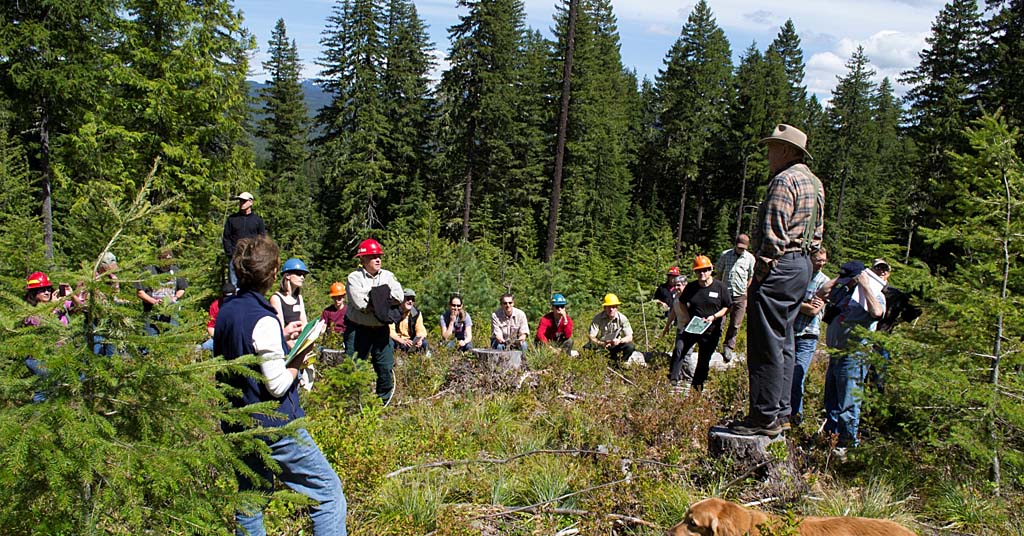
All together then: Renowned forest ecologist Dr. Jerry Franklin addresses the South Gifford Pinchot Collaborative in southwest Washington in 2012. Photo: Jurgen Hess
By Nathan Gilles. August 7, 2025. In May, the White House Office of Budget and Management sent Congress President Trump’s proposed budget for discretionary spending for upcoming fiscal year 2026.
Among the budget’s many cuts is a proposal to eliminate all funding for a program designed to make timber projects run more smoothly.
The Collaborative Forest Landscape Restoration Program (CFLRP) funds forest collaboratives—a decades-long experiment to get conservationists, the timber industry and U.S. Forest Service back to the proverbial table after the timber wars of years past.
Collaboratives have been widely credited with incorporating conservationists environmental concerns in the design of timber harvests and, consequently, reducing lengthy environmental litigation known to slow down the implementation of those harvests.
The CFLRP has been lauded by some for helping implement forest thinning and restoration projects meant to both reduce wildfire risk and increase timber production and, by extension, jobs in rural communities.
As Columbia Insight reported in February, the Forest Service has long sought to link its efforts to reduce the nation’s hazardous fuels with the agency’s efforts to increase timber production.
The elimination of the CFLRP is part of President Trump’s broader push to slash funding for the agency’s so-called non-fire related programs by 40% (a total cut of $1.4 billion) and follows Trump’s executive order calling for the “immediate expansion of American timber production.”
What are forest collaboratives?
Forest collaboratives are groups of stakeholders that operate within individual national forests. Along with timber representatives and conservationists, they sometimes include representatives from outdoor recreation organizations as well as state, county, municipal and tribal governments.
Through collaboration, the idea goes, representatives of these diverse groups can reach consensus and compromise around how the Forest Service should implement specific timber sales.
Through cooperation rather than litigation, conservationists’ environmental concerns can be addressed in ways that don’t harm the livelihoods of the people who cut down and process the trees. Or so the thinking goes.
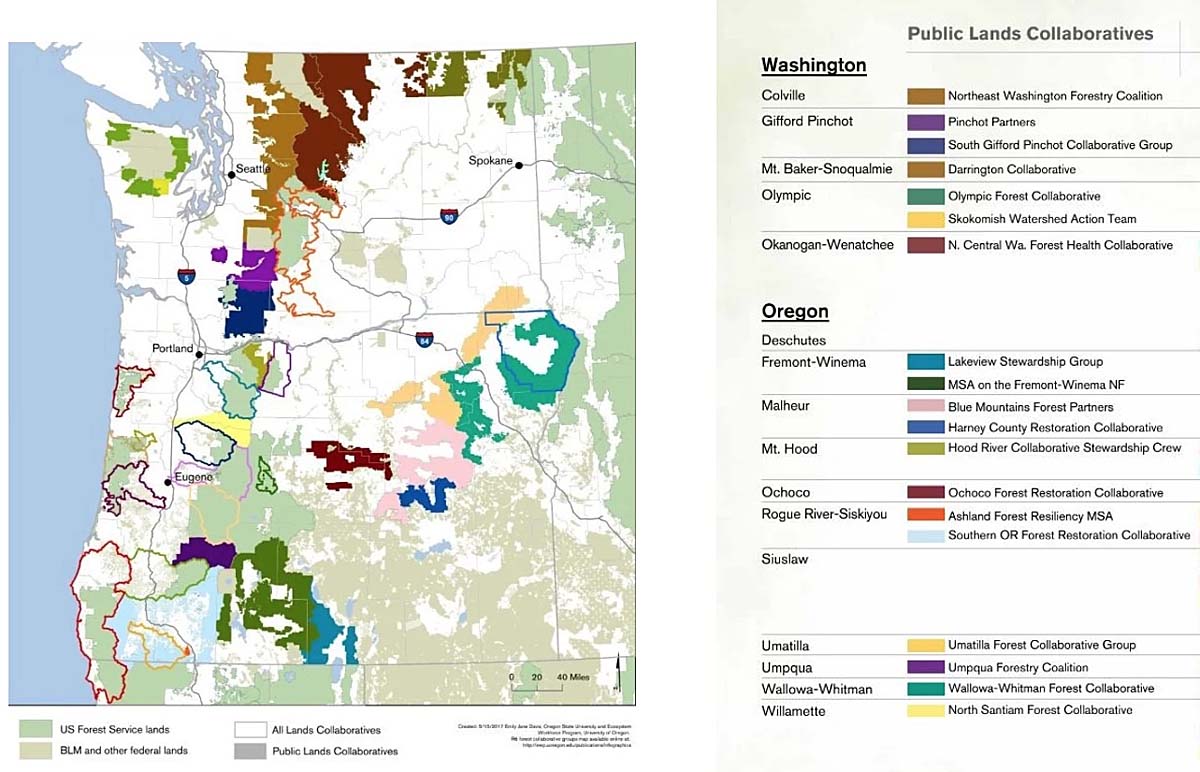
According to Pacific Northwest Forest Collaboratives, there are 56 forest collaborative groups that operate in the Pacific Northwest. Map: PNFC
Money from the CFLRP funds half of the administrative costs of operating a select number of collaboratives nationwide.
This money typically goes to a nonprofit, often an environmentally oriented nonprofit, within the collaborative to facilitate the work.
In an email to Columbia Insight, the Forest Service’s Region 6 Office of Communications and Community Engagement, representing Oregon and Washington, wrote: “Defunding [the CFLRP] would undercut collaborative, landscape-scale restoration efforts that reduce wildfire risk, support local economies, and protect natural resources.”
“Collaboratives help shape forest management decisions across timber harvests, fuels reduction, habitat restoration, and recreation,” the email continued. “Beyond CFLRP, they contribute to planning, prioritization, and public support for project implementation.”
A total of 56 forest collaboratives operate in Oregon and Washington, according to PNWForestCollaborativesNetwork.org, a website run by the nonprofit Sustainable Northwest.
Only a handful of these receive direct CFLRP support to fund their operations.
Those that don’t, as well as many collaborative-associated nonprofits, can still benefit from CFLRP funds for ecological monitoring before and after Forest Service timber projects to determine their impact and effectiveness.
All of these groups will potentially feel the effects of the proposed budget cuts.
Past success, future worries
According to its website, the CFLRP directly funds four forest collaboratives in Oregon, three in Washington and one that operates in both states.
The Northern Blues Restoration Partnership (NBRP), the CFLRP-funded arm of the Northern Blues Forest Collaborative (NBFC), advises the Forest Service on projects within the Umatilla National Forest in northeast Oregon and southeast Washington as well as the Wallowa–Whitman National Forest in northeast Oregon and western Idaho.
Founded in 2012 and originally called the Wallowa Whitman Forest Collaborative, the Northern Blues Forest Collaborative started receiving CFLRP funding in October 2020.
“It’s been incredible what we’ve been able to do,” says Nils Christoffersen, longtime member of the NBFC’s leadership team and executive director of Wallowa Resources, the nonprofit facilitating NBRP. “The scale of active restoration and the resulting support to jobs in our communities and providing more wood to the mills has been really significant.”
Nils Christoffersen. Photo: Wallowa Resources
According to the Northern Blues Restoration Partnership website, the collaborative covers 10.4 million acres.
Christoffersen credits CFLRP funding with helping “bring a diverse group of stakeholders together with a shared set of goals.”
Christoffersen told Columbia Insight that CFLRP funds help pay Wallowa Resources to not only facilitate the collaborative but also pays for ecological monitoring before and after Forest Service timber projects, including forest thinning projects meant to reduce the risk of wildfire.
Christoffersen says losing CFLRP funding “will definitely have an effect” on his collaborative, adding “the monitoring program would definitely get hit hard.”
Tiana Luke, co-chair of the North Central Washington Forest Health Collaborative, one of Washington’s four CFLRP grant recipients, says losing the CFLRP is going to slow down the pace of restoration work.
“You can’t do landscape scale restoration without stable funding,” says Luke. “And this is the only program that’s designed specifically to do [that] type of work. If it goes away, a lot of the progress could unravel.”
The North Central Washington Forest Health Collaborative operates in Washington’s Okanogan-Wenatchee National Forest.
“I consider myself a happy ‘kumbaya’ person. I love that about collaboratives,” says Luke. “It means sitting across the aisle from my timber forest partner and finding the points of agreement.”
Luke, who is also an employee of the Washington state branch of the nonprofit conservation organization the Wilderness Society, says in addition to her organization losing funding, CFLRP funds help create jobs locally to do forest restoration work.
Luke says the rural communities she works with “will have reduced economic stability due to this decreased work.”
The ultimate goal of this collaboration, says Luke, is to make sure critical ecological restoration work gets done.
“Collaboration is a mechanism to help do that, to bring all of the parties to the table,” she says.
Critics of collaboratives
Initially, forest collaboratives were widely praised by conservationists.
In recent years, however, many groups have soured on collaboratives and the institutionalized détente they embody, seeing them as a way to give timber projects the appearance of being supported by the environmental community.
“It’s a waste of money to have a singalong around the campfire to say how cool this is,” says Andy Stahl, executive director of Forest Service Employees for Environmental Ethics.
A former forester for the U.S. Forest Service, Stahl has been a lobbyist for multiple environmental organizations. He’s also an outspoken critic of forest collaboratives, referring to them in a scathing post on his organization’s blog as a “failed experiment.”
In Stahl’s opinion, defunding the Collaborative Forest Landscape Restoration Program is unlikely to have a major impact on the implementation of Forest Service projects.
“They were created to give legitimacy, political legitimacy, to what the Forest Service wanted to do anyway,” says Stahl.
To help do this, Stahl says collaboratives not only offered environmental groups a seat at the table but also offered them funding. This, he says, compromised the integrity of the environmental groups that receive these funds.
“This is the pernicious problem,” says Stahl. “You can’t be a government watchdog group on the one hand and receive government money on the other. Those are absolutely mutually exclusive.”
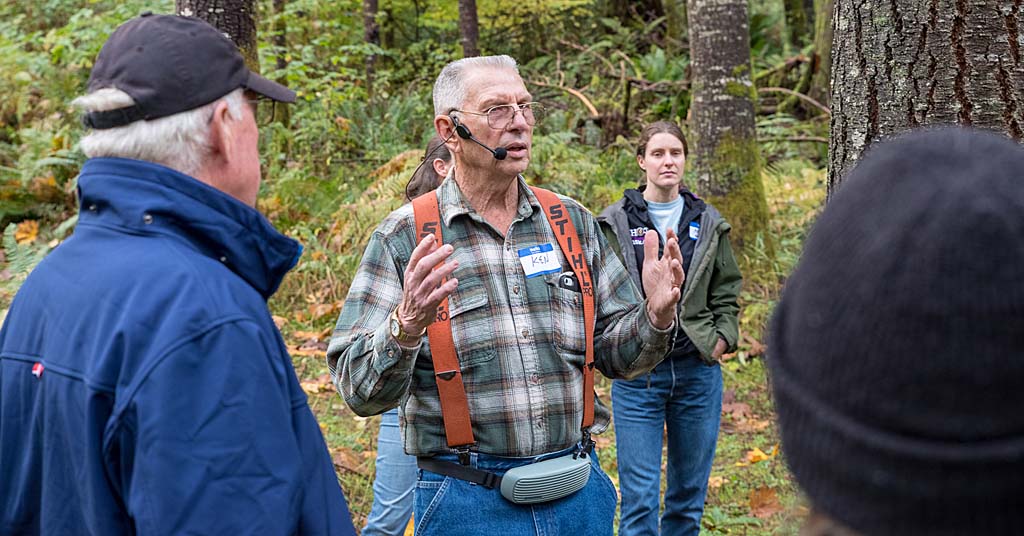
Sounds good: Ken Miller, family forest owner near Olympia, Wash., talks about managing his tree farm with Cascades to Coast Landscape Collaborative members. File photo: John Mankowski/CCLC
Others in the conservation community share some of Stahl’s concerns about forest collaboratives.
“They started with good intentions. Then they [became] the rubber stamp. And now they’ve become the lead foot on the accelerator of the Forest Service’s agenda to log more,” says Rob Klavins, northeast Oregon field coordinator for Oregon Wild.
In June 2020, Oregon Wild and another conservation group, the Greater Hells Canyon Council, resigned from the Northern Blues Forest Collaborative.
In a joint op-ed, Klavins and Veronica Warnock, then the conservation director for the Greater Hells Canyon Council, stated they’d decided to leave because they felt the collaborative had “devolved to a point where we can no longer lend it credibility with our continued participation.”
In May, Klavins told Columbia Insight that while he felt the Northern Blues Forest Collaborative, which was co-founded by his predecessor at Oregon Wild, was created with good intentions and produced some projects he stands by, over time it supported projects that Oregon Wild could not endorse.
Klavins says he left because he felt his voice as a conservationist had become marginalized.
“Increasingly what we started to see was the Forest Service looked to these collaboratives as rubber stamps for, basically, what they were already proposing,” says Klavins. “We would tinker around the edges, but at the end of the day, they would make proposals, and we would rubber stamp them, provide a few comments.”
In an email to Columbia Insight Brian Kelly, senior advisor at the Greater Hells Canyon Council, wrote that his organization continues to attend Northern Blues Forest Collaborative meetings, but only as public observers, not as collaborative members.
“We are not members of the Collaborative and we do not participate in the Collaborative’s decision-making or policy-making processes,” wrote Kelly. “I think it would be fair to say that we attend the Collaborative meetings and field trips similarly to the way we attend a variety of public events hosted by the US Forest Service and other public entities as part of our efforts to advance GHCC’s mission.”
Asked to comment on the resignation of Oregon Wild and the Greater Hells Canyon Council, Wallowa Resource’s Christoffersen responded: “I find it challenging that they would suggest they were being marginalized, because if you look back at the record of all the minutes at the time, their voices are more represented throughout those meetings than any other stakeholder’s voice.”
Some in the timber industry are also critical of the CFLRP.
“AFRC and our members frequently engage in forest collaboratives across the west and will continue to do so. We have seen some successes with CFLRP, but this program alone hasn’t been a significant driver to getting more work done on the ground,” said Nick Smith, public affairs director for the American Forest Resource Council (AFRC), a trade association representing logging and related industries in the Pacific Northwest. “We recognize CFLRP enjoys strong support in Congress. In fact, both the House and Senate have approved appropriations bills to provide $30 million to CFLRP, so we are expecting the program to continue—not eliminated as was initially proposed in the administration’s budget.” [Only congressional appropriations committees have approved funding, not the full bodies of the House and the Senate. An earlier version of this story included an edited version of this quote. —Editor]
Brian Dill, associate professor of sociology at the University of Illinois at Urbana-Champaign, says a potential reason for forest collaboratives’ mixed reception among conservationists is that they have no legal power to determine Forest Service policy, instead acting only as de facto advisory groups.
“Congress, with this whole collaborative thing, just kind of kicked the can down the road and hoped that something miraculous would happen by getting people back at the table. But they didn’t give any real guidelines, and they didn’t really give meaningful funding, and they didn’t really give the collaboratives any meaningful power,” says Dill.
Dill says in the absence of clear guidelines, whether a collaborative’s projects are seen as achieving the intended goals of its diverse partners often comes down to the personalities within the collaborative.
Dill, who is the author of a 2025 article on collaboratives published in the journal Sociology Compass, observed the Northern Blues Forest Collaborative as part of his research.
While not official federal advisory organizations, collaboratives can weigh in on logging projects, but that’s about it. In practice, Dill says, the decision to implement a logging project in a national forest comes down to the forest’s ranger.
“At the end of the day, the ranger makes the decision,” says Dill.
Finding common ground
Tom Uniack, executive director of Washington Wild, says the negative attitude toward forest collaboratives among some conservationists stems from a misunderstanding about what collaboratives are.
“It’s about common ground. It’s not about trading favors,” says Uniack.
Washington Wild participates in two collaboratives, the Olympic Forest Collaborative and the Darrington Collaborative.
U.S. House and Senate Appropriations Committees recommend funding the collaboratives program in FY 2026.
Uniack says he’s found common ground with timber groups over the need to cut down overgrown trees on former plantations on national forest lands.
“They’re 50, 60, 70 years old and they’re all growing up in a densely packed [stand],” says Uniack. “There’s no sunlight, no food on the floor for critters. … It’s a dead zone.”
Uniack says most of the trees also happen to be 10 to 25 inches in diameter.
“That’s exactly what the mills want, and that’s key because that’s where the common ground is,” says Uniack. “If we were begging the mills to take this stuff, then that would be very different.”
Washington Wild does not receive CFLRP funding but has received funding from the State of Washington to facilitate the two collaboratives. That funding is also currently in question.
Funding house of cards
Washington has two separate grant programs that fund forest collaboratives. Both go through the Washington Department of Natural Resources.
In its last legislative session, which ended in April, Washington lawmakers provided less than half of the funding DNR typically previously received to run the program for the upcoming biennium.
Forest Resilience Division Manager at the Washington Department of Natural Resources Jennifer Watkins, who manages the budget for Washington’s two grant programs that fund the state’s forest collaboratives, says this has led to some “really tough budget scenarios.”
“Washington State has been very clear that forest collaboratives are a critical piece of infrastructure and partnership for us to implement our forest health and resilience goals,” says Watkins. “The state cannot support those collaboratives fully on their own. We depend on other funding sources to leverage us.”
As it happens, the CFLRP is also about leveraging outside funding.
CFLRP grant recipients are required to provide matching funding from other sources. According to the Region 6 Office of Communications, every CFLRP-funded dollar is matched by at least $1.64 from partner organizations. In Region 6, the $123 million in CFLRP funds received by collaboratives have allowed them to leverage an additional $204 million in matching funds, according to the regional office.
While a portion of this funding comes from private donors, much of it comes from state-run programs like DNR’s, leading to a funding house of cards for some forest collaboratives, including many in Oregon.
Oregon-based forest collaboratives are funded through a program overseen by the Oregon Department of Forestry and the Oregon Watershed Enhancement Board. ODF allocates state funds to OWEB, which then disburses them to collaboratives.
As part of its requirement to propose reductions in spending for the upcoming biennial budget, ODF is recommending a $500,000 reduction in funding for forest collaboratives.
However, relief from collaboratives’ federal funding woes could be on the horizon. Although the Trump administration wants to eliminate the CFLRP, the program has strong bipartisan backing.
Both the U.S. House and Senate Appropriations Committees are recommending funding the program in FY 2026.
In addition to this, Oregon Senator Jeff Merkley, a strong supporter of the CFLRP, has introduced two bills that would reauthorize the program. The first of Merkley’s bills, introduced in May, has five co-sponsors, three of whom are Republican.
In a statement on his website, Merkley called the CFLRP “a proven, bipartisan model that delivers healthier forests and stronger communities instead of litigation and conflict.”
“Investing more in collaborative solutions,” Merkley continued, “will make a real difference in rural communities across Oregon and beyond.”
Although Merkley’s bills seek to reauthorize the CFLRP, funding for the program could still be reduced or eliminated entirely.
Even for some critics of forest collaboratives, not funding the program would be a loss. One of these is the University of Illinois’s Dill, who says for all their faults, he supports the continued funding of collaboratives.
“Again, not every collaborative is equally functional. [It] depends on the personalities,” says Dill. “But I think some of them have been able to work quite well together. And simply defunding doesn’t offer an alternative for managing our forests.”







I represented an environmental group on a collaborative and we never got any funds from it. Funds paid for staff for the collaborative and some field trips, not for any groups how participated in that case.
I was on the South Gifford Pinchot Collaborative for 10 years with reps from timber interest and local county. We frequently didn’t agree, but hammered out consensus. The USFS took our comments and changed their proposed plan. It was a lot of hard work but the process worked. Would be real loss if it ended