The federal agency change will give timber companies more control over deciding which trees get cut down and which get saved
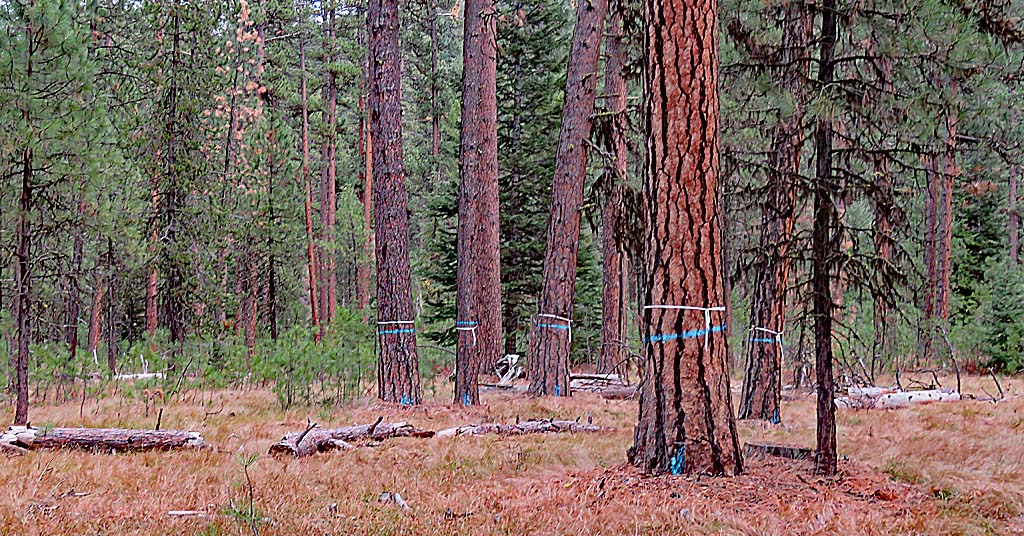
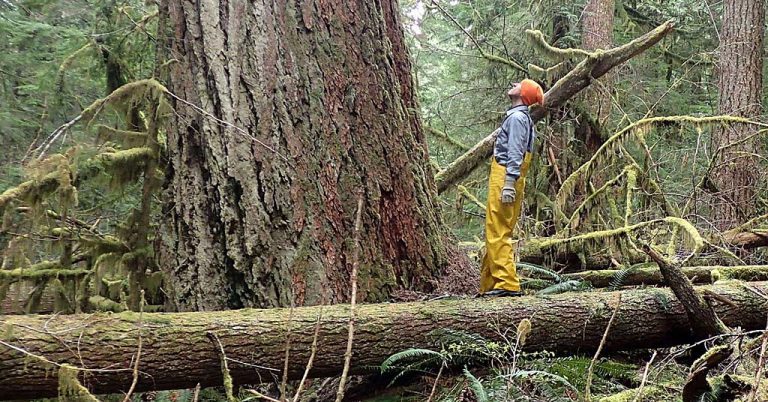
Blues fest: The white tape measure shows means it’s old. The blue paint means it’s ready to be cut down. Photo: Rob Klavins/Oregon Wild
By Nathan Gilles. June 12, 2025. On March 1, President Trump issued an executive order calling for the “Immediate Expansion of American Timber Production.”
The U.S. Forest Service is now working to implement that order.
One way the agency plans to do this is to substitute its practice of marking trees with paint—indicating timber sale contract specifications—with two alternative practices that give loggers greater discretion over which trees get cut.
The practices are “designations by description,” or DxD, and “designations by prescription,” or DxP. Both DxD and DxP are different from “designation by marking” or marking with paint.
In an April 3 memo addressed to Forest Service regional foresters and deputy chiefs, Christopher French, the Forest Service’s acting associate chief, directed his agency on how to implement Trump’s executive order.
French’s directives included an order to make DxD and DxP the agency’s new “default approach in implementing timber projects.”
Marking with paint, generally considered the agency’s current default, is typically carried out by Forest Service staff.
The paint marks communicate which trees to fell and which to leave standing to the non-agency loggers who ultimately cut down a Forest Service project’s trees.
If marking with paint is a direct order—cut this, don’t cut that—DxD and DxP are more like general guidelines on how to log a stand of trees.
Under DxD and DxP timber projects, the Forest Service provides these guidelines to loggers, but it’s largely up to the loggers to interpret those guidelines.
DxD and DxP are generally seen as cheaper alternatives to marking with paint and are meant to save the agency staffing time and costs. However, they’re not always cheaper or “appropriate” alternatives to marking with paint and can instead increase Forest Service workloads and costs rather than cut them, according to agency documents.
Both alternatives, in giving more control to loggers, also require those loggers to have more knowledge of forestry.
Whether loggers have this knowledge and whether they are likely to abuse the greater discretion afforded to them when paint is not used largely depends on whom you ask.
The Forest Service’s national Office of Communication denied Columbia Insight’s request for an interview. The press office for Region 6, representing Oregon and Washington, did not respond to a request for an interview.
“A couple of mistakes”
Craig Thomas, a longtime environmental activist living in California’s Sierra Nevada mountains and founder of the environmental nonprofit Fire Restoration Group, says loggers have a powerful economic incentive to interpret DxD and DxP prescriptions in ways favorable to their bottom line. This, he says, makes the agency’s new default “extremely risky.”
“I’m not saying every logger is corrupt, but the incentive to take a bigger and more valuable tree is undeniable,” says Thomas.
Thomas, who believes dryland forests, like the ones where he lives, need to be thinned to help mitigate the effects of wildfire, says Forest Service logging prescriptions should be about more than just producing timber volume—they should also create desirable ecological conditions, including retaining older, larger trees as habitat for animals.
“Leave it up to someone behind their feller buncher or their chainsaw to look and certify the ecological value or not of a larger tree? No, thank you. That’s why Forest Service people get paid to do that,” says Thomas.
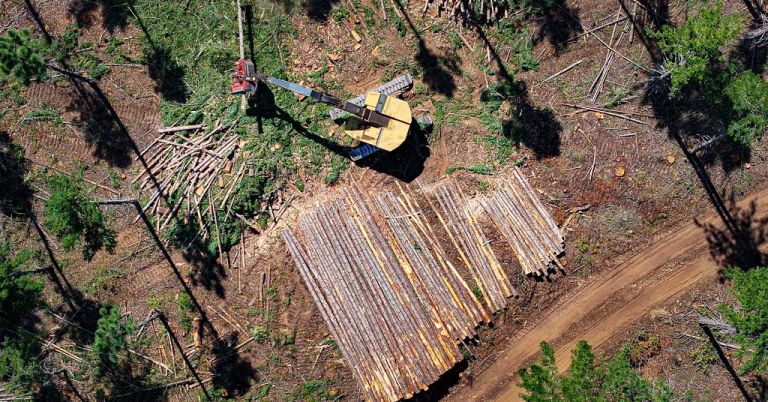
A feller buncher is a machine used to harvest timber.
Watch: Feller buncher at work. Video: Tigercat Industries
While the Forest Service creates and enforces DxD and DxP guidelines, John Bailey, professor at Oregon State University’s College of Forestry and author of the book A Walk with Wildland Fire, says how they are interpreted ultimately falls to the person doing the logging.
Unlike Thomas, however, Bailey doesn’t see the greater discretion DxD and DxP affords loggers as inherently bad.
“It’s really the forest workers making the decision with guidelines,” says Bailey of DxD and DxP. “In my experience, these folks working in the woods, they love the woods, they understand the woods, they can implement any prescription.”
Bailey, who says he supports the use of DxD and DxP with proper oversight, nonetheless acknowledges that loggers sometimes make mistakes when interpreting DxD and DxP guidelines. He says these mistakes, however, are just that: mistakes.
“There might be a couple of mistakes, but there’s not going to be malicious mistakes,” says Bailey.
The Associated Oregon Loggers, a timber industry association representing foresters across rural Oregon, also feels that loggers have the know-how to properly interpret DxD and DxP prescriptions.
“Associated Oregon Loggers supports the expanded use of Designation by Prescription (DxP) and Designation by Description (DxD) as common-sense tools that reflect modern, efficient, and science-based forest management practices,” wrote Amanda Sullivan-Astor, forest policy manager for the Associated Oregon Loggers in an email to Columbia Insight.
“Many operators are qualified through the Oregon Professional Logger program,” Sullivan-Astor continued, “which includes education in forest stewardship, water protection, safe operations, and regulatory compliance.”
The Oregon Professional Logger program is a certification program run by the Associated Oregon Loggers.
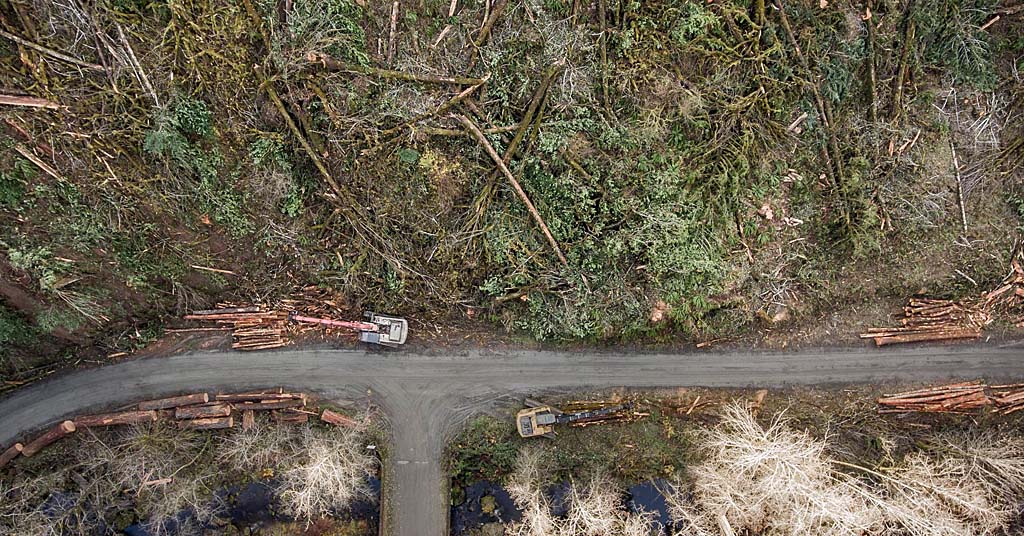
Take down: Logging concerns may soon have more discretion to choose the trees they want to cut. Photo: Oregon Wild
AOL has previously advocated for the increased use of DxD and DxP on national forests in Oregon.
In an April 3, 2018, internal email written to Region 6 staff, Rex Storm, then forest policy manager for AOL, attached a letter outlining where he felt the Forest Service could be more efficient in implementing its timber projects.
The letter and email are part of a trove of internal Region 6 Forest Service documents obtained by the nonprofit WildEarth Guardians through a public records request and shared with Columbia Insight.
In his letter, Storm lists marking with paint as an agency “deficiency/barrier” that leads to “Inferior tree selection decisions by FS [Forest Service].”
To remedy this, Storm recommends the agency adopt the “Efficiency tools: DxD, DxP” in part because the “Purchaser/operator makes better tree selections.”
Asked to clarify Storm’s comments, Sullivan-Astor responded in an email: “This statement acknowledges the value of using experienced operators, under the guidance of Forest Service prescriptions and oversight, to help achieve project goals in real-time field conditions. It is not a delegation of planning authority or a reduction of standards.”
Storm, now AOL’s executive vice president, couldn’t be reached for comment.
Complexity and logger know-how
Evan Frost, forest ecologist at Ashland, Oregon-based environmental consulting business Wildwood Consulting, strongly disagrees with the assertion that most loggers have the knowledge and training to correctly interpret a DxD or DxP prescription.
Frost is a co-author of Forestry Gone Awry, a December 2024 report critical of the Forest Service and Bureau of Land Management’s forestry practices. The report was funded by the Climate Forest Coalition, a group made up of multiple environmental nonprofits.

Chris French, USFS acting associate chief. Photo: USDA/Tom Witham
Frost says he prefers marking with paint to DxD and DxP because having trained Forest Service staff marking trees tends to lead to better ecological outcomes.
“Without having that [Forest Service] expertise on the ground, determining on a tree-by-tree basis what happens, that takes all the nuance and ecological concerns out of the picture, because you can’t include all of that in a designation by prescription or description. You just can’t do it,” says Frost.
One reason DxD and DxP might not be an appropriate replacement for marking with paint is cost.
Similar concerns have been expressed by members of the Forest Service.
These positions are discussed in a 2020 paper on the pros and cons of using DxP. The paper notes “some operators may not have the ability or technology to implement complex silvicultural prescriptions.”
According to the paper, DxP prescriptions work best when they’re “not too complex.”
The paper also appears to echo Frost and Thomas’s concerns that DxP is less accurate than marking with paint, noting that “the assurance of meeting desired conditions [of a logging project] may be lessened when paint is not used.”
Despite these concerns, the Forest Service has pushed to expand the use of DxP as part of its Forest Products Modernization Strategic Framework. One reason is expense.
Marking with paint typically costs the agency about $70 per acre, according to the 2020 paper.
While marking with paint has been around for decades, it wasn’t until 2014 that Congress amended the National Forest Management Act to make DxD and DxP “valid methods” to harvest trees. Prior to this, both DxD and DxP were not as widely used as marking with paint.
Costs and adequate staffing
Andy Geissler, federal timber program director for the American Forest Resource Council (AFRC), a trade association representing logging and related industries in the Pacific Northwest, told Columbia Insight in an email that, “I support the expanded use of DxP and DxD where it’s appropriate. That said, DxP and DxD are not appropriate everywhere. There are certain stands and certain treatments where paint is necessary.”
Prior to Chris French’s order to make DxD and DxP the agency’s new default, this was also the position of many in the Forest Service.
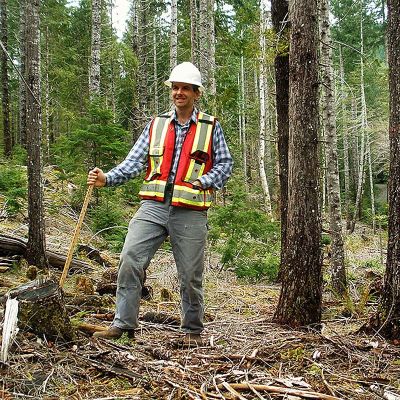
Andy Geissler. Photo: AFRC
The 2020 paper states, “DxP may not always be the most appropriate tool.”
In Region 6, agency staff discussed the appropriate circumstances to use DxD and DxP in the regional office’s FY 2019 Program .
The document reads, “[Region 6 National] Forests are expected to use Designation by Prescription (DxP) and Designation by Description (DxD) for sales of forest products where it is appropriate.”
One reason DxD and DxP might not be an appropriate replacement for marking with paint is cost.
Forest Service documents note that while DxD and DxP can be cheaper than marking with paint, they’re not always cheaper.
According to the 2020 paper, one drawback to using DxP is that Forest Service “Sale administration responsibilities and costs can increase” when paint is not used “due to a lack of paint marks that aid the Forest Service’s ability to quickly determine whether the correct trees were cut.”
The agency’s official 2021 Forest Service Handbook makes similar statements, noting that there can be “increased costs to sale administration associated with DxD and DxP …”
The handbook states that national forest supervisors must ensure “that sale administration personnel have the specialized training and additional time needed to administer contracts where timber is designated by description or by prescription.”
Region 6’s FY 2019 Program Direction contains a similar statement, noting “[National] Forests must ensure administration personnel are available to adequately administer DxP contracts and agreements.”
Whether the current wave of staff cuts and early retirements will impair the Forest Service’s ability to adequately administer the increase in DxD and DxP agency higher-ups are calling for remains to be seen.